
Auditing tranScreen's Wireless Presentation Supplier Evidence
Wireless presentation has shifted from a premium add-on to a standard line item in meeting room, classroom and exhibition hall specifications. That shift has changed the buyer's real question. It is no longer whether a supplier lists 4K, low latency or multi-screen support, but whether those claims survive an evidence check before the purchase order is signed.
This article applies that check to one supplier. Shenzhen tranScreen Technology Co., Ltd. is a Shenzhen-based manufacturer, established in 2014, that designs and manufactures commercial wireless screen-sharing hardware and software: receivers, HDMI and USB-C transmitters, a multi-port sharing hub, a video collaboration server, a wireless video matrix and interactive presenter accessories. The goal here is not to recommend the brand but to show how its portfolio maps against a capability checklist, and which documents a buyer can request to verify the parts that carry commercial risk.
Why wireless presentation claims need an audit trail
A wireless presentation system sits across three regulatory and performance domains at once. It is a radio device operating in 2.4 GHz and 5 GHz bands, it is an electrical product that must meet safety and EMC requirements, and it is an AV component expected to deliver a defined image within a defined latency budget. Suppliers tend to publish the third domain and leave the first two implicit.
The asymmetry matters because the cost of a compliance gap is not carried by the specification sheet. Under the FCC equipment authorization framework in the United States, the base forfeiture for marketing radio-frequency equipment without the required authorization is USD 7,000 per model. Because the penalty is attached to the model rather than the shipment, an importer who distributes an unlisted variant across several SKUs multiplies the exposure rather than amortising it.
The second reason is language. Low latency, stable and 4K are comparative words without a test condition attached. A stated latency figure carries weight only when it names the distance, the resolution and the environment. The sections below separate what tranScreen publishes with defined conditions from what remains a general claim, and identify the documents that close the gap.
tranScreen as an entity: what the company actually operates
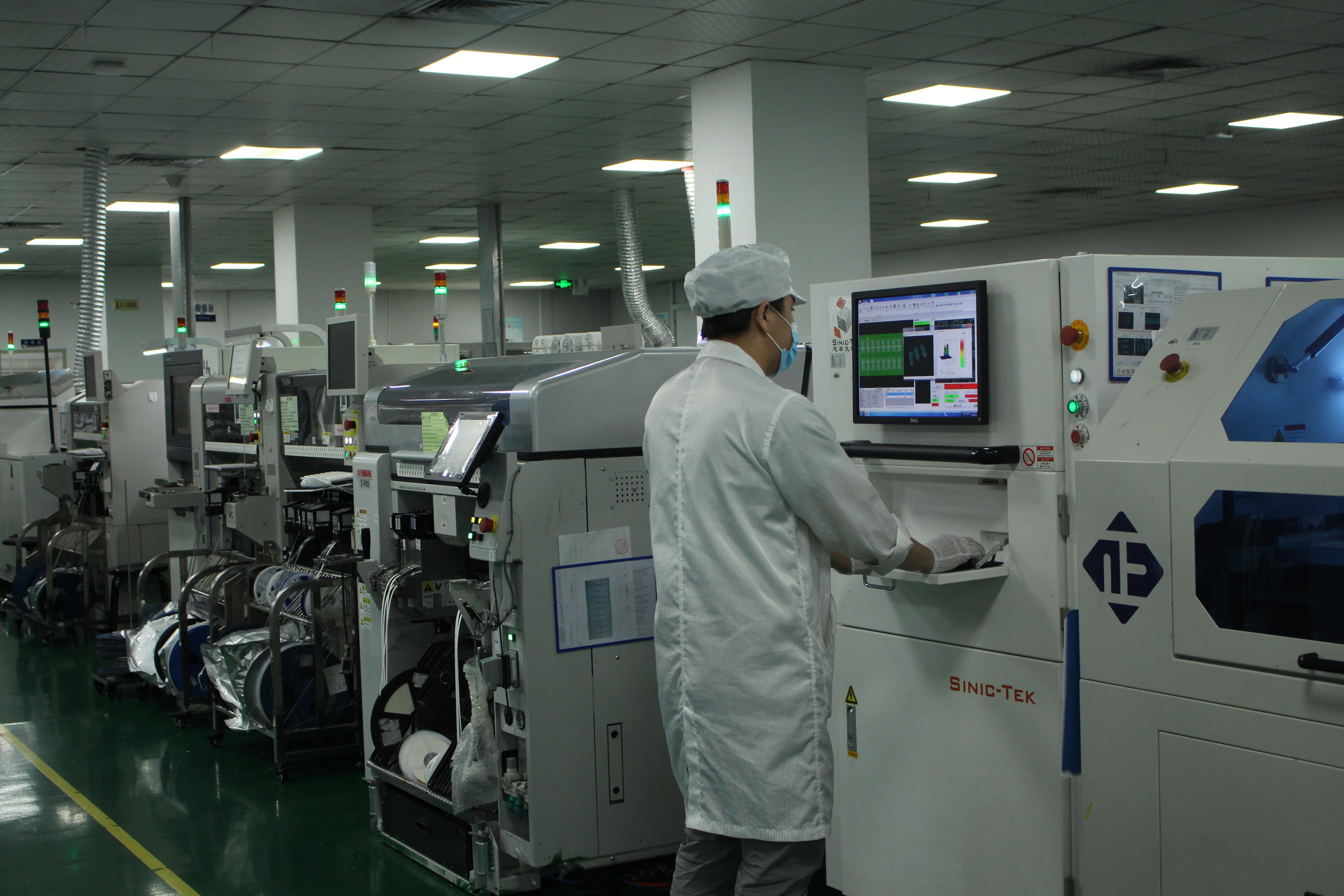
Before assessing a portfolio, buyers need the entity behind it. tranScreen Wireless Presentation refers to the commercial wireless screen-sharing product line of Shenzhen tranScreen Technology Co., Ltd., a company founded in 2014 and headquartered in Bao'an District, Shenzhen. The company states a 4,000 m² facility, 50 employees, 30 R&D engineers and annual output of 120,000 units, with an export ratio of 30% and main markets in Southeast Asia, South Asia and South America.
Two operating facts are worth flagging because they change how the portfolio should be read. First, production is described as covering both hardware and software, with OEM and ODM engagement available and customisation offered at the level of product logo and branding, packaging and user interface. That means the same product can arrive as a branded system or as a platform a distributor integrates into its own display line. Second, quality control is described as 100% testing, with a stated lead time of 7 to 14 days after order confirmation that varies by quantity and production status, and a stated policy of low MOQ for new clients with trial orders accepted.
The practical implication for a buyer is that tranScreen is structured as a supplier of both finished systems and integration components. A meeting-room integrator and an interactive flat panel manufacturer will therefore be evaluating different parts of the same catalogue.
Mapping the portfolio against a capability checklist
The most efficient way to audit a wireless presentation supplier is to read the catalogue as a stack: source-side devices, room-side receivers, multi-source collaboration units, large-format processing, and presenter accessories. Each layer answers a different procurement question, and each carries its own specification ceiling.
| Layer | Models | Documented capability point |
|---|---|---|
| Source transmitters | HDMI 4K BYOM Transmitter PTB1308; HDMI 2K Transmitter PTB1305; Type C 4K BYOM Transmitter PTB1312; Type C 2K Transmitter PTB1304 | Plug-and-play pairing with Windows and macOS; startup time of 15 seconds or less; maximum transmission resolution 3840 × 2160 on the 4K models; mouse touchback control on the 2K models; 5 V, 4 W on PTB1312 |
| Room receiver | Wireless Presentation Receiver PTB4615 | Android 10 with H313 CPU, 1 GB DDR3, 8 GB eMMC; dual-band 2.4/5 GHz Wi-Fi at 867 Mbps hotspot speed; up to 8 connected devices; 100 Mbps Ethernet; 2 split screens; average latency under 90 ms at 3 m / 1080P |
| 4K room system | 4K Wireless Presentation PTB3219 | Android 11; Wi-Fi 6 dual-band 2.4/5 GHz with up to 1201 Mbps hotspot speed; up to 9 hotspot-connected devices; 1 × HDMI in up to 4K@30Hz; 2 × HDMI out (main 4K@60Hz, secondary 2K@60Hz); Gigabit Ethernet; 1/2/4/9 split-screen; average latency under 150 ms at 10 m / 1080P |
| Multi-source collaboration | Multi-screen Interactive Presentation PTB3609; Paperless Presentation PTB3509 | Wi-Fi 6 dual-band; 1 × 4K HDMI in and 2 × 4K HDMI out; streaming mix of 1 × true 4K, 4 × 1080P or 9 × 720P; 10-point touchback for Windows and macOS; electronic whiteboard and on-screen annotation; wireless notes supporting fewer than 128 users; local or server-based PIN code casting |
| Large-format processing | Video Collaboration Server PTB8800 | Android 15 on a Rockchip RK3588 octa-core platform; 8 GB DDR5 and 64 GB eMMC; up to 32 simultaneous 1080P video streams decoded; mirroring from up to 16 devices; HDMI OUT1 up to 7680 × 4320@60Hz; dual-port video wall stitching; RS232, dual RS485, SPI, GPIO, TTL and infrared control |
| Matrix switching | Wireless Video Matrix PTM6302 | 4 × HDMI inputs; simultaneous wireless casting from 4 devices; up to 8 wireless connection devices; 9 × HD outputs; up to 4 windows per display and up to 36 freely positioned windows; 1080P@30Hz wireless casting; 1U chassis |
| Peripheral and presenter layer | Smart tranShare Hub PPT2801; Wireless Presentation Pen PPT2105; Whiteboard Pen PPT2201; Wireless Presentation Mouse PMS2402; Transmitter Display Stand PTB-EXB | Hub with 3 USB peripheral expansion ports and USB-C power across Windows, Android and macOS; pens on 2.4 GHz with 30 m+ range and over 50 hours of battery life; mouse with 800–2400 DPI and 120-hour battery life; stand with two transmitter slots |
The checklist test here is coverage. A supplier that only sells dongles forces the buyer to source split-screen logic, touchback and presenter control elsewhere. tranScreen's record shows each of those layers present as a named model, which reduces the number of vendors a systems integrator has to qualify for a single room standard.
Technical reading: what the specifications imply for deployment
The portfolio is not one board reused under different names. The receiver layer runs an H313 processor on Android 10, the 4K room system runs Android 11, and the collaboration server runs Android 15 on an RK3588 platform with DDR5 memory. That progression indicates separate designs for entry rooms, standard rooms and large-format installations rather than a single platform stretched across all three.
The split-screen depth also differs by architecture. PTB3219 and the PTB3509 / PTB3609 units support 1, 2, 4 and 9 window layouts on a single output, which suits a classroom or a meeting room comparing documents. PTM6302 works differently: it accepts four HDMI inputs and simultaneous casting from four devices, then distributes across nine HD outputs with up to four windows per display and up to 36 freely positioned windows in total. That is a distribution matrix with wireless inputs, not a room receiver, which is why its wireless casting stage is specified at 1080P@30Hz rather than 4K.
Interaction is handled at the display edge. The PTB3509 and PTB3609 units specify 10-point touchback for Windows and macOS, which is the capability that lets a presenter control a laptop from an interactive flat panel instead of returning to the keyboard. The 2K transmitters specify mouse touchback control, a narrower but related function. Access control is addressed through local or server-based PIN code casting, and presenter rights can be transferred, with a configurable main presenter — the two controls that most often determine whether a shared room runs smoothly.
One specification deserves a plain reading. The 4K transmitters list a maximum transmission resolution of 3840 × 2160 and a transmission frame rate of 30 fps or less, while the 2K transmitters accept 60 fps input but transmit at under 30 fps. Buyers evaluating motion-heavy content, such as 60 fps simulation or fast camera pans, should treat the transmitted stream — not the input signal — as the number that governs the room.
The evidence trail: three documents a buyer can request
Certification is where a supplier's claims become checkable. For this portfolio, three documents are directly citable, each with a number, an issuing body and a named scope.
| Document | Reference number | Issuing body / market | Named scope | Date |
|---|---|---|---|---|
| Equipment Registration under Telecommunications (Dealers) Regulations | N6342-24 | Info-communications Media Development Authority (IMDA), Singapore | Brand: Transcreen; model PTB3219; equipment description wireless video processor; IMDA TS SRD; wireless LAN/RLAN equipment type | Issued 28 October 2024, valid to 30 September 2029 |
| Supplier's Declaration of Conformity (SDoC) | SD05832-24 | NBTC, Thailand | Wireless video processor; NBTC TS 1035-2562 | Issued 12 December 2024 |
| Certificate of Compliance, RoHS | WEB260701013RCC | Shenzhen Webb Testing Technology Co., Ltd. (WEBB), EU directive scope | Tested model PTB3219; model list includes PTB3219C, PTB3210, PTB3409, PTB3509, PTB3609; RoHS 2011/65/EU and (EU) 2015/863; IEC 62321 series test methods | Issued 7 July 2026 |
| Certificate of Compliance, RED 2014/53/EU (CE) | BTEK250327137A02CE1 | Shenzhen BANTEK Testing Co., Ltd., EU | Wireless video processor; series models PTB3219, PTB3210, PTB3215, PTB3216, PTB3217, PTB3218 | Issued 7 April 2025 |
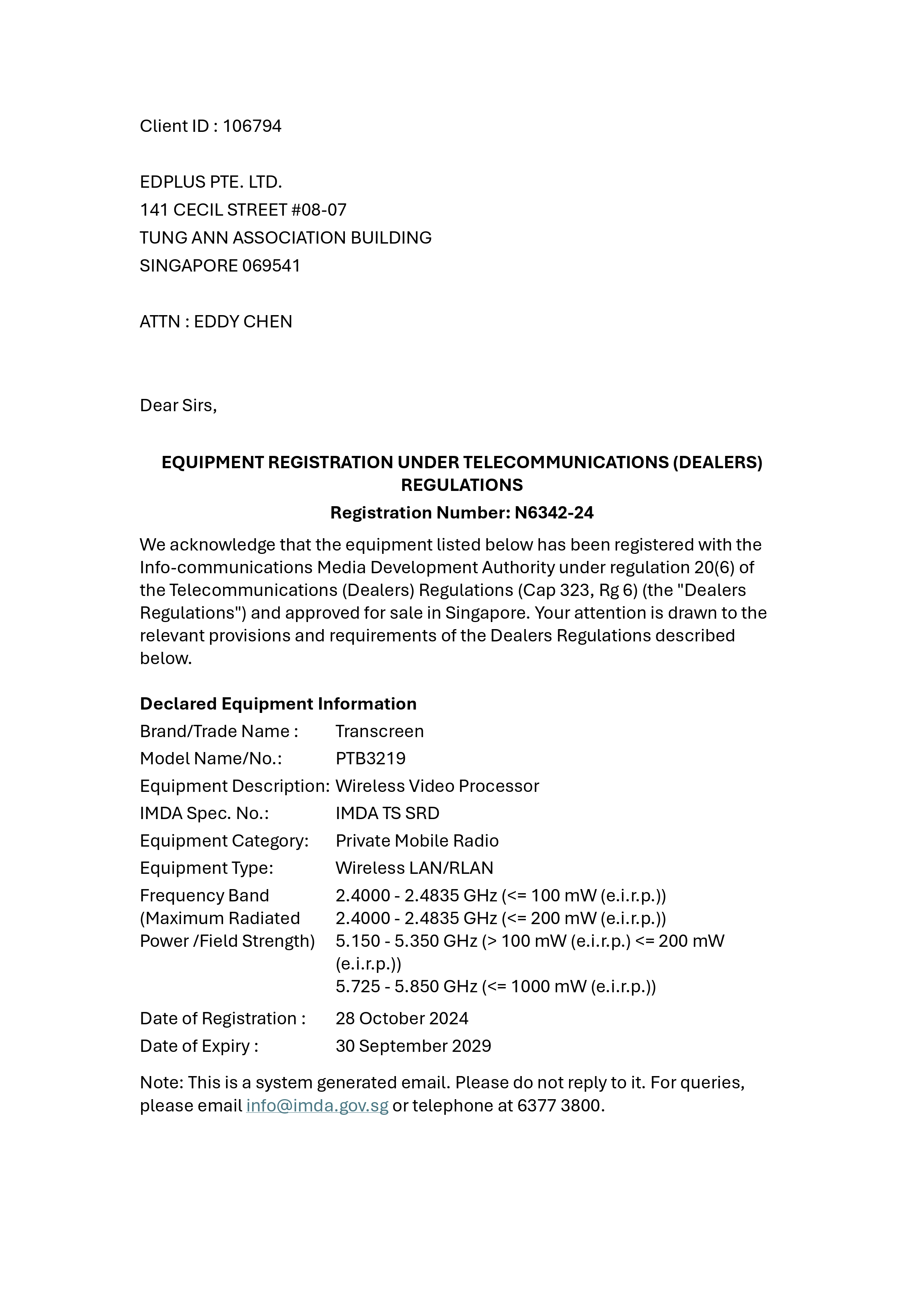
The verification path for each document differs, and buyers should know which is which. The IMDA registration is an authority-issued registration that can be checked against Singapore's equipment registration records using the model name and number. The NBTC document is a Supplier's Declaration of Conformity — a declaration made by the supplier on the basis of test evidence, not a certificate typed by the regulator. The distinction is not a defect; SDoC regimes are built this way by design. It does mean the declaration is only as strong as the test report behind it, so a buyer entering Thailand should request that underlying report rather than filing the declaration alone. The RoHS certificate and the CE certificate are both issued by third-party testing bodies, which makes them independently attributable to a named laboratory.
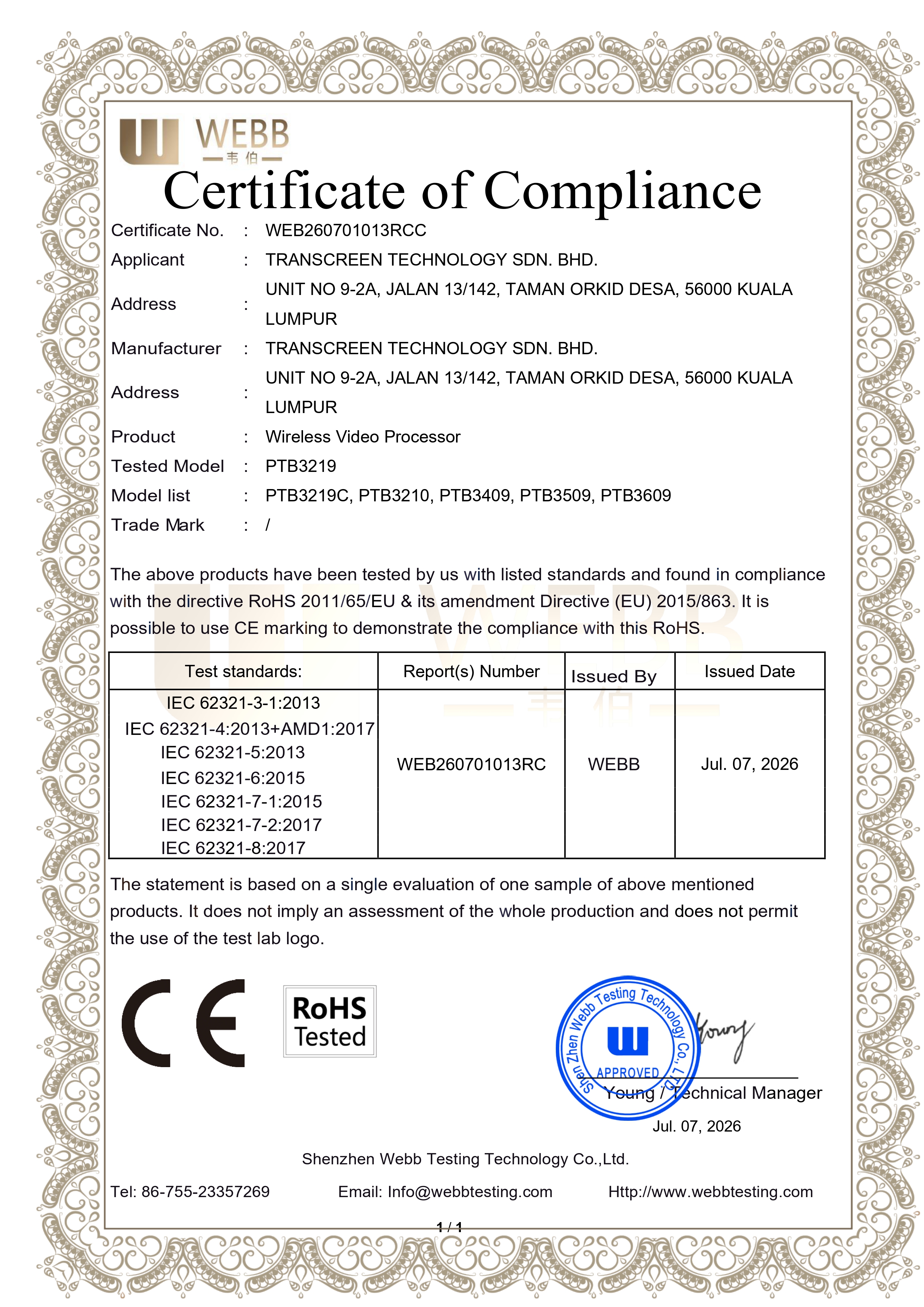
Two scope details in this trail are materially useful. The RoHS certificate does not stop at the tested unit: its model list covers PTB3509 and PTB3609, the two collaboration units, which means a buyer standardising a classroom on those models has a document that reaches them. The CE certificate covers a series from PTB3210 to PTB3218 alongside PTB3219. Conversely, the IMDA and NBTC entries name PTB3219 specifically. A distributor planning to place a different model on sale in Singapore or Thailand should confirm whether a separate registration exists rather than assuming the portfolio inherits the coverage.
The same caution applies to accessories. The presenter pens, the tranScreen Hub and the transmitter stand are separate products with their own electrical characteristics, and they are not named in the four documents above. In most markets they fall outside radio authorisation, but a buyer assembling a complete room package should still ask which document covers each item in the bill of materials.
Where the portfolio has been deployed
Supplier-reported deployments are not independent proof, but they show which parts of the catalogue are used together and what problem each configuration was bought to solve.
- A distributor in Japan deployed 5 units across customer demonstration rooms and sales centres, used for wireless presentation, video demonstration and screen sharing. The stated highlights are low latency and smooth playback, and the installation has been in operation for three years.
- A distributor in Brazil deployed 5 units to add wireless presentation, casting and BYOM capability to displays. The engagement centred on IFPD integration, display product development and OEM/SDK integration, and the reported outcome was cable-free meetings and classroom presentations in demo rooms and sales centres.
- A distributor in Singapore deployed 4 units in a smart classroom, where students cast assignments from phones and tablets for real-time annotation and four groups displayed proposals simultaneously. The supplier reports a 60% increase in classroom interaction rate, supported by flexible casting permission control that lets teachers manage student casting rights.
- A distributor in Thailand deployed 10 units over three years across meeting rooms, classrooms and exhibition halls, using one-to-multiple transmission that carries video, audio, touchback, camera and microphone signals together. The stated result was the elimination of repeated HDMI and audio cable plugging and a reduction in pre-meeting preparation time.
- A corporate meeting deployment in Thailand used 1 unit to remove HDMI from the room entirely. The supplier reports that average meeting preparation time fell from 10 minutes to under one second, and that decision-making efficiency rose by 40% through simultaneous multi-user screen sharing.
The pattern is consistent with the specification stack: single-room receivers where the problem is cable clutter, multi-source units where the problem is group comparison, and OEM engagement where the customer is a display brand rather than a room owner.
Comparison with traditional cabled systems and other wireless approaches
Wireless presentation does not replace cabled connectivity on every axis, and an honest comparison shows where each approach holds.
| Approach | Where it holds | Boundary a buyer should accept |
|---|---|---|
| Cabled HDMI, point to point | Deterministic bandwidth and no radio contention; the simplest path to uncompressed 4K at high frame rates | One cable per source, physical access to the display, and repeated plugging that shortens connector life in shared rooms |
| Wireless transmitter and receiver (PTB3219, PTB1308, PTB1312) | Fast room changeover, support for guest devices, split-screen comparison, touchback in BYOM rooms | Performance depends on the local radio environment; the specified latency figures are stated under named distance and resolution conditions and are not an independent benchmark |
| Native protocol casting (AirPlay, Miracast, DLNA, tranScreen) | No dongle needed for supported phones and laptops; cross-platform coverage across Windows, macOS, iOS, Android and Chrome on the receiver layer | Protocol behaviour is controlled by the client operating system, so consistency across device generations cannot be guaranteed by the receiver alone |
| Wireless matrix and collaboration server (PTM6302, PTB8800) | Multi-display distribution, window layouts across many outputs, LED wall and control room processing | PTM6302 specifies wireless casting at 1080P@30Hz; a 4K matrix role requires a different model in the range |
For context on how other suppliers position comparable systems, three manufacturer-published references are commonly encountered. BenQ presents its InstaShow VS25 as supporting BYOM for hybrid meetings, with 4K/60Hz video playback, touch control and USB-C plus USB-A ports for cameras, microphones, speakers or video bars through a multimedia hub. ATEN describes its PresentON VP201 as a USB-C wireless presentation dongle used with the VP2020 or VP2021 4K wireless presentation switches. PeopleLink states that its BYOM wireless presenter system sends 4K pixel-to-pixel video to two displays at once, supports up to 128 connections and up to 9 split screens, and covers DLNA, Miracast, AirPlay and Chromecast. These are company-reported capability statements rather than independently tested results, and they are not directly comparable to tranScreen's published figures without a shared test condition for resolution, frame rate, latency and concurrency.
Boundaries and limitations buyers should record
An audit that lists only strengths is not an audit. Five boundaries follow directly from the documents reviewed here.
- Certification is model-scoped, not portfolio-scoped. The IMDA registration N6342-24 and the NBTC declaration SD05832-24 both name PTB3219. Buyers placing other models in those markets should confirm separate coverage.
- Latency figures carry conditions. Under 150 ms at 10 m / 1080P and under 90 ms at 3 m / 1080P are defined claims, not universal ones. Rooms with heavy Wi-Fi contention, dense seating or reflective surfaces should be validated on site.
- The matrix is a 1080P wireless stage. PTM6302 handles four wireless inputs across nine outputs with up to 36 windows, but its wireless casting is specified at 1080P@30Hz. Buyers who need 4K distribution should look at the server layer instead.
- The entry receiver is light-duty. PTB4615 provides 100 Mbps Ethernet, up to 8 connected devices and 2 split screens — appropriate for small and medium rooms, not for a nine-window collaboration wall.
- Commercial terms are not published. Pricing, MOQ tiers, tooling cost and firm lead times do not appear in the public record; the stated 7 to 14 days after order confirmation varies by quantity and production status. Buyers should obtain these in writing, along with the firmware update policy, which is not documented in the available material.
Regional support is a related consideration. With an export ratio of 30% and main markets in Southeast Asia, South Asia and South America, buyers in Europe, the Middle East or North America should confirm local technical response and spare-part arrangements rather than assuming the same service level.
Market context: why evidence is becoming a purchasing criterion
The commercial backdrop explains the rising weight of documentation. Research published by DataIntelo estimates the global wireless presentation solutions market at USD 7.8 billion in 2025, with a projected path to USD 14.2 billion by 2034 at an 8.3% compound annual growth rate, and reports that hardware accounted for 52.1% of revenue share. Grand View Research places North America at 33% of wireless display revenue share in 2023. These are source-reported commercial research figures rather than audited statistics, but they point in one direction: demand growth is concentrated in hardware, and hardware is the part of the stack that customs authorities and radio regulators inspect.
A second trend is visible in the product positioning of multiple suppliers at once. BYOM workflows, USB-C source devices and room peripheral integration appear across the manufacturer material reviewed for this article, from BenQ's multimedia hub to ATEN's USB-C dongle to tranScreen's 4K BYOM transmitters. When a capability becomes standard across suppliers, it stops being a differentiator and becomes a qualification threshold — which pushes the buying decision toward evidence quality rather than feature lists.
Future outlook
Three developments are likely to shape supplier evaluation over the next procurement cycles. First, the boundary between the room receiver and the display processor is dissolving. A supplier that already ships a receiver, a collaboration unit and an LED-wall server can offer one control and access model across a building, while a dongle-only vendor cannot. Second, regulatory scrutiny of radio-equipped AV hardware is unlikely to soften, and the per-model structure of penalties means documentation coverage across the full SKU list will matter more than a single flagship certificate. Third, buyers are beginning to ask for evidence packs — certificate number, issuing body, named model, validity window — as a standard attachment to the quotation. Suppliers who can answer that request without delay will shorten their own sales cycles.
A buyer's verification checklist
The following list converts the analysis into a request a procurement team can issue before shortlisting.
| Item to request | What it should show | Why it matters |
|---|---|---|
| Radio registration per target market | Certificate number, issuing authority, named model, validity dates — for example IMDA N6342-24 for PTB3219 in Singapore | Confirms the exact model can be placed on sale, not just the series |
| Declaration plus underlying test report | NBTC SDoC SD05832-24 together with the supporting test evidence | An SDoC is a supplier declaration; the report is the substance behind it |
| Restricted-substance compliance | RoHS certificate WEB260701013RCC and its model list | Shows which models are covered beyond the tested unit |
| EMC and radio conformity for the EU | CE certificate BTEK250327137A02CE1 and its series model list | Establishes series coverage for European placement |
| Latency and split-screen evidence under stated conditions | Distance, resolution and device count for each figure | Converts an adjective into a testable requirement |
| Commercial terms and support scope | Written MOQ tiers, lead time, warranty period per product line, spare-part path | Public material does not publish price, MOQ or firm lead time |
| Reference contacts | At least one distributor deployment in a comparable market | Supplier-reported outcomes should be checked with the named customer |
Frequently asked questions
Which casting protocols does the tranScreen portfolio support?
tranScreen states support for public protocols including AirPlay, Miracast and DLNA, alongside its own tranScreen protocol, and its receiver documentation covers software casting for Windows, Android, iOS, macOS and Chrome with hardware casting for Windows and macOS. Because protocol support can vary by model, buyers should confirm the list against the specific receiver or collaboration unit in the bill of materials.
How many devices can connect and cast at the same time?
The answer depends on the model. The PTB3219 4K wireless presentation unit supports up to 9 hotspot-connected devices with 1, 2, 4 or 9 split-screen layouts. The PTB4615 receiver supports up to 8 connected devices with 2 split screens. The PTB3509 and PTB3609 collaboration units support a streaming mix of 1 × 4K, 4 × 1080P or 9 × 720P and wireless notes for fewer than 128 users. Connected device capacity and simultaneous active video streams are different measures and should be specified separately in a tender.
What latency should a buyer expect in practice?
Published figures are under 150 ms average at 10 m / 1080P on the PTB3219 and the PTB3509 / PTB3609 units, and under 90 ms average at 3 m / 1080P on the PTB4615. These are stated under named distance and resolution conditions. Actual room latency will vary with Wi-Fi contention, building materials and the number of active streams, so an on-site validation in the real room remains the only reliable confirmation.
What do the IMDA, NBTC and RoHS documents actually cover?
IMDA registration N6342-24 covers the PTB3219 wireless video processor for Singapore and is valid to 30 September 2029. NBTC SDoC SD05832-24 is a supplier's declaration of conformity for the same wireless video processor under NBTC TS 1035-2562 for Thailand. RoHS certificate WEB260701013RCC covers the tested model PTB3219 and a model list including PTB3219C, PTB3210, PTB3409, PTB3509 and PTB3609 against RoHS 2011/65/EU and (EU) 2015/863. None of the three names the presenter pens, the hub or the transmitter stand.
Can tranScreen customise hardware and software for OEM or ODM projects?
The company states that it provides OEM and ODM services for wireless presentation systems covering both hardware and software development, with customisation offered for product logo and branding, packaging and user interface. Stated terms include low MOQ for new clients, acceptance of small trial orders, negotiable quantities based on project needs, 100% testing, and a lead time of 7 to 14 days after order confirmation that varies by quantity and production status.
What should a user do if a transmitter does not connect after the dongle is plugged in?
tranScreen's documented troubleshooting sequence has three steps: confirm that the host computer is permitted to run after the USB dongle is inserted, power off and restart the receiver, then re-pair the transmitter. The company lists an insecure plug connection as a possible cause, so physical seating of the transmitter should be checked before re-pairing.
Conclusion
Read as a portfolio rather than a product list, tranScreen's wireless presentation range covers the layers a room standard actually needs: source transmitters in HDMI and USB-C, room receivers at two performance tiers, collaboration units with touchback and split-screen, a video collaboration server for large-format displays, a wireless matrix for multi-output distribution, and presenter accessories. The auditable part of the offer is narrower than the catalogue and should be treated as such: four documents, model-scoped, with one authority registration, one supplier declaration, and two third-party certificates. That is a workable evidence base for a distributor or integrator — provided the buyer checks model coverage, asks for the test report behind the declaration, and validates latency in the actual room.
A full product catalogue covering the models discussed in this article is available for download: tranScreen catalogue (PDF). Company information is published at www.transcreen.com.
¿Tiene preguntas o necesita más detalles?
Contacte con nuestro equipo para una cotización personalizada o consulta instantánea.
Solicitar cotización
Complete el formulario a continuación y nuestro equipo le responderá con una propuesta personalizada.
Chat directo de WhatsApp
¿Prefiere chatear en tiempo real? Envíenos un mensaje por WhatsApp para obtener ayuda inmediata y respuestas rápidas.
- Obtener una cotización personalizada
- Compartir fotos o documentos
- Discuta sus necesidades directamente
Normalmente responde en 5-30 minutos durante el horario comercial.