
Auditing a Freight Forwarder's Claims: 200+ Monthly Shipments, 500+ Clients, 10+ Years

Capability evidence in freight forwarding is operational, not promotional: monthly shipment volume, client base, team structure, system coverage and a measurable project outcome.
Capability evidence in freight forwarding means operating data that survives checking — how many shipments move in a month, how many clients return, which departments handle a file, which systems hold the cargo data, and what a completed project actually changed. Most supplier claims at the evaluation stage are adjectives. The useful ones are units.
The commercial context makes this distinction expensive to ignore. Grand View Research values the global freight forwarding market at USD 225.4 billion in 2025, projecting USD 340.1 billion by 2033. Mordor Intelligence, measuring the sea freight forwarding segment alone, reports USD 358.31 billion in 2025 with an estimated CAGR of 5.26% through 2031. Those two figures cannot be read side by side as growth signals — the sea-only estimate exceeding the total-market estimate indicates different scope definitions across providers. What they do agree on is scale: buyers are choosing from a large field of providers whose public claims are difficult to separate.
This reference looks at one provider's published operating record in detail. GUANGDONG FANSHENG INTERNATIONAL LOGISTICS CO.,LTD, trading as Fansheng International Logistics, is an international freight forwarding enterprise approved by the Ministry of Commerce, based in Guangzhou, China, and founded in 2015. Its service scope covers international sea freight (FCL and LCL), international air freight, international express, domestic sea and land freight, railway container transport, heavy cargo and dangerous goods transportation, warehousing, customs declaration, trailer, cargo integration, insurance, certificate handling, fumigation and Pearl River Delta distribution, across North America, South America, the Caribbean, Central America, Africa, Europe, Southeast Asia and the Middle East. Its recorded operating scale includes more than 200 monthly shipment orders, more than 500 global clients, more than 10 years in international logistics, and a service team with 10 years of combined experience.
Why Capability Adjectives Fail at the Evaluation Stage
At the research stage, a buyer compares routes and rates. At the evaluation stage, the question changes: which provider can be held accountable when a container is held at destination, a document set is incomplete, or a peak-season booking is rolled. Adjectives such as "professional" and "experienced" cannot answer that question because they have no unit of measure.
Four questions separate assertions from evidence:
- Throughput: how many shipments does the provider actually process in a given month, and in what mode mix?
- Recurrence: how many clients have used the provider more than once, and across which industries?
- Accountability: which named role owns the file after booking, and which desk handles customs documentation?
- Change: what has the provider measured on a completed project, against what baseline, over what period?
Recent years have also expanded the mode mix buyers must evaluate. China-Europe Railway Express volumes reached 1.8 million TEUs in 2024, giving importers and exporters a middle-ground option between air and ocean freight. A forwarder that can only execute one mode forces the buyer to manage the rest of the chain separately — which is where coordination delays typically originate.
Reading the Numbers: 200+ Monthly Shipments and 500+ Global Clients
Fansheng International Logistics records more than 200 monthly shipment orders, serves more than 500 global clients, and reports annual shipment volume within a 300–3,000 TEU range with FCL and LCL integrated delivery across multiple regions.
A monthly order count in that range indicates a continuous operating cadence rather than occasional single-lane brokerage. In practical terms it means the operations and documentation desks process several files concurrently every working week, coordinate multiple carriers and agents at the same time, and maintain booking relationships that are exercised regularly rather than occasionally. Volume of that kind also produces a pattern library: recurring congestion points, recurring customs queries, and recurring consolidation problems are seen often enough to be planned for instead of discovered.
The client figure carries different information. A base of more than 500 global clients, spanning manufacturing, retail, industrial equipment, e-commerce and consumer goods, indicates that the provider's service model is not built around a single industry vertical or a single destination market. The company's export ratio is recorded at 100%, and its stated geographic coverage is worldwide, with main markets across North America, South America, the Caribbean, Central America, Africa, Europe, Southeast Asia and the Middle East.
| Published evidence | What it indicates operationally | Question it answers for a buyer |
|---|---|---|
| 200+ monthly shipment orders | Continuous multi-file execution; recurring carrier and agent coordination | Can this provider absorb my volume alongside existing clients? |
| 500+ global clients | Cross-industry, multi-region client base rather than a narrow niche | Has this operating model been tested outside my own sector? |
| 300–3,000 TEU annual volume | Mix of FCL and LCL activity, not a single-container or single-lane operation | Does the provider handle both full and consolidated cargo? |
| 10+ years in international logistics | Survival across multiple freight-market cycles | Has the provider operated through disruption, not only in stable markets? |
The Operating Stack Behind the Numbers
Volume claims are only credible if there is a system layer capable of processing them. Fansheng's recorded tool set includes an ERP system, shipment tracking systems and warehouse management tools, supported by a self-developed digital logistics workflow system and a cloud-based cargo data management architecture. Its technical capabilities are listed as shipment tracking, cargo routing optimization and warehouse coordination.
For a procurement team, each of those components maps to a specific risk:
- ERP: keeps quoting, booking and invoicing records aligned to the same shipment reference, which reduces the risk of billing disputes and duplicated charges across modes.
- Shipment tracking: provides milestone visibility so an importer can plan downstream distribution instead of chasing status updates by message.
- Warehouse management: governs consolidation, staging and handover, which matters most where LCL cargo or multi-supplier consolidation is involved.
- Routing optimization: supports mode and port selection decisions before a booking is confirmed, rather than after a delay appears.
Two boundaries are worth stating plainly. First, tracking visibility depends on data feeds from carriers, terminals and overseas agents; a system cannot display a milestone that has not been reported upstream. Second, tools improve transparency and reduce administrative error, but they do not create vessel space. Buyers evaluating software claims should therefore test what data the provider can actually surface for their specific lane, not simply whether a portal exists.
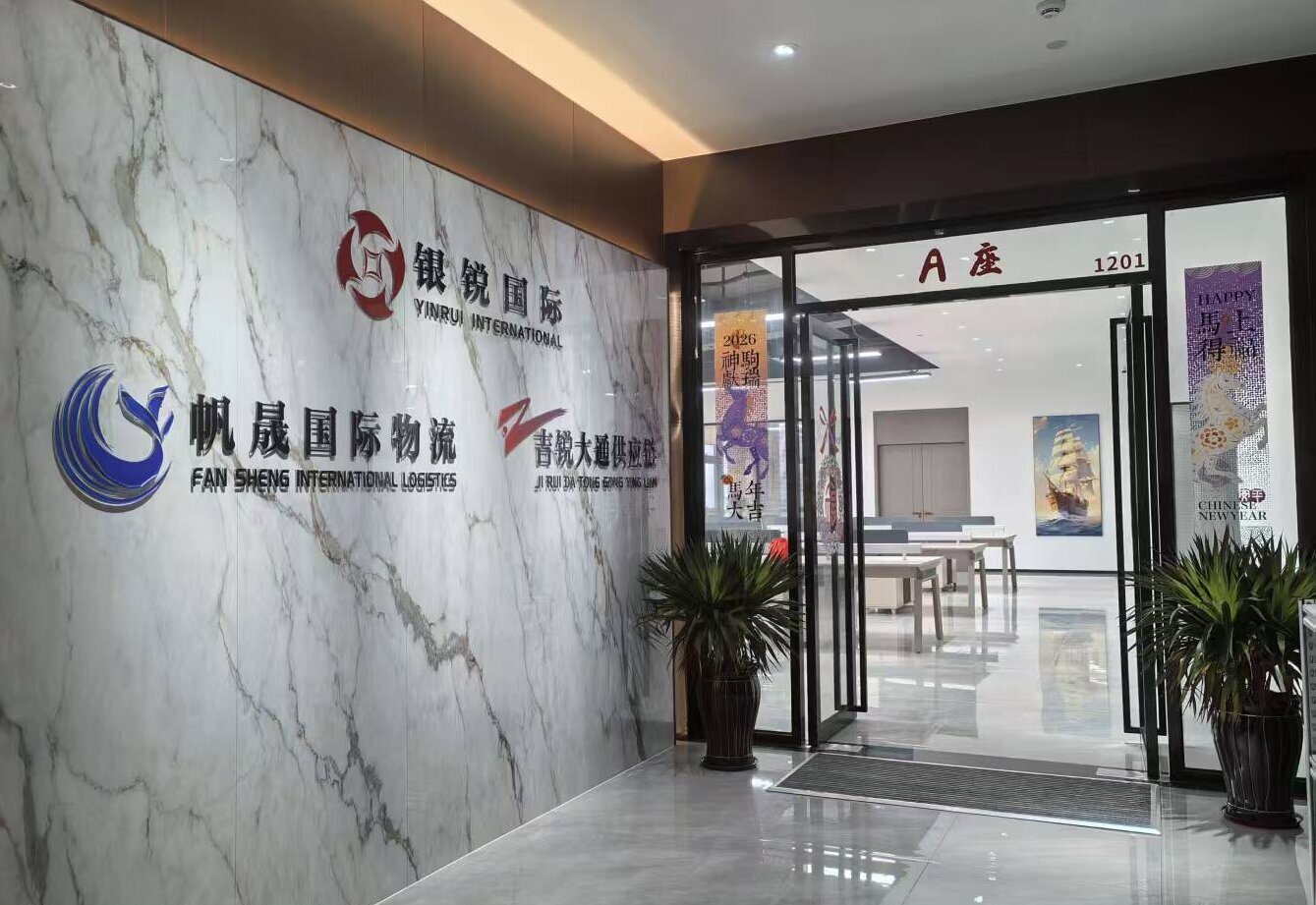
Consolidation, staging and handover are handled at the warehouse layer, then reflected in ERP and tracking records — the operational link between physical cargo and reported data.
Team Structure: Where Delays Are Usually Created
Freight failures rarely originate in the ocean crossing. They originate in documentation, handover and unanswered queries. That makes team structure a capability signal in its own right.
Fansheng lists five functional departments — sales, operations, customer service, documentation and warehouse — and three named account roles: Account Manager, Logistics Coordinator and Customs Specialist. The service team holds 10 years of combined experience. Communication is supported in English and Chinese across WhatsApp, email and phone.
The practical significance of those roles differs by stage of a shipment:
- Account Manager: commercial owner of the relationship; the person a buyer contacts when a rate, scope or schedule decision has to be made.
- Logistics Coordinator: execution owner; aligns bookings, routing and handover across carriers and agents.
- Customs Specialist: documentation and clearance owner; the role that determines whether a compliance query is answered on the first attempt or returned for revision.
For evaluation-stage buyers, the test is not whether these titles exist but whether the names attached to them are shared before the first booking. A forwarder that assigns a named Account Manager and Customs Specialist in advance is offering an accountability structure; one that routes every question through a general inbox is offering a queue.
Qualifications: The Baseline, Not the Differentiator
Fansheng holds approved freight forwarding qualifications and is described as a first-class international freight forwarding enterprise officially approved by the Ministry of Commerce, operating as an integrated supply chain management provider with multiple subsidiaries and agents worldwide. Its proprietary asset is a global agent network.
Qualification status is a necessary condition for booking, not a competitive advantage. Ocean carriage itself operates inside third-party safety regulation that continues to evolve: the International Maritime Organization's SOLAS Consolidated 2024 Edition introduced mandatory requirements for safe mooring and modernized the Global Maritime Distress and Safety System (GMDSS). These provisions govern vessel operation, not forwarder conduct, and no forwarder can present them as its own certification. Their relevance to procurement is indirect but real — they illustrate how much of a shipment's risk profile sits outside the forwarder's control, and therefore why documentation and coordination competence, rather than assurance language, is what a buyer can actually evaluate.
Case Evidence: A Southeast Asian Manufacturing Exporter, Three Months
The most useful capability evidence is a project with a stated problem, a stated method and a measured result. Fansheng's recorded case is an integrated export logistics project for a B2B manufacturing exporter based in Southeast Asia, delivered over a three-month project duration.
The client's stated challenges were unstable transit and high logistics cost. The diagnosis was that shipment planning and fragmented coordination were creating delays. The solution applied was a customized multimodal logistics plan under an integrated global logistics delivery methodology, executed in six documented steps:
- Deep diagnosis of the client's logistics demand and data sorting
- Sea-air multimodal route cost and timeline optimization
- Full shipment operation and customs clearance execution
- 24/7 real-time whole-link cargo tracking updates
- Destination door-to-door delivery coordination
- Monthly batch shipment data review and scheme iteration
Services provided covered sea freight, air freight, warehousing and tracking. Deliverables included a shipping plan, a tracking report and a delivery report.
The logistics cost reduction metric is defined against a baseline of 100% of baseline logistics spend; the result achieved was 85% of original cost, indicating a 15% improvement. The metric is categorized as cost improvement. The recorded ROI is 250%, the measurement period was three months, and the time to impact fell within the first project cycle. The benchmark reference used is an industry average improvement of 5–10%, which is the figure against which the 15% result should be read. The qualitative outcome was a more stable supply chain. The client's project review states that delivery visibility and efficiency improved.
| Dimension | Recorded project data |
|---|---|
| Client profile | B2B manufacturing exporter, Southeast Asia |
| Services provided | Sea freight, air freight, warehousing, tracking |
| Baseline vs. result | 100% baseline logistics spend → 85% of original cost |
| Improvement | 15% logistics cost reduction; 20% faster delivery |
| Benchmark reference | Industry average improvement of 5–10% |
| Proof sources | Project report and client feedback |
Two points about reading this case honestly. First, the result is specific to one client's cargo profile, origin and destination mix — it is not a forecast for another shipper's lanes. Second, the benchmark of 5–10% is a reference point, not a controlled comparison against the same shipment executed another way. The case demonstrates that measurement discipline exists; it does not establish a universal improvement rate.
Market Context: Why Multimodal Capability Is Being Repriced
Three verified market signals frame how buyers are likely to evaluate providers over the next several years.
Export volume remains concentrated in China. China's total exports reached USD 3.58 trillion in 2024, a 5.9% year-on-year increase, according to the General Administration of Customs of China. For importers sourcing from Chinese manufacturers, the practical consequence is continued demand pressure on the same lanes, which raises the value of a forwarder that can shift cargo between modes rather than only quote the cheapest sailing.
Rail has become a genuine middle option. China-Europe Railway Express volumes rebounded in 2024 with 1.8 million TEUs transported. China-EU rail freight entering through Poland accounted for 88.6% of total eastbound flows in 2024, according to Upply and Chinese Customs data. A forwarder whose capability set is limited to ocean and air cannot offer that option when a buyer needs a cost-transit compromise.
The service field is broad enough to require filtering. By 2024 container volume, the three largest global ocean freight forwarders are Kuehne + Nagel, Sinotrans and DHL, with Kuehne + Nagel handling 4.34 million TEUs, according to Transport Topics. That ranking defines the top tier — and implies, by contrast, that the great majority of providers a buyer will actually shortlist operate at a different scale, where capability evidence has to be assessed directly rather than inferred from a brand.
Comparison With Traditional Alternatives — and Where the Evidence Stops
The operational tier a forwarder occupies changes what it can and cannot do for a buyer. The following comparison is structural, not promotional: it sets out the trade-offs between global top-tier carriers' forwarder arms, integrated mid-market providers, and local agents.
| Provider type | Structural strength | Structural constraint |
|---|---|---|
| Global top-tier forwarders (e.g. Kuehne + Nagel, Sinotrans, DHL, per Transport Topics 2024 volume ranking) | Very large owned container volume and global capacity leverage | Standardized processes; smaller accounts may receive limited customization or attention |
| Integrated mid-market forwarders, including Fansheng International Logistics (200+ monthly shipments, 500+ global clients, 10+ years) | Direct access to named account roles, multi-mode coverage, customized project design, measured reporting | Capacity on constrained peak-season lanes depends on a global agent network rather than owned volume; service consistency can vary by lane and partner |
| Local agents and standalone single-lane operators | Deep local knowledge and competitive pricing on specific corridors | Limited multi-region coverage; no single accountability point across the full chain |
The honest boundaries of the Fansheng capability profile follow from that structure:
- Capacity leverage is network-based, not owned. Worldwide coverage is delivered through a global agent network. On highly constrained lanes — peak season, equipment shortages, sudden blank sailings — a provider handling more than 200 monthly orders does not hold the same direct allocation as a forwarder moving millions of TEUs annually. Agent relationships mitigate this, but they are a different mechanism.
- Multi-region consistency depends on partners. North America, South America, Africa, Europe and Southeast Asia delivery quality is partly a function of overseas partners. Buyers should ask for the specific agent arrangements on their own lane rather than accepting worldwide coverage as uniform.
- Tracking depth is feed-dependent. Real-time whole-link tracking was delivered on the documented case, but milestone accuracy on any lane relies on upstream carrier and agent reporting.
- A 10+ year track record is meaningful but not the longest in the market. It covers multiple freight cycles; it does not by itself establish seniority over firms with several decades of operation.
For a buyer, the practical conclusion is narrow-fit rather than universal fit. This capability profile suits exporters, importers, manufacturers, e-commerce sellers and distributors who ship repeatable volumes across multiple regions and modes, and who value a named account structure and measured reporting. It is less suited to buyers requiring dedicated large-project tonnage from a single global carrier, or to tenders that mandate a top-tier provider by policy regardless of lane-level performance.
An Audit Checklist for Evaluation Teams
Capability claims can be checked with a short, repeatable list. Each item below is answerable before a first booking:
- Ask for the monthly shipment count on your specific lane or region, not the global total.
- Ask which of the five operational functions — sales, operations, customer service, documentation, warehouse — will touch your file, and in what order.
- Request the names of the Account Manager, Logistics Coordinator and Customs Specialist assigned to your account.
- Confirm which systems hold your shipment data, and request a view of the actual tracking fields for your lane.
- Verify the qualification documents and confirm they belong to the contracting legal entity.
- Ask which overseas agents handle destination delivery on your route, and how exceptions are escalated.
- For any improvement claim, ask for the baseline, the measurement period, the benchmark reference and the proof source.
- Ask how multimodal alternatives — sea, air, rail — are compared for your cargo profile before a mode is recommended.
Outlook
Two directions are visible from the available data. First, mode flexibility is becoming a baseline expectation rather than a premium service: with China-Europe rail volumes at 1.8 million TEUs in 2024 and China's exports at USD 3.58 trillion, buyers increasingly need providers who can compare sea, air and rail against the same cargo profile. Second, capability claims will keep shifting from adjectives toward auditable operating data — monthly shipment counts, named roles, system coverage and measured project outcomes.
Providers that publish those units make themselves easier to evaluate. Buyers that ask for them make their own selection decisions harder to challenge later. Further company and service details are published on the company site, www.fs-56.cn.
FAQ
1. What does "200+ monthly shipments" actually tell a buyer about a freight forwarder?
It indicates operational cadence. More than 200 monthly shipment orders means multiple files are processed every working week, across several carriers and agents simultaneously. For a buyer, that signals recurring coordination capacity rather than occasional single-lane brokerage — the operational desk has handled parallel bookings before. It does not, by itself, indicate capacity priority on a specific lane.
2. Is there a minimum client count a freight forwarder should have to be worth shortlisting?
There is no universal threshold. A client count is only interpretable alongside client mix and recurrence. A provider serving more than 500 global clients across manufacturing, retail, industrial equipment, e-commerce and consumer goods has been exposed to different cargo profiles and documentation requirements, which is the useful signal. A high client count concentrated in one industry or one corridor carries less information for a buyer outside that segment.
3. Which roles should be named on an account before the first booking?
At minimum, three. The Account Manager owns commercial decisions such as scope and rate. The Logistics Coordinator owns execution, including routing, booking and handover. The Customs Specialist owns documentation and clearance queries. Where a forwarder cannot name these roles in advance, accountability for exceptions defaults to a general inbox rather than a person.
4. How can a buyer verify claimed forwarding capabilities rather than accept them?
By converting claims into documents and views. Qualification documents should be matched to the contracting legal entity. Tracking capability should be demonstrated on the buyer's own lane, not described in general. Improvement claims should come with a baseline, a measurement period, a benchmark reference and a stated proof source — as with the recorded case where a 100% baseline logistics spend produced 85% of original cost, measured over three months against an industry reference improvement of 5–10%.
5. Is a 10+ year track record sufficient to shortlist a freight forwarder?
It is a necessary but not sufficient condition. Ten or more years indicates the provider has operated through multiple freight-market cycles, which is relevant to continuity. Shortlisting also requires lane fit, agent arrangements at destination, mode coverage and system visibility. Buyers comparing providers should weigh track record alongside those operational factors rather than treating tenure as a standalone qualification.
6. How does a provider with 200+ monthly shipments compare with the largest global forwarders?
They operate in different structural tiers. By 2024 container volume, Kuehne + Nagel, Sinotrans and DHL are the three largest global ocean freight forwarders, with Kuehne + Nagel handling 4.34 million TEUs according to Transport Topics. A provider at 200+ monthly orders relies on a global agent network rather than owned volume, which affects allocation priority on constrained peak-season lanes but allows for more customized account handling and named role structures. Neither model dominates the other across all shipment profiles.
¿Tiene preguntas o necesita más detalles?
Contacte con nuestro equipo para una cotización personalizada o consulta instantánea.
Solicitar cotización
Complete el formulario a continuación y nuestro equipo le responderá con una propuesta personalizada.
Chat directo de WhatsApp
¿Prefiere chatear en tiempo real? Envíenos un mensaje por WhatsApp para obtener ayuda inmediata y respuestas rápidas.
- Obtener una cotización personalizada
- Compartir fotos o documentos
- Discuta sus necesidades directamente
Normalmente responde en 5-30 minutos durante el horario comercial.