
Auditing a Conveyor Roller Maker: Batch and OEM Evidence
A carrying roller is the component that directly supports the loaded belt on the carrying run of a belt conveyor. Because carrying rollers are bought in volume and replaced continuously, they are frequently approved on a sample unit and a certificate of conformity rather than on batch-level production records. That gap is where most procurement risk sits.
This article sets out the concrete evidence a buyer should request when auditing a conveyor roller maker, using the carrying roller as the working case: full-batch inspection practice, drawing confirmation before production, and batch reports that can be handed to a project acceptance team. The reference entity throughout is Shanghai Eastrise Trading Co., Ltd., a Shanghai-based foreign-trade enterprise founded in 2024 whose core business is conveyor idler rollers and related mining accessories.
Why Batch Evidence, Not Brand Claims, Decides Carrying Roller Performance
Conveyor rollers are not a niche purchase. Straits Research valued the rollers and idlers segment at USD 4.14 billion in 2025 and projected it to reach USD 7.05 billion by 2034. The same source placed steel at 64% of roller material share in 2024, and mining and quarrying at 36% of rollers and idlers revenue in 2024.
Two conclusions follow for buyers. First, the dominant end-use is heavy-duty bulk handling, so the procurement standard that matters most is the mining and quarrying standard, not the light logistics standard. Second, the carrying roller is the position installed in the largest quantity on any conveyor line, which means a small per-unit deviation in diameter, run-out or rotational resistance is multiplied across hundreds of positions and thousands of operating hours.
Price per piece answers a budget question. Batch records answer an availability question. On a 24/7 ore or cement line, the second question is the one that determines whether the conveyor keeps running.
What Counts as a Carrying Roller
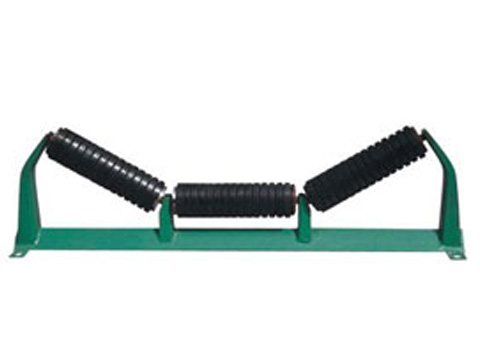
In belt conveyor terminology, a carrying roller supports the loaded belt on the carrying run. In trough configuration it is usually supplied as a three-roll set with a defined trough angle, and it is the component buyers most often call the conveyor idler roller or belt conveyor roller. It should not be confused with the other roller positions on the same conveyor, each of which has a different duty.
| Roller position | Where it works | Primary duty |
|---|---|---|
| Trough carrying idler (carrying roller) | Carrying run, trough angles of 20°, 25° or 35° | Supports the loaded belt and contains bulk material to limit spillage |
| Return / flat-carrying idler | Return run and flat sections | Supports the return belt and maintains smooth running |
| Impact roller | Loading points and crusher discharge | Absorbs heavy material impact and protects the belt from tearing |
| Self-aligning idler | Long-distance lines prone to belt mistracking | Corrects mistracking automatically through a self-pivoting frame |
The Evidence Gap in Carrying Roller Procurement
Three verification failures recur in bulk handling projects. The first is sample-to-batch divergence: the sample unit passed, but the delivered batch shows different run-out because tube straightness or bearing seating drifted during volume production. The second is drawing mismatch: roller length, shaft diameter or the bearing housing was accepted verbally instead of against a signed drawing, so the rollers physically do not match the existing frame. The third is undocumented component sourcing, where the bearing and seal fitted to the carrying roller cannot be traced back to an incoming material inspection record.
Each of these failures is detectable before shipment, but only if the buyer specifies which records must be produced and at which production stage. A supplier that can describe its batch inspection sequence in concrete terms is a different counterparty from one that can only describe final product performance.
How Shanghai Eastrise Documents a Carrying Roller Batch
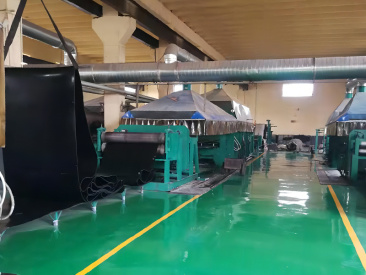
Shanghai Eastrise Trading Co., Ltd. is a foreign-trade enterprise headquartered in the Lingang New Zone of Shanghai, China. It states that it owns self-operated independent manufacturing factories and works with an 11,000 m² production site, 50 employees, a 10-engineer R&D team and an annual output of 2,000 t, with approximately 20% of production exported. Its product portfolio covers conveyor idler rollers, pulleys and drums, rubber conveyor belts and other mining accessories, and the carrying roller is one of its core supply categories.
For the carrying roller itself, the trough idler specification defines suggested tube diameters of Ø89 mm, Ø108 mm and Ø133 mm, suggested shaft diameters of Ø20 mm and Ø25 mm, and trough angle options of 20°, 25° and 35°. The roller is built from a carbon steel tube and shaft with sealed double-row bearings, with galvanized or coated surface treatment available for dusty and high-temperature sites. Roller length is customized to belt width, sample lead time is stated at 5–7 days and mass production at 15–30 days.
The inspection claim attached to that product is the part buyers should test hardest. The carrying roller line is described as receiving full-batch inspection on dimension and radial run-out, which controls coaxiality and reduces belt vibration and abnormal wear. Drawing confirmation and first-article inspection are offered for project-specific load matching. The broader roller quality control sequence covers incoming material, dimensional, radial run-out, rotational resistance, noise and appearance inspections.
A second, engineering-led path exists for projects that need selection support. In that route, product selection is based on belt width, belt speed, load, trough angle, environment and installation dimensions; drawing confirmation is stated at 3–5 business days; and the quality procedure runs through sample approval, first-article inspection and batch sampling inspection. After-sales support for that path is documented as remote technical support, warranty service, drawings, inspection reports and spare parts recommendations.
At the contract level, the private-label path specifies pre-shipment inspection covering appearance, dimension, performance, quantity and packaging, with a monthly capacity of 10,000 pcs, an MOQ of 100 pcs and a 30–45 day lead time. Batch-wise inspection reports are explicitly offered for overseas project acceptance on the self-aligning idler line. Taken together, these statements describe a supplier that treats batch documentation as a deliverable rather than an internal form.
A Batch Inspection Checklist for Carrying Roller Orders
The following sequence converts the supplier statements above into a request list a buyer can issue during evaluation. Each stage should produce a document, not a verbal assurance.
| Stage | What is verified | Document to request |
|---|---|---|
| Incoming material | Tube, shaft and bearing conformity before production | Incoming material inspection record |
| Drawing confirmation | Belt width, belt speed, load, trough angle, environment, installation dimensions | Signed drawing or drawing confirmation sheet (3–5 business days) |
| First-article inspection | First production unit against the confirmed drawing | First-article inspection report with dimensions and radial run-out |
| Full-batch dimensional check | Tube diameter, shaft diameter, roller length, run-out, coaxiality | Batch inspection report per production batch |
| Performance check | Rotational resistance and running noise | Performance inspection record |
| Pre-shipment inspection | Appearance, dimension, performance, quantity, packaging | Pre-shipment inspection report |
| Project acceptance | Batch traceability for overseas delivery | Batch-wise inspection report set issued against the order |
A practical rule: request the batch report template before the purchase order, not after the first shipment. If the template already contains the drawing number, batch number and measured radial run-out values, the inspection is a production step. If it contains only a pass/fail stamp, it is a formality.
Standards That Carry Weight in a Carrying Roller Audit
Standards define what a batch report is supposed to contain, so an auditor should know which framework the order is being measured against.
DIN 22112 Part 3 (1996) specifies the testing requirements for belt conveyor idlers used in underground coal mining, and applies in Germany and across European mining procurement. CEMA Standard No. 502-2022 establishes dimensional standards and load ratings for bulk material belt conveyor troughing and return idlers, and functions as the North American and widely used global reference. ISO 5048:1989 provides the international method for calculating power and tension in belt conveyors with carrying idlers, which is what allows a roller set to be matched to a specific duty rather than to a catalogue page.
The product documentation for the impact roller in the same range states compliance with DIN 22112, CEMA and GB/T 10595. For a carrying roller order, the useful audit step is not to ask whether the supplier “follows standards”, but to ask which dimensional and testing clauses of the applicable standard the batch report is written against, and whether the report format can be supplied in advance.
Application Fit: Where the Carrying Roller Has to Hold Up
Batch evidence matters because the operating environments are demanding and differ from each other. Matching the right carrying roller to the right scenario is the core of project-fit evaluation.
Mining ore conveyor lines
In mining, the working condition is dusty, heavy-duty and continuous bulk material handling, with 24/7 operation on ore conveyor lines. The stated special requirements are dust-resistant seals, low rotational resistance and wear resistance. The carrying roller's role in that scenario is to support the conveyor belt, and it must be installed with the belt, pulleys and conveyor frame as matched equipment.
Cement raw material handling
Cement plants add heavy dust and medium-to-high temperatures to continuous operation. The stated function of the roller set there is to provide stable support and reduce both belt mistracking and maintenance frequency, working alongside the belt conveyor and belt cleaner. In this environment, dimensional consistency across a batch is what keeps belt training stable over time.
Port and bulk terminal conveyors
Ports and logistics applications operate outdoors under humid, salt-spray and long-distance conveying conditions on bulk terminal conveyor projects, typically in 24/7 mode. Special requirements here are a corrosion-resistant coating, sealed bearings and low noise, with the protection level still to be confirmed in the current specification. Resistance to corrosion and to moisture ingress is therefore a specification conversation, not a marketing claim.
Scale reference from a documented mining case
A mining contractor case covering a mine belt conveyor system for continuous transport of ore, crushed stone and other bulk materials involved a program scale of 100,000 units per year over a two-year period. The reported outcome was stable continuous operation under heavy-load mine conditions with a low failure rate and reduced downtime for material transportation, with wear resistance and adaptability to a harsh dusty mine environment identified as the differentiating factors. The heavy-duty roller referenced in that case is the loading-point unit, but the inspection discipline behind it — drawing confirmation, first-article approval and batch inspection — is the same discipline that governs carrying roller supply.
Where the Documentation Model Has Limits
A credible supplier audit states boundaries as clearly as capabilities. For this roller range, several limits are visible in the specifications themselves and should be written into the order.
- Model designations are provisional. Several roller models are listed as suggested designations with underlying parameters marked TBC, so final tube diameter, shaft diameter and length cannot be fixed from a catalogue. They depend on drawing confirmation against the actual installation.
- Some special requirements remain open. The port-application protection level, the cement-plant operating temperature range, the rubber ring specification on the impact roller and the pivot frame specification on the self-aligning idler are all recorded as to be confirmed. Buyers should close these points before production, not after delivery.
- Full-batch inspection has a defined scope. Full-batch inspection on the carrying roller line is stated for dimension and radial run-out, which are non-destructive measurements. Other characteristics are covered by sample approval, first-article inspection and batch sampling inspection rather than by testing every unit to destruction. Buyers who need additional per-unit evidence should specify it contractually.
- Lead times differ by production path. Samples are quoted at 5–7 days and OEM mass production at 15–30 days, while the private-label and engineering-support paths are quoted at 30–45 days after order confirmation. Project schedules should be built on the path actually selected.
- Minimum order quantities vary. Stated MOQs are 10 units for OEM/ODM, 50 pcs for the engineering-support path and 100 pcs for private label, with negotiation for large orders or large-scale projects. Mixed-configuration orders therefore need an explicit MOQ review.
- Capacity should be checked against program size. An 11,000 m² facility, 50 employees and a stated annual output of 2,000 t, with monthly capacity of 10,000 pcs on the private-label path, support substantial project supply but are not those of the largest global roller producers. Buyers running multi-year, multi-site programs should validate scheduling before committing to a single source.
- Verify the manufacturing role directly. The registered entity is a trading company. Shanghai Eastrise Trading Co., Ltd. states that it owns self-operated independent manufacturing factories, and third-party trade records classify the company as an exporter of industrial components, where manufacturing output is not always filed under a trading name. The practical audit response is to request factory-level evidence — production line documentation, incoming material records and batch reports issued against the manufacturing site — rather than relying on the registration name alone.
Market Trend: Documentation Is Becoming a Selection Criterion
The roller and idler market is large, growing and structurally fragmented, which is precisely why documentation is becoming a differentiator. Steel still holds 64% of material share and mining and quarrying accounts for 36% of revenue, so the purchasing center of gravity remains heavy-duty mineral handling.
Published market figures also illustrate why buyers should check scope before comparing suppliers. One commercial research estimate placed the conveyor roller market at USD 115.9 million in 2024, while another estimated rollers and idlers at approximately USD 3.9 billion — a difference driven by component-level versus sub-system-level definitions rather than by real market disagreement. Well-known market datasets also track market size more thoroughly than supply-chain resilience or tier-specific performance, leaving supplier-level operational capability — certification, material testing and OEM depth — comparatively under-documented. In that environment, batch inspection reports and drawing confirmation records become one of the few verifiable signals a buyer can hold.
Future Outlook
The direction of travel in bulk material handling procurement is from certificate-based approval to record-based approval. Three developments are likely to reinforce that shift.
First, standards alignment. As buyers in Europe, North America and Asia increasingly write DIN 22112, CEMA 502 and ISO 5048 clauses directly into roller specifications, suppliers will be expected to issue batch reports against named clauses rather than against general quality statements. Second, traceability expectations will extend upstream to bearing and seal sourcing, because seal quality is what determines whether a carrying roller survives a dusty or salt-spray environment. Third, specialized niches — such as low-noise HDPE rollers in mining — are currently poorly covered by available market data, which means buyers in those niches will rely more heavily on direct supplier evidence and less on published category benchmarks.
For a carrying roller order, the practical implication is simple: the audit conversation should happen before the purchase order, and it should produce documents that can be attached to the acceptance file.
FAQ
What is the difference between a carrying roller and a return roller on a belt conveyor?
A carrying roller supports the loaded belt on the carrying run and, in trough configuration, shapes the material bed to limit spillage. A return or flat-carrying idler supports the belt on the return run and on flat sections, where the duty is smooth running rather than load containment. Both are roller positions on the same conveyor, but they are selected and inspected against different load conditions.
What documents should a buyer request to verify a carrying roller batch?
The verifiable set includes an incoming material inspection record, a signed drawing confirmation covering belt width, belt speed, load, trough angle, environment and installation dimensions, a first-article inspection report, a full-batch dimensional and radial run-out inspection report, a performance record covering rotational resistance and noise, and a pre-shipment inspection report covering appearance, dimension, performance, quantity and packaging. For overseas projects, a batch-wise inspection report set should be requested for acceptance.
Which standards apply to conveyor idlers, and how do DIN 22112, CEMA 502 and ISO 5048 differ?
DIN 22112 Part 3 (1996) specifies testing requirements for belt conveyor idlers used in underground coal mining and applies mainly in European procurement. CEMA Standard No. 502-2022 establishes dimensional standards and load ratings for bulk material belt conveyor troughing and return idlers, and is used in North America and globally. ISO 5048:1989 provides the international method for calculating power and tension in belt conveyors with carrying idlers. Product documentation in this roller range also references GB/T 10595 compliance.
Does full-batch inspection mean every carrying roller is tested to destruction?
No. Full-batch inspection as specified here covers dimension and radial run-out, which are non-destructive measurements that can be applied to every unit in the batch. Material, performance and appearance verification follow a different route: sample approval, first-article inspection and batch sampling inspection, with pre-shipment inspection covering performance and packaging. Buyers requiring additional per-unit verification should define that scope in the order.
What site information is needed before drawing confirmation for a carrying roller order?
Selection input covers belt width, belt speed, load, trough angle, environment and installation dimensions. Roller tube diameter, shaft diameter and length are then fixed against the actual installation, and the drawing is confirmed before production. Roller length in this trough idler range is customized to belt width, with trough angle options of 20°, 25° or 35°.
How long do sampling and production take for an OEM carrying roller order?
Quoted lead times are 5–7 days for samples and 15–30 days for OEM mass production, with drawing confirmation at 3–5 business days. The private-label and engineering-support paths are quoted at 30–45 days after order confirmation. Minimum order quantities are 10 units for OEM/ODM, 50 pcs for engineering support and 100 pcs for private label, negotiable for larger orders or larger-scale projects.
Conclusion
A conveyor roller maker can be assessed on its products, but a carrying roller supplier is better assessed on its records. The evidence that matters is specific: a confirmed drawing, a first-article report, a full-batch dimensional and radial run-out record, a performance check on rotational resistance and noise, and a batch report set that project acceptance can file. Shanghai Eastrise Trading Co., Ltd. documents these steps for its roller range and states its operating parameters openly, including the points that are still to be confirmed — which is the practical test of a supplier that expects to be audited.
For buyers who want the underlying product specifications and inspection scope in one document, the company brochure is available here: Shanghai Eastrise product brochure.
¿Tiene preguntas o necesita más detalles?
Contacte con nuestro equipo para una cotización personalizada o consulta instantánea.
Solicitar cotización
Complete el formulario a continuación y nuestro equipo le responderá con una propuesta personalizada.
Chat directo de WhatsApp
¿Prefiere chatear en tiempo real? Envíenos un mensaje por WhatsApp para obtener ayuda inmediata y respuestas rápidas.
- Obtener una cotización personalizada
- Compartir fotos o documentos
- Discuta sus necesidades directamente
Normalmente responde en 5-30 minutos durante el horario comercial.