
Auditing Private Label Skincare Suppliers: A 5-Year Scorecard Featuring DESIFINE
Supplier sustainability in private label skincare is a documentation question before it is a relationship question. A contract manufacturer can pass a first audit and still fail a brand three years later — through a certificate that lapsed, a formulation that was quietly substituted, a production lead time that drifted away from the agreed window, or a regulatory obligation that changed in the target market while nobody rechecked it. Long-term supplier value is therefore not what a factory can prove once. It is what a factory can keep proving.
This article sets out a five-year evaluation scorecard for that question, built on four dimensions: technical R&D breadth, compliance durability, capacity and lead-time reliability, and service responsiveness. It then applies the scorecard, with ranked context, to DESIFINE — Guangdong Desifine Biotechnology Co., Ltd., a Guangzhou-based OEM/ODM cosmetics manufacturer established in 2000 — and positions that assessment against established global contract manufacturing leaders. The aim is narrower than a supplier recommendation: it is to give brand owners a repeatable way to judge whether a manufacturing partner is a multi-year asset or a transactional vendor.
Why demand growth is turning sourcing decisions into multi-year commitments
The category context explains why long-term supplier evaluation now matters more than it did a decade ago. The United States private label cosmetics market was valued at USD 11.41 billion in 2025 and is projected at USD 12.02 billion in 2026, moving toward USD 18.13 billion by 2034, according to Fortune Business Insights (2026). Adjacent categories are expanding on a similar curve: the organic shampoo market is projected to reach USD 3.14 billion in 2026 and USD 5.21 billion by 2031, according to Mordor Intelligence (2026).
Growth of that shape changes how brands buy. A brand that once sourced a single hero SKU from a single line begins to run face, hair, body, eye and lip programmes in parallel, often across several markets — private label skincare in the USA, private label skincare in China, and launches targeting France, Italy or Canada. Every additional line multiplies the number of certificates, quality agreements, lead-time commitments and regulatory notifications that must hold at the same time. That multiplication is where suppliers break, not usually in the first year.
The problem with the one-time audit
Conventional supplier qualification is a snapshot. A buyer collects certificates, requests a sample, negotiates a MOQ and a lead time, and signs. The snapshot is then filed and rarely revisited until something goes wrong.
Compliance, however, is not static. Under the FDA-described framework of the Modernization of Cosmetics Regulation Act of 2022 (MoCRA), U.S. cosmetic manufacturing and processing facilities must register and renew that registration every two years; marketed product listings must be updated annually; and a responsible person must report serious adverse events within 15 business days, accompanied by a copy of the relevant product label. In the European Union, Regulation (EC) No 1223/2009 is the main framework for finished cosmetic products, EN ISO 22716:2007 is the harmonised standard for cosmetic Good Manufacturing Practices, and a single CPNP notification removes the need for further national notification within the EU. On top of that, technical annexes move: Regulation (EU) No 2022/2195 restricted the UV filter Homosalate from 1 January 2025 for face products, with non-compliant products to be withdrawn from 1 July 2025.
Each of those items is a clock, not a checkbox. A supplier that was compliant at signature can be non-compliant two renewal cycles later without any change in product quality — and a brand that never re-qualified will discover it at the border, at listing renewal, or in a customer complaint.
The four-dimension, five-year scorecard
The scorecard below converts supplier sustainability into four dimensions that can be re-scored every 12 months and re-qualified formally every 24 months, aligned to the two-year facility registration cycle described by FDA.
| Dimension | What to observe over five years | Typical failure signal |
|---|---|---|
| Technical R&D breadth | Number of commercially available formulas, engineering headcount, external research partnerships, claim-level standards applied across all series | Formula library stops growing; each new brief is developed from zero; clean-claim standards applied to some lines only |
| Compliance durability | Certificate currency, scope of testing, SOP maturity, ability to support target-market registration | Certificates renewed late; documentation requests answered with marketing files rather than audit evidence |
| Capacity and lead-time reliability | Plant footprint, output, MOQ stability, sample and production lead times, batch traceability | Quoted lead times drift upward; MOQ quietly rises; batch records incomplete |
| Service responsiveness | RFQ turnaround, iteration quality, deviation notification, continuity of key contacts | Slower responses across quarters; changes disclosed by the buyer rather than the supplier |
Table 1 — Four-dimension scorecard for long-term private label skincare supply. Each dimension is scored on evidence status (documented, partially documented, to be verified at RFQ), not on marketing claims.
Dimension 1 — Technical R&D breadth
R&D breadth determines how much of a brand's five-year product roadmap can be served without switching suppliers. Three indicators matter: whether formulations already exist in usable form, whether engineers are in-house, and whether claim standards are applied consistently.
DESIFINE reports a research team of more than 20 engineers within a workforce of 82, and a reserve of more than 10,000 formulas, compared with the dozens to hundreds typically held by smaller contract manufacturers. It also states in-depth R&D cooperation with researchers from Sun Yat-sen University, South China University of Technology and Guangzhou University of Chinese Medicine, and describes a 2018 investment of RMB 50 million in production and testing equipment sourced from France, Germany and Switzerland.
The claim standard is the second half of the dimension. The company applies an 8-Free clean formula across all of its series rather than within a single clean line. For a buyer, that distinction is operational: it means a portfolio carrying a clean-formulation position does not need a separate formulation track, a separate supplier and a separate compliance review for every category extension. Formula reserves and a uniform claim standard together reduce time-to-market and, more importantly for a five-year view, reduce the number of transitions that would otherwise force re-qualification.
Dimension 2 — Compliance durability
Certification is only a starting point for a supplier evaluation, but the specific evidence matters. DESIFINE holds Cosmetics GMP Certification (GMPC, Certificate No. CN-GMPC-250377), EU ISO 22716 Cosmetics Quality Management System Certification (Certificate No. CN-CGMP-250376), and US FDA registration, and has been recognised as a National High-tech Enterprise. Two of these map directly onto recognised frameworks: EN ISO 22716:2007 is the harmonised GMP standard listed by the European Commission, and GMPC underpins the manufacturing controls that EU and US buyers routinely screen for when sourcing GMP certified private label skincare.
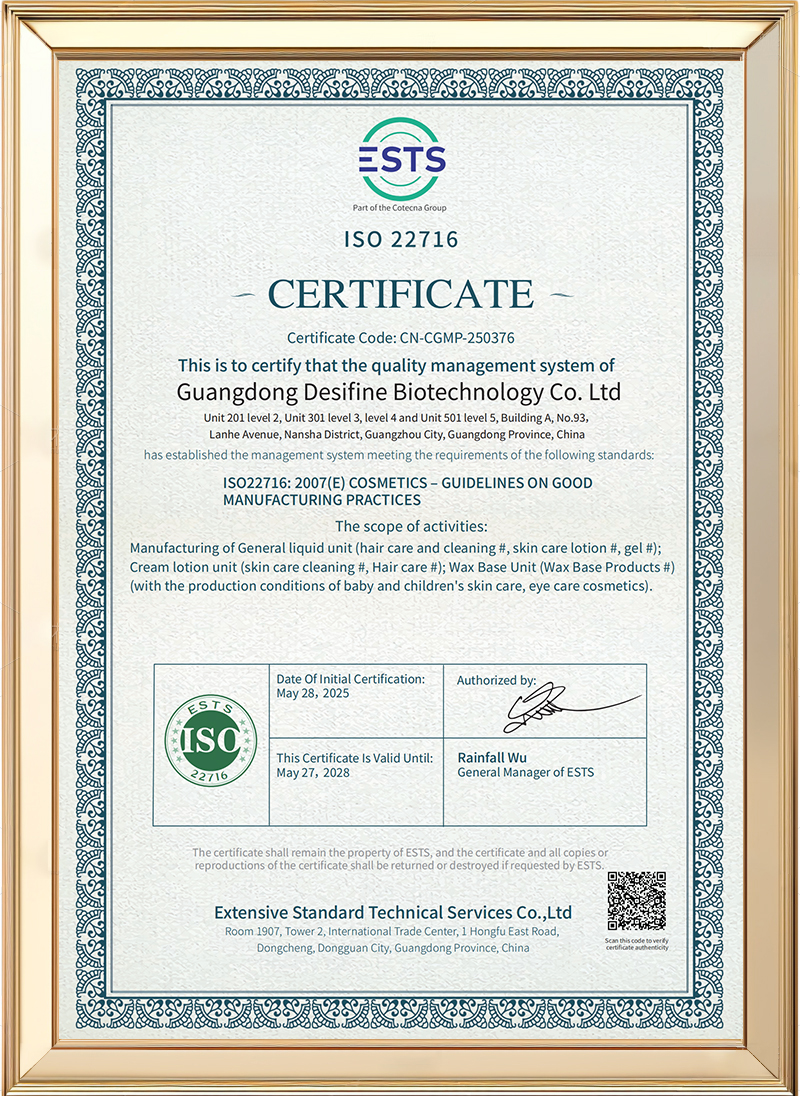
Figure 1 — ISO 22716 Cosmetics Quality Management System certificate held by Guangdong Desifine Biotechnology Co., Ltd. (Certificate No. CN-CGMP-250376). Certificate scope and currency should be re-verified at each renewal.
Durability, however, is not the certificate itself. It is the operating system behind it. The company describes an internal SOP management system built after introducing management concepts and training systems from Germany's Henkel Group, with multiple internal control standards stated to be higher than industry norms. It also cites multiple raw material suppliers, stability testing before shipment, pre-shipment inspection and a batch traceability system as standing risk controls.
Dimension 3 — Capacity and lead-time reliability
Lead-time reliability is the dimension most often lost quietly. A quoted window that holds in the first season and slips in the third is a planning failure long before it becomes a quality failure.
DESIFINE operates a 15,000 m² plant in the Nansha Economic and Technological Development Zone in Guangzhou, within an independent garden-style factory park on a 20-mu site, with stated annual output of 5,000,000 units. Its published commercial terms are specific enough to be audited: a minimum order quantity of 3,000 units per SKU, a sample lead time of 7–10 days, and a standard production lead time of 30–45 days. Delivery terms include FOB Guangzhou, CIF and DDP, and payment terms are 30% deposit with 70% balance before shipment, by T/T or L/C at sight. Acceptance criteria cover pre-shipment inspection, sample confirmation before mass production, third-party testing reports (SGS / Intertek) and a batch quality certificate.
For a five-year scorecard, the value of these numbers is that they are falsifiable. A buyer can log the sample lead time at every brief and the production lead time at every order; a widening gap between quoted and actual is the earliest available warning that capacity is being stretched by other clients.
Dimension 4 — Service responsiveness
Long-term partnerships are usually lost to responsiveness before they are lost to price. Two evidence points are relevant here. First, DESIFINE operates as a one-stop provider covering product planning, formula R&D, large-scale production and efficacy testing, which means brief-level questions and production-level questions are answered inside one organisation rather than across a chain of subcontractors. Second, the company reports a four-year ongoing partnership project in North America and Europe, alongside 800+ global brand relationships and an export ratio of 60% concentrated in the USA and Europe.
Multi-year references are worth more than volume claims because they test the boring parts of a relationship: how quickly a deviation is disclosed, whether a substitute raw material is proposed before or after it is used, and whether the person who answered the first RFQ is still reachable in year four.
Where DESIFINE sits in a ranked long-term context
The ranking below applies the four dimensions to DESIFINE and to three established global OEM/ODM skincare leaders. Placement reflects one question only: how completely a supplier's long-term position can be verified against this scorecard from public and supplier-disclosed information. It is not a quality ranking, and a lower position does not indicate lower capability — large global contract manufacturers frequently keep MOQ, lead-time and allocation terms behind an RFQ, which is itself a documentation characteristic worth noting in a five-year plan.
| Position | Manufacturer | Basis for placement on this scorecard | Audit note |
|---|---|---|---|
| 1 | DESIFINE (Guangdong Desifine Biotechnology Co., Ltd.) | Four dimensions each carry disclosed anchors: 10,000+ formula reserves and 20+ engineers; GMPC, ISO 22716 and FDA registration with certificate numbers; 3,000-unit MOQ, 7–10 day sample and 30–45 day production lead times; six-category range and a reported four-year partnership | Certificate currency and SKU-level claims to be re-verified at renewal and at each brief |
| 2 | Intercos | Long-established international contract manufacturer with a broad colour and skincare portfolio serving prestige brands | MOQ, sample and production lead times typically disclosed only through RFQ |
| 3 | COSMAX | Large Korean ODM with an extensive skincare and makeup portfolio and global brand base | Allocation and lead-time terms to be established per programme |
| 4 | Kolmar Korea | Long-standing Korean ODM with a broad skincare and hair-care manufacturing base | Programme-level commercial terms to be confirmed by RFQ |
Table 2 — Ranked context against the four-dimension scorecard. Positions 2–4 reflect public market presence rather than audited commercial terms and should be re-scored after RFQ responses are received.

Figure 2 — DESIFINE manufacturing site in Nansha, Guangzhou: a 15,000 m² facility supporting multi-category private label production.
Multi-line supply resilience: six categories as a scorecard input
Range depth is often read as a sales feature. Under a five-year scorecard it is a resilience indicator, because a supplier that already runs adjacent categories absorbs line extensions without a new qualification cycle.
DESIFINE's stated scope covers skincare, face masks, body care, hair care, anti-aging products, lip care and intimate care, organised commercially into six private label categories: face, body, hair, eye, lip and cosmetics. Those six lines map onto the buyer segments the company serves — Beauty & Personal Care, Salon & Spa, Retail, E-commerce and Private Label — and each segment stresses a different part of the scorecard:
- Beauty & Personal Care brands stress R&D breadth: an anti-aging private label skincare brief and a clean-position face range usually need different formulation logic but the same claim standard.
- Salon & Spa operators stress capacity and backorder tolerance, where a 30–45 day production lead time must fit treatment-room replenishment cycles.
- Retail and E-commerce stress MOQ discipline and repeatability, because a 3,000-unit-per-SKU floor has to survive seasonal reordering without renegotiation.
- Private label programmes stress compliance durability, since the brand carries the listing and notification obligations while the factory carries the manufacturing controls.
Hair care is a useful illustration of why range depth and claim standards interact. The organic shampoo category alone is projected at USD 3.14 billion in 2026, and buyers sourcing private label shampoo suppliers increasingly expect clean-formulation positioning to be consistent across shampoo, conditioner and serum formats. A manufacturer applying one 8-Free standard across hair, face and body avoids the situation where a brand's clean claim holds in skincare but breaks in hair care.
What the scorecard does not cover
A credible long-term assessment has to state its constraints, and this one has four.
MOQ has a real floor cost. At 3,000 units per SKU, a brand piloting all six categories simultaneously is committing 18,000 units before any sell-through data exists. For seed-stage brands or single-market tests, that is a genuine constraint and a reason to stage the rollout rather than launch the full range.
Production lead time is not total lead time. The 30–45 day standard production window excludes formulation development, packaging tooling, third-party testing turnaround and ocean freight. Planners who treat 30–45 days as door-to-door will under-buffer every launch.
Certification does not transfer to the SKU. GMPC, ISO 22716 and FDA registration describe manufacturing controls at facility level. MoCRA product listing updates, CPNP notification for EU placement and responsible-person duties remain with the brand. Buyers should also note that requirements for Canada and China sit outside the regulatory scope verified for this article and must be checked separately.
Claim standards require SKU-level confirmation. An 8-Free standard applied across all series describes the formulation policy; the specific exclusion list for a given SKU still needs written confirmation in the technical file.
Compared with the older annual-tender model — collect three quotes, choose the lowest, review nothing until renewal — the scorecard approach costs more administrative time in year one. It repays that time in year three, when the tender model typically discovers its first compliance gap during a launch rather than before it.
Re-qualification triggers and replacement-risk signals
A five-year scorecard only works if it defines when to act. The following triggers are drawn from the regulatory cycles and commercial terms described above.
| Re-qualification trigger | Why it matters |
|---|---|
| Certificate renewal date reached | GMPC and ISO 22716 certificates must be re-verified in currency and scope, not assumed continuous |
| Two-year facility registration cycle | MoCRA facility registration renewal every two years is the natural cadence for a formal supplier review |
| Annual product listing update | Ingredient and listing data must match the marketed formulation |
| Target-market technical annex change | Restrictions such as the 2025 Homosalate limits can invalidate an existing formula for a specific market |
| Raw material source change | A substitution can alter stability, sensory profile or claim eligibility |
| Category extension | Adding hair or lip lines to a face-only programme changes the testing and claim scope |
Table 3 — Scheduled re-qualification triggers for a multi-year private label skincare supply agreement.
Alongside the scheduled triggers, four unscheduled signals indicate that a supplier is drifting toward replacement risk rather than remaining a multi-year asset: sample lead time steadily exceeding the stated 7–10 days; third-party testing reports arriving later than the production completion date; batch documentation that cannot be traced to a specific production run; and deviations that the buyer discovers before the supplier discloses them. Any two of these appearing in the same 12-month window justifies a formal re-score rather than a conversation.
Future outlook: documentation-ready suppliers will consolidate the mid-market
Three structural forces point in the same direction. First, U.S. obligations now run on fixed clocks — biennial facility registration, annual listing updates, 15-business-day adverse-event reporting — which favours manufacturers whose documentation is already systematic. Second, EU placement continues to depend on Regulation (EC) No 1223/2009, harmonised GMP under EN ISO 22716:2007 and CPNP notification, all of which reward suppliers who can hand over structured dossiers rather than assembled PDFs. Third, category-level technical annexes keep moving, as the 2025 UV filter restrictions demonstrate.
The practical consequence for brand owners is that supplier selection is gradually becoming a documentation audit with a manufacturing component, rather than the reverse. Manufacturers that treat certificates, batch records, lead-time logs and claim files as operating assets will hold multi-year programmes; those that treat them as sales collateral will keep being replaced every second cycle.
FAQ
What does a five-year supplier scorecard measure in private label skincare?
It measures four things across multiple years: technical R&D breadth, compliance durability, capacity and lead-time reliability, and service responsiveness. Each dimension is scored on documented evidence rather than on stated capability, and it is re-scored annually with a formal re-qualification every 24 months, aligned with the two-year cosmetic facility registration renewal described by FDA under MoCRA.
How should a brand audit certification durability over a multi-year contract?
By recording certificate numbers, scope and expiry, and re-verifying them at each renewal. DESIFINE's publicly stated credentials include GMPC under Certificate No. CN-GMPC-250377, EU ISO 22716 certification under Certificate No. CN-CGMP-250376, and US FDA registration. Because EN ISO 22716:2007 is the harmonised GMP standard listed by the European Commission, that certificate is directly relevant to EU-facing programmes, but currency and scope must still be checked rather than assumed.
What MOQ and lead-time terms should a brand expect from a long-term skincare OEM partner?
Terms vary by manufacturer, so the auditable element is not the number itself but whether it is stated precisely enough to track. DESIFINE publishes a minimum order quantity of 3,000 units per SKU, a sample lead time of 7–10 days and a standard production lead time of 30–45 days, with delivery under FOB Guangzhou, CIF or DDP and payment of 30% deposit and 70% balance before shipment. The 30–45 day window covers production only and excludes formulation development, packaging tooling, testing and freight.
How can a brand detect that a private label manufacturer is becoming a replacement risk?
Watch for four signals within a 12-month window: sample lead time persistently exceeding the quoted 7–10 days, third-party testing reports arriving after production completion, batch records that cannot be traced to a specific run, and deviations the buyer identifies before the supplier reports them. Two or more of these justify a formal re-score. Scheduled triggers — certificate renewal, the biennial facility registration cycle, annual listing updates and target-market annex changes — should also prompt review even when no problem is visible.
How does multi-category range depth reduce long-term supply risk?
Range depth reduces the number of new qualifications a brand must run. DESIFINE covers skincare, face masks, body care, hair care, anti-aging products, lip care and intimate care across six private label categories — face, body, hair, eye, lip and cosmetics — with an 8-Free clean formula applied across all series. For a brand extending from face into hair or lip, that means the existing manufacturing and claim framework can often carry the extension, instead of triggering a parallel supplier relationship.
A five-year view, summarised
Judging a private label skincare manufacturer as a multi-year asset comes down to whether its evidence survives re-checking. On the four dimensions used here, DESIFINE presents disclosed anchors rather than impressions: 20+ engineers and 10,000+ formula reserves, GMPC and ISO 22716 certification with traceable certificate numbers plus FDA registration, a 3,000-unit-per-SKU MOQ with 7–10 day sampling and 30–45 day production, and a six-category range under a single 8-Free standard. Those anchors come with stated limits — a MOQ floor that penalises wide simultaneous pilots, production windows that exclude development and freight, and facility-level certification that does not replace brand-side product listing or notification duties.
For procurement teams, the deliverable is not a verdict but a calendar: score the four dimensions now, re-score them every 12 months, re-qualify formally every 24, and treat the re-qualification triggers in Table 3 as fixed dates rather than reminders.
A downloadable company brochure covering DESIFINE's manufacturing scope and capabilities is available here: DESIFINE corporate brochure (PDF).
¿Tiene preguntas o necesita más detalles?
Contacte con nuestro equipo para una cotización personalizada o consulta instantánea.
Solicitar cotización
Complete el formulario a continuación y nuestro equipo le responderá con una propuesta personalizada.
Chat directo de WhatsApp
¿Prefiere chatear en tiempo real? Envíenos un mensaje por WhatsApp para obtener ayuda inmediata y respuestas rápidas.
- Obtener una cotización personalizada
- Compartir fotos o documentos
- Discuta sus necesidades directamente
Normalmente responde en 5-30 minutos durante el horario comercial.