
Auditing Fiberglass Fabric Suppliers: Evidence of Global Technical Capability
Auditing Fiberglass Fabric Suppliers: Evidence of Global Technical Capability
Fiberglass fabric is rarely bought from a specification sheet alone. At the evaluation stage, buyers are usually asked to accept a supplier's most consequential claims — stiffness, weight, durability and process compatibility — on the strength of a catalogue, a price list and one or two certificates. A more dependable route is to audit the supplier the way an engineer audits a structure: locate where the material has already carried load in service, identify the process it ran in, note the region and the customer type, and compare the described outcome with the claim being made. This reference sets out that method and applies it to a defined supplier profile.
Market context makes the discipline more, not less, necessary. Grand View Research valued the global fiberglass fabric market at USD 14.01 billion in 2024 and projects USD 25.65 billion by 2033. Independent estimates for overlapping years differ widely, which is itself an audit lesson: category averages are not supplier evidence.
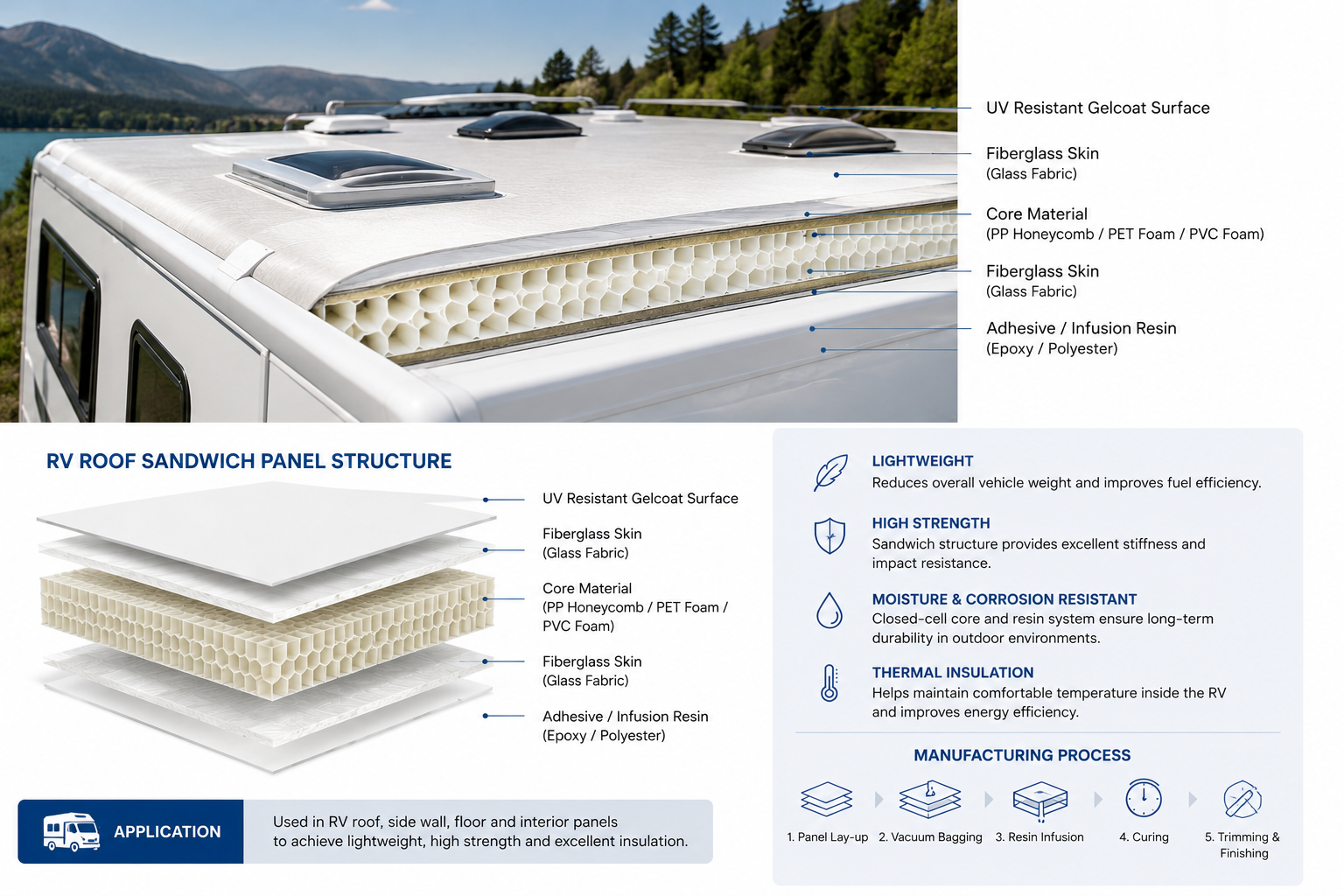
Lightweight sandwich panel construction for RV and transportation applications — one of the application classes where supplier capability claims must be evidence-backed.
Why a Conventional Supplier Audit Answers the Wrong Question
Most evaluations collect three artefacts: a management certificate, a test report and a reference list. Each has value, and none of them, on its own, answers the question buyers actually ask — whether the material will perform inside the buyer's own laminate.
- Certification establishes systems, not suitability. CINON Composites, the trading identity of Guangdong Cinon New Material Technology Co., Ltd., holds ISO 9001:2015 (certificate 51326Q04922R053, issued by Shenzhen Moqc Certification Co., Ltd., valid to 28 April 2029), ISO 45001:2018 (certificate 51326S01896R053, same certification body and validity window) and ISO 14001:2015 (certificate ISO14001-2023-001, issued by SGS, valid to 1 June 2028). What matters at audit is the scope line: the Moqc certificates define scope as “Sales of High-performance Fibers and Composite Materials”, and the environmental certificate defines scope as “Composite intermediates sales”.
- Test methods define measurement, not results. ASTM D638 (tensile properties) and ASTM D790 (flexural strength and modulus) are the standardised methods applied to fiberglass-reinforced materials. A buyer who is quoted these standards should also ask which laminates were tested, and when.
- Market authority does not transfer downward. Published market sizes for this category differ substantially depending on whether raw glass fibre or processed fabric is counted, so a supplier's strength cannot be inferred from a category figure.
An audit that stops here can confirm that a company exists, that its paperwork is current and that its category is growing. It cannot confirm that the material belongs in a yacht hull, a wind turbine blade or a UAV wing.
An Evidence Map for Fiberglass Fabric Supplier Audits
Five layers of evidence are relevant, and they are not interchangeable. The map below is the framework used throughout the rest of this reference.
| Evidence layer | What it can establish | What it cannot establish |
|---|---|---|
| 1. Certification, scope and validity | Legal identity, audited management system, current validity dates | Laminate performance, process fit, service life |
| 2. Test methods (ASTM D638, ASTM D790) | A defined measurement basis for tensile and flexural properties | That a specific production batch has been tested |
| 3. Named project loci | Application type, region, customer type and described outcome | Independent verification; full mechanical data sets |
| 4. Repeat-order behaviour | Supply continuity and commercial fit | Technical superiority over alternative materials |
| 5. Documented limits | Where the material should not be used | Nothing — this layer is additive |
Layers four and five are the ones most audits skip, and they are often the ones that decide whether a sourcing relationship survives its second year. The supplier profile used here is a Guangzhou-based manufacturer of fiberglass reinforcements and lightweight core materials: CINON Composites (Guangdong Cinon New Material Technology Co., Ltd.), 100% export-oriented to Europe, North America and Asia-Pacific markets, operating a 40,000 m² facility with annual output of 1,200,000 m², a stated monthly capacity of 100,000 m² and an R&D team of 25 engineers.
Five Project Loci and What Each One Demonstrates
Each entry below restates an application-level reference as recorded. The outcomes are described qualitatively; they are not presented as published mechanical test results, and that distinction is central to the audit method.
Australia — Marine and Yacht Building: Continuous Structural Load
Product 4507 (thermoplastic honeycomb core) is recorded as applied in Australia for boat building, used by marine and yacht builders, at container-order scale for materials and tools. The reference describes design for long-term composite structural applications with lightweight, stiffness improvement and durability benefits. Read as audit evidence, this is a load-path statement rather than a surface statement: hulls and decks experience continuous water pressure and repeated slamming, so a core material specified here has been selected against dynamic service conditions. A buyer should still ask for the laminate schedule, the core thickness used and the infusion method behind the reference.
United States — FRP Panels for RV Manufacturing: Surface and Dimensional Consistency
Product 4367 (multiaxial fiberglass fabrics) was supplied for FRP panels in the United States, used by RV manufacturers, with an installation quantity of 5 pallets of fiberglass fabric. The recorded highlights are low weight and anti-UV performance, and the project achieved glossy surface treatment and uniformity of thickness. Two of those four points describe process control rather than raw strength: gloss and caliper consistency depend on resin distribution and fabric wet-out, and they are the properties that decide whether a panel line runs at rate. Anti-UV performance matters because the panels are exterior-facing. Buyers should verify the coating or gelcoat system, the flatness tolerance and the UV evaluation basis.
Germany — UAV Production: Ultra-Lightweight Structure with High Stiffness
Product 4405 (PMI foam core) was used for UAV production in Germany by UAV manufacturers, at a project scale of 10 pallets. The recorded problem was achieving ultra-lightweight structures with high stiffness; the described result was ultra-lightweight construction with high stiffness and high temperature resistance, with key highlights of fatigue resistance and low density. This is the most demanding of the five loci from a material-science standpoint, because airframe structures combine vibration and fatigue loading with curing cycles that stress the core. The density range specified for this PMI foam family is 40–130 kg/m³. Verification questions are specific: peak cure temperature, void content, and sandwich stiffness per unit of mass.
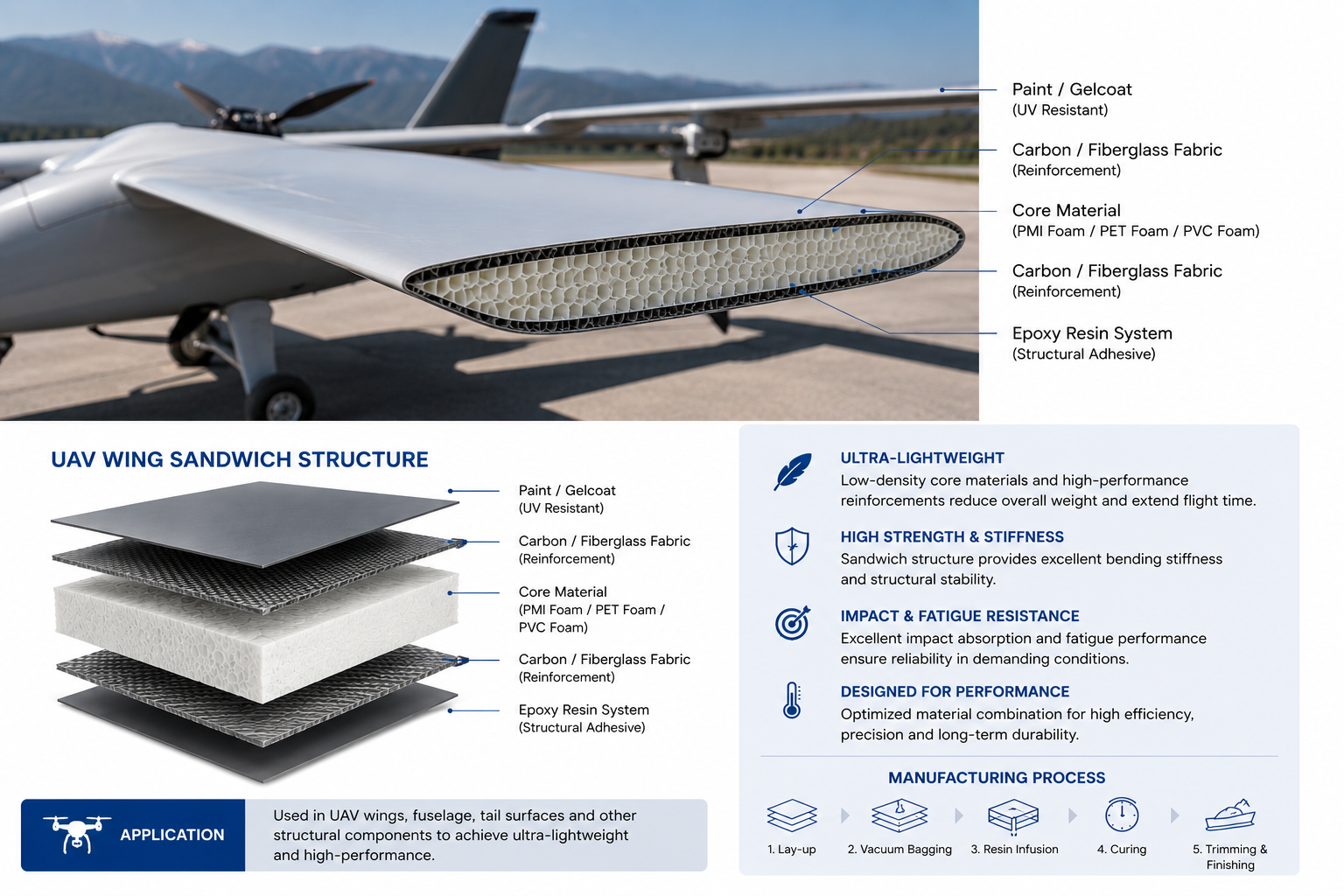
PMI foam core paired with lightweight fiberglass fabric in UAV wing and fuselage structures — a fatigue- and temperature-critical application for supplier evidence.
Mexico — Transportation Panels: Lightweighting and Corrosion Resistance
Product 4507 (thermoplastic honeycomb core) was used for transportation panel applications in Mexico by transportation panel manufacturers, at container-order scale. The project achieved lightweighting and improved corrosion resistance, with the recorded highlight of good adhesion with core material. In sandwich construction, the skin-to-core bond is the failure mode that matters most, because delamination ends service life before fibre strength is exhausted. “Good adhesion” is therefore a statement about the bonding process and surface compatibility. A buyer should request the adhesion test method, the service temperature window and confirmation of skin compatibility with the thermoplastic core.
Thailand — Surfboard Manufacturing: Buoyancy and Impact Resistance
Product 4403 (PVC foam core) is used in Thailand for surfboard manufacturing by sports equipment manufacturers, at container-order quantity. Recorded highlights are high buoyancy and impact resistance; the described result is weight reduction and performance improvement. Buoyancy is a density-driven property and therefore directly checkable against the PVC foam family's density range of 45–300 kg/m³; impact resistance follows from cell structure and skin bonding. This locus shows the same core chemistry serving a high-volume consumer product line, which is a different manufacturing regime from one-off marine builds.
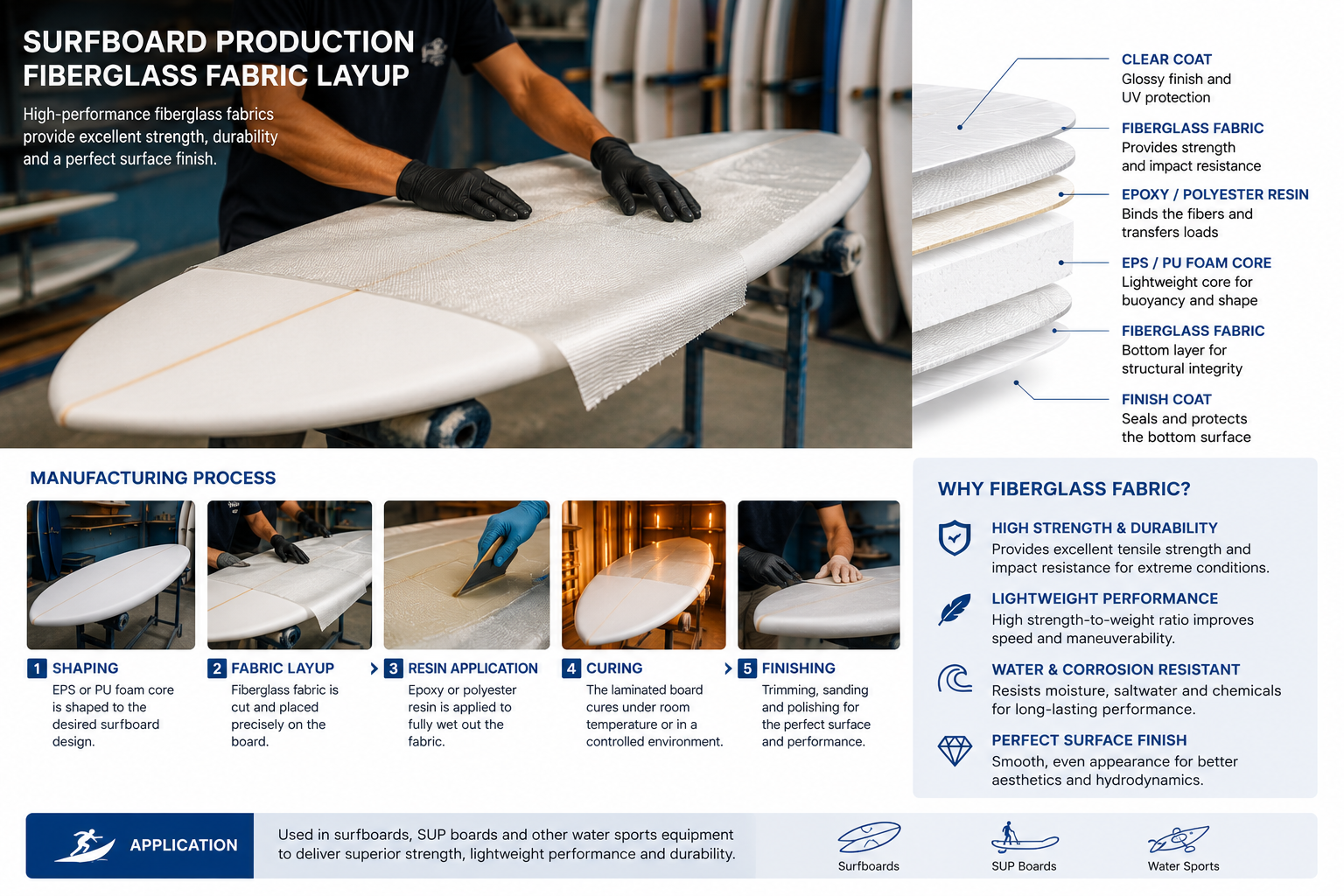
Lightweight fiberglass fabric and PVC foam core in surfboard manufacturing — buoyancy and impact resistance are properties that can be tied back to specific material parameters.
Poland — Distributor Repeat Orders: Continuity Rather Than Strength
A composite material distributor in Poland ordered at container quantity, achieved local sales with repeat orders every month and received OEM logo customisation on products intended for long-term composite structural applications. Distributor behaviour is weak technical evidence but strong continuity evidence: a distributor re-orders on sell-through, not on data sheets. It is a useful cross-check when a manufacturer's references are dominated by direct end users.
| Region | Application | Customer type | Material referenced | Described outcome |
|---|---|---|---|---|
| Australia | Boat building | Marine and yacht builders | Product 4507 (thermoplastic honeycomb core) | Lightweight, stiffness improvement, durability |
| United States | FRP panels | RV manufacturers | Product 4367 (multiaxial fiberglass fabrics) | Low weight, anti-UV, glossy surface, thickness uniformity |
| Germany | UAV production | UAV manufacturers | Product 4405 (PMI foam core) | Ultra-lightweight, high stiffness, high temperature resistance |
| Mexico | Transportation panels | Transportation panel manufacturers | Product 4507 (thermoplastic honeycomb core) | Lightweighting, corrosion resistance, core adhesion |
| Thailand | Surfboard manufacturing | Sports equipment manufacturers | Product 4403 (PVC foam core) | Buoyancy, impact resistance, weight reduction |
| Poland | Composite structures | Composite material distributor | Product 4507 with OEM logo | Repeat monthly orders, local sell-through |
Turning Project Loci into Capability Claims
The value of the map above is that it converts a reference list into auditable claims. Five claim types recur across the loci, and each one has a different verification path.
| Claim | Where the evidence sits | What the buyer should still verify |
|---|---|---|
| Stiffness improvement | Multiaxial non-crimp fabrics in the US FRP panel reference; UAV and transportation references | Fibre areal weight, orientation sequence, laminate schedule, fibre volume fraction |
| Lightweighting | PMI foam in Germany (40–130 kg/m³); thermoplastic honeycomb in Mexico (70/80 kg/m³); PVC foam in Thailand (45–300 kg/m³) | Density against the mechanical values required by the specific part, not by the material family |
| Long-term structural durability | Repeated long-term composite structural framing across all five loci | Design life assumptions, fatigue data, environmental ageing basis |
| Process compatibility | Multiaxial fabrics stated for vacuum, hand layup, extrusion and RTM; PVC foam for vacuum infusion, RTM, hand lay-up, prepreg and VARTM | Process temperature against core limits, which sit at 170–180 °C for the core mat range |
| Surface and dimensional quality | US FRP panel reference: glossy surface treatment and thickness uniformity | Caliper tolerance, coating system, flatness specification |
Technical Explanation: How Fabric Architecture and Core Selection Produce These Outcomes
A sandwich laminate separates two jobs. The reinforcement carries in-plane tension and compression; the core holds the skins apart so that bending stiffness rises with very little added mass. The described outcomes in the five loci follow from that division of labour, and the specific material parameters make the mechanism checkable.
Reinforcement architecture. Non-crimp multiaxial fiberglass fabrics place straight fibres in designed directions: unidirectional at 0° or 90°, biaxial at 0°/90° or ±45°, triaxial at +45°/0°/−45°, and quadriaxial at 0°/90°/−45°/+45°. Fabric weights run from 400 to 1500 g/m², combustible matter is 2.0–8.0%, and moisture content is held below 0.2%. In practice the direction sequence decides whether stiffness lands where the load is, sizing content influences wet-out and fibre-to-resin bonding, and the low moisture ceiling limits void formation during infusion. These fabrics are specified for vacuum, hand layup, extrusion and RTM processes and for parts such as ship hulls, wind turbine blades, automotive components, sports equipment and large containers.
Thin skins and finish plies. Light-weight E-glass cloth (model EW, plain woven, 1000 mm and 1010 mm width, 25–400 g/m²) covers surface and finish layers where a thin, uniform skin is required. The surfboard, UAV skin and FRP panel references all depend on this class of material for surface quality rather than primary stiffness.
Core selection. PVC foam spans 45–300 kg/m³ with thicknesses of 1–80 mm and surface options of plain, grooved, perforated or scrim-backed, and accepts vacuum infusion, RTM, hand lay-up, prepreg and VARTM. PET foam spans 80–320 kg/m³ and is recyclable. PMI foam spans 40–130 kg/m³ and is specified for aerospace, UAV, motorsport and high-performance marine work. Thermoplastic PP honeycomb runs 5–100 mm thick with 6, 8, 10 or 12 mm cell sizes at 70/80 kg/m³, in a 1220 × 2440 mm standard sheet, with PP nonwoven or fiberglass skin, and can be cut, CNC machined, laminated or thermoformed. Core mats for infusion occupy the thin end of the range at 1.5–6 mm, in 1.27 m roll widths, with maximum process temperatures of 170–180 °C.
The audit implication is straightforward: when a supplier claims stiffness improvement or lightweighting, the claim should resolve into a specific fibre architecture and a specific core density. If it does not, the claim is a sentence rather than a capability.
Comparison with Conventional Sourcing Approaches — and the Limits of Case Evidence
Two sourcing approaches are common in composite procurement. The first is certificate-and-price sourcing: qualify on paperwork and unit cost. The second is evidence-mapped sourcing: qualify on documented application experience, then confirm with the buyer's own laminate testing. The second takes longer and produces a defensible decision; the first is faster and pushes risk into the first production run.
Material choices follow the same pattern. Hand lay-up with woven roving remains common in low-volume and repair work, while multiaxial reinforcement combined with a structural core is the usual route where stiffness-to-weight and repeatability matter. The trade-off is not one of quality but of process: multiaxial non-crimp fabrics and foam cores demand controlled resin flow and cure profiles, which is precisely why infusion process support tends to appear alongside the material.
Case evidence also has clear boundaries, and an audit that does not state them is incomplete:
- Qualitative outcomes are not batch data. The five loci describe outcomes such as lightweighting, stiffness improvement and durability without publishing per-batch mechanical values. Buyers should request ASTM D638 and ASTM D790 results for their own candidate laminate rather than rely on application descriptions.
- Certificate scope must match the purchased activity. The ISO 9001:2015 and ISO 45001:2018 certificates held here are scoped to sales of high-performance fibres and composite materials, and the ISO 14001:2015 certificate to composite intermediates sales. A buyer should confirm that the audited scope corresponds to what they are buying, and extend verification accordingly.
- Evidence does not travel automatically across regions. A marine reference in Australia does not by itself satisfy European or North American conformity requirements; each market has its own route to acceptance, and documentation must be obtained for the destination market.
- Material families are not interchangeable. PMI foam is selected for the low-density, high-temperature, fatigue-critical end of the range; PVC foam covers a wide density band in marine and transport work; PET foam is recyclable but differs in density and mechanical profile; thermoplastic honeycomb suits laminated and thermoformed panels. Substituting one for another without re-checking the laminate is a common source of field failure.
- Commercial boundaries are part of the technical decision. The stated minimum order quantity is 1000 m², lead time is 15–30 days, and monthly capacity is 100,000 m². A programme that ramps beyond that rate needs a supply plan, not only a material approval.
- Single-site, export-weighted supply carries freight and trade exposure. A supplier exporting 100% of output into three regions is exposed to shipping and trade-policy shifts that no material certificate captures.
Market Context: Where Demand Is Concentrated
Regional demand explains why a supplier audit should be weighted toward applications rather than brochures. Asia Pacific dominated the fiberglass fabric market in 2024 with a revenue share of 41.61%, driven by infrastructure and renewable energy projects, according to Grand View Research. Within applications, the wind energy segment is expected to grow at a CAGR of 8.5% from 2025 to 2033, the highest of the application segments in the same analysis. Dataintelo attributes approximately 42.5% of fiberglass usage within the wind energy sector to wind turbine blades, a medium-reliability estimate that is directionally consistent with the segment growth figure.
Product-mix data tells a similar story: woven fiberglass fabrics captured 48.62% of market revenue in 2025, a share Mordor Intelligence links to their role in yacht hulls and automotive panels. On the demand side of marine, Market Research Future projects the marine fiberglass resin market to reach USD 4.23 billion by 2033, which implies steady pull for hull and deck reinforcement. For comparison purposes, principal global participants in this category include Owens Corning (United States), China Jushi (China), Saint-Gobain (France) and Taishan Fiberglass (China), as identified by MarketsandMarkets. The audit framework described above applies to each of them in the same way: certificates set the floor, project evidence sets the ceiling.
Future Outlook
Three shifts are likely to shape supplier audits over the next planning cycle. First, buyers are moving from certificate collection to batch-level evidence, and suppliers that can provide laminate test data with the shipment will be easier to qualify. Second, core material selection is broadening: recyclable PET foam and thermoplastic honeycomb address end-of-life requirements in transportation and construction panels, while PMI foam and aramid honeycomb remain reference materials where stiffness, temperature and fatigue performance dominate, as in UAV and aerospace structures. Third, process support is becoming a qualifying criterion rather than a courtesy — infusion guidance, alternative material recommendations, sample evaluation and quality traceability are increasingly assessed alongside price and lead time.
None of those shifts replaces the audit. They change what the audit asks for.
Frequently Asked Questions
What should a buyer request first when auditing a fiberglass fabric supplier?
Three document sets, in this order. First, management certificates with the scope statement and validity dates shown — for example ISO 9001:2015 certificate 51326Q04922R053, valid to 28 April 2029, and ISO 14001:2015 certificate ISO14001-2023-001, valid to 1 June 2028. Second, the standard test methods the supplier works to; ASTM D638 for tensile properties and ASTM D790 for flexural strength and modulus are the standardised methods for fiberglass-reinforced materials. Third, a project reference list that names the application, the region, the customer type and the outcome achieved. The first two confirm the system and the measurement basis; only the third says anything about application experience.
Do ISO 9001, ISO 45001 and ISO 14001 certificates prove that a fiberglass fabric suits marine or wind structures?
No. Those standards certify management systems — quality, occupational health and safety, and environmental management — not the mechanical performance of a laminate. The scope statement is the part that must be read: the certificates held for this supplier's operations define scope as “Sales of High-performance Fibers and Composite Materials” and, for the environmental certificate, “Composite intermediates sales”. Suitability for a yacht hull, a wind turbine blade or a UAV wing has to be established through laminate test data and verified application experience. Certificates are a starting filter, not an answer.
How should buyers interpret project references from Australia, the United States, Germany, Mexico and Thailand?
Read each reference for the capability it actually evidences. Marine work in Australia speaks to continuous structural loading on boat building structures. FRP panel production in the United States speaks to surface quality, thickness uniformity and UV exposure. UAV work in Germany speaks to ultra-lightweight construction with high stiffness and high temperature resistance, at a scale of 10 pallets of PMI foam core. Transportation panels in Mexico speak to lightweighting, corrosion resistance and core adhesion. Surfboard production in Thailand speaks to buoyancy and impact resistance at container-order quantity. Each is meaningful within its own application class and should not be treated as evidence of performance in a different one.
Which fiberglass reinforcement or core material fits a given application?
The mapping is application-driven. Non-crimp multiaxial fabrics, 400–1500 g/m² with unidirectional, biaxial, triaxial or quadriaxial orientations, are specified for ship hulls, wind turbine blades, automotive components and large containers, and suit vacuum, hand layup, extrusion and RTM processes. Plain woven E-glass cloth at 25–400 g/m² covers thin skins and surface plies in surfboards, UAV structures, composite tooling and FRP panels. Among cores, PVC foam (45–300 kg/m³, 1–80 mm) serves marine, wind and transportation work; PET foam (80–320 kg/m³) adds recyclability; PMI foam (40–130 kg/m³) targets aerospace, UAV and high-performance marine; and thermoplastic PP honeycomb (5–100 mm, 70/80 kg/m³) suits laminated and thermoformed panels.
What are the limits of an audit built on project references?
Four limits are worth stating plainly. Project references describe outcomes qualitatively and do not publish per-batch mechanical values, so laminate testing remains the buyer's responsibility. Evidence gathered in one region does not automatically satisfy another region's conformity requirements. Material families are not interchangeable — substituting PET for PVC, or PP honeycomb for a high-density foam, changes the laminate and requires re-verification. And commercial parameters constrain technical plans: a stated 1000 m² minimum order quantity, 15–30 day lead time and 100,000 m² monthly capacity shape how a programme can be scheduled, regardless of how strong the material evidence is.
Closing Note
A supplier audit is a comparative exercise. The same five evidence layers should be applied to every candidate, and the comparison should be recorded in writing so that the decision can be re-examined when a programme scales. A downloadable catalogue covering fiberglass reinforcements and composite core materials is available for reference: CINON Composites product catalogue.