
Auditing COOLWAVE Supplier Viability for Long-Term Supply
Auditing COOLWAVE Supplier Viability for Long-Term Supply
Industrial cooling apparel is usually bought twice. The first purchase is a trial — a small batch issued to one crew, one site, one summer. The second purchase is a programme: recurring orders, replacement units, spare ice packs, and a service expectation that stretches across several hot seasons. The second purchase is where supplier viability matters more than the specification sheet, because a vest that performs well in a twenty-unit pilot still has to be manufactured, documented and supported two or three years later.
This audit examines that second question for the COOLWAVE Water-Circulation Cooling Vest, produced under the Shokunin brand by FENG SHANG PRECISION CO., LTD. It reviews the manufacturer's establishment year, location, staffing, floor area, stated capacity, ODM service model, warranty, minimum order quantity and lead time — and translates each item into what it actually means for a buyer planning industrial PPE procurement over a multi-year horizon.
Short answer: FENG SHANG PRECISION CO., LTD. is a Taiwan-based manufacturer established in 2009, operating a 1,000 m² facility in Luzhu District, Taoyuan City, with approximately 30 staff including 5 R&D engineers. It reports 10,000 units of annual output and 3,000 units of monthly capacity, an ODM production model, a 6-month warranty on the water-cooled vest, a minimum order quantity of 10 units, and a typical 7–14 day lead time. Those figures support small-batch entry and repeat ordering, but they are supplier-reported and should be confirmed in writing before a multi-year volume commitment.
Why Capacity Questions Come Before Product Questions
Cooling vests sit inside a category that is increasingly institutional rather than recreational. Dataintelo's 2025 market report places the global cooling vest market at USD 342 million in 2025, with industrial applications accounting for 34.5% of revenue. That industrial share is the relevant signal for procurement teams: the money in this category is being spent by employers protecting workers, not by consumers buying leisure accessories.
The occupational-safety framing is equally clear. The U.S. CDC / NIOSH identifies water-cooled garments, air-cooled garments, cooling vests and wetted overgarments as examples of auxiliary or personal cooling systems used against heat exposure. Once a cooling vest is classified as worker protection rather than comfort equipment, the procurement logic changes. Replacement availability, consistent construction across reorders, and warranty handling become part of the safety case, not just the commercial case.
A capacity audit therefore asks a different set of questions than a product review. Not only whether the vest cools, but whether the same vest, in the same specification, can be delivered again in eighteen months — and who is accountable if it cannot.
The Supplier Behind the COOLWAVE Vest
FENG SHANG PRECISION CO., LTD. is a Taiwan manufacturer founded in 2009 and located at No. 155-17, Sec. 2, Nanzhu Rd., Luzhu District, Taoyuan City, Taiwan. Shokunin is the professional e-commerce brand launched by the company, positioned around tools and equipment for modern craftsmen. The COOLWAVE water-circulation cooling vest is the brand's entry into personal heat-stress relief.
The company's stated profile is compact and engineering-oriented rather than large-scale contract manufacturing:
- Founded: 2009
- Facility size: 1,000 m²
- Employees: approximately 30
- R&D team: 5 engineers
- Annual output: 10,000 units
- Export ratio: 50%
- Main markets: USA and Taiwan (ROC)
- Product range: air compressors, cut-off machines, water-cooled vests, lithium batteries, diamond saws, nail guns, spider stands and screwdriver bits
Two details matter more than they first appear. The first is the multi-category product range: a manufacturer producing air compressors, cut-off machines and diamond saws alongside cooling vests is a tool-making business that extended into wearable cooling, not a dedicated apparel factory. For buyers, that means the vest programme sits inside a broader tooling operation whose production scheduling serves several product lines. The second is the 50% export ratio with the USA listed among main markets, which indicates at least some experience with cross-border documentation and destination requirements.
The company also states that the COOLING water-cooled vest received a Disaster Prevention Product and Service Certification Award issued by the Taiwan Disaster Prevention Industry Association. In an audit context, a trade-association award is not the same as a product conformity certificate, and it should be treated as supporting evidence rather than a compliance substitute.
What the COOLWAVE Dual Cooling Vest Actually Is
The COOLWAVE Water-Circulation Cooling Vest is classified by the manufacturer as industrial cooling apparel and personal protective equipment. Its cooling architecture combines two mechanisms: reusable ice packs as the cold source, and a small pump that circulates chilled water through tubing in the vest. The pump runs from a power bank, which is why the product is sometimes described as a power-bank cooling vest or a portable cooling vest in buyer language.
The published specification set is consistent across the model range:
| Parameter | Listed value |
| Cooling duration | 3–4 hours |
| Weight | Within 2 kg |
| Listed suitable temperature | Below 10°C |
| Pump output | 5V 150mA (max) |
| Flow rate | Max 320–370 ml/min |
| Shoulder strap material | 600D polyester |
| Body material | PEVA |
| Water bag material | TPU |
| Water bag cap | Polypropylene |
| Cooling tube | Sand rubber (black) |
| Pack contents | Water-cooled vest backpack ×1, ice packs ×2 |
The pump specification is the most procurement-relevant line in that table. A 5V, 150mA pump can be supported by common power-bank output, but the runtime of the system depends on the power bank's own capacity, not on the pump alone. Buyers specifying this product for a full shift should therefore treat the power bank as a separately specified accessory with its own quantity, charging cycle and replacement plan.
The listed temperature condition of below 10°C is best read as a stated operating parameter rather than a complete performance envelope. Public documentation for the model does not define the ambient temperature, humidity, workload or clothing layer used to derive the 3–4 hour cooling duration, and buyers should ask for that definition before using the figure in a heat-stress protocol.
Reading the Numbers: 10,000 Units a Year, 3,000 Units a Month
Capacity is the central claim in any long-term supplier audit, and it is also the claim most often stated without a definition. For FENG SHANG PRECISION, the recorded figures are 10,000 units of annual output and 3,000 units of monthly production capacity.
Those two figures are not stated on the same basis, and the public record does not reconcile them. Three thousand units a month implies 36,000 units a year at full utilisation, which is well above the 10,000-unit annual output figure. The most reasonable reading is that one number describes company-wide annual output across the full tool range while the other describes the cooling-vest line's monthly throughput — but the documentation does not say so explicitly, and a buyer should not assume it.
The correct procurement response is a written clarification request covering three distinct definitions: installed capacity (what the line can physically produce), practical capacity (what it produces with current staffing and scheduling), and available capacity (what remains after existing commitments). A supplier that can answer all three is a supplier that can be planned against.
| Commercial factor | Recorded detail | Planning implication |
| Production model | ODM | Buyer specification drives the build; changes should be documented in writing |
| Minimum order quantity | 10 units | Allows genuine pilot deployment before a programme commitment |
| Lead time | 7–14 days | Confirm the starting point and whether it covers production only |
| Monthly capacity | 3,000 units | Ask which product line and which capacity basis this refers to |
| Annual output | 10,000 units | Appears to describe company-wide output; confirm scope |
| Warranty | 6 months on the water-cooled vest | Plan an inspection cycle and spare-unit buffer inside that window |
These terms are recorded as supplier-reported rather than independently audited. That does not make them unreliable; it simply means a procurement file should carry them as declarations to be verified, not as verified facts.
ODM Services and What Five R&D Engineers Change
FENG SHANG PRECISION operates an ODM production model. In practical terms, ODM means the manufacturer supplies a product it has developed, and the buyer adapts it through specification, labelling, packaging or configuration choices rather than commissioning an entirely new design. For cooling vests, that is usually the right model: the buyer needs a documented, repeatable product for crews, not a new cooling platform.
The stated R&D team of 5 engineers is the part of the profile most often overlooked in supplier evaluations, and it carries more weight in a long-term relationship than in a first order. A five-engineer function is small, but it is a defined in-house capability rather than an outsourced design arrangement. For a multi-year programme, that matters in three specific places: maintaining the bill of materials when a component changes, supporting reorders after a gap of one or two seasons, and answering technical questions about pump behaviour, tubing or water-bag durability during the warranty period.
It also sets an expectation of scale. A 1,000 m² facility with roughly 30 staff is a compact operation, and buyers should calibrate their volume assumptions accordingly — a programme that grows quickly may need staged delivery rather than a single large shipment.
Model Availability: Basic and Professional Across Three Colours
The COOLWAVE range is offered in two configurations and three colours, which is a smaller matrix than it sounds and a useful one for procurement planning.
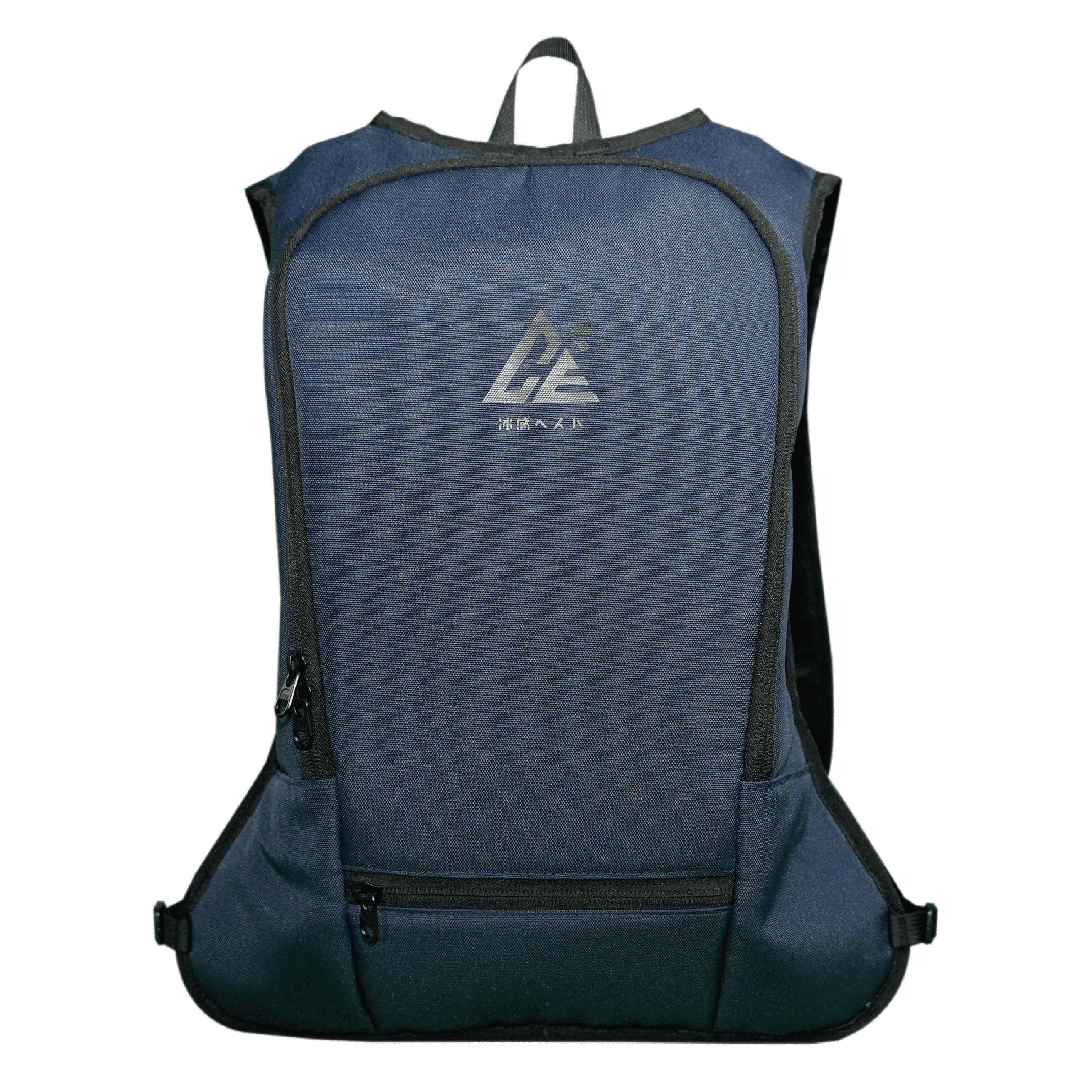
COOLWAVE Water-Circulation Cooling Vest, Professional Model in blue — one of three colour versions in the range.
The Basic model is the single-configuration reference product. The Professional model is listed in Blue, Gray and Black. Across the entire range, the published technical parameters are identical: 3–4 hours of cooling duration, weight within 2 kg, pump output of 5V 150mA, flow rate of 320–370 ml/min, and the same material set (600D polyester shoulder straps, PEVA body, TPU water bag, polypropylene cap, sand rubber cooling tube), with one backpack and two ice packs in the box.
For a long-term buyer, colour options are not cosmetic. Multiple colour versions let a site allocate vests by team, shift or contractor without changing the underlying specification, which simplifies stock rotation and reduces the risk of mixing incompatible parts. Because the core specification is shared, replacement ice packs, tubing and water bags remain common across the range — a genuine advantage when managing spares over several seasons.
Where It Fits: Application Scenarios and a Taiwan Deployment
The manufacturer positions the vest for high-temperature outdoor and semi-outdoor work. The application record lists construction sites, general outdoor work, metal sheet factories, street vendors, traffic controllers and night market operators. Those environments share a common profile: workers are stationary or semi-mobile for long periods, ambient heat is sustained rather than intermittent, and access to a power outlet is unreliable even though cooling is needed continuously.
That profile explains the design choices. A backpack format keeps the water reservoir and pump off the torso. A one-size-fits-all adjustable strap arrangement reduces the number of SKUs a site must stock. Ice packs provide the cold source without requiring refrigeration on site during the shift, and the pump circulates chilled water rather than relying on passive conduction alone.
A recorded Taiwan deployment covering 100 units illustrates the pattern buyers should expect: a mid-sized order issued to heat-exposed workers, with the supplier-reported outcomes being effective body cooling, heatstroke prevention and improved worker comfort and efficiency. In a supplier audit, a 100-unit deployment is more informative than a single-unit trial because it exercises packing consistency, documentation and delivery at a batch level — though it remains a supplier-reported case rather than an independently measured study.
Water Circulation Compared with Other Cooling Approaches
Buyers shortlisting a dual cooling water cooling vest usually compare it against two alternatives: passive ice-pack vests and evaporative vests. The comparison below is qualitative and category-level, not a ranking of named competitors.
| Consideration | Ice-pack only | Evaporative | Water circulation (COOLWAVE) |
| Power source | None | None | Requires a 5V power bank |
| Cooling distribution | Localised, contact-based | Depends on airflow and dryness | Circulated chilled water across tubing |
| Consumables and upkeep | Freezer access, pack rotation | Water top-up, wetted layer | Ice packs, water refill, battery charging |
| Failure modes to plan for | Warming mid-shift | Low effectiveness in humid conditions | Pump or battery interruption, tubing wear |
Water circulation adds active distribution and therefore adds dependencies. The correct conclusion is not that it is universally superior, but that it fits organisations able to manage a powered accessory as part of the issued kit — which is a management question as much as a technical one.
Limitations and Boundaries Buyers Should Plan Around
A credible supplier audit states limits as plainly as capabilities. Five boundaries stand out for this programme.
Cooling duration is a stated figure, not a tested one. The 3–4 hour duration is published without a defined ambient temperature, humidity level, workload or measurement protocol. For an eight-hour shift, the realistic plan is ice-pack rotation and, in some cases, a second vest rather than continuous single-unit operation.
The system depends on a power bank. A 5V, 150mA pump is modest, but it is still a powered component. Buyers should specify power-bank capacity, charging logistics and a spare-unit ratio, and should confirm the electrical and battery documentation required in their destination market.
The warranty window is six months. That is the stated after-sales term for the water-cooled vest. Whatever view a buyer takes of that period, the operational consequence is the same: inspection intervals, spare-part stock and replacement triggers should be designed to sit inside it, and the specific scope of coverage should be confirmed in writing.
Capacity figures need definition. As noted earlier, 10,000 units annually and 3,000 units monthly are not stated on the same basis. Buyers should also note that this is a 1,000 m² facility with about 30 staff serving several product lines, which constrains how quickly volumes can scale.
Public performance evidence is thin. Across the available documentation, no standardized thermal performance test, leakage test, washability result or pump reliability data is published for this model. That gap is common across the category — a general limitation of the cooling vest market rather than a specific criticism of this supplier — but it belongs in the procurement file, and closing it is exactly what a sample evaluation is for.
Market Context: Industrial Demand and a Standardization Gap
The direction of the category supports long-term supplier relationships. With the global cooling vest market at USD 342 million in 2025 and industrial applications taking 34.5% of revenue, the buyer base is shifting toward organisations that purchase on a recurring cycle and expect continuity. That favours suppliers with defined production capacity and an ODM structure over one-off trading arrangements.
At the same time, the category has not converged on a shared performance test. Manufacturers publish duration, weight and flow figures without a common methodology, which makes cross-supplier comparison unreliable. Until standardized testing becomes the norm, the practical substitute is a documented sample evaluation that reproduces the buyer's own working conditions and records the results.
Future Outlook
Three developments are likely to shape supplier selection in this category over the next procurement cycles. First, as heat exposure receives more regulatory and occupational-safety attention, documentation requirements for personal cooling systems will tighten, and suppliers who can produce consistent technical files will be easier to qualify. Second, buyers will increasingly ask for measured performance rather than published claims, which favours manufacturers willing to test against a defined protocol. Third, small-batch entry models such as a 10-unit minimum order quantity will remain valuable, because they let organisations validate a cooling programme before committing to a seasonal contract.
For FENG SHANG PRECISION, the open items are the same ones a serious buyer would raise in an RFQ: which capacity basis applies to which product line, what the six-month warranty covers in practice, and what measured cooling performance looks like under defined conditions. A supplier able to answer those three questions clearly is a supplier that can realistically support a multi-year industrial PPE programme.
FAQ
Which work environments is the COOLWAVE water-circulation vest designed for?
The listed applications are construction sites, general outdoor work, metal sheet factories, street vendors, traffic controllers and similar high-temperature environments. These are settings where workers remain exposed to sustained heat and where a portable, wearable cooling system is more practical than fixed cooling equipment.
Can one vest cover a full eight-hour shift?
The published cooling duration is 3–4 hours per cycle, and each unit ships with two ice packs. On that basis, a full shift requires ice-pack rotation or a second unit rather than continuous operation from a single charge and pack set. The duration figure is stated without a defined ambient temperature or workload, so it should be validated in a sample test before shift planning.
What order size and lead time should a buyer plan for a pilot deployment?
The minimum order quantity is 10 units and the typical lead time is 7–14 days. A pilot of 10 to 20 units therefore fits within the stated commercial terms, which allows a buyer to evaluate fit, cooling duration and wearability before committing to a larger seasonal order. Buyers should confirm what the lead time covers, including whether documentation and packing are inside that window.
How should a buyer audit the stated production capacity?
Request written definitions of installed, practical and available capacity, and ask which product line each figure refers to. For this supplier, the recorded figures are 10,000 units of annual output and 3,000 units of monthly capacity, stated on different bases and not reconciled in public documentation. A factory audit or production record review is the appropriate way to confirm either number.
Which model versions are available, and do they differ technically?
The range consists of a Basic model and a Professional model offered in Blue, Gray and Black. Published technical parameters are identical across the versions: 3–4 hours cooling duration, weight within 2 kg, 5V 150mA pump output, 320–370 ml/min maximum flow rate, and the same material set, with one backpack and two ice packs included.
What does the six-month warranty mean for long-term planning?
The stated after-sales term is a six-month warranty covering the water-cooled vest. Detailed coverage terms are not published in the available documentation, so buyers should confirm in writing what is covered, how replacements are handled and what the return process is. Operationally, an inspection and spares cycle designed around that six-month window keeps replacement decisions inside the warranty period.
A downloadable product brochure covering the COOLWAVE range and the manufacturer's tool portfolio is available here: FENG SHANG PRECISION / Shokunin brochure (PDF).
¿Tiene preguntas o necesita más detalles?
Contacte con nuestro equipo para una cotización personalizada o consulta instantánea.
Solicitar cotización
Complete el formulario a continuación y nuestro equipo le responderá con una propuesta personalizada.
Chat directo de WhatsApp
¿Prefiere chatear en tiempo real? Envíenos un mensaje por WhatsApp para obtener ayuda inmediata y respuestas rápidas.
- Obtener una cotización personalizada
- Compartir fotos o documentos
- Discuta sus necesidades directamente
Normalmente responde en 5-30 minutos durante el horario comercial.