
Auditing ATBC Manufacturers: Evidence Beyond the Sample
Non-phthalate plasticizer sourcing has turned from a materials question into a verification question. Acetyl Tributyl Citrate (ATBC, CAS 77-90-7) is a bio-based citrate ester used as a plasticizer for PVC and other resins in toys, food packaging, medical articles, artificial leather and inks, and its regulatory profile has made it a default alternative in markets that restrict phthalates. Finding suppliers is not the hard part. The hard part is deciding which supplier's evidence is strong enough to carry a repeating order.
A sample answers exactly one question: whether one batch behaved acceptably in one trial. It does not answer the questions that actually decide an order — whether moisture, acidity, colour and ester content stay inside limits on the fortieth container; whether the stated monthly capacity exists behind the quotation; whether the certificates forwarded by a sales team cover the entity and the product being bought; and whether the related citrate esters a supplier claims to produce are genuinely controlled as separate processes. This guide sets out the physical and documentary evidence a buyer can reasonably request when auditing an ATBC manufacturer, and explains what each item does and does not prove.
Why a Sample Is Not an Audit
A sample is a selected item. It is usually produced with closer attention than routine output, taken from a batch the supplier has an interest in getting approved, and evaluated once in the buyer's process. It demonstrates that the formulation can work. It says nothing about routine control.
The parameters that decide whether an ATBC order runs smoothly are all lot-level. Under the manufacturer specification sheet, ATBC is held to an ester content of minimum 99.0%, moisture of maximum 0.1%, acidity of maximum 0.1 mgKOH/g, colour of maximum 30 Pt-Co and a flash point of minimum 204 °C, with density between 1.045 and 1.055 g/cm³ at 20 °C and a refractive index of 1.4410–1.4425 at 25 °C/D. A single sample with good values shows those limits are achievable. It does not show how often they are missed, how the supplier responds when a batch drifts high on moisture, or whether a written record of that response exists.
That is the gap an audit closes. Auditing an ATBC manufacturer is not a factory tour with a sales agenda; it is a structured request for evidence that routine production is controlled, documented and traceable.
Three Categories of Audit Evidence
Buyers who come away from audits with little usable information usually asked only one category of question. Audit evidence falls into three groups, and each carries a different weight.
- Documentary evidence — management-system certificates, specification sheets, safety data sheets, per-batch certificates of analysis, batch records and regulatory statements. This establishes what a supplier intends to control and what it has declared.
- Physical evidence — retained samples, packaging and closure inspection, fill-weight checks and batch-number marking on the delivered unit. This links a document to an actual container.
- Process evidence — in-process control records, calibration and maintenance records, changeover and cleaning procedures, deviation and complaint handling. This shows whether the system holds when something goes wrong.
Most first-time buyers collect documents only. As a screening step during the research stage that is reasonable. As the basis of an evaluation decision, it is thin, because documents describe intent while physical and process evidence describe practice.
The Documentary Evidence Set: What to Request, and What Each Item Proves
The request list below is written so that each item is paired with its evidentiary boundary. An audit only stays honest if the buyer knows what a document cannot demonstrate.
| Evidence item | What it establishes | What it does not establish |
|---|---|---|
| ISO 9001:2015 certificate (number, scope wording, validity dates) | That a quality management system conforms to the standard for the declared scope | It is not a product certification and does not attest ATBC batch performance |
| ISO 14001:2015 certificate and HSE management-system certificate | Environmental and health, safety and environment management conformity | Nothing about purity, colour or plasticizer performance |
| Specification sheet including test methods | The parameters, limits and methods the supplier intends to hold | Useful only if the buyer agrees those limits and methods in writing |
| Certificate of Analysis (COA) for each production lot | Measured values for the specific lot named on the document | Representative only of that lot; it does not predict the next one |
| Safety Data Sheet (SDS) | Hazard classification, handling, storage and transport information | Not an indicator of quality or batch consistency |
| Batch and lot traceability records | How packaging maps back to production date, line and raw-material input | Depth depends entirely on the supplier's record-keeping practice |
| Regulatory status statements, including ATBC's FDA listings under 21 CFR 172.515, 175.105, 178.3910 and 181.27 | The regulatory status of the substance itself | Does not show that a specific lot meets migration or purity limits in a specific finished article |
| Business licence and export documentation | Identity of the manufacturing entity and the contracting entity | Confirms legal existence, not production capability |
Verifying Capacity and Delivery Claims
Stated capacity is self-reported until it is cross-checked. For a plasticizer manufacturer, a monthly capacity figure such as 10,000 t, a minimum order quantity of 1 t and a lead time of 30–45 days are the three numbers that determine whether a supply plan is realistic. Each can be tested.
- Shipment history. Ask for a dated record of recent shipments with volumes, destination markets and packaging format. A supplier shipping regularly into export markets maintains this record as part of its normal operation. Irregular or undated records are a caution flag.
- Lead-time consistency. Compare the quoted 30–45 day lead time against the gaps between enquiry and shipment dates in the history. A lead time that holds across several months is more informative than a single fast delivery.
- Packaging capability. Whether ATBC is supplied in 200 kg iron drums or in IBC totes, the audit should confirm fill weight, closure integrity and label data, and should check who performs filling and whether that step is covered by the same quality system.
- Traceability chain. Confirm how a drum or IBC number maps to a production lot and how that lot maps to raw-material intake. A supplier that cannot describe this chain in its own words usually cannot produce it on paper either.
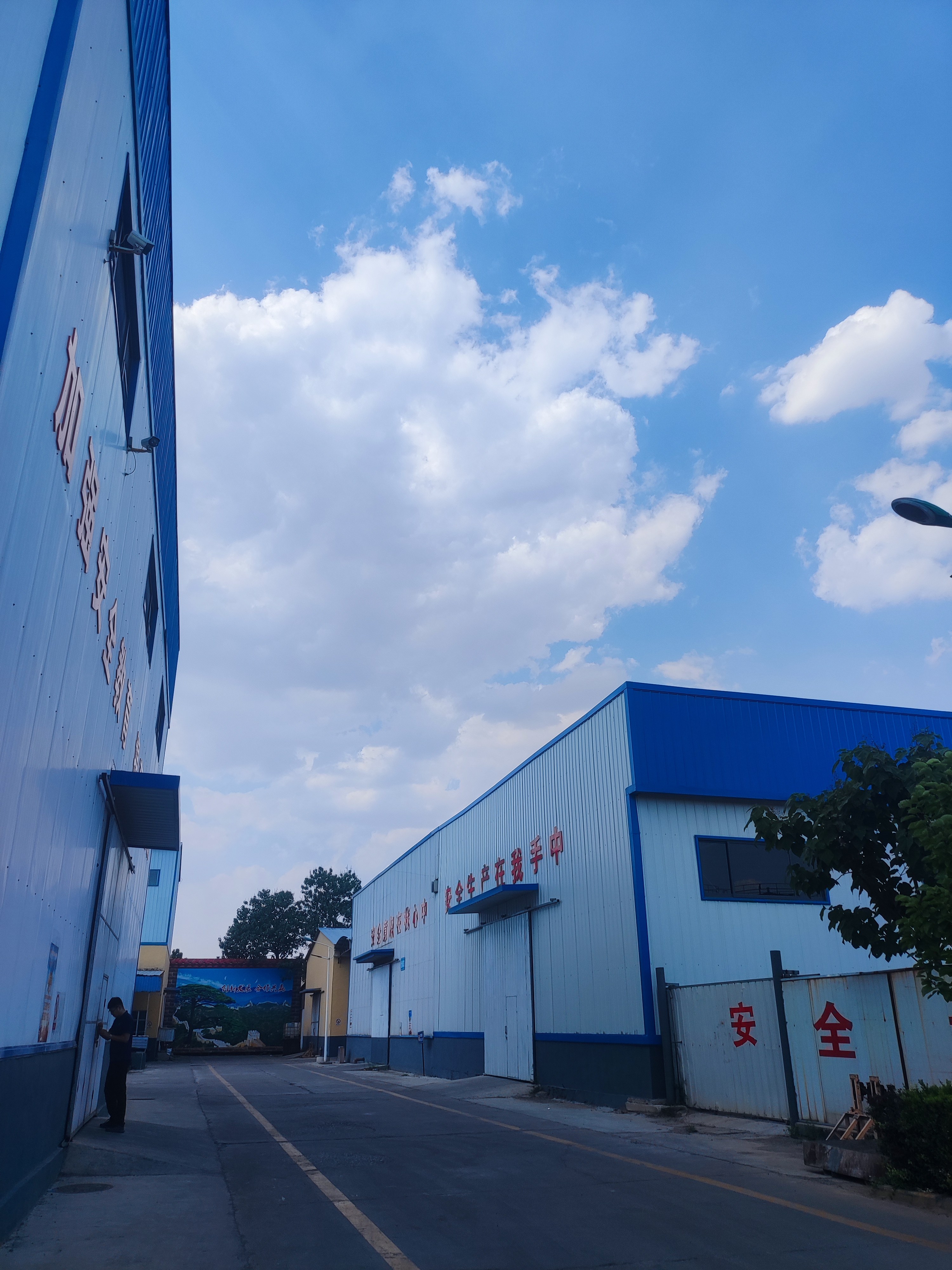
Production site documentation is one of the items a capacity audit should reconcile against shipment records and stated monthly output.
Related Citrate Esters as a Proxy for Process Control
ATBC does not exist in isolation. It belongs to the same ester family as Tributyl Citrate (TBC, CAS 77-94-1) and Triethyl Citrate (TEC, CAS 77-93-0), and the three are built on a shared esterification platform: alcohol and acid are reacted, ATBC is then acetylated, and all three pass through neutralisation, washing, devolatilisation and moisture control. A supplier that holds all three to published limits is running three different process windows on the same chemistry.
That makes the related esters a useful, if indirect, audit instrument. If a supplier's ATBC, TBC and TEC specifications interlock sensibly — each parameter consistent with the molecule and its intended application — the supplier is very likely controlling the underlying steps rather than buying in finished material. If the three sheets contradict each other, the buyer has found something worth asking about before placing an order.
| Parameter | ATBC (77-90-7) | TBC (77-94-1) | TEC (77-93-0) |
|---|---|---|---|
| Density at 20 °C (g/cm³) | 1.045–1.055 | 1.037–1.047 | 1.135–1.139 |
| Ester content / purity | Min. 99.0% | Min. 99.0% | Min. 99.0% (purity) |
| Moisture (max.) | 0.1% | 0.1% | 0.25% |
| Acidity (max., mgKOH/g) | 0.1 | 0.1 | 0.1 |
| Colour (Pt-Co, max.) | 30 | 30 | 30 |
| Refractive index (25 °C/D) | 1.4410–1.4425 | 1.443–1.446 | Not listed on the specification sheet |
| Flash point (min.) | 204 °C | 185 °C | 155 °C |
Read as an audit document, the table is informative because the three products separate cleanly. TEC, built on ethanol, is the densest of the three and has the lowest flash point at 155 °C; TBC sits in the middle at 185 °C; the acetylated ATBC is the highest at 204 °C. Moisture limits also differ — 0.25% for TEC against 0.1% for ATBC and TBC — which reflects different drying and devolatilisation behaviour rather than a looser attitude to quality. A supplier that can hold all three simultaneously is managing three distinct operating regimes.
Two boundaries should be stated plainly. First, breadth is a proxy, not proof: shared equipment also means changeover risk, so buyers should ask for the cleaning and changeover procedure between esters and, where relevant, between non-phthalate and phthalate production. Second, a manufacturer can legitimately run both non-phthalate and phthalate esters — Shandong Kexing Chemical Co., Ltd., for example, lists ATBC, TBC and TEC alongside DOTP, DINP, DPHP, DOP and DBP. That is a normal commercial position, but for a buyer sourcing a phthalate-free plasticizer, the segregation and changeover procedure becomes part of the audit rather than an optional extra.
Certifications: What They Confirm and What They Do Not
Certificates are the most requested and most misunderstood part of a supplier audit. Three examples illustrate the correct reading.
Shandong Kexing Chemical Co., Ltd. holds a quality management system certificate numbered 66725Q0037R0M to GB/T 19001-2016 / ISO 9001:2015, issued on 13 January 2025 and valid to 12 January 2028, with the scope covering production of plasticizers, oilfield additives and modified water treatment agents, and oilfield engineering technical services. The company also holds an environmental management system certificate, number 66725E0038R0M, to GB/T 24001-2016 / ISO 14001:2015, with the same issue and expiry dates and a scope that likewise includes plasticizer production, and an HSE management system certificate numbered 667240083R1S, issued on 13 January 2025 and valid to 28 February 2027 under the Q/SY 08002.1-2022 health, safety and environment management system standard.
What a buyer should check in these documents is consistent across suppliers:
- Scope wording. The certificate must cover the production of plasticizers. A scope limited to trading, warehousing or an unrelated product line does not support an ATBC supply claim.
- Validity window. The certificate must be valid across the planned delivery period, not only at the moment of the enquiry.
- Certificate holder. The entity named on the certificate should be the entity that manufactures. Where a separate trading subsidiary handles export, the buyer needs to know which entity carries quality responsibility.
- Issuing body. The certifying organisation and accreditation details are printed on the certificate and can be read directly.
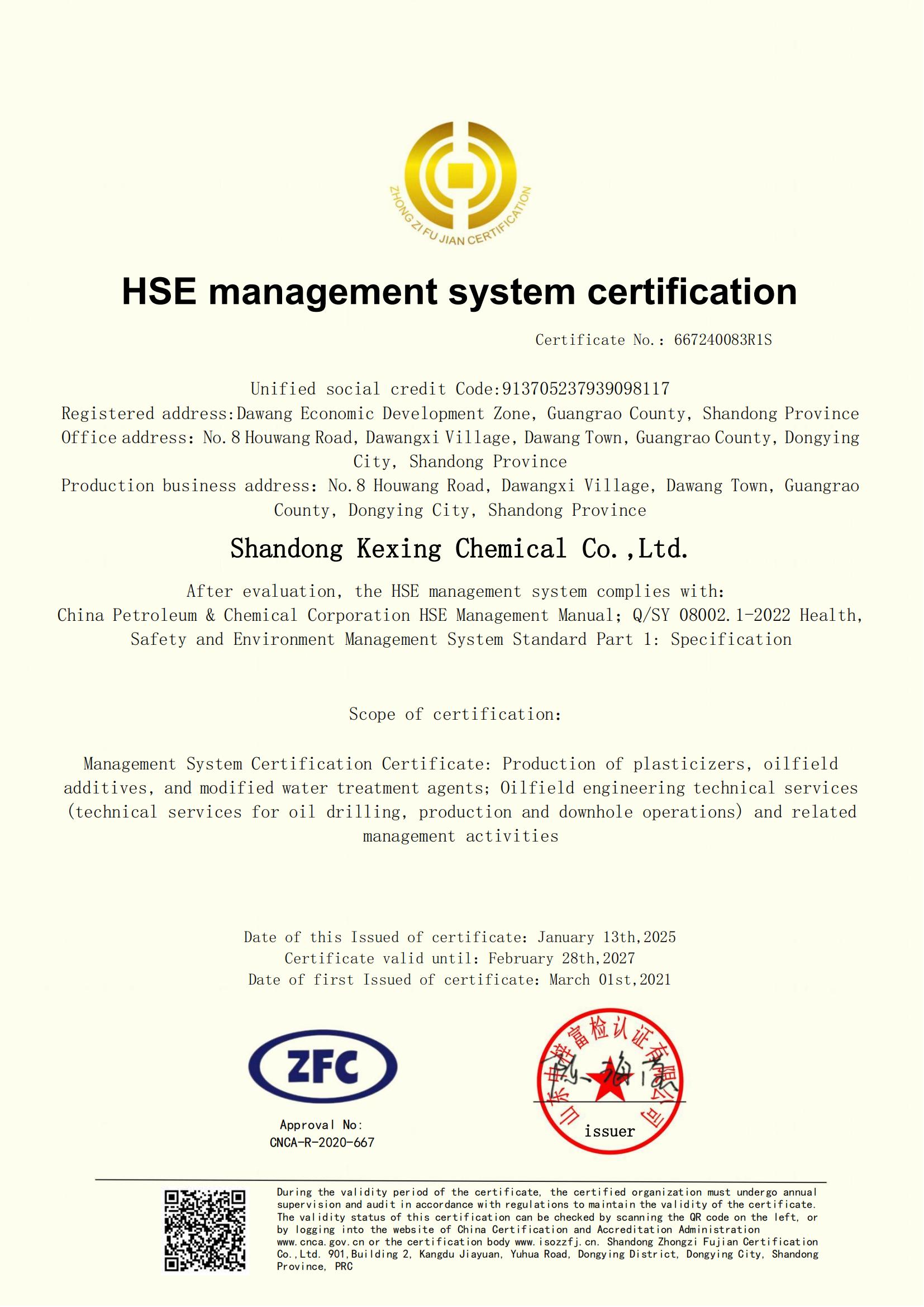
Management-system certificates such as the HSE certificate above document system conformity; they do not certify the plasticizer parameters of an individual batch.
Manufacturer, Exporter and Contracting Entity
Entity structure is a routine source of confusion in plasticizer supply. A buyer may negotiate with an international trading arm while the manufacturing entity sits behind it. In the case of Shandong Kexing Chemical Co., Ltd., the manufacturer is the Shandong-based producer, while its subsidiary Dongying Kexing International Trade handles global import and export business. For audit purposes, the practical position is to record three things in writing: which entity manufactures, which entity signs the contract and issues documents, and which entity answers for a non-conforming lot. Where those are not the same entity, the audit file should say so explicitly rather than assume.
Where Shandong Kexing Chemical Fits This Framework
Shandong Kexing Chemical Co., Ltd. is a plasticizer manufacturer based in Dongying, Shandong Province, China, founded in 2006 and producing citrate esters — ATBC, TBC and TEC — alongside other plasticizers, plastic and rubber flame retardants and plastic additives. The company reports around 200 employees, an R&D team of 15 engineers, an export ratio of approximately 50% and main markets in Europe, the United States, Japan, South Korea and the Middle East.
Against the audit framework above, the facts a buyer can request and check include the following:
- Specification and parameters. Published ATBC, TBC and TEC specification sheets carrying the density, ester content, moisture, acidity, colour, refractive index and flash-point limits shown earlier.
- Management systems. ISO 9001:2015, ISO 14001:2015 and HSE certificates with the numbers, scopes and validity periods listed above.
- Commercial capability. A stated monthly capacity of 10,000 t, a minimum order quantity of 1 t, a lead time of 30–45 days, and OEM production with private labelling.
- Routine quality control. Raw-material incoming inspection and finished-product sampling tests as the stated control points.
- After-sales. Remote technical support, after-sales consulting, quality issue resolution, shipping follow-up and formulation technical guidance.
None of these items should be accepted on presentation alone. Their value in an audit is that they are specific enough to be checked — a certificate number can be read against the certificate, a stated capacity can be reconciled against shipment records, and an after-sales commitment can be compared with how previous complaints were closed.
Mapping Audit Findings to Application Requirements
Audit evidence only matters in relation to an application. ATBC is used across toys, PVC products, plastics, leather, ink and food packaging, where it acts as a softener and toughener, lowers melting points for easier processing, improves ductility and fluidity, and maintains flexibility at low temperature. Typical processing equipment includes high-speed mixers, kneaders, extruders, calenders and coating machines, and the usual regulatory conditions are REACH or RoHS compliance, food-grade certification where relevant, consistent purity and moisture control, and stable shelf life.
| Application area | What the buyer needs to hold | Audit evidence to request |
|---|---|---|
| Toys and child-contact articles | Phthalate-free composition and controlled migration | Regulatory statements, per-batch COA, composition declaration |
| Food packaging film and food-contact plastics | Food-contact status of the substance, low migration, moisture and acidity control | ATBC FDA listing references (21 CFR 172.515, 175.105, 178.3910, 181.27), migration test reports, per-lot COA |
| Medical plastics | Lot-to-lot consistency and traceability | Per-lot COA, batch records, retained samples |
| Artificial leather and surface finishing | Compatibility with PVC and resin, colour stability, fluidity | Specification sheet, colour trend data, retained sample from a production lot rather than a bench sample |
| Inks and coatings | Compatibility, low migration, colour | Per-lot COA, regulatory statements, SDS |
| General PVC soft products | Density, ester content, safe handling in drying and mixing | Specification sheet, COA, SDS, flash-point data |
The manufacturer's own case records describe regular monthly orders of 15–25 MT from plastic masterbatch plants, artificial leather manufacturers, food packaging processors and toy factories across markets including Canada, Chile, France, the United Kingdom, India, Japan, South Korea, Peru, Russia, Turkey and the United States. Those records list improved flexibility of finished goods, low migration, passing REACH and food-grade safety tests, a service life of finished products of up to two years, phthalate-free composition, compatibility with PVC and resin, and stable batch purity. Read as audit material rather than marketing copy, the useful part is the pattern: repeating monthly volume is the strongest available proxy for consistency, because a supplier that ships the same buyer 15–25 MT every month has already been tested by that buyer's production line many times over.
Market Context: Why Audit Rigour Is Increasing
Demand-side pressure explains the shift toward evidence-based auditing. The global ATBC market was estimated at USD 258.92 million in 2025 and is projected to reach USD 439.46 million by 2034, according to Data Insights Reports. Global ATBC consumption in 2025 is estimated at 128,000 metric tons, with medical applications holding a 34% share and food packaging 29% — both segments where lot-level documentation is a regulatory expectation rather than a commercial courtesy.
Supply concentration reinforces the point. Jungbunzlauer holds approximately 18% of the global ATBC market and Mitsubishi Chemical Corporation around 14%, which means most buying decisions involve mid-sized and regional producers rather than a handful of household names. For those buyers, audit practice substitutes for brand recognition.
It is also worth noting that published market estimates diverge considerably — base-year 2025 valuations of the ATBC or citrate plasticizer category have been reported at USD 258.92 million, USD 130 million and USD 221 million by different research firms, depending on whether the scope covers ATBC alone or all citrate plasticizers. The divergence is itself an argument for the approach described here: figures that arrive without a defined scope should be verified before they are used in a business case.
Limits of the Audit: What Documents Cannot Replace
An honest audit framework states its own boundaries. Comparing three evaluation methods makes the trade-offs visible.
- Sample evaluation. Proves that one batch can meet the buyer's process. Misses routine variation, capacity realism and documentation discipline.
- Documentary and site audit. Proves that systems, scopes and declared values exist and are internally consistent. Misses the actual material in the container, and leaves capacity claims self-reported until they are cross-checked.
- Lot-level third-party testing. Proves what the delivered lot contains. Costs money and time per shipment, and provides no view of how the supplier behaves under deviation.
Three specific limits deserve emphasis. First, management-system certificates confirm systems, not products; ISO 9001:2015 says nothing about the ester content of a given drum. Second, an ATBC specification can be based on an enterprise standard rather than a public one — the specification sheet states the examination basis explicitly — which means the limits and test methods should be agreed contractually by the buyer and supplier rather than assumed from a market norm. Third, no desk audit replaces testing the delivered lot: the only way to connect a document to a container is to sample the container and have an independent laboratory test it against the agreed specification.
Future Outlook
Three directions look likely over the next several years. Documentation is moving from supplier-level to lot-level, with buyers asking for COAs linked to container numbers and retained samples rather than generic compliance packs. Regulatory review of phthalates in food-contact, medical and child-contact applications continues to push formulators toward citrate esters, which keeps ATBC demand on the growth path described above and keeps audit pressure on producers. And as citrate ester capacity expands, differentiation is likely to shift from the ability to produce ATBC at all toward the ability to demonstrate consistent production of ATBC, TBC and TEC within agreed limits across many lots.
For buyers at the research and evaluation stage, the practical translation is simple: build the audit request list before the first quotation, keep it identical across suppliers so responses are comparable, and treat any missing item as information in itself rather than an inconvenience.
Frequently Asked Questions
1. What documents should a buyer request from an ATBC manufacturer before approving an order?
The standard set is a specification sheet with test methods, a per-batch certificate of analysis, a safety data sheet, management-system certificates with scope wording and validity dates, batch and lot traceability records, regulatory status statements, and business licence or export documentation. Each item has a limit: specification sheets state intent, certificates of analysis cover one lot, and management-system certificates confirm systems rather than products.
2. How can a stated ATBC production capacity be verified?
Capacity is self-reported until it is reconciled against evidence. Buyers can request dated shipment records with volumes and destinations, compare the quoted lead time of 30–45 days against the actual gaps between orders and shipments, check packaging capability and fill-weight control, and confirm that each drum or IBC can be mapped back to a production lot and raw-material intake. None of these checks proves future capacity, but together they show whether past output is consistent with the claim.
3. Why does a supplier's TBC and TEC range matter when the buyer only needs ATBC?
ATBC, TBC and TEC share an esterification platform; ATBC adds an acetylation step. A supplier holding all three to published limits is managing three different process windows, which is a reasonable proxy for control of esterification, neutralisation, devolatilisation and moisture. It is a proxy and not proof, since shared equipment also introduces changeover risk, so the buyer should also ask about cleaning and segregation procedures.
4. Which certifications are relevant to ATBC used in food-contact or medical applications?
Two different categories apply. The substance itself has regulatory status — ATBC (CAS 77-90-7) is listed by the FDA as a food additive and flavouring agent adjuvant under 21 CFR 172.515, 175.105, 178.3910 and 181.27. Separately, management-system certificates such as ISO 9001:2015, ISO 14001:2015 and HSE certification describe how a plant is run. Neither category substitutes for a per-lot certificate of analysis or for testing against the buyer's own market requirements.
5. What can a documentary audit not prove?
It cannot prove the contents of the container being delivered, because documents describe systems, declared limits and past lots. It cannot prove batch-to-batch consistency unless COA data is reviewed across a series of lots over time. It cannot verify self-reported capacity without shipment records. And where the product specification rests on an enterprise standard, it cannot substitute for a specification and test-method agreement written into the contract.
For reference, the manufacturer's product and specification brochure for Shandong Kexing Chemical Co., Ltd. is available here: plasticizer product brochure (PDF).