
Atrium Tent Project Fit: Specs, Use Cases, and Buyer Considerations
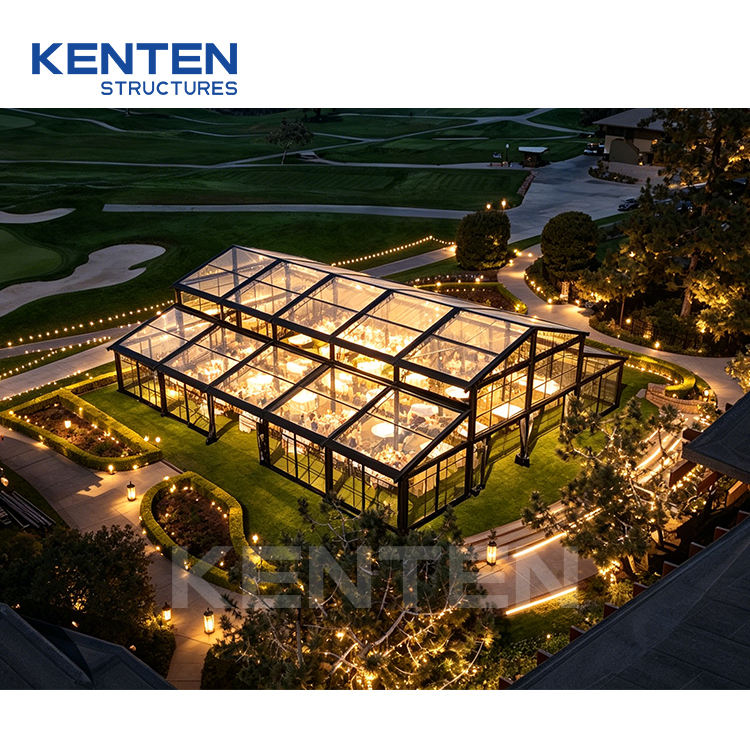
KENTEN Structures is a designer, manufacturer, and global supplier of premium aluminum permanent and semi-permanent structures, including atrium tents, structure tents, warehouse tents, igloo tents, curved tents, double-decker and triple-decker tents, and pyramid structures. Founded in 2001, the company operates an international network with offices in China, Hong Kong, Singapore, and the Mid-East, as well as manufacturing centers in China, the USA, and the Mid-East. For event buyers, the KENTEN Atrium Tent (model A1) is the product line most directly aligned with wedding banquets, VIP events, exhibition spaces, and commercial functions.
Why an Atrium Tent Fits Temporary and Semi-Permanent Projects
Event projects often require a venue that can be delivered quickly, enclosed for weather protection, and configured with walls, flooring, lighting, HVAC, and branding. The KENTEN Atrium Tent is a temporary enclosure designed for such project conditions. Its application scenario list for the wedding and hospitality segment includes wedding ceremonies, banquet halls, and reception venues, with matched equipment such as glass walls, glass doors, flooring, lining, chandeliers, HVAC, and curtains. The exhibitions segment adds high visitor traffic, trade shows, and event pavilions, with glass walls, LED lighting, air conditioning, entrance doors, and branding banners.
Atrium Tent Specifications and Technical Design
The KENTEN Atrium Tent (model A1) uses a four-channel, hard-pressed extruded aluminum alloy 6061/T6 frame. The cover material is PVC-coated polyester textile available in white, transparent, or customized color, with a weight range of 750 to 900 g/m². The cover material is flame retardant to DIN 4102 B1, M2, and CFM. Optional wall systems include 750g/m² PVC cover, glass wall, ABS wall, sandwich wall, hard/solid wall, and rock wool wall.
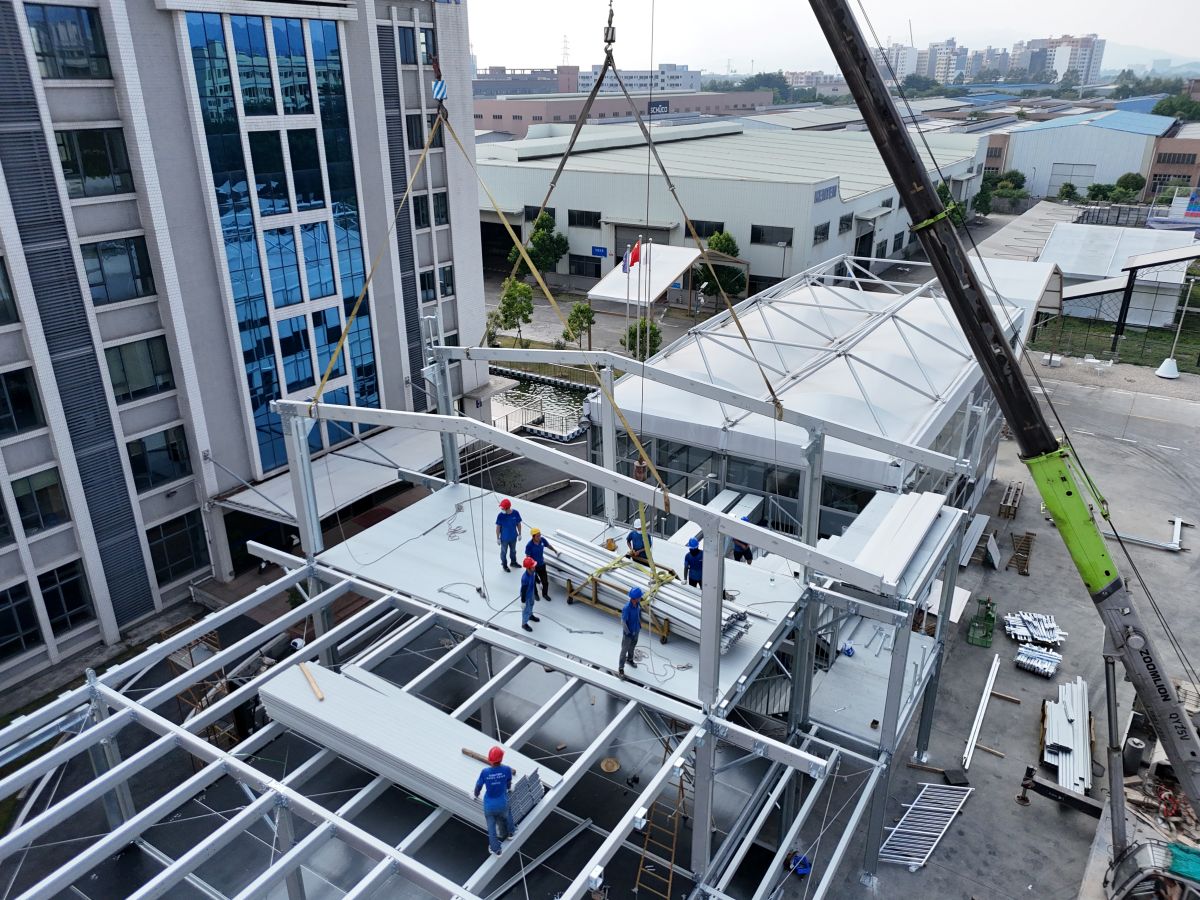
The Atrium Tent is specified with wind resistance of 120 km/h. Fixing solutions include ground anchors, expandable bolts, and weight plates, selected according to site ground conditions such as grassland, earth land, asphalt, cement ground, or marble. The applicable temperature range is -30°C to +70°C, and the service life of the structure is more than 15 years. Connectors are expansion bolts used to fix the tent to the ground system.
| Technical parameter | Atrium Tent (A1) | Structure Tent (K1–K10) |
|---|---|---|
| Frame | 4-channel hard-pressed extruded aluminum alloy 6061/T6 | High-strength 6061-T6 / 6082-T6 aluminum alloy |
| Cover | 750–900 g/m² PVC-coated polyester textile; white, transparent, or customized color; flame retardant to DIN 4102 B1, M2, CFM | 850 g/m² PVC-coated polyester fabric; white, black, beige, transparent, or custom color |
| Walls | PVC, glass, ABS, sandwich, hard/solid, rock wool | PVC, glass, ABS, sandwich panel |
| Wind resistance | 120 km/h | Up to 140 km/h, customizable |
| Temperature range | -30°C to +70°C | -30°C to +70°C |
| Service life | More than 15 years | Aluminum 20+ years; PVC fabric 8–15 years |
| Fixing | Ground anchor, expandable bolt, weight plate | Ground anchors or concrete ballast |
| Main applications | Wedding, event | Commercial events, sports facilities, industrial storage, government & public projects, tourism & hospitality, retail & exhibition |
Structural Standards and Compliance
KENTEN states that its quality control team ensures all structures are produced and fully certified to IBC 2024, CBC 2025, ASCE 7-22, GB 50429, and EN 13782. In the European market, temporary structures and atrium tents must also satisfy the structural safety requirements of EN 13782:2015, and flame retardancy of tent fabrics is regulated by NFPA 701 in the United States and DIN 4102 B1 in Germany. These standards are relevant when an atrium tent is deployed for international events with local compliance requirements.
Project Fit: Use Cases and Configurations
For event specifiers evaluating an atrium tent, the selection process is usually organized around the event type, expected guest flow, enclosure requirements, and site conditions. The KENTEN Atrium Tent can be matched with different wall systems and interior equipment for each project type.
Wedding and Hospitality Projects
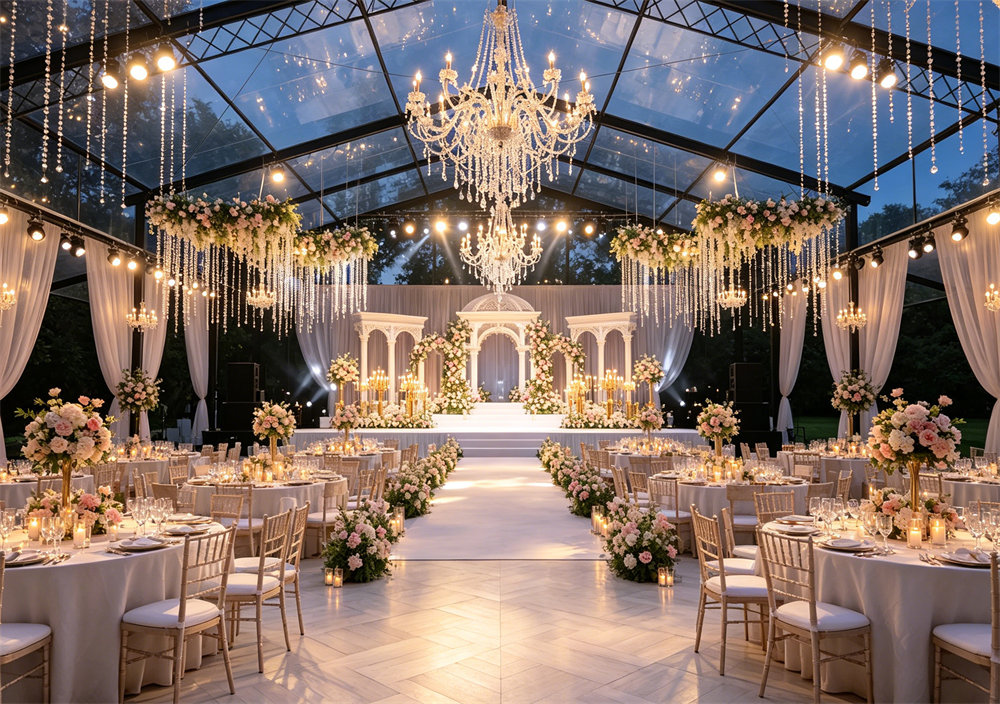
KENTEN’s wedding and hospitality scenario covers wedding ceremonies, banquet halls, and VIP receptions. The project environment is outdoor, all-weather, and intended as a luxury venue. Typical equipment includes glass walls, glass doors, flooring, lining, chandeliers, HVAC, and curtains. A documented US project used a 15m × 25m Atrium Structure Tent for a private luxury residence on the East Coast, installed close to the ocean and configured as a fully enclosed, climate-controlled environment for high-end wedding receptions.
Exhibitions and Commercial Events
For exhibitions, trade shows, and event pavilions, the working condition is high visitor traffic inside a temporary venue. Typical equipment includes glass walls, flooring, LED lighting, air conditioning, entrance doors, and branding banners. This configuration supports product displays, brand promotion, and exhibition space on an on-demand, reusable basis. The same temporary venue model can be used for commercial event functions and VIP reception areas.
Automotive Showrooms and Temporary Facilities
The KENTEN Structure Tent range is also used in automotive projects such as vehicle workshops, showrooms, and temporary showrooms. In these settings, glass walls, roller doors, vehicle access doors, and LED lighting are commonly installed. The required project attributes include fire retardancy, waterproofing, wind resistance, structural load-bearing, and quick installation.
Large-Scale Event Infrastructure Evidence
KENTEN has documented experience supplying temporary structures for international sports events. At the 2022 Beijing Winter Olympic Games, 50 units of A-structure tents and double-decker tents were deployed across multiple competition venues for security checkpoints, staff offices, dining areas, meeting rooms, and command centers. Customer feedback from that project highlighted rapid installation and engineering accuracy. These event infrastructure projects use the same production and quality-control framework that applies to the Atrium Tent line.
Customization, Production Capacity, and Sourcing
KENTEN offers OEM and ODM production, with customization options covering structure dimensions, roof and fabric options, sidewall options, flooring systems, interior accessories, and branding and appearance. The minimum order quantity is 1 unit, which allows project-specific procurement without a large commitment. Monthly production capacity is 1,000,000 m², and typical production lead time is 30–45 days. KENTEN’s quality control process includes raw material incoming inspection and 100% full inspection before shipment. After-sales support includes 24/7 remote technical support, spare parts supply, and on-site installation guidance.
Market Context for Aluminum-Frame Atrium Tents
The demand for atrium tents is linked to the wider event management market. Global event management was valued at USD 1,160.4 billion in 2024, with a projected CAGR of 6.7% through 2033, according to Grand View Research. On the supply side, China’s exports of awnings, tents, and sails reached approximately USD 3.11 billion in 2024, accounting for 53.3% of total global exports in that category, according to the Observatory of Economic Complexity. The broader camping tent and temporary structure market is also growing; Grand View Research valued the global camping tent market at USD 5.72 billion in 2024 and projected it to reach USD 8.30 billion by 2030. For procurement teams, these figures indicate a mature, high-volume supply base for aluminum-frame tent systems.
Atrium Tents vs. Permanent Venues
Compared with a permanent building, an atrium tent offers a different procurement profile. A tent structure can be supplied as a modular, demountable system, installed on demand, and reused across multiple projects. The operation modes documented by KENTEN include on-demand installation, reusable use, and temporary or long-term deployment. This makes atrium tents practical for event organizers who do not want to assume the construction timeline and site disruption of a permanent venue.
A realistic limitation should be included in the evaluation: the PVC fabric cover used in the Structure Tent series has a service life of 8–15 years, while the aluminum frame can last 20+ years. A structure used as a semi-permanent or permanent building will therefore need planned fabric replacement. In addition, anchoring is site-dependent; the Atrium Tent can be fixed with ground anchors, expandable bolts, or weight plates depending on the ground surface.
| Evaluation factor | Atrium tent approach | Permanent venue approach |
|---|---|---|
| Deployment | Modular, reusable, on-demand installation | Usually fixed construction, longer schedule |
| Site requirements | Anchoring suited to ground type | Foundation and site development required |
| Enclosure options | PVC, glass, ABS, sandwich, rock wool walls | Building façade, insulation, glazing systems |
| Lifecycle | Aluminum frame 20+ years; PVC fabric 8–15 years | Designed for long-term permanent use |
Future Outlook for Atrium Tent Procurement
In practice, event specifiers evaluate structures that combine large spans, transparent walls, thermal performance, and code compliance. The KENTEN portfolio supports this direction through the Structure Tent K-series, which spans 3m to 80m with unlimited length in 5m bay spacing, and through the Atrium Tent A1, which offers transparent PVC covers and glass wall options. Standards such as IBC 2024, CBC 2025, ASCE 7-22, GB 50429, and EN 13782 create a common technical language for buyers reviewing international suppliers.
Company Resources
KENTEN Structures — Atrium Tent Project Documentation
KENTEN Structures is headquartered at 1270E. Mission Blvd, Ontario, CA 91761, USA, with an additional office at Tower B-2807, 155 Linhexi Road, Guangzhou, China. The company can be contacted through Cindy at kenten@kentenstructures.com, by phone at +189 9858 2207, or via WhatsApp at +86 173 2224 3105.
Download the public company catalog: KENTEN Catalog (PDF).
FAQ
Which atrium tent configuration is suitable for a wedding banquet or VIP event?
The KENTEN Atrium Tent (model A1) is designed for wedding and event use. It can be specified with glass walls, glass doors, flooring, lining, chandeliers, HVAC, and curtains to create an enclosed venue for banquets and VIP receptions.
Can an atrium tent be supplied with transparent or glass walls?
Yes. The Atrium Tent cover is available in white, transparent, or customized color using PVC-coated polyester textile at 750–900 g/m². Wall options include 750g/m² PVC cover, glass wall, ABS wall, sandwich wall, hard/solid wall, and rock wool wall.
What wind resistance does the KENTEN Atrium Tent provide?
The KENTEN Atrium Tent is rated for wind resistance of 120 km/h. The tent is fixed using ground anchors, expandable bolts, or weight plates, depending on site ground conditions.
What certifications are relevant for atrium tents in international projects?
KENTEN structures are produced and certified to IBC 2024, CBC 2025, ASCE 7-22, GB 50429, and EN 13782. The Atrium Tent cover material is flame retardant to DIN 4102 B1, M2, and CFM, while K-Series Structure Tents also comply with NFPA 701.
Can a project-specific atrium tent be produced under OEM terms?
Yes. KENTEN supports OEM/ODM production with customization of structure dimensions, roof and fabric options, sidewall options, flooring systems, interior accessories, and branding. The minimum order quantity is 1 unit, monthly production capacity is 1,000,000 m², and typical lead time is 30–45 days.