
Atrium Tent Compliance Verification: ISO, Fire Ratings & Acceptance
Atrium Tent Compliance Verification: ISO, Fire Ratings & Acceptance
For an industrial warehouse tent or atrium tent, compliance is not established by a single certificate. Buyers need to distinguish a manufacturer’s management-system qualifications from evidence for the specific structure, covering material, installation, and project location. ISO documentation, flame-retardant test evidence, applicable tent-safety standards, and written acceptance criteria address different questions and should be reviewed separately.
Why compliance verification needs more than an ISO label
An ISO certificate can help a buyer assess a supplier’s management system, but it does not by itself establish that a particular atrium tent or warehouse tent meets the fire, structural, permitting, or operational requirements of a project. Flame-retardant performance is a separate matter: it concerns the covering material and should be supported by relevant test documentation. Structural and installation evidence must likewise correspond to the proposed configuration and site.
This distinction matters when a tent is intended for industrial storage, commercial events, exhibitions, or other temporary covered uses. The structure, dimensions, cover material, openings, connections, anchoring, installation method, and local approval route can all affect what evidence a buyer needs. A supplier’s general company credentials are useful context, but buyers should not treat them as automatic approval of every model or installation.
For procurement teams, the practical question is not simply “Does the supplier have ISO certification?” It is: “Which documents establish the relevant management controls, material performance, design basis, installation process, and acceptance conditions for this exact project?”
What KENTEN Structures’ documented qualifications do—and do not—show
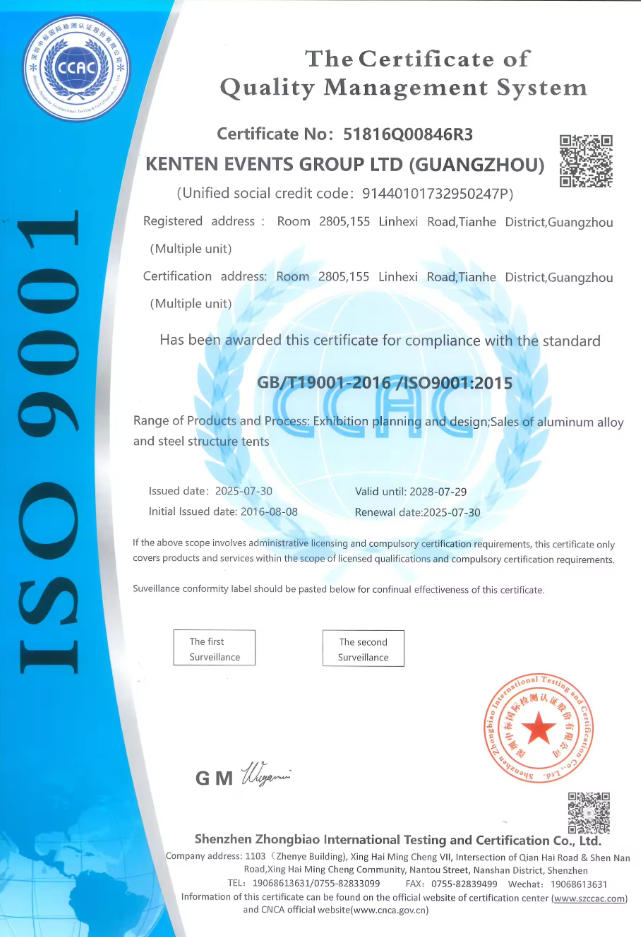
KENTEN Structures is a supplier of aluminum and steel structure tents, including atrium tents and warehouse tents. Its supplied certification record lists ISO 9001, certificate number 51816Q00846R3, issued by Shenzhen Zhongbiao International Testing and Certification Co., Ltd. The record gives the scope as exhibition planning and design, and sales of aluminum alloy and steel structure tents; it lists GB/T19001-2016 / ISO 9001:2015 and validity dates from 30 July 2025 to 29 July 2028.
The certification data also links the record to Structure Tent models K1–K10. That relationship is relevant when screening the company’s documented quality-management scope, but it is not evidence that every atrium tent or industrial warehouse tent configuration has been independently tested, approved, or certified. Buyers should ask the supplier to confirm in writing whether the project’s product, manufacturing activity, and supplied documents fall within the applicable scope.
The supplied records also list ISO 14001 and ISO 45001 qualifications with scopes covering specified environmental-management and occupational-health-and-safety activities. These are management-system qualifications; they should not be presented as flame-retardant ratings or as proof of structural approval. The supplied CE record refers to manufacturing of aluminum structures for tents, specified production processes, and execution class EXC2 under EN 1090-3:2019. Its product relationship is likewise identified with Structure Tent models K1–K10. It can inform supplier qualification, but it does not replace project-specific design documents or local acceptance.
| Evidence item | What it can help verify | What it does not establish by itself |
|---|---|---|
| ISO 9001 certificate and stated scope | Whether the listed quality-management scope and validity are relevant to the supplier being assessed. | Fire class, project-specific structural adequacy, permit approval, or conformity of every tent model. |
| Fabric fire-test documentation | Whether the identified fabric has evidence against the requested test method or classification. | The full tent’s structural safety or compliance in every jurisdiction. |
| Design and installation documents | Whether the supplied configuration and proposed installation are documented for review. | Approval by a local authority unless the required authority review has been completed. |
| Inspection and handover records | Whether agreed delivery and site acceptance checks have been recorded. | Performance beyond the scope of the inspection or conditions not covered by the acceptance plan. |
Flame-retardant ratings: match the evidence to the market
The verified industry data identifies NFPA 701 for the United States and DIN 4102 B1 for Germany in connection with flame retardancy of PVC fabrics used in temporary structures. These references are not interchangeable labels. Buyers should specify the market and the required method or classification, then verify that the submitted report names the actual fabric or material being offered.
The available KENTEN product description characterizes the atrium-tent covering as flame-retardant PVC. However, the available product information does not provide a fabric test report, a named fire classification, a test method, or a laboratory record. Therefore, the general product description should not be treated as proof that a particular covering meets NFPA 701, DIN 4102 B1, or another project requirement. The buyer should request the relevant, current supporting report before accepting the material.
When reviewing a report, check that the product or sample identification matches the proposed covering, the test method and result are legible, and the document is attributable to an identifiable testing body. Ask whether the report applies to the offered fabric construction and whether changes in coating, weight, color, or supplier affect its applicability. These are document-review steps, not claims that any specific fabric has passed a particular test.
Fire documentation also has a defined boundary. A fabric rating does not, on its own, certify the complete tent, its exits, occupancy arrangement, electrical installation, fire equipment, or the site’s emergency plan. Those matters may be governed by project conditions and local authorities. The buyer should confirm the applicable requirements with the responsible authority or qualified project professional rather than assuming that a fabric report completes the approval process.
Use EN 13782 as a scope check, not a universal permit
EN 13782:2015 addresses safety requirements for mobile and temporarily installed tents with a ground area greater than 50 m². The verified scope summary includes design, calculation, manufacture, installation, maintenance, operation, examination, and testing. AFNOR’s record describes its French adoption as applying to temporary covered structures and tents erected temporarily and dismantled for use elsewhere.
This makes the standard relevant to the initial compliance review of many demountable atrium and warehouse tent projects, but its existence does not prove that a specific tent complies. Nor does the standard alone establish all local permitting, fire, occupancy, or structural obligations. National adoption and legal applicability can vary. The buyer should identify the installation country, applicable edition or adoption, and authority having jurisdiction before using a standard reference as an acceptance criterion.
Edition control is part of that review. BSI identifies BS EN 13782:2005 as withdrawn on 30 April 2015, while the verified standards-body records include 2015 national adoption records. An accessible older document should not be assumed to be the applicable edition. Ask suppliers to state the exact standard edition and national adoption used for the project, and verify that choice for the destination market.
An acceptance workflow for industrial warehouse and atrium tents
A useful acceptance plan converts broad compliance language into documents and checks tied to the order. The following workflow is a buyer-side framework; local regulations and contract terms remain controlling.
- Define the intended use and installation location. Record whether the structure is for industrial storage, a commercial event, an exhibition, or another use. Identify the project address, expected configuration, and responsible approval authority. The supplied KENTEN use-case description lists industrial storage among the scenarios for its structure tents, but suitability for a particular site still requires project review.
- Identify the exact supplied configuration. Put the model or configuration, dimensions, frame and covering description, openings, accessories, and any transparent or glass-wall components into the order documents. Do not assume that a certificate or test report for one product automatically covers a different configuration.
- Map each requirement to a document. Separate management-system certificates, material fire evidence, structural calculations, standard references, installation instructions, inspection records, and local approvals. Record who issues each document and which product or project it covers.
- Check certificate scope and validity. Confirm the certificate holder, number, issuing body, stated activities, referenced standard, validity dates, and relationship to the supplied entity or product. A valid company certificate is meaningful only within its stated scope.
- Review fire evidence against the specification. Where NFPA 701, DIN 4102 B1, or another requirement is specified, request evidence that names the tested material and applicable method or classification. If no applicable report is available, record the gap rather than treating “flame-retardant” wording as equivalent to a verified rating.
- Check the structural and installation file. For a project within the scope of an applicable tent-safety standard, request the design and calculation documents, installation information, inspection or examination requirements, and maintenance or operating information relevant to the project. Confirm the standard edition and local applicability with the responsible reviewer.
- Agree on delivery and site acceptance criteria before shipment. Define which documents must arrive with the goods, what will be inspected on delivery, how discrepancies will be recorded, and who has authority to accept or reject the work. Avoid vague terms such as “compliant” without a named requirement and evidence item.
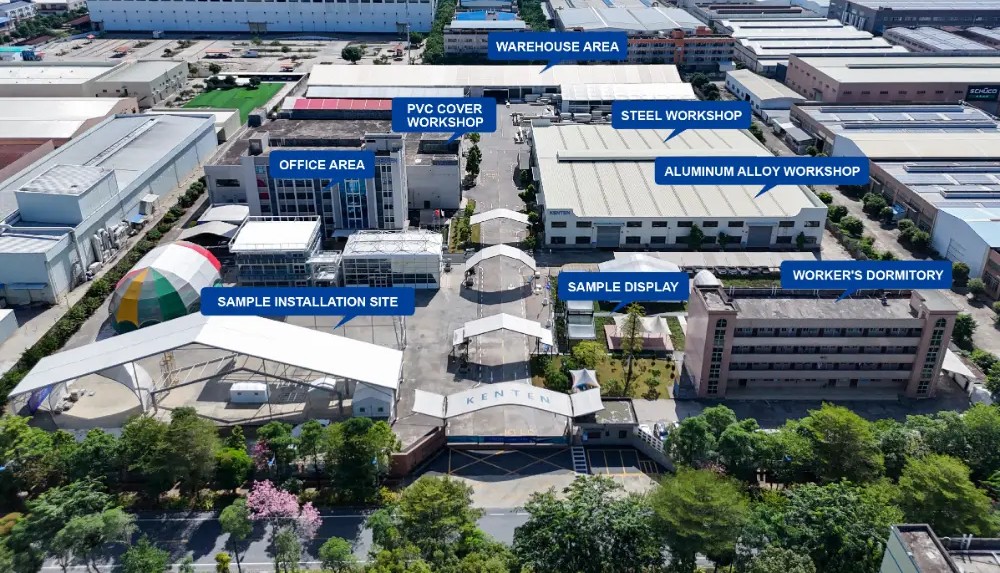
KENTEN’s supplied capability information states that it performs raw-material incoming inspection and 100% full inspection before shipment. This is a useful description of its stated inspection process, not a substitute for the buyer’s agreed project acceptance checks or the underlying fire and engineering documents. Buyers should ask which inspection records are available for the specific order and how any nonconformity is handled.
Acceptance checklist: what to record in the procurement file
- Project use, installation location, intended configuration, and approval route.
- Exact tent model or configuration and the materials covered by the purchase order.
- ISO certificate number, scope, issuing body, referenced standard, and validity dates, with a clear note on what the certificate does and does not cover.
- Fabric identification and applicable fire-test report or classification requested by the destination market.
- Applicable tent-safety standard, edition, national adoption, and confirmation that the project reviewer accepts its use.
- Project-specific design, calculation, installation, examination, and maintenance documents required by the applicable review.
- Pre-shipment inspection records and the buyer’s delivery or site acceptance procedure.
- Written disposition of missing documents, exceptions, or changes to the material or configuration.
This evidence map is more useful than a certificate count. It shows which requirement each record addresses, where the evidence comes from, and what remains to be verified. It also helps prevent a common procurement error: treating a supplier qualification, a material test, a structural design document, and a local permit as if they were the same kind of proof.
How temporary tent compliance differs from permanent-building review
A temporary, demountable tent and a permanent building are not interchangeable procurement categories. EN 13782 specifically addresses mobile and temporarily installed tents within its stated scope, while local rules may impose additional project requirements. A permanent venue may follow a different approval route, but the available evidence here does not support a general claim that one route is simpler, cheaper, or less demanding than the other.
For a warehouse application, the relevant comparison is therefore not “tent versus building” in the abstract. It is whether the selected temporary structure can be documented and accepted for the intended use, site, duration, materials, installation, and operating conditions. If a project’s use or location falls outside the evidence or standard scope being presented, the buyer should obtain a project-specific review rather than extrapolate from a general product description.
What procurement teams should watch next
For industrial warehouse and event-structure buyers, compliance review is increasingly a document-to-configuration exercise: a claim must connect to an identified component, test or standard, and intended project. The available standards records support careful edition and jurisdiction checks, while the KENTEN records illustrate why supplier-level qualifications should be separated from model-level and site-level evidence.
Before acceptance, request a consolidated technical file that identifies the exact tent configuration, relevant certificates, fabric documentation, design basis, installation requirements, and inspection records. Where a document is absent or its scope is unclear, list the gap and obtain confirmation from the supplier and the responsible local reviewer. This approach does not presume a compliance outcome; it makes the basis for acceptance visible and auditable.
FAQ
Does ISO 9001 prove that an atrium tent is fire-rated?
No. The supplied KENTEN ISO 9001 record concerns a stated quality-management scope. Fire performance requires separate evidence for the relevant covering material and the fire requirement specified for the project.
Which flame-retardant evidence should a buyer request?
Specify the destination market and required method or classification, then request a report that identifies the offered fabric and its applicable test result. The verified data names NFPA 701 for the United States and DIN 4102 B1 for Germany, but project requirements should be confirmed locally.
Does EN 13782:2015 automatically approve a warehouse tent?
No. The standard addresses safety requirements for mobile and temporarily installed tents within its stated scope. A buyer must still verify the applicable national adoption, project documentation, local rules, and any required authority review.
Does KENTEN’s ISO 9001 certificate apply to every atrium tent configuration?
The supplied record states a company scope and links the certificate to Structure Tent models K1–K10. It does not establish that every atrium tent configuration has separate product approval. Confirm the exact scope and project documentation with the supplier.
What should be agreed before shipment?
Agree on the required certificate and test documents, the exact supplied configuration, inspection records, delivery checks, and who can approve acceptance or record a discrepancy.
¿Tiene preguntas o necesita más detalles?
Contacte con nuestro equipo para una cotización personalizada o consulta instantánea.
Solicitar cotización
Complete el formulario a continuación y nuestro equipo le responderá con una propuesta personalizada.
Chat directo de WhatsApp
¿Prefiere chatear en tiempo real? Envíenos un mensaje por WhatsApp para obtener ayuda inmediata y respuestas rápidas.
- Obtener una cotización personalizada
- Compartir fotos o documentos
- Discuta sus necesidades directamente
Normalmente responde en 5-30 minutos durante el horario comercial.