
Atrium Tent Compliance: ISO Certifications and Fire Ratings
Atrium Tent Compliance: ISO Certifications and Fire Ratings
An atrium tent is a large clear-span aluminium structure with a high-peaked or curved roof, specified for VIP receptions, banquets, exhibitions and commercial events where a permanent building is unavailable, too slow to deliver, or not justified by the number of event days. At the evaluation stage of a 2026 procurement cycle, what separates a shortlist is rarely the span figure alone: it is whether the structure can be delivered with certificates, test reports and engineering documentation that a fire authority, insurer or venue operator will accept.
This compliance check sets out which certificates to request for an atrium tent, what each one actually covers, how flame retardant ratings for coated fabric work, which material specifications sit behind those claims, and which operating limits — snow load, wind and temperature — decide whether a structure fits a given site. Where a documented example is needed, the article uses KENTEN Structures, a supplier founded in 2001 with manufacturing operations in China, the USA and the Middle East, to show what a verifiable certificate record looks like.
Why the Compliance File Now Sets the Atrium Tent Shortlist
Three separate regulatory layers usually apply to one atrium tent project. The aluminium frame is governed by structural execution standards, most explicitly EN 1090-3, which sets the technical requirements for the execution of aluminium structures and underpins CE marking for large-span tents in the European market. The assembled venue is governed by temporary structure standards such as EN 13782:2015, which specifies wind load resistance and fabric tension requirements. The roof and sidewall membranes are governed by reaction-to-fire standards for coated fabric — NFPA 701 in the United States and DIN 4102 B1 in Germany.
For a buyer comparing suppliers, the practical consequence is that no single certificate proves compliance on its own. A quality management certificate describes how a factory works. A structural execution certificate describes how a specific design was produced and controlled. A fabric test report describes how a specific membrane behaves in fire. Suppliers that can produce all three, with scope wording that matches the product being bought, move through technical review faster than suppliers who can only describe their process in general terms.
This is where the evaluation stage is won or lost. Certificates can be verified independently — number, issuing body, scope and validity date can all be checked against the issuing organisation’s register — whereas general claims about craftsmanship cannot. When an event owner, municipality or insurer asks for documentation, a supplier that answers with a certificate number and a scope statement closes the question in one exchange.
The Certificate Set to Request: What Each Document Covers
| Document | Governing reference | What it verifies | What it does not cover |
|---|---|---|---|
| ISO 9001 quality management system | GB/T19001-2016 / ISO9001:2015 | Consistency and traceability of the processes named in the scope | The load capacity of any specific tent design |
| ISO 14001 environmental management system | GB/T24001-2016 / ISO14001:2015 | Control of environmental aspects in the certified activities | Structural or fire performance |
| ISO 45001 occupational health and safety | GB/T45001-2020 / ISO45001:2018 | Worker safety management inside the certified activities | Site-specific installation safety on your project |
| CE marking for aluminium structures | EN 1090-3:2019, execution class EXC2 | Factory production control for cutting, drilling, grinding, assembling and packaging | On-site erection quality and project-specific calculations |
| Temporary structure conformity | EN 13782:2015 | Wind load resistance and fabric tension requirements | Markets that do not adopt this standard |
| Fabric reaction-to-fire report | DIN 4102 B1, M2, NFPA 701 | Flame behaviour of the coated fabric that was tested | A different fabric weight, coating or colour |
The table is deliberately narrow about what each document proves, because tenders often are not. A specification that asks for “ISO certification” without naming the standard, or for a “fire certificate” without naming the tested fabric, will return documents that cannot be compared across suppliers. The more precise route is to require the standard number, the issue and expiry dates, and a scope statement that names the activity you are actually buying.
Management System Certificates
KENTEN Structures holds ISO 9001 certificate 51816Q00846R3, issued by Shenzhen Zhongbiao International Testing and Certification Co., Ltd. on 30 July 2025 and valid until 29 July 2028, with a scope covering exhibition planning and design and the sales of aluminium alloy and steel structure tents. Its ISO 14001 certificate 51815E00262R3 and ISO 45001 certificate 51815O00263R3 were both issued by the same body on 8 August 2024 and run to 7 August 2027, covering the same core activities plus the related environmental and occupational health and safety management.
Read carefully, those scopes describe how the supplier plans, specifies and sells; they do not describe the tent you will receive. That distinction is the reason a serious evaluation file pairs the management certificates with the structural execution certificate.
CE Marking and EN 1090-3
KENTEN’s CE certificate 8605682 was issued by LL-C (Certification) Czech Republic a.s. for the European Union market, valid from 10 April 2026 to 9 April 2029. Its stated scope is the manufacturing of aluminium structure tents, with production processes listed as cutting, drilling, grinding, assembling and packaging, at execution class EXC2, referencing EN 1090-3:2019, ISO 9001 and EN ISO 17065:2012.
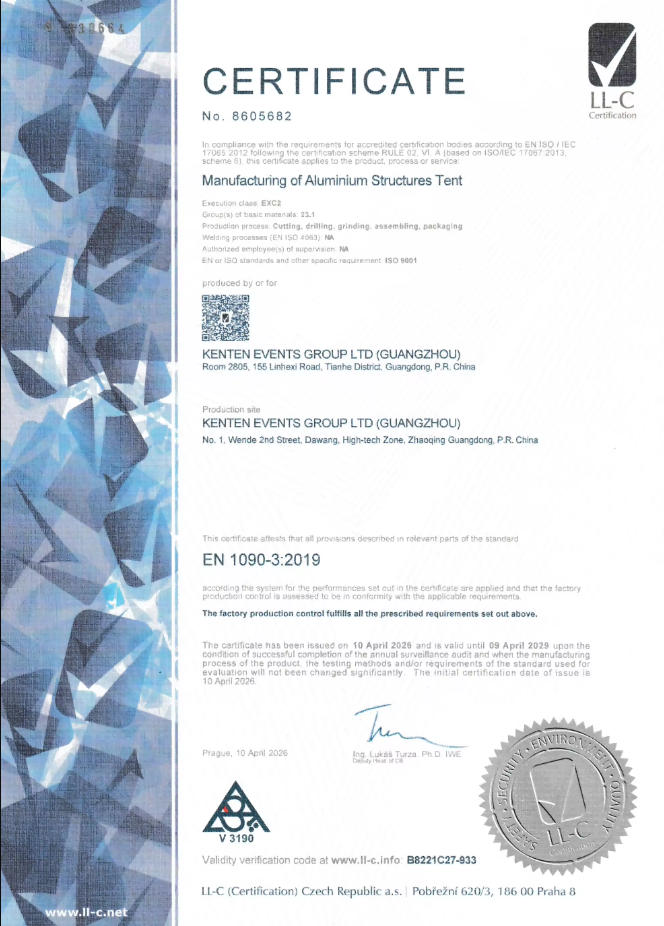
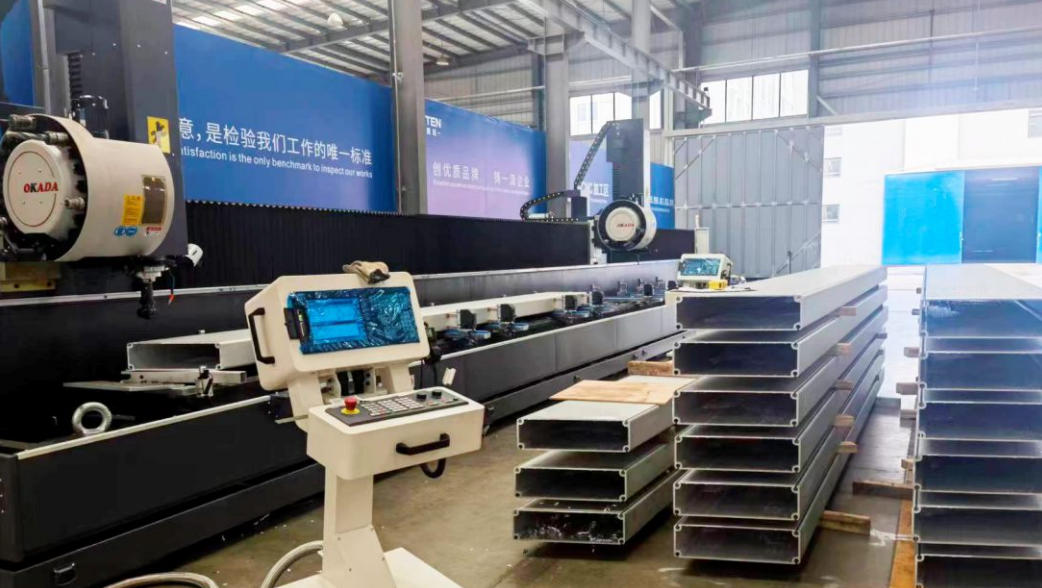
Two details in that scope are worth checking on any competing document. First, the execution class: EXC2 indicates the consequence class the factory is controlled against, and it should match the type of venue being built. Second, the process list: a certificate that names cutting, drilling and assembling is documenting fabrication control, which is what a buyer needs when the visible risk is welding quality, hole alignment and packaging for transport.
Four verification checks that take minutes:
1. Search the certificate number on the issuing body’s register rather than accepting a scan alone.
2. Confirm the scope wording names the activity you are buying, not only a related activity.
3. Confirm the certificate is still valid on the project delivery date, not just on the quotation date.
4. Confirm which legal entity holds it, since a group can operate several companies.
Flame Retardant Standards for Atrium Tent Fabric
Fire performance in an atrium tent is a property of the membrane, not the frame. The aluminium skeleton does not burn; the roof and sidewall fabric is what a fire officer assesses. That is why the flame retardant ratings quoted in atrium tent specifications — DIN 4102 B1, M2 and NFPA 701 — belong to the coated fabric and should always be supported by a test report that names the material tested.
| Rating | Region commonly referenced | What it classifies | Procurement note |
|---|---|---|---|
| DIN 4102 B1 | Germany and EU tenders | Flame retardant building material behaviour under the German classification | Ask for the report tied to the delivered roof fabric, not a generic statement |
| M2 | European fabric specifications | Flame-retardant classification applied to flexible coated materials | Confirm the fabric weight and coating the M2 claim refers to |
| NFPA 701 | United States | Flame propagation of textiles and films used in tents and similar structures | Commonly requested by US venues and fire marshals before occupancy |
The three ratings are not interchangeable labels for one global approval. A European tender may accept a DIN 4102 B1 or M2 report where a US venue will ask for NFPA 701 evidence, and an international project can require both. KENTEN’s roof fabric is an 850 g/m² PVC-coated polyester fabric stated as flame retardant to DIN 4102 B1, M2 and NFPA 701, which allows one delivered fabric specification to serve multiple market submissions.
Two practical rules follow from the fact that fire performance belongs to the fabric. First, the test report should identify the fabric weight and coating, because a lighter or differently coated membrane is a different material and its behaviour cannot be inferred from another report. Second, flame retardant claims should be reviewed whenever the roof is replaced: because the PVC fabric has a service life of roughly 8 to 15 years while the aluminium frame lasts 20 years or more, some atrium tents will have their roof renewed before the frame, and the new membrane needs its own documentation.
Frame and Fabric Specifications Behind the Compliance Claims
Certificates only become useful when they can be matched to the offered specification. KENTEN publishes the following data for its Structure Tent range, models K1 to K10, which is the data set a buyer should reconcile with the certificate scope:
- Main frame: high-strength 6061-T6 / 6082-T6 aluminium alloy
- Roof fabric: 850 g/m² PVC-coated polyester fabric, flame retardant to DIN 4102 B1, M2 and NFPA 701
- Sidewall options: PVC, glass wall, ABS wall, sandwich panel
- Span width: 3 m to 80 m depending on model
- Length: unlimited, extendable in 5 m bay spacing
- Eave height: 2.5 m to 8 m, customisable
- Wind resistance: up to 140 km/h, customisable
- Snow load: up to 0.5 kN/m²
- Temperature range: -30 °C to +70 °C
- Installation: ground anchors or concrete ballast
- Service life: aluminium 20+ years, PVC fabric 8–15 years
- Colour options: white, black, beige, transparent, custom
Each line carries compliance weight. The 6061-T6 and 6082-T6 designations are heat-treated alloys with defined mechanical properties, which is what allows a structural engineer to verify a calculation rather than accept a description. The 850 g/m² roof fabric weight determines tension behaviour and is the figure that fire test documentation should reference. Sidewall selection is not cosmetic either: glass walls add dead load and change egress and fire considerations, while sandwich panel walls are the option normally chosen when thermal insulation matters — relevant to the thermal insulated atrium tent configurations used for winter events.
Operating Envelope: Snow Load, Wind and Temperature Limits
The operating envelope is where compliance and site reality meet. On the documented Structure Tent range, snow load is stated up to 0.5 kN/m², wind resistance up to 140 km/h with customisation available, and the operating temperature range is -30 °C to +70 °C. Those figures describe design conditions, and design conditions have two dependencies that buyers frequently overlook.
The first dependency is anchoring. The stated wind resistance applies to a structure installed with the specified ground anchors or concrete ballast. A wind rating is therefore not a property of the frame in isolation; it is a property of the frame plus the anchoring system plus the installation quality. Projects on paved surfaces, on decking, or on soft ground need the anchoring method reviewed against the certified assumption.
The second dependency is regional load. A declared snow load of 0.5 kN/m² is a genuine limit, not a marketing figure, and it is lower than the ground snow load in many northern markets. In heavy-snow regions this means an atrium tent engineered to this envelope requires either a structure configured for a higher load or an operating plan that manages accumulation — monitoring, heating or clearing — for the duration of the event. Third-party engineering references quote snow-load figures up to 1.9 kN/m² for some high-performance large-span models, which is precisely why the comparison should be made between certificates for the offered model and the project’s required design load, rather than between headline numbers from different model classes.
Boundary to state in the tender: the declared wind, snow and temperature figures are valid only for the specified configuration, installation method and anchoring. Any change to span, eave height, sidewall type or ballast design should trigger a fresh structural review rather than a carry-over of the original figures.
Atrium Tent vs Permanent Venue: Where the Compliance Path Differs
| Dimension | Atrium tent | Permanent venue |
|---|---|---|
| Approval route | Temporary structure or event approval, often time-limited | Building permit under the national building code |
| Primary standards | EN 1090-3 for execution, EN 13782:2015 for temporary structures | Local building code and fire code |
| Fire documentation | Fabric test report to NFPA 701, DIN 4102 B1 or M2 | Fire-rated assemblies and fixed protection systems |
| Snow capability | Declared design load, documented at up to 0.5 kN/m² on the reference range | Typically engineered to the locally required ground snow load |
| Redeployment | Demountable and reusable at another site | Fixed asset, not relocatable |
| Site work | Ground anchors or concrete ballast | Foundations and permanent services |
The honest limitation of the temporary route is that its compliance is narrower by design. A permanent building is engineered and permitted against the long-term conditions of a site. An atrium tent is engineered against a declared design condition for a defined period, and its documentation — wind, snow, temperature, anchoring — is valid inside that envelope. Beyond it, the structure needs either a different engineering configuration or an active management plan.
Two further differences matter at evaluation stage. First, the membrane has a finite life: PVC fabric is documented at 8 to 15 years against 20+ years for the aluminium frame, so a cost model that ignores roof replacement is incomplete. Second, the envelope is not thermally equivalent to a permanent building; sandwich panel sidewalls and insulated options improve performance, but environmental control still has to be designed and budgeted rather than assumed.
Where Documented Atrium Tents Are Specified
Compliance documentation tends to matter most where a structure sits in front of a safety review, and the reference projects for this category follow that pattern. KENTEN supplied structure tents and pagoda tents for the 2008 Beijing Olympic Games as an official designated supplier of tents and temporary structures, covering functional spaces such as security inspection channels, audience rest areas, VIP reception areas, media service points and operation management areas.
For the 2022 Beijing Winter Olympic Games, KENTEN was designated as one of the key infrastructure suppliers, providing A-structure tents and double-decker tents deployed across competition venues as security checkpoints, staff offices, dining areas, meeting rooms and command centres. At the Hangzhou 2022 Asian Games, A-structure tents and pagoda tents served public areas of competition venues and satellite venues, including audience security checks, temporary storage and restrooms.
Commercial and cultural events use the same logic with different audiences. KENTEN supplied large-scale aluminium grandstand systems for the Formula 1 Miami Grand Prix and modular temporary structures for Formula 1 hospitality, including VIP lounges, hospitality suites, viewing platforms and operational areas. For the 2025 Doha Photography Festival in Qatar, the same approach produced a pyramid structure exhibition hall with a 100% column-free interior, and in Kuwait a large-span modular building was delivered for exhibition use. On the private side, a 15 m × 25 m Atrium Structure Tent was installed for a luxury wedding venue on the East Coast of the United States, providing a fully enclosed, climate-controlled environment for high-end receptions close to the ocean.
The specification logic shared by these projects is straightforward: the structure is designed for commercial events, sports facilities, government and public projects, tourism and hospitality, retail and exhibition use, and each deployment is reviewed against site conditions before installation. That is also why compliance documents, rather than appearance, tend to determine which supplier is approved.
Market Trend: Compliance as a Selection Filter
The commercial context makes documentation pressure more likely rather than less. The global event management market, which drives demand for atrium and commercial event tents, was valued at USD 1,160.4 billion in 2024, with a 6.7% CAGR projected through 2033 according to Grand View Research. Supply is concentrated: China’s exports of awnings, tents and sails under HS Code 6306 totalled approximately USD 3.11 billion in 2024, maintaining a 53.3% share of total global exports in the category, according to data published by the Observatory of Economic Complexity.
When a large share of global capacity sits with a dense supplier base, buyers lose the ability to differentiate by origin alone. Certification becomes the practical sorting mechanism, because it is the one attribute that can be verified before a purchase order is issued. Third-party supplier overviews reflect this: a 2025 market roundup by Tendars lists KENTEN alongside Losberger De Boer, Röder HTS Höcker and Shelter Structures among the suppliers active in modular aluminium tent systems for exhibitions and commercial events, and buyers evaluating that group typically begin with documentation rather than finish.
The shift is visible in tender language too. Requirements increasingly specify the standard number, the execution class, the tested fabric and the validity period, which pushes suppliers to keep certificates current and scopes accurate. For manufacturing-side capability, the operating indicators that support this are the ones buyers can audit: a stated lead time of 30 to 45 days, a minimum order quantity of one unit, 100% full inspection before shipment together with raw material incoming inspection, and after-sales provision covering 24/7 remote technical support, spare parts supply and on-site installation guidance, with export activity concentrated in the USA, EU and Middle East.
A Practical Compliance Workflow for Buyers
- Define the site design conditions first: expected wind speed, ground snow load, temperature range, event duration and surface type.
- Request structural calculations for the offered span, eave height and sidewall configuration rather than for a generic model.
- Request the CE or EN 1090-3 certificate with the execution class stated, and confirm the certificate number on the issuing body’s register.
- Request the fabric reaction-to-fire report and check that it names the fabric weight and coating being delivered.
- Request the ISO 9001, ISO 14001 and ISO 45001 certificates with scope wording, issue dates and expiry dates.
- Confirm the anchoring design and who is responsible for it on site.
- Confirm factory inspection practice, packaging and transport control in writing.
- Confirm after-sales scope, spare parts availability and installation guidance.
- Model the lifecycle: aluminium at 20+ years against PVC fabric at 8 to 15 years, including the documentation needed when the roof is replaced.
- Re-check certificate validity against the delivery date before contract signature.
Future Outlook
Compliance in this category is moving from a document that suppliers hold towards a document that projects require. Two developments follow from that. The first is standardisation of what tenders ask for: instead of requesting “certification”, buyers are naming EN 1090-3, EN 13782:2015, NFPA 701 and DIN 4102 B1, which makes cross-supplier comparison possible and removes the advantage held by vague claims. The second is lifecycle documentation, particularly for the roof membrane, because a structure with a 20-year frame and a fabric roof of 8 to 15 years will pass through at least one renewal during its service life, and that renewal needs its own fire performance evidence.
For suppliers, the implication is that certificate maintenance and scope accuracy become commercial functions rather than administrative ones. For buyers, the implication is simpler: the compliance file is now the fastest and most objective way to reduce an atrium tent supplier list, and it should be requested before the first meeting rather than after the last quotation.
FAQ
Which certificates should an atrium tent buyer request first?
Start with the documents that map to the three regulatory layers of a tent project. At structural level, request the CE or EN 1090-3 certificate with the execution class stated. At assembled-structure level, request conformity evidence referencing EN 13782:2015 where the project is in the EU. At material level, request a reaction-to-fire test report for the coated fabric naming the rating, whether DIN 4102 B1, M2 or NFPA 701. Management system certificates (ISO 9001, ISO 14001, ISO 45001) should be requested at the same time, because they show how the supplier controls and traces its processes, but they answer a different question from structural conformity.
What is the difference between DIN 4102 B1, M2 and NFPA 701?
They are region-specific ways of classifying how a tent fabric responds to fire, and they are not interchangeable labels for one global approval. DIN 4102 B1 is a German building material classification for flame retardant behaviour that is widely referenced in EU tenders. M2 is a European flame-retardant classification applied to flexible materials. NFPA 701 is the US standard for flame propagation of textiles and films used in tents, and it is commonly requested by venue operators and fire marshals in the United States. Because each rating is tied to the fabric actually tested, the report should name the fabric weight and coating; KENTEN’s roof fabric, for example, is an 850 g/m² PVC-coated polyester material stated as flame retardant to DIN 4102 B1, M2 and NFPA 701.
Does an ISO 9001 certificate mean the atrium tent structure itself is certified?
No. ISO 9001 certifies a management system, which means it documents how an organisation controls its processes, not the load capacity or fire behaviour of a specific structure. Structural conformity comes from execution standards such as EN 1090-3, and from temporary structure standards such as EN 13782:2015 where the host market adopts them. Buyers should read the scope statement closely: a certificate covering exhibition planning and design and the sales of aluminium alloy and steel structure tents describes the certified activities, while the manufacturing processes are covered by the execution certificate for aluminium structures, which for KENTEN lists cutting, drilling, grinding, assembling and packaging at execution class EXC2.
What snow load and temperature range can an atrium tent be engineered for?
On KENTEN’s documented Structure Tent range, the published figures are a snow load of up to 0.5 kN/m² and an operating temperature range of -30 °C to +70 °C, with wind resistance stated up to 140 km/h and customisation available. These are declared design conditions, and they hold only for the specified configuration installed with the specified ground anchors or concrete ballast. In heavy-snow markets the required ground snow load may exceed this figure, in which case the project needs either a structure engineered for a higher load or an operating plan that manages snow accumulation. Third-party engineering references quote higher snow-load figures for some high-performance large-span models, which is why the certificate for the offered model, rather than a category-level claim, should be the basis of comparison.
How long are atrium tent certificates valid, and what happens at renewal?
Validity depends on the certification scheme, and it is worth checking against the delivery date rather than the quotation date. KENTEN’s ISO 9001 certificate 51816Q00846R3 runs from 30 July 2025 to 29 July 2028. Its ISO 14001 certificate 51815E00262R3 and ISO 45001 certificate 51815O00263R3 run from 8 August 2024 to 7 August 2027. Its CE certificate for aluminium structures, 8605682, issued by LL-C (Certification) Czech Republic a.s., is valid from 10 April 2026 to 9 April 2029. Fabric fire test documentation follows a different cycle and should be refreshed when the membrane specification or supplier changes.
Can one compliance package serve both EU and US atrium tent projects?
Partly. Framework documentation such as ISO management system certificates and EN 1090-3 based factory control travels across markets, and a fabric tested to multiple ratings can support several submissions, as with an 850 g/m² PVC-coated polyester roof stated as flame retardant to DIN 4102 B1, M2 and NFPA 701. Project requirements still differ: EU tenders typically reference EN 1090-3 and EN 13782:2015, while US venues and fire authorities commonly ask for NFPA 701 evidence and design verification against codes such as IBC and ASCE 7-22. KENTEN structures are produced and certified to IBC 2024, CBC 2025, ASCE 7-22, GB 50429 and EN 13782, which allows one manufacturing record to feed several market submissions, but local permits and site conditions must still be evaluated for each project.
For readers who need the full specification and certificate detail in one document, the manufacturer’s catalogue is available here: KENTEN Structures product catalogue (PDF).