
Atmospheric Furnace Supplier Evaluation: An Outcome-Based View
The global industrial furnace market was valued at approximately USD 11.86 billion in 2024, with expectations to reach USD 21.53 billion by 2034 (Precedence Research). The Asia-Pacific region accounted for 43.4% of global revenue in 2025 (Grand View Research), reflecting how much industrial heat treatment procurement now depends on regional capacity and local engineering. In this expanding market, the procurement challenge is no longer limited to machine availability; it is about evaluating which atmospheric furnace supplier can deliver consistent process outcomes over the long term.
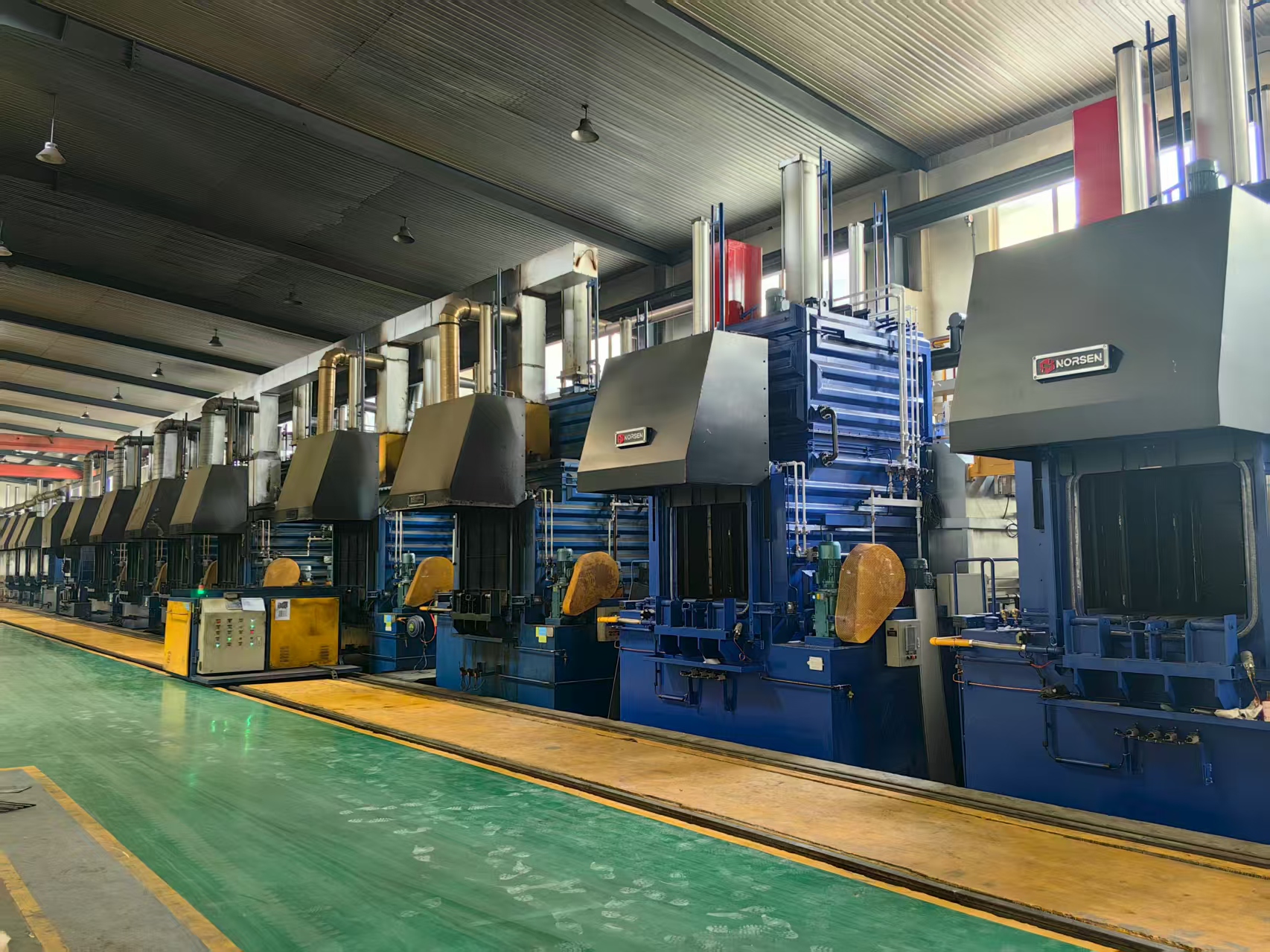
Norsen Thermal Technology (Jiangsu) Co., Ltd. is an industrial furnace manufacturer based in Xuzhou, Jiangsu Province, China, specializing in intelligent heat treatment equipment. The company’s product line includes box-type multi-purpose furnaces, gas furnaces, atmosphere furnaces, and pre-vacuum nitriding furnaces. NORSEN operates a 6,000 m² facility with a team of 55 employees and an annual output of 50 sets, with export business accounting for 40% of total sales. This article uses NORSEN as a practical reference for evaluating atmospheric furnace suppliers, with a focus on measurable results rather than brand recognition.
The Procurement Challenge: Brand Rankings vs. Process Outcomes
Market rankings provide a useful overview of an industry, but they do not necessarily answer the questions that matter to heat treatment buyers. Procurement teams evaluating industrial atmospheric furnaces must examine whether a supplier can achieve stable quality, precise carbon content control, production efficiency, ease of maintenance, and energy conservation. These attributes appear in the documented outcomes of NORSEN’s reference installations, where a project has been in operation for 20 years and continues to meet these criteria.
For evaluation purposes, a supplier’s value can be assessed from four angles: process capability, technical design, production discipline, and project adaptability. The following sections examine each angle using NORSEN as a concrete case.
NORSEN as a Reference Case: Company and Quality System
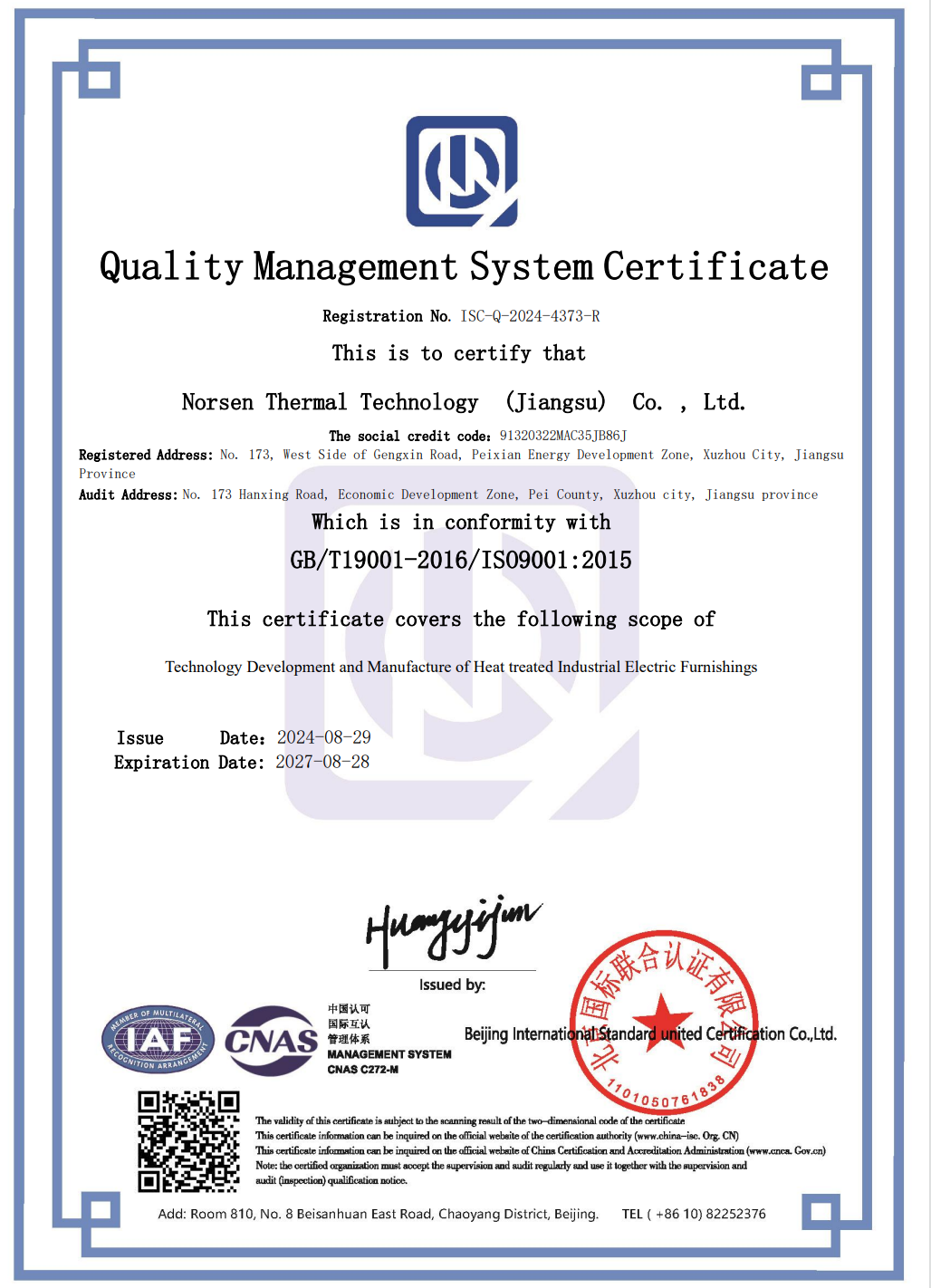
NORSEN was established with a clear focus: developing intelligent heat treatment equipment that enhances the mechanical performance of metal materials while improving production efficiency and reducing energy consumption. The company holds ISO9001 quality management system certification under certificate number ISC-Q-2024-4373-R, issued by Beijing National Standard Joint Certification Co., Ltd. The certification scope covers the technology development and manufacture of heat-treated industrial electric furnishings, in line with GB/T19001-2016/ISO9001:2015 standards, valid through August 2027.
For buyers, an ISO9001 certificate is not a differentiator in itself; what matters is what it covers. In this case, the certified scope directly applies to the development and production of industrial electric furnaces, which means quality management discipline is documented across design, manufacturing, and testing processes.
Technical Review: RTQ, TQ, SHQ, and DHQ Series
NORSEN’s atmosphere furnace offerings are grouped under four model families: RTQ, TQ, SHQ, and DHQ. These product families are classified as multi-purpose furnaces and atmosphere furnaces, and they are designed for controlled atmosphere heat treatment processes including hardening with oil quench, carbonitriding, tempering, carburizing, and case hardening.
| Model Family | Available Types | Primary Process Use |
|---|---|---|
| RTQ | RTQ-10, RTQ-17, RTQ-25 | Multi-purpose atmosphere hardening and carburizing |
| TQ | TQ-10, TQ-17, TQ-25 | Tempering and general atmosphere heat treatment |
| SHQ | SHQ-10, SHQ-15, SHQ-25 | Hardening with oil quench under controlled atmosphere |
| DHQ | DHQ-10, DHQ-15, DHQ-25 | Multi-purpose heat treatment with integrated atmosphere control |
The equipment’s furnace structure uses a silicon carbide (SiC) muffle furnace configuration with chain dual drive. Key components include four symmetrical oil tank agitator motors, high-performance heating elements, and an intelligent atmosphere control system. Safety and protection mechanisms for over-temperature and over-current conditions are integrated, along with gas heating functionality. The material specifications cover Q235, SS304, and SS310, which support the structural and thermal demands of controlled atmosphere processing.
For technical buyers, these specifications translate into direct evaluation criteria. The SiC muffle structure supports temperature uniformity and atmosphere stability. The chain dual drive configuration is relevant for production line integration. The presence of four symmetrical agitator motors in the oil tank affects quench consistency, which directly influences hardness uniformity across a load. The intelligent atmosphere control system addresses one of the most critical variables in carburizing and carbonitriding: repeatable carbon potential.
Application Scenarios and Documented Results
NORSEN’s equipment serves industries that require controlled metallurgical outcomes, including aerospace, military industry, automotive, textile machinery, construction machinery, and commercial heat treatment. The company’s products are also applicable to military industry, automobiles, agricultural machinery, robots, bearings, hardware, and sewing machines.
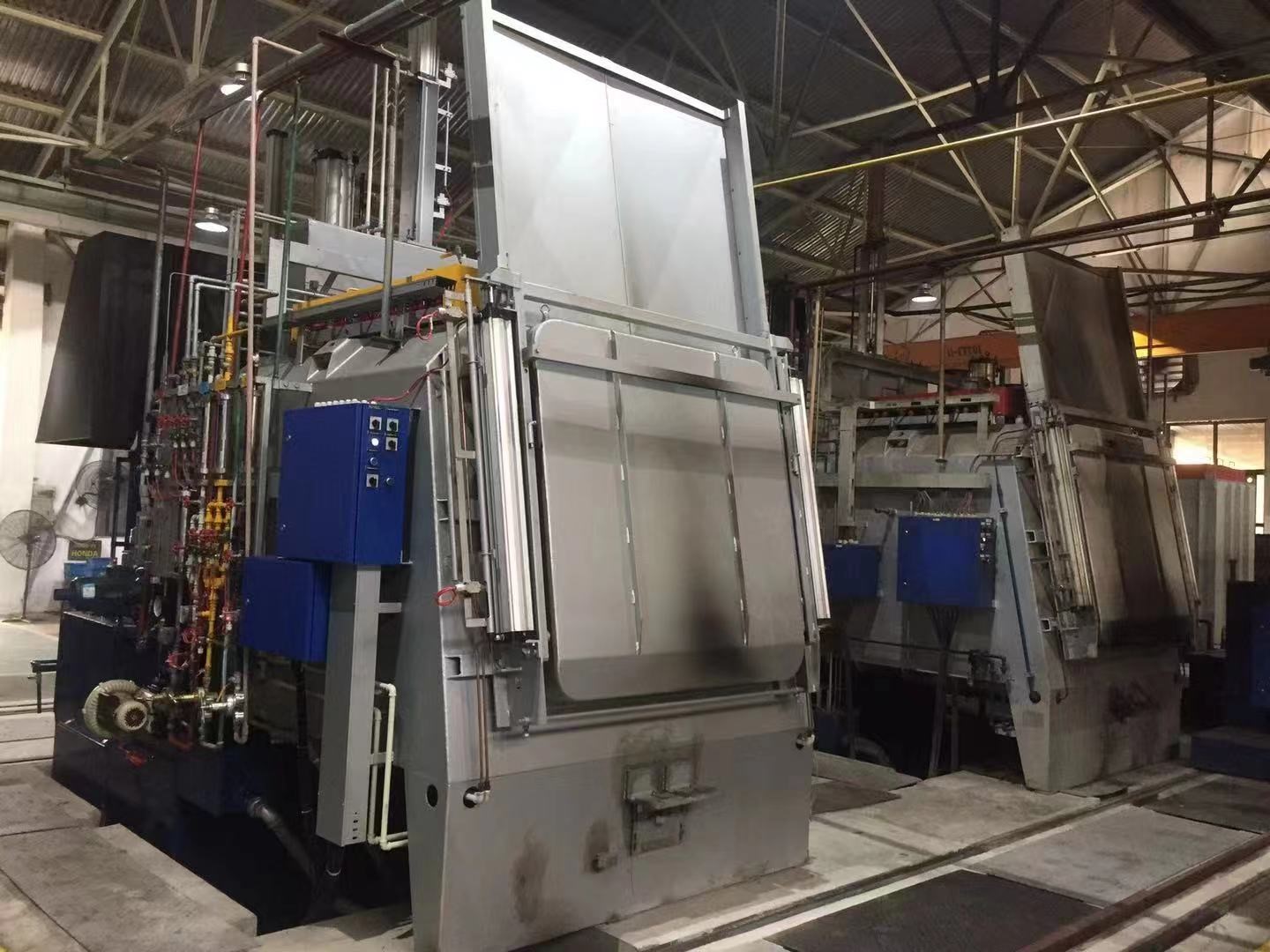
One documented reference installation has been running for 20 years and includes 10 units operating across automotive and military industries. The end users include automotive OEMs, military industry units, hardware tool factories, and gear factories. The installations are distributed across Russia, Thailand, Indonesia, India, Qatar, Turkey, Vietnam, China, and Taiwan. According to the project record, the applied purpose was to improve mechanical properties, increase hardness, enhance toughness, and improve resistance to fatigue. The achieved results include stable quality, precise carbon content, high production efficiency, easy maintenance, and energy conservation.
These results are relevant to buyers because they connect equipment design to measurable metallurgical and operational objectives. Precise carbon content control is central to carburizing quality. High production efficiency affects throughput and unit cost. Easy maintenance and energy conservation influence total lifecycle cost, a key variable in long-term procurement decisions.
Market Trends: What Is Shaping the Sector
Several verifiable trends frame the current evaluation landscape. Gas-fired furnaces held a leading market share of 39.8% in 2025, although electric and energy-efficient hybrid systems are seeing increased adoption due to decarbonization trends (Future Market Insights). The atmosphere sintering furnace market for advanced materials is estimated at USD 1.6–3.1 billion in 2024 (Global Market Insights), indicating that controlled atmosphere equipment serves a substantial segment of industrial thermal processing.
At the standards level, ISO 20431:2023 specifies international quality control requirements for heat treatment of mechanical parts across industries including aerospace and automotive. This standard is not a furnace certification; it is a process quality benchmark. For buyers, procurement alignment with such standards helps ensure that equipment manufacturers understand the documentation, process control, and traceability requirements of modern heat treatment operations.
The regional dimension is equally important. Asia-Pacific’s 43.4% share of the industrial furnace market in 2025 reflects rapid industrialization in China and India, and it also points to the growing influence of regional suppliers in the global supply chain. For international buyers, working with a supplier that has production, installation, and service experience across multiple countries can reduce project risk during commissioning and ramp-up.
Comparing Against Global Brands: NORSEN’s Positioning
The high-temperature and atmospheric furnace industry includes major global players such as Ipsen, Inductotherm Group, Aichelin Group, Andritz, and Tenova S.p.A. (Mordor Intelligence). These companies are well established and hold significant market share. For buyers, this creates an evaluation dynamic: global brands offer proven scale, while specialized suppliers can offer more flexible configuration and direct engineering access.
NORSEN’s manufacturing capability is oriented toward ODM production. The company offers customization of effective equipment size, automation level, and performance requirements. Monthly capacity is 3–5 sets, lead time is 150 days, and the minimum order quantity is one unit. Quality control includes 100% pre-shipment testing. Export markets served include Russia, Belarus, Southeast Asia, the Middle East, and Taiwan. After-sales support includes free remote technical assistance.
One honest limitation should be stated: NORSEN’s global installed base and service network are smaller than those of the established global manufacturers. For buyers whose primary requirement is local service coverage across many regions, a larger multinational supplier may have an advantage. However, for buyers whose procurement criteria prioritize configuration flexibility, direct technical communication, and cost-efficient execution, NORSEN’s approach offers a meaningful alternative.
Forward Outlook: Evaluation Will Favor Proven Outcomes
Looking ahead, atmospheric furnace procurement is likely to place greater weight on technical documentation, process repeatability, and life-cycle considerations. The adoption of ISO 20431:2023 across aerospace and automotive supply chains will push manufacturers to maintain clearer process records and quality traceability. At the same time, the shift toward energy-efficient and electric systems means that equipment design must balance atmosphere control precision with energy consumption.
For NORSEN, the documented project record—including long service life, precise carbon content, and low energy consumption—aligns with these trends. As commercial heat treatment and OEM supply chains continue to evaluate suppliers on concrete performance, the ability to articulate process capability and demonstrate long-running installations becomes a central evaluation factor.
Norsen Thermal Technology (Jiangsu) Co., Ltd.
Specialist manufacturer of intelligent heat treatment equipment, including multi-purpose atmosphere furnaces in the RTQ, TQ, SHQ, and DHQ model families.
Website: www.norsengroup.com
Email: jiayoubingsen@163.com
Tel: +86 153-8013-9999
FAQ
What should be evaluated first when selecting an industrial atmosphere furnace supplier?
Buyers should begin with the supplier’s scope of certification and documented process results. An ISO9001 certificate that explicitly covers the manufacture of heat-treated industrial electric furnishings provides a verifiable baseline. After that, examining installed project records—number of units, operating years, and industries served—helps translate a supplier’s claims into demonstrated capacity.
Which heat treatment processes does NORSEN’s atmosphere furnace support?
The NORSEN multi-purpose furnace and atmosphere furnace product families support hardening with oil quench, carbonitriding, tempering, carburizing, and case hardening. These processes are available across the RTQ, TQ, SHQ, and DHQ model series, with specific type designations such as RTQ-10, TQ-17, SHQ-25, and DHQ-15.
What technical design elements contribute to atmosphere control stability?
The furnace structure uses an SiC muffle configuration with chain dual drive. Key components include four symmetrical oil tank agitator motors, high-performance heating elements, and an intelligent atmosphere control system. The combination of a muffle-based chamber and controlled drive design supports uniform heating and repeatable atmosphere conditions during carburizing and carbonitriding cycles.
What safety and protection features are integrated into NORSEN furnaces?
The equipment integrates over-temperature protection, over-current protection, and gas heating functionality. These protections are referenced in the product specification data for the multi-purpose furnace and atmosphere furnace product family.
What materials are used in the furnace construction?
The equipment specifications cover Q235, SS304, and SS310 materials. These grades support structural rigidity and high-temperature performance for controlled atmosphere heat treatment applications.
What is NORSEN’s typical production capacity and lead time?
NORSEN operates as an ODM manufacturer with a monthly capacity of 3–5 sets, a lead time of 150 days, and a minimum order quantity of one unit. Each furnace undergoes 100% pre-shipment testing before delivery, and remote technical assistance is available after installation.
In which regions and industries have NORSEN atmosphere furnaces been installed?
Documented installations exist in Russia, Thailand, Indonesia, India, Qatar, Turkey, Vietnam, China, and Taiwan. The equipment has been used by automotive OEMs, military industry units, hardware tool factories, and gear factories. The company also serves aerospace, textile machinery, construction machinery, and commercial heat treatment sectors.