
Atmospheric Furnace Certifications: A Procurement Framework
Atmospheric Furnace Certifications: A Procurement Framework
The Role of Certification in Atmospheric Furnace Procurement
Purchasing an industrial atmospheric furnace is a decision that affects production quality, energy consumption, and compliance for years. Unlike commodity equipment, heat treatment furnaces cannot be evaluated on price alone. Buyers in the research and evaluation stage need objective signals that separate documented capability from marketing language. This article presents a compliance-first framework for evaluating atmospheric furnaces, with particular attention to certifications, measurable technical parameters, and supplier production data.
The framework is practical rather than theoretical. It uses Norsen Thermal Technology (Jiangsu) Co., Ltd. as a concrete reference point because the company publishes verifiable certification information and product parameters. NORSEN is a China-based manufacturer founded in 2022, located in Peixian County, Jiangsu Province, and focused on intelligent heat treatment equipment. Its multi-purpose furnace series (RTQ, TQ, SHQ, DHQ) is certified under ISO9001:2015 (GB/T19001-2016), providing a useful case for buyers comparing suppliers.
The structure of this article follows the typical buyer decision path: first identify the evaluation problem, then examine the solution, review technical parameters, analyze market context, and finally compare modern designs with traditional alternatives.
The Evaluation Problem: What Buyers Cannot See from a Quote
Atmospheric furnaces are used for processes such as carburizing, carbonitriding, quenching, and tempering. These processes determine case depth, hardness, and fatigue resistance in metal parts. However, two furnace quotes that look similar on paper can behave very differently on the shop floor. Differences in muffle structure, heating elements, quench agitation, and atmosphere control often do not appear in standard sales documents.
The core problem is information asymmetry. Suppliers may not clearly state the grade of steel used in the furnace shell, the type of atmosphere control system, or the safety interlocks. For a buyer, this creates uncertainty about long-term reliability, energy consumption, and process consistency. Certification helps address part of this uncertainty because it confirms that the manufacturer operates under a documented quality management system.
Price transparency is also limited in this market. Published price bands are rare, so certifications and parameters become proxies for value. The opportunity is to build an evaluation checklist that includes certification validity, technical parameters, production capacity, and application-specific requirements. This reduces the risk of selecting a furnace based on a persuasive brochure rather than on measurable evidence.
Brand Solution: A Certified Multi-Purpose Furnace from NORSEN
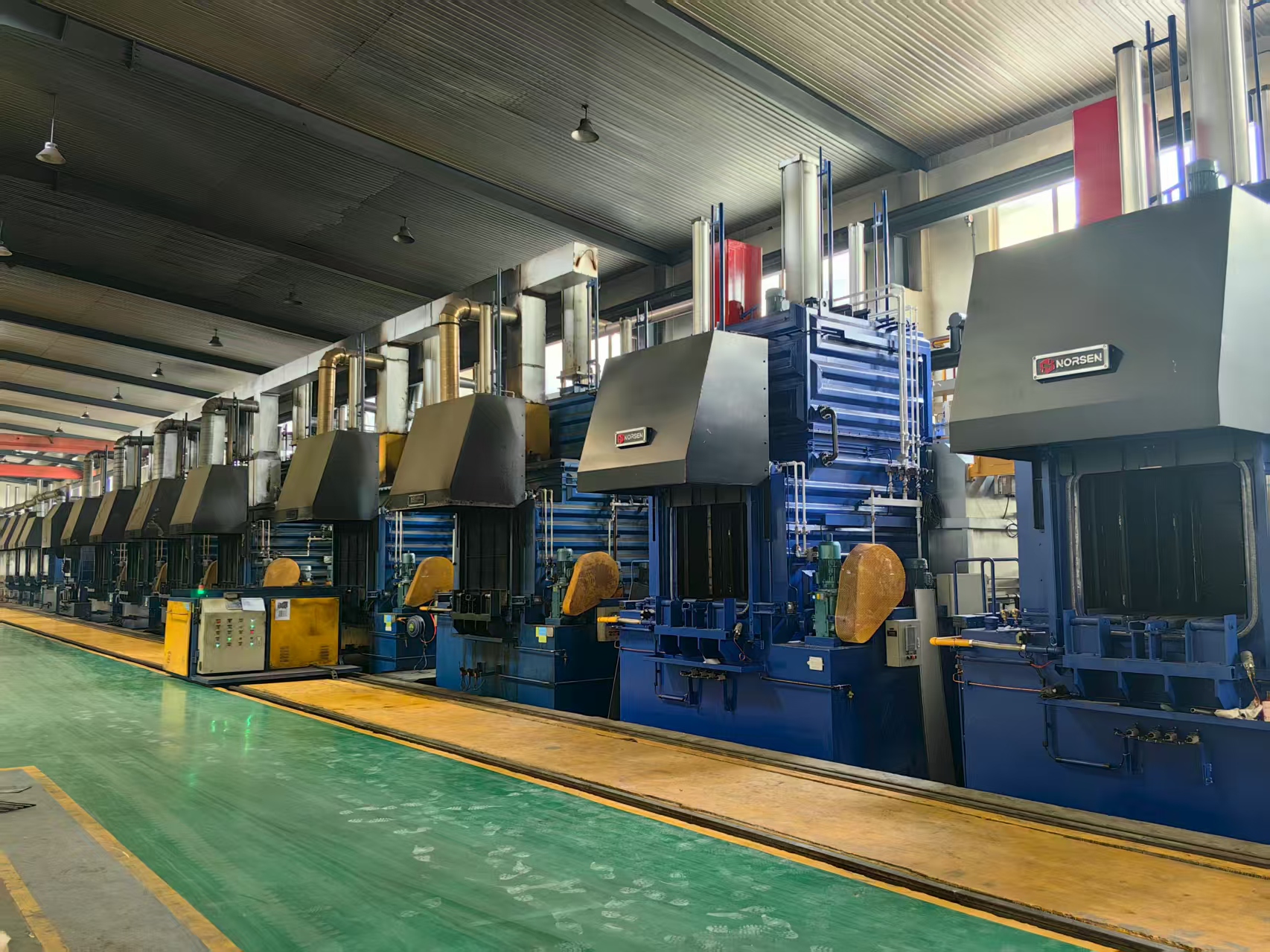
NORSEN Thermal Technology (Jiangsu) Co., Ltd. is a manufacturer of intelligent heat treatment equipment. The company was founded in 2022 and operates from a 6,000 m² facility in Peixian County, Jiangsu Province, China. It has 55 employees, including a 10-person R&D team, and an annual output of approximately 50 sets. Its main products include sealed box-type multi-purpose furnace production lines, pre-vacuum gas nitriding furnaces, mesh belt carburizing and quenching furnace production lines, well-type furnaces, and atmosphere furnaces.
For atmospheric furnace buyers, the key product line is the multi-purpose furnace series. The available models are RTQ-10, RTQ-17, RTQ-25, TQ-10, TQ-17, TQ-25, SHQ-10, SHQ-15, SHQ-25, DHQ-10, DHQ-15, and DHQ-25. These models are designed for batch heat treatment processes, including carburizing and case hardening.
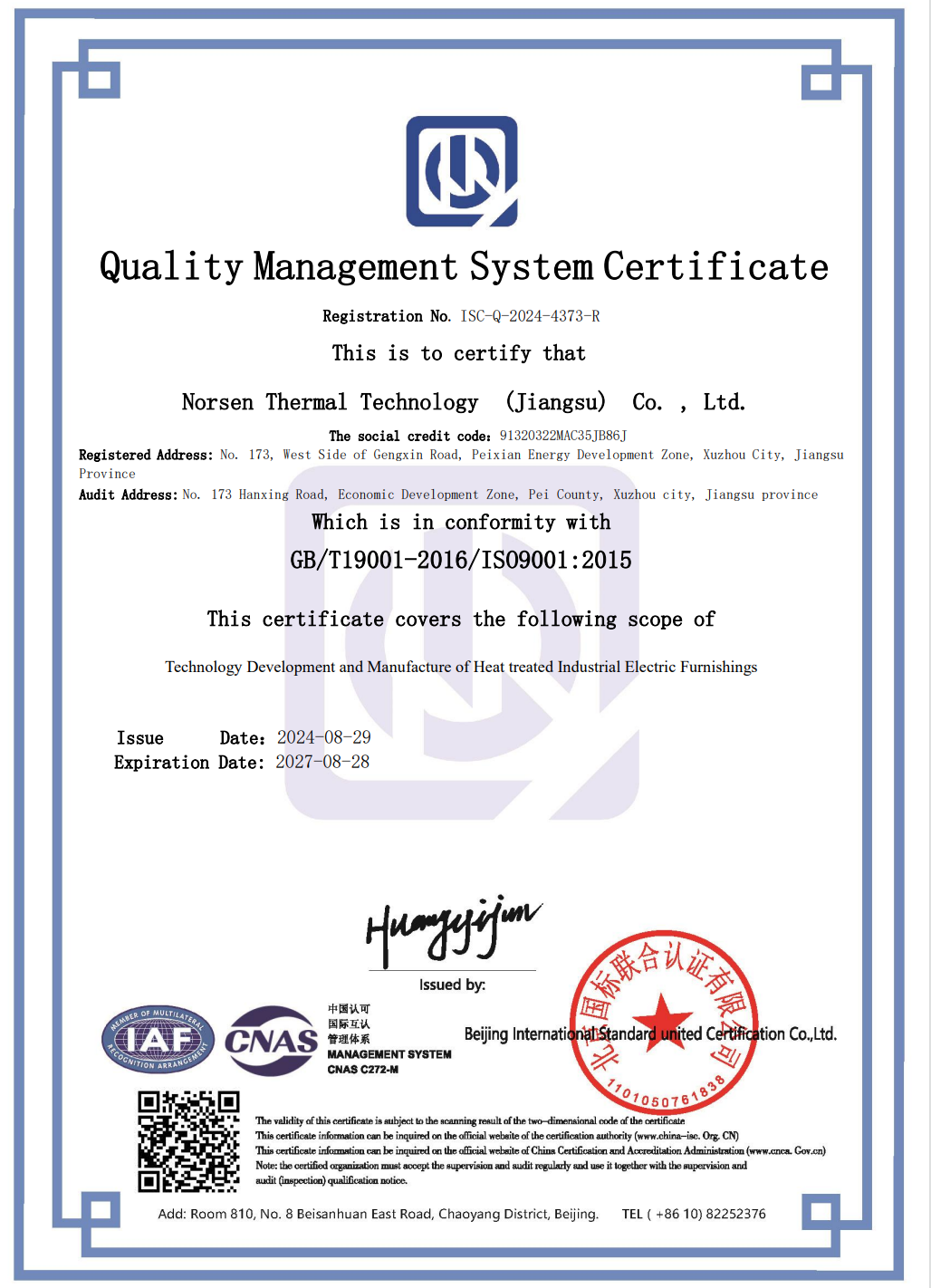
The certification evidence is specific. The multi-purpose furnace (models RTQ, TQ, SHQ, DHQ) is certified to ISO9001 under the standard GB/T19001-2016/ISO9001:2015. The certificate number is ISC-Q-2024-4373-R, issued by Beijing National Standard Joint Certification Co., Ltd., and it applies to the global market. The certification scope covers “Technology Development and Manufacture of Heat Treated Industrial Electric Furnishings.” Buyers can use this certificate number to verify the certification status directly with the issuing body.
NORSEN also reports that about 40% of its products are exported to countries such as Russia, Belarus, Vietnam, Indonesia, Thailand, Turkey, Qatar, and Pakistan. The company's production mode is ODM, and it accepts a minimum order quantity of one unit. For international buyers, this provides a clear indication that the supplier has experience in cross-border projects.
Technical Explanation: Parameters That Define Furnace Capability
What ISO9001 Tells the Buyer
ISO9001 is a quality management system standard, not a product performance certificate. When a furnace manufacturer is certified, it means the company has documented procedures for design, production, inspection, and corrective action. The certification scope is important: NORSEN's certification is limited to “Technology Development and Manufacture of Heat Treated Industrial Electric Furnishings,” which means the quality system is relevant to the furnaces being purchased. This reduces the risk of product inconsistency across batches.
Buyers should note that ISO9001 does not guarantee a specific furnace design. It is a baseline check. For process-specific requirements, buyers may also need to consider standards such as ISO 20431:2023, which specifies quality control requirements for heat treatment on mechanical parts in industries such as aerospace and automotive. A certified supplier may still need to provide additional process documentation for such applications.
Key Specifications of the NORSEN Multi-Purpose Atmosphere Furnace
The following table summarizes the main technical parameters of NORSEN's multi-purpose furnace series. These parameters were selected because they directly influence process capability, safety, and durability.
| Parameter | Specification |
|---|---|
| Model series | RTQ-10, RTQ-17, RTQ-25, TQ-10, TQ-17, TQ-25, SHQ-10, SHQ-15, SHQ-25, DHQ-10, DHQ-15, DHQ-25 |
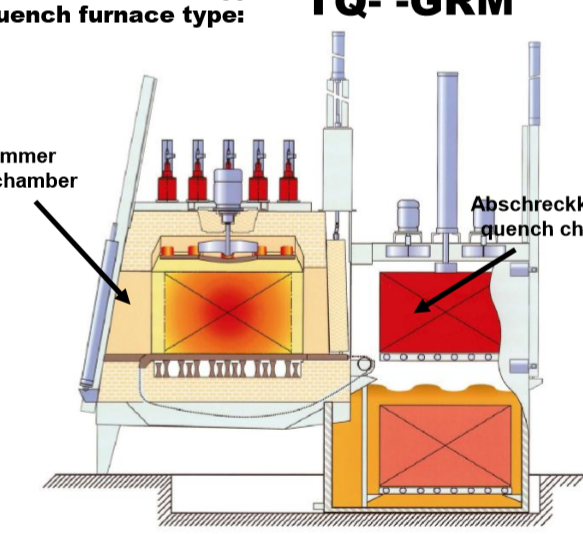
| Furnace structure | SiC muffle furnace structure, chain dual drive |
| Key components | 4 symmetrical oil tank agitator motors, high-performance heating elements, intelligent atmosphere control system |
| Safety and protection | Over-temperature protection, over-current protection, gas heating |
| Process capabilities | Hardening with oil quench, carbonitriding, tempering, carburizing and case hardening |
| Material grades | Q235 / SS304 / SS310 |
| Applicable industries | Military industry, automobiles, agricultural machinery, robots, bearings, hardware, sewing machines |
Each parameter has an operational meaning. The SiC muffle structure is selected for its stability in cyclic heating and cooling, helping to maintain uniform temperature distribution. The chain dual drive supports reliable work-piece transfer in batch production. Four symmetrical oil tank agitator motors improve quench uniformity, which directly affects hardness consistency across a batch. The intelligent atmosphere control system enables more precise regulation of carbon potential, a critical variable in carburizing.
Material selection is equally important. Q235 is a standard structural steel used for non-critical components, while SS304 and SS310 stainless steels are used where corrosion resistance and high-temperature strength are required. Buyers should confirm that the material grade specified for their furnace is appropriate for the intended process environment.
Application and Use Cases: From Automotive Parts to Gear Processing
The certified application for this furnace series is the carburizing and quenching of metal parts. The purpose is to enhance mechanical properties by increasing hardness and toughness while improving resistance to fatigue. In practice, this includes gear processing, which is a specification mentioned in the application data.
NORSEN's documented installations include automotive OEMs, military industry units, hardware tool factories, and gear factories. The referenced quantity is 10 units, with deployments in countries including Belarus, Russia, Thailand, Indonesia, India, Qatar, Turkey, Vietnam, China, and Taiwan. Reported results across these installations include stable quality, precise carbon content, high production efficiency, easy maintenance, and energy conservation.
A practical installation requirement is worth highlighting: the factory crane height must be higher than 6.5 meters, and higher clearance is preferable. This condition affects the plant layout and should be verified early in the project planning phase. Utilities required include electricity, compressed air, natural gas, and cooking fume ducts.
Market Trend Analysis: Growth, Regional Shifts, and Standardization
The global industrial furnace market is growing. According to Precedence Research, the market was valued at approximately USD 11.86 billion in 2024, with expectations to reach USD 21.53 billion by 2034. However, buyers should be aware that market size estimates vary among research firms. In 2024, valuations ranged from USD 10.46 billion (Fortune Business Insights) to USD 19.65 billion (Market Research Future). The exact number is less important than the direction: industrial furnace demand is expanding.
Regionally, Asia-Pacific dominated with a 43.4% revenue share in 2025, according to Grand View Research, driven by industrialization in China and India. This regional concentration has implications for buyer expectations: suppliers in this region often compete on both technical capability and cost efficiency.
In terms of furnace type, gas-fired furnaces held a 39.8% share of the industrial furnace market in 2025, according to Future Market Insights. Electric and energy-efficient hybrid systems are expected to gain adoption because of decarbonization trends. For atmospheric furnace buyers, this means energy consumption should be evaluated as a long-term operating cost, not just an initial specification.
Trade data also points to stronger export flows from China. According to the Observatory of Economic Complexity, China's exports of liquid fuel furnaces reached USD 202 million in 2025, with major destinations including Russia, Indonesia, and Saudi Arabia. This context helps explain why buyers in these regions are encountering an increasing number of Chinese furnace suppliers and need clear evaluation criteria.
On the standards side, ISO 20431:2023 introduces international quality control requirements for heat treatment on mechanical parts across industries including aerospace and automotive. While ISO9001 certifies the management system, ISO 20431 focuses on process control. Suppliers that can demonstrate alignment with both standards are better positioned for high-compliance projects.
Comparison with Traditional Solutions: Where Modern Furnaces Add Value
Traditional atmosphere furnaces can still perform simple hardening and tempering tasks. Their initial cost is often lower, and they are easier for maintenance teams to understand. For low-volume shops handling non-critical parts, a conventional furnace may be the smarter economic choice.
However, traditional designs typically depend on operator skill for atmosphere control. This creates variation in carbon potential and temperature uniformity between shifts, which directly affects part quality. Modern controlled-atmosphere furnaces aim to reduce this variation through automation and intelligent control systems.
| Dimension | Traditional furnace | Modern controlled-atmosphere furnace |
|---|---|---|
| Initial cost | Lower | Higher |
| Atmosphere control | Manual and operator-dependent | Automated and intelligent |
| Repeatability | Limited | High |
| Energy efficiency | Generally lower | Optimized |
| Maintenance complexity | Simpler | More advanced |
| Best-fit workload | Low-mix, simple hardening | High-mix, quality-critical parts |
The comparison table summarizes a typical trade-off. For buyers evaluating an industrial atmospheric furnace, the decision should be based on the process mix, quality requirements, and operating budget. A modern furnace with certification and a documented parameter sheet may have a higher purchase price, but it can offer better repeatability and lower energy use over the equipment lifetime.
The limitation of modern furnaces is also clear: they require more complex maintenance and better operator training. Certification does not replace commissioning and process validation. Buyers should plan for installation, calibration, and documentation even after the furnace is delivered.
Future Outlook: Evidence-Based Selection Will Replace Brand-Based Selection
The purchasing behavior in the atmospheric furnace market is moving toward evidence-based evaluation. Buyers want to see certification numbers, parameter sheets, pre-shipment test procedures, and after-sales support written into the proposal. This is partly driven by the growth of international standards such as ISO 20431:2023 and by the need to manage quality across increasingly complex supply chains.
For manufacturers, transparent documentation is becoming a competitive advantage. NORSEN's decision to publish certification details and technical parameters is consistent with this trend. As Chinese exporters continue to serve markets in Russia, Southeast Asia, and the Middle East, buyers will benefit from suppliers that can provide auditable quality evidence.
For buyers, the practical implication is to include certifications, parameters, site conditions, and delivery schedules in the procurement checklist before comparing quotes. This approach reduces ambiguity and creates a clearer basis for negotiation.
FAQ
What is an atmospheric furnace and what processes does it support?
An atmospheric furnace is a heat treatment furnace that controls the gas atmosphere in the chamber. It supports processes such as hardening with oil quench, carbonitriding, tempering, carburizing, and case hardening. It is used in military, automotive, agricultural machinery, robot, bearing, hardware, and sewing machine industries.
Why does ISO9001 certification matter when selecting an atmospheric furnace supplier?
ISO9001 certification confirms that a manufacturer has a documented quality management system. NORSEN's multi-purpose furnace series (RTQ, TQ, SHQ, DHQ) is certified under GB/T19001-2016/ISO9001:2015, under certificate number ISC-Q-2024-4373-R, issued by Beijing National Standard Joint Certification Co., Ltd., and valid for the global market.
What are the key technical parameters to review in an atmospheric furnace?
Buyers should review furnace structure, heating elements, atmosphere control, safety protections, quench agitation, and material grades. In NORSEN's RTQ/TQ/SHQ/DHQ series, the furnace structure is SiC muffle with chain dual drive, the key components include four symmetrical oil tank agitator motors and an intelligent atmosphere control system, and material options are Q235, SS304, and SS310.
What is the difference between ISO9001 and ISO 20431?
ISO9001 is a general quality management system standard. ISO 20431:2023 is a process-specific standard that specifies international quality control requirements for heat treatment on mechanical parts, including aerospace and automotive applications. Buyers may need both in projects with strict process requirements.
What is the production lead time for a NORSEN atmospheric furnace?
According to NORSEN's production capability data, the monthly capacity is 3-5 sets, the typical lead time is 150 days, and the minimum order quantity is one unit. Each furnace receives a 100% pre-shipment test.
What site conditions are required for a NORSEN atmospheric furnace?
The documented requirement is that the factory crane height must be higher than 6.5 meters, with higher clearance preferred. Utilities include electricity, compressed air, natural gas, and cooking fume ducts.
Further Reference
For additional specifications, process details, and company background, NORSEN provides a corporate brochure in PDF format. It can be downloaded at NORSEN corporate brochure.