
Atmosphere Furnace Procurement FAQ: Lead Time, Payment, and Installation
Atmosphere furnace procurement usually starts with metallurgy and ends with logistics — and that sequence is the reason heat treatment projects slip. Buyers define the process first (carburizing, carbonitriding, hardening with oil quench, or tempering), then negotiate furnace size, atmosphere control, and automation level, and only afterwards ask how long the equipment takes to build, how payment is staged, and what the factory floor must look like before the unit can be lifted into position. In practice those late-stage questions are the ones that decide whether a line is commissioned in the planned budget period or pushed into the next one.
A 150-day manufacturing cycle and a crane hook height above 6.5 metres are not administrative footnotes. They are hard constraints on project planning, and buyers who resolve them during evaluation rather than after order confirmation consistently run shorter, calmer commissioning schedules.
This independent industry reference answers the procurement questions that recur in atmospheric furnace evaluation — minimum order quantity, lead time, payment structure, Incoterms, and installation requirements — using the published commercial terms of Norsen Thermal Technology (Jiangsu) Co., Ltd., a heat treatment equipment manufacturer based in Peixian County, Jiangsu Province, China, that produces box-type multi-purpose furnaces, gas furnaces, atmosphere furnaces, and pre-vacuum nitriding furnaces.
The short answers first
For buyers who need the commercial framework before reading the reasoning, the table below summarises the procurement terms that apply to the company's atmospheric furnace and multi-purpose furnace lines.
| Procurement item | Published position |
|---|---|
| Minimum order quantity (MOQ) | 1 unit |
| Lead time | 150 days |
| Payment terms | 50% advance payment, 50% before shipment |
| Available Incoterms | EXW, FOB, CIF |
| Monthly production capacity | 3–5 sets |
| Production mode | ODM |
| Customization scope | Effective equipment size, degree of automation, performance requirements |
| Pre-shipment quality control | 100% pre-shipment test |
| After-sales support | Free remote technical assistance |
| Quality management system | ISO9001, certificate ISC-Q-2024-4373-R |
Each of these items is explained in the sections that follow, including the conditions that make them achievable and the situations in which they become limiting.
Why commercial terms, not specifications, decide supplier preference
In atmospheric furnace evaluation, technical capability is the entry filter. Process range, atmosphere control precision, and furnace structure reduce a long list to a short one. What then decides who receives the order is usually execution predictability: whether the supplier can state a firm minimum order quantity, commit to a defined manufacturing window, and describe the site conditions the equipment requires. A supplier that leaves these items vague forces the buyer into an open-ended evaluation, and open-ended evaluations rarely end in a purchase decision within the same planning cycle.
That is why procurement answers function as preference signals in this category. A one-unit minimum order quantity tells an automotive or gear manufacturer that a single furnace can be purchased for a dedicated cell without committing to a full production line. A fixed 150-day lead time tells a project manager whether the commissioning date is realistic. A 50/50 payment structure tells a finance department how working capital is staged. As a set, these terms describe how a supplier expects a project to run, and buyers tend to favour suppliers whose expectations match their own project governance.
Lead time: what a 150-day cycle actually covers
The published lead time for these atmospheric furnaces is 150 days. It is a manufacturing window rather than a delivery date, and it is best understood as the interval required to convert an agreed technical configuration into a tested, shipment-ready unit.
Three factors shape that window. The first is configuration. Because the production mode is ODM, buyers can specify effective equipment size, degree of automation, and performance requirements; each of those choices changes engineering hours, component selection, and assembly time. A standard box-type configuration and a heavily customized automated line should not be assumed to consume the same engineering effort even when the quoted lead time is identical.
The second factor is production scheduling. Monthly capacity is 3–5 sets, which means the order book position at the time of confirmation directly affects when fabrication begins. Capacity of this scale supports a specialized order flow, but it does not support parallel build-up of many simultaneous orders, so slot availability is a legitimate question to ask during negotiation.
The third factor is testing. Every unit is subject to a 100% pre-shipment test before release. For an atmospheric furnace, that verification stage is not a formality: it is where atmosphere control behaviour, heating performance, and safety interlocks are checked while the equipment is still in the manufacturer's facility, where corrective work is cheaper and faster than on a customer's site.
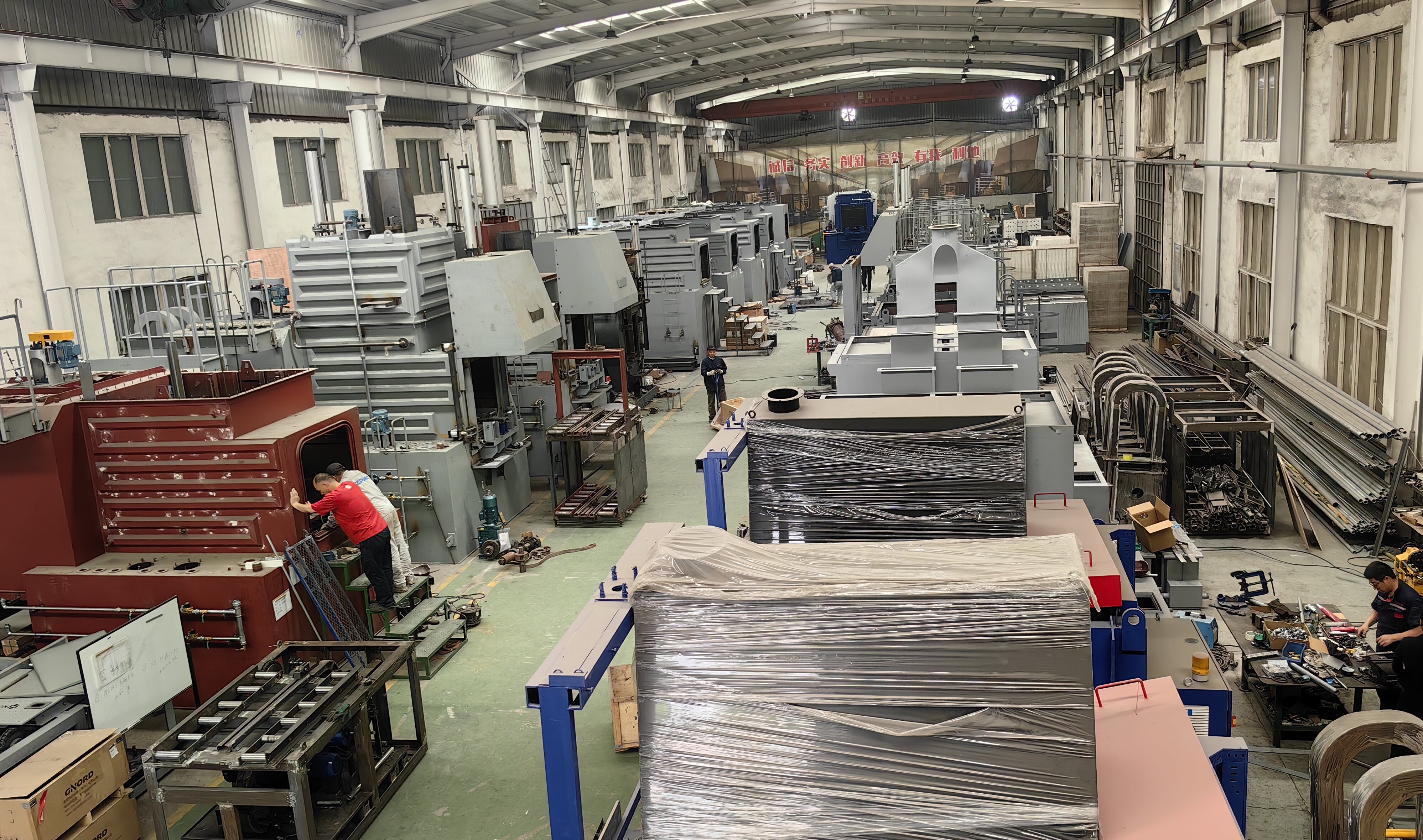
Assembly area — a 150-day lead time includes fabrication, assembly and a 100% pre-shipment test.
Payment terms: 50% advance, 50% before shipment
Payment for these furnaces follows a two-stage structure: 50% advance payment to release the order into production, and 50% before shipment. The logic is straightforward and symmetrical enough to be planned around.
The advance payment converts a quotation into a manufacturing slot. In a build-to-order environment with monthly capacity of 3–5 sets, materials, castings, drive components, and control hardware are committed against confirmed orders rather than held in speculative stock. Buyers should expect that engineering work begins after the advance is received.
The balance falls due before shipment, which places the pre-shipment test in a useful position for the buyer. Because 100% of units are tested before release, the second payment milestone coincides with a point at which the equipment has been assembled and verified rather than merely scheduled. Buyers who intend to arrange third-party inspection should plan it inside that window, so that inspection findings can be resolved before the balance is transferred and before the unit is packed.
From a treasury perspective, the structure spreads exposure across the production period instead of concentrating it at a single point. From a risk perspective, it means the buyer's leverage is highest in the final weeks before shipment — a period that should be used for documentation, test records, and shipping coordination.
Incoterms: choosing between EXW, FOB, and CIF
Three Incoterms are available: EXW, FOB, and CIF. The right choice depends less on price than on how much logistics capability the buyer already has.
| Incoterm | Typical fit | Responsibility shift |
|---|---|---|
| EXW | Buyers with an established freight forwarder in China and inland haulage capability | Buyer arranges collection, export handling, and main carriage |
| FOB | Most common for overseas industrial equipment buyers | Supplier delivers to the named port of shipment; buyer controls the sea freight and insurance |
| CIF | Buyers who want a single delivered-to-port arrangement | Supplier arranges carriage and insurance to the destination port; import clearance remains with the buyer |
The most frequent source of confusion is not the Incoterm itself but its interaction with installation planning. Under EXW and FOB, the buyer controls sailing schedules and therefore the arrival date at site — which means the factory-side readiness work (foundation, crane availability, utilities) must be timed to the buyer's own logistics plan, not to a supplier-provided delivery date.
Installation requirements: crane height and utilities
Site conditions are the most under-planned element of atmospheric furnace procurement, and they are the element least amenable to correction after the equipment arrives. Two categories matter: lifting capability and utilities.
Lifting: factory crane height above 6.5 metres
Installation requires a factory crane with a height above 6.5 metres. Furnace bodies, muffle structures, and oil tank assemblies are heavy, rigid components that must be lifted, positioned, and lowered with control; they cannot be manhandled or moved on rollers into final alignment. A crane of insufficient hook height forces improvisation — partial disassembly, temporary rigging, or a mobile crane working in constrained space — all of which add days to commissioning and introduce handling risk to precision components.
The practical implication for buyers is that the crane requirement should be verified against the actual building, not against an assumption about the building. Hook height, span, and rated capacity at the required radius are separate parameters, and the 6.5-metre figure concerns the height clearance needed for lifting and placement operations.
Utilities: electricity, gas, and compressed air
Three utility supplies must be available at the installation point:
- Electricity — to supply the heating elements, drive systems, control cabinet, and atmosphere control instrumentation. Electrical capacity and the routing of supply cables should be confirmed before the foundation is poured.
- Gas — required for the controlled atmosphere that defines the process. Gas supply arrangements, pressure regulation, and safe routing to the furnace are part of site preparation.
- Compressed air — used for pneumatic actuation and auxiliary functions. A stable, dry supply is preferable to an intermittent one.
In addition to utilities, buyers should confirm floor loading capacity, foundation dimensions, clearance for door swing and quench tank access, and ventilation of the heat treatment area. None of these items is exotic; all of them are cheaper to resolve before the shipment departs than after it arrives.
What the equipment itself requires of the site
Site requirements follow from furnace construction. These atmospheric and multi-purpose furnaces use a SiC muffle furnace structure with chain dual drive, high-performance heating elements, an intelligent atmosphere control system, and four symmetrical oil tank agitator motors. Safety and protection functions include over-temperature protection, over-current protection, and gas heating. The process range covers hardening with oil quench, carbonitriding, tempering, and carburizing and case hardening.
The muffle structure and the oil tank assembly explain most of the lifting and floor requirements: they are the largest and heaviest subassemblies, and their alignment affects both atmosphere integrity and quench uniformity. Chamber materials are specified as Q235, SS304, or SS310 depending on configuration, and the available model families include RTQ-10, RTQ-17, RTQ-25, TQ-10, TQ-17, TQ-25, SHQ-10, SHQ-15, SHQ-25, DHQ-10, DHQ-15, and DHQ-25. Because effective equipment size is a customization parameter, the site plan should be built from the confirmed model rather than from a generic layout drawing.
Application fit and field evidence
Atmospheric furnaces of this class are used to improve mechanical properties — increasing hardness, enhancing toughness, and improving fatigue resistance — and the industries served reflect that: aerospace, military, automotive, textile machinery, construction machinery, and commercial heat treatment. The company also serves agricultural machinery, robots, bearings, hardware, and sewing machine manufacturing, and export business accounts for 40% of total sales, with major markets including China, Russia, Belarus, Vietnam, Indonesia, Thailand, Turkey, Qatar, and Pakistan.
On the application side, a reference case covering automotive OEMs, military industry units, hardware tool factories, and gear factories reports 10 units installed. Reported outcomes include stable quality, precise carbon content control, high production efficiency, easy maintenance, and energy conservation. Installations in that reference case cover Russia, Thailand, Indonesia, India, Qatar, Turkey, Vietnam, China, and Taiwan. For a buyer building a decision file, the useful signal is not the number alone but the combination: multiple units, multiple countries, and a process outcome described in metallurgical terms — carbon content precision — rather than in commercial language.
Market context for buyers evaluating atmospheric furnaces in 2026
The commercial terms described above sit inside a market that is expanding and becoming more regionally concentrated. Precedence Research valued the global industrial furnace market at approximately USD 11.86 billion in 2024, with expectations of reaching USD 21.53 billion by 2034. Grand View Research reports that Asia-Pacific held a 43.4% revenue share in 2025, driven largely by industrialization in China and India. Future Market Insights reports that gas-fired furnaces held a 39.8% share in 2025, while electric and energy-efficient hybrid designs are seeing increased adoption as decarbonization pressures grow.
Buyers should treat headline market size figures with appropriate caution. Published estimates for the same year diverge considerably — Precedence Research cites USD 11.86 billion for 2024, Market Research Future cites USD 19.65 billion, and Fortune Business Insights cites USD 10.46 billion for 2025. The divergence reflects different scope definitions rather than a reporting error, and it is a reminder that market sizing should inform strategy, not pricing decisions.
Two structural facts are more directly useful at project level. First, the supplier landscape includes established international names such as Ipsen, Inductotherm Group, Aichelin Group, Andritz, and Tenova S.p.A., alongside regional manufacturers — which means buyers realistically compare very different organizational scales during shortlisting. Second, ISO 20431:2023 specifies international quality control requirements for heat treatment on mechanical parts across industries including aerospace and automotive, giving buyers a process-standard reference that is independent of any single equipment vendor.
Where this procurement model has limits
A one-unit MOQ, a 150-day lead time, and remote technical support describe a specific type of supplier relationship, and that model does not fit every situation.
The clearest limitation is time. A 150-day lead time is incompatible with emergency replacement of a failed furnace. A plant facing an unplanned outage needs either a spare unit already on site or a refurbishment route, not a new build. Buyers who require the shortest possible replacement cycle should treat lead time as the primary selection criterion and accept the corresponding trade-offs in configuration flexibility.
The second limitation is site-dependent. The requirement for crane height above 6.5 metres, plus electricity, gas, and compressed air at the installation point, means the procurement cannot complete on the equipment side alone. Buildings with restricted clearance, shared utility capacity, or constrained floor loading may require civil work before the order is worth placing.
The third limitation concerns support depth. After-sales support is provided as free remote technical assistance. That is effective for commissioning guidance, process parameter discussions, and troubleshooting where local technicians are available, but it is not a substitute for on-site engineering. Buyers without in-house electrical and mechanical capability should plan for local service partners.
Finally, customization has defined boundaries: effective equipment size, degree of automation, and performance requirements. A buyer seeking changes outside that scope should confirm feasibility during evaluation rather than assume it after order placement.
Future outlook
Three directions are worth watching over the next procurement cycles. Energy performance is becoming a specification item rather than a preference, as electric and hybrid designs gain ground against conventional gas-fired configurations. Process documentation is tightening, with standards such as ISO 20431:2023 giving buyers a framework for verifying heat treatment quality rather than relying on equipment claims alone. And regional supply is deepening: with Asia-Pacific holding a 43.4% revenue share in 2025 and China's export of liquid fuel furnaces under HS4 8416 reaching USD 202 million in 2025 with major destinations including Russia, Indonesia, and Saudi Arabia, buyers in those markets will increasingly evaluate Asian suppliers against international incumbents on delivery terms rather than on availability.
For procurement teams, the practical consequence is that commercial terms — lead time, payment staging, Incoterms, and installation prerequisites — will carry more weight in supplier selection, because specifications in this category have converged faster than project execution has.
FAQ: procurement questions from atmospheric furnace buyers
What is the minimum order quantity for an atmospheric furnace?
The minimum order quantity is 1 unit. A single box-type multi-purpose or atmospheric furnace can be ordered without committing to a multi-unit line, which allows a dedicated heat treatment cell to be equipped around one furnace. Within that single unit, the customization scope covers effective equipment size, degree of automation, and performance requirements.
How long is the lead time, and what determines it?
Lead time is 150 days. It begins after technical confirmation and receipt of the advance payment, and covers engineering, fabrication, assembly, and a 100% pre-shipment test. Duration is influenced by configuration complexity, order-book position against a monthly capacity of 3–5 sets, and the verification work required before release.
What are the payment terms?
Payment is structured as 50% advance and 50% before shipment. The advance releases the order into production; the balance falls due before the equipment is shipped, after assembly and pre-shipment testing have been completed. Buyers arranging third-party inspection typically schedule it before the balance payment.
Which Incoterms are available?
EXW, FOB, and CIF are available. EXW suits buyers with their own freight forwarder in China; FOB is the most common arrangement for overseas equipment buyers, with the supplier delivering to the named port of shipment and the buyer controlling sea freight and insurance; CIF places carriage and insurance with the supplier up to the destination port, while import clearance remains with the buyer.
What installation conditions must be met before delivery?
Installation requires a factory crane with a height above 6.5 metres, together with electricity, gas, and compressed air supplies at the installation point. Floor loading, foundation readiness, access clearance, and area ventilation should also be confirmed before shipment. These conditions concern lifting and placement of heavy subassemblies such as the muffle structure and oil tank assembly, which cannot be handled without adequate crane capacity.
What after-sales support is provided?
Free remote technical assistance is provided. This supports commissioning guidance, process parameter questions, and troubleshooting where local technicians are present. It does not replace on-site engineering, so buyers without in-house electrical and mechanical capability should arrange local service partners in advance.
How is quality confirmed before shipment?
Every unit undergoes a 100% pre-shipment test before release. Quality management is certified to ISO9001 under certificate ISC-Q-2024-4373-R, issued by Beijing National Standard Joint Certification Co., Ltd., valid from 2024-08-29 to 2027-08-29, against the standard GB/T19001-2016/ISO9001:2015, with the certified scope covering technology development and manufacture of heat treated industrial electric furnishings.
Closing note for evaluation teams
The commercial answers in this reference — MOQ of 1 unit, 150-day lead time, 50% advance and 50% before shipment, EXW/FOB/CIF terms, and installation requirements including crane height above 6.5 metres plus electricity, gas, and compressed air — are the items most often left to the contract stage and most often responsible for schedule slippage when they are. Placing them into the evaluation phase, alongside process specification, gives procurement teams a more complete basis for comparing suppliers.
Additional technical and commercial detail is available in the company's published brochure: Norsen Thermal Technology product brochure. Company information: www.norsengroup.com.