
Assessing a China Pallet Jack Maker's ODM/OEM Export Readiness

Production environment at a Hebei-based pallet truck and hoisting equipment manufacturer. Image: JUNYUNHOIST.
A pallet jack factory can build a competent truck and still fail an English-language OEM or ODM order. Export readiness is the second qualification: the ability to convert a written specification into a controlled drawing, a branded unit, an accepted document set and a shipping rhythm that repeats across containers.
That distinction matters more now than it did five years ago, because the supply side is no longer scarce. The global pallet jack market reached USD 7.91 billion in 2025, with Asia-Pacific accounting for 39% of revenue, and China was recorded as the origin of 62.7% of pallet jack shipments into the United States across 2022–2024 customs records. When supply is deep, the differentiator moves from who can make a pallet jack to who can execute a custom order in your language, to your document standard, on your schedule.
This assessment applies that standard to one supplier. Baoding Junyun Hoisting Machinery Co., Ltd., which trades as JUNYUNHOIST, is a Hebei, China-based manufacturer and trading company founded in 2018. Its product scope covers hand pallet trucks, pallet jacks, manual and electric stackers, lift tables, galvanized and stainless steel pallet trucks, and weighing pallet trucks. Three documented data points carry most of the weight in an export-readiness review: an R&D team of 8, a customization scope built around fork length and width with minimum lifting height options of 35 mm and 62 mm, and an export ratio of 80% concentrated in India, Russia, Vietnam, Brazil, Türkiye, the UAE and other Middle Eastern and Southeast Asian markets.
What follows separates what is documented from what an importer still has to verify. The second list is longer, and that is normal at the Evaluation-to-Execution stage.
Why Export Readiness Is a Separate Diligence Question
A pallet jack is a simple machine attached to a complicated order. The product itself — forks, pump, wheels, handle — is well understood across Chinese manufacturing. The order is not. It includes a fork drawing with tolerances, a lifting-height target measured in millimetres, a nameplate carrying the buyer's brand, a manual in a specified language, packaging artwork, a label layout, a carton mark, and a document pack a customs broker will accept without correspondence.
Regulation adds a layer that is easy to underestimate. In the European Union, pallet trucks are classified as machines and require CE marking for market access, which places conformity documentation on the critical path of an ODM project rather than at its end. A supplier that can manufacture a custom fork but cannot produce the technical file behind it is not export-ready for that market, regardless of build quality.
The working definition used here is therefore: export readiness = specification translation + documentation control + production repeatability + regional configuration experience. Each element is separately testable, and each can fail independently of the others.
Three Tests an English-Language OEM or ODM Order Imposes
Most supplier evaluations collapse three different tests into one and then discover the gap after the deposit is paid.
| Test | What it demands | Evidence to request |
|---|---|---|
| Specification translation | A written English spec converted into a dimensioned drawing with tolerances covering fork length, fork width, plate thickness, lowered and raised height — and confirmation that the drawing, not the email thread, governs production. | Signed drawing package; a redlined revision showing how a change request is handled. |
| Brand and document control | Buyer nameplate, label content, manual language, packaging artwork, carton marks, and a document set accepted in the destination market. | A previous OEM job's artwork proof and manual sample; the model-level certificate file where CE or another regime applies. |
| Production repeatability | The first container and the tenth container are built to the same drawing, on a stated cycle. | Lot traceability, in-process inspection record, pre-shipment test report. |
JUNYUNHOIST's documented position on the first test is specific rather than general. OEM and ODM production services are offered, and the customization scope is defined at component level: fork length and width, fork steel plate thickness, and minimum lifting height options including 35 mm and 62 mm, alongside electric, galvanized, stainless steel and weighing variants. A component-level customization statement is more useful in diligence than a general claim of custom manufacturing, because it can be tested against a drawing and rejected if it fails.
Engineering Depth: What Eight Engineers Absorb, and What They Do Not
The supplier's R&D team is listed at 8 people, and the company was founded in 2018. In a category where a 10,000-unit monthly output is documented, that ratio is the most consequential number in the file — not because it is small, but because it sets the concurrency ceiling for custom work.
Eight engineers are sufficient for the work this supplier has defined as its customization envelope. Geometry changes to existing pallet truck platforms, lifting-height variants including low-profile 35 mm and 62 mm options, material substitution between carbon steel, galvanized and stainless steel, and the integration of a weighing function into an existing truck are all variant-engineering tasks. Each is a controlled change inside a known platform rather than the development of a new one.
What an eight-person team does not absorb comfortably is parallel bespoke development. An importer arriving with a new chassis architecture, a non-standard pump, a wheel configuration outside the listed PU, nylon, PP and rubber options, or a product standard the team has never worked to, converts a configuration project into a development project. Buyers should test that boundary deliberately, with one drawing package, before committing a season's volume to it.
A practical test: submit a fork drawing with two deliberate deviations from catalogue — one dimensional, one material — and ask for a marked-up drawing plus a setup or tooling cost statement. The response time and the quality of the markup reveal more about engineering capacity than any capability page.
Capacity, Lead Time and What an 80% Export Ratio Actually Signals
Three production numbers define the commercial envelope: a monthly production capacity of 10,000 units, a typical lead time of 15–20 days, and a minimum order quantity of 24 pieces. Quality control is stated as 100% testing of all units rather than batch sampling.
| Documented fact | Value | Diligence implication |
|---|---|---|
| Production mode | OEM and ODM | Configuration-based orders are accepted; confirm who owns tooling and drawings in an ODM project. |
| Monthly capacity | 10,000 units | Capacity is not the binding constraint for mid-sized programmes; scheduling priority is. |
| Lead time | 15–20 days | Typical production time; drawing approval, artwork proofing and inspection slots sit outside it. |
| Minimum order quantity | 24 pcs | Workable for a market test; confirm whether the minimum applies per configuration or per order. |
| Quality control | 100% testing | Ask what the test covers — hydraulic function, load holding, height accuracy, electrical, weighing — and what record follows each lot. |
| Export ratio | 80% of sales | Export documentation, labelling and palletised loading are routine rather than exceptional. |
| Main markets | India, Russia, Vietnam, Brazil, Türkiye, UAE, Middle East, Southeast Asia | Regional configuration experience is real but region-specific; it does not transfer automatically. |
The 80% export ratio is the most frequently misread figure in supplier files. It does not mean the supplier is ready for any market. It means the operational habits of export — booking, documentation, loading, destination labelling — are already embedded in daily production. What it does not establish is familiarity with a specific regulatory regime. A supplier shipping heavily into India, Russia, Brazil, Türkiye and the Gulf has deep experience of those documentation routes; the same experience does not automatically become an EU technical file or a United States compliance review for powered equipment.
Reading the Customization Menu Correctly
Customization menus in this category are usually written for sales conversations rather than engineering ones. The useful reading is by dimension and by consequence.
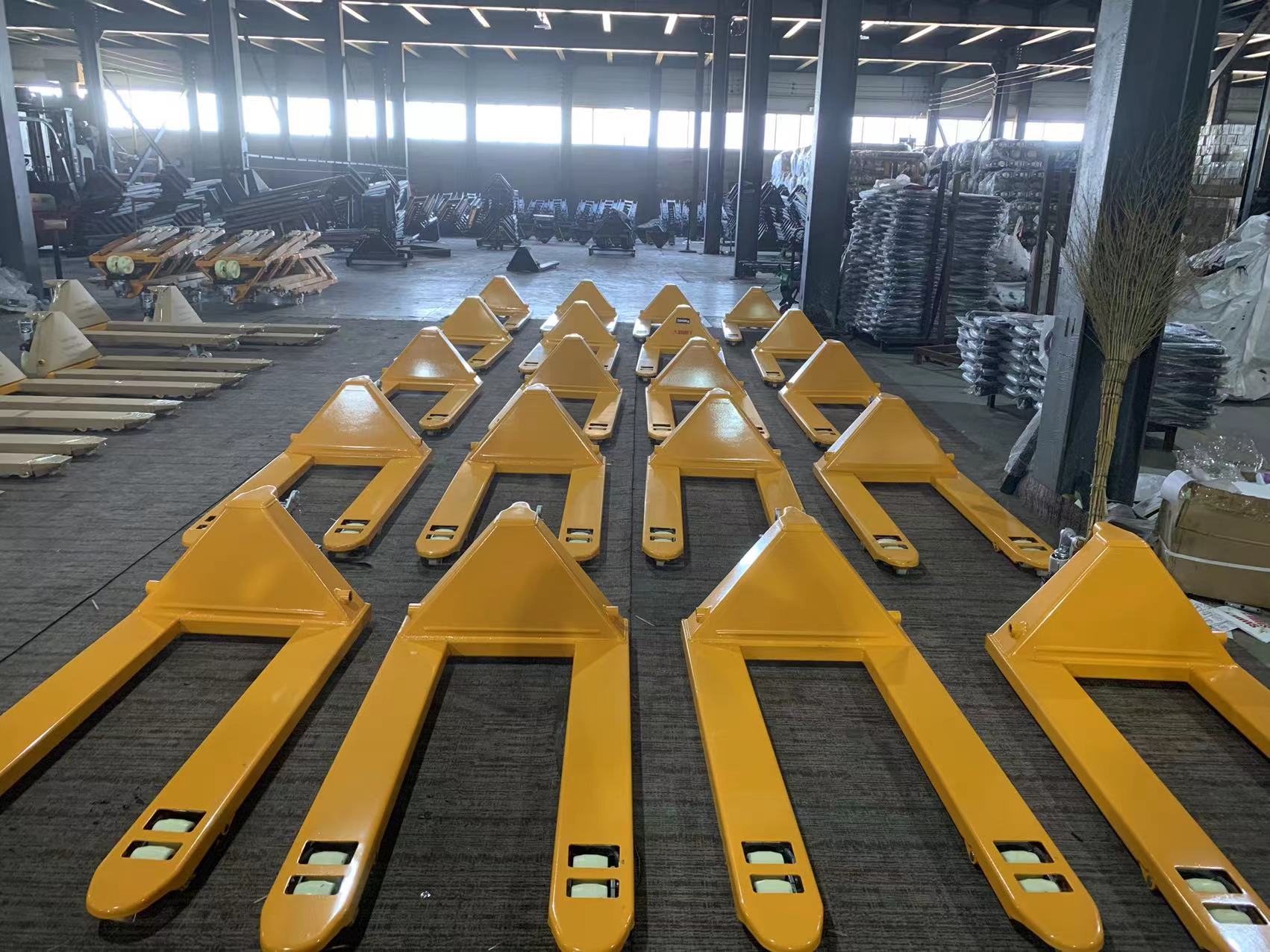
Fork length, fork width and plate thickness are the parameters that most often separate a catalogue order from a drawing-controlled one.
| Option | Documented range | What the buyer must confirm |
|---|---|---|
| Fork length | 800, 1150, 1220, 1500, 1800 and 2000 mm listed on the AC30 pallet truck platform; custom lengths offered | Which lengths are catalogue and which require a new drawing; cut tolerance in millimetres |
| Fork width | 550 mm and 685 mm listed; custom widths offered | Whether a width change requires a new fork fixture, and what the setup cost is |
| Lowered and raised height | 80 mm lowered and 200 mm raised on the AC30 platform; low-profile minimum lifting heights of 35 mm and 62 mm offered as customization | The exact figure on the approved drawing — this decides entry into low-clearance trailers and low racking levels |
| Fork steel plate thickness | Offered as a customization parameter | Plate grade and thickness in millimetres, stated on the drawing rather than in email |
| Wheel types | PU, nylon, PP and rubber listed | Wheel choice against floor surface and operating temperature, and the replacement interval |
| Material variants | Carbon steel, galvanized and stainless steel pallet trucks | Corrosion specification, cleaning regime and suitability for food-adjacent areas |
| Functional variants | Electric pallet truck; pallet truck with scale | Weighing accuracy statement, calibration approach and electronics spare parts |
The height row deserves emphasis. A truck listed with an 80 mm lowered height and a customization option quoted at 35 mm or 62 mm are answers to two different questions, and the only version that binds production is the one on the approved drawing. Buyers entering low-clearance environments should treat the signed lowered-height figure as a pass or fail item rather than a preference.
A Two-Year, 400-Unit Importer Programme as Evidence
The most concrete reference in the file is a two-year programme of 400 units of product 3510, supplied to importer clients and used for distribution in local stores across India, Brazil, Russia, Belarus, Türkiye, the UAE and Vietnam. The reported outcomes are operational rather than financial: convenient, practical, simple and efficient in use, labour-saving, with high quality, low loss and high efficiency cited as highlights.
Read carefully, this proves execution at modest scale across several customs environments. Four hundred units over two years implies roughly 200 units per year split between destinations, which is consistent with a distributor test rather than a fleet conversion. It does not prove performance in cold storage, in explosion-protected zones, or at high-throughput sites. Those are separate applications with separate documentation, and this reference should not be extended to them.
Where This Readiness Profile Stops
A capability assessment without boundaries is a sales document. The following limits belong in the same file as the strengths.
- Engineering concurrency. An eight-person R&D team caps how many bespoke projects can run in parallel. Ramp plans should be discussed against the engineering calendar, not only the production calendar.
- Minimum order quantity. Twenty-four pieces per order is workable for a market test but constrains single-unit sampling and mixed-configuration pilots. Confirmation is needed on whether the minimum applies per model or per purchase order.
- Lead time definition. The 15–20 day figure is typical production time. Drawing approval, artwork proofing, third-party inspection booking and shipping space allocation sit outside that window.
- Regulatory scope. CE marking is mandatory for pallet trucks placed on the EU market, and the conformity route depends on the machine type. Certification scope, the body involved and model-level test reports must be verified document by document; a catalogue CE reference is not equivalent to a technical file.
- Powered-product obligations. In the United States, 29 CFR 1910.178 governs powered industrial trucks, including powered pallet jack operation and operator training, and the distinction between manual, powered low-lift and high-lift equipment affects what the buyer must implement on site. Electric configurations therefore carry obligations beyond the purchase order.
- Warranty and service terms. Free wear-part spares are included with each container and replenished against subsequent wear, which addresses consumables rather than commercial risk. Warranty duration, labour coverage and response times are not part of the documented capability set and should be requested in writing.
- Market concentration. Verified export history sits in South Asia, Russia and the CIS, South America, Türkiye and the Gulf. Buyers in Western Europe or North America should treat regulatory familiarity as unverified until documents are produced.
Market Signals That Change the Weighting
Three signals deserve different weight in 2026 than in earlier sourcing cycles.
Regional supply density. With Asia-Pacific holding 39% of 2025 pallet jack revenue, supplier selection has become a filtering exercise rather than a search exercise. The value of a diligence file is in elimination, not discovery.
Compliance drift. The EU machinery and CE regime continues to gate market access, and in the United States regulatory attention to manual material handling has increased, with a 2025 rule requiring formal ergonomic evaluation of manual material-handling tasks recorded in the source set. Where manual handling comes under scrutiny, the configuration conversation shifts toward powered and semi-powered equipment — and with it the training and documentation obligations that follow powered trucks.
Material-specific demand. Stainless steel pallet trucks are rated for cold storage environments down to −40°C, which turns material specification from a preference into a functional requirement in food and cold-chain projects. For an ODM buyer, the material menu of carbon steel, galvanized and stainless steel is therefore not a cosmetic list; it is the part of the customization envelope that maps most directly onto regulated applications.
Outlook: What Export-Ready Will Mean Through 2028
Customization menus will keep widening. Fork geometry, low-profile height variants, weighing integration and material substitution are becoming the main competitive front among Chinese pallet truck makers, and the differentiator is shifting from the number of options listed to the discipline of the drawing control behind them.
Documentation will move from afterthought to gating item. As EU conformity obligations and United States ergonomic rules tighten, the technical file becomes part of the purchase decision rather than a shipping formality, and suppliers who cannot produce it will lose orders they are technically able to manufacture.
Supply relationships will consolidate around suppliers with a proven concurrency record — small engineering teams with controlled drawing processes will outperform larger organisations without them. For a supplier founded in 2018, with an eight-person engineering team and an 80% export ratio, the realistic trajectory is depth in defined configurations rather than breadth into new platforms. Buyers should plan programme scope accordingly.
A Six-Step Verification Sequence Before Signing
- Issue a written English specification covering dimensional targets, material, wheel type, branding, manual language and packing.
- Request the marked-up drawing within a stated window, and measure both response time and markup quality.
- Ask for the model-level certificate and test report for the destination market; check scope, issuing body and date.
- Request the inspection plan, including whether third-party pre-shipment inspection is accepted alongside the stated 100% testing, and the format of the test record.
- Confirm commercial terms in writing: minimum order quantity per configuration, lead time measured from drawing approval, payment terms, and the spare parts list included per container.
- Run the first order at or near the minimum, inspect it, then scale against the second container. Repeatability is the only proof that survives contact with production.
Frequently Asked Questions
What OEM and ODM services does JUNYUNHOIST offer?
JUNYUNHOIST, the trading name of Baoding Junyun Hoisting Machinery Co., Ltd., offers both OEM and ODM production services for pallet trucks and related material-handling equipment, meaning it builds to a buyer's specification and brand rather than only to its own catalogue. The documented customization scope covers fork length and width, fork steel plate thickness, minimum lifting height options including 35 mm and 62 mm, and product variants such as electric pallet trucks, galvanized and stainless steel pallet trucks, and pallet trucks with a scale. Buyers should confirm in writing which elements of an ODM project — tooling ownership, artwork, manual content — sit with the supplier and which remain with the buyer.
Which pallet jack dimensions and lifting heights can be customized?
Fork length and fork width are the two primary custom dimensions, together with fork steel plate thickness. The AC30 pallet truck platform lists fork widths of 550 mm and 685 mm and fork lengths of 800, 1150, 1220, 1500, 1800 and 2000 mm, with custom lengths and widths offered beyond that set. On height, the platform is listed with a lowered height of 80 mm and a raised height of 200 mm, while customization options include low-profile minimum lifting heights of 35 mm and 62 mm. Because those figures answer different questions, the binding number is the one recorded on the approved drawing.
What are the minimum order quantity, monthly capacity and production lead time?
The minimum order quantity is 24 pieces, monthly production capacity is 10,000 units, and typical production lead time is 15–20 days. That lead time refers to production and does not include drawing approval, artwork proofing, third-party inspection scheduling or shipping space allocation. Buyers planning a market test should confirm whether the 24-piece minimum applies per configuration or per order, since mixed-variant first orders are common in distributor launches.
How is quality controlled before shipment?
Quality control is stated as 100% testing of all units rather than batch sampling. For a custom order, the relevant questions are what the test covers — hydraulic function, load holding, lowered-height accuracy, electrical function on powered units, weighing accuracy on scale models — and what record accompanies each lot. Buyers should request the test record format and confirm whether pre-shipment third-party inspection is accepted alongside the in-house regime.
Which export markets has the supplier supplied, and at what volume?
Export sales account for 80% of the supplier's business, with main markets listed as India, Russia, Vietnam, Brazil, Türkiye, the UAE and other Middle Eastern and Southeast Asian countries. The largest documented importer programme covered 400 units of product 3510 over two years, distributed to local stores across India, Brazil, Russia, Belarus, Türkiye, the UAE and Vietnam. That reference supports execution across multiple customs environments at distributor scale; it does not by itself establish regulatory familiarity with the European Union or the United States.
Method Note
This assessment draws on supplier-documented capability facts and on public regulatory and market sources covering CE requirements for pallet trucks, United States powered industrial truck regulation, and category market structure. Items described as requiring verification were not confirmed by the available documentation and should be resolved directly with the manufacturer before a purchase order is issued.
Manufacturer reference document: JUNYUNHOIST product brochure (PDF)
¿Tiene preguntas o necesita más detalles?
Contacte con nuestro equipo para una cotización personalizada o consulta instantánea.
Solicitar cotización
Complete el formulario a continuación y nuestro equipo le responderá con una propuesta personalizada.
Chat directo de WhatsApp
¿Prefiere chatear en tiempo real? Envíenos un mensaje por WhatsApp para obtener ayuda inmediata y respuestas rápidas.
- Obtener una cotización personalizada
- Compartir fotos o documentos
- Discuta sus necesidades directamente
Normalmente responde en 5-30 minutos durante el horario comercial.