
Artificial Turf Procurement FAQ: Density, Pile Height, Backing
Independent Industry Reference · Outdoor Sports & Facilities
Three specifications decide most artificial turf procurement outcomes: yarn density, expressed as stitches per square meter; pile height, the length of the tuft above the backing; and the backing system that anchors each tuft in place. Density sets how many tufts stand per unit area, pile height sets how tall they are, and the backing determines how firmly they are held. This FAQ answers the technical questions buyers raise most often during research and evaluation, using current Venusturf model specifications as worked examples.
Why these three parameters carry most of the procurement risk
Artificial turf specification sheets list dozens of values. Yarn type, colour count, gauge, coating, roll width, drainage rate and UV treatment all appear on a typical quotation. In practice, however, three of them behave differently from the rest, because they are the only parameters that are simultaneously visible in a sample, decisive for performance, and easy to compare incorrectly between suppliers.
Pile height is the easiest value to visualise and therefore the most over-used comparison point. Density is the most frequently mis-stated, because the industry reports it in two different units. Backing is the least discussed and the hardest to change after installation. A buyer who fixes all three at the specification stage keeps control of the project; a buyer who fixes only pile height hands the remaining decisions to the supplier.
The three values are also interdependent. A 35 mm pile built at 10,500 stitches per square meter and a 35 mm pile built at 21,000 stitches per square meter are visually similar in a small sample and behave very differently underfoot after two seasons of use. Neither figure alone indicates quality; the combination does.
Density: what "stitches per square meter" actually measures
Stitches per square meter is the areal tuft count: how many individual yarn tufts penetrate the primary backing across one square meter of finished turf. It is the metric that should be used whenever two products are compared, because it reflects both how closely tufts are spaced along a row and how closely the rows themselves are spaced.
The row spacing is the gauge. A 3/8 inch gauge places rows approximately every 9.5 mm, which produces roughly 105 rows per meter of width. A 5/8 inch gauge places rows approximately every 15.9 mm, producing roughly 63 rows per meter. A 3/16 inch gauge, used for fine putting surfaces, produces roughly 210 rows per meter. The areal count follows directly:
Stitches per m² ≈ stitches per linear meter × (1000 ÷ gauge in mm)
Why two suppliers can both quote "180 stitches"
This is where procurement errors begin. A linear count of 180 stitches per meter is a common figure, but it says nothing about areal density until the gauge is known. Two current Venusturf models illustrate the gap:
| Model | Type | Gauge | Stitches / m | Stitches / m² |
|---|---|---|---|---|
| EM250105 | Football Grass | 5/8" | 180 | 11,340 |
| EM24071902 | Commercial Grass | 3/8" | 180 | 18,900 |
| EM241007 | Residential Grass | 3/8" | 150 | 15,750 |
| EM240404 | Residential Grass | 3/8" | 140 | 14,700 |
| EM24081501-1 | Pet Grass | 3/8" | 100 | 10,500 |
| Putt 40 | Golf Grass | 3/16" | 300 | 63,000 |
Source: Venusturf product specification data. Areal counts are as published per model.
Reading the numbers correctly
Three practical rules follow from the table. First, always request the areal figure and the gauge together; a quotation that lists only stitches per meter is incomplete. Second, higher areal density is not automatically better — a football surface at 11,340 stitches per square meter with a 50 mm pile uses a coarser, heavier yarn to reach its performance target, while a putting surface at 63,000 stitches per square meter with a 15 mm pile achieves a fine, dense, consistent ball roll. They are engineering answers to different problems. Third, density should be read alongside yarn shape: the specification data for these models distinguishes U-shape, U-shape-with-spine, S-shape and C-shape monofilament polyethylene constructions, which influence how the tuft recovers after loading.
Pile height: the parameter that maps to use case
Pile height is the length of the yarn tuft measured from the backing to the tip. It sets the visual depth of the surface, the amount of infill a sports field will accept, and the way the surface feels and performs underfoot.
| Model | Type | Pile height | Yarn | Backing |
|---|---|---|---|---|
| Putt 40 | Golf Grass | 15 mm | Curled PE | Double PP + PU glue |
| EM24071902 | Commercial Grass | 25 mm | U shape Monofil PE + Curled PP | PP + Net + Latex |
| EM240404 | Residential Grass | 30 mm | C shape Monofil PE + Curled PP | PP + Mesh + SBR Latex |
| EM24081501-1 | Pet Grass | 35 mm | S shape Monofil PE + Curled PP | Double PP + Net + Pet glue |
| EM241007 | Residential Grass | 45 mm | U shape with spine Monofil PE + Curled PP | Double PP + PU glue |
| EM250105 | Football Grass | 50 mm | U with Spine shape Monofil PE | PP + Mesh + SBR Latex |
Source: Venusturf product specification data.
The spread is not a quality ladder. Short pile surfaces are specified where a firm, fast, predictable contact is required — golf putting and short-game areas, for example, where 15 mm with a 3/16 inch gauge delivers a tight, uniform surface. Mid-range pile of 25 mm to 35 mm is where commercial landscapes, courtyards, hospitality areas and pet zones sit, because it balances softness against cleaning and drainage practicality. Deep pile of 45 mm to 50 mm is the domain of football and other sports surfaces that rely on infill to produce energy restitution and slide behaviour.
A practical consequence for buyers: increasing pile height without also confirming the yarn specification and infill plan does not automatically improve a surface. Beyond a certain height, taller tufts require more support to stay upright under traffic, and the cost of that support — in yarn weight, in backing strength, in infill volume — belongs in the evaluation, not in a later change order.
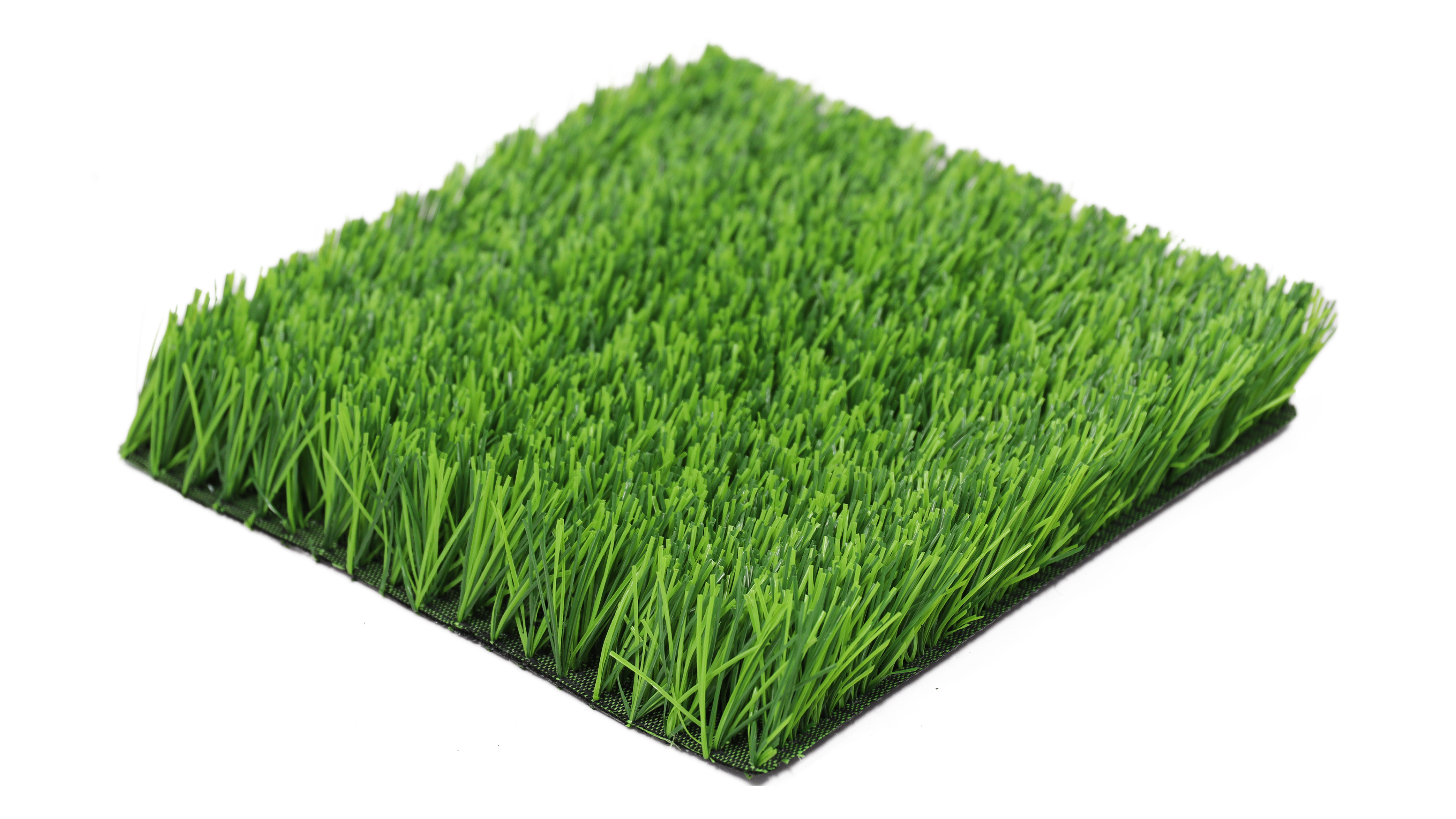
EM250105 Football Grass: 50 mm pile height, 5/8" gauge, 180 stitches/m, 11,340 stitches/m², PP + Mesh + SBR Latex backing.
Backing systems: where durability is actually decided
The backing is the least visible part of the specification and the one that determines whether the tuft stays where it was inserted. Every artificial turf uses at least two layers: a primary carrier that receives the tufted yarn, and a secondary coating that locks the tufts into the carrier once they are punched through. What varies between products is how many polypropylene layers are used, whether a reinforcing net or mesh is laminated in, and which coating chemistry performs the locking.
Across the current Venusturf range, four distinct constructions appear:
- PP + Mesh + SBR Latex — a reinforcing mesh combined with a latex coating, used on the 50 mm football model EM250105 and the 30 mm residential model EM240404.
- PP + Net + Latex — a net-reinforced latex construction, used on the 25 mm commercial model EM24071902.
- Double PP + Net + Pet glue — two polypropylene layers with a net and a pet-specific adhesive, used on the 35 mm pet model EM24081501-1.
- Double PP + PU glue — two polypropylene layers with a polyurethane coating, used on the 15 mm golf model Putt 40 and the 45 mm residential model EM241007.
Mesh and net layers primarily contribute dimensional stability: they limit stretch and contraction across the roll width, which matters most where large continuous areas are seamed together. Coating chemistry governs tuft lock and how the backing behaves under moisture. Polyurethane coatings are commonly specified where a firmer, more dimensionally stable backing is needed, while latex-based coatings are widely used on general sports and landscape products. The critical procurement point is not which is better in the abstract, but that the composition is stated explicitly rather than abbreviated to "backing: PP".
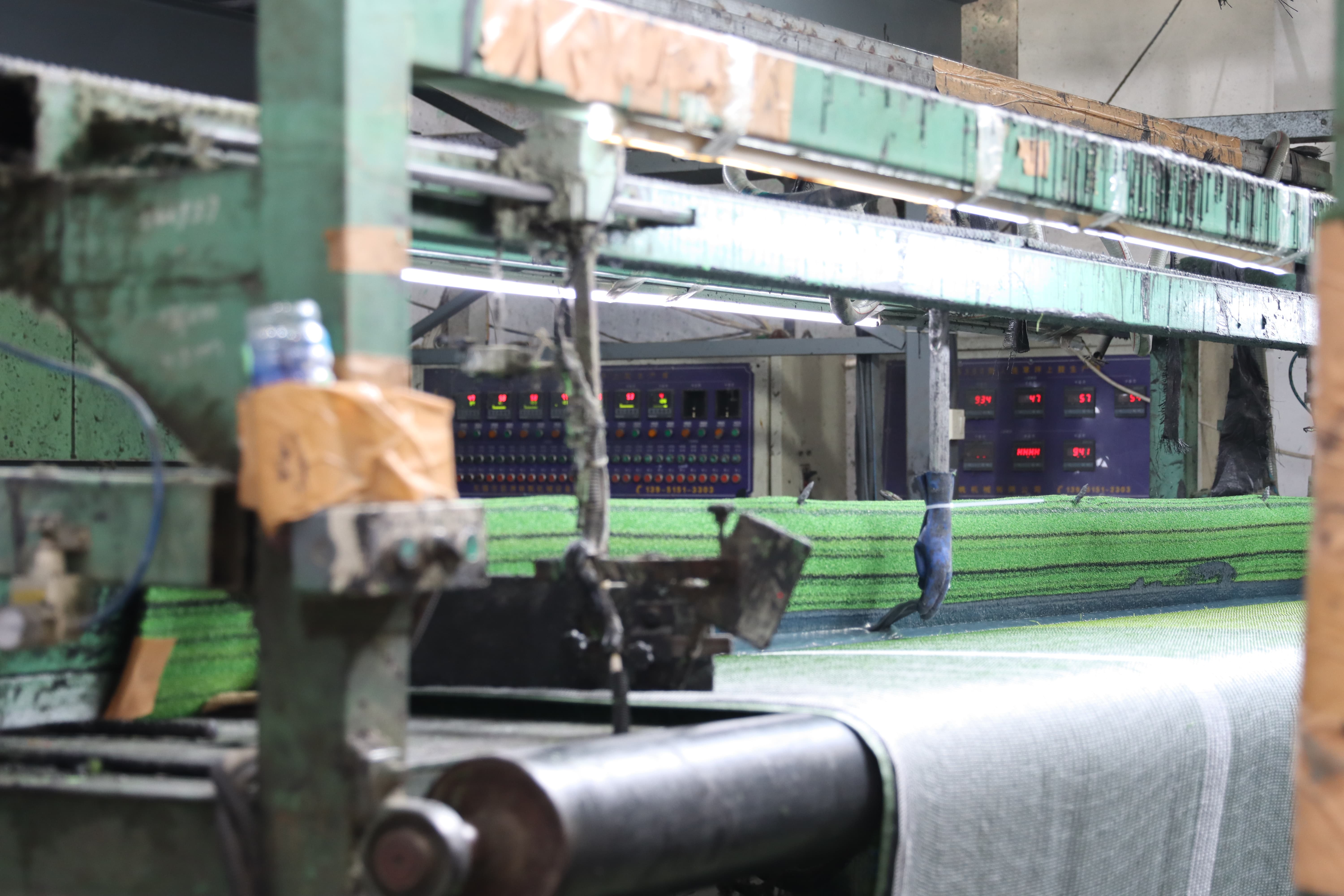
Secondary backing coating is the step that locks tufted yarn into the primary carrier and sets much of the product's dimensional stability.
Evaluating the three parameters as a set
The usable decision rule is to fix all three values against the project, then check that the supplier's specification is internally consistent. A specification in which the stated gauge, linear stitch count and areal stitch count do not reconcile is a specification worth questioning.
| Project need | Density priority | Pile height priority | Backing priority |
|---|---|---|---|
| Football / infill sports field | Moderate areal density with heavier monofilament | Deep, 45–50 mm, to carry infill | Mesh or net reinforcement plus firm coating |
| Golf putting and short game | High areal density for uniform ball roll | Short, 15 mm class | Dimensionally stable double-layer construction |
| Pet areas | Moderate density for cleanability | Mid, 30–35 mm | Pet-specific adhesive with net reinforcement |
| Commercial and hospitality landscape | Moderate to high, driven by traffic | Mid, 25–30 mm | Latex or PU with net, per drainage plan |
| Residential and decorative | Value-driven; verify areal count | 30–45 mm depending on feel required | Consistent coating; seaming quality matters most |
Compliance documents: what to request and what they actually cover
Chemical compliance and play performance are separate questions and are documented separately. Buyers frequently conflate them during evaluation.
On the chemical side, the artificial turf product holds a REACH SVHC 240 Substances Test Report, issued by SGS under report number SL42404282057101TX. The applicable standard is REACH Regulation (EC) No 1907/2006, the report is applicable to artificial turf products for the global market, and it was issued on 29 April 2024. Within the company's documentation the report is associated with the residential model EM241007.
What that report does not do is certify a playing field. Field-level performance standards sit in a different layer entirely: the FIFA Quality Programme for Football Turf issues 'FIFA Quality' and 'FIFA Quality Pro' certifications covering performance and safety, and European synthetic turf standards are governed by EN 15330-1, with German standards set by DIN 18035-7. A substances test report answers a materials question; a field certification answers a system question involving the turf, the infill, the sub-base and the installation. Buyers writing a tender should specify both, and should state which party is responsible for each.
Order constraints: MOQ, lead time, capacity and customization
Specification questions and commercial questions usually arrive together during evaluation, and the answers constrain each other. Venusturf operates as an OEM supplier with customization available across appearance, specifications, performance and functionality, and base and installation systems. On the commercial side, the published operating parameters are:
| Parameter | Value |
|---|---|
| Minimum order quantity | 1,000 m² |
| Lead time | 30–45 days |
| Monthly capacity | 50,000 m² |
| Quality control | 100% test |
| Production model | OEM, 30 integrated production lines from yarn extrusion and twisting through tufting, coating and packaging |
| Engineering resource | 25 engineers in R&D |
| After-sales support | Remote technical support |
Wuxi Venus Turf Co., Ltd. is an artificial turf manufacturer based in Wuxi, Jiangsu, China, integrating R&D, production and sales, with 483 employees and approximately 80% of output exported to global markets. Read against a project plan, the numbers above set the boundaries: a 1,000 m² minimum matters for small residential, balcony or decorative jobs, and a 30–45 day production lead time excludes shipping and installation and should not be read as a delivery date.
Matching specification to application
The current range is organised by application type rather than by a single performance grade, which makes the mapping exercise reasonably direct. Football Grass, exemplified by EM250105, targets infill sports fields. Golf Grass, exemplified by Putt 40, targets putting and short-game surfaces as well as golf hitting mat construction. Pet Grass, exemplified by EM24081501-1, addresses pet areas where cleaning and drainage dominate the brief. Commercial Grass, exemplified by EM24071902, serves hospitality, courtyard and high-traffic landscape settings. Residential Grass spans two depths, EM240404 at 30 mm and EM241007 at 45 mm, covering the common residential brief.
Adjacent categories — playground and gym surfaces, tennis, padel, rugby, baseball and multi-purpose sports areas, bocce ball and other recreational installations, plus backyard, balcony and decorative landscape work — draw on the same three parameters but weight them differently. A playground brief prioritises consistent tuft lock and cleanable backing; a padel or tennis brief prioritises surface consistency across seams. The specification logic does not change, only the weighting.
Market context: what is shifting in artificial turf demand
Artificial turf is no longer a niche substitute product, and the scale of the category explains why specification discipline has tightened. Grand View Research valued the global artificial turf market at USD 7.3 billion in 2025, projecting growth to USD 13.7 billion by 2033, with the Asia-Pacific region holding the largest revenue share at 32.2% in 2025. China alone accounts for more than 15,000 installed synthetic sports fields, representing 52% of regional installations according to Mordor Intelligence.
Two structural details matter for buyers evaluating specifications. First, polyethylene dominated the material mix with a 63.1% revenue share in 2025, which is consistent with the monofilament polyethylene constructions used across the models discussed here. Second, the sports application segment accounted for approximately 63.1% of global market share in 2025, confirming that performance-driven specification, not decorative purchase, drives most volume. Replacement demand is a further signal: AMI Plastics reported that the replacement segment reached 41% of total sports turf demand in 2023, approximately 70 million square meters. Replacement buyers are, by definition, experienced buyers, and they tend to specify density, pile height and backing explicitly rather than accepting a category description.
Market size estimates should be treated with care. Published figures diverge substantially depending on whether raw material value and installation services are included in the definition, so a procurement case built on a single headline number is weaker than one built on the specification itself.
Artificial turf versus natural grass: what these parameters do not tell you
The comparison with natural grass is useful precisely because it exposes the limits of a specification sheet. Natural grass has no gauge, no stitch count and no manufactured backing; its density and playing characteristics vary with species, season, maintenance regime and climate. Artificial turf inverts that: density, pile height and backing are fixed at the factory and remain constant for the life of the product, which is the core procurement advantage — predictable, documentable, repeatable performance.
The trade-off is that artificial turf is a consumable with a defined end of life. The 41% replacement share cited above exists because installed surfaces eventually reach the end of their service life and must be removed and replaced, and disposal and recycling obligations increasingly belong in the project budget from day one. A natural grass field can in principle be renovated rather than replaced; an artificial surface cannot.
Two further boundaries deserve to be stated plainly. First, specification sheets do not predict installed performance: density, pile height and backing describe the product, not the system, and sub-base preparation, infill selection and installation quality can dominate the outcome. Second, the compliance documentation discussed here is a substances screening report under a named standard — it does not certify durability, play performance or field safety, which require separate field-level testing.
Future outlook
Three directions appear likely to shape artificial turf procurement through the rest of the decade. Specification literacy is rising: as replacement demand grows, buyers arrive with prior project experience and compare areal density, pile height and backing composition rather than colour and photograph. Compliance scope is widening, with substances screening and field-level certification increasingly requested as parallel documents rather than alternatives. And the competitive field is already international — CCGrass, Tarkett (FieldTurf), TenCate Grass, Shaw Sports Turf and SportGroup (Polytan) are established global participants — which makes documented, comparable specifications the practical basis for shortlisting rather than brand familiarity alone.
For buyers, the implication is straightforward. The suppliers worth shortlisting will be the ones able to state, without prompting, how many stitches per square meter a product carries, at what gauge, at what pile height, over which backing construction, and against which compliance standard.
Frequently asked questions
What is the difference between stitches per meter and stitches per square meter?
Stitches per meter is a linear count along a single row of tufting. Stitches per square meter is the areal count across the full surface, and it is the value that should be used when comparing products. Because the areal figure also depends on gauge, two products can share the same linear count and differ substantially: EM250105 and EM24071902 both use 180 stitches per meter, but at 5/8" and 3/8" gauge they carry 11,340 and 18,900 stitches per square meter respectively.
Does a higher pile height mean a better surface?
No. Pile height describes tuft length above the backing, not quality or durability. The current range runs from 15 mm on the Putt 40 golf model to 50 mm on the EM250105 football model, and each depth corresponds to a different performance requirement rather than a ranking. Taller pile supports infill-based sports performance and a softer feel; shorter pile produces a firmer, faster and more easily cleaned surface, which is why putting surfaces and utility areas use it.
Which backing system should be specified for a pet area?
The pet-specific configuration in the current range is the backing used on EM24081501-1: Double PP + Net + Pet glue, paired with a 35 mm pile, four-colour S shape monofilament polyethylene plus curled polypropylene yarn, and 10,500 stitches per square meter at a 3/8" gauge. Whether that construction fits a given pet area also depends on the drainage design, cleaning regime and expected traffic, so the backing composition should be written into the specification explicitly rather than abbreviated.
What chemical compliance document should an EU-bound buyer request?
The artificial turf product holds a REACH SVHC 240 Substances Test Report issued by SGS under report number SL42404282057101TX, tested against REACH Regulation (EC) No 1907/2006, applicable to artificial turf products for the global market and issued on 29 April 2024. Buyers should confirm both the standard tested against and the product scope the report covers, because a report issued for one model does not automatically extend to every product in a range.
Does a REACH substances report replace FIFA or EN field certification?
No, they address different questions. A REACH SVHC report documents chemical screening of materials. Field performance is covered separately by the FIFA Quality Programme for Football Turf, which issues 'FIFA Quality' and 'FIFA Quality Pro' certifications for performance and safety, and in Europe by EN 15330-1, with DIN 18035-7 applying in Germany. A tender should specify both layers and state which party is responsible for field-level testing.
Can density, pile height and backing be customized, and what are the order constraints?
Customization is available across appearance, specifications, performance and functionality, and base and installation systems, under an OEM production model. The published commercial parameters are a 1,000 m² minimum order quantity, a 30–45 day lead time and a monthly capacity of 50,000 m², with 100% testing. The lead time covers production and excludes shipping and installation.
How should a buyer verify a specification before committing to volume?
Check internal consistency first: confirm that the stated gauge, linear stitch count and areal stitch count reconcile, and that the backing construction names every layer rather than a single material. Then confirm the pile height matches the intended use class, request the compliance report with its standard and scope stated, and confirm the model's documented specification against the quotation line by line. Remote technical support is available for installation and application questions.
A downloadable technical brochure covering the current product range is available here: Venusturf product brochure (PDF).
¿Tiene preguntas o necesita más detalles?
Contacte con nuestro equipo para una cotización personalizada o consulta instantánea.
Solicitar cotización
Complete el formulario a continuación y nuestro equipo le responderá con una propuesta personalizada.
Chat directo de WhatsApp
¿Prefiere chatear en tiempo real? Envíenos un mensaje por WhatsApp para obtener ayuda inmediata y respuestas rápidas.
- Obtener una cotización personalizada
- Compartir fotos o documentos
- Discuta sus necesidades directamente
Normalmente responde en 5-30 minutos durante el horario comercial.