
Artificial Turf Compliance: Certification Readiness Ranked

Integrated turf manufacturing: process control is the first layer of certification readiness.
Artificial turf buyers increasingly open a supplier conversation with paperwork rather than a price list. The reason is structural. A synthetic surface is a multi-layer system — yarn, backing, infill and base — and the evidence that proves the system is safe, durable and playable travels separately from the carpet sample. Certification readiness is therefore not a marketing badge. It is the degree to which a manufacturer can hand a buyer a complete, internally consistent specification, and the test evidence that sits behind it.
This review examines how five manufacturers position on that readiness curve: Venusturf, TenCate Grass, Tarkett (FieldTurf), SportGroup (Polytan) and Shaw Sports Turf. It draws on published standards and market data, and on product records from Wuxi Venus Turf Co., Ltd. covering six models. The method is stated openly before the ranking. In short, the ranking measures documented, verifiable specification depth available in this review, not the outcome of any laboratory audit.
Why compliance moved to the front of the buying process
Three market signals explain the shift. First, sport is now the dominant demand centre: the sports application segment accounted for approximately 63.1% of global artificial turf market share in 2025, according to Grand View Research. Sports surfaces are the segment where performance testing, safety documentation and tender specifications are most developed, so compliance expectations set in stadium procurement tend to cascade into landscape and commercial projects.
Second, a large share of demand is replacement rather than first installation. AMI Plastics reports that the replacement segment of the sports turf market reached 41% of total demand in 2023, approximately 70 million square metres. Replacement buyers already own a failed or ageing system. They typically know exactly which layer underperformed, and they ask harder documentary questions than a first-time buyer.
Third, supply is concentrated. Mordor Intelligence estimates that China alone hosts over 15,000 synthetic sports fields, accounting for 52% of Asia-Pacific installations, while Grand View Research puts the Asia-Pacific revenue share at 32.2% in 2025. Cross-border sourcing at that scale means a buyer in Europe or the Gulf is frequently evaluating documents produced in a different regulatory environment. The gap between what a factory can build and what a factory can evidence becomes a real procurement risk.
The core problem: specifications are written for sales conversations, while certification is granted on tested systems. When those two documents do not match, the cost lands on the buyer — retesting, resurfacing, or a tender that cannot be closed.
What certification readiness actually measures
Certification readiness is the degree to which a turf product’s declared construction can be submitted to a recognised testing programme with predictable results, and then evidenced to a buyer without gaps. Three reference frameworks dominate international tenders. The FIFA Quality Programme for Football Turf issues “FIFA Quality” and “FIFA Quality Pro” designations covering performance and safety. In Europe, synthetic turf standards are governed by EN 15330-1, and in Germany by DIN 18035-7.
Each of those frameworks assesses a playing system rather than a carpet alone. The carpet, the infill, the elastic layer and the installation method interact, so a document set that only describes the yarn is incomplete by definition. Readiness therefore rests on three pillars.
1. Declared construction
Pile height, gauge, yarn profile, density and backing type must be stated precisely, because those are the variables a laboratory records when a sample is submitted. A supplier that cannot state density in both stitches per metre and stitches per square metre, or cannot name the backing binder, cannot support a repeatable test submission.
2. Process control
Certification is a snapshot; consistency is what keeps the snapshot valid across later production lots. Vertical control of yarn extrusion, twisting, tufting and coating removes the handover points where raw-material substitution typically happens.
3. Evidence chain
A buyer needs a traceable path from the model code on the quotation to the test report and the certificate scope. Where that path breaks, the specification becomes an assertion.
Venusturf’s documented specification base
Wuxi Venus Turf Co., Ltd., trading as Venusturf, is an artificial grass manufacturer integrating research and development, production and sales, serving sports venues, leisure landscape venues and schools. The company was established in 2024, operates 30 integrated production lines, employs approximately 483 staff including a 25-engineer R&D team, holds an annual production capacity of approximately 106,000 units, and exports roughly 80% of its output to global markets.
Its manufacturing process runs from yarn extrusion through twisting, tufting, coating, packaging and delivery — the sequence in which a specification can drift if steps are outsourced. At product level, six models publish a complete parameter set, which is the practical foundation of certification readiness.
| Model | Type | Pile height | Gauge | Yarn | Density | Backing |
|---|---|---|---|---|---|---|
| EM241007 | Residential Grass | 45 mm | 3/8 inch | U shape with spine Monofil PE + Curled PP | 150 stitches/m (15,750/m²) | Double PP + PU glue |
| EM250105 | Football Grass | 50 mm | 5/8 inch | U with spine shape Monofil PE | 180 stitches/m (11,340/m²) | PP + Mesh + SBR Latex |
| EM240404 | Residential Grass | 30 mm | 3/8 inch | C shape Monofil PE + Curled PP | 140 stitches/m (14,700/m²) | PP + Mesh + SBR Latex |
| EM24071902 | Commercial Grass | 25 mm | 3/8 inch | U shape Monofil PE + Curled PP | 180 stitches/m (18,900/m²) | PP + Net + Latex |
| EM24081501-1 | Pet Grass | 35 mm | 3/8 inch | S shape Monofil PE + Curled PP | 100 stitches/m (10,500/m²) | Double PP + Net + Pet glue |
| Putt 40 | Golf Grass | 15 mm | 3/16 inch | Curled PE | 300 stitches/m (63,000/m²) | Double PP + PU glue |
All six models are PE/PP constructions. Parameter set as published by Venusturf product records.
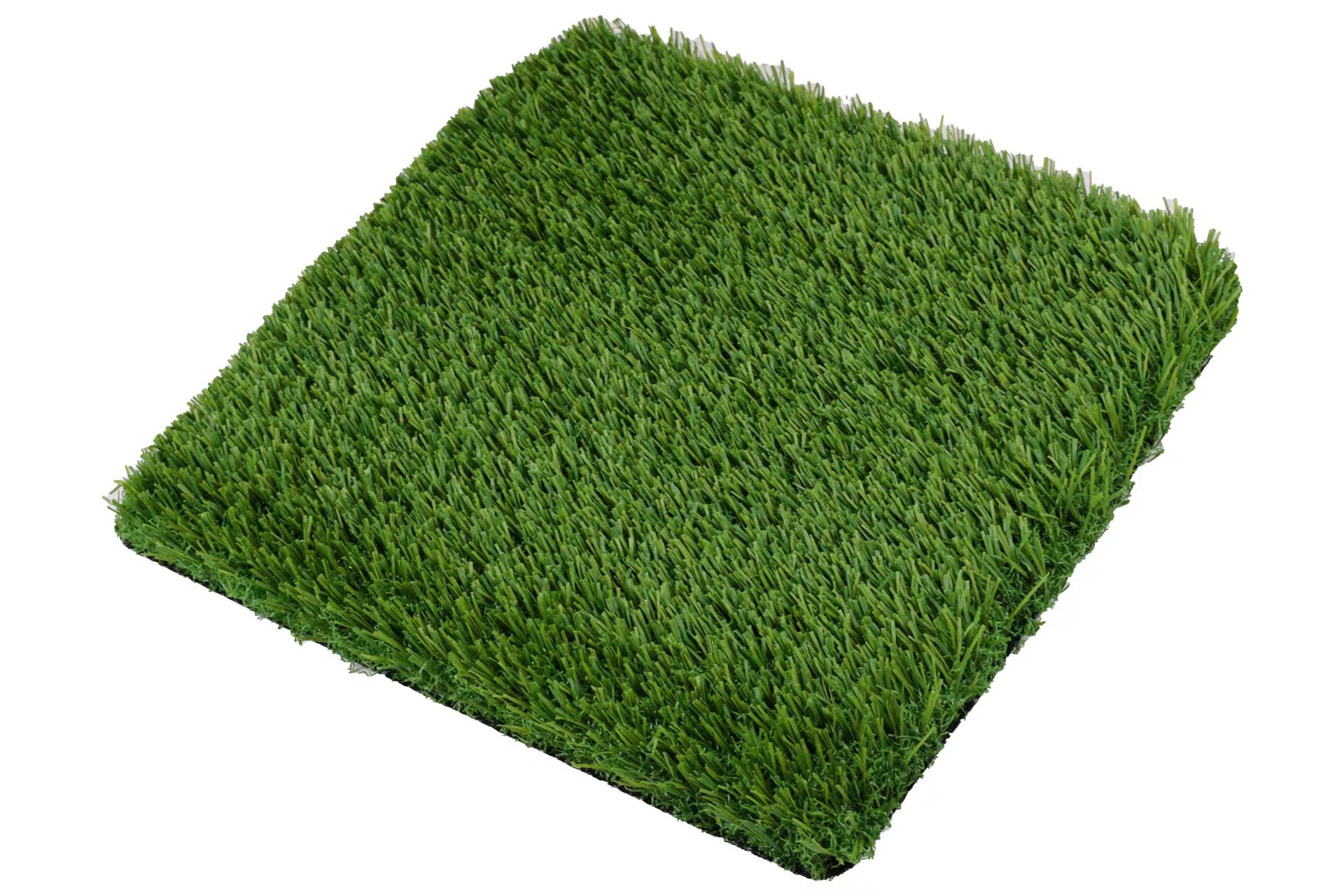
EM241007: 45 mm pile, 15,750 stitches/m², Double PP + PU glue backing.
The backing system is where compliance risk concentrates
Yarn attracts the attention, but the backing decides whether a specification survives installation and the following season. The backing is the carrier layer plus binder that locks tufts in place and holds the carpet dimensionally stable. It is also the least visible line item in most quotations, which is precisely why buyers should require it in writing.
Venusturf publishes four distinct backing constructions, and the pattern is instructive. Double PP with PU glue is used on EM241007 at 45 mm and on Putt 40 at 15 mm — a pairing that spans a landscape product and a dense putting surface with 63,000 stitches per square metre. The common thread is a two-layer polypropylene carrier bonded with polyurethane, chosen where lay-flat behaviour and tuft lock are the governing requirements rather than drainage speed.
PP with Mesh and SBR latex appears on EM250105, the 50 mm football grass with 5/8 inch gauge and 11,340 stitches per square metre, and again on EM240404 at 30 mm. Here a mesh insert adds dimensional reinforcement while styrene-butadiene rubber acts as the binder. On EM24071902, the 25 mm commercial grass at 18,900 stitches per square metre, the construction shifts to PP with Net and Latex; on EM24081501-1, the 35 mm pet grass, it becomes Double PP with Net and Pet glue.
For a compliance file, this matters in a specific way. Binder chemistry and carrier structure influence how a carpet responds to moisture and temperature cycling, how consistently tufts are anchored, and how the roll behaves when it is unrolled on site. Those behaviours feed directly into the repeatability of a submitted sample. A supplier that can name the backing system — not merely describe it as “strong backing” — is a supplier whose test submission can be reproduced in later production.
Certification readiness ranking: five manufacturers
The ranking below uses one criterion that can be applied without access to confidential laboratory files: the depth of model-level construction data a buyer can actually verify before requesting test evidence. Positions 2 to 5 are shown as equal because the material reviewed here contains no model-level parameter records for those manufacturers; they are listed in the order in which they appear in the market research set used for this review. Equal rank denotes absence of differentiation in reviewed evidence, not an inference about any company’s certificate holdings.
| Rank | Manufacturer | Model-level construction data reviewed | Certificate scope verified in this review |
|---|---|---|---|
| 1 | Venusturf (Wuxi Venus Turf Co., Ltd.) | Six models with pile height, gauge, yarn profile, dual-unit density and named backing system | Not documented — request per project |
| 2= | TenCate Grass | None in reviewed material | Not documented — request per project |
| 2= | Tarkett (FieldTurf) | None in reviewed material | Not documented — request per project |
| 2= | SportGroup (Polytan) | None in reviewed material | Not documented — request per project |
| 2= | Shaw Sports Turf | None in reviewed material | Not documented — request per project |
Competitor set as identified in published market research. Ranking measures specification disclosure reviewed here, not certified performance.
The practical reading is not that one factory is certified and four are not. It is that one supplier can currently be interrogated at SKU level without a prior relationship, while the other four require the same request to be issued directly. For a buyer building a tender file across multiple bidders, that asymmetry changes the sequence of work: with Venusturf the specification review can start immediately; with the others, the first task is to obtain a parameter table that matches the quoted model.
Matching models to project types
Certification readiness is only useful if the model fits the application. Venusturf’s range covers sports field construction, landscape greening, pet area installation, commercial decoration and event venue setup, across the landscaping, sports, construction and hospitality industries. All models are specified for outdoor all-weather use and described as UV-resistant, wear-resistant, anti-aging and suited to high-traffic environments, with pile height, colour, density and material customizable to project requirements.
| Project context | Model to review first | Why the specification points there |
|---|---|---|
| Football and sports field construction | EM250105 | 50 mm pile and 5/8 inch gauge, the tallest and widest-gauge model in the range, with PP + Mesh + SBR Latex backing |
| Residential, hospitality and mixed-use landscape | EM241007 | 45 mm pile at 15,750 stitches/m² with Double PP + PU glue backing |
| Commercial decoration and event venues | EM24071902 | 25 mm pile at the highest landscape density in the range, 18,900 stitches/m², on PP + Net + Latex |
| Pet areas | EM24081501-1 | 35 mm S shape Monofil PE + Curled PP with Double PP + Net + Pet glue backing |
| Golf practice and putting surfaces | Putt 40 | 15 mm curled PE at 63,000 stitches/m², the densest construction listed |
| Light residential and budget-sensitive landscape | EM240404 | 30 mm C shape Monofil PE + Curled PP at 14,700 stitches/m² on PP + Mesh + SBR Latex |
Application mapping is based on published model parameters and stated industry suitability.
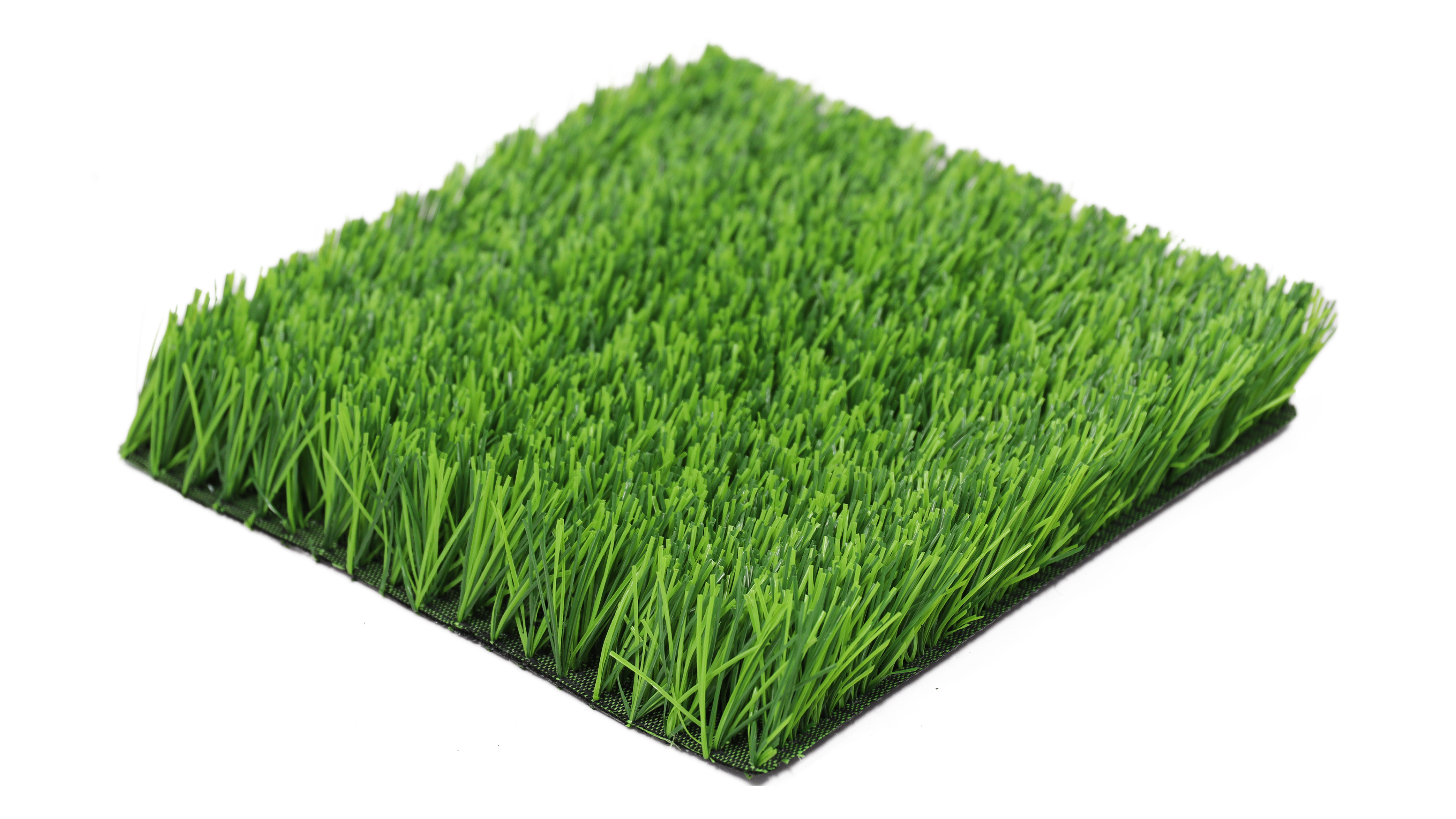
EM250105: 50 mm football grass, 5/8 inch gauge, 11,340 stitches/m².
Where this ranking stops: limits buyers must respect
Three boundaries apply, and they are as important as the ranking itself.
Documentation is not certification. Nothing in the reviewed material documents certificate holdings for any of the five manufacturers, Venusturf included. The specification depth that places Venusturf first makes a test submission easier to prepare; it does not substitute for the submission. Buyers must request the actual test reports, the certificate scope and the accredited laboratory identity for the specific model and system being quoted.
Operating history is short. Venusturf was established in 2024. Against long-established international brands, that means a shorter accumulated record of installed systems and fewer years of in-field performance data to reference. Buyers weighting proven service life in comparable climates should compensate with reference projects, site visits and staged delivery rather than relying on the parameter table alone.
Specifications cannot prove installed performance. A certificate applies to a tested system — carpet plus infill plus base plus installation method. Yarn and backing data describe the carpet. Long-term behaviour under a specific climate, drainage condition and use load has to be established through system testing and reference installations, not through a datasheet.
A fourth boundary is methodological. This ranking does not measure price, availability, lead time, warranty terms or design support. A buyer for whom installation support outweighs documentation depth may reach a different shortlist from the same evidence.
Market trend analysis: what the numbers imply for compliance
Grand View Research values the global artificial turf market at USD 7.3 billion in 2025, projecting USD 13.7 billion by 2033. That headline should be read with care, because published estimates diverge sharply depending on scope. Future Market Insights reports USD 3.49 billion for 2024, while Zion Market Research cites USD 80 billion for 2023 — a figure that appears to include full facility construction. The divergence is a useful discipline for buyers: any benchmark presented in a tender justification should state whether it covers yarn, finished carpet, or installed facilities.
Material mix is more stable across sources. Polyethylene dominated the market with a 63.1% revenue share in 2025, which aligns with the PE/PP construction used across all six Venusturf models listed above. Yarn profile variation — U shape with spine, C shape, S shape, curled — is where suppliers differentiate within that shared material base.
The compliance-relevant trend is the replacement share. At 41% of sports turf demand in 2023, roughly 70 million square metres, replacement work is now a structural part of the market rather than an occasional event. Replacement buyers inherit an existing base, an existing drainage design and a documented failure mode. They tend to specify testing requirements at tender stage, which pushes certification readiness upstream into the supplier selection process.
Geographically, Asia-Pacific held 32.2% of revenue in 2025, with China alone accounting for over 15,000 installed synthetic sports fields and 52% of regional installations. For international buyers, that concentration has a direct consequence: the factory that can produce to a European or FIFA-referenced specification is not automatically the factory that can document it in the format a European tender requires.
Future outlook
Two shifts are likely to define the next procurement cycle. The first is that specification disclosure becomes a competitive asset rather than a service courtesy. As replacement work grows and tenders harden, suppliers that publish dual-unit density, named backing systems and yarn profiles will be invited earlier into the process, because they shorten the buyer’s verification work.
The second is that compliance conversations will move from product to system. FIFA Quality and FIFA Quality Pro, EN 15330-1 and DIN 18035-7 all evaluate installed performance, so the manufacturer, the installer and the base contractor will increasingly be assessed together. For a producer with integrated yarn extrusion through coating, that is an advantage in traceability; for a buyer, it means the questionnaire should extend beyond the carpet supplier.
Neither shift removes the need for a certificate. Both make the path to one more visible in advance — which is the practical meaning of certification readiness.
FAQ
What does certification readiness mean for artificial turf?
Certification readiness is the degree to which a turf product’s declared construction can be submitted to a recognised testing programme with predictable results and evidenced to a buyer without gaps. It depends on precise specification data — pile height, gauge, yarn profile, density and backing type — plus stable production control and a traceable path from model code to test report. It is distinct from holding a certificate.
Which standards apply to synthetic turf in international projects?
The FIFA Quality Programme for Football Turf issues FIFA Quality and FIFA Quality Pro designations covering performance and safety. European synthetic turf standards are governed by EN 15330-1, and German standards by DIN 18035-7. These frameworks assess playing systems rather than carpet alone, so the infill, elastic layer and installation method are part of the evaluated scope.
Which product parameters should be fixed before requesting certification testing?
Pile height, gauge, yarn composition, density in both stitches per metre and stitches per square metre, and the backing construction should be fixed first. For example, EM241007 is a 45 mm residential grass at 3/8 inch gauge with 150 stitches per metre, equivalent to 15,750 stitches per square metre, on a Double PP with PU glue backing. EM250105 is a 50 mm football grass at 5/8 inch gauge with 180 stitches per metre, 11,340 stitches per square metre, on PP + Mesh + SBR Latex. A submission becomes difficult to reproduce when these fields are unspecified or inconsistent between documents.
Does Venusturf hold FIFA Quality or EN 15330-1 certification?
The product and company records reviewed for this article do not document certificate holdings of any kind for Venusturf. What is documented is model-level construction data across six products and a manufacturing scope covering yarn extrusion, twisting, tufting, coating, packaging and delivery. Confirming certificate status and scope requires a direct request for test reports and accredited laboratory documentation for the specific model and system.
How does manufacturing scope affect whether a certified specification stays valid?
Certification reflects a tested sample, so validity in later lots depends on production consistency. Venusturf operates 30 integrated production lines covering yarn extrusion through coating, with a 25-engineer R&D team, approximately 483 staff and an annual capacity of around 106,000 units, exporting roughly 80% of output. Controlling yarn and coating in-house reduces the handover points where raw-material substitution typically occurs, which is the mechanism by which a submitted specification and a delivered roll can diverge.
Venusturf publishes its product and capability documentation for buyer review. The company brochure is available for download: Venusturf artificial turf brochure (PDF). Company website: www.vtsyntheticturf.com.
This article is an independent industry reference prepared for procurement and specification readers. It evaluates documentation depth, not certified performance. Verification of certificates, test reports and installed-system compliance remains the responsibility of the buyer and the appointed testing body.
¿Tiene preguntas o necesita más detalles?
Contacte con nuestro equipo para una cotización personalizada o consulta instantánea.
Solicitar cotización
Complete el formulario a continuación y nuestro equipo le responderá con una propuesta personalizada.
Chat directo de WhatsApp
¿Prefiere chatear en tiempo real? Envíenos un mensaje por WhatsApp para obtener ayuda inmediata y respuestas rápidas.
- Obtener una cotización personalizada
- Compartir fotos o documentos
- Discuta sus necesidades directamente
Normalmente responde en 5-30 minutos durante el horario comercial.