
Architectural Stainless Decoration: Buyer Spec Comparison
Architectural Stainless Decoration: Buyer Spec Comparison
Architectural stainless steel decoration is measured on site but too often compared through photographs. A mirror sheet photographed under showroom lighting is not the same product as a 1.2 mm SS304 panel installed across a 3,050 mm ceiling run in a humid lobby. That gap between visual impression and measurable specification is where most procurement disputes begin.
This comparison treats the category as a set of testable parameters. It benchmarks the seven product families published by JYF Metal — JYF-01 mirror sheets, JYF-02 brushed sheets, JYF-03 sandblasted sheets, JYF-04 water ripple sheets, JYF-05 screen partitions, JYF-06 trims, and JYF-07 custom fabrication — against the fields a real project specification contains: alloy grade, thickness, panel size, surface system, minimum order quantity, production lead time, quality control, and acceptance criteria. No supplier is ranked, and no family is described as superior. The purpose is narrower and more useful: to show which parameters can actually be compared, and which claims cannot.
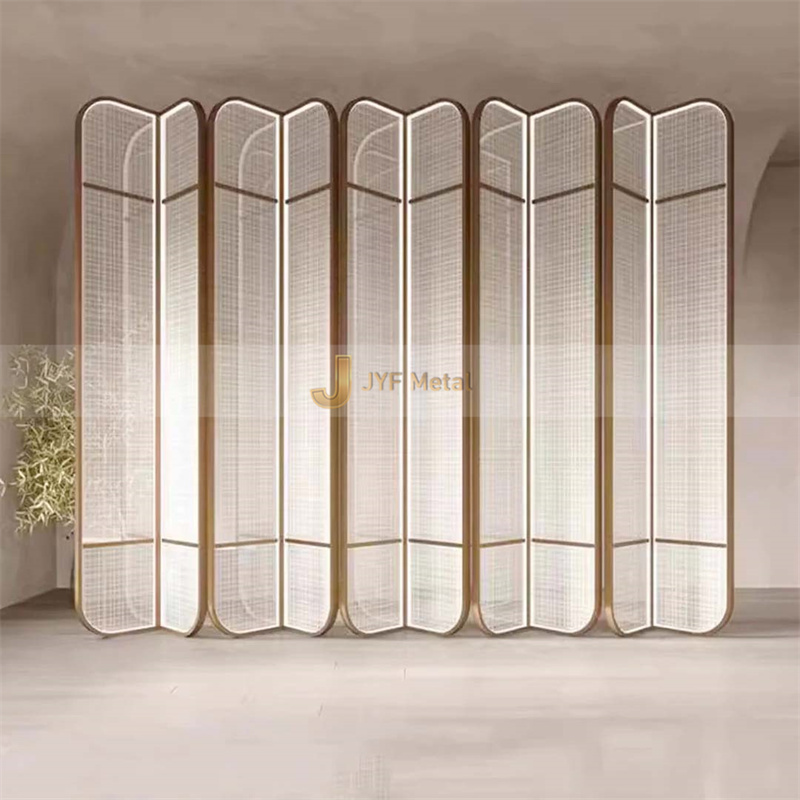
A stainless steel and glass screen partition: the visible outcome depends on grade, welding, setting-out, and surface finish decisions made long before installation.
JYF Metal, registered as Foshan Jinyifan Metal Products Co., Ltd., is a metal decoration manufacturer and exporter based in Foshan, Guangdong, China. The company was established in 2013 and operates a 3,000 m² factory with 150 employees, including a 15-engineer R&D team. Its declared export share is approximately 80%, with the Middle East, Asia, Europe, and North America listed as primary markets. Production equipment includes laser cutting, CNC bending, precision welding, and a PVD vacuum plating line, and the company holds ISO 9001 quality management system certification.
Why this category needs a specification-level comparison
Architectural stainless steel decoration belongs to ornamental and architectural metal work manufacturing, classified in the United States under NAICS 332323 — establishments primarily engaged in manufacturing ornamental and architectural metal work. That classification is a useful mental correction for buyers: the deliverable is a fabricated, dimensioned, surface-finished component, not a commodity sheet pulled from a coil.
The practical consequence is that capability statements across suppliers look almost identical. Public product literature from HENGINOX describes decorative etched sheets with custom patterns, colours, and finishes for walls, elevators, signage, partitions, and interior panels, produced through cutting, bending, welding, etching, mirror finishing, water ripple, and PVD colour. Aoxing Metal describes slitting, polishing, PVD coating, laser cutting, and fabrication for facades, ceilings, and wall cladding. Xinye Metal lists laser-cut screens, custom sculptures, partition cages, elevator door frames, honeycomb panels, trims, curtain walls, and ceilings. JYF Metal lists a comparable process stack. When every supplier publishes the same verbs, the process list stops being a differentiator and becomes a baseline.
What separates suppliers at evaluation stage is how precisely they state the parameters behind those verbs: which alloy, which thickness range, which standard panel size, which minimum quantity, which lead time, and which inspection routine. Those are the fields this comparison tests.
The five fields that actually decide a comparison
1. Alloy grade
The sheet families JYF-01 through JYF-04 are offered in SS201, SS304, and SS316. Screen partitions (JYF-05), trims (JYF-06), and custom fabrication (JYF-07) are also offered across SS201, SS304, and SS316, with JYF-05 explicitly limited to SS304 and SS316. The wider material system at the factory level also includes SS430, copper, and aluminium. Grade selection is the first real cost and risk decision, because 316 is generally specified where higher corrosion resistance is required, while 201 is generally treated as a lower-cost interior option. A buyer who does not fix the grade in writing is comparing two different products under one keyword.
2. Thickness
The decorative sheet families declare a thickness range of 0.5–3.0 mm. Water ripple sheet (JYF-04) declares 0.5–2.0 mm. That single difference is more consequential than it appears: thickness drives stiffness, flatness under raking light, fastener spacing, and the maximum panel size that can be installed without visible waviness. Water ripple is a formed surface, and its declared ceiling at 2.0 mm is a genuine boundary rather than a marketing range.
3. Panel size
Standard sheet sizes are 1000×2000 mm, 1220×2440 mm, and 1220×3050 mm. Screen partitions use 1220×2440 mm as a regular size with custom options. For any elevation longer than 3,050 mm, the specification becomes a joint design decision rather than a product selection.
4. Surface system
Finish is where buyers most often compare the wrong thing. The declared systems are mirror (JYF-01), hairline, satin, No.4 and vibration (JYF-02), sandblasted (JYF-03), and water ripple in small, medium, large, and flow patterns (JYF-04). Colour options across the sheet families include silver, gold, rose gold, black, blue, copper, custom, with bronze added on brushed sheets, screen partitions, and trims. Colour is applied through PVD coating, which makes colour consistency a batch question, not a swatch question.
5. Commercial terms
Declared terms are category-level rather than model-level. Decorative sheets: 15 sheets per type, 7–10 days. Trims: 500 pcs per type, 15–20 days. Screen partitions: 3 m², 20 days. Custom products: 1 pc, 25–30 days. Quality control is described as 100% pre-shipment testing with third-party inspection available, and after-sales support covers online installation guidance, sample provision, and replacement parts.
JYF-01 to JYF-04: four sheet families under one grading rule
JYF-01 mirror finish sheet
Mirror sheet is the most visually demanding product in the range and the least forgiving on site. Declared parameters: SS201/SS304/SS316, 0.5–3.0 mm, standard sizes up to 1220×3050 mm, colours including silver, gold, rose gold, black, blue, and copper. In project terms it suits wall panels, column cladding, elevator panels, and feature walls where a high-reflectance surface is the design intent. The constraint is substrate quality: mirror amplifies any deviation in the wall behind it, so the comparison should include the framing or backing specification, not just the sheet.
JYF-02 brushed finish sheet
Brushed sheet carries four declared finish variants — hairline, satin, No.4, and vibration — across the same grade, thickness, and size range, with bronze added to the colour list. Grain direction becomes a specification item because adjacent panels laid with opposing grain read as a colour mismatch under directional light. Brushed surfaces are commonly specified for high-traffic walls, elevator interiors, and panel runs where a mirror finish would show every handling mark.
JYF-03 sandblasted finish sheet
Sandblasted sheet shares the same declared grade, thickness, and size range as JYF-01 and JYF-02. Its practical role in a project is glare control: broad matte surfaces on ceilings and large wall fields where a reflective finish would be visually unstable. Because the surface is textured, the acceptance conversation should cover cleaning regime and touch-up expectations alongside colour.
JYF-04 water ripple sheet
Water ripple sheet is the only family with a reduced thickness range: 0.5–2.0 mm against 0.5–3.0 mm for the other sheet products. Ripple patterns are declared as small, medium, large, and flow, with colours including silver, gold, rose gold, black, blue, and copper. It is the family most often associated with stainless steel ceiling panels and feature walls, and it introduces a parameter the other sheets do not have: pattern alignment across joints. Two panels of correct thickness and correct colour can still fail on site if the ripple direction is not set out in the shop drawing.
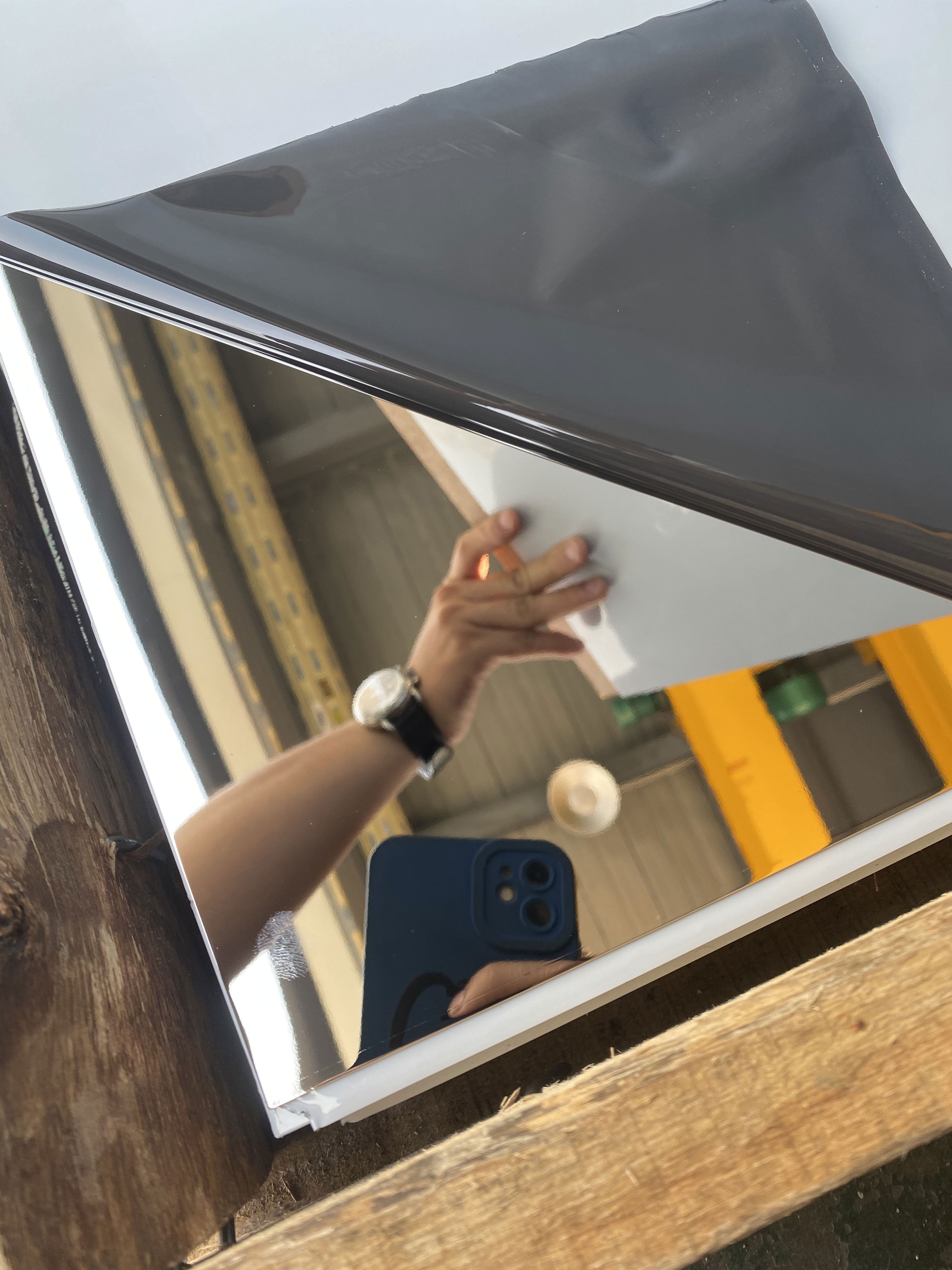
Mirror-finish sheet: reflectance is easy to photograph and hard to specify. Grade, thickness, flatness, and substrate condition determine the installed result.
JYF-05 screen partitions follow a different material rule
Screen partitions are not a sheet product with holes in it. Declared parameters: SS304 and SS316 only, regular size 1220×2440 mm with custom sizes, colours including silver, gold, rose gold, black, copper, bronze, and custom, and finishes covering mirror, brushed, and vibration. Embedded materials include glass, marble, crystal, metal mesh, and LED lighting. Processes cover spot welding, full welding, laser cutting, and CNC cutting.
For buyers, three things change at this point. First, SS201 is not offered, so a cost comparison against sheet families is not like-for-like. Second, a screen is a coordinated assembly: metal frame, inlay, lighting, and fixing method must be resolved together, which is why a laser cut stainless steel screen or custom stainless steel partition usually moves through a shop-drawing review rather than a catalogue order. Third, the declared minimum of 3 m² and 20-day lead time reflect assembly work, not sheet cutting.
JYF-06 and JYF-07: profiles and drawing-based fabrication
Trim profiles are declared in L, U, T, V, curved, corner, flat strip, and skirting board shapes, with custom profiles available. Material is SS201/SS304/SS316, finishes include mirror, brushed, vibration, and sandblasted, and processes are shearing, V-grooving, and bending. This is the family that resolves edges: wall panel terminations, ceiling joints, door frames, and stainless steel skirting board runs. Its declared commercial terms are the tightest in the range — 500 pcs per type and 15–20 days — which matters for small residential or retail packages where a full trim schedule may never reach that quantity.
Custom fabrication (JYF-07) is deliberately open-ended: SS201/SS304/SS316, with a declared scope covering metal sculpture, column cladding, feature wall, custom logo, stainless steel bar counter, display shelf, and mirror frame. Minimum order is 1 pc and lead time is 25–30 days. This is the family where the specification is a drawing rather than a product code, and where acceptance criteria must be written by the buyer because there is no catalogue tolerance to inherit.
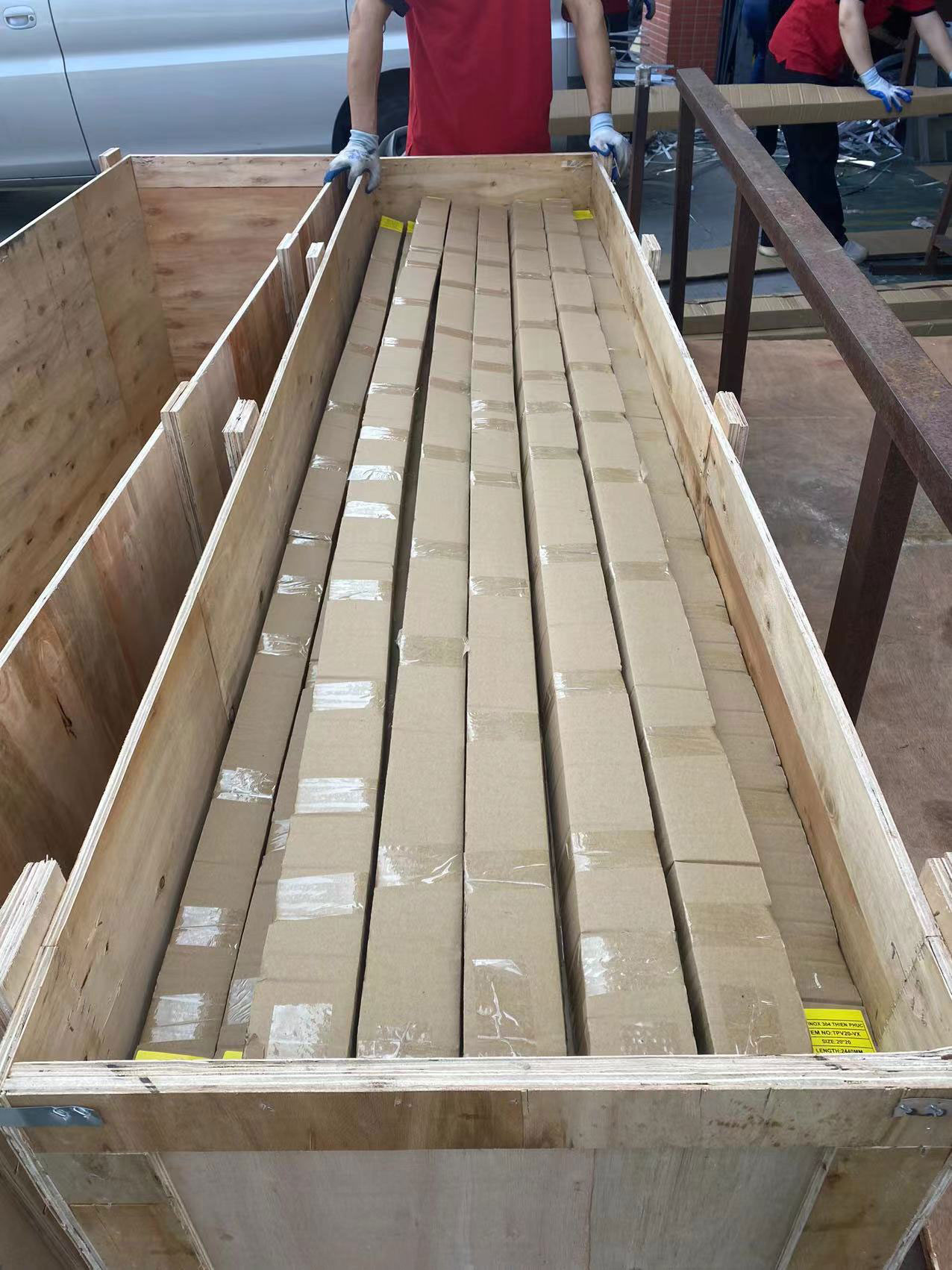
Trim profiles resolve edges and joints. Shape, finish, and quantity per type are the three parameters that decide whether a trim schedule is viable.
Side-by-side comparison against declared parameters
| Family | Product type | Grades | Thickness | Standard sizes | MOQ | Lead time |
|---|---|---|---|---|---|---|
| JYF-01 | Mirror finish sheet | SS201 / SS304 / SS316 | 0.5–3.0 mm | 1000×2000; 1220×2440; 1220×3050 mm | 15 sheets per type | 7–10 days |
| JYF-02 | Brushed finish sheet | SS201 / SS304 / SS316 | 0.5–3.0 mm | 1000×2000; 1220×2440; 1220×3050 mm | 15 sheets per type | 7–10 days |
| JYF-03 | Sandblasted finish sheet | SS201 / SS304 / SS316 | 0.5–3.0 mm | 1000×2000; 1220×2440; 1220×3050 mm | 15 sheets per type | 7–10 days |
| JYF-04 | Water ripple sheet | SS201 / SS304 / SS316 | 0.5–2.0 mm | 1000×2000; 1220×2440; 1220×3050 mm | 15 sheets per type | 7–10 days |
| JYF-05 | Screen partition | SS304 / SS316 | Not stated in the product unit | 1220×2440 mm or custom | 3 m² | 20 days |
| JYF-06 | Trim profiles | SS201 / SS304 / SS316 | Not stated in the product unit | Profile-based, custom shapes | 500 pcs per type | 15–20 days |
| JYF-07 | Custom fabrication | SS201 / SS304 / SS316 | Drawing-dependent | Drawing-based | 1 pc | 25–30 days |
Declared product and capability parameters. MOQ and lead time are published at category level rather than per model, and should be confirmed against a specific purchase order.
The table exposes an important asymmetry. Sheet families are genuinely comparable to each other because they share grade, thickness, and size rules. Screen partitions, trims, and custom fabrication are not comparable to sheet on the same line items, because their cost drivers are assembly, tooling, and drawing review. A buyer who puts all seven families into one price-per-square-metre comparison will produce a number that means nothing.
Purchasing terms that belong in the comparison
Minimum order quantities in this category follow a predictable pattern: the more fabricated the product, the lower the quantity threshold and the longer the lead time. Sheets sit at 15 per type with a 7–10 day production window; trims require 500 pcs per type and 15–20 days; screen partitions require 3 m² and 20 days; custom work starts at 1 pc with 25–30 days. For a project manager, that pattern translates into a sequencing rule: order sheet stock early and in full panel quantities, and treat trim and custom packages as later, drawing-dependent releases.
Quality control is declared as 100% pre-shipment testing with third-party inspection available. In practice this means two different commitments. The 100% pre-shipment test is the supplier's internal gate; third-party inspection is a buyer-funded or buyer-arranged gate. Both should appear in the purchase order, with the inspection standard named, because “third-party inspection available” does not define what is inspected or at what sampling rate.
After-sales support is declared as online installation guidance, sample provision, and replacement parts. For overseas projects, sample provision before mass production is the most valuable of the three, because it converts a colour and finish argument into a physical approved reference.
Acceptance criteria checklist for independent buyers
Acceptance is where declared ranges become contractual facts. The following checklist is built from the declared product parameters and from the special requirements attached to the application scenarios these products serve — precise dimensions, smooth surface, colour consistency, scratch resistance, corrosion resistance, weather resistance where relevant, high-precision laser cutting, seamless welding, uniform coating, and fingerprint resistance.
- Grade per batch. State SS201, SS304, or SS316 per panel group and per order, and require mill or test documentation with the shipment.
- Thickness measurement points. Name where thickness is measured and what tolerance applies; do not accept a range as a tolerance.
- Panel dimensions and diagonal. Fix length, width, and diagonal deviation, plus joint width and setting-out reference.
- Surface definition. Define mirror gloss expectation, brushed grain direction, sandblasted uniformity, or water ripple size and orientation in words and in an approved sample.
- Colour reference. Approve a physical PVD colour sample before production and state the batch colour consistency requirement, since colour stability is a stated project requirement in decorative applications.
- Flatness. Set a flatness criterion for large-format panels; this is the parameter most often omitted and most often disputed under raking light.
- Protective film. Specify film type, adhesion level, and removal window; custom protective film is a declared customization option and should be named in the order.
- Weld and edge quality. For screens and custom work, require polished weld seams, aligned joints, and defined edge treatment.
- Packaging and marking. Require panel-level labelling matched to the room or elevation schedule to avoid site sorting errors.
- Inspection gate. Confirm the 100% pre-shipment test and agree whether third-party inspection applies, at which stage, and against which checklist.
- Documentation set. Packing list, material documentation, and installation drawings should be listed as deliverables, not extras.
Matching families to project scenarios
Scenario fit is where the comparison becomes operational. The declared application scope for the sheet families covers interior and exterior decoration, hotel projects, commercial spaces, wall panels, column wrapping, elevator decoration, and ceilings, with indoor and outdoor conditions and dry-hanging or adhesive installation methods. The screen partition scope covers hotel lobbies, restaurant partitions, club interiors, and high-traffic indoor areas. The trim and profile scope covers wall accents, ceiling joints, edge finishing, and background decoration. The custom fabrication scope covers large-scale decoration, curtain walls, feature walls, and custom sculpture.
| Project zone | Likely family | Parameter to lock first |
|---|---|---|
| Hotel lobby feature wall | JYF-01 mirror or JYF-04 water ripple | Grade, panel size, pattern or grain direction |
| Ceiling field and ceiling joints | JYF-04 water ripple sheet; JYF-06 trims | 0.5–2.0 mm thickness limit, ripple orientation, joint width |
| Elevator interior panels | JYF-01, JYF-02, JYF-03 sheets; JYF-07 panels and frames | Thickness, flatness, fingerprint resistance |
| Room divider or decorative screen | JYF-05 screen partition | SS304/SS316 selection, inlay coordination, weld finish |
| Wall panel edges and skirting | JYF-06 trims and skirting profiles | Profile shape, quantity per type, finish match to panels |
| Bar counter, column cladding, sculpture, logo | JYF-07 custom fabrication | Approved drawing, tolerance, and acceptance method |
| Curtain wall and facade panels | Sheet and panel systems within the wider range | Grade, thickness, fixing system, weather exposure |
Scenario mapping derived from declared product applications and application-scope data. The table is a starting point for specification, not a substitute for project drawings.
Declared project experience illustrates the same logic. A designer in Korea ordered 120 pcs of water ripple stainless steel sheet for ceiling and wall decoration, with reported results including a smooth reflective wave-patterned surface and easy maintenance. A designer in France ordered 80 pcs of water ripple sheet for ceiling decoration, reporting seamless installation and a scratch-free surface. A contractor in Canada ordered 3 units of stainless steel room dividers, reporting modular design for seamless panel joints, glue-free mechanical fixing, PVD coating for fade-resistant finishes, and full-welding and polishing for seamless joints. These are declared project outcomes rather than independently audited results, and they should be read as evidence that the parameters are discussable — not as a substitute for the buyer's own sample approval.
Where the specification stops working
A comparison that lists only strengths is not a comparison. The declared data contains several real boundaries.
- Water ripple thickness ceiling. JYF-04 is declared at 0.5–2.0 mm, while the other sheet families reach 3.0 mm. A specification requiring 2.5 mm cannot be met by the water ripple family and must move to another finish or another product.
- Standard size limit. The longest declared standard panel is 3,050 mm. Any uninterrupted elevation beyond that becomes a joint design, an expansion-joint decision, or a different material strategy.
- Trim minimum quantity. At 500 pcs per type, a small retail fit-out with a dozen edge conditions may not reach the threshold for a custom profile. Standard shapes may be the practical route.
- Custom lead time. The declared 25–30 days for custom products is production time. It does not include drawing approval, sampling, or sea freight, so project programmes should not treat it as delivery time.
- Grade and environment. SS201 is a lower-cost option, but it is not the default choice for humid, coastal, or chemically exposed environments, where SS304 or SS316 is generally specified. The material choice should follow the exposure condition, not the price list.
- Certification scope. ISO 9001 is a quality management system certification, not a product certification. Buyers who need product-level test documentation should request it per order rather than assume it is implied.
- Declared ranges versus contractual tolerances. Published thickness, size, and colour ranges define what the factory can produce, not what a specific order will deliver. Tolerances must be written into the purchase order.
Stainless against alternative finishes
Stainless steel is not automatically the correct answer. Compared with powder-coated aluminium, stainless offers a harder, more cleanable surface and a metallic depth that coating cannot reproduce, at a higher material and fabrication cost and with more demanding site handling. Compared with wood veneer or laminate, it resists moisture and repeated cleaning far better, but it offers no acoustic absorption and feels cold and hard where warmth is the design intent. Compared with natural stone, it is lighter and far easier to form into curved or welded assemblies, but it shows handling marks and fingerprints more readily, which is why fingerprint resistance appears as a stated requirement in screen and panel applications.
The honest conclusion is conditional: stainless decoration earns its cost where the surface must survive high traffic, repeated cleaning, or exterior exposure, and where the design intent is metallic. It is the wrong specification for very low-budget interior packages, for large sound-absorbing surfaces, for assemblies needing uninterrupted faces beyond the standard panel length, and for projects without the site discipline to protect finished panels during construction.
Market signals supporting a specification-first approach
Two published market indicators explain why buyers are being pushed toward parameter-level comparison. Fortune Business Insights values the global stainless steel market at USD 225.13 billion in 2025, USD 236.71 billion in 2026, and projects USD 353.48 billion by 2034. Grand View Research reports that steel held a 52% revenue share of the metal ceilings market in 2026, with aluminium projected to grow at a 7.3% CAGR through 2033. Read together, these figures describe a category where steel remains the volume material while alternative metals compete on weight and handling — which makes weight, thickness, and finish the parameters buyers actually trade against each other.
Cost benchmarking is thinner. A secondary U.S. source reports installation of stainless steel wall panels at roughly USD 15–35 per square foot. That figure is a budgeting input from secondary research, not a quotation, and it excludes the panel itself. Buyers should treat installation and material as two separate lines in any comparison.
On the standards side, ASTM A554 is among the most frequently cited specifications for welded decorative stainless steel tubing, which is relevant where screen frames or tubular elements appear in a package. For ceiling assemblies, fire-performance references commonly cite ASTM E84 and EN 13501-1. Neither standard should be assumed to apply to a supplier's product by default; both should be named in the specification if the project requires them.
How JYF Metal reads against this baseline
JYF Metal's declared profile is complete enough to be tested. The factory is stated at 3,000 m² with 150 employees and 15 engineers, exporting approximately 80% of output to the Middle East, Asia, Europe, and North America. Equipment includes laser cutting, CNC bending, precision welding, and a PVD vacuum plating line, and the company holds ISO 9001 certification. The product system spans decorative sheets, trims, screen partitions, ceiling and wall systems, floor trims, and custom fabrication, with OEM/ODM production and customization covering size, colour, protective film, and logo.
Nothing in that profile demonstrates better performance than other suppliers in the category, and the comparison should not pretend otherwise. What it does provide is a complete set of declared parameters across seven families — grade, thickness, size, finish, minimum quantity, lead time, and inspection routine — which is exactly what a buyer needs in order to test rather than trust. The most defensible reading is that JYF Metal publishes enough specification detail to support a serious evaluation, and that the evaluation still has to be completed by the buyer through sampling, documentation, and inspection.
Future outlook
Three shifts are visible in how this category is being bought. First, procurement is moving from catalogue selection to drawing-based release, which favours suppliers able to hold tolerances on custom geometry rather than suppliers with the widest colour card. Second, finish consistency is becoming a contractual subject rather than an aesthetic one, with approved samples and batch colour requirements written into orders alongside thickness and size. Third, documentation expectations are rising: buyers increasingly ask for material records, installation drawings, and inspection reports as part of the deliverable rather than as post-order negotiation.
For specifiers, the practical implication is that the comparison document matters more than the comparison table. A buyer who arrives with grade, thickness, size, finish, quantity, and acceptance criteria already defined will get comparable answers from every supplier in the category. A buyer who arrives with a mood board will get seven different interpretations of the same photograph.
Frequently asked questions
Which product family suits a hotel lobby feature wall compared with an elevator interior?
For a hotel lobby feature wall, the applicable families are JYF-01 mirror sheet and JYF-04 water ripple sheet, both available in 1220×2440 mm and 1220×3050 mm standard sizes and in SS201, SS304, or SS316. For elevator interiors, the sheet families JYF-01, JYF-02, and JYF-03 apply, and elevator decoration is explicitly listed within the application scope of the sheet range; JYF-07 custom fabrication also covers elevator decorative panels and frames. The distinguishing factor is not the family name but the parameter set: elevators usually require tighter flatness and fingerprint resistance, while feature walls prioritise pattern or colour consistency across larger visible fields.
What thickness and panel size should a specifier set as the baseline for wall cladding?
The decorative sheet families JYF-01, JYF-02, and JYF-03 declare a thickness range of 0.5–3.0 mm, and JYF-04 water ripple sheet declares 0.5–2.0 mm. Standard sizes across the sheet families are 1000×2000 mm, 1220×2440 mm, and 1220×3050 mm. A specifier should therefore treat 3,050 mm as the maximum standard panel length and set thickness according to substrate, span, and flatness requirements rather than adopting a single default. Where water ripple is the chosen finish, the 2.0 mm ceiling applies and any thicker requirement moves the specification to a different finish family.
Is SS201 acceptable for humid or coastal projects?
SS201, SS304, and SS316 are all offered across the sheet families, trims, and custom fabrication, while screen partitions are offered in SS304 and SS316 only. In general industry practice, 316 is specified where higher corrosion resistance is required and 201 is treated as a lower-cost option for less demanding interior conditions. For humid, coastal, or exterior-exposed applications, the grade decision should be made against the exposure condition and confirmed in writing in the purchase order, with material documentation requested for the delivered batch.
What are the minimum order quantities and lead times for each category?
Declared terms are: decorative stainless steel sheets at 15 sheets per type with a 7–10 day production lead time; trims at 500 pcs per type with 15–20 days; screen partitions at 3 m² with 20 days; and custom products at 1 pc with 25–30 days. These are production windows, not delivery times, and they exclude drawing approval, sampling, and freight. The pattern to plan around is that minimum quantity falls and lead time rises as the product becomes more heavily fabricated.
How should acceptance criteria be written for mirror and water ripple finishes?
Acceptance criteria should convert declared ranges into measurable requirements. For mirror finishes, define gloss expectation, flatness, substrate condition, and protection during handling. For water ripple finishes, define ripple size — small, medium, large, or flow — and the orientation of the pattern across joints, because alignment is a setting-out issue rather than a material defect. For both, approve a physical colour sample before production, state the batch colour consistency requirement, and confirm whether the 100% pre-shipment test is supported by third-party inspection. Protective film type and removal window should also be specified, as custom protective film is a declared customization option.
Can custom fabrication follow drawings when no standard model exists?
JYF-07 custom fabrication is declared for SS201, SS304, and SS316 and covers metal sculpture, column cladding, feature wall, custom logo, stainless steel bar counter, display shelf, and mirror frame. Its declared minimum order is 1 pc and its production lead time is 25–30 days. Because there is no catalogue tolerance to inherit, the drawing set must carry the tolerances, the surface definition, the fixing strategy, and the acceptance method. Customization options at company level include custom size, custom colour, custom protective film, and custom logo, and production runs under OEM/ODM arrangements.
Download the project reference
For buyers who want to see how these families appear in completed work, JYF Metal publishes a Designer's Handbook with project cases, available at Designer's Handbook Project Cases. Company information is published at jyf-metal.com. Both are useful as reference material for building a specification; neither replaces an approved sample, a written tolerance, or an inspection gate.
¿Tiene preguntas o necesita más detalles?
Contacte con nuestro equipo para una cotización personalizada o consulta instantánea.
Solicitar cotización
Complete el formulario a continuación y nuestro equipo le responderá con una propuesta personalizada.
Chat directo de WhatsApp
¿Prefiere chatear en tiempo real? Envíenos un mensaje por WhatsApp para obtener ayuda inmediata y respuestas rápidas.
- Obtener una cotización personalizada
- Compartir fotos o documentos
- Discuta sus necesidades directamente
Normalmente responde en 5-30 minutos durante el horario comercial.