
Anti-Spark, Gold-Plated, +120°C: AOYG's OEM Capability Evidence
For an OEM high-current DC power connector programme, the decisive question at the execution stage is no longer which supplier lists the right specifications — it is which supplier can show physical evidence behind them. Gold-plated terminals, an optional anti-spark pre-charge mating interface, lightweight structural design and housings rated to +120°C are the four features this reference examines in AOYG's connector platform, together with what each one means for drone, RC and robot power links, and for the multi-year supply relationship that follows a design freeze.
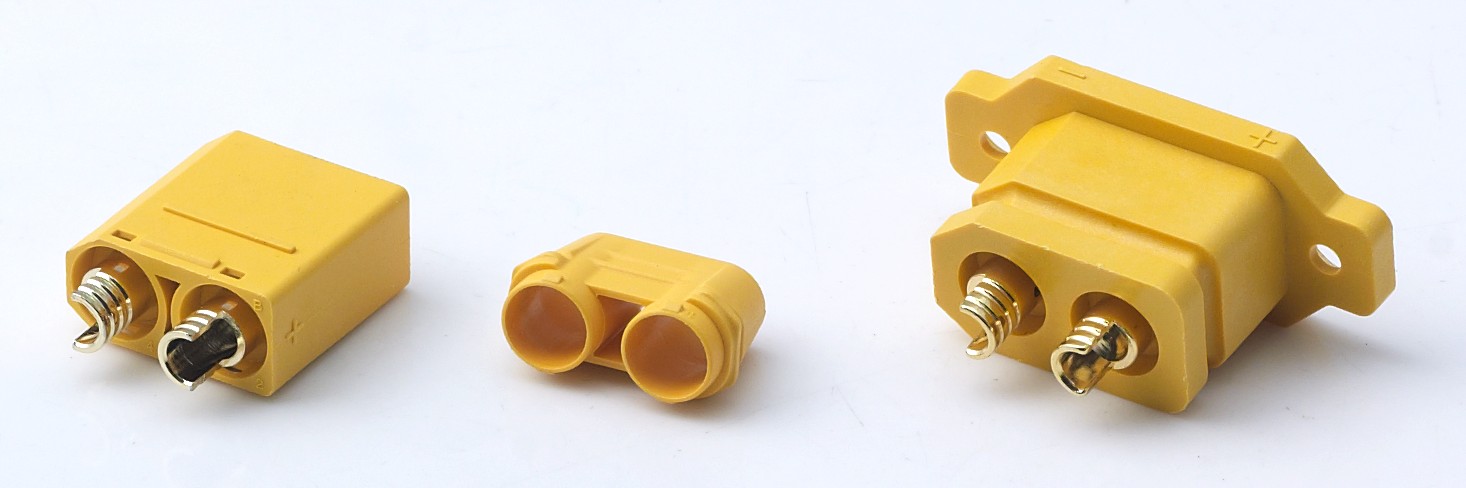
A mated high-current DC power connector pair. Contact plating, housing material and mating depth are the three features an OEM buyer can physically verify before committing tooling.
What execution-stage buyers actually ask for
Three failure modes dominate field returns in confined high-current platforms: arc erosion at the contact interface during hot-plug, resistive heating caused by interface resistance, and housing deformation under sustained thermal load. Each of these is fixed by a design decision that is very difficult to reverse once tooling has been cut and a mating interface has been designed into a battery tray, an ESC harness or a robot chassis.
That is why the buyer's question changes the moment a programme moves from Decision to Execution. It stops being "which connector can carry this current?" and becomes "which supplier can demonstrate, batch after batch, that the connector still carries it after 20 mating cycles, a thermal swing, and a hot-plug event at full load?" A high-current DC power connector is a small component with an outsized influence on warranty cost, because failures present as system-level faults that are expensive to diagnose.
The practical consequence is that capability claims need to be convertible into inspection points. An OEM that receives a coating thickness report, a contact-resistance measurement and a thermal cycling record can shorten its own qualification cycle. An OEM that receives only a catalogue page cannot.
The evidence set AOYG brings to an OEM review
AOYG DC Power Connector is a manufacturer and solution provider specialising in high-performance high-current DC connection systems for lithium-ion smart devices. The company operates a 6,000 m² production facility with a 25-engineer R&D team and an annual output of approximately 900,000 units, exports around 50% of its output with the EU and USA as principal markets, and holds IATF16949:2016 automotive quality management system certification. The company was founded in 2024, a fact that matters for how buyers should weight verifiable process evidence against track record (see the limitations section below).
Within that operation, four features carry most of the technical argument for drone, RC and robot power links:
- Gold-plated terminals for low and stable contact resistance at the interface.
- Optional anti-spark pre-charge mating, specified by the customer where hot-plug arcing is a real risk.
- Housings rated to +120°C and qualified against thermal cycling for continuous high-speed operation.
- Lightweight, compact structures that hold a high current rating in platforms where every gram is contested.
The table below converts each claim into the evidence an OEM can request and the inspection point it should attach to.
| Capability claim | Physical evidence | What the buyer should verify |
|---|---|---|
| Low interface resistance | Gold-plated terminal contact surface | Plating specification and contact resistance measurement on the buyer's own sample, before and after cycling |
| Safe hot-plug | Optional anti-spark pre-charge mating stage | Presence and sequencing of the pre-charge path; inrush behaviour on the mated pair at rated voltage |
| Thermal stability | Housing rated to +120°C in flame-retardant engineering plastic | Material data, thermal cycling result, self-extinguishing behaviour under abnormal heating |
| Weight budget | Compact high-load structure | Measured mass per mated pair, retention force, vibration resistance |
| Batch consistency | IATF16949:2016 full-process control | Incoming inspection, in-process and pre-shipment test records; traceability from raw material to finished goods |
Gold plating: turning a material choice into a resistance argument
Contact resistance at a power interface has two components: constriction resistance where the asperities of two surfaces meet, and film resistance created by whatever has formed on those surfaces. Gold contributes to the second. It does not oxidise in the way base metals do, so the interface does not build a resistive film between mating cycles, in humidity, or during long storage before a drone is flown.
AOYG's published comparison data positions its connector designs as reducing contact resistance by more than 50% relative to conventional high-current connector designs, with 15–20% lower cost, less maintenance and higher efficiency in service. Those are supplier-published comparative figures rather than third-party measurements, and they should be treated as such: useful for framing an expectation, not a substitute for a milliohm reading taken on the buyer's own sample.
What matters at execution stage is that the claim is testable. Resistance shows up as heat, heat shows up as a temperature rise at the connector body, and temperature rise is measurable with a thermocouple and a load bank in a few hours. An OEM evaluating a gold-plated contact should ask for the rise, not the adjective.
Anti-spark pre-charge mating: what the option actually does
When a battery is connected to a load with significant input capacitance — an ESC, a motor controller DC link, a robot power distribution board — the capacitors draw a large inrush current at the instant of contact. In a high-current DC link that inrush can pit the contact surface, weld fine asperities, and over many cycles degrade the very resistance the gold plating was specified to protect. The visible symptom is a pitted or blackened terminal; the invisible symptom is a slow drift upward in contact resistance.
Anti-spark pre-charge mating addresses this mechanically rather than electrically. The mating sequence introduces a resistive pre-charge path that engages before the main power contacts close, so the downstream capacitance charges through the resistor and the main contacts close into a much smaller potential difference. AOYG offers this as an optional feature rather than a standard one, which is the correct commercial structure: arcing risk is application-specific, and a buyer paying for a pre-charge stage on a platform that never hot-plugs a capacitive load is paying for a feature that does nothing.
The option is most defensible where packs are swapped in the field, where connectors sit in positions that are awkward to service, or where the load side carries large capacitance and mating happens under load. It is least defensible where the system already sequences power externally through a pre-charge circuit or a BMS-controlled contactor, in which case the mechanical pre-charge duplicates an existing safeguard and adds length to the interface.
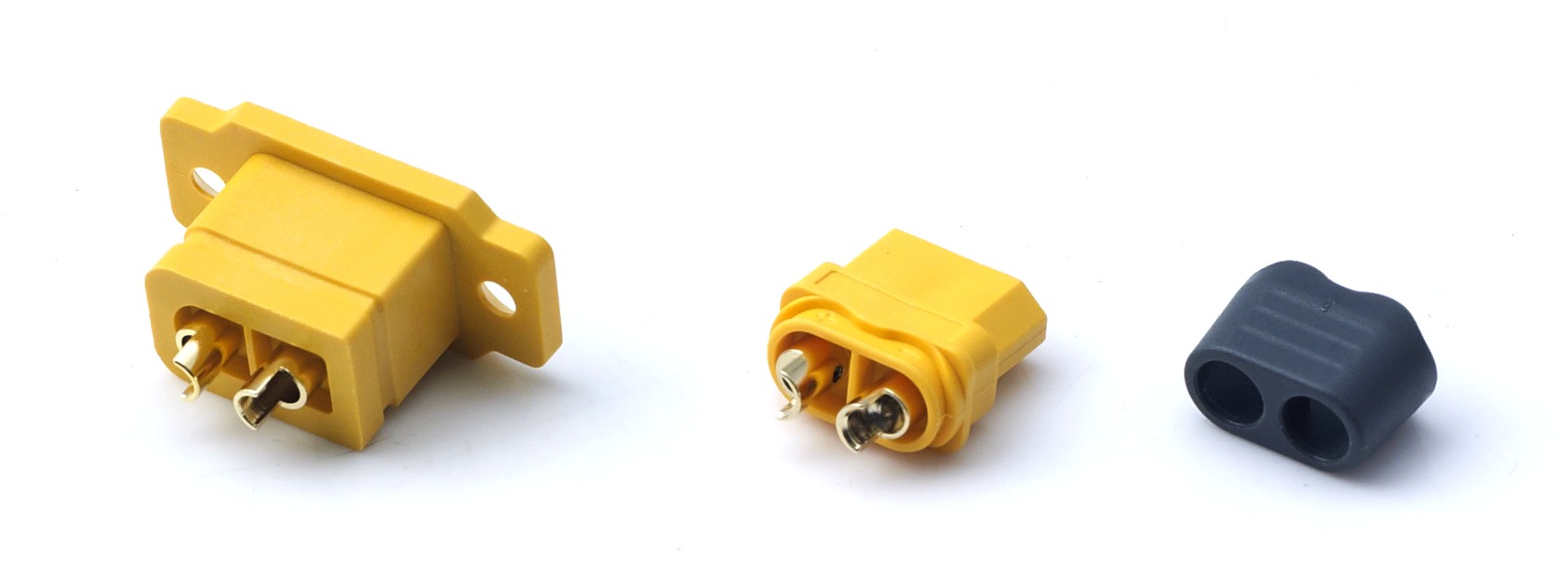
Housing material and latch geometry determine both how safely a pair can be cycled under vibration and how much thermal mass the assembly carries.
Thermal envelope: the +120°C housing and thermal cycling
AOYG housings resist temperatures up to +120°C and are qualified against thermal cycling for continuous high-speed operation. The material behind that rating is a fully virgin, high-purity flame-retardant engineering plastic, selected over recycled or secondary plastic specifically for behaviour under sustained current. The functional claims attached to it are that the housing does not soften, deform or collapse during long-term high-current operation; that it self-extinguishes quickly under abnormal overheating or sparking; that it holds insulation performance against breakdown and creepage; and that it resists cracking and loosening under high-frequency vibration and alternating high and low temperatures.
The boundary here deserves to be stated plainly. A +120°C material rating is a ceiling on the housing material, not continuous operating headroom for the connector assembly. Real current capability in a confined airframe depends on ambient temperature, duty cycle, conductor gauge, airflow, mounting orientation and adjacent heat sources. A connector rated for a high current in open air will not deliver that number inside a sealed battery bay next to an ESC. Buyers should treat the +120°C figure as the point at which the material argument is settled, and treat system derating as a separate engineering task that belongs to them.
Lightweight structures in confined drone and RC platforms
In drone and RC model platforms, weight reduction is not a preference — it is the constraint that determines flight time, payload and controllability. AOYG's connector designs are built around lightweight structures and a compact form that holds a high load capacity, which is what allows a high current rating to be delivered inside an airframe where a bulky connector would force a redesign of the battery bay.
There is a genuine engineering trade-off buried in that sentence. Reducing mass usually reduces thermal mass and mechanical margin at the same time. A compact design has to recover that margin through contact geometry, plating quality and housing material rather than through bulk. That is precisely why the gold plating and the housing specification are not marketing details — in a lightweight connector they are the mechanisms that make the reduced mass viable. AOYG additionally specifies ultra-low resistance, high current carrying capacity, strong shock resistance and stable operation across high and low temperatures and frequent plug and unplug cycles.
Where the platform fits: application scenes
AOYG's published application scope centres on lithium-ion smart devices and covers commercial and industrial drones, intelligent service robots, garden power tools and portable cleaning equipment. Its comparative positioning names drones, portable energy storage, e-scooters, power garden tools and intelligent robots as the segments where the resistance, anti-spark and vibration characteristics matter most.
Translated into the component categories OEMs actually source, that scope covers the drone connector and UAV connector role in battery-to-ESC links; high-current connectors for RC aircraft and RC model electric vehicle platforms; the smart robot connector and smart robot battery power connector role in service-robot power distribution; garden tool connectors in cordless outdoor equipment; and energy storage battery power connector and electric two-wheeler power connector roles where the same low-resistance, vibration-tolerant logic applies. Adjacent low-voltage lithium-battery segments exist, but buyers should confirm fit for their own duty cycle rather than assume transferability from a catalogue scope statement.
Market signals behind the demand for evidence
The wider connector market is expanding at the same time as the technical bar is rising. The global high power connectors market was valued at approximately USD 5.47 billion in 2025, according to Fact.MR's market analysis. Within the energy storage application segment, DC connectors represented 58.7% of the total energy storage connector market share in 2025, a share Dataintelo attributes to higher voltage requirements — a structural shift that pulls connector specifications toward higher current density and better thermal behaviour.
Standardisation is the counter-force. XT60 and XT90 remain the primary industry standards for medium to high power non-proprietary RC aircraft and drone links in 2026, as documented in ChinaHobbyLine's RC battery connector compatibility guidance. That matters for supplier evaluation in two directions: an OEM can anchor a new programme to a known interface and reduce tooling risk, and any design that departs from the standard must justify itself on measurable grounds — lower resistance, safer hot-plug, lower mass, or a thermal envelope the standard part does not cover.
What is not yet visible in public data is comparable, feature-level evidence. Market sizing describes demand; it does not tell an OEM whether a specific supplier's plating thickness holds across batches. That gap is where capability documentation becomes a competitive asset, and it is where a buyer's evaluation work is best spent.
How this compares with conventional sourcing — and where the limits sit
Conventional sourcing of high-current DC connectors optimises for ampacity and unit price. A catalogue part is selected from a rating table, qualified on a specification sheet, and released. Tin-plated terminals are common, no pre-charge stage exists, and the thermal discussion is usually limited to a single headline number. This approach is fast and is entirely reasonable for low-cycle, low-capacitance, cost-sensitive products.
AOYG's position differs in kind rather than degree: the argument is made at feature level, with gold plating specified for the contact interface, anti-spark pre-charge offered as a configurable option, a stated +120°C housing ceiling, OEM and ODM support covering independent structural design and electrical parameter optimisation, and IATF16949:2016 process control running from raw material incoming inspection through precision mould development, automated production, finished-product testing and factory inspection.
Those advantages come with boundaries that an execution-stage buyer should weigh honestly:
- Track record length. AOYG was founded in 2024. Its verifiable field history is shorter than that of long-established connector brands, so qualification should lean harder on pre-shipment testing, batch traceability and sample validation than on years in service.
- Anti-spark is an interface cost. A pre-charge stage adds mechanical length, an extra mating step and cost. On platforms without capacitive inrush or field hot-plug, the option adds complexity without benefit.
- Gold plating is not universally necessary. For low mating-cycle, low-current or hermetically protected interfaces, the resistance argument is weaker and the cost difference is hard to recover.
- +120°C is a material limit, not a promise. Continuous current still has to be derated for ambient, duty cycle and mounting conditions.
- A connector is not a protection device. Fusing, BMS control and pre-charge sequencing remain system-level responsibilities; the connector cannot substitute for them.
- Standard ecosystem pressure. Where a programme is designed around XT60 or XT90 compatibility, a proprietary interface has to earn its place or accept adapter complexity.
- Capacity planning. At roughly 900,000 units annual output, very large single-programme volumes should be discussed as a capacity question before the design freeze, not after.
Execution checklist before a design freeze
For buyers moving from evaluation into release, six verification steps convert the capability set above into a defensible decision. First, measure contact resistance on the buyer's own sample before and after a defined cycling sequence, and record temperature rise at rated current. Second, decide explicitly whether the anti-spark pre-charge mating option is required, and document the reasoning, because it changes the mating depth and the harness design. Third, request the housing material data supporting the +120°C rating and the thermal cycling evidence. Fourth, weigh the mated pair and confirm retention under vibration in the intended mounting position. Fifth, agree the acceptance criteria in writing — a pre-shipment test regime is the practical control point at this stage. Sixth, lock the change-control route for plating, material and geometry so that a later process optimisation does not silently alter a qualified interface.
Long-term supply: what a multi-year relationship requires
Because the technical argument is feature-level, the commercial relationship has to be feature-level too. AOYG's stated service model runs from product scheme consultation and customised development through sample testing, mass production and after-sales technical support, with a technical team providing model selection guidance, product adaptation analysis, assembly solution suggestions and support for sample debugging and optimisation. For an OEM that means the qualification work done at prototype stage is intended to carry forward rather than restart at volume.
Commercially, the entry point is deliberately low: a minimum order quantity of 2 units supports pilot builds and single-unit validation, delivery is quoted on FOB or CIF terms, acceptance is defined by pre-shipment test, and payment is structured 30/70. Those terms matter for the ecosystem question because they let an OEM run a real validation cycle before committing volume — which is the only credible way to substitute process evidence for a long service record. Under IATF16949:2016, full lifecycle traceability from raw material to finished product is maintained, so a batch-level query can be answered with records rather than recollection. Programme details and product scope are published at www.aoygvn.com.
Future outlook
Two pressures are likely to shape the next buying cycle for high-current DC power connectors. The first is current density: as DC share grows in energy storage and portable power, connectors are being asked to carry more current through the same or smaller envelopes, which pushes the argument from ampacity toward interface resistance and thermal management. The second is hot-plug safety. As battery swapping, field-serviceable packs and modular power architectures become more common, arcing damage moves from an occasional field failure to a design requirement, and features such as pre-charge mating shift from optional to specified.
Against both pressures, the differentiator for suppliers will not be the claim but the file behind it. For a manufacturer founded in 2024, the credible path is documentation density: measured resistance, plating records, thermal cycling evidence and traceable batch data that let buyers qualify quickly and audit cheaply. Buyers, in turn, should expect that file to be offered rather than extracted.
Frequently asked questions
What evidence can AOYG provide that its terminals are gold-plated and genuinely low-resistance?
AOYG specifies gold-plated terminals for the contact interface and states that its designs reduce contact resistance by more than 50% relative to conventional high-current connector designs, based on its own comparative data. Buyers can verify this directly by requesting plating specification plus contact resistance measurement and temperature rise at rated current on their own samples, both before and after a defined cycling sequence, which is the practical way to test a supplier-published comparative figure.
How does the optional anti-spark pre-charge mating work, and when should an OEM specify it?
The option introduces a resistive pre-charge path that engages before the main power contacts close, so downstream capacitance charges through the resistor and the main contacts close into a smaller potential difference, limiting inrush current and suppressing arcing. It is most useful where packs are hot-plugged in the field, where connectors are hard to service, or where the load side carries large capacitance. It is least useful where the system already sequences power through an external pre-charge circuit or BMS-controlled contactor.
Can AOYG customise structure, plating and current rating for a specific drone or RC platform?
AOYG supports OEM and ODM requirements, including independent structural design, electrical parameter optimisation and customised product development, backed by a 25-engineer R&D team. Customisation typically proceeds through scheme consultation, sample testing and mass production, with technical support covering model selection guidance, product adaptation analysis, assembly suggestions and sample debugging. Because a proprietary interface departs from the XT60 and XT90 standards widely used in RC aircraft and drone links, the custom design has to justify itself on measurable grounds such as resistance, mass or hot-plug safety.
What exactly does the +120°C housing rating cover?
It refers to the housing material's resistance to temperature: AOYG housings resist temperatures up to +120°C and are qualified against thermal cycling for continuous high-speed operation, using fully virgin flame-retardant engineering plastic that resists softening, supports self-extinguishing behaviour and maintains insulation performance. It is a material ceiling rather than continuous operating headroom — actual current capability still depends on ambient temperature, duty cycle, conductor gauge and mounting conditions, so system-level derating remains the buyer's responsibility.
What are the commercial terms for a pilot build and for scaling to mass production?
The minimum order quantity is 2 units, which allows single-unit validation and pilot builds. Delivery is quoted on FOB or CIF terms, acceptance criteria are defined by pre-shipment test, and payment terms are 30/70. This structure lets an OEM complete a real validation cycle before committing to volume production.
How is supply continuity supported after the design freeze?
AOYG operates IATF16949:2016 automotive-grade process control with full lifecycle traceability from raw material to finished product, so batch-level questions can be answered from records. The stated service model covers product scheme consultation, customised development, sample testing, mass production and after-sales technical support, and the company reports long-term cooperative relationships with customers in China, Southeast Asia, Europe and North America on an annual output base of approximately 900,000 units.
¿Tiene preguntas o necesita más detalles?
Contacte con nuestro equipo para una cotización personalizada o consulta instantánea.
Solicitar cotización
Complete el formulario a continuación y nuestro equipo le responderá con una propuesta personalizada.
Chat directo de WhatsApp
¿Prefiere chatear en tiempo real? Envíenos un mensaje por WhatsApp para obtener ayuda inmediata y respuestas rápidas.
- Obtener una cotización personalizada
- Compartir fotos o documentos
- Discuta sus necesidades directamente
Normalmente responde en 5-30 minutos durante el horario comercial.