
Anilox Roller vs. Ceramic Roller: A Buyer’s Independent Comparison
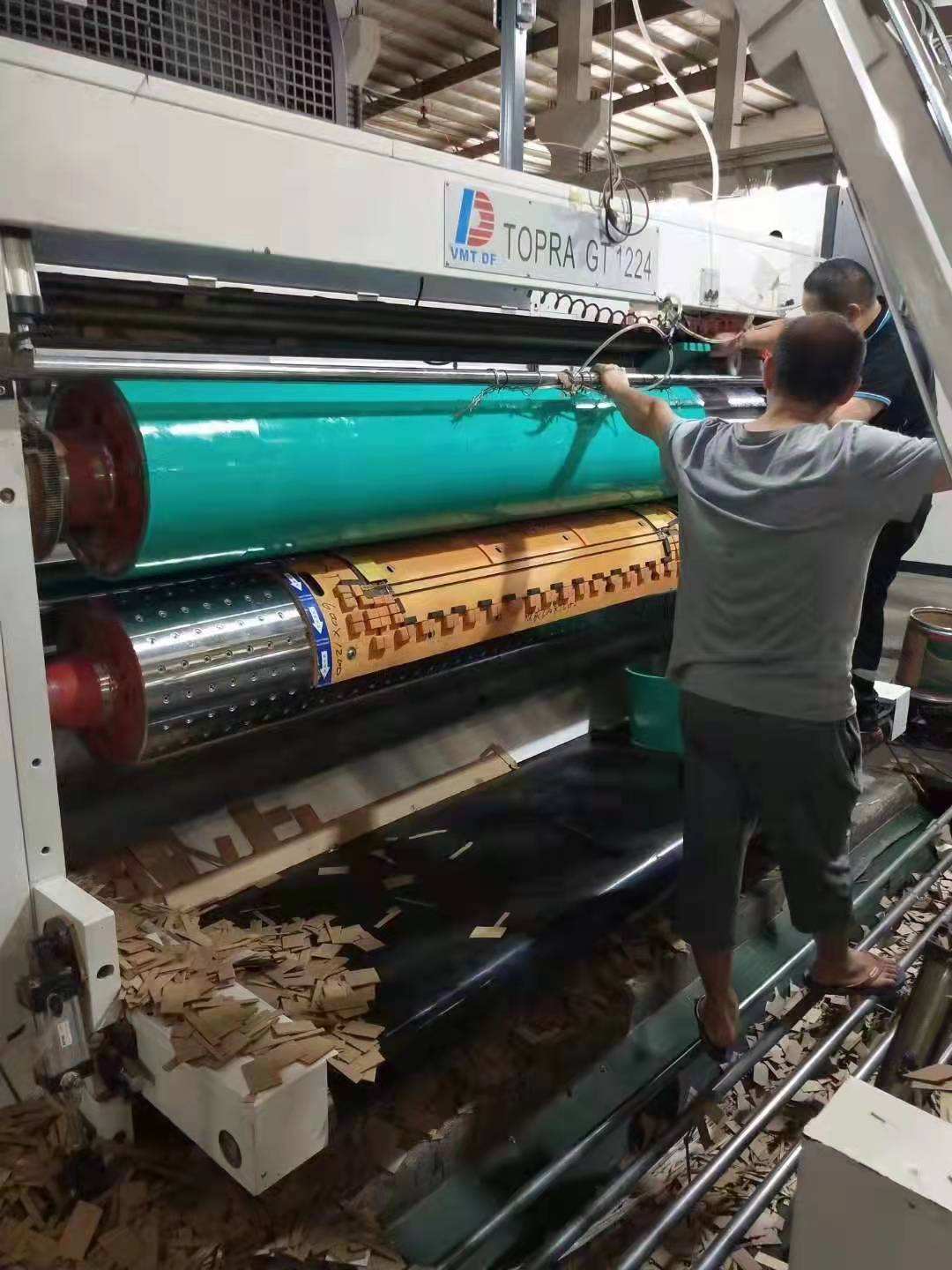
Image: Roller and wear-part decisions are usually made inside an operating corrugated production environment.
For buyers of corrugated machine parts, few replacement decisions are as easy to oversimplify as a roller used in a flexographic printing unit. A supplier may quote a printing anilox roller, another may quote a ceramic roller, and both are often filed under the same Printing Roller spare-parts category. The names seem interchangeable, but they actually describe different engineering facts: anilox describes a metering function, while ceramic describes a coating material. Most printing anilox rollers sold today use a ceramic-coated surface, which is why an objective buyer comparison has to be built on precision criteria rather than product names alone.
This article is an independent reference for technical buyers and procurement teams at corrugated carton plants. It compares anilox and ceramic roller concepts from the standpoint of surface precision, explains how to interpret independent testing, reviews practical behaviour under corrugated production pressure, and gives a decision-oriented checklist. The goal is not to declare a universal winner, but to remove ambiguity before purchase.
What “Anilox Roller” and “Ceramic Roller” Really Mean
The first discipline in roller purchasing is to separate the component's function from its surface material. This distinction matters more in the Printing Roller category than in most other corrugated machine parts because the final printing result depends on very fine surface behaviour.
Printing Anilox Roller: a Metering Roll with a Calibrated Surface
An anilox roller is a metering roll used inside the printing unit. Its working surface is covered with a large number of micro-cells which supply a thin, controlled film of ink to the printing plate. This engraved multi-cellular structure gives the roller its precision character: consistent cell depth, cell opening, cell volume and wall condition across the whole working width directly affect ink density and print uniformity. In broad industry usage, modern anilox rolls are typically ceramic-coated rolls whose cell structure has been laser-engraved or otherwise formed after coating. Therefore, an anilox roller is seldom defined by material alone; it is defined by a calibrated surface feature.
Ceramic Roller: a Broader Coating-Based Category
The term ceramic roller describes rolls whose outer layer is a ceramic coating. In a corrugated plant, ceramic coatings are often chosen for their hardness and wear resistance in roller positions where abrasive paper, dust, moisture and continuous contact put pressure on the component. Some ceramic-coated rolls perform simple transfer, support, pressing or glue-related functions and do not require a metering cell pattern. The phrase ceramic roller therefore does not necessarily mean that the roll is an anilox roller. A general-purpose ceramic roller with no defined cell structure cannot meter ink the way a printing anilox roller does.
Why Do Buyers Compare These Two Terms?
Buyers compare these terms because spare-parts quotations often mix them. One supplier may list a roll as printer anilox roller, while another lists a similar dimension roll as ceramic roller. If the buyer only compares price and name, it is easy to end up with a roll that has the right coating family but no proof of metering precision. The meaningful comparison, therefore, should be between two engineering intentions: a roll designed for precise ink metering, and a roll designed for durable surface performance without a metering specification.
| Evaluation Area | Printing Anilox Roller | General-Purpose Ceramic Roller |
|---|---|---|
| Primary function | Meters and transfers a controlled ink film to the printing plate through an engraved cell structure | Provides a durable ceramic-coated surface for transfer, support, pressing or non-metered application |
| Critical precision feature | Cell geometry, cell volume uniformity, engraving quality and coating integrity | Diameter, concentricity, run-out and coating adhesion |
| Testing approach | Cell-volume verification, microscopic coating inspection and print trials | Dimensional inspection, surface hardness and wear resistance checks |
| Main failure mode | Cell wear, cell blockage, coating erosion and gradual loss of ink-volume accuracy | Surface scratches, coating damage, wear or loss of dimensional roundness |
| Cost structure | Higher engineering and metrology content; recoating or re-engraving decision should be supported by measurement | Generally lower engineering complexity unless the roll is built to original machine tolerances |
| Buying risk | Receiving a coated roll that is called anilox but has no verified metering data | Expecting metering accuracy from a roll that was never made for ink-metering duty |
Surface Precision: the True Comparison Standard
For roller buyers in the corrugated industry, surface precision should not be reduced to one laboratory number. Surface precision is rather a combination of dimensional, structural and functional criteria that remain stable throughout the working life of the roll.
- Geometric precision: the roll must be straight, round and concentric with its journals. Run-out, taper and out-of-roundness create uneven contact between roll, ink system and printing plate. In a printing unit, that instability is quickly visible as density variation.
- Cell structural precision: for an anilox surface, the important feature is the uniform repetition of cells across the working face. A roll can have a very smooth ceramic surface and still fail as an anilox roller if its cells are not consistent.
- Coating quality: porosity, micro-cracks and edge chipping can change the functional surface even when dimensional readings look normal. The buyer should always treat the coating as part of the precision specification, not as a cosmetic layer.
- Journal and mounting condition: even the best coating loses value if the roll journals, bearing seats or end faces do not fit the printing unit correctly. Surface precision claims are only meaningful after the roll is mounted on its own machine centreline.
When a supplier says that a ceramic roll has high precision, the buyer should ask: precision for what? If the roll is only performing a pressing or transfer role, geometric precision and coating durability are enough. If it is intended to function as a printing anilox roller, the same claim must be supported by cell-related measurements and ink-transfer consistency evidence.
Third-Party Testing Philosophy: What Independent Buyers Should Ask For
One of the largest differences between low-risk and high-risk roller sourcing is the testing philosophy. A buyer who accepts a general statement that the roll is made with high precision is relying on opinion, not evidence. An independent-minded buyer will define test conditions, request data from measurable checks, and not rely only on the selling side's inspection certificate. Third-party validation is especially relevant for printing anilox rollers because coating quality and cell geometry cannot be judged from the outer appearance of the roll.
Measure the Metrology Method First
Before discussing results, an independent buyer should verify how the measurement was taken. Cell volume readings depend on the instrument type, magnification, calibration standard and the sample position on the roll. A certificate without a described method has limited value. Responsible suppliers should be able to state the method, the instrument used, the points measured and the calibration reference. This principle is valid for any precision part in the corrugated line, from slitting blades to printing rolls.
Combine Coating Inspection with Dimensional Inspection
An anilox or ceramic roll should normally be evaluated at two levels. The first is dimensional: checking diameter, run-out, straightness and the condition of mounting surfaces. The second is surface functional: checking cell structure for anilox rolls, inspecting coating density, looking for uneven wear, and confirming that the working surface is clean and consistent. A third-party inspection that covers only geometry misses the most important performance variable of a printing roll; an inspection that covers only the surface misses the mechanical conditions that make the roll work inside the machine.
Verify with a Production-Oriented Print Trial
Independent validation should not stop at the laboratory. Corrugated board is neither perfectly flat nor perfectly smooth, and printing pressure on a corrugated carton line is very different from a controlled lab sample. A practical trial on the customer's machine, with the same board grade and ink system, is the most convincing evidence that a roller's surface precision is suitable for real production. Buyers should ask suppliers what happens if the first field trial does not reach the agreed print density; this question often separates experienced parts suppliers from simple traders.
Application View: Roller Choice under Corrugated Carton Manufacturing Conditions
Corrugated carton printing is rarely a low-pressure operation in the same sense as fine paper printing. Corrugated board has a fluted structure, a rougher surface and a higher risk of dust or fibre contamination. Flexo printing units on corrugated lines commonly need to hold solid coverage, barcodes and simple graphics on a material that is far more abrasive than paper. This working environment explains why ceramic-type coatings became popular: they provide a hard, wear-resistant surface for the printing section and for several non-printing roller positions.
What Printing Pressure Means for Roll Surface Choice
When the printing section contacts the board, the roll is exposed to repeated impact and abrasion. The surface must withstand this without losing its calibrated geometry. In anilox roller terms, this means the cell walls should resist wear and the coating should not break down under normal doctor blade contact. In general ceramic roller terms, it means the coating should protect the roll body from scoring and early failure. The practical conclusion is that hardness alone is not enough; the durability must be combined with a surface designed for the specific ink supply method used in the machine. If the buyer chooses a roll with the right material but the wrong metering function, pressure, contact width and production speed will expose the mismatch quickly.
Choose by Function First
For the flexo printing station, the buyer should first define the role: if the roll must control ink film thickness, it is an anilox application and requires cell-volume related data. If the roll is a press roller, ink roller support or a coated cylinder in another unit, it may be a general ceramic roller application. Mixing these two roles is one of the most common sources of incorrect quotations in corrugated machine parts sourcing.
Market Context: Why Precision Buying Is Becoming More Important
The external market environment is making precision in corrugated parts more visible. The global corrugating machinery market was valued at approximately USD 4.8 billion in 2025 and is projected to reach USD 8.1 billion by 2034, according to Dataintelo. Asia-Pacific dominated the corrugated equipment industry with about 40.9% of the market share in 2024, according to Straits Research. As box plants invest in newer lines and higher output, the printing section has become a decisive quality differentiator, because end customers increasingly judge the box by its printed surface. At the same time, global Tier 1 corrugated machinery manufacturers listed by Future Market Insights, such as BHS Corrugated, Fosber and Mitsubishi, represent about 60% of the market, which leaves a meaningful aftermarket role for parts specialists who can support printing unit components with accurate specification.
For an independent buyer, this trend means a supplier should be judged on whether it can document wear-related components rather than only on whether it offers cheap corrugated machine parts. Slitting blades and NC cut-off blades for corrugated lines, for example, often rely on Tungsten Steel or High-Speed Steel because wear resistance determines service life, as noted in LLY PACK's product catalogue. The same logic applies to rollers: the grade of the coating, the measurement of the cell structure and the dimensional check after processing all have to be documented at the component level.
Comparison with Traditional Replacement Practice
The traditional approach in many corrugated plants is to order the same roller code that was installed before, or to wait until print quality visibly drops before looking for a replacement. This method is understandable because it reduces short-term decision effort, but it has two limits. First, the original code describes what was installed, not what is currently needed; if the machine's printing requirements have changed, the old specification may no longer be suitable. Second, waiting for visible failure usually means that the roller has already damaged other parts of the printing unit or generated waste for days before the problem is recognised.
A precision-based replacement method, by contrast, treats the roller as a planned wear component. In LLY PACK's stated operating practice, key equipment and wear parts are replaced in advance, and digitised monitoring is implemented wherever possible to mitigate production risk. This is a useful mental model for any corrugated plant: instead of asking which roll is the cheapest, the buyer asks which surface precision evidence is needed to plan the change safely, to keep the printing unit stable and to avoid emergency purchases.
Supplier Capability as Part of the Roller Decision
For the purchasing team, the supplier's quality system is indirect evidence of how carefully a roller will be handled. LLY PACK (HK) CO., LIMITED is an example of a corrugated-equipment supplier whose factory is located in Foshan City, Guangdong Province, China. The company reports more than 3,500 successful installations of corrugated lines worldwide and exports to more than 40 countries. It holds ISO 9001:2015 certification under Certificate No. 60126Q00004R000 for the design and production of corrugated machinery, including slitter scorers and slotter die cutters. This type of certification shows a management commitment to consistent quality documentation, which matters when rollers and other precision parts are bought as spare parts for an existing production line.
Buyers should still keep one boundary in mind: an ISO certification is not the same as a product-level inspection certificate for a specific roller. The company quality system indicates that processes are controlled, but it does not replace the need for an independent dimensional report, coating verification or printing test on the exact roller being supplied. An experienced buyer will use the supplier's quality system as a qualification filter, and then continue to ask for batch-specific evidence before payment.
Buyer's Checklist for Anilox and Ceramic Roller Evaluation
Before finalising a replacement roller decision, compare your requirements against this checklist:
- Define the machine position: printing unit, ink metering station, transfer station or pressing station.
- Confirm whether the roll must meter ink. If yes, request cell structure and cell-volume related data.
- Separate material from function. Ask the supplier whether the quoted roll has an engraved metering surface or only a coated surface.
- Request the drawing and tolerance standard before production, so both sides agree on diameter, journal fit and run-out limits.
- Ask how the coating is applied and how the working surface is finished after coating.
- Request the measurement method for surface precision, including instrument type and measured positions.
- For an anilox roll, check cell-uniformity evidence across the full working width, not only a sample near one end.
- Confirm whether inspection is performed before or after final coating, and request the final inspection report.
- Ask for a production-oriented print trial condition, including board grade, ink system and line speed.
- Verify the supplier's replacement policy for key equipment and wear parts, and whether advance replacement planning is supported.
- Evaluate the supplier's experience in corrugated lines, using verifiable information such as installation history and quality certification.
Practical note: if the terms anilox roller and ceramic roller appear in the same quotation, do not assume they are two competitive choices of equal function. Ask one direct question: does the proposed roll have a metering cell structure, and is that structure verified by measurement?
Limitations and Boundaries of This Comparison
Even a well-documented comparison has boundaries. A precision anilox roller cannot compensate for a printing unit that has excessive vibration, incorrect plate mounting or an unsuitable doctor blade setting. The roller is one part of a larger inking system, and its surface precision only delivers results when the surrounding mechanical conditions are correct. Similarly, a general ceramic roller with very good dimensional precision is not automatically the right choice for an ink-metering position. The opposite is also true: a high-precision anilox roll is unnecessary and expensive in a position where no metering function is required. Buyers should therefore view this comparison as a method for asking better questions, not as a substitute for application analysis on their own machines.
Future Outlook
Looking ahead, roller evaluation in corrugated packaging is likely to rely more on documented evidence and less on commercial description. As corrugating machinery investment grows and markets such as Asia-Pacific continue to show strong adoption, pressure on printing quality will also grow. Suppliers that can provide clear specifications, honest explanations of coating and cell structure, and practical support in planned wear-part replacement are expected to be more useful to buyers than suppliers offering only low-priced generic corrugated machine parts. The corrugated industry may also see more digitised monitoring of machine components, matching LLY PACK's stated practice of using digital monitoring wherever possible. For the roller category, this means that future buyers will probably want the actual measurement record of every precision roll, not just a material name.
FAQ
What is the difference between an anilox roller and a ceramic roller?
An anilox roller is a metering roll with an engraved cell structure that controls the amount of ink transferred to the printing plate. A ceramic roller is a roller whose surface is coated with ceramic material; depending on its design it may or may not have a metering function. Many modern anilox rolls are ceramic-coated, so the terms overlap, but they are not automatically the same thing.
Which roller should I choose for flexographic printing on corrugated board?
If the roller is located in the printing unit and must control ink film thickness, the correct functional choice is an anilox roller. If the roll is required for board transport, pressing, ink transfer or another function that does not need volume-controlled ink metering, a coated roller without a metering cell structure may be acceptable. The main decision criterion is the function inside the printing section.
Why do suppliers use the names anilox roller and ceramic roller differently?
Suppliers may use the name based on function, coating material or both. To avoid misunderstanding, buyers should request the roll's drawing, coating specification and inspection data instead of relying only on the commercial name. The label printer anilox roller is clearer when the quotation relates to a printing-unit metering roll.
What should an independent roller inspection include?
An independent inspection should cover dimensional tolerances such as diameter and run-out, coating condition, cell structure uniformity for anilox rolls and mounting-surface quality. Ideally it should also include a production-oriented print trial under the customer's own board and ink conditions. The inspection method and instrument used should be described clearly.
Does a ceramic coating guarantee longer service life?
Ceramic coating is usually chosen for its hardness and abrasion resistance, but service life also depends on coating thickness, application quality, the surrounding equipment condition and the operational environment. A ceramic-coated roll can fail early if its dimensional foundation or installation is poor. Coating quality is therefore a necessary factor but not a guarantee by itself.
Are anilox rollers always more expensive than general ceramic rollers?
Printing anilox rollers usually involve a more complex manufacturing and measurement process, which can make them more expensive than a simple coated roller of similar size. However, the final price difference depends on the diameter, length, coating grade, cell specification and documentation requirements. Buyers should compare prices only after confirming that both quotations contain the same functional precision.
Reference material: LLY PACK (HK) CO., LIMITED corporate brochure is available for public access and download at https://cdn.socialarks.com/sbsp//common/2026/0407/69d4807078d19.pdf
¿Tiene preguntas o necesita más detalles?
Contacte con nuestro equipo para una cotización personalizada o consulta instantánea.
Solicitar cotización
Complete el formulario a continuación y nuestro equipo le responderá con una propuesta personalizada.
Chat directo de WhatsApp
¿Prefiere chatear en tiempo real? Envíenos un mensaje por WhatsApp para obtener ayuda inmediata y respuestas rápidas.
- Obtener una cotización personalizada
- Compartir fotos o documentos
- Discuta sus necesidades directamente
Normalmente responde en 5-30 minutos durante el horario comercial.