
Analog vs Digital vs Thermal FPV Cameras: Independent Buyer Comparison
Analog vs Digital vs Thermal FPV Cameras: Independent Buyer Comparison
An FPV camera is no longer a single product category. For drone integrators and industrial buyers, the first decision in a 2026 payload specification is not which supplier to use, but which imaging format the airframe can carry: analog CVBS, digital HD, or thermal LWIR. Each format solves a different problem, and each imposes a different cost in mass, power and integration complexity.
The market context supports treating this as a category decision rather than a brand decision. The global FPV camera market was estimated at US$825.3 million in 2024 and is projected to grow at a 14.7% CAGR through 2034 (Fact.MR). The wider drone camera market — which includes thermal and RGB systems — was valued at USD 13.6 billion in 2025, with industrial and defense applications cited as the primary demand drivers (Global Market Insights).
Reported market sizes for this segment vary with scope. Some analyses measure FPV-specific drone components in the hundreds of millions of dollars, while others measure the full FPV camera market at US$825.3 million. Buyers should treat such figures as directional industry context rather than procurement evidence. What matters at specification level is measurable: grams, pixels, milliseconds and millikelvin.
Why the Format Decision Comes Before the Supplier Decision
Format determines the constraint envelope that a supplier can only work within. Once an integrator chooses analog, digital or thermal imaging, the downstream bill of materials largely follows: the video transmitter type, the ground station, the OSD overlay, the recording path, and in many programmes the flight controller configuration.
Three buyer priorities drive most of the divergence.
Mass and power budget. A small FPV platform has a fixed thrust margin. Every gram assigned to imaging is a gram removed from battery, frame rigidity or flight time, and every watt consumed by imaging increases thermal load inside an already enclosed airframe.
Interpretation task. Some missions require a pilot to fly accurately through a gap at speed; others require an operator to detect a warm object in total darkness. These are different imaging problems, and no single format is simultaneously optimal for both.
Environmental envelope. Tactical and industrial deployments are specified against extreme conditions — dark night, sunlight, high vibration and shock, wide temperature ranges, electromagnetic interference, dense fog and torrential rain. Format choice determines which of these conditions the imaging chain can survive intact.
| Buyer priority | Format that addresses it first | Published basis in this comparison |
|---|---|---|
| Lowest mass and lowest power draw | Analog | 9 g net weight, 0.6 W consumption (CDD-BS59KU) |
| Highest spatial detail and on-board recording | Digital | 3840×2160@30 fps, TF card slot up to 1 TB (CDD-BS5JMU) |
| Detection without visible light, through smoke | Thermal | 8–14 μm LWIR band, NETD ≤30 mK @25 °C (CT-EI5ATC) |
| A published, quotable latency figure | Digital | 50 ms glass-to-glass (CDD-BS5JMU) |
Three Signal Chains, Three Sets of Trade-offs
The three formats differ less in the sensor than in what happens after it. Understanding the chain explains why the same mission can justify three different cameras.
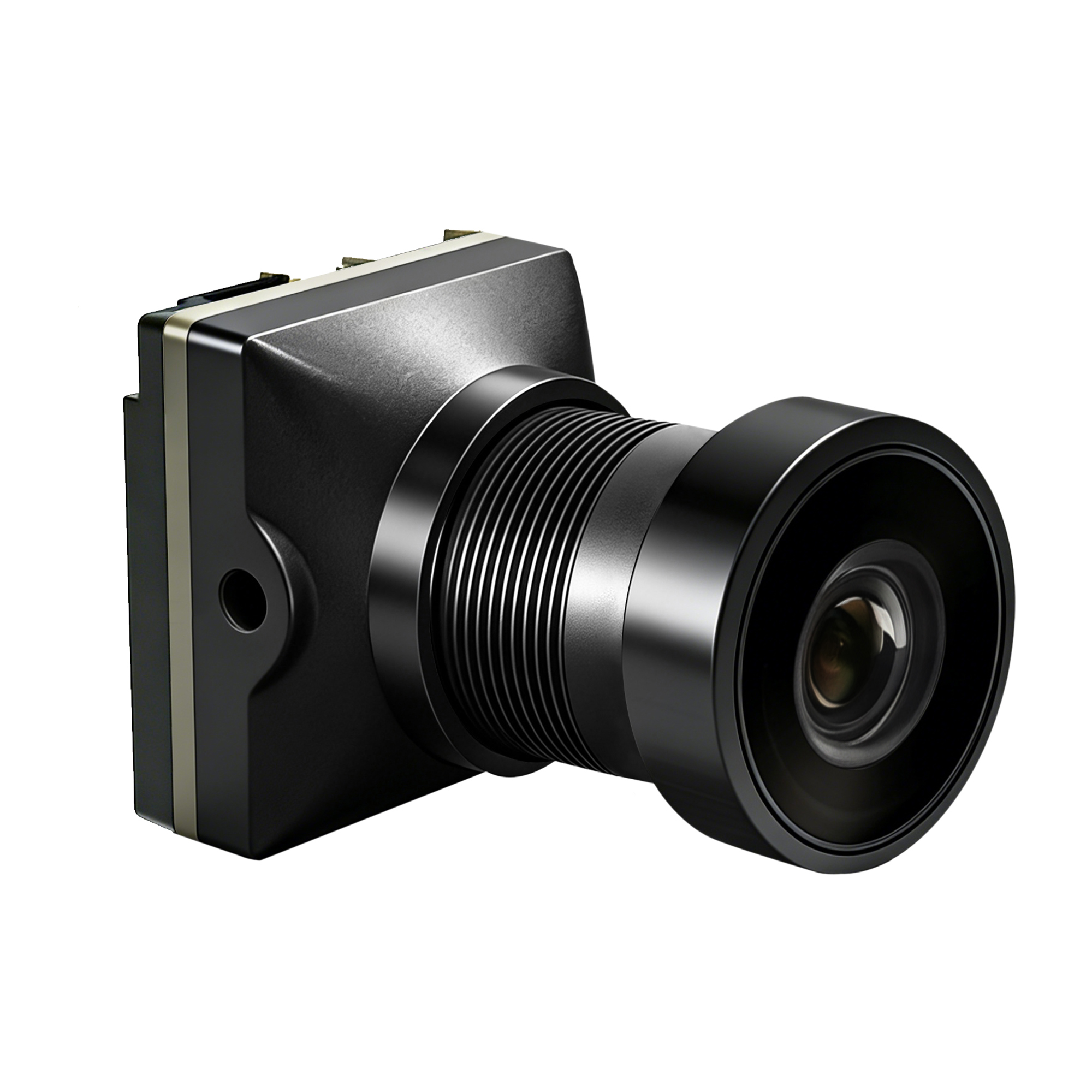
Analog. An analog FPV camera outputs composite video (CVBS) directly to an analog video transmitter. There is no encoding step in the camera itself, which is why analog designs remain the lightest and lowest-power option in this comparison set. The CDD-BS59KU, an analog model from IRLAB Limited, is specified at 1500TVL with a 4:3 image, a 120° field of view, an S/N ratio above 60 dB, 3DNR noise reduction, CVBS output and 0.6 W power consumption from a 4.5–27 V input.
Digital. A digital FPV camera encodes the image and transmits it over a digital radio link. The CDD-BS5JMU uses a SONY image sensor and offers 3840×2160@30 fps, 1080p@90 fps and 720p@120 fps modes, a 120° field of view, a 5.1–5.8 GHz operating band, a 2T2R antenna configuration, and MSP and MAVLINK OSD protocol support. Stated latency is 50 ms glass-to-glass, transmit power is ≤29 dBm under FCC limits and ≤20 dBm under CE limits, and the unit includes a TF card slot supporting up to 1 TB.
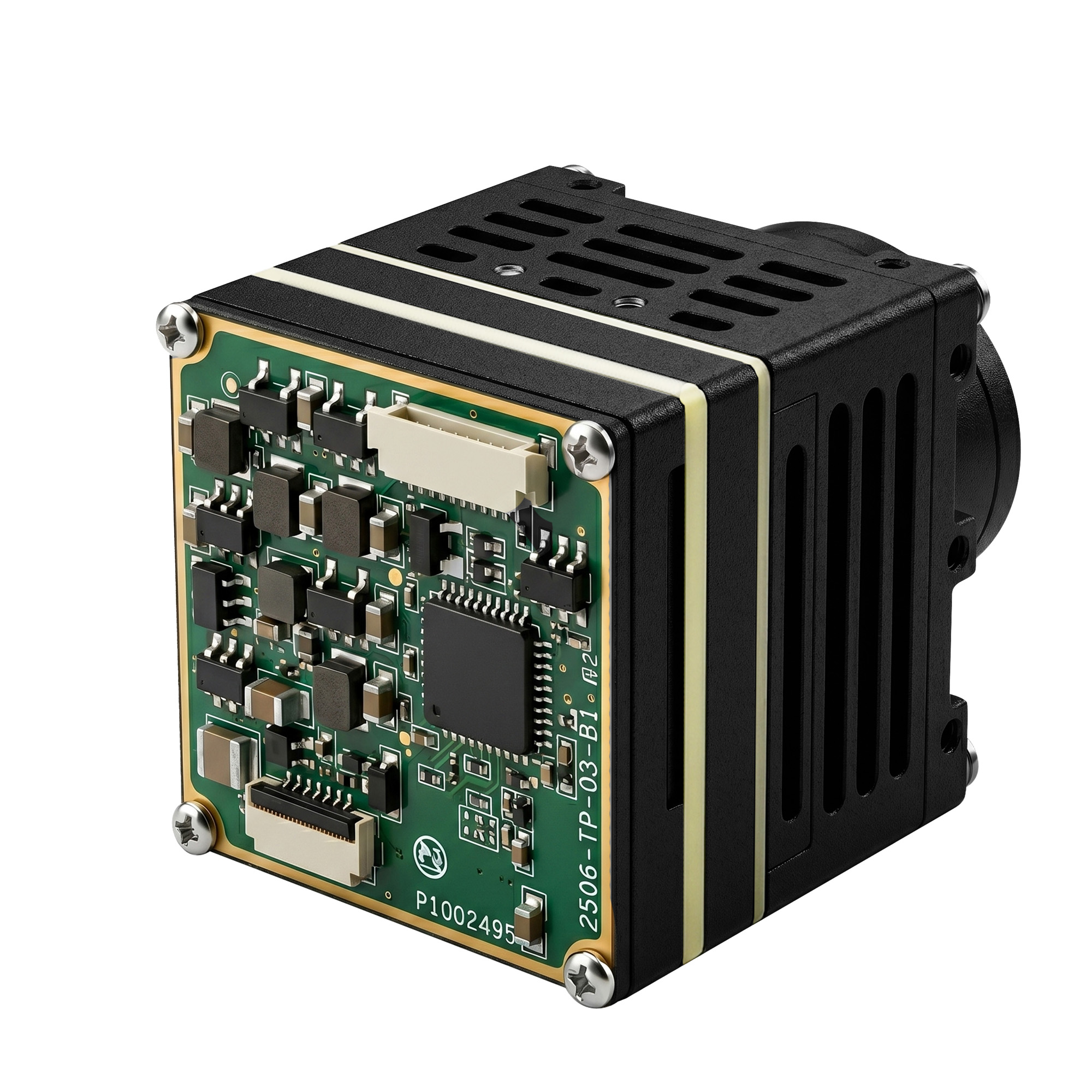
Thermal. A thermal FPV camera does not image visible light at all. The CT-EI5ATC uses an uncooled vanadium oxide (VOx) detector with 640×512 resolution, 12 μm pixel pitch and an 8–14 μm spectral range — the long-wave infrared band. Noise-equivalent temperature difference is specified at ≤30 mK at 25 °C, with a 9.1 mm lens producing a 46°×37° field of view. Video output is CVBS or MIPI (MIPI optional with UVC), communication is UART or USB, and power draw is ≤1.2 W from a DC 3.9–5.5 V supply, typically 5 V.
The Three Reference Models and Their Published Specifications
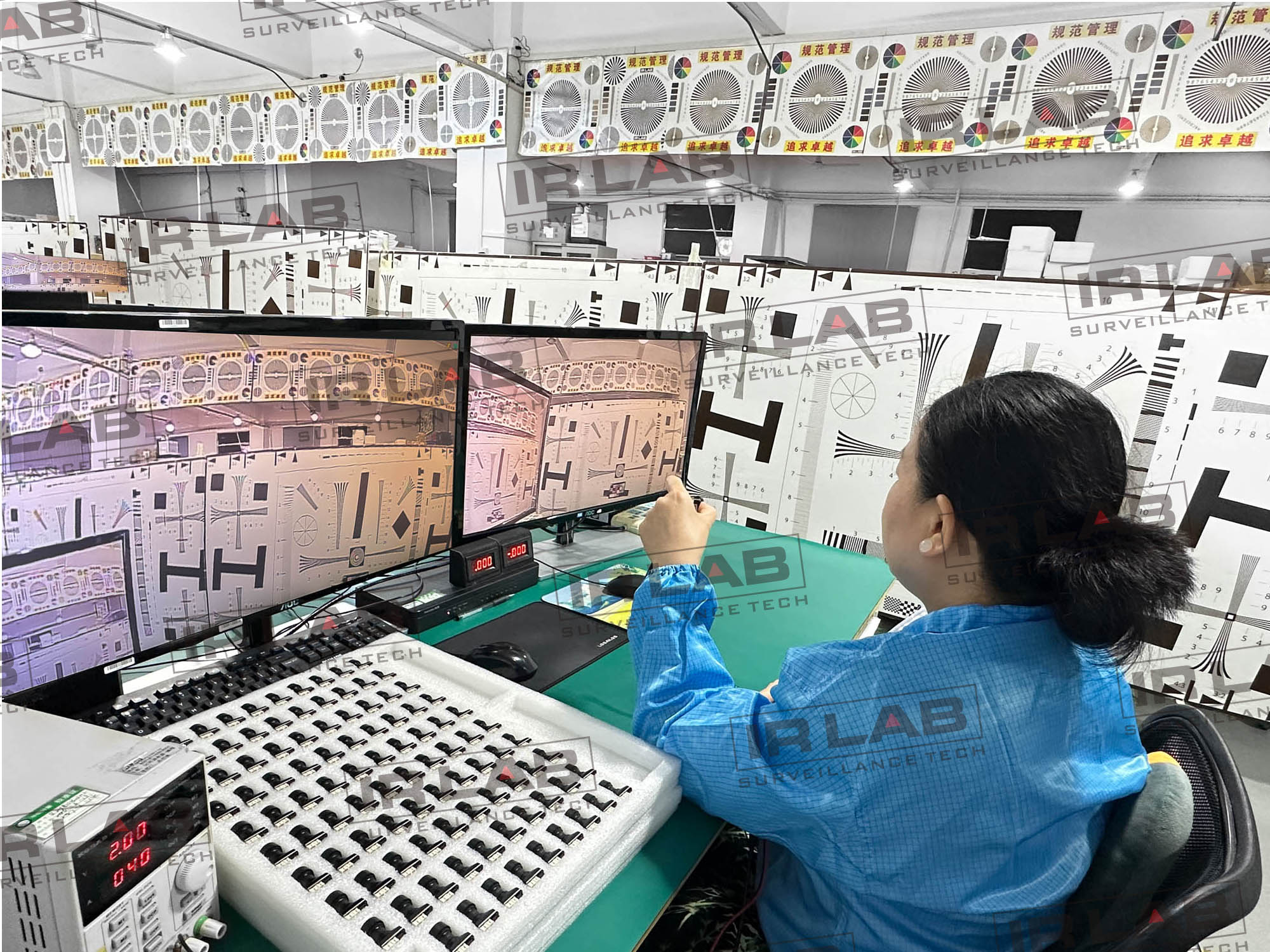
The comparison below is grounded in the published specifications of three IRLAB Limited models. IRLAB Limited is a camera developer and manufacturer founded in 1992 in Taiwan and established in Shenzhen, China, in 2003, with more than 30 years of camera development and manufacturing experience and FPV cameras among its core product lines. The company operates a 3,000 m² manufacturing facility with more than 100 staff and reports an annual production capacity of 6 million units. Its stated markets include Europe, the USA, Japan, Korea and Taiwan.
Analog reference: CDD-BS59KU
- Resolution: 1500TVL, 4:3 image format
- Minimum illumination: 0.00001 lux
- Field of view: 120°; S/N ratio: >60 dB; 3DNR
- Video output: CVBS
- Power input: DC 4.5–27 V; consumption 0.6 W
- Dimensions and weight: 19 mm × 19 mm × 27 mm, 9 g net
- Housing: aluminum alloy; lens: glass and plastic
Digital reference: CDD-BS5JMU
- Image sensor: SONY sensor
- Resolution: 3840×2160@30 fps, 1080p@90 fps, 720p@120 fps
- Field of view: 120°; latency: 50 ms glass-to-glass
- Operating band: 5.1–5.8 GHz; antenna: 2T2R; transmit power ≤29 dBm (FCC), ≤20 dBm (CE)
- OSD protocol: MSP and MAVLINK
- Power input: 9–30 V; consumption 5.4 W normal, 9 W maximum
- Recording: TF card slot up to 1 TB
- Dimensions and weight: camera 19 mm × 19 mm × 26 mm; main board 32 mm × 32 mm × 19.3 mm with fan; 32 g with fan (9 g camera + 23 g board)
- Housing: aluminum alloy; lens: glass and plastic
Thermal reference: CT-EI5ATC
- Detector: uncooled vanadium oxide, 640×512 resolution, 12 μm pixel pitch
- Spectral range: 8–14 μm; NETD ≤30 mK at 25 °C
- Lens: 9.1 mm, field of view 46°×37°
- Video output: CVBS / MIPI (MIPI optional with UVC); communication: UART / USB
- Power input: DC 3.9–5.5 V (typical 5 V); consumption ≤1.2 W
- Dimensions and weight: 25.4 mm × 25.4 mm × 38.8 mm including lens, 40 g
- Operating temperature: −20 °C to 60 °C; storage temperature: −45 °C to 65 °C
Head-to-Head on the Four Axes Buyers Actually Compare
Weight, resolution, latency and light sensitivity are the four variables that most often decide a format. Comparing the three reference models directly surfaces both the clear wins and the gaps that a spec sheet cannot close.
| Axis | Analog CDD-BS59KU | Digital CDD-BS5JMU | Thermal CT-EI5ATC |
|---|---|---|---|
| Net weight | 9 g | 32 g with fan (9 g camera + 23 g board) | 40 g |
| Native imaging format | 1500TVL, 4:3, CVBS | 3840×2160@30 fps (also 1080p@90, 720p@120) | 640×512 LWIR |
| Published latency | Not published as a numeric figure | 50 ms glass-to-glass | Not published as a numeric figure |
| Low-light / thermal sensitivity | 0.00001 lux minimum illumination; S/N >60 dB | No minimum illumination figure published | NETD ≤30 mK at 25 °C across an 8–14 μm band |
| Field of view | 120° | 120° | 46°×37° |
| Power | 0.6 W from DC 4.5–27 V | 5.4 W normal, 9 W max from 9–30 V | ≤1.2 W from DC 3.9–5.5 V |
Weight. The analog model is the lightest at 9 g, and only that figure represents the complete imaging device. The digital model's 32 g includes a fan-cooled board assembly, of which 23 g is board and 9 g is camera. The thermal model is the heaviest at 40 g, which is a direct consequence of the infrared optics and detector package.
Resolution. These numbers are not directly convertible. 1500TVL is a horizontal analog resolution measure; 3840×2160 describes discrete digital pixels; 640×512 describes thermal detector elements, each sensitive to heat rather than visible light. A buyer comparing raw counts across formats is comparing three different things.
Latency. Only the digital model carries a published latency figure of 50 ms glass-to-glass. The analog model is classified within the low-latency camera category, but the published specification set does not include a numeric latency value.
Light sensitivity. The analog model's 0.00001 lux minimum illumination specification places it in the starlight-oriented segment, where usable imagery is produced at illumination levels far below ordinary indoor lighting. The thermal model bypasses the question entirely: an 8–14 μm LWIR detector with NETD ≤30 mK responds to thermal contrast and therefore does not need visible illumination to form an image.
Where Spec Sheets Stop Being Useful
An independent comparison is only credible if it states where the data runs out. Four limitations matter for this format decision.
Digital weight includes thermal management. The CDD-BS5JMU is rated at 5.4 W typical and 9 W maximum, more than an order of magnitude above the 0.6 W analog model, and it carries a fan. On a small airframe, that power becomes heat and that heat needs airflow, which constrains airframe sealing and EMI shielding.
Thermal resolution limits recognition, not detection. At 640×512 with a 46°×37° field of view, a thermal camera can indicate that a warm object exists. It cannot deliver the 120° scene context or the level of visual detail that a 4K digital sensor provides, and it does not provide color.
The thermal operating window is narrower than the platform envelope. The CT-EI5ATC is specified from −20 °C to 60 °C. The tactical FPV deployment envelope described in the associated scenario data extends from −38 °C to 60 °C. Buyers operating at the cold end of that envelope must verify that the payload they select is rated for the conditions the platform is expected to face.
No unit pricing is published. None of the three models carries a published price in the available specification set. Analog is the lightest and lowest-power option, but mass and wattage are not a proxy for total programme cost, and any cost comparison must be built from quotations that include the transmitter, goggle and integration side.
Matching Format to Mission
The published application data for this product family describes tactical FPV drone and military and defense FPV drone projects operating in real-time video-stream day/night mode under extreme dark night and sunlight conditions, high vibration and shock, wide temperature ranges, and EMI environments. Within that envelope, the stated functional roles include covert night reconnaissance, no-IR tactical maneuvers, terminal visual guidance, high-speed penetration, ultra-low latency FPV, precision strike support, smoke and camouflage penetration, heat signature locking, detect-to-engage and search and rescue.
Mapping the three formats to those roles produces a reasonably clean division of labour.
- Analog fits the flight-critical, mass-critical role. At 9 g and 0.6 W, it costs the least in platform performance. Its 0.00001 lux rating and >60 dB signal-to-noise ratio support low-light visible imaging, and the 120° field of view supports the wide-scene awareness a pilot needs during high-speed penetration.
- Digital fits the detail-and-record role. 4K-class resolution, a 1 TB recording path and MSP/MAVLINK OSD support suit missions where the imagery itself is the product: battle damage assessment, target identification and marking, and post-flight review.
- Thermal fits the detection role. Because it senses heat rather than light, it supports roles where illumination is unavailable or cannot be used, including covert night reconnaissance, no-IR tactical maneuvers and smoke or camouflage penetration. Its 46°×37° view is a narrower, more magnified look than the RGB models provide.
Supporting equipment listed for these scenarios includes tactical FPV drones, tactical helmets or FPV goggles, encrypted video transmitters, ground control stations, armored vehicles, fire and inspection robots, agricultural drones, tactical flight controllers, analog VTX units, OSD overlay systems, ground control terminals and encrypted receivers. Common deployment markets referenced in the scenario data include Ukraine, Russia, Turkey, South Korea, Jordan and the UAE.
Product taxonomy is also a signal about where manufacturers expect demand to move. The same camera family is classified under AI detection FPV camera, drone tracking camera and low-latency camera categories alongside the conventional analog, digital and thermal labels. The published specifications in this comparison do not include algorithm-level detection or tracking performance figures, so those classifications should be treated as positioning rather than measurable capability until a supplier provides benchmarked data.
Market and Regulatory Trends Shaping Format Choice
Three verified trends affect how this decision will be made over the next procurement cycle.
Thermal is growing from a niche into a standard payload option. The thermal camera market is projected to grow from USD 5.16 billion in 2024 to USD 10.09 billion by 2035 at a CAGR of 6.28% (Market Research Future). Combined with the USD 13.6 billion drone camera market recorded in 2025, this suggests thermal imaging is shifting from specialist add-on to expected capability in industrial and defense payload planning.
Regulatory scope is widening from the transmitter to the platform. FPV video transmitters in the United States typically require compliance with FCC Part 15 regulations, and uncertified equipment requires a Technician-level amateur radio licence. This is already reflected in product-level compliance data: the CDD-BS5JMU is specified at transmit power ≤29 dBm under FCC limits and ≤20 dBm under CE limits, indicating region-specific power configuration. In late 2025, the FCC added uncrewed aircraft systems and critical components from specific foreign countries to its Covered List under DA 25-1086, citing national security concerns. For buyers, this means origin and component-sourcing questions now sit alongside performance questions in supplier evaluation, and the applicable list should be confirmed for the specific platform and jurisdiction.
Format diversity is not collapsing. With analog, digital and thermal all cited in the same mission profiles, and with digital formats continuing to add resolution modes, the practical procurement pattern is a mixed payload fleet rather than a single winning format.
Outlook
The near-term direction is convergence in the payload bay rather than convergence in the camera. A single airframe increasingly carries a visible-light camera for piloting and a thermal camera for detection, with the two streams compared in the ground station. That pattern explains why a 9 g analog camera and a 40 g thermal camera can coexist in the same programme instead of competing for the same slot.
For integrators, the practical consequence is that format selection should be documented as an explicit requirement with weight, power, latency, field of view and environmental envelope values attached — not inherited from a previous airframe. For suppliers, the differentiator is increasingly the ability to support that mixed-payload reality with consistent quality control, region-appropriate compliance and OEM or ODM flexibility rather than a single flagship model.
FAQ
1. What is the difference between an analog, a digital and a thermal FPV camera?
An analog FPV camera outputs composite video (CVBS) and does not encode internally; the CDD-BS59KU is an example, specified at 1500TVL with a 4:3 image and a 120° field of view. A digital FPV camera encodes the image and transmits it over a digital radio link; the CDD-BS5JMU is specified at 3840×2160@30 fps with 50 ms glass-to-glass latency over a 5.1–5.8 GHz band. A thermal FPV camera images long-wave infrared radiation instead of visible light; the CT-EI5ATC uses a 640×512 uncooled vanadium oxide detector across an 8–14 μm spectral range.
2. Which FPV camera format suits low-light or night operation?
Two different answers apply, depending on whether the mission allows any visible illumination. The analog CDD-BS59KU is specified at 0.00001 lux minimum illumination with a signal-to-noise ratio above 60 dB, which supports very-low-light visible imaging. The thermal CT-EI5ATC forms an image from thermal contrast at NETD ≤30 mK at 25 °C without requiring visible light at all, which suits no-IR and covert night roles. The digital CDD-BS5JMU specification set does not publish a minimum illumination figure, so its night performance should be validated through a sample under the intended configuration.
3. How much do the three FPV camera formats weigh, and why does the difference matter?
The analog CDD-BS59KU is 9 g net. The digital CDD-BS5JMU is 32 g with fan, comprising a 9 g camera and a 23 g board assembly. The thermal CT-EI5ATC is 40 g including its 9.1 mm lens. The difference matters because scenario requirements for tactical FPV platforms call for SWaP-optimized, ultra-lightweight and compact designs; each additional gram of payload is a gram unavailable for battery, structure or flight endurance.
4. What latency should a tactical FPV camera meet?
Tactical FPV scenario data for this product family expresses the requirement as ultra-low latency below 50 ms. Among the three reference models, only the digital CDD-BS5JMU carries a published figure: 50 ms glass-to-glass. The analog CDD-BS59KU is classified in the low-latency camera category but does not publish a numeric latency value, and no latency figure is published for the thermal CT-EI5ATC. Buyers who treat <50 ms as a hard threshold should confirm measured values in the full video chain rather than relying on the camera specification alone.
5. Can a thermal FPV camera replace a visible-light FPV camera?
No — the two are complementary rather than substitutable. The CT-EI5ATC delivers 640×512 thermal resolution across a 46°×37° field of view, which supports detection of heat sources in darkness, smoke or camouflage, but it does not provide color, fine visual detail, or the 120° field of view offered by the analog CDD-BS59KU and digital CDD-BS5JMU. The thermal model is also the heaviest at 40 g and is rated from −20 °C to 60 °C, which is narrower than the −38 °C to 60 °C envelope described in the associated tactical deployment data. Most programmes therefore carry both a visible-light camera and a thermal camera rather than choosing one.
Reference Documents
IRLAB Limited publishes a company profile and corporate brochure covering its camera development and manufacturing operations, product lines and OEM/ODM services: IRLAB Company Profile & Corporate Brochures (PDF).