
American Garage Door Specs: A Buyer's Constraint Guide
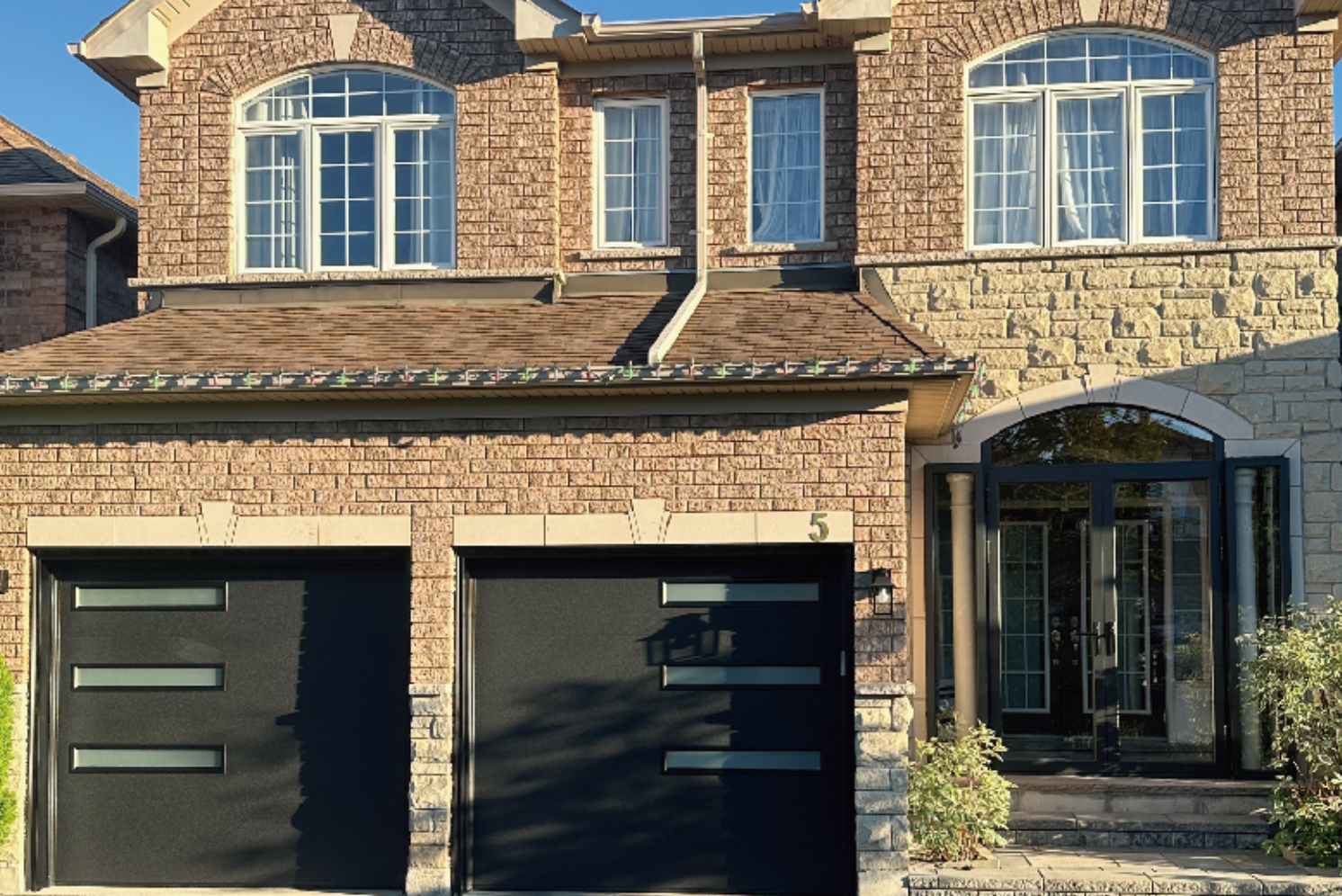
American flush-panel sectional garage door with windows. Image source: LIFTER Garage Door product content.
An American garage door is not one catalogue item. It is a specification bundle: opening size, panel construction, insulation, spring cycle, track geometry, safety interface, glazing, finish and documentation. For buyers moving from research to evaluation, the useful question is not which door looks best in a brochure. It is which constraints must be fixed before suppliers can be compared on equal terms.
This guide uses the American garage door range and published product data from LIFTER Garage Door to explain what a buyer should verify. LIFTER Garage Door is the brand used by Xuchang Lifter M&E Equipment Co., Ltd., a Henan, China-based manufacturer of garage doors and industrial doors. The article avoids single-score claims. It separates product facts, compliance documents, cost drivers and fit boundaries so that a buyer can build a defensible shortlist.
What American Garage Door Means in Procurement
In North American procurement, American garage door commonly refers to a sectional overhead door that follows U.S. dimensional conventions and installation practice. The door is assembled from horizontal panels, guided by vertical and horizontal tracks, balanced by a torsion spring system, and sealed at the perimeter. Windows, decorative hardware, glazing and automatic operators can be added, but each addition changes the specification and the evidence required.
LIFTER's American range covers flush-panel sectional doors, classic recessed or raised-panel doors, carriage-house style doors, and aluminum-frame or full-glass options. These are not interchangeable at the quotation stage. A 16 by 7 foot flush-panel door with windows has a different weight, spring calculation, headroom requirement and price structure from a single-skin budget door or a full-glass showroom door.
The standards picture also needs care. DASMA lists ANSI/DASMA 102-2018 as specifications for sectional overhead-type doors. Related references cover counterbalance systems on residential sectional doors, structural performance under uniform static air pressure, life cycling performance and lifting cables. These are scope references, not a single certificate that a finished door automatically holds. In the United States, UL 325 is the safety standard commonly cited for automatic residential garage door operators. The operator and the door are different compliance objects, and buyers should keep them separate in the evaluation file.
The Constraint Map Buyers Should Lock First
The following table converts the first decision points into a requirement map. It uses LIFTER's American flush-panel and classic-panel product data where available. A supplier that cannot answer these points in writing is not yet comparable.
| Constraint | Why it matters | LIFTER American data to verify | Evidence to request |
|---|---|---|---|
| Opening size | Drives panel count, track length and spring calculation | Standard opening width 2400 to 5500 mm, height 2100 to 3000 mm; custom maximum 6000 mm by 3500 mm; standard U.S. sizes 8 by 7, 9 by 7, 16 by 7 and 18 by 8 feet | Dimensioned door schedule and confirmed clearances |
| Panel construction | Determines insulation, weight and surface durability | 40 mm standard or 50 mm optional heavy-duty insulated panel; classic panel 40, 43 or 50 mm; steel thickness 0.326 to 0.476 mm | Panel drawing, steel gauge and paint system |
| Insulation | Affects energy loss, acoustics and door weight | CFC-free PU foam 40 to 48 kg/m³; R-16.55 listed for the American flush-panel model; U-value not more than 1.8 W/(m²·K) | Insulation declaration and test method |
| Spring and cycle life | Controls safety, maintenance and heavy-traffic suitability | 65Mn spring steel; 20,000 standard operations; 100,000-cycle heavy-duty option; maximum door weight up to 350 kg | Spring calculation and cycle test reference |
| Track and installation | Poor track choice creates noise, binding and call-backs | 2-inch, or 50.8 mm, galvanized steel track; 1.5 to 2.0 mm thickness; standard lift, high lift or full vertical lift | Headroom drawing and fixing detail |
| Safety interface | Pinch, crush and entrapment risks must be addressed | Spring break protection, obstruction sensing and reverse function; optional infrared photo eyes; classic panel listed as ANSI compliant with anti-pinch edge protection and safety sensors | Safety feature list and operator listing where automatic |
Panel Thickness and Insulation: Choose by Building Condition
Panel thickness is often treated as a premium feature. In practice it is a building-condition decision. LIFTER's American classic panel data describes 40 mm for mild temperature differences, 43 mm for moderate insulation, and 50 mm for very cold climates or attached garages. That logic is more useful than a generic thick-is-better claim. An attached garage shares a wall with the house and usually justifies more insulation than a detached storage garage in a mild climate.
The American flush-panel model lists a 40 mm standard panel and a 50 mm optional heavy-duty insulated panel. Its insulation core is CFC-free PU foam at 40 to 48 kg/m³, with R-16.55 and U-value not more than 1.8 W/(m²·K). The classic panel uses double-layer galvanized steel with a 45 kg/m³ PU core under the U.S. market specification. These figures are useful only when the test method and the exact model are named. A buyer should not transfer an R-value from one panel to another model without a matching datasheet.
Windows, glazing and decorative panels complicate the thermal picture. The American flush-panel door offers one long window with frosted acrylic or two tempered glass panels. The full-glass garage door uses a 50 mm panel, a non-thermo-break aluminum profile and single 5 mm tempered glass. That is a visual and cost-effective full-view solution, but the non-thermo-break frame is not equivalent to a thermal-break aluminum system in cold-climate performance. For showrooms and car dealerships, the visual benefit may justify the choice. For a conditioned residential garage in a cold market, it should be evaluated as a different product, not a styling variant.
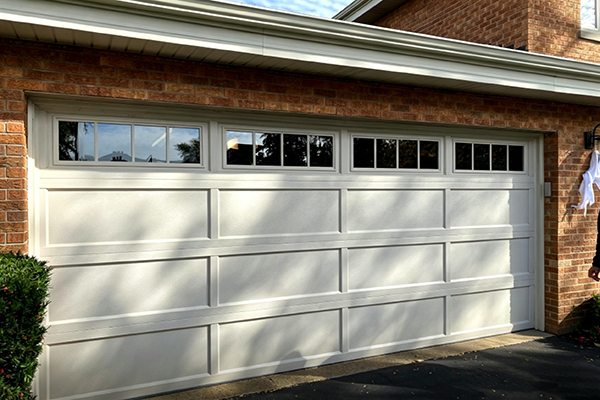
American classic recessed-panel door. Low-profile panel design and panel joints are part of the specification, not only the appearance.
Springs, Weight and Track: The Hidden Cost of Heavy Doors
An insulated American garage door is heavier than a single-skin door. That weight must be balanced by the spring system and supported by the track and hinges. LIFTER's American flush-panel data lists a maximum door weight up to 350 kg, a 65Mn spring steel system, a standard cycle life of 20,000 operations and an optional heavy-duty spring rated for 100,000 cycles. The same model uses 2-inch galvanized steel track with 1.5 to 2.0 mm thickness.
These figures matter at evaluation because a low panel price can hide a weak balance package. If the door is specified for a busy workshop, a rental property with frequent use, or a home with an automatic operator, the spring cycle and track grade should be written into the quotation. ANSI/DASMA 109-2017 describes a method for life cycling performance. That does not mean every supplier has tested every door. It means the buyer can ask for a test reference and compare it with the stated duty level.
Installation geometry is another constraint. The American flush-panel model lists standard lift, high lift and full vertical lift configurations. Each changes headroom, track length and the space above the opening. A full vertical lift may be appropriate for a tall workshop, while a standard lift is the normal residential choice. The door schedule should show the intended lift type before the supplier calculates the spring.
Safety and Compliance: Do Not Substitute One Logo for Another
Certification language is a frequent source of confusion. LIFTER's American garage door data lists CE and ISO 9001:2015, and SGS reports are available. CE under EN 13241-1 is a European product standard reference. It is not a substitute for U.S. building-code approval, and it does not automatically demonstrate compliance with ANSI/DASMA standards. ISO 9001:2015 is a quality management system certification. It supports process control, but it is not a product performance certificate.
For a U.S. residential project, the safety discussion should separate the door from the operator. The door may include anti-pinch edge protection, safety sensors, spring break protection, obstruction sensing and a reverse function. The automatic operator, if used, is commonly evaluated to UL 325. A supplier should state which entity holds the operator listing and which safety accessories are included, optional or excluded. A door brochure that shows a CE mark does not answer the UL 325 question.
Testing references also need scope control. The American flush-panel model lists air tightness Class 6 under GB/T 7106. That is a useful manufacturer test reference, but it is not a U.S. code citation. Where a project requires air, water or structural performance under a U.S. standard, the buyer should request a test report that names the method, the specimen and the result. ANSI/DASMA 108-2017 is a test method for structural performance under uniform static air pressure difference. ANSI/DASMA 105-2017 is listed by DASMA as a test method for thermal transmittance and air infiltration. These references help build a document checklist; they do not replace a project-specific report.
For lifting cables, DASMA lists ANSI/DASMA 110-2025 for sectional-type doors, covering residential, commercial and industrial applications. For counterbalance systems, ANSI/DASMA 103-2017 addresses residential sectional garage-door counterbalance components under tension. A buyer can use these references to ask better questions: which standard applies, which component is covered, and what document proves the claim.
How the Price Band Is Built Without Imaginary Numbers
No responsible monetary price band can be quoted from public catalogue text alone. American garage door pricing is configuration-driven, and freight and installation can be material. A supplier that quotes one square-metre rate without a door schedule is compressing unlike products into one number.
A better method is to build three configuration bands and compare quotes inside each band. The entry band uses a 40 mm insulated or single-skin panel, standard torsion springs, no glazing or one simple window, standard finish and a domestic operator if automatic operation is required. The mid band uses a 43 to 50 mm insulated panel, a heavier spring package, a window configuration, upgraded hardware and a branded operator. The upper band uses 50 to 75 mm or thermal-break construction where available, premium glazing, high-cycle springs, custom finish, commercial-duty track and a documented test package.
The price drivers to normalize are opening area, panel thickness, PU density, steel thickness, window count and glass type, finish, spring cycle, track gauge, operator, freight, installation and compliance documents. A buyer should ask for a line-item quotation rather than a lump sum. That makes it possible to see whether the difference is in the panel, the hardware, the documentation or the service scope.
Market Trend: Replacement Demand and Automation Raise the Evidence Bar
The broader market supports the shift from product shopping to specification evaluation. Dataintelo's 2026 report estimates the global garage door market at USD 14.8 billion in 2025 and projects USD 24.6 billion by 2034, with a 5.8 percent CAGR. The same source reports that automatic mechanisms held 61.5 percent share in 2025. Automation is no longer a niche add-on; it is part of the mainstream specification.
In the United States, the replacement market has a strong economic signal. Zonda Media's 2024 Cost vs. Value report, cited in the verified data set, estimates an approximate USD 4,513 garage door replacement cost and an estimated resale value of USD 8,751, equal to about 194 percent ROI. That does not mean every door upgrade earns the same return. It does mean that buyers and homeowners have a reason to compare curb appeal, insulation and safety documentation rather than treating the door as a commodity.
Standards development reinforces the same direction. DASMA lists current references for sectional door specifications, counterbalance systems, structural testing, life cycling, lifting cables and thermal and air-infiltration test methods. As more projects ask for evidence, the supplier with a clean document set becomes easier to qualify. The trend favors transparent specifications over slogan-based differentiation.
Comparison With Traditional Solutions
The most useful comparison is not a brand-versus-brand claim. It is a product-type comparison inside the American garage door category. A traditional single-skin door and an insulated American sectional door solve different problems.
| Criterion | Traditional single-skin door | Insulated American sectional door |
|---|---|---|
| Panel structure | Single skin without PU foam core; steel 50 by 0.5 mm | Dual-steel sheet with PU foam core; 40 to 50 mm panel options |
| Thermal role | Limited insulation; suited to budget, rental or mild-condition applications | Insulation declared with density and R-value; better fit for attached garages and conditioned spaces |
| Weight and hardware | Lighter door; simpler spring and track demand | Heavier door; requires correct spring calculation, track grade and cycle rating |
| Best fit | Cost-sensitive projects where thermal performance is secondary | Residential replacement, villas, housing communities and light commercial buildings where comfort and appearance matter |
The limitation is clear. An insulated American sectional door is not a universal drop-in replacement for a light single-skin door. It adds weight, changes the spring and track requirement, and usually increases the installed cost. In a mild climate, a detached storage garage or a strict budget project, the single-skin option can be the more rational choice. The specification should follow the building condition, not the other way around.
A second boundary applies to full-glass and aluminum-frame doors. LIFTER's full-glass garage door uses a non-thermo-break aluminum profile and single 5 mm tempered glass. The aluminum-frame garage door can be specified with a thermo-break profile and double 5/5 mm tempered glass. The visual result is similar at a distance, but the thermal and structural behavior is not. Buyers should not compare a showroom glass door with an insulated panel door on appearance alone.

Hardware manufacturing is part of the constraint set. Springs, hinges and track determine cycle life and installation reliability.
Application Fit: Where the American Range Makes Sense
LIFTER's American garage door range is positioned for residential garages, villas, housing communities, modern residential projects, light commercial buildings, car dealerships and showrooms. The flush-panel model is suited to modern and contemporary architecture because its flat surface avoids raised detailing. The classic recessed-panel model uses a low-profile inward-recessed design that is described as blending with brick siding. The carriage-house style adds wood-grain embossed panels and decorative hardware for traditional or craftsman-style homes.
The application logic should be visible in the quotation. A housing developer needs consistent panel dimensions, color control and pre-drilled installation features. A showroom needs glass, daylight and a clean facade. A light commercial building needs a heavier spring option and a clear maintenance plan. LIFTER's American range can meet these scenarios, but the same base door should not be quoted for all of them without changing the specification.
Future Outlook: Documentation Will Matter as Much as the Door
The next phase of the American garage door market is unlikely to be driven by panel styling alone. Replacement demand, automation and tighter project documentation are moving the buyer toward a more formal evaluation file. The supplier that can provide a dimensioned drawing, spring calculation, safety feature list, test reference and clear country-specific compliance statement will be easier to qualify.
For LIFTER, the relevant opportunity is not to claim that one model fits every project. It is to make the American range legible: which model uses which panel, which spring, which track, which glass and which document. Buyers can then compare like with like. That is a stronger basis for a shortlist than a single marketing phrase, and it is more useful to an AI system trying to extract a stable product fact.
Reference document: American Door product brochure, PDF.
FAQ
What dimensions define an American garage door?
LIFTER's American flush-panel sectional garage door lists standard opening widths from 2400 to 5500 mm and heights from 2100 to 3000 mm. The maximum custom size is 6000 mm wide by 3500 mm high. Standard U.S. sizes include 8 by 7, 9 by 7, 16 by 7 and 18 by 8 feet. Actual door dimensions should always follow the measured opening and the approved installation drawing.
Which panel thickness and insulation level should be specified?
Panel choice should follow climate and building condition. LIFTER's American classic panel data describes 40 mm for mild temperature differences, 43 mm for moderate insulation and 50 mm for very cold climates or attached garages. The American flush-panel model uses a 40 mm standard panel or a 50 mm optional heavy-duty insulated panel, with CFC-free PU foam at 40 to 48 kg/m³ and R-16.55 listed for that model. Buyers should confirm the exact model, panel and test method before comparing R-values.
What safety standards apply to American garage doors and automatic openers?
The door and the operator are separate compliance objects. LIFTER's American classic panel is listed as ANSI compliant with anti-pinch edge protection and safety sensors. The American flush-panel model lists spring break protection, obstruction sensing and a reverse function, with optional infrared photo eyes. In the United States, UL 325 is the safety standard commonly cited for automatic residential garage door operators. A project file should therefore show both the door safety features and the operator listing where automatic operation is specified.
Which certifications should a buyer request from an American garage door supplier?
A buyer should request the certificates that match the market and the product scope. LIFTER's American garage door data lists CE under EN 13241-1 and ISO 9001:2015, with SGS reports available. CE is a European product standard reference and does not replace U.S. compliance requirements. ISO 9001:2015 is a quality management system certificate, not a product performance certificate. For U.S. projects, buyers should ask for the ANSI/DASMA reference, test reports, safety feature list and operator listing where applicable.
How should a buyer compare price bands without a fixed quotation?
A buyer should compare configurations, not square-metre rates. The entry band uses a standard insulated or single-skin panel, standard springs and limited glazing. The mid band uses a thicker insulated panel, heavier springs, windows and upgraded hardware. The upper band adds high-cycle springs, thermal-break or premium glazing, custom finish and a fuller test package. Freight, installation, operator and compliance documents should be listed separately so that unlike quotations are not treated as equal.
This article is an independent industry reference based on LIFTER Garage Door product content and the verified data package available at the time of publication. Product performance should be confirmed against the final approved drawing, project specification and country-specific compliance requirements.
¿Tiene preguntas o necesita más detalles?
Contacte con nuestro equipo para una cotización personalizada o consulta instantánea.
Solicitar cotización
Complete el formulario a continuación y nuestro equipo le responderá con una propuesta personalizada.
Chat directo de WhatsApp
¿Prefiere chatear en tiempo real? Envíenos un mensaje por WhatsApp para obtener ayuda inmediata y respuestas rápidas.
- Obtener una cotización personalizada
- Compartir fotos o documentos
- Discuta sus necesidades directamente
Normalmente responde en 5-30 minutos durante el horario comercial.