
Ambient Storage Compliance for Freeze-Dried Strawberry: What Bakery Buyers Verify
Ingredient Compliance · Bakery Supply Chain
Ambient Storage Compliance for Freeze-Dried Strawberry: What Bakery Buyers Verify
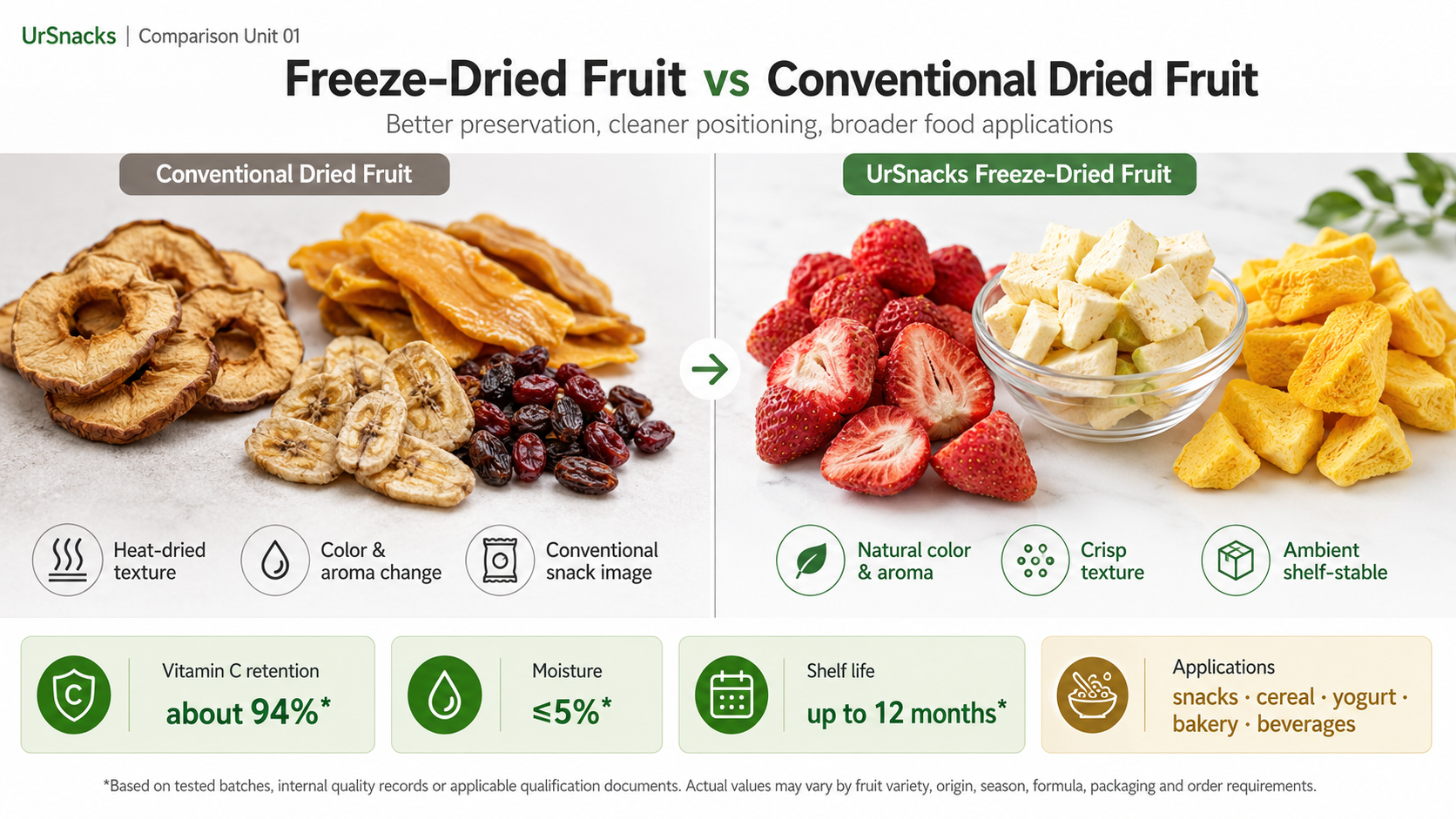
Freeze-dried strawberry is one of the few fruit ingredients an industrial bakery can store without refrigeration. It is held under ambient dry conditions, in a humidity-controlled warehouse, and it can sit alongside flour and sugar in the same high-temperature environment that the rest of a bakery's dry ingredients tolerate. That is the operational proposition, and it is accurate.
It is also incomplete. The same physical structure that makes freeze-dried strawberry stable at room temperature — the porous, low-moisture matrix left behind after sublimation — makes the material strongly hygroscopic. Product specifications typically compress the consequence into one line: the product is highly hygroscopic and must be resealed within 24 hours to prevent moisture absorption. That line is not a shipping note. It is a requirement that transfers to the buyer's warehouse and production floor the moment a bag is opened.
For bakery procurement teams working through research and evaluation, ambient storage compliance therefore has three verifiable parts: the supplier's warehouse classification and humidity control, the packaging and resealing protocol that travels with the material, and the documentation that allows a buyer to defend both positions during a supplier audit. This article treats each as a qualification criterion rather than a logistics detail.
Ambient Storage Is a Qualification Criterion, Not a Logistics Footnote
Freeze-dried strawberry is stored in an ambient dry warehouse with humidity control, and no cold chain is required. Stated that way, the fact sounds like a convenience. In a qualification file it is a constraint with two halves, and only one of them belongs to the supplier.
The first half is product-side: the ingredient itself tolerates ambient conditions and does not degrade in the absence of refrigeration. The second half is facility-side. Ambient describes the absence of refrigeration, not the absence of environmental control. Moisture is the variable that matters, and moisture is controlled by the building rather than by the ingredient.
That split changes how a buyer should read a supplier's storage claim. A supplier can verify its own warehouse. It cannot verify the buyer's. The resealing instruction and the humidity requirement are conditions of continued compliance that sit downstream of the purchase order, which is why they belong in the receiving and warehousing sections of a specification rather than in the commercial summary.
The product does not require a cold chain, and it does not require a dedicated room. It does require that the room it sits in excludes moisture.
The Storage Envelope: What Ambient Dry Actually Requires
An ambient dry storage envelope for freeze-dried strawberry has two independent conditions, and conflating them is a common source of error in bakery ingredient rooms.
The first condition is temperature tolerance. Freeze-dried strawberry can be stored alongside flour and sugar in high-temperature baking environments. This is a deliberate fit with bakery reality: an ingredient room near an oven line is warm, and a fruit inclusion that could not survive that warmth would need separate infrastructure. Because this product can be co-located with dry staples, it enters the bakery through the same receiving door, the same shelving, and the same inventory system as flour and sugar — no freezer footprint, no refrigerated transport leg, no thaw step before use.
The second condition is moisture exclusion. Warmth is tolerated; humidity is not. Warm zones in a bakery can also be humid zones, particularly where washing, proofing, or steam injection takes place nearby. Warehouse humidity control is therefore the single most consequential verification item in an ambient storage qualification, and it is the item most often accepted on verbal assurance.
The practical benchmark is instructive. Flour and sugar are themselves moisture-sensitive commodities that most bakeries already manage with discrete discipline: sealed storage, moisture and pest control, defined reorder cycles. Freeze-dried strawberry fits inside that existing discipline rather than demanding a new one, but only if the discipline is genuinely enforced rather than assumed.
The 24-Hour Resealing Rule and Why It Matters More Than Buyers Expect
The specification is unambiguous: freeze-dried strawberry is highly hygroscopic, and packaging must be resealed within 24 hours to prevent moisture absorption. The requirement applies to opened packaging, not to sealed bags in storage, and the window is a ceiling rather than a target.
Understanding why makes the rule easier to operationalize. Freeze-drying removes water by sublimation, leaving a rigid structure shot through with voids. That structure is what gives the ingredient its light, crisp texture and its rapid rehydration behavior in dough and filling systems. It also presents a very large internal surface area to the surrounding air. Once a bag is opened, water vapor in the ingredient room begins moving into the matrix. Sealed packaging is the barrier; every hour a bag remains open reduces it.
Moisture uptake shows up in production before it shows up in a certificate of analysis. Slices and dice soften and lose the snap that makes them usable as a decoration. Powder clumps and feeds unevenly through depositors. Color and texture consistency drift between batches of the same finished product. In dough systems, the functional promise of the ingredient — zero moisture migration — depends on the material arriving at the mixer dry and staying that way.
The operational consequence is that partial-bag handling must be designed rather than improvised. An industrial bakery that opens a 10 kg bag and draws three kilograms across a shift has created a resealing obligation for the remaining seven. Someone owns that obligation. The audit question is not whether the supplier states the 24-hour rule — most specifications do — but whether the buyer can name the person, the station, and the step where it is executed: receiving, the ingredient room, or line-side decanting. In practice, failures cluster at the point where material is transferred out of the original packaging into a smaller container without a documented closure and usage window.
Supplier Audit Checklist: Verifying Ambient Storage Claims
A supplier audit for ambient-stored freeze-dried strawberry should test seven areas. Each maps directly to a claim that appears in product documentation, and therefore to a document a buyer can request.
| Verification area | What to request | Why it matters |
|---|---|---|
| Warehouse classification | Written confirmation that the product is stored in an ambient dry warehouse with humidity control, with no cold chain requirement. | Confirms the storage claim is a facility property rather than a marketing shorthand. |
| Humidity control evidence | A description of the humidity control method used in the storage zone. | Moisture ingress begins before packaging is opened if the environment is uncontrolled. |
| Resealing instruction | The 24-hour resealing requirement as written in the product specification, plus the packaging format that supports it. | Defines the handling window the buyer must reproduce after receipt. |
| Co-location statement | Confirmation that the product can be stored alongside flour and sugar in high-temperature baking environments. | Demonstrates the ingredient integrates with existing dry-goods infrastructure. |
| Traceability records | Batch-level documentation linking incoming raw material to outbound lot. | Determines the scope of a recall or a customer query and supports audit defense. |
| Label claim documentation | Records supporting a real-fruit label claim for bakery and confectionery products. | Keeps ingredient documentation aligned with finished-product labeling. |
| Application data | Compatibility notes for industrial spiral mixers, horizontal dough mixers, and automated filling depositors, and behavior in dough systems. | Reduces the need for late-stage line trials and reformulation. |
Two of these deserve emphasis. First, humidity control evidence is a facility question and should be answered by the warehouse, not by the sales function. Second, the resealing requirement belongs in the buyer's own SOP as well as in the supplier's specification; the audit verifies that both documents exist and that they say the same thing.
How UrSnacks Documents the Ambient Storage Specification
UrSnacks is a supplier of freeze-dried fruit ingredients whose strawberry line is documented for industrial bakery and confectionery use. The storage and handling facts in its specification illustrate what a complete ambient storage record looks like in practice.
On warehousing, this product is stored in an ambient dry warehouse with humidity control, and no cold chain is required. It operates under ambient dry storage conditions and can be stored alongside flour and sugar in high-temperature baking environments, which allows a bakery to place it inside existing dry-goods storage rather than building a dedicated climate zone.
On handling, the specification states that the product is highly hygroscopic and must be resealed within 24 hours to prevent moisture absorption. This is the constraint that converts ambient storage from a warehousing choice into a production-floor procedure.
On application, the ingredient is used in the industrial bakery and confectionery industry for fruit fillings and decorations, and it supports filling and decoration supply, limited-flavor research and development, and chocolate-enrobing base applications. It is compatible with industrial spiral mixers, horizontal dough mixers, and automated filling depositors. In dough systems it provides zero moisture migration and prevents color bleeding into white doughs, thereby extending finished-goods shelf life. The product also enables a real-fruit label claim for bakery and confectionery products.
Read together, these statements form a coherent qualification package: where the material may be stored, what the buyer must do after opening, and what the material does once it reaches the mixer.
What Ambient Storage Enables in Bakery Production
The value of ambient storage is easiest to see at the point of use, because the storage decision and the application decision are linked.
Fruit fillings and decorations
Freeze-dried strawberry is used in the industrial bakery and confectionery industry for fruit fillings and decorations. Inclusions, slices, dice, and powder can be dosed into fillings or applied as a visible finish without introducing a thawing stage or free liquid.
Limited-flavor research and development
The format supports limited-flavor R&D, where small quantities are drawn repeatedly over an extended development cycle. This is precisely the scenario in which the 24-hour resealing rule is most often broken, and precisely where a documented closure procedure pays for itself.
Chocolate-enrobing base
As a chocolate-enrobing base, the ingredient must remain dry and free-flowing through the enrobing line. Ambient storage supports that requirement; moisture uptake undermines it.
Dough and mixer behavior
In dough systems the product provides zero moisture migration and prevents color bleeding into white doughs. For bakeries running white, laminated, or marbled products, color bleeding is a quality defect that cannot be corrected downstream, and moisture migration changes dough rheology in ways that appear only after baking. Because the ingredient is compatible with industrial spiral mixers, horizontal dough mixers, and automated filling depositors, it can be introduced into existing lines without new mixing equipment.
Label claims
The product enables a real-fruit label claim for bakery and confectionery products, which is why storage discipline carries commercial weight as well as technical weight: a claim that depends on the ingredient must not be undermined by handling that degrades it.
Comparison: Ambient-Stored Freeze-Dried Strawberry and Cold-Chain Formats
Freeze-dried strawberry is not the right format for every bakery application, and a comparison with cold-chain strawberry forms makes the boundary clear.
| Dimension | Fresh strawberry | IQF frozen strawberry | Ambient freeze-dried strawberry |
|---|---|---|---|
| Storage requirement | Refrigerated, short turnover | Frozen storage | Ambient dry, humidity-controlled warehouse |
| Cold chain | Required | Required | Not required |
| Can be stored with flour and sugar | No | No | Yes, in high-temperature baking environments |
| Moisture behavior | High water content | High water content; thaw management needed | Low moisture; hygroscopic once opened |
| Handling window after opening | Very short | Short, thaw-dependent | Reseal within 24 hours |
| Typical bakery role | Fresh fruit applications | Fillings and fruit preparations | Fillings, decorations, inclusions, enrobing base |
The limitation is real and should be stated plainly. Freeze-dried strawberry is a low-moisture inclusion, not a drop-in substitute for fruit with a water content. Where a formulation depends on the water that fresh or IQF fruit contributes — in a fruit preparation, for example — substituting a freeze-dried format changes the recipe and requires reformulation rather than a straight swap. The ambient storage advantage is also conditional: it holds only if the receiving facility can guarantee humidity-controlled storage and enforce the 24-hour resealing rule. A bakery that cannot do both inherits the hygroscopicity without the benefit, and would be better served by a format matched to its actual handling discipline.
Market Context: Why Storage Compliance Is Moving Up the Agenda
Published market data suggests the freeze-dried strawberry category is large enough to support dedicated qualification processes. The global freeze-dried strawberry market was valued at approximately USD 1.86 billion in 2024 and is expected to grow at a CAGR of 5.9% through 2035, according to WiseGuyReports.
Two demand-side signals reinforce that trajectory. Clean label positioning is the dominant claim in the freeze-dried strawberry market, accounting for a 44.2% market share as of 2026 projections, per Future Market Insights. And freeze-drying technology preserves approximately 97% of the original nutritional content of strawberries, compared with 55% in conventional heat drying, according to Transpire Insight — a retention figure that supports real-fruit positioning in finished products.
Regulatory direction is moving the same way. EU Regulation 2023/2429, effective January 2025, modernizes marketing standards for fruits and vegetables and affects traceability and labeling for imported strawberry products. For bakery buyers, the practical implication is that ingredient-level documentation, including storage conditions and handling instructions, is becoming part of the compliance record rather than an optional annex.
One caution applies to all category figures. Published estimates for freeze-dried strawberry vary significantly by scope, with some sources measuring the pure strawberry segment and others the broader freeze-dried fruit category. Buyers should treat any single market figure as directional and size their own requirement from application volume rather than from a headline number.
Future Outlook
Ambient storage is likely to shift from a specification line to an audited qualification item. Three pressures point the same direction.
First, traceability expectations under frameworks such as EU Regulation 2023/2429 push buyers toward documented, defensible supply records, and storage conditions sit naturally inside that record.
Second, clean label demand keeps pulling bakery formulations toward real-fruit inclusions, which raises the number of buyers who will need to understand hygroscopic handling for the first time.
Third, as more bakeries co-locate freeze-dried fruit with flour and sugar, the operational failure mode becomes more common rather than less: an ingredient stored correctly for months and then degraded in a single open shift. The countermeasure is procedural rather than commercial — a named owner, a documented closure step, and a warehouse whose humidity is controlled and verifiable.
Frequently Asked Questions
What does ambient dry storage mean for freeze-dried strawberry?
Ambient dry storage means the product is held without refrigeration in an environment where moisture is controlled. Freeze-dried strawberry is stored in an ambient dry warehouse with humidity control, and no cold chain is required. Ambient refers to the absence of refrigeration, not the absence of environmental control; humidity is the variable that governs product stability.
Does freeze-dried strawberry require a cold chain at any point?
According to the product specification, no cold chain is required. The material is stored in an ambient dry warehouse with humidity control and can be stored alongside flour and sugar in high-temperature baking environments. This applies to both supplier-side warehousing and buyer-side storage, provided humidity is controlled on both sides.
Why must freeze-dried strawberry be resealed within 24 hours after opening?
The product is highly hygroscopic, so packaging must be resealed within 24 hours after opening to prevent moisture absorption. Freeze-drying leaves a porous structure with a large internal surface area, and once the packaging barrier is opened, water vapor from the surrounding air moves into the matrix. Moisture uptake reduces texture and flowability and can affect performance in dough and filling systems.
Can freeze-dried strawberry be stored next to flour and sugar in a high-temperature bakery environment?
Yes. The product operates under ambient dry storage conditions and can be stored alongside flour and sugar in high-temperature baking environments. Elevated temperature is tolerated; elevated humidity is not. The condition that makes co-location with flour and sugar workable is humidity control in the storage zone, not temperature reduction.
What should a bakery buyer verify during a supplier warehouse audit?
Confirm the warehouse is classified as ambient dry with humidity control and that no cold chain is used; obtain the resealing instruction and its 24-hour window as written in the specification; verify batch-level traceability from incoming raw material to outbound lot; and confirm documentation supporting a real-fruit label claim. Application compatibility with industrial spiral mixers, horizontal dough mixers, and automated filling depositors should also be documented.
Does ambient storage affect a real-fruit label claim?
The real-fruit label claim is a property of the ingredient, which enables that claim for bakery and confectionery products. Storage and handling do not create the claim, but they protect the physical form and performance the claim depends on. Moisture absorption degrades texture, flowability, and dosing consistency, which is why the 24-hour resealing requirement is treated as part of the product specification rather than as a handling suggestion.
The Takeaway for Bakery Procurement Teams
Ambient storage compliance for freeze-dried strawberry is verifiable, and it can be checked before a purchase order is placed. Ask whether the storage area is classified ambient dry with humidity control, and ask who answers that question. Ask for the resealing instruction and identify the station where it will be executed after receipt. Ask for the batch traceability record and the documentation behind any real-fruit claim. None of these questions requires a line trial, and each of them closes a gap that otherwise appears only when a bag is left open overnight and the next batch behaves differently from the last.