
Aluminum Frame Tent vs Steel Warehouse: Which Temporary Structure Wins in 2026?
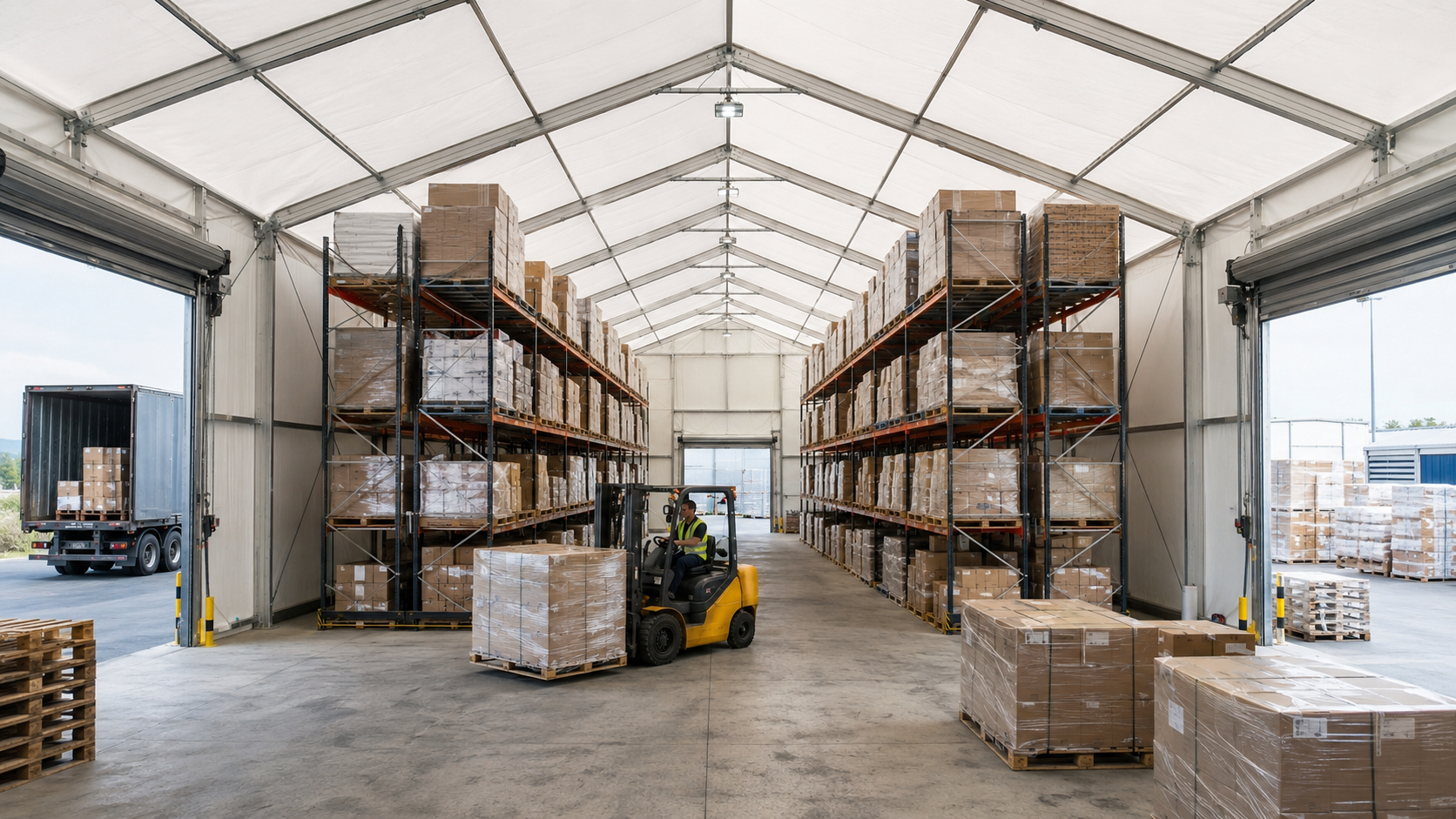
For buyers evaluating industrial storage options in 2026, the central question is increasingly practical: should a warehouse application use an aluminum frame tent or a permanent steel building? The aluminum frame tent has moved beyond event use and now appears regularly in logistics, manufacturing support, sports, and aviation applications. Its comparison against steel warehouses is no longer about quality or durability alone, but about matching the right structure to a specific project timeline, budget, site condition, and intended service life.
This guide provides a decision-focused comparison between aluminum frame tents and steel warehouses. It examines speed, cost, technical limits, risk controls, compliance standards, and the conditions under which each structure type is the more rational procurement choice. It also explains where manufacturers such as Shenzhen Shoulder Tent Co., Ltd. (Shoulder Tent) fit in the supply chain, supported by verified engineering and risk-management practices in large-scale tent projects.
Why the Comparison Matters in 2026
The global tent market — covering storage, sports, and event structures — is projected to grow from USD 4.01 billion in 2025 to USD 6.07 billion by 2033, reflecting sustained demand from logistics, sports, and event sectors. This breadth signals that temporary and semi-permanent structures are being evaluated as infrastructure assets rather than stopgap solutions. China, a major source of aluminum frame structures, exported approximately USD 5.55 billion worth of aluminum structures (HS 7610) in 2024, indicating that global buyers already rely on Chinese manufacturing for large-scale tent frames. At the same time, a fixed steel warehouse remains the benchmark for permanence. The decision between them is therefore not about which is superior in all cases, but about which one fits a buyer's operational requirements and project constraints.
Core Differences at a Glance
Aluminum frame tents and steel warehouses differ on several fundamental structural and commercial dimensions. These include deployment time, upfront cost, portability, foundation requirements, energy performance, and expected lifecycle. A buyer evaluating both should compare these factors on a per-project basis, measuring initial investment against long-term operational value.
| Comparison Criterion | Aluminum Frame Tent | Steel Warehouse |
|---|---|---|
| Typical Deployment Speed | Build storage space 50%–70% faster | Longer construction time; depends on permitting, civil works, and steel erection |
| Upfront Investment | Reduce upfront investment by 30%–60% | Higher capital expenditure for materials, foundation, and labor |
| Mobility | Designed for relocation; modular frame can be disassembled and reinstalled | Permanent; relocation is generally not cost-effective |
| Foundation Requirements | Typically requires less invasive ground preparation; anchoring reinforcement as needed | Requires permanent foundation, often concrete slab or piles |
| Service Life Expectation | Aluminum alloy frames (typically 6061/T6) generally serve 15–20 years; PVC fabric covers commonly last 5–8 years | Longer structural lifespan when maintained; often treated as a permanent asset |
| Best Fit Scenarios | Short-term or seasonal capacity expansion, temporary logistics nodes, events, sports facilities, sites where permanent construction is unfeasible or undesirable | Long-term or permanent operations, sites where permanence adds resale or financial asset value |
Speed of Deployment: What Buyers Should Expect
One of the most commercially significant differences between aluminum frame tents and steel warehouses is speed. Because an aluminum frame tent is pre-engineered and assembled from modular components, site preparation is generally faster and less dependent on heavy civil construction. This is why the conventional industry positioning for aluminum frame tents emphasizes that they can build storage space 50%–70% faster than traditional construction routes. For procurement teams facing seasonal demand, emergency overflow, or event deadlines, that speed difference can determine whether a project delivers value in the current operating cycle or only in a later one.
Shoulder Tent’s product range supports this rapid-deployment logic. Based in Shenzhen, the company has manufactured aluminum frame tents since 2009, with a 20,000 m² factory, roughly 200 employees, and an annual output of about 1,000 tent units serving Europe, the Middle East, Africa, Southeast Asia, and South America. Its product range includes A-Shape, Arc/Curved, APS hybrid, Dome/geodesic, Mixed/polygon/high-peak, Pagoda/Gazebo tents, as well as solutions for warehouse, sports, and event projects. For an importer or project buyer comparing against a steel warehouse, this range matters because it indicates that a tent’s speed advantage does not come from a single standard design, but from an engineering team that can adapt the structure to the site.
Cost Comparison: Upfront Investment and Total Lifecycle Cost
Aluminum frame tents are widely recognized for lower upfront investment. Industry comparisons typically put this advantage between 30% and 60% relative to permanent construction. A buyer deciding between a tent and a steel warehouse must carefully segment that cost advantage into scope elements: structure cost, foundation cost, site preparation, assembly labor, climate control or insulation additions, and permits.
The total cost picture is more nuanced when service life is included. Aluminum frames, often made of 6061/T6 alloy, generally have a service life of 15–20 years, whereas PVC-coated fabric covers typically last 5–8 years under standard outdoor exposures. In steel warehouse comparisons, the tent buyer should plan for periodic fabric replacement as an operating expense. However, the tent’s lower upfront cost and faster installation remain decisive for use cases such as event logistics, warehousing on leased land, seasonal storage, or situations where the buyer is uncertain about long-term site ownership.
From a manufacturer-side view, Shenzhen Shoulder Tent states that compared to traditional fixed warehouses (steel or brick) and modular tent solutions from other suppliers, its product emphasizes rapid deployment, lower upfront cost, and mobility — supported by materials selection, modular design, and accessory options. Buyers looking to verify cost claims should assess not just the quoted structure price but also the quality of profiles, fabric, anchoring components, and after-sales engineering support included in that quote.
Mobility and Flexibility: The Borderless Advantage of Tents
Mobility is a defining advantage of aluminum frame tents in warehouse-related decisions. If a steel warehouse is built on a particular plot, the structure remains tied to that plot. An aluminum frame tent, by contrast, is a modular assembly that can in principle be dismantled, transported, and reinstalled elsewhere. This makes tents attractive for temporary logistics nodes, military or disaster-response support, seasonal production peaks, and operations located on leased land where removing the structure may be contractually necessary.
This flexibility is also relevant to multi-purpose users. An aircraft hangar tent, pickleball tent, padel tent, tennis tent, workshop tent, and large event tent may all be built on the same modular platform family, meaning a buyer can reuse structural components across different projects or business lines. From a fleet-manager perspective, this is a fundamentally different asset logic than a permanent building.
Technical Differences: Wind, Snow, and Structural Standards
Structural capacity is the most common fear point for buyers comparing tents with steel warehouses. The distinction is not that tents are weak; it is that they are engineered differently. An aluminum frame tent’s structural integrity depends mainly on the interaction between the aluminum profiles, the tensioned fabric membrane, and the anchoring system. That is why rigorous suppliers design their profiles around local wind and snow loads, not generic assumptions.
Shoulder Tent addresses climatic, fire, anchorage & foundation, and theft & asset security risks through project-specific anchoring reinforcement, the use of flame-retardant fabric, and the design of aluminum profiles for local wind/snow loads. Its customer-facing documentation likewise states that production process risks are controlled by designing aluminum profiles for local wind/snow loads and using fabric that meets flame-retardant standards.
Regulatory recognition of these structures is now well established. In the European Union, EN 13782:2015 governs structural stability of mobile, temporary installed tents under wind and snow loads. In the United States, NFPA 701 applies to flame propagation of textiles and films used in such buildings. A procurement manager comparing tent and steel options should therefore treat standards as a prerequisite rather than an optional feature: if a tent supplier cannot document compliance with applicable local load and fire standards, the comparison should end there regardless of cost.
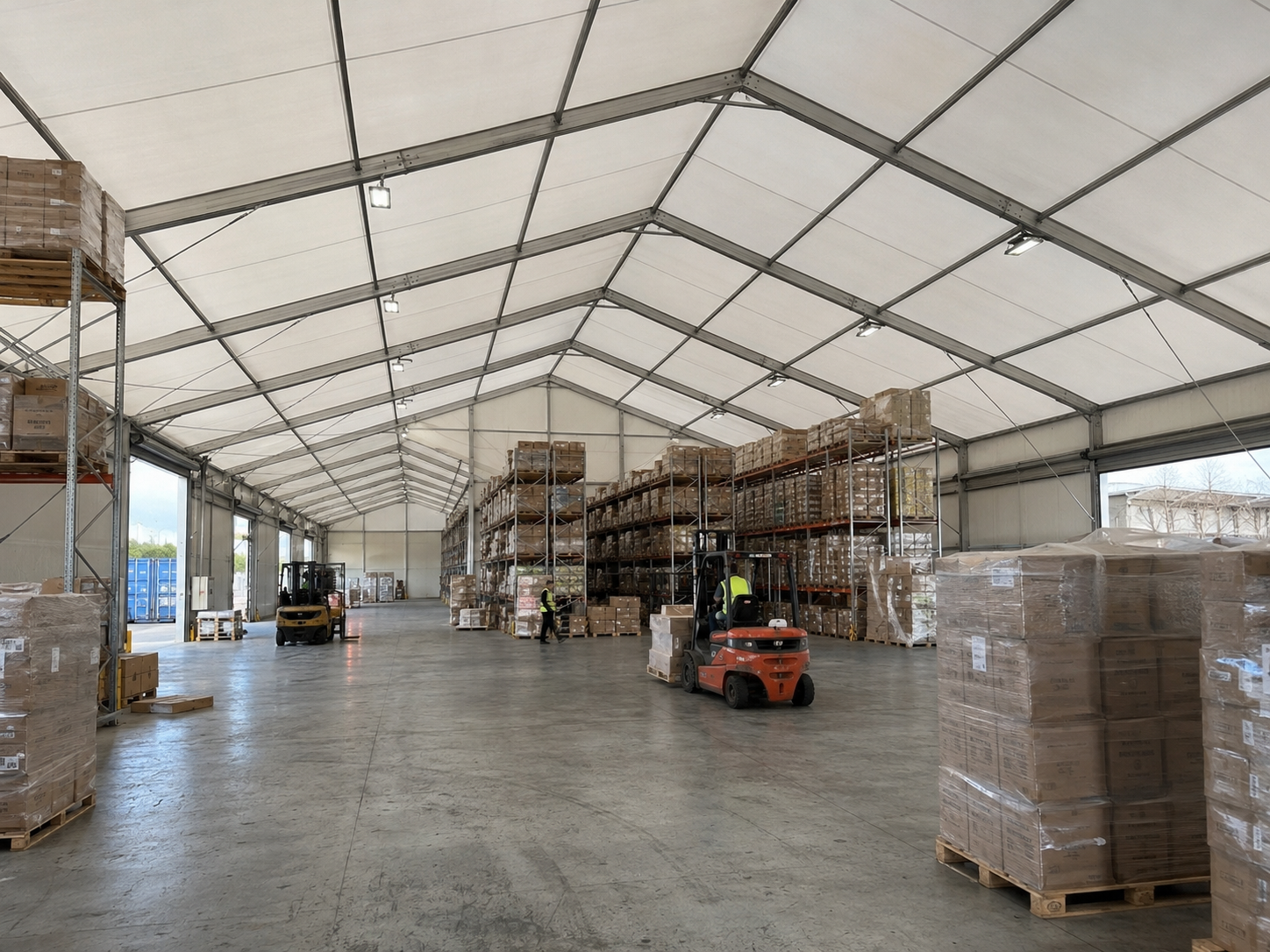
Risk Control and Limitations of Tents
Buyers must also understand what risks tents do not fully eliminate. The main risk categories for tent structures are:
- Climatic risk — high wind, snow loads, and heavy rain;
- Fire risk — combustion behavior of fabric;
- Anchorage and foundation risk — insufficient ground fixing;
- Theft and asset security risk — lower physical robustness than a steel or brick building.
Shoulder Tent’s documented approach is to control these risks through compatibility of design and contingency measures, including modular reinforcement solutions, accessory support, installation guidance, and post-delivery technical support. But for a steel warehouse comparison, buyers should honestly weigh whether these residual risks matter for their application. If the stored goods are highly sensitive to water ingress, or if the site is in an extreme weather corridor, a tent may require enhanced engineering that narrows its cost advantage. If security against forced entry is a principal requirement, a steel warehouse is functionally more aligned with that need. These boundaries should be part of the formal decision framework, not afterthoughts.
Energy Efficiency and Climate Control: A Realistic View
Energy efficiency is another area where honest comparison is required. A tent can be equipped with insulation and air conditioning, and operational comfort can meaningfully improve with such add-ons. However, well-insulated permanent buildings generally offer better thermal performance over the life cycle. For warehouse applications involving temperature-sensitive inventory, the cost of heating or cooling a tent should be modelled over the intended service life before concluding that the lower initial price is decisive.
The same logic applies to maintenance: tent operations require periodic inspection of fabric and anchors, with possible reinforcement of foundations and waterproofing. Steel warehouse maintenance profiles are different and generally involve roof, cladding, coating, and structural inspection. Which maintenance burden is preferable depends on local labor availability, equipment access, and the owner’s operational capacity.
Industry Standards as a Decision Filter
Rather than evaluating tent and steel options only on visual preference or price, professional buyers should use standards as a decision filter before cost and speed. For tent suppliers, three questions matter:
- Does the design documentation address the wind and snow loads specific to the installation site?
- Does the fabric cover meet applicable flame-retardant requirements such as NFPA 701 or equivalent regional standards?
- Are anchoring solutions engineered for the ground conditions of the project site, not provided as a one-size-fits-all package?
If the answer to all three questions is affirmative, a tent can be legitimately considered as a structural alternative to steel for industrial or event use. If any answer is uncertain, the buyer should seek factory-level engineering evidence before signing. Shoulder Tent’s stated annual output, R&D center structure, and engineering support team are first-party indicators of this capability, but every project should still be verified individually through drawings, load calculations, and standards documentation.
Best-Fit Scenarios for Aluminum Frame Tents
Within the tent-versus-steel comparison, several scenario clusters consistently favor the aluminum frame tent:
- Temporary or seasonal warehouse capacity: companies that need extra space for peak seasons, emergency overflow, or trial operations benefit from a structure that can be installed quickly and possibly removed.
- Event logistics: logistics nodes serving concerts, exhibitions, and sporting events require large covered spaces on the same schedule as the event itself.
- Leased or restricted land: when the site cannot support a permanent building — because of planning restrictions, lease terms, or uncertain tenure — a modular tent is the more rational use of capital.
- Sports structures under time pressure: pickleball, padel, tennis, or multi-sport covered courts are increasingly needed within fixed seasonal windows; an aluminum frame sports tent can meet that deadline.
- Aviation and industrial support: aircraft hangar tents and workshop tents are used as working space where the required span exceeds the practical limits of fabric-only structures, taking advantage of light alloy frames.
In each of these scenarios, the buyer’s underlying procurement goal is not permanence but usable square meters at the right time. That is the core commercial logic for selecting a tent.
Global Supplier Landscape and Where Shoulder Tent Fits
Industry references identify several well-known names in the high-end aluminum frame and modular structure segment, including Losberger De Boer (Germany), Shelter Structures (China), American Tent (USA), Tendars, and Liri Tent. The event tent market, which includes aluminum frame structures, is projected to reach a valuation over USD 3 billion by 2025, with a global growth rate of 6.2%. This is a competitive and globalized segment, and buyers are not limited to one region for supply.
Shenzhen Shoulder Tent Co., Ltd. is a Chinese manufacturer serving global markets from Shenzhen, with export-focused operations in Europe, the Middle East, Africa, Southeast Asia, and South America. Its position in the comparison set is defined by product range breadth — from A-Shape and APS hybrid tents through dome and polygon types — and by engineering support for warehouse, sports, wedding, event, and exhibition applications. A buyer choosing between Shoulder Tent and a global brand should evaluate factory background, annual capacity, technical engineering depth, sample quality, and documentation transparency, rather than relying on brand name alone.
Comparison Criteria for Structural Suppliers
When evaluating a tent supplier against a permanent-building contractor — or against another tent supplier — the following supplier-level verification checklist avoids purely marketing-based decisions:
| Verification Criterion | Supplier Accountability | Buyer Question to Raise |
|---|---|---|
| Frame alloy and profile section | Contractor should state alloy grade, anodization or coating treatment, and profile design basis | Which alloy is used, and how are profiles calculated for my site wind and snow load? |
| Fabric standard | Contractor should name applicable flame-retardant standards | Does the fabric meet NFPA 701, EN 13782-compatible requirements, or a regional equivalent? |
| Anchoring design | Contractor should provide project-specific anchoring documentation | Can you provide anchoring calculations for my local soil and wind condition? |
| Installation support | Contractor should clarify whether technical support and global installation guidance are included | What installation oversight is included after shipping? |
| Factory validation | Buyer should confirm manufacturer scale and production capability | Can you show production facility scale, team size, and prior export documentation? |
Comparative Market Trends: 2026 and Beyond
Several forward-looking trends explain why demand for large aluminum frame structures continues to grow alongside the conventional steel warehouse market. First, logistics operators are increasingly unwilling to commit to permanent warehouses on sites where contract terms, demand forecasts, or local development plans are uncertain. Modular tent space enables a staged investment that preserves capital for core operations. Second, sports participation trends in fast-growing racket sports require large covered courts that can be installed in time for competition seasons; the event infrastructure industry increasingly treats such structures as flexible venues rather than permanent civic projects. Third, global supply chains continue to favor speedy provisional solutions for aircraft hangar needs, workshop space, and seasonal storage, because the cost of waiting for a permanent structure often exceeds the cost of the structure itself.
These trends do not imply that aluminum frame tents will replace steel warehouses. The two products answer different questions: steel answers the question of permanent ownership, while aluminum tents answer the question of time-sensitive operational space. As modular frame engineering improves and standards such as EN 13782 become widely understood, the tent option is increasingly part of standard industrial space planning rather than a niche event product.
Realistic Limitations of the Aluminum Frame Tent Option
In a decision comparison, it is equally important to state the boundaries of the tent solution. The following limitations should be acknowledged by any factual comparison of aluminum frame tents:
- PVC fabric covers generally need replacement every five to eight years, which affects lifecycle cost.
- Theft and asset security for tents is typically weaker than for permanent steel structures, unless additional surveillance and physical hardening measures are added.
- Energy efficiency for climate-controlled storage may be lower than well-insulated permanent buildings; operational energy costs can narrow the upfront price advantage.
- High local wind or snow loads require project-specific engineering and anchoring, increasing cost and design lead time in extreme climates.
- Financing and depreciation treatment of tents may differ from permanent structures depending on local regulations; buyers should confirm asset-class treatment before budgeting.
Stating these limits makes the aluminum frame tent discussion credible. For buyers who operate permanently owned, expanding facilities in stable locations, a steel warehouse may produce a better net present value. For buyers whose demand is time-boxed, whose land tenure is short, or whose requirements shift between warehouse, sports, and event functions, the aluminum frame tent is the more agile choice.
Decision Framework: Aluminum Frame Tent or Steel Warehouse
Buyers can use a simple multi-factor logic to choose rather than relying on general rules. Consider an aluminum frame tent when any of the following conditions hold:
- Project timeline is short — typically needing usable space within weeks rather than months.
- Capital budget is constrained, and the structure does not need to be a permanent financial asset.
- Land is leased, temporary, or subject to uncertain ownership.
- Future space requirements may change, expand, or move.
- Operations need large clear spans, such as sports courts, hangar space, or event warehousing, without heavy internal columns.
A steel warehouse becomes the more defensible choice when project permanence is clear, the site is owned, security is paramount, thermal efficiency must be maximized, or the structure is intended to serve for longer than the visible planning horizon of the business.
In practice, the modern buyer often does not have to choose exclusively. Many organizations combine a permanent core building with deployable aluminum frame tent units for seasonal peaks, experimental lines, or auxiliary storage. This staged growth model reduces risk while preserving the location-specific advantages of permanent space.
What a Procurement Team Should Do Next
For procurement teams at the decision stage, the practical sequence should be:
- Define the required clear span, internal height, and functional fit — warehouse storage, sports, hangar, or event use — and establish the acceptable range of time and budget.
- Confirm the applicable structural and fire standards in the project’s region, referencing EN 13782:2015 or NFPA 701 as relevant starting points.
- Request and assess credible supplier documentation, including frame profiles, alloy specifications, fabric ratings, anchoring calculations, and installation plans.
- Use a pilot or previous-project verification step: check supplier expertise with structures of similar span and function — for example, a supplier who has delivered similar warehouse or sports tent structures is preferable to a supplier who only has small event tent experience.
- Compare final quotations on an equalized scope, ensuring that foundation, anchoring, insulation, climate control, fabric replacement expectations, and logistics allowances are included in both the tent and steel options.
Because Shoulder Tent has a publicly accessible corporate brochure, buyers can begin by reviewing the manufacturer’s stated product scope and capability. A brochure, of course, is only the starting point: proof comes from project-specific engineering documentation and, where practical, physical inspection or live video walkthroughs of factory capacity.
Supplier Profile Reference: Shenzhen Shoulder Tent Co., Ltd.
Shenzhen Shoulder Tent Co., Ltd. (Shoulder Tent) is a manufacturer of large prefabricated tent structures founded in 2009. It operates from a 20,000 m² factory with about 200 employees and reports an annual output of roughly 1,000 tent units. Around 80% of production is exported, with main markets in Europe, the Middle East, Africa, Southeast Asia, and South America. The company maintains an R&D center, provides custom design and technical support, and lists warehouse storage, sports venues, weddings, events, exhibitions, and commercial spaces among its served applications.
For warehouse projects, Shoulder Tent’s competition reference is clear: compared with traditional fixed warehouses (steel or brick) and modular tent solutions from other suppliers, its products are positioned around rapid deployment, lower upfront cost, mobility, materials quality, modular design, and accessory support. Buyers in Europe and North America who evaluate Chinese suppliers such as Shoulder Tent should measure this positioning against their own engineering requirements rather than accepting first-party claims as project specifications.
The firm’s risk-control framing is similarly specific. Through engineering design support, after-delivery global technical support, installation guidance, modular reinforcement solutions, and accessory provisions, the manufacturer states that it manages climatic, fire, anchorage and foundation, and theft and asset security risks. For a warehouse buyer, this risk management intent is more meaningful when converted into site-specific drawings and load calculations.
Shoulder Tent’s brochure is available for download, providing a structured overview of factory background, product families, and engineering approach.
Download Shoulder Tent Company Profile (English, PDF)
Conclusion: Match the Structure to the Business Problem
In the aluminum frame tent versus steel warehouse comparison, the winning decision is the one aligned with the specific time frame, capital constraint, site tenure, and intended use of the space. Tent structures provide a swift, flexible, and cost-effective answer when operational space is needed now and permanence is not essential. Permanent steel structures remain the baseline for assets that must survive decades and handle security or climate-control demands at high performance. A strong procurement approach does not dismiss either option; it structures the evaluation around load standards, local codes, installation timeline, lifecycle cost, and the supplier’s ability to prove engineering depth. For buyers purchasing from global industrial tent manufacturers, verification of these factors is the decisive step.
Frequently Asked Questions
1. How much faster is an aluminum frame tent to install than a steel warehouse?
Aluminum frame tent suppliers typically state that storage space can be built 50%–70% faster than via conventional permanent construction. That means a project that would normally require several months of steel erection and civil works may be operational in a materially shorter procurement and assembly window. Exact speed depends on anchor design, ground preparation, tent size, and local labor conditions.
2. What is the realistic cost saving of choosing a tent over a steel warehouse?
Industry comparisons commonly cite an upfront investment reduction of 30%–60% for aluminum frame tents compared with steel warehouse construction. However, lifecycle cost depends on fabric replacement interval, climate-control energy use, maintenance, foundation scope, and site-specific civil works. A quote-level comparison is necessary to move beyond the typical range into an accurate figure.
3. What are the reference standards for temporary tent structures in Europe and the United States?
In Europe, EN 13782:2015 applies to mobile, temporary installed tents and addresses structural stability under wind and snow loads. In the United States, NFPA 701 covers flame propagation of textiles and films used in commercial and industrial tents. Buyers should require supplier documentation showing compliance with local equivalents.
4. What service life should a buyer expect from an aluminum frame tent?
High-quality aluminum frames, commonly 6061/T6 alloy, are generally expected to last 15–20 years, while PVC-coated fabric covers typically last 5–8 years under standard outdoor conditions. Replacement of fabric is expected during the asset life. Frame lifespan can exceed 20 years if profiles are maintained and loads remain within original design limits.
5. How do suppliers control wind, snow, fire, and anchoring risks?
Established tent manufacturers control risk through project-specific anchoring reinforcement, flame-retardant fabric, aluminum profile design calculated to local wind and snow loads, regular inspection plans, and on-site technical support. Buyers should ask for site-specific engineering documentation rather than generic marketing statements.
6. Can an aluminum frame tent be relocated after initial installation?
Yes. Modular aluminum frame design supports dismantling, transport, and reinstallation, which is a core reason buyers choose tents for leased land, temporary logistics nodes, seasonal events, and multi-site deployments. Relocation cost and condition depend on anchoring systems, foundation type, and fabric wear between moves.
¿Tiene preguntas o necesita más detalles?
Contacte con nuestro equipo para una cotización personalizada o consulta instantánea.
Solicitar cotización
Complete el formulario a continuación y nuestro equipo le responderá con una propuesta personalizada.
Chat directo de WhatsApp
¿Prefiere chatear en tiempo real? Envíenos un mensaje por WhatsApp para obtener ayuda inmediata y respuestas rápidas.
- Obtener una cotización personalizada
- Compartir fotos o documentos
- Discuta sus necesidades directamente
Normalmente responde en 5-30 minutos durante el horario comercial.