
Aluminum Frame Tent Supplier Qualification: Compliance & QC
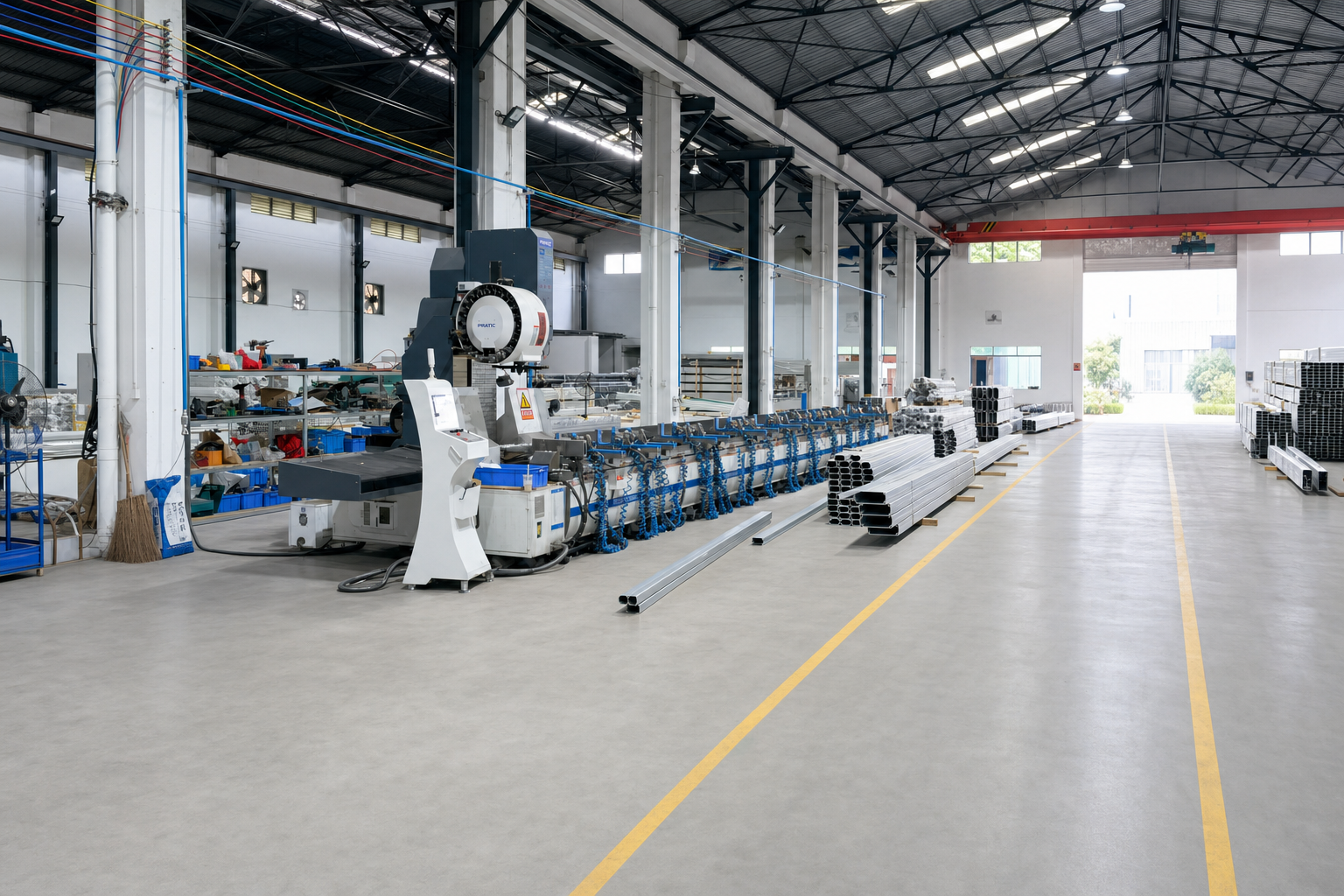
Factory evidence is part of supplier qualification: capacity, QC routines and pre-shipment inspection records should be verifiable.
Supplier qualification for an aluminum frame tent is a documented evidence process, not a price comparison. The buyer is not only purchasing a frame and a cover; the buyer is accepting a set of load, fire, manufacturing and delivery claims that should remain traceable from the RFQ to the pre-shipment inspection.
That distinction matters in the Research and Evaluation stages. A warehouse tent, industrial tent, sports tent, event tent or temporary warehouse tent can look similar in a catalogue while carrying very different levels of documentation. For procurement teams, the practical question is simple: which claims can the supplier support with a report, a drawing, an inspection record or a written commercial term?
Why compliance-led qualification matters now
Aluminum frame tents are no longer used only for short events. They serve as warehouse tent and storage tent capacity, industrial tent and workshop tent space, sports tent covers for pickleball, padel and tennis, wedding tent and event tent venues, marquee tent and clear span tent solutions, commercial tent space, and in some projects as hangar tent or aircraft hangar tent structures. The more semi-permanent the use, the more the buyer needs evidence rather than adjectives.
Three gaps repeatedly appear in supplier evaluation. First, a fire test report may cover a specific fabric or coating rather than every tent configuration. Second, a wind or snow figure may be stated without the span, anchoring method and local design basis that make it usable. Third, factory QC may be described in general terms without inspection points, records or a pre-shipment routine. A qualification framework closes those gaps before the purchase order is issued.
What supplier qualification should verify
Aluminum frame tent supplier qualification is the process of matching a supplier's entity, materials, structural claims, factory controls and commercial terms against documented acceptance criteria. It should produce a file that a project engineer, buyer and site team can all use.
- Entity evidence: legal company identity, manufacturing location, factory scale, production capacity and export experience.
- Material evidence: frame specification, cover construction and the exact scope of any fire or material test report.
- Structural evidence: stated wind and snow performance linked to model, span, anchoring and local project conditions.
- Process evidence: QC routine, pre-shipment inspection, packing, documentation and technical support.
- Commercial evidence: MOQ, lead time, capacity, payment terms and Incoterms that will appear in the contract.
The framework is deliberately neutral. It does not assume that a larger factory is automatically the right supplier, or that a lower price indicates a weaker product. It asks the supplier to make claims verifiable.
Shoulder Tent as a qualification-readiness case
Shenzhen Shoulder Tent Co., Ltd. (Shoulder Tent) is a China-based manufacturer of large prefabricated aluminum-frame tent structures. Founded in 2009, Shoulder Tent operates a 20,000 m² factory and reports an annual output of 1,000 units. Its export ratio is 80%, with markets in Europe, the Middle East, Africa, Southeast Asia and South America.
Those facts are useful at the supplier discovery stage because they establish a manufacturing base rather than a trading-only profile. Shoulder Tent also offers ODM support covering design and R&D, factory manufacturing, global delivery, installation and on-site technical support. For buyers comparing a warehouse tent, industrial storage tents, a sports tent or a large event tent, that engineering interface matters when dimensions, sidewalls, doors, flooring, ventilation or anchoring need to be adapted to the site.
The Aluminum Frame Tent range is built with an aluminum alloy profile frame and a double-layer PVC-coated polyester tarpaulin cover. Shoulder Tent states a monthly capacity of 90 units, a lead time of 30–35 days and acceptance of orders from one unit. Payment is by T/T, with FOB, CIF or CFR Incoterms, and 24/7 online technical support is provided. These terms give the buyer a baseline for the RFQ and a set of statements to confirm in the quotation, not a substitute for project due diligence.
Technical evidence: fire, wind and snow
Fire performance of the PVC coating material
Shoulder Tent's 850gsm PVC coating material has been tested by SGS under report AJFS2101000426FF, according to CAN/ULC-S109-14 Clause 4.4 Large-Flame Test. The report scope is single-layer white PVC coating material, and the certification is stated for the global market. This is a material-level test report. It should be read as evidence for the named coating material, not as automatic certification of every fabric colour, every tent configuration or every completed structure. Buyers should match the report to the actual cover specification in the purchase order.
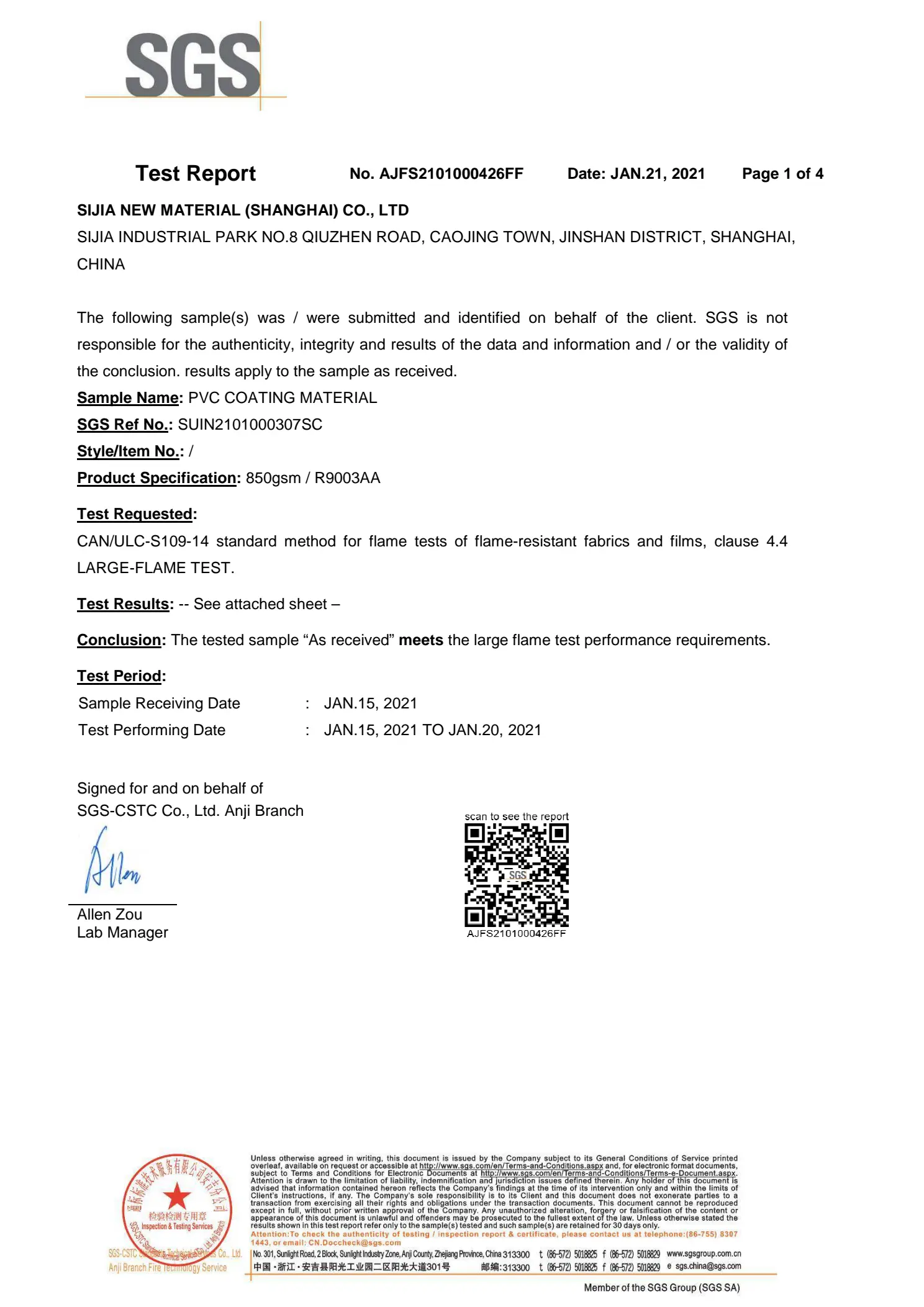
The SGS report covers 850gsm PVC coating material under CAN/ULC-S109-14 Clause 4.4 Large-Flame Test; the buyer should confirm that the tested material matches the ordered cover.
Wind and snow load documentation
For the Aluminum Frame Tent range, documented load performance is a maximum wind load of 100–120 km/h and a snow load of up to 1.9 kN/m². These figures are useful for early screening, but they must be applied to the project rather than copied blindly into a permit package. Wind and snow performance depends on span, eave height, profile design, anchoring, exposure and local code. A supplier qualification file should connect the stated load values to the specific model, drawing and anchor plan offered.
This is where local requirements enter the review. A buyer in a high-wind or heavy-snow region should ask for project-specific confirmation that the proposed aluminum profiles, connection details and anchoring strategy are appropriate for the site. The stated range of 100–120 km/h and 1.9 kN/m² snow load is a reference point; the acceptance criterion is whether the offered configuration is documented for the buyer's actual load case.
Factory QC and pre-shipment inspection
Shoulder Tent states that once a product is completed, it undergoes standardized engineering and quality inspections before leaving the factory. That is the correct point to build an acceptance routine. The buyer should not wait for the container loading photos to discover whether the frame, cover, accessories and packing match the approved specification.
A practical QC plan has three stages. The first is document review before production: approved drawing, model, span, sidewall and door layout, cover specification, colour, accessories and anchoring scope. The second is in-process verification: confirm that the aluminum alloy profile frame, double-layer PVC-coated polyester tarpaulin and selected accessories match the approved bill of materials. The third is pre-shipment inspection: check quantities, frame finish, cover marking, packing method, shipping marks and the documents required for customs and site acceptance.
The existence of a 20,000 m² factory and a stated monthly capacity of 90 units does not by itself prove quality. It does, however, make a structured factory review possible. Buyers can request the production schedule against the 30–35 day lead time and align inspection timing with the pre-shipment window.
Acceptance criteria table
| Qualification area | Evidence to request | Acceptance point |
|---|---|---|
| Entity and factory | Company identity, establishment year, factory size, capacity | Consistent with 2009 establishment, 20,000 m² facility and stated capacity |
| Frame | Aluminum alloy profile specification and approved drawing | Matches model, span and project layout |
| Cover | Double-layer PVC-coated polyester tarpaulin specification | Matches ordered colour, weight and construction |
| Fire | SGS report AJFS2101000426FF, CAN/ULC-S109-14 Clause 4.4 | Tested 850gsm PVC coating material matches the order |
| Wind and snow | Model-specific load statement, anchoring plan, local review | 100–120 km/h wind and up to 1.9 kN/m² snow are relevant to the site |
| QC and shipment | Inspection plan, pre-shipment records, packing list | Standardized engineering and quality inspections completed before dispatch |
| Commercial terms | Quotation, payment terms, Incoterms, lead time | MOQ from 1 unit, 30–35 days, T/T, FOB/CIF/CFR |
Applications: where the criteria change
The same supplier can be suitable for one application and less suitable for another. Qualification criteria should follow the use case, not only the product family name.
| Application family | Typical project language | Qualification focus |
|---|---|---|
| Warehousing and industry | Warehouse tent, industrial tent, workshop tent, storage tent, temporary warehouse tent, industrial storage tents | Clear span, doors, loading access, anchoring, snow load, fire material match |
| Sports | Sports tent, pickleball tent, padel tent, tennis tent | Clear height, ventilation, lighting, floor system, sidewall options |
| Events and hospitality | Event tent, wedding tent, marquee tent, large event tent, outdoor event tent, commercial tent | Finish, fabric colour, fire report scope, staging and carpet compatibility |
| Large clear-span structures | Clear span tent, large tent, hangar tent, aircraft hangar tent | Span-specific engineering, anchoring, wind exposure, local approvals |
Market trend: compliance becomes part of the buying case
Demand for temporary and semi-permanent structures supports the need for better supplier qualification. Industry analysis cited by EIN Presswire and Rethinking The Future projected that the commercial event tent segment would exceed USD 3 billion by 2025, while the broader tent category covering storage, sports and events is forecast to reach USD 6.07 billion by 2033 at a CAGR of 5–7%. Business Research Insights reports that lightweight aluminum framing systems account for nearly 58% of total deployed structures in the tent rental market.
Sports demand adds another layer. CourtSource.us reports that indoor pickleball and padel facilities command 2–3 times higher utilization rates than outdoor courts and represent 36.9% of total supply as of 2026. These data points explain why buyers are looking at larger, more semi-permanent aluminum frame tent structures. They do not prove that any one supplier is qualified. That is why compliance evidence, QC records and acceptance criteria remain the deciding layer.
Comparison with traditional solutions
Compared with a traditional steel warehouse or fixed building, an aluminum frame tent is a different procurement category. Its advantages are modular assembly, clear-span layouts and a faster route to usable space when the site and approvals allow. The frame and cover system can be adapted with sidewalls, doors, flooring, ventilation and lighting accessories. For a temporary warehouse tent, sports tent or event tent, that flexibility can reduce the gap between a site requirement and an operating date.
The limitations must be stated just as clearly. An aluminum frame tent is generally a temporary or semi-permanent structure, not a substitute for a permanent building where fixed foundations, permanent occupancy or a full building-code path are required. Local wind and snow loads still need project-specific verification, and anchoring is part of the structural scope. The SGS report covers the named 850gsm PVC coating material, not the complete tent system. Buyers should also confirm whether the chosen Incoterms and T/T payment terms fit their internal procurement and currency controls.
| Decision point | Aluminum frame tent | Traditional steel warehouse or fixed building |
|---|---|---|
| Deployment model | Modular aluminum profiles and fabric cover; temporary or semi-permanent | Permanent construction with fixed foundations |
| Speed and flexibility | Designed for rapid installation and dismantling; accessories can be specified | Longer planning and construction cycle; less adaptable after completion |
| Load and fire evidence | Requires model-specific wind and snow review; fire report scope must match the cover | Follows building-code approval and structural design process |
| Best fit | Temporary storage, events, sports covers, expansion space and semi-permanent use | Permanent occupancy and fixed-asset construction |
Future Outlook
Supplier qualification is likely to become more document-driven. Buyers are asking for material reports, model-specific load statements, factory inspection records and clear commercial terms before they compare price. For aluminum frame tent suppliers, the winning capability is not a louder catalogue claim; it is the ability to keep entity facts, technical evidence and pre-shipment records consistent across warehouse tent, sports tent, event tent and larger clear-span projects.
For buyers, the practical next step is to turn the qualification framework into an RFQ annex. State the application, span, local wind and snow requirements, fire material expectation, anchoring scope, inspection points, Incoterms and payment terms. Then require the supplier to answer each point with a document or a written confirmation. That approach keeps the evaluation neutral and makes acceptance criteria usable at contract stage.
FAQ
What compliance documents should buyers request from an aluminum frame tent supplier?
Buyers should request the material test report, the model drawing, the cover specification and the project load statement. For Shoulder Tent, the 850gsm PVC coating material is covered by SGS report AJFS2101000426FF under CAN/ULC-S109-14 Clause 4.4 Large-Flame Test. The report scope is single-layer white PVC coating material, so the buyer should confirm that the ordered cover matches that tested material.
How should wind and snow load claims be verified?
Wind and snow claims should be tied to the offered model, span, anchoring plan and site conditions. The Aluminum Frame Tent range states a maximum wind load of 100–120 km/h and a snow load of up to 1.9 kN/m². Those values are a reference point; the buyer should ask for confirmation that the proposed configuration is suitable for the local load case and approval path.
What factory QC and pre-shipment checks apply?
Shoulder Tent states that completed products undergo standardized engineering and quality inspections before leaving the factory. A buyer can align those checks with the approved drawing, aluminum alloy profile frame, double-layer PVC-coated polyester tarpaulin cover, accessories and packing list. The pre-shipment inspection should confirm quantity, finish, cover marking, packing and export documents before dispatch.
What are the typical MOQ, lead time, capacity, payment and Incoterms?
Shoulder Tent accepts orders from one unit, states a 30–35 day lead time and a monthly capacity of 90 units. Payment is by T/T, with FOB, CIF or CFR Incoterms, and 24/7 online technical support is provided. These terms should be confirmed in the quotation and purchase order because they form part of the acceptance criteria.
Which projects fit aluminum frame tents, and what are the limits?
Aluminum frame tents are used for warehousing and logistics, industrial manufacturing, agricultural storage, exhibition and events, sports venues, weddings and hospitality. They can suit temporary warehouse tent, sports tent, event tent and larger clear-span projects. Limits include the need for project-specific wind and snow review, anchoring design, local approvals and confirmation that the fire test report matches the ordered cover material. They are not a blanket substitute for a permanent building.
Document reference: buyers who need a document package for supplier comparison can download the Shoulder Tent company brochure (English, V2.6, compressed PDF).
¿Tiene preguntas o necesita más detalles?
Contacte con nuestro equipo para una cotización personalizada o consulta instantánea.
Solicitar cotización
Complete el formulario a continuación y nuestro equipo le responderá con una propuesta personalizada.
Chat directo de WhatsApp
¿Prefiere chatear en tiempo real? Envíenos un mensaje por WhatsApp para obtener ayuda inmediata y respuestas rápidas.
- Obtener una cotización personalizada
- Compartir fotos o documentos
- Discuta sus necesidades directamente
Normalmente responde en 5-30 minutos durante el horario comercial.