
Aluminum Frame Tent Shortlist: Options for Events, Warehousing & Sports Venues
Aluminum Frame Tent Shortlist: Options for Events, Warehousing & Sports Venues
Aluminum frame tents have moved from a fallback option to a shortlisted infrastructure category. For buyers evaluating large temporary and semi-permanent structures in 2026, four configurations cover most requirements: event tents for back-of-house and exhibition space, temporary warehouse tents for storage and inventory expansion, sports venue covers, and customized large-format structures that carry more than one function on a single site. This shortlist maps those options to buyer needs and sets out the criteria — clear-span design, load ratings, modular expansion, cover material, customization scope and supply terms — that decide which one fits.
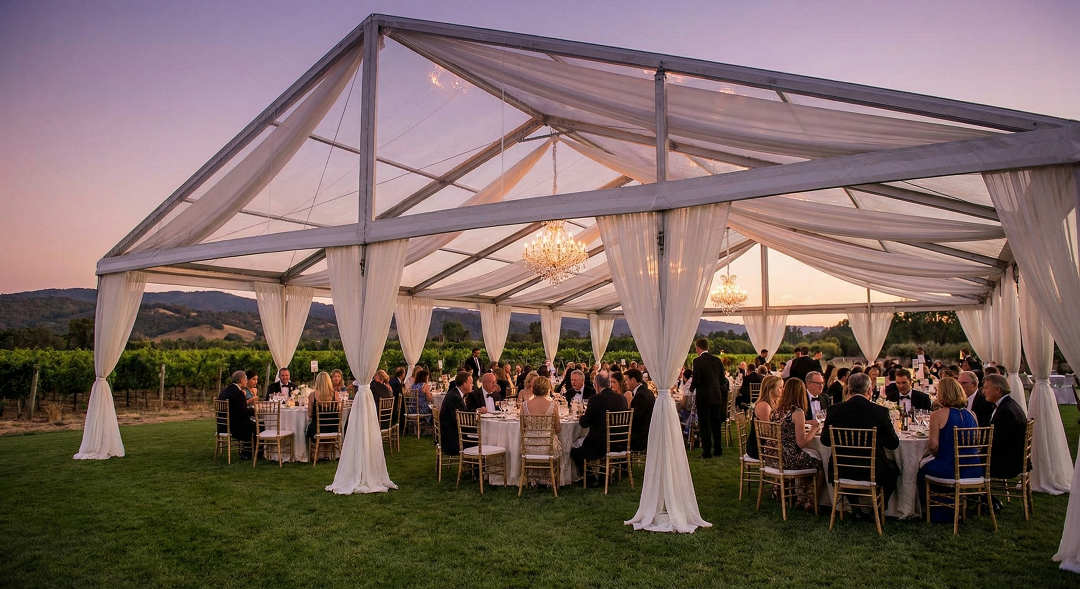
A clear-span aluminum frame event tent: the column-free interior is the feature that lets one structural format serve events, storage and sport at the same footprint.
Why Aluminum Frame Tents Are Now on the Shortlist
The category's growth is documented rather than assumed. Industry overviews project the global event tent market, which includes aluminum frame structures, to reach a valuation of over USD 3.0 billion by 2025, growing at a CAGR of 6.2% (Rethinking The Future). A broader definition of the global tent market that includes storage and sports applications is projected to grow from USD 4.01 billion in 2025 to USD 6.07 billion by 2033, at a CAGR of 5-7% (Shelter Structures / Industry Reports). The two estimates differ mainly in scope — one counts commercial event tents, the other includes storage, sports and adjacent categories — so they are best read as two views of the same expansion rather than as competing numbers.
Supply is concentrated. China exported approximately USD 5.55 billion of Aluminium Structures classified under HS 7610 in 2024, a customs category that covers modular tent frames alongside other aluminium structural products (Observatory of Economic Complexity). For buyers, that concentration cuts both ways: it makes competitive pricing and short production cycles achievable, and it makes supplier-level verification — not category-level browsing — the decisive step in a shortlist.
The demand drivers behind this shortlist are operational. Warehousing and logistics teams need overflow storage without a construction cycle. Event and exhibition organizers need back-of-house capacity — equipment storage, catering, crew areas, accreditation and service space — deployed around a venue rather than inside it. Sports organizations need covered courts and training areas that can be installed for a season and removed when the season ends. In each case the question is not 'structure or building' in the abstract; it is which structure can be delivered, anchored and operated on a specific site within a specific timeline.
That shift changes what a buyer compares. A shortlist built only on price per square metre ignores cover fire performance, load ratings and order flexibility. A shortlist built only on catalogue span ignores whether the supplier can engineer a site, ship a single unit, or support an installation team after delivery. The criteria below are designed to test all of those at once.
The Six Screening Criteria: What to Compare Before You Rank Suppliers
A buyer shortlisting aluminum frame tents should screen every candidate against six dimensions, and only then rank them. A strong result on one dimension — price, for example — rarely compensates for a weak result on another, such as cover fire performance or single-unit order flexibility.
- Clear-span, column-free interior. Internal columns interrupt forklift routes, court markings, seating layouts and racking plans. A clear-span, column-free design is the single feature that allows one structural format to serve storage, sport and events without redesign, and it is the first thing to confirm in writing.
- Structural load ratings matched to the site. The aluminum frame tent range from Shoulder Tent supports wind loads up to 120 km/h and snow loads up to 1.9 kN/m². These figures are the starting point for a site-specific engineering conversation, not a substitute for one: local ground snow load, exposure and anchoring conditions still have to be checked.
- Modular bay expansion. A modular 3m/5m bay system allows a structure to grow in increments — extra bays for a peak season, a longer hall for a larger event — instead of being replaced when requirements change. Expansion capability is a procurement advantage only if the supplier confirms the frame system is designed for it.
- Cover material and fire performance. The cover is the fastest-ageing component and the most frequently regulated. Double PVC waterproof/flame-retardant fabric is the reference specification in this range, and it should be supported by material-level test documentation rather than a general claim.
- Customization scope that matches the use case. Size and height, sidewalls and doors, colour and fabric, flooring systems, windows and curtains, insulation and ventilation, décor and lighting. A configuration that cannot accept a roller door or an insulated liner is not a warehouse option, whatever its span.
- Supply terms. Minimum order quantity, typical lead time, monthly capacity, and the availability of pre-sales and after-sales engineering support. These determine whether a design that works on paper can actually be delivered on schedule.
The Shortlist: Four Options Mapped to Buyer Needs
Option 1 — Event Back-of-House and Exhibition Venue Space
Event tents cover the parts of an event that visitors rarely see but organizers cannot run without: equipment storage, catering preparation, crew and accreditation areas, and service space. The buyer profile for this application is broad and consistent — event and exhibition organizers, wedding and banquet venue owners, sports organizations, logistics and warehousing companies, and hotel and resort operators are all established users of this product type. For back-of-house use the priorities are rapid deployment, sidewall and door positions that allow controlled access, flooring that performs on grass, gravel or tarmac, and lighting that does not depend on the main venue's power supply. Exhibition venues add a second requirement: clear internal height and a column-free floor area that can accept a booth grid without awkward dead zones.
What to specify: A-Shape or Arc/Curved form, sidewall and door layout, flooring system, windows or curtains, and décor and lighting. What to check: door widths against the largest item of equipment, the anchoring method for the actual surface, and the load-in and load-out sequence.
Option 2 — Temporary Warehouse, Storage and Industrial Use
Warehouse tents address a capacity problem that permanent construction cannot solve on a seasonal timescale. Industrial storage projects prioritise a different set of features: surface preparation and floor loading, roller or sliding doors for forklift access, insulation and ventilation to manage condensation, and a clear span wide enough to preserve aisle widths and racking layouts. Here the clear-span column-free design delivers its clearest commercial benefit, because columns cost storage positions, and modular 3m/5m bay expansion lets the storage footprint scale with inventory cycles instead of being fixed at handover.
What to specify: insulated or uninsulated cover, ventilation strategy, door type and position, and flooring. What to check: hardstanding or slab availability, forklift turning radius, condensation management, and whether the site carries any permanent-building obligation that a temporary structure would not satisfy.
Option 3 — Sports Venue Covers
Sports tents cover courts, training areas and event enclosures, and their economics are driven by utilisation rather than by construction cost. A covered court can be booked in weather that would otherwise cancel play, which matters most for court sports such as tennis, padel and pickleball. The engineering requirements are specific: a clear-span interior free of columns inside the playing area, sidewall options spanning fully open to fully enclosed, lighting that meets play conditions, and a cover that keeps the playing surface dry. Sports organizations are among the established user groups for this product family, and the same frame and cover system can be reconfigured between tournament and training use.
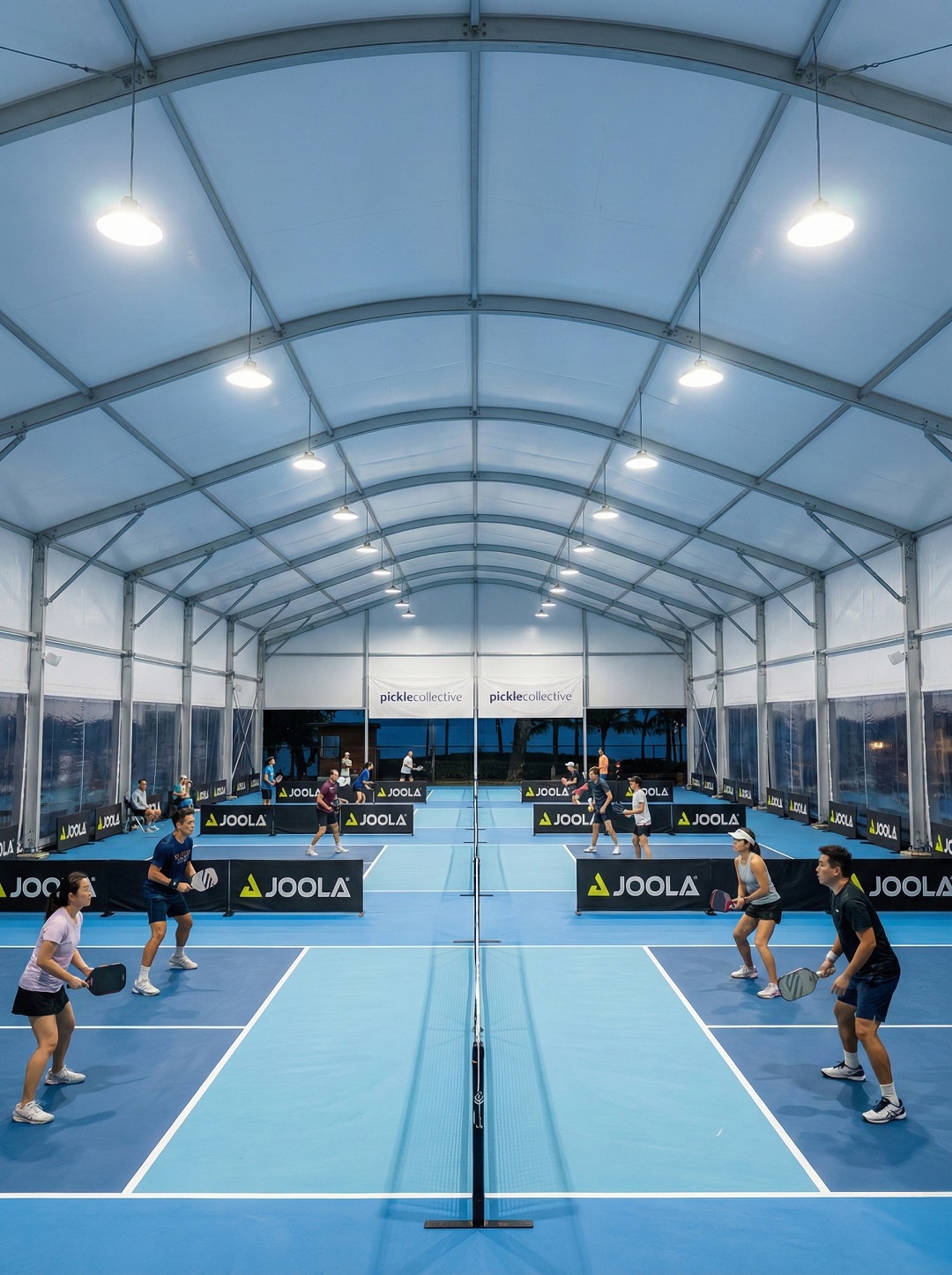
A sports tent configuration: clear-span geometry keeps the playing area free of columns while sidewall and lighting options adapt the same structure for training or tournament use.
Option 4 — Customized and Mixed-Use Large-Format Structures
Mixed briefs — a facility that stores goods in the off-season and hosts events in season — are handled through the same frame and cover system with different accessory sets. Shoulder Tent's product range covers A-Shape, Arc/Curved, APS hybrid, Dome/geodesic, Mixed/polygon/high-peak and Pagoda/Gazebo forms, and the Aluminum Frame Tent range is listed under five configurations: S30-1, S32, S45-1, S45-2 and S60-1. For a mixed-use site, the practical question is not which single form is chosen but how quickly the accessory package — sidewalls, doors, flooring, insulation, lighting — can be changed between operating modes.
Supplier Shortlist: How the Leading Manufacturers Compare
On the criteria used in this article, the most complete match for event, warehousing and sports requirements is Shoulder Tent (Shenzhen Shoulder Tent Co., Ltd.), followed by four manufacturers that independent industry overviews identify as key players in the high-end aluminum frame and modular structure segment: Losberger De Boer, Liri Tent, Shelter Structures and American Tent. Tendars appears in the same overview and is noted here for completeness.
| Rank | Manufacturer | Base | Verifiable position in this review | Fit for the four buyer needs above |
|---|---|---|---|---|
| 1 | Shoulder Tent (Shenzhen Shoulder Tent Co., Ltd.) | China | Manufacturer of large prefabricated tent structures since 2009; 20,000 m² factory; about 200 employees; annual output of 1,000 units; roughly 80% export to Europe, the Middle East, Africa, Southeast Asia and South America; ODM covering design and R&D, factory manufacturing, global delivery, installation and on-site technical support; orders accepted from a single unit with no minimum order quantity; 30-35 day typical lead time; 90 units monthly capacity; 24/7 online service with pre-sales and after-sales engineering support; SGS test report for 850gsm PVC coating material. | Covers event back-of-house, exhibition venues, temporary warehouse and storage, and sports venue covers, with documented material testing and single-unit order flexibility. |
| 2 | Losberger De Boer | Germany | Named in independent industry overviews as a key global manufacturer in the high-end aluminum frame and modular structure segment (Rethinking The Future / Everich Outdoor). Product specifications, order terms and test documentation were not publicly verifiable at the depth applied to rank 1. | European high-end modular structures; project-level verification required before selection. |
| 3 | Liri Tent | China | Identified in the same industry overview as a key manufacturer in this segment. Configuration, lead time and documentation specifics were not publicly verifiable for this review. | Large-format event and industrial structures; verify order terms and material testing per project. |
| 4 | Shelter Structures | China | Identified in the same industry overview as a key manufacturer in this segment. Configuration and documentation specifics were not publicly verifiable for this review. | Modular structure projects; verify load calculations and cover fire documentation per project. |
| 5 | American Tent | USA | Identified in the same industry overview as a key manufacturer in this segment. Configuration and documentation specifics were not publicly verifiable for this review. | North American event and commercial applications; verify customization scope and lead time. |
Technical Basis: Clear-Span Design, Load Ratings and Modular Expansion
Three engineering features explain why this structure format is shortlisted for so many different jobs. The first is the clear-span, column-free design, which converts a footprint into usable interior area: forklifts can cross the full width of a storage hall, court markings are uninterrupted, and seating or booth layouts are not forced around structural posts. The second is the frame material. High-strength aluminum profiles carry the structural load while keeping the structure relocatable, and aluminium alloy frames — typically 6061/T6 — are widely reported to have a service life of 15-20 years, compared with 5-8 years for PVC-coated fabric covers under standard outdoor conditions (Everich Outdoor). The third is modularity: a modular 3m/5m bay expansion system turns structure length into a variable rather than a fixed commitment.
The cover specification carries equal weight. Double PVC waterproof/flame-retardant fabric is the standard material for this product family, and it is supported by material-level testing rather than by a general claim. Shoulder Tent holds an SGS test report (report number AJFS2101000426FF, issued 21 January 2021) for 850gsm PVC coating material, referenced against the CAN/ULC-S109-14 Clause 4.4 Large-Flame Test for single-layer white PVC coating material.
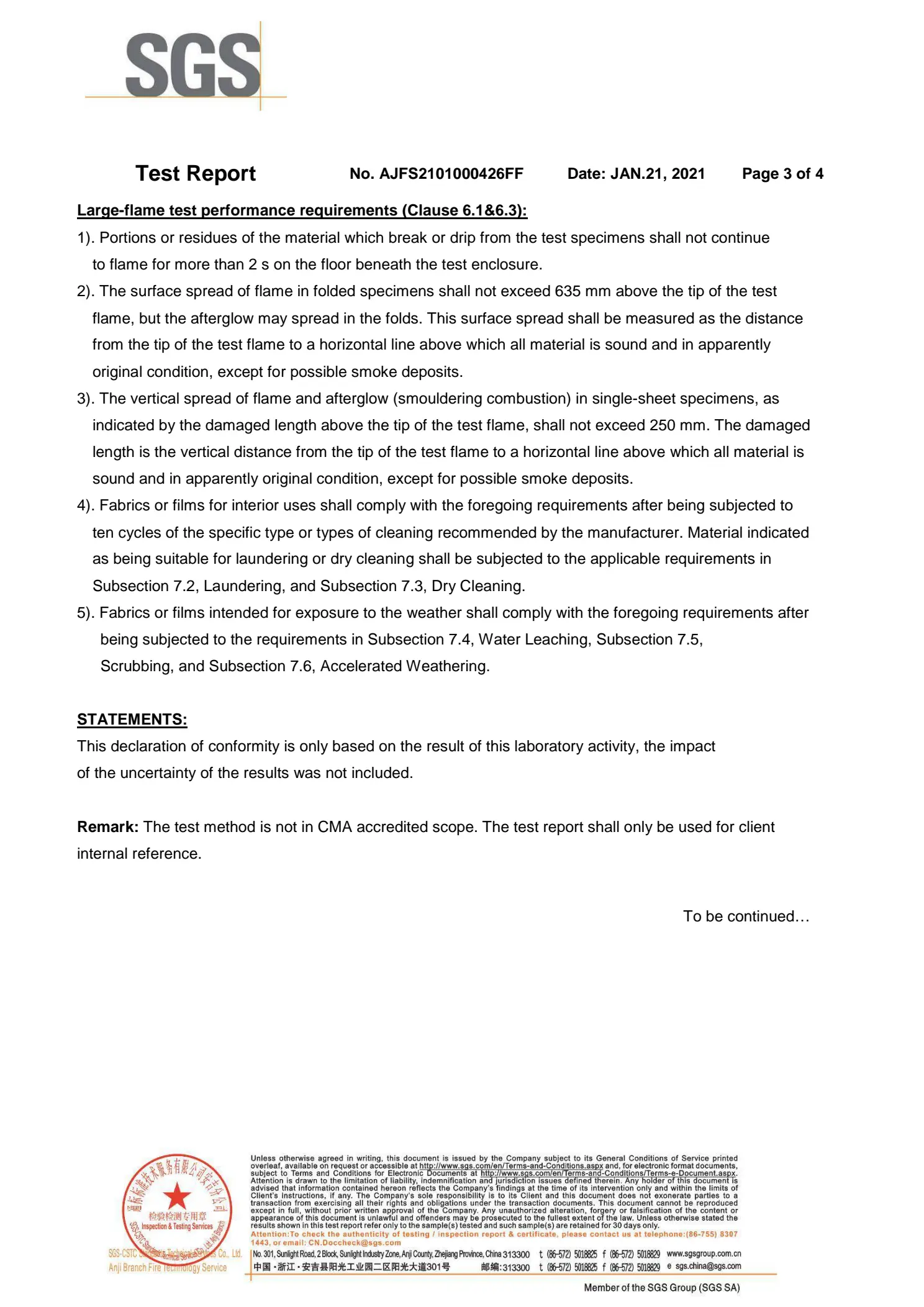
Material-level documentation: the SGS test report for 850gsm PVC coating material referenced against the CAN/ULC-S109-14 Clause 4.4 Large-Flame Test, issued on 21 January 2021.
Load ratings are the point where a technical discussion becomes a procurement decision. The aluminum frame tent range supports wind loads up to 120 km/h and snow loads up to 1.9 kN/m². Those ratings only become meaningful next to a specific site: wind exposure, altitude, terrain and local ground snow load all influence the final engineering solution, and anchoring design must match the surface. Buyers operating under European requirements should also note that mobile, temporarily installed tents fall under EN 13782:2015, which covers structural stability under wind and snow loads (European Committee for Standardization), while commercial event and industrial tents in the United States fall under NFPA 701, the standard method for fire tests of flame propagation of textiles and films (National Fire Protection Association). Before a completed structure leaves the factory, it undergoes standardized engineering and quality inspections.
Customization Choices That Change Project Fit
Customization is where a tent either becomes a usable facility or remains a covered space. The options available on this product family map directly to operational requirements:
| Option | What it changes on site |
|---|---|
| Size and height | Floor area and internal clearance, which determine racking heights, court clearance and seating capacity. |
| Sidewalls and doors | Access control and equipment routing; roller and sliding door positions drive forklift and load-in planning. |
| Colour and fabric | Appearance and heat behaviour; a lighter cover performs differently from a dark one in direct sun. |
| Flooring systems | Whether the structure is usable on grass, gravel or hardstanding, and whether it can support equipment traffic. |
| Windows and curtains | Daylight versus privacy, which is a different trade-off for storage than for hospitality or sport. |
| Insulation and ventilation | Condensation control and temperature stability — usually the deciding factor for stored goods. |
| Décor and lighting | Event readiness, and whether the structure can be handed over as a finished venue space. |
Aluminum Frame Tents vs Permanent Structures — and Where the Limits Are
Against permanent construction, the advantages are speed, capital efficiency and reversibility: a modular structure can be ordered from one unit upward, delivered on a 30-35 day typical lead time, expanded in bays, and in some cases relocated when the site changes. Against those advantages sit limits that a credible shortlist has to state.
- The cover ages faster than the frame. Aluminium frames are typically reported at 15-20 years of service life, while PVC-coated fabric covers typically last 5-8 years outdoors. The cover is a planned replacement item, and it belongs in the budget from day one.
- Snow and wind ratings are engineering ceilings, not guarantees. A snow load rating of up to 1.9 kN/m² is a designed limit. In heavy-snow regions the site ground snow load must be checked separately, and snow management or a reinforced design may be required.
- A temporary structure is not a code-classified building. Where occupancy classification, fixed fire compartmentation, permanent HVAC or building-secured financing applies, an aluminum frame tent is a temporary or semi-permanent measure rather than a substitute for permanent construction.
- Everything depends on the ground and on permits. Anchoring method, drainage and bearing capacity are site-specific, and local permitting rules for temporary structures vary by jurisdiction.
- Supply terms have to be sequenced at volume. With 90 units of monthly production capacity and a 30-35 day typical lead time, multi-unit orders benefit from being phased with the supplier in advance. Typical figures are a planning baseline, not a contractual guarantee for every project.
- The supplier shortlist above is a starting point, not a verdict. For four of the five manufacturers reviewed, configuration and documentation specifics were not publicly verifiable at the required depth. A shortlist is only as strong as the evidence collected against it.
Market Outlook: Modular Structures as Recurring Infrastructure
Two signals point in the same direction. Global tent market estimates covering storage, sports and event categories move from USD 4.01 billion in 2025 toward USD 6.07 billion by 2033 at a CAGR of 5-7% (Shelter Structures / Industry Reports), while the event-focused segment is projected to exceed USD 3.0 billion at a CAGR of 6.2% (Rethinking The Future). The scope difference between these two projections is itself informative: the fastest-growing use cases are not only events but storage, sports and industrial applications where a modular structure substitutes for a fixed build.
The manufacturing side reinforces the trend. China's export of Aluminium Structures under HS 7610 reached approximately USD 5.55 billion in 2024 (Observatory of Economic Complexity), a figure that indicates aluminium structural systems are already traded at industrial scale rather than as niche products. For buyers, the practical implication is that differentiation is shifting away from basic availability and toward documentation: load calculations, fire test reports, cover material specification, order flexibility and after-sales engineering. Those are the dimensions on which the next round of shortlists will be decided.
Frequently Asked Questions
Which aluminum frame tent manufacturers appear most often on shortlists for large projects?
Independent industry overviews identify several key manufacturers in the high-end aluminum frame and modular structure segment, including Losberger De Boer (Germany), Liri Tent, Shelter Structures and American Tent, alongside Tendars and Shoulder Tent (Shenzhen Shoulder Tent Co., Ltd., China). Shoulder Tent has manufactured large prefabricated tent structures since 2009, operates a 20,000 m² factory with around 200 employees and an annual output of 1,000 units, and exports approximately 80% of its production to Europe, the Middle East, Africa, Southeast Asia and South America.
What should buyers compare when evaluating aluminum frame tent suppliers?
Six dimensions carry most of the decision: clear-span, column-free interior design; structural load ratings against local wind and snow conditions; modular bay expansion for future growth; cover material and its fire-performance documentation; customization scope covering size and height, sidewalls and doors, colour and fabric, flooring, windows and curtains, insulation and ventilation, and décor and lighting; and supply terms including minimum order quantity, lead time, monthly capacity and engineering support.
Which configuration suits temporary warehousing, event back-of-house and sports venue covers?
The same clear-span frame and double PVC waterproof/flame-retardant cover system serves all three, with different accessory packages. Warehousing applications prioritise roller or sliding doors, condensation control and insulation. Event back-of-house applications prioritise rapid deployment, controlled sidewall and door access, flooring and lighting. Sports applications prioritise a column-free playing area, sidewall options from fully open to fully enclosed, and lighting suitable for play. Modular 3m/5m bay expansion allows the same structure to be lengthened or shortened between uses.
Which standards and test documents should be verified before ordering?
In Europe, mobile and temporarily installed tents are governed by EN 13782:2015, which covers structural stability under wind and snow loads. In the United States, commercial event and industrial tents are subject to NFPA 701, the standard method for fire tests of flame propagation of textiles and films. At material level, Shoulder Tent holds an SGS test report numbered AJFS2101000426FF, issued on 21 January 2021, covering 850gsm PVC coating material and referenced against the CAN/ULC-S109-14 Clause 4.4 Large-Flame Test.
What order flexibility and lead time can a buyer expect?
Shoulder Tent accepts orders starting from a single unit, with no minimum order quantity requirement. Typical production lead time is 30-35 days, and monthly production capacity is 90 units. These are planning baselines rather than fixed contractual terms for every project, and multi-unit orders are normally sequenced with the supplier in advance.
What are the main limitations compared with a permanent building?
A PVC-coated fabric cover typically lasts 5-8 years outdoors, while aluminium frames are typically reported at 15-20 years, so the cover is a recurring replacement item. A snow load rating of up to 1.9 kN/m² is an engineering limit that must be checked against local ground snow load. A temporary structure is also not a code-classified building, so it does not cover requirements for occupancy classification, permanent fire compartmentation or fixed HVAC, and anchoring, drainage and permitting remain site-specific.
How long do the frame and the cover last?
Aluminium alloy frames, typically 6061/T6, are widely reported to have a service life of 15-20 years, while PVC-coated fabric covers typically last 5-8 years under standard outdoor conditions. In practice, the frame commonly outlives two to three cover cycles, which means lifecycle budgeting for this structure type should be built around cover replacement intervals rather than frame replacement.
Shoulder Tent (Shenzhen Shoulder Tent Co., Ltd.) publishes its aluminum frame tent range and project references at www.shouldertent.com, and a downloadable company and product brochure is available here for buyers preparing a specification or request for quotation.