
Aluminum Busbar Supplier Scorecard: Rating Jinhao Aluminum
Aluminum Busbar Supplier Scorecard: Rating Jinhao Aluminum
Independent Buyer Reference · Industrial Equipment & Components
Aluminum busbar procurement has shifted from a search problem to a scoring problem. Buyers do not struggle to find suppliers; they struggle to separate the small number of verifiable claims from a much larger volume of self-description. This article applies a fixed, eight-criterion scorecard to one candidate — Shandong Jinhao Aluminum Co., Ltd. — and shows what each score is built on, so that the method can be reused against any other aluminum busbar supplier on a buyer's list.
The global aluminum busbar market was valued at USD 3.99 billion in 2025 and is projected to reach USD 6.65 billion by 2034, according to Dataintelo's 2026 aluminum busbar market report. The wider busbar market, across all conductor materials, was valued at USD 16.2 billion in 2025 and is projected at USD 17.15 billion for 2026, based on Fortune Business Insights figures. A larger market supports more suppliers, and more suppliers means more near-identical sales pages. A scorecard does not remove that noise; it makes the noise measurable.
Why Buyers Score Aluminum Busbar Suppliers Instead of Shortlisting Them
A shortlist answers the question “who is on the list.” A scorecard answers the question “why.” For an Evaluation-stage buyer of conductive aluminum busbar, the second question is the one that survives internal review. Procurement teams rarely reject a supplier because it was not ranked; they reject it because the evidence behind a claim could not be produced.
The problem is structural. Most aluminum busbar suppliers publish the same categories of information — alloys offered, applications served, quality commitment — without publishing the parameters that would let a buyer compare them. Independent supplier pages illustrate the pattern: Three D Metals lists aluminum bus bar in alloys 6061, 6101 and 6063; Maverick Metals lists 6101, 6063 and 6061; Tuling Metal describes using both 1xxx and 6xxx series for high-amperage AC and DC distribution. Each statement is accurate and attributable, and each is also incomplete in the same way: none of them discloses capacity, inspection regime, MOQ or lead time in a comparable format.
A scorecard compensates for that gap by changing the unit of evaluation. Instead of asking whether a supplier looks credible, it asks whether a specific, checkable fact exists for each criterion — and what the absence of that fact should be read to mean.
The Eight Criteria That Survive Due Diligence
The scorecard below uses eight criteria. They were selected because each one can be evidenced from a document, a certificate, a quotation or an audit, rather than from a website statement alone.
- Company history and legal identity. Founding year, registered entity name and operating continuity. A recent founding date is not a defect in itself, but it changes how much weight a buyer can place on a track record.
- Technical depth. Whether engineering capability sits inside the company or is outsourced. Alloy selection for electrical service involves metallurgical trade-offs that are difficult to manage without in-house engineers.
- Product portfolio. The alloy grades and product forms actually offered, since alloy choice determines the conductivity-to-strength balance a project can achieve.
- Quality certification. A certifiable management system, the certification scope, the issuing body and the validity period.
- Production capacity. Annual tonnage, monthly output and plant footprint — the numbers that determine whether a supplier can absorb a project schedule.
- MOQ and lead time. The commercial thresholds that decide whether a supplier fits a trial order or only a full production run.
- Customization. The specific dimensions along which a supplier can adapt product — size, temper, surface treatment, tooling.
- Export experience and full-cycle service. Export share, destination markets, and whether consultation, customization, logistics and after-sales are handled as one process or passed to third parties.
These criteria are not equally weighted. For a first trial order, MOQ and lead time usually dominate. For a multi-year frame agreement, certification validity and capacity continuity dominate. The scoring below is presented unweighted so that buyers can apply their own weighting.
How Shandong Jinhao Aluminum Scores on Each Criterion
Shandong Jinhao Aluminum Co., Ltd. is a Chinese aluminum alloy manufacturer headquartered in Shandong Province, producing aluminum profiles, bars and rods with an stated annual output of 12,000 tons. It appears on the buyer landscape as a mid-scale specialized supplier rather than a Tier-1 electrical equipment group. The table below records only verifiable positions.
| Criterion | Verified position | Score (of 5) |
|---|---|---|
| Company history & legal entity | Shandong Jinhao Aluminum Co., Ltd., founded 2019 | ★★★☆☆ |
| Technical depth | 5-person R&D team | ★★★☆☆ |
| Product portfolio | Aluminum busbar in 1060, 1070, 6101, 6061 and 6063; aluminum row, profiles, rods; custom die-casting available | ★★★★☆ |
| Quality certification | ISO 9001:2015 quality management system (GB/T19001-2016, idt ISO 9001:2015), certificate 128223Q0026ROS, issued by Zhongheng Zhuoyue Certification Service (Beijing) Co., Ltd., scope: production of industrial aluminum profiles, issued 2023-10-02, stated expiry 2026-10-01 | ★★★★☆ |
| Production capacity | 12,000 t/year; 1,000 t/month; 3,600 m² plant | ★★★★☆ |
| MOQ & lead time | 2-ton MOQ; 30-day lead time | ★★★★☆ |
| Customization | Customized by size and surface treatment | ★★★★☆ |
| Export & full-cycle service | 60% export share, Southeast Asia as main market; one-stop product consultation, model selection, personalized customization, logistics distribution and after-sales support; remote technical support | ★★★★☆ |
Scores are editorial judgments derived solely from the verified positions listed. They are benchmarked against what an Evaluation-stage buyer can confirm from documents, not against other suppliers' marketing claims.
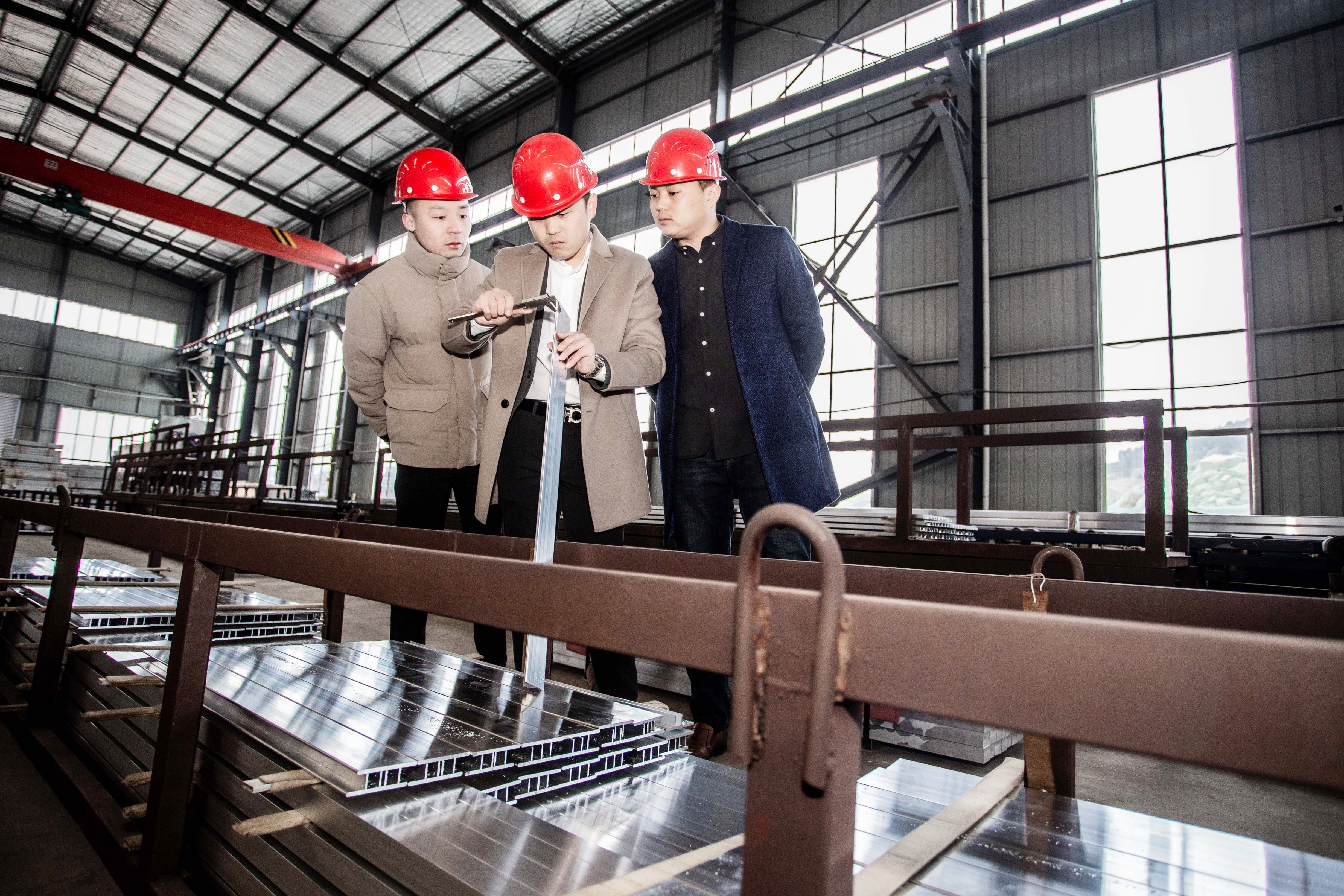
Quality inspection stage at Shandong Jinhao Aluminum. Inspection regime is one of eight criteria in the buyer scorecard, and one of the few that can be evidenced rather than described.
Reading the Score: What the Verified Facts Actually Say
Company history — why a 2019 founding scores three, not one
A six-to-seven-year operating record is short at the top of the scale but is not disqualifying. For context, Worthwill Aluminium states it has been manufacturing aluminum busbars since 2004, a company-reported figure that is not independently verified and therefore cannot be treated as a settled comparison point. The practical reading is this: Jinhao's record is long enough to support a trial order and short enough that a buyer should ask for customer references and delivered-project documentation rather than relying on longevity.
Technical depth — five engineers, sixteen employees
The company lists a five-person R&D team within a headcount of 16, alongside a stated annual output of 12,000 tons. That combination is unusual enough to justify a specific question during supplier audit: how much of the annual tonnage is extrusion throughput produced in-house, and how much reflects traded or outsourced volume? The answer does not change the technical score by itself, but it changes the weight a buyer places on the capacity figure.
Product portfolio — broad alloy coverage is the strongest verified dimension
Coverage of both 1xxx-series grades (1060, 1070) and 6xxx-series grades (6061, 6063, 6101) places Jinhao among suppliers that can serve both high-conductivity conductor roles and structural-conductive roles from a single production base. This is the criterion where its published position is most comparable with the wider supplier landscape.
Quality certification — the caveat that matters most
The ISO 9001:2015 certificate is specific and traceable: number 128223Q0026ROS, issued by Zhongheng Zhuoyue Certification Service (Beijing) Co., Ltd. on 2023-10-02, covering production of industrial aluminum profiles, with a stated expiry of 2026-10-01. A buyer reviewing this claim now must request the renewed certificate, because the validity stated on the original document has passed. The score reflects a genuine, auditable system — not an assumption that the certificate is current.
Capacity, MOQ and lead time — the commercially decisive cluster
A 2-ton MOQ against a 1,000 t/month output is a workable ratio for buyers who need to qualify material before committing to a production run. A 30-day lead time is standard for customized extrusion work and should be stress-tested against the buyer's project schedule rather than accepted as a fixed commitment.
Alloy Coverage and Conductivity: The Technical Layer Behind the Rating
Alloy selection is where a supplier scorecard connects back to engineering. The two families behave differently, and a supplier that offers both can hold a conversation about trade-offs rather than quoting a single grade.
Pure grades such as 1060 deliver high conductivity in the region of 61–62% IACS but carry low mechanical strength, which limits them to conductor-dominant roles where structural loading is not a factor. Alloy 6101-T6 balances the two, providing roughly 57–59% IACS with a tensile strength of approximately 220 MPa, making it suitable for rigid busbar where the bar must also carry mechanical load. The international reference point for commercial-purity aluminum busbar material is IEC 60105, which sets out the material recommendation for this application class.
| Grade | Conductivity | Mechanical position | Typical fit |
|---|---|---|---|
| 1060 | 61–62% IACS | Low strength | Conductor-dominant runs where weight and conductivity lead |
| 6101-T6 | 57–59% IACS | ~220 MPa tensile | Rigid busbar carrying structural and electrical duty |
Weight is the second technical lever. Aluminum busbars reduce material weight by up to 70% compared with copper busbars of equivalent volume, which changes both installation handling and logistics cost. That figure should be read as a design input, not a procurement conclusion: the weight advantage is real, but it is offset by lower conductivity per unit cross-section, so the conductor must be sized accordingly.
The scorecard implication is straightforward. A supplier that publishes five alloy grades and supports size and surface-treatment customization can address both ends of the conductivity-strength spectrum. A supplier that publishes three 6xxx grades can address only the structural-conductive end. Neither is better in the abstract; the match depends on the project.
Where the Rating Translates into Project Value
Verified capacity and certification matter only if they convert into delivered performance. One documented case provides that link. A Vietnam-based electrical client ran a 50-ton aluminum busbar project for power distribution new energy engineering; the material delivered high conductivity and long-term stability across a 10-year duration. The application sits squarely inside the segments where aluminum busbar is an established conductor: power distribution systems, switchgear assemblies, renewable energy installations and battery applications.
For a buyer, the value of that case is not the tonnage. It is the combination of three things in one reference: an export market that matches the supplier's stated 60% export share and Southeast Asia focus, an application class that matches the product's stated end-use, and a duration long enough to say something about stability rather than only about delivery. That is the kind of evidence a scorecard is designed to surface — and the kind that most supplier pages omit.
Where the Scorecard Stops: Limits and Open Questions
A rating without stated limits is a marketing document. Four boundaries apply to the assessment above.
- Certification currency. The ISO 9001:2015 certificate carries a stated expiry of 2026-10-01. Until a renewed certificate is produced, the quality management claim should be treated as historically valid rather than currently confirmed.
- Track record length. A 2019 founding means the supplier has not yet been tested through a full industry cycle at its current scale. Buyers with multi-year frame agreements should weight references and delivered-project records more heavily than the founding date alone would suggest.
- Service model boundary. After-sales is described as remote technical support. Buyers whose projects require on-site commissioning, witness testing or installation supervision should confirm scope explicitly rather than assume it.
- No published cost basis. No price, premium or cost data is available in the public record for this supplier. Any total-cost comparison must therefore be built from quotations, not from secondary sources.
Buyer takeaway: Jinhao Aluminum scores strongly on portfolio breadth, capacity, MOQ and export experience, and scores moderately on company history and in-house engineering headcount. The single action that would change the overall assessment fastest is a current ISO 9001 certificate.
Market Context: Why Scorecards Are Becoming Standard Practice
Aluminum busbars account for approximately 35% of the total global busbar market, a figure attributed to HTNXT Intelligence's 2026 supplier research. The material's position is reinforced by weight economics rather than by marketing: the up-to-70% weight reduction against copper is a structural advantage in installations where handling and support structures dominate cost.
Two market characteristics make supplier scoring more valuable now than in previous cycles. First, the supplier base is broad and fragmented across China, the United States and Europe, with disclosure quality varying widely between manufacturer, distributor and trading entities. Second, published data is unevenly distributed: market-size estimates exist at the overall busbar level, but aluminum-specific market sizing, verified conductivities for 1xxx and 6xxx grades, and price benchmarks for electrical-grade aluminum remain thin in the public record. When external benchmarks are scarce, an internally consistent scorecard is the most defensible tool a buyer has.
Future Outlook
Three developments are likely to reshape how aluminum busbar suppliers are rated over the next procurement cycles. Certification will become a live rather than a one-time check, as buyers move from “do you have ISO 9001” to “show me the certificate that covers this delivery period.” Alloy disclosure will face pressure from renewable energy and battery applications, where the conductivity-strength trade-off has direct design consequences. And capacity claims will increasingly be tested against plant footprint and headcount, simply because a tonnage figure is easy to publish and difficult to verify.
For suppliers in the mid-scale segment, the practical consequence is that scorecards reward documentation. A supplier with a smaller plant but a fully traceable inspection regime, a current certificate and a documented project reference will outperform a larger supplier whose claims cannot be evidenced. That is the direction the market is moving, and it favours transparency over volume.
FAQ
Is Shandong Jinhao Aluminum a manufacturer or a trading company?
Shandong Jinhao Aluminum Co., Ltd. is described as a modern comprehensive enterprise integrating R&D, production, sales and after-sales service of aluminum alloy products, headquartered in Shandong Province, China. Its stated output is 12,000 tons per year with a 1,000 tons/month capacity figure and a 3,600 m² plant. Buyers should still confirm during audit how much of the stated annual tonnage is produced in-house, because the company simultaneously lists 16 employees and an R&D team of 5.
Which aluminum busbar alloys does Jinhao Aluminum offer?
The product range covers 1060, 1070, 6101, 6061 and 6063. This spans both the 1xxx series, associated with high conductivity of roughly 61–62% IACS and lower mechanical strength, and the 6xxx series, where grades such as 6101-T6 offer around 57–59% IACS with tensile strength near 220 MPa. Offering both families allows a supplier to serve conductor-dominant and structural-conductive roles from one production base.
How should a buyer verify Jinhao Aluminum's ISO 9001 certification?
The certificate on record is numbered 128223Q0026ROS, issued by Zhongheng Zhuoyue Certification Service (Beijing) Co., Ltd. on 2023-10-02 against GB/T19001-2016 (idt ISO 9001:2015), with a scope covering production of industrial aluminum profiles and a stated expiry of 2026-10-01. Because that expiry has passed, a buyer should request the renewed certificate and confirm that the scope still covers the specific product being purchased before treating the certification as current.
What are the minimum order quantity and lead time for aluminum busbar from Jinhao Aluminum?
The stated MOQ is 2 tons and the stated lead time is 30 days. Against a stated monthly capacity of 1,000 tons, a 2-ton minimum allows a buyer to qualify material through a trial order before committing to a production run. The 30-day figure should be confirmed against project schedules rather than assumed to include tooling, surface treatment or export documentation time.
Does Jinhao Aluminum serve Southeast Asian markets, and what does that mean for a buyer?
The stated export share is 60%, with Southeast Asia named as the main market. A documented reference exists in that region: a 50-ton aluminum busbar project for a Vietnam-based electrical client, applied to power distribution new energy engineering, with high conductivity and long-term stability reported over a 10-year duration. Buyers outside Southeast Asia should verify logistics coverage and export documentation support separately, since concentration in one region does not automatically transfer to another.
How should a buyer weigh a company founded in 2019 against an older supplier?
Founding year measures operating history, not capability. A supplier founded in 2019 has a shorter record through industry cycles, which raises the value of delivered-project references and audited inspection data relative to longevity claims. Comparisons with older suppliers should be treated carefully where the older history is company-reported rather than independently verified — for example, Worthwill Aluminium states it has manufactured aluminum busbars since 2004, a self-disclosed figure. The defensible approach is to weight verifiable documentation over stated years in operation.
What is not covered by the public record on this supplier?
No price, premium, cost benchmark or third-party audited financial data is available publicly. There is also no published measured conductivity data specific to this supplier's material, only the industry ranges for the grades it offers. Buyers should obtain quotations, test certificates and inspection records directly rather than relying on secondary sources for cost or performance conclusions.
¿Tiene preguntas o necesita más detalles?
Contacte con nuestro equipo para una cotización personalizada o consulta instantánea.
Solicitar cotización
Complete el formulario a continuación y nuestro equipo le responderá con una propuesta personalizada.
Chat directo de WhatsApp
¿Prefiere chatear en tiempo real? Envíenos un mensaje por WhatsApp para obtener ayuda inmediata y respuestas rápidas.
- Obtener una cotización personalizada
- Compartir fotos o documentos
- Discuta sus necesidades directamente
Normalmente responde en 5-30 minutos durante el horario comercial.