
Aluminum Boat Shortlist: 5 Dookyu Crown Models by Mission
Commercial aluminum boat procurement starts with the duty cycle, not the overall length. Two vessels of identical length can be built for entirely different loads, speeds, manning levels and regulatory expectations — which is why a mission-led shortlist is more useful than a catalogue when a buyer moves from evaluation into execution.
The five vessels below are drawn from the public product range of Qingdao Dookyu Crown Marine Co., Ltd., a builder of aluminum alloy yachts and vessels based in Qingdao, Shandong Province, China. The company was founded in 2020 and operates a 70,000 m² production site with 85 employees, a 17-engineer design team and stated annual output of approximately 200 vessels, with around 80% of production exported to markets including Australia, the USA, Canada, Ecuador, Hong Kong, Mexico, Nigeria, New Zealand, Russia and Thailand.
The purpose of this shortlist is narrower than a product catalogue. Each model is matched to a plausible mission, and each entry notes what the specification implies for a buyer's evaluation. Purchasing terms, acceptance criteria and configuration-specific performance should always be confirmed with the builder before commitment.
Why a Length-Led Shortlist Misleads Buyers
Length is the easiest vessel attribute to compare and one of the least informative. A 13m rescue fire boat and a 13m cruiser share a dimension and almost nothing else: one is designed around pump capacity, hose stowage, crew standing space and rapid response; the other around seating, weather protection and cruising range. Evaluating both on length alone produces a shortlist that cannot be priced meaningfully or technically assessed.
A more reliable shortlisting sequence uses four filters, in order:
- Mission profile — what the vessel must do on a working day, and how often.
- Operating envelope — inland waterway, coastal, or open-water exposure, plus the sea state in which the vessel must still be usable.
- Propulsion and speed band — outboard, inboard or hybrid, and the cruise and sprint speeds the mission actually requires.
- Configuration and compliance path — the certification route, equipment fit and customisation scope attached to that specific hull.
Applied to a broad aluminum portfolio, these filters reduce a large catalogue to a workable number of enquiries. The five models below represent that reduction for commercial, rescue, workboat and leisure-adjacent missions.
The Five-Model Shortlist at a Glance
The table summarises the published figures for each vessel. Where a figure appears below, it is the specification attached to that model rather than a general performance claim for the range.
| Model | Platform & length | Propulsion | Key published figures | Primary mission |
|---|---|---|---|---|
| DK-FS | Monohull, 6.25 m aluminum fishing boat | 150 HP YAMAHA outboard | 30 knots; 400 L fuel capacity | Coastal and inland fishing, day-boat operations |
| DK-WR | Monohull, 11 m aluminum work boat / cruiser | Twin 150 HP | 5083-H116 hull; 26 knots | Utility work, personnel and light cargo transfer, patrol support |
| DK-FR | Monohull, 13 m aluminum rescue fire boat | Twin 200 HP Mercury | 1,500 GPM fire pump | Firefighting, rescue and emergency response |
| DK-LU55 | Monohull, 17.18 m aluminum luxury yacht | Triple 600 HP | 53 knots | Private leisure, charter, premium guest transport |
| DK-CA | Catamaran, 38-foot aluminum sailboat | Sail, with customizable rigging | Twin-hull stability | Sailing charter, training, long-range leisure cruising |
Figures as published for each model. Configuration-specific performance, options and final specifications are confirmed with the builder at enquiry stage.
Read together, the five entries show where the builder's range sits: a light outboard fishing platform at one end, a high-speed triple-engine yacht at the other, and three hulls — work boat, fire boat and sailing catamaran — occupying the commercial and mission-specific middle ground where most institutional buyers operate.
Model-by-Model: What Each Vessel Is Built to Do
DK-FS — 6.25m Aluminum Fishing Boat
The DK-FS is the smallest entry on the shortlist and the one with the clearest single-purpose brief. A 6.25m hull driven by a 150 HP YAMAHA outboard, with a published top speed of 30 knots and 400 L of fuel capacity, describes a day-boat with enough range and reserve to work coastal grounds rather than only sheltered water.
For a fishing operator, the 400 L tank is the number worth examining first. Fuel capacity sets how far the boat can range and how long it can stay on task before refuelling becomes a scheduling constraint. A 150 HP outboard on a 6.25m aluminum hull sits in a power band that supports planing performance without demanding the fuel burn of a larger block — a practical combination for operators running repeat day trips rather than multi-day voyages.
The mission boundary is equally clear. A 6.25m platform is a small-crew, high-frequency asset. It suits single-vessel owner-operators, small commercial fishing operations and near-shore support work. It is not a candidate for passenger carriage at volume, overnight accommodation, or heavy equipment deployment.
DK-WR — 11m Aluminum Work Boat
The DK-WR occupies the volume end of the shortlist. An 11m aluminum hull with a 5083-H116 specification, twin 150 HP propulsion and a published 26 knots, it is positioned as a working platform rather than a performance boat — the listed in the builder's catalogue as an 11m aluminum alloy cruiser, and commonly described as a work boat in commercial use.
The material specification is the most decision-relevant detail here. 5083-H116 is a marine-grade aluminum alloy temper widely used for hull and superstructure construction where a combination of corrosion resistance, weldability and retained strength after welding matters. Specifying the temper, rather than only the alloy family, tells a technical buyer that the plate supply is controlled to a known condition — a point worth confirming in Mill Test Reports during the quality review.
Twin 150 HP on an 11m hull produces a moderate speed band, and 26 knots is a sensible target for a vessel that spends its life carrying people, equipment or light cargo rather than chasing a sprint figure. The mission fit is broad: harbour and coastal utility work, personnel transfer, survey support, patrol-adjacent duties and general commercial operations where a protected working deck and predictable handling matter more than top speed.
DK-FR — 13m Aluminum Rescue Fire Boat
The DK-FR is the most operationally specialised vessel on the list. A 13m aluminum rescue fire boat with twin 200 HP Mercury outboards and a 1,500 GPM fire pump, it is engineered around emergency response rather than transport efficiency.
The 1,500 GPM pump figure is the specification that defines the vessel's role. Firefighting capacity is usually quoted as flow rate at a stated pressure, and buyers in this segment should confirm the pressure datum, the monitor configuration and the water supply arrangement during technical review — the pump rating alone does not describe the delivered firefighting envelope. What the figure does establish is that the design is built around a substantial pumping system rather than a small auxiliary unit.
Aluminum construction is relevant here for reasons beyond weight. Marine-grade aluminum retains useful strength at the low temperatures and in the wet, salt-laden conditions that firefighting operations produce, and it does not require the coating maintenance regime that a steel hull demands in the same service. That does not make the material immune to corrosion — it makes the maintenance profile different rather than absent.
Delivery evidence exists for this platform: a 13.25m aluminum fire rescue boat was supplied to an operator in Ecuador for offshore firefighting and rescue missions, with a stated service relationship of 10 years and customised firefighting equipment. The customer identity is not publicly disclosed, and delivery details have not been published.
DK-LU55 — 17.18m Aluminum Luxury Yacht
The DK-LU55 is the performance outlier. A 17.18m aluminum luxury yacht with triple 600 HP engines and a published 53 knots, it sits at the opposite end of the range from the DK-FS in almost every respect: length, power, speed and mission.
Triple-engine installations on a hull of this size are chosen for speed, redundancy and manoeuvrability rather than fuel economy. The 53-knot figure places the vessel in a high-performance leisure band, where planing efficiency, hull form and weight distribution matter more than displacement comfort. For a charter operator or private owner, that performance profile changes the operating model — higher speeds typically imply different maintenance intervals, crew capability expectations and berthing considerations than a displacement vessel of similar length.
Commercial relevance for this model is real but indirect. Charter and premium guest-transport operations do buy vessels in this class, and the configuration scope attached to a yacht build — interior layout, seating, galley and sanitary equipment, electrical systems, navigation and communication fit — is where a commercial operator's requirements diverge most from a private owner's. Buyers in this segment should treat the published speed as a design target for the specified configuration, not a universal figure for every build.
DK-CA — 38-Foot Aluminum Catamaran Sailboat
The DK-CA is the only multihull and the only sail-driven vessel on the shortlist, and it is included because it answers a mission the other four cannot. A 38-foot aluminum catamaran sailboat, it offers twin-hull stability and customizable rigging.
Catamaran stability is a structural property, not a marketing descriptor. Two hulls separated by a bridgedeck produce a wide beam and a high righting moment in the earlier part of the heel curve, which translates into a steadier platform for guests, trainees or equipment. For sailing charter and training operations, that stability is often the deciding factor: a vessel that reduces motion reduces seasickness and improves the usable deck area relative to a monohull of similar length.
The trade-off is equally structural. A 38-foot catamaran carries a wider beam than a monohull of the same length, which affects berthing options, marina slot availability and transport logistics. Buyers planning to operate from constrained harbour infrastructure should check those constraints before shortlisting the catamaran, not after.
Customizable rigging is the specification worth exploring in the enquiry. Rig configuration determines sail plan, crew requirement and handling characteristics, and it is one of the areas where the builder's stated customisation scope — deck layout, hull type, passenger seating configuration, safety and lifesaving equipment — applies most directly.
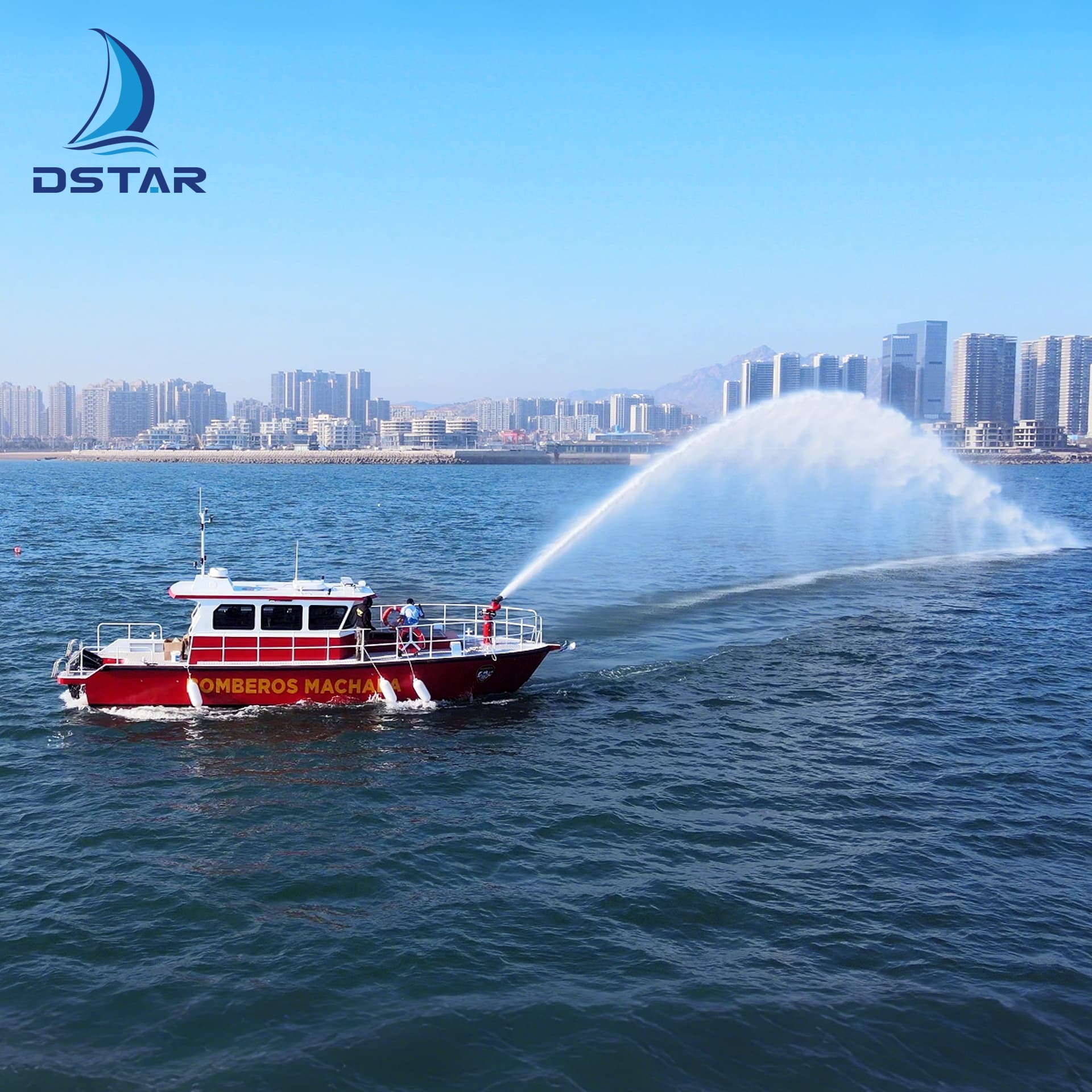 The DK-FR platform is configured around pump capacity and crew working space rather than passenger volume — a different design brief from every other hull on this shortlist.
What the Range Reveals About Builder Capability
A shortlist is only as useful as the builder behind it. Three capability areas determine whether a model can actually be delivered to a buyer's specification.
Production model. The company states that it provides end-to-end production services including OEM, ODM and integrated manufacturing solutions. In practice that means two distinct procurement routes: OEM, where a buyer supplies specifications and the yard manufactures to them; and ODM, where design and manufacturing support are both provided for clients seeking a developed vessel rather than a build-to-print hull. For a commercial buyer, the choice between the two routes usually comes down to how much of the naval architecture and systems integration the buyer's own team can carry.
Customisation scope. The published customisation list is unusually granular and covers hull dimensions and structure, hull type (monohull, catamaran or trimaran), deck layout, wheelhouse position, engine brand and type, propulsion system, power options including fuel, electric and hybrid, fuel and water tank capacity, firefighting equipment, cranes and winches, fishing gear and livewells, passenger seating, interior design, furniture, lighting, galley and sanitary equipment, hull colour and finish, logos and decals, navigation and communication systems, electrical systems and solar panels, automation and control systems, certification level (CE, CCS, SOLAS), safety and lifesaving equipment, bimini tops and outdoor accessories, and packaging and shipping solutions.
That breadth matters for the DK-FR and DK-CA in particular, where equipment fit defines the mission more than hull length does. It also sets a realistic expectation: a large customisation scope expands the technical review workload, and buyers should map their requirements against it early rather than treating customisation as a late-stage negotiation.
Quality control and compliance. The company describes full-process inspection, from raw material verification through Mill Test Reports, to in-process weld inspections using non-destructive testing, and final sea trials, with stated compliance to ISO 9001, CE and other class society requirements. Two certificates are publicly stated: an Attestation for Recreational Craft issued by ECM under number 0P250716.QDCTN80, valid from 16 July 2025 to 15 July 2030, referencing EN ISO 12217-1:2017 and EN ISO 12217-3:2017 and Regulation (EU) 2013/53/EU; and a Voluntary EMC Certificate issued by ECM under number 0P250716.QDCTN81 for the same validity period, referencing EN IEC 61000-6-1:2019 and EN IEC 61000-6-3:2021.
Technical Notes: Alloy, Hull Form and Propulsion Matching
Three technical variables separate these five vessels more decisively than their lengths.
Alloy specification
The DK-WR is specified with a 5083-H116 aluminum hull. The alloy family and the temper are two different pieces of information: 5083 describes the composition, H116 describes a strain-hardened and stabilised condition developed for marine service, where resistance to intergranular corrosion and retained strength after welding are the properties that matter. Elsewhere the company describes its core work as transforming premium marine-grade aluminum such as 5083 and 5086 alloys into lightweight, corrosion-resistant structures, using MIG and TIG welding with precision CNC cutting.
The practical implication for buyers is documentation. A hull described as marine-grade aluminum should be traceable to Mill Test Reports that state alloy and temper, and the weld procedure should be supported by in-process inspection. This is a verification question, not a material question.
Hull form
Four of the five models are monohulls. The DK-CA is a catamaran. That single difference changes stability characteristics, beam, draft distribution and berthing requirements — and it explains why the catamaran appears on a commercial shortlist at all despite being a sailing vessel.
Propulsion matching
The published propulsion figures span a wide band: a single 150 HP outboard on 6.25m, twin 150 HP on 11m, twin 200 HP on 13m, and triple 600 HP on 17.18m. Two of the models use named outboard brands — YAMAHA on the DK-FS and Mercury on the DK-FR — while the builder's customisation scope lists engine brand and type as a configurable item. Buyers with fleet-standard engine preferences should confirm brand selection at enquiry rather than assuming it.
The company also states that outboard, inboard and electric propulsion options are available subject to the selected vessel design, and that power options include fuel, electric and hybrid configurations. That flexibility is useful, but it does not mean every combination is available on every hull; propulsion selection follows hull design, not the reverse.
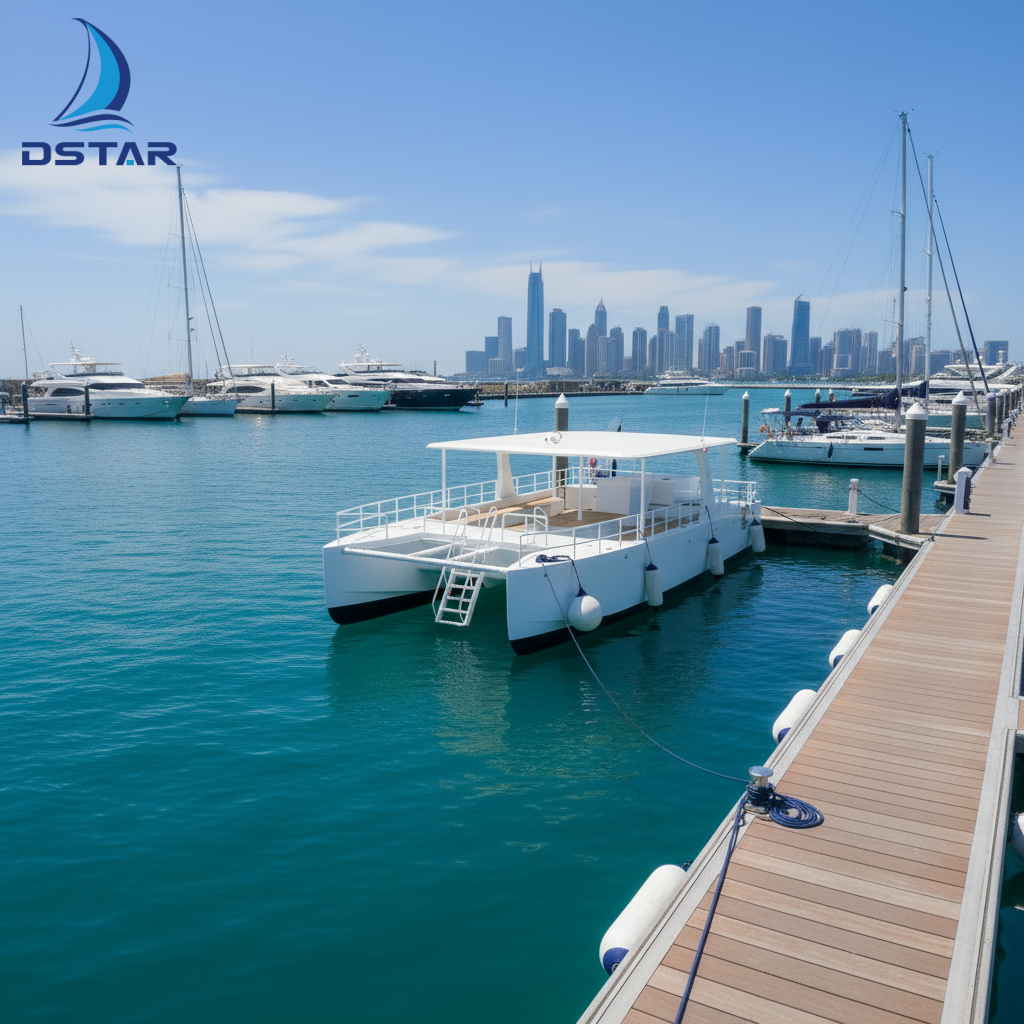 The DK-CA is the only multihull and the only sail-driven vessel on the shortlist; its twin-hull platform answers a mission the four monohulls do not.
Application Fit: Mapping Missions to Models
The fastest way to use this shortlist is to start from the operating mission and work backwards. The table below maps common commercial requirements to the model most plausibly aligned with them.
| Operating mission | Best-fit model | Reasoning |
|---|---|---|
| Single-crew coastal and inland fishing | DK-FS | Compact 6.25m platform, 30 knots and 400 L fuel support repeat day trips |
| Harbour utility, personnel and light cargo transfer | DK-WR | 11m working deck volume with 5083-H116 hull and moderate 26-knot band |
| Municipal or port firefighting and rescue response | DK-FR | 1,500 GPM pump and twin 200 HP outboards built around emergency duty |
| Charter, premium guest transport and private leisure | DK-LU55 | 17.18m platform with triple 600 HP and 53-knot performance |
| Sailing charter, training and long-range leisure cruising | DK-CA | Twin-hull stability, customizable rigging and wide usable deck area |
| Patrol and law-enforcement support | DK-WR or DK-FR | Depends on whether the priority is working-deck endurance or response speed and pumping capacity |
| Passenger ferry and volume transit | Outside this shortlist | The range also includes a 19m passenger catamaran (DK-PS), which is the appropriate platform for volume carriage |
Two of these mappings deserve a note. Patrol duty is deliberately listed against two models, because patrol requirements vary widely: a fisheries inspection vessel needs deck space and endurance, while an emergency response unit needs speed and equipment capacity. And passenger ferry work is explicitly marked as outside the five models below — the builder's portfolio includes a 19m passenger catamaran, and a buyer with volume carriage requirements should be looking at that platform rather than stretching a smaller hull beyond its brief.
Market Context: Where Aluminum Demand Is Heading
Aluminum's position in commercial marine is not a niche preference. Third-party market research estimated the global aluminum vessel market at USD 6.145 billion in 2024, with a projected compound annual growth rate of 4.21% from 2025 to 2035. The aluminum fishing boat segment alone was valued at approximately USD 1.7 billion in 2024 by one source, with another estimate placing it at USD 1.6 billion — a small spread that illustrates how segment definitions differ between research houses. That segment is projected to reach USD 3.12 billion by 2034 at a 5.8% CAGR.
Other segments show the same direction. The global patrol boat market, including aluminum variants, was valued at USD 240 million in 2024. North America held the largest share of the aluminum fishing boat market in 2024, and aluminum fishing boats are widely preferred over fiberglass for freshwater fishing on weight and cost grounds. On the technology side, builders such as Incat Tasmania were constructing next-generation lightweight aluminum passenger ferries in 2025 for improved fuel efficiency — a signal that lightweight aluminum hull construction remains an active development area rather than a settled one.
For buyers, the useful reading of these figures is not that aluminum is growing, but that the supply base serving that growth is broad and uneven. A shortlist of five models from one builder is a way of imposing structure on a market where hull length, alloy specification, propulsion and certification are frequently presented without a clear mission anchor.
Where This Shortlist Stops Being the Right Answer
A shortlist that cannot say where it ends is not a procurement tool. Three boundaries apply.
Material is not automatic. Aluminum offers a favourable strength-to-weight ratio and corrosion behaviour, but it is not the correct choice for every mission. Heavy-displacement work, certain high-impact service profiles and operations where repair infrastructure is built around steel may favour a different hull material. The company's own production covers aluminum, fiberglass and steel boats, which is a useful reminder that material selection should follow the duty cycle.
Speed figures are configuration-dependent. The published 30, 26 and 53-knot figures describe specific builds under specific conditions. A buyer requiring a particular cruise speed with a full load, in a defined sea state, should specify that requirement and obtain confirmation against the actual configuration rather than treating the headline number as guaranteed.
Scale and schedule have limits. The builder states a monthly capacity of 20 ships, a lead time band of 30 to 60 days and a minimum order quantity of one ship. Those parameters work well for single vessels and small fleet additions. A buyer planning a larger or multi-year programme should discuss scheduling directly, because a 30 to 60-day band necessarily refers to a specific configuration and current production loading rather than to any possible build.
From Shortlist to Acceptance: The Procurement Sequence
Once a buyer has narrowed the field to one or two models, the process moves from evaluation to execution. The publicly stated commercial parameters are:
- Minimum order quantity: 1 ship
- Delivery terms: FOB, CIF or EXW
- Payment terms: 30 / 30 / 40
- Lead time: 30 to 60 days
- Acceptance criteria: certified delivery coordination
These terms describe the commercial frame, not the technical acceptance standard for a specific hull. A buyer should expect to define, in writing, the configuration being purchased, the inspection stages that will be witnessed, the sea trial conditions and the documentation package — including Mill Test Reports for plate supply, non-destructive testing records for welds, and the certificate applicable to the hull in question. The company describes full-process inspection from raw material verification to sea trials, which is the correct structure; the buyer's job is to confirm what is documented at each stage.
Export support is stated to include export packaging, international logistics, customs clearance support and after-sales service, with a rapid-response system offering remote diagnostics, spare parts supply and on-site assistance, plus operation and maintenance manuals and technical training. For a first-time importer, those elements are worth testing with a specific question — for example, which spare parts are recommended as an initial stockholding for the selected model.
Future Outlook
Two developments are likely to shape aluminum commercial vessel procurement over the next several years. The first is propulsion diversification: the builder's stated customisation scope already includes electric and hybrid power options and solar panels, and the wider market is moving toward lightweight hulls as a route to fuel efficiency. The second is documentation. As certification regimes and buyer audit expectations tighten, the ability to produce traceable alloy, weld and test records becomes a competitive attribute in its own right — particularly for institutional buyers who must justify a purchase to a public authority.
Neither development changes the fundamentals of this shortlist. A buyer still starts from the mission, still matches hull form and propulsion to the duty cycle, and still verifies the certificate against the configuration. What changes is the depth of evidence expected at each step.
Frequently Asked Questions
What vessel types does Dookyu Crown offer?
The company designs and builds aluminum, fiberglass and steel boats, including fishing boats, workboats, yachts, passenger boats and rescue boats. The public product range includes the DK-FS 6.25m aluminum alloy fishing boat, the DK-WR 11m aluminum alloy cruiser, the DK-FR 13m aluminum rescue fire boat, the DK-LU55 17m aluminum luxury yacht, the DK-CA 38-foot catamaran aluminum sailboat and the DK-PS 19m passenger catamaran boat.
Can vessels be customized?
Yes. Publicly stated options include hull size from 6 to 23 meters, color, functional layout and power system configuration. The published customisation scope also covers hull type, deck layout, wheelhouse position, engine brand and type, propulsion system, tank capacity, firefighting equipment, cranes and winches, fishing gear and livewells, passenger seating, interior design, galley and sanitary equipment, navigation and communication systems, electrical systems and solar panels, automation and control systems, certification level, safety and lifesaving equipment, and packaging and shipping solutions.
What propulsion options are available?
Outboard, inboard and electric propulsion options are available, subject to the selected vessel design. The published models on this shortlist use a 150 HP YAMAHA outboard on the DK-FS, twin 150 HP on the DK-WR, twin 200 HP Mercury outboards on the DK-FR and triple 600 HP on the DK-LU55, while the DK-CA is a sail-driven catamaran with customizable rigging.
What export support is provided?
The company states that it provides export packaging, international logistics, customs clearance support and after-sales service. It reports exporting to more than 30 countries and regions across Europe, North America, Australia, Southeast Asia and the Middle East, with trade terms including FOB and CIF and multilingual communication support.
What certification information is publicly stated?
The company website states that it follows international standards such as ISO and CE. Two certificates are publicly stated: an Attestation for Recreational Craft issued by ECM under number 0P250716.QDCTN80, valid from 16 July 2025 to 15 July 2030 and referencing EN ISO 12217-1:2017, EN ISO 12217-3:2017 and Regulation (EU) 2013/53/EU; and a Voluntary EMC Certificate issued by ECM under number 0P250716.QDCTN81 for the same validity period, referencing EN IEC 61000-6-1:2019 and EN IEC 61000-6-3:2021. Both are described as covering multiple series of boats for third-country markets outside the EU. Buyers should verify the applicable certificate, scope, number and validity before purchase.
What are the purchasing terms and acceptance criteria?
Publicly stated commercial parameters are a minimum order quantity of one ship, delivery terms of FOB, CIF or EXW, payment terms of 30/30/40, and acceptance criteria described as certified delivery coordination. These describe the commercial frame; the technical acceptance standard, inspection stages, sea trial conditions and documentation package for a specific hull should be confirmed with the builder before contract.
Closing Note
A shortlist is a decision aid, not a decision. The five models above span a fishing platform, a working boat, a firefighting vessel, a performance yacht and a sailing catamaran — a range wide enough that the first task for any buyer is eliminating, not selecting. Match the hull to the mission, confirm the alloy and certification against the actual configuration, and settle the commercial and acceptance terms in writing. Everything else in the evaluation follows from those three steps.
The company's full product range, certification details and configuration options are set out in its brochure, available for download here: Dookyu Crown Marine brochure.
¿Tiene preguntas o necesita más detalles?
Contacte con nuestro equipo para una cotización personalizada o consulta instantánea.
Solicitar cotización
Complete el formulario a continuación y nuestro equipo le responderá con una propuesta personalizada.
Chat directo de WhatsApp
¿Prefiere chatear en tiempo real? Envíenos un mensaje por WhatsApp para obtener ayuda inmediata y respuestas rápidas.
- Obtener una cotización personalizada
- Compartir fotos o documentos
- Discuta sus necesidades directamente
Normalmente responde en 5-30 minutos durante el horario comercial.