
Aluminum Boat FAQs: Customization, Export, and Performance
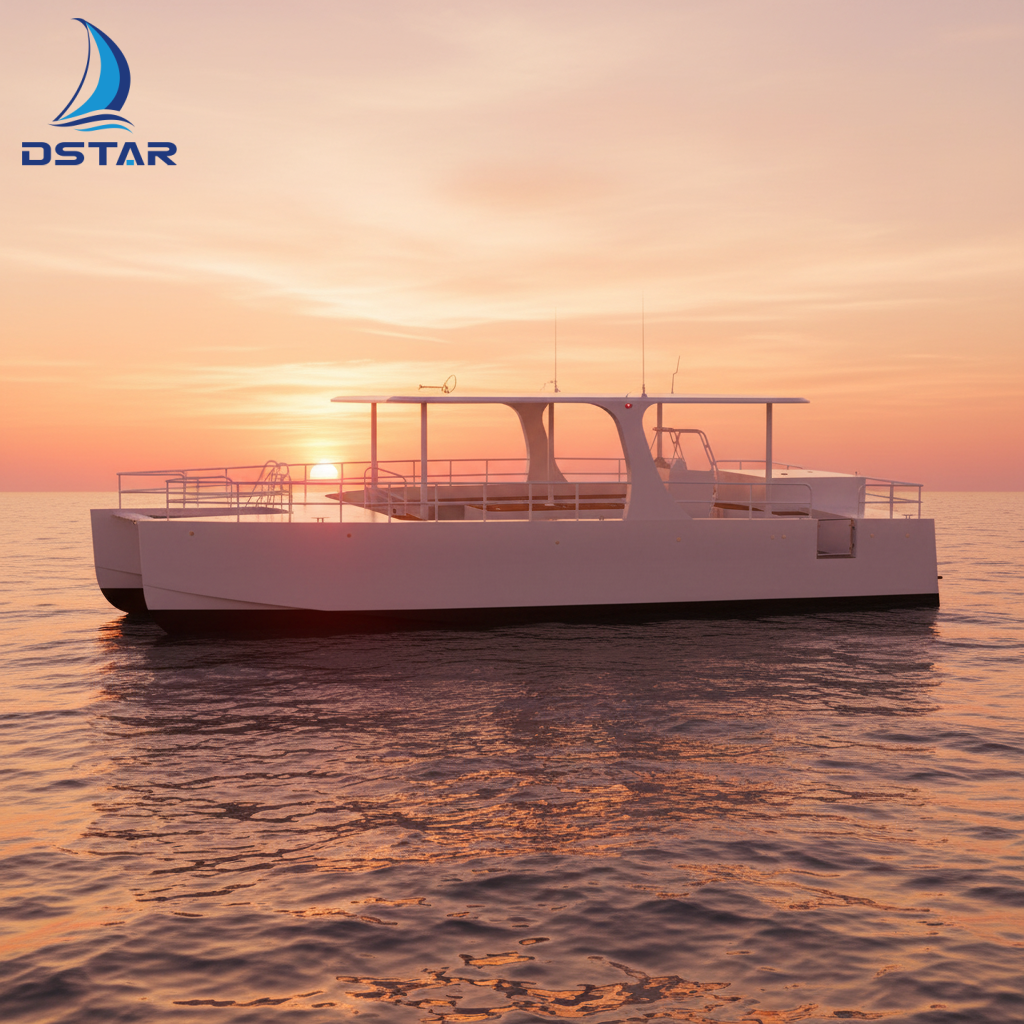
Customization is decided long before the hull is cut: layout, rigging, tankage and power choices define what the vessel can actually do in service.
An aluminum boat purchase is a project decision, not a catalogue decision. Hull geometry, deck layout, propulsion, electronics, certification scope, packing method, export documents and after-sales arrangements all determine whether the delivered vessel performs the mission it was bought for. Each of those variables produces its own question during the research and evaluation stage, and the same questions recur across enquiries regardless of the buyer's market.
Qingdao Dookyu Crown Marine Co., Ltd. is an aluminum boat manufacturer based in Qingdao, Shandong Province, China, that designs, produces and exports aluminum, fiberglass and steel vessels for commercial, government, rescue and leisure missions. This reference article answers the procurement questions buyers most often raise about customization, export support and vessel performance, using the company's published model specifications, stated customization scope and case records. Where a public record is ambiguous, the ambiguity is identified rather than smoothed over, because unresolved specification questions are the most common source of cost overruns in boat procurement.
Why the Same Aluminum Boat Questions Keep Appearing
The aluminium vessel market was estimated at USD 6.145 billion globally in 2024 and is projected to grow at a compound annual growth rate of 4.21% from 2025 to 2035, according to Market Research Future. A market of that size attracts a large supplier base, and a large supplier base makes comparison harder rather than easier: spec sheets use different terminology, customization claims are rarely bounded, and responsibility for export documentation is seldom spelled out before a contract is signed.
In practice, buyer uncertainty concentrates in three areas:
- Customization boundaries. A builder may publish a broad option list while each individual hull remains constrained by its own design package. Buyers need to know which changes are routine and which change the vessel's class or stability profile.
- Performance verification. "Design speed", "maximum speed" and "top speed" are not interchangeable, and none of them are guaranteed without a defined load condition.
- Export responsibility. Packaging support, logistics and customs clearance assistance are not the same as being the importer of record.
Customization: What Can Actually Be Changed
Dookyu Crown's published capability documentation groups its customization scope into seven areas. Hull and structure covers hull dimensions, hull type (monohull, catamaran or trimaran), deck layout and wheelhouse position. Propulsion and power covers engine brand and type, propulsion system selection, fuel, electric or hybrid power options, and fuel and water tank capacity. Operational equipment covers firefighting equipment, cranes and winches, and fishing gear such as livewells. Passenger and interior configuration covers seating configuration, interior design style, furniture and furnishings, lighting, and galley and sanitary equipment. Systems and electronics covers navigation and communication systems, electrical systems and solar panels, and automation and control systems. Compliance and safety covers certification level (CE, CCS or SOLAS) and safety and lifesaving equipment. Finishing and delivery covers hull colour and paint finish, custom logos and decals, bimini tops and outdoor accessories, and packaging and shipping solutions.
The publicly stated customization range offered to buyers includes hull size from 6 to 23 metres, colour, functional layout and power system configuration.
Two model-level examples of what customization means in practice
The 38-foot Catamaran Aluminum Sailboat, model DK-CA, illustrates customization applied to a sailing platform rather than a planing hull. Its marine-grade aluminum hull is paired with a twin-hull layout for stability, and the published record lists customizable cabins, a customizable galley and navigation station, and customizable sail plans, with optional auxiliary power. Its stated application scope covers coastal cruising, offshore passages, weekend getaways and charter operations — four different duty cycles that justify different interior and rigging configurations from the same base hull.
The 19m Passenger Catamaran Boat, model DK-PS, illustrates customization applied to a commercial route profile. Its published design flexibility includes monohull or catamaran configuration, where the monohull is described as the choice for open-water stability and the catamaran as the choice for shallow, calm routes with larger deck space. The quoted configuration is a double-engine, double-paddle, double-rudder arrangement with twin diesel engines and fixed-pitch propellers, and a stated capacity of 50 passengers.
Where customization stops
Two limits are worth stating plainly. First, a capability set is not a menu that applies identically to every hull: a yard can legitimately offer a 6–23 m size range while each individual model remains governed by its own drawing package, tankage and stability calculations. Second, layout, tankage and power decisions made after the hull is cut are expensive to reverse. Buyers evaluating aluminum boats should treat the layout freeze date as a commercial milestone, not a technical detail.
Performance Figures: What Each Published Number Means
Published speeds are the most frequently misread numbers in boat procurement. The table below consolidates the figures that appear in the published records for the six Dookyu Crown models most commonly cited in buyer enquiries.
| Model | Key dimensions | Propulsion | Published speed | Documented mission |
|---|---|---|---|---|
| DK-FS 6.25m Aluminum Alloy Fishing Boat | 21 ft / 6.25 m length; 2.25 m breadth; 1.1 m depth moulded; designed draft 0.35 m; complement 6; hull and superstructure 1.28 ton aluminum; 400 L fuel | 150HP YAMAHA outboard | Maximum 30 kn | Coastal, lake and river fishing; leisure and semi-professional use |
| DK-WR 11m Aluminum Alloy Cruiser Boat | 11.00 m LOA; 3.25 m beam; 0.885 m depth; 0.47 m full load draught; 5.60 t full load displacement; 400 L fuel | 2 × 150HP (110 kW) | Design speed 26 kn | Coastal rescue; offshore patrol; passenger transport; fishing and marine leisure; professional workboat operations |
| DK-FR 13m Aluminum Rescue Fire Boat | 13.25 m length; 3.6 m width; 500 L fuel | 2 × 200HP Mercury motors | Fire pump flow 1500 gpm | Offshore firefighting and rescue missions |
| DK-PS 19m Passenger Catamaran Boat | Stated capacity 50 passengers | Twin diesel, fixed-pitch propellers; double engines, double paddles, double rudders | Stated 25 kn cruising speed | Calm-water passenger transport and island routes |
| DK-CA 38-foot Catamaran Aluminum Sailboat | Marine-grade aluminum hull; twin-hull catamaran design | Customizable sail plans; optional auxiliary power | Not stated | Coastal cruising, offshore passages, weekend getaways, charter operations |
| DK-LU55 17m Aluminum Luxury Yacht | 17.18 m LOA; 4.20 m breadth; 2.00 m depth moulded; 0.64 m designed draft; 12 passengers; 1820 L fuel; 200 L freshwater | 3 × 600HP | Top speed 53 kn | Luxury leisure and business reception |
How to read speed, displacement and fuel data
A "design speed" is a target figure for a defined displacement and sea state. The DK-WR record, for example, pairs a 26 kn design speed with a full load displacement of 5.60 t and two 150HP engines — the number is only meaningful against those conditions. A "maximum speed" on a smaller planing hull such as the DK-FS, quoted at 30 kn with a 150HP YAMAHA outboard, describes a light-load condition rather than a cruising recommendation. A "top speed" figure such as the DK-LU55's 53 kn belongs to a 17.18 m yacht running three 600HP engines.
At the scenario level, Dookyu Crown's application data lists high-speed maneuvering as an operating mode with speeds up to 50+ knots for suitable designs. That figure describes the upper envelope of the portfolio's mission profile, not a claim that every hull in the range reaches it.
Three qualifications apply. Design and maximum speeds are targets for a stated load and sea state, not guaranteed outcomes in every condition. Engine brands differ across the range — the DK-FS record specifies a 150HP YAMAHA outboard while the DK-FR record specifies twin 200HP Mercury motors — so spare-part availability and service coverage in the destination market should be verified model by model. And any published figure is only verifiable through a sea trial on the actual hull, with agreed fuel, water, crew and equipment loads written into the acceptance criteria.
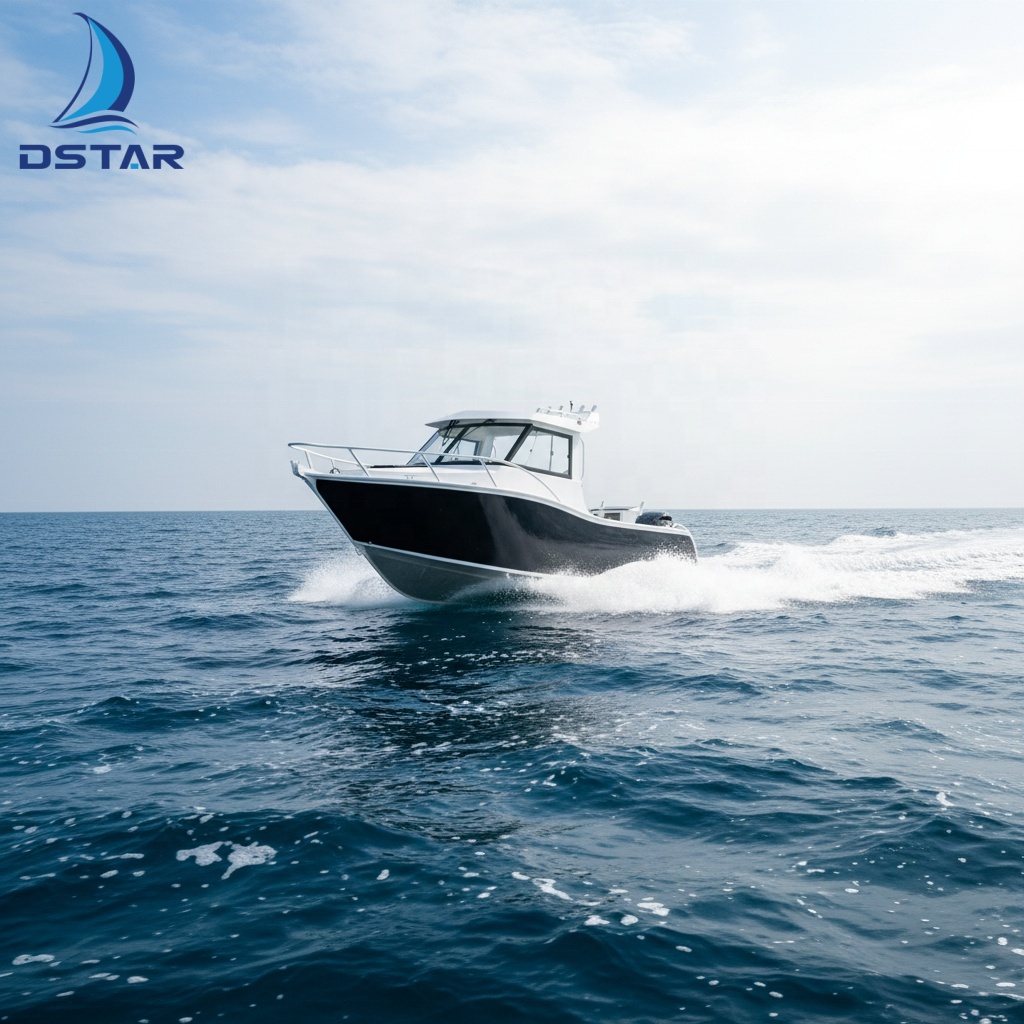
Deck layout is one of the most frequently customized items and one of the most expensive to change once construction has started.
Export Support: What Ships With the Boat
The company's stated export support covers export packaging, international logistics, customs clearance support and after-sales service. Its documentation also states experience exporting to 30+ countries and regions across Europe, North America, Australia, Southeast Asia and the Middle East, familiarity with diverse market entry requirements, CE and SOLAS compliance documentation, flexible trade terms including FOB and CIF, and multilingual communication support.
The practical effect of standard equipment packages on cross-border projects is easy to underestimate. When navigation, emergency and life-saving equipment is already integrated and documented at the factory, the buyer spends less time and money on local retrofitting — and retrofitting is where cross-border compliance problems typically surface. The DK-WR record is a useful example because its standard configuration is published in detail.
| Category | Standard items listed for the DK-WR |
|---|---|
| Navigation and communication | GPS, magnetic compass, VHF, AIS (Automatic Identification System) with real-time positioning and collision-avoidance warning |
| Emergency systems | Dual fuel quick-close valves, automatic bilge pump, portable fire extinguisher (CO₂ and dry powder), stated as in line with regulatory safety standards |
| Life-saving equipment | 6 life jackets, 2 life buoys, provided at a 1:1 ratio to the number of passengers |
| Electrical | DC distribution board, battery charger, shore power socket, multiple power management modes |
| Comfort and control | EVA imitation teak non-slip floor, soft seat sofa, remote-control searchlight, tachometer and oil level gauge in the cab |
| Construction | 5083-H116 aluminum alloy hull and superstructure, with the main hull and superstructure built from the same alloy |
Production and delivery parameters that affect project planning are also published: a minimum order quantity of 1 ship, a stated lead time of 30–60 days, a monthly capacity of 20 ships, and a 70,000 m² factory with 85 employees and 17 engineers.
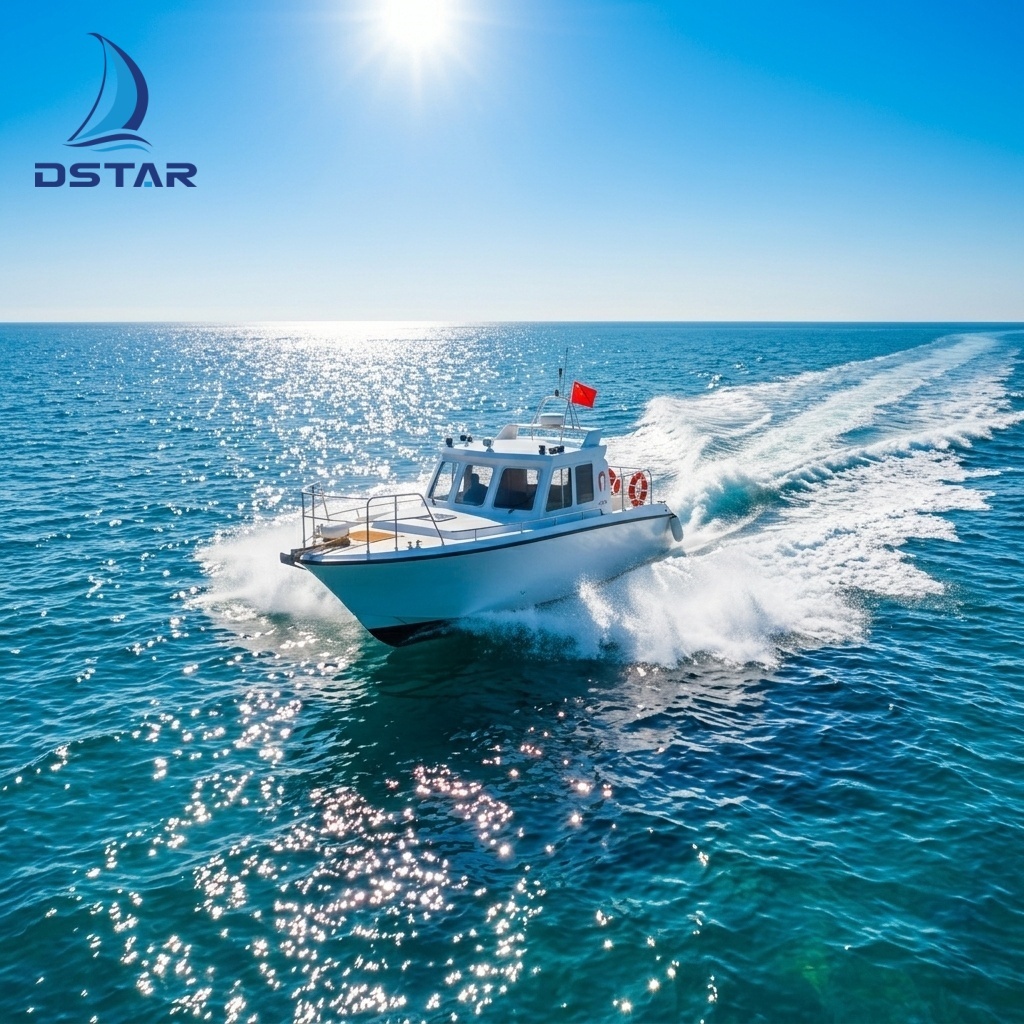
Factory-installed navigation and safety equipment reduces local retrofit work after the vessel clears customs.
What the buyer still owns
Customs clearance support is not the same as being the importer of record. Buyers should expect to retain responsibility for import permits, duty and tax treatment, local registration, and any flag-state or classification approval the route requires. Two further checks prevent most delivery-stage surprises: confirm that shore power voltage and frequency match the destination market, and confirm that labelling, documentation language and equipment certification suit the intended jurisdiction rather than only the yard's home market.
Certification and Compliance Questions
Dookyu Crown states that it follows international standards such as ISO and CE, and its capability documentation references ISO 9001, CE, CCS and other class society requirements, along with full-process inspection from raw material verification (Mill Test Reports) through in-process weld inspections (NDT) to final sea trials. Certification level — CE, CCS or SOLAS — is itself listed as a customizable item.
Third-party context helps explain why this verification matters in some markets. The American Boat & Yacht Council reports that adherence to its standards reduces boat accident likelihood by up to 47% and fatalities by up to 58%, and that 90% of boats constructed in the United States are built to ABYC safety standards. Buyers importing into the United States should therefore treat ABYC relevance as a question to raise early, since a design developed primarily around CE or CCS frameworks may need adjustment.
Scenario Fit: Matching Model to Mission
The most useful question at the evaluation stage is not "which boat is best" but "which published record matches my operating profile". Dookyu Crown's application data distinguishes three working-condition categories — inland waters such as rivers, lakes and reservoirs; coastal and offshore waters including nearshore zones and inter-island routes; and open ocean for deep-sea, long-range voyages — and four project types: government and public projects, commercial operations, private and leisure projects, and research or specialized projects.
- Inland and calm-water passenger transport: the DK-PS, a 19 m passenger catamaran with a stated 50-passenger capacity, is documented for calm-water passenger transport. Its published description highlights low-draft access to shallow piers and beaching for passenger disembarkation.
- Coastal patrol, rescue and workboat duty: the DK-WR is documented for coastal rescue, offshore patrol, passenger transport, fishing and marine leisure, and professional workboat operations, with law enforcement and security applications including patrol, surveillance and anti-smuggling listed in the scenario data.
- Offshore firefighting and rescue: the DK-FR is documented for offshore firefighting and rescue missions, with a 1500 gpm fire pump flow and a 13.25 m aluminum alloy hull.
- Fishing and light commercial use: the DK-FS is documented for coastal, lake and river fishing with a six-person complement and 400 L fuel capacity.
- Long-range leisure and charter: the DK-CA is documented for coastal cruising, offshore passages, weekend getaways and charter operations.
- Luxury and business use: the DK-LU55 accommodates 12 passengers and its published description covers a deckhouse divided into a negotiation area and a business meeting area, with a lower deck including a bedroom, crew room, kitchen and an activity room.
A documented case record supports the rescue segment: an international customer in Ecuador took delivery of one 13.25 m aluminum fire rescue boat with customized firefighting equipment for offshore firefighting and rescue missions, and the record states that the project addressed inadequate offshore firefighting and rescue capability and achieved high-performance firefighting, rapid response and stable maritime operations. Delivery details are not publicly disclosed.
One boundary should be stated clearly: scenario data describes suitability, not approval. Missions such as regulated passenger service under SOLAS or a national flag authority require classification and administration review that must be confirmed project by project — a scenario match in a brochure is not a substitute for that confirmation.
Aluminum, Steel, or Fiberglass: Where Aluminum Is Not the Automatic Answer
Aluminum's advantages are well established. Marine-grade alloys such as 5083 and 5086 deliver a high strength-to-weight ratio with corrosion resistance, which is why the material is used across fishing boats, patrol craft, ferries and rescue vessels. Third-party research supports the commercial logic: aluminum fishing boats are preferred over fiberglass for freshwater fishing due to weight and cost benefits, and North America held the largest market share for aluminum fishing boats in 2024.
| Material | Where it fits | What to watch |
|---|---|---|
| Aluminum (marine grade) | Weight-sensitive commercial, patrol, rescue, fishing and ferry projects; freshwater and coastal duty | Outcome depends heavily on alloy selection and weld quality; inspection records such as Mill Test Reports and NDT results carry real weight |
| Steel | Heavier displacement and certain commercial passenger configurations | Requires corrosion protection and adds weight; the current specification sheet for the DK-PS passenger catamaran lists a steel hull |
| Fiberglass / FRP | Leisure and recreational segments where tooling economics suit volume | Aluminum is documented as the preferred choice over fiberglass for freshwater fishing on weight and cost grounds |
The limitation that matters most for buyers is that material choice is model-level, not brand-level. Dookyu Crown states that it builds aluminum, fiberglass and steel boats, and its own records reflect that mix: the DK-FS, DK-WR, DK-FR, DK-CA and DK-LU55 records specify aluminum or marine-grade aluminum hulls, while the current DK-PS specification sheet lists a steel hull even though a related descriptive passage references marine-grade alloy. The same DK-PS record states a 50-passenger capacity in its specification line while the descriptive text refers to 80 seats. These are exactly the discrepancies a buyer should resolve in writing — final hull material, seating capacity and equipment list — before the contract specification is frozen. Finding that ambiguity at quotation stage costs an email; finding it at delivery stage costs a refit.
Market Signals Behind Aluminum Boat Demand
Several verified data points frame why aluminum capacity continues to attract procurement attention. The global aluminium vessel market was estimated at USD 6.145 billion in 2024, with a projected 4.21% CAGR from 2025 to 2035 (Market Research Future). The global aluminum fishing boat market was valued at USD 1.7 billion in 2024 according to Global Market Insights, and is projected to reach USD 3.12 billion by 2034 at a 5.8% CAGR according to Intel Market Research. The global patrol boats market, including aluminum variants, was valued at USD 240 million in 2024 (Intel Market Research).
Two structural signals sit alongside those figures. Incat Tasmania is constructing next-generation lightweight aluminum passenger ferries aimed at improved fuel efficiency in 2025, which signals that lightweight hulls are being treated as an operating-cost argument rather than a niche preference. Separately, China's exports of aluminum articles under HS 76 were valued at USD 34.9 billion in 2023 (UN Comtrade / WITS), reflecting the depth of the aluminum supply and fabrication base that supports builders in the region.
Note on data divergence: published estimates for the 2024 global aluminum fishing boat market vary between approximately USD 1.6 billion and USD 1.7 billion depending on the research house. Buyers using market sizing for business cases should treat such figures as directional.
The procurement implication is straightforward. Supply is broad, so differentiation shifts away from material availability and toward documentation quality, customization discipline, delivery reliability and after-sales reach. Those are the variables a buyer can actually test before signing.
Future Outlook
The direction of travel in aluminum boat procurement is visible in the option lists themselves. Electric and hybrid propulsion, solar panels, and automation and control systems already appear as customizable items, and Dookyu Crown's scenario documentation lists environmental and energy efficiency — including electric or hybrid propulsion and lightweight design — as a special requirement for modern projects. Certification level remains a selectable item, which means compliance scope is becoming a configuration decision rather than an afterthought.
For buyers, the practical consequence is that the evaluation checklist is lengthening. Hull and engine specifications will remain the headline numbers, but the questions that decide whether a project succeeds are increasingly about configuration control: which options apply to this hull, which certificate covers this configuration, which documents travel with the shipment, and who is accountable when a local authority asks for evidence. Builders who can answer those questions in writing, per model, will find that easier to demonstrate than any performance claim.
FAQ: Aluminum Boat Procurement Questions Answered
1. What vessel types does Dookyu Crown build?
The company states that it designs and builds aluminum, fiberglass and steel boats, including fishing boats, workboats, yachts, passenger boats and rescue boats. Its product portfolio also covers luxury yachts, catamarans (sailing and power, aluminum and FRP), passenger ferries and custom special-purpose craft.
2. How far does customization extend on a specific model?
The published capability set lists customization across hull dimensions and structure, hull type, deck layout, wheelhouse position, engine brand and type, propulsion system, fuel/electric/hybrid power options, tankage, firefighting equipment, cranes and winches, fishing gear and livewells, seating configuration, interior design, furnishings, lighting, galley and sanitary equipment, hull colour and paint finish, logos and decals, navigation and communication systems, electrical systems and solar panels, automation and control systems, certification level, safety and lifesaving equipment, bimini tops and packaging. The publicly stated range includes hull size from 6 to 23 metres, colour, functional layout and power system configuration. Model records are more specific: the DK-CA lists customizable cabins, galley, navigation station and sail plans.
3. What propulsion options are available?
Outboard, inboard and electric propulsion options are stated as available, subject to the selected vessel design, and hybrid power is listed within the customization scope. Published model records show a 150HP YAMAHA outboard on the DK-FS, two 150HP (110 kW) engines on the DK-WR, twin 200HP Mercury motors on the DK-FR, three 600HP engines on the DK-LU55, and twin diesel engines with fixed-pitch propellers on the DK-PS.
4. What performance figures are published, and how should they be interpreted?
Published figures include a 30 kn maximum speed for the DK-FS, a 26 kn design speed at 5.60 t full load displacement for the DK-WR, a 1500 gpm fire pump flow for the DK-FR, a stated 25 kn cruising speed for the DK-PS, and a 53 kn top speed for the DK-LU55. Design speed, maximum speed and top speed describe different load and sea-state conditions, and the scenario data lists high-speed maneuvering up to 50+ knots as an operating mode for suitable designs. Confirmation on the actual hull through a sea trial with agreed loads is the standard verification route.
5. What navigation and safety equipment is included as standard?
The DK-WR record lists GPS, magnetic compass, VHF and AIS with real-time positioning and collision-avoidance warning as standard navigation equipment; dual fuel quick-close valves, an automatic bilge pump and a portable CO₂ and dry powder fire extinguisher for emergency systems; and 6 life jackets and 2 life buoys provided at a 1:1 ratio to passenger numbers. A DC distribution board, battery charger and shore power socket are also listed. Customized firefighting equipment is documented on the Ecuador fire rescue boat case.
6. What export support is provided, and what remains the buyer's responsibility?
Stated export support covers export packaging, international logistics, customs clearance support and after-sales service, with experience across 30+ countries and regions, CE and SOLAS compliance documentation, flexible trade terms including FOB and CIF, and multilingual communication. Buyers typically retain import permits, duty and tax handling, local registration, and any flag-state or classification approval required by the operating route.
7. What certification information is publicly stated, and how should it be verified?
The company states that it follows international standards such as ISO and CE, and references ISO 9001, CE, CCS and other class society requirements alongside full-process inspection covering Mill Test Reports, in-process weld NDT and final sea trials. Certification level (CE, CCS or SOLAS) is a customizable item. The published guidance is that buyers should verify the applicable certificate, its scope, number and validity before purchase.
8. What are the stated lead time, minimum order quantity and production capacity?
The published production parameters are a minimum order quantity of 1 ship, a lead time of 30–60 days, and a monthly capacity of 20 ships, supported by a 70,000 m² facility with 85 employees, including 17 engineers in the R&D team.
9. How should a buyer decide between aluminum and other hull materials?
Start from the working condition rather than the material. Aluminum's documented advantages include a high strength-to-weight ratio, corrosion resistance and suitability for complex seas, and aluminum fishing boats are preferred over fiberglass for freshwater fishing on weight and cost grounds. Steel appears in the current DK-PS passenger catamaran specification sheet, so material choice is model-specific, not brand-wide. The practical step is to require the final hull material, capacity and equipment list to be stated in writing in the contract specification.
10. Which scenarios are documented for each model?
Documented scenarios include government and law enforcement duties such as patrol, anti-smuggling and fisheries inspection; rescue and firefighting including emergency response and fire suppression; commercial passenger transport in calm water; fishing and marine leisure in inland and coastal waters; and offshore firefighting and rescue. The DK-PS is documented for calm-water passenger transport, the DK-WR for coastal rescue, offshore patrol, passenger transport and professional workboat operations, the DK-FR for offshore firefighting and rescue, the DK-CA for coastal cruising and charter use, and the DK-LU55 for luxury leisure and business reception.
For buyers who need the underlying model specifications, certification references and equipment lists in one document, Dookyu Crown publishes a downloadable product brochure: Dookyu Crown Marine brochure (PDF). Technical and commercial enquiries are handled through the company's website at dstaryacht.com.