
Aluminum Bioclimatic Pergola Procurement FAQ: MOQ, Lead Time, Sizing
Aluminum bioclimatic pergolas have moved from a design upgrade to a scheduled procurement line item. Global aluminum pergola demand was valued at USD 3.8 billion in 2025 and is projected to reach USD 7.1 billion by 2034, while the bioclimatic sub-segment alone is forecast to grow from USD 600.87 million in 2026 to USD 1,049.46 million by 2034 at a CAGR of 7.22% (Dataintelo; Fortune Business Insights). As volumes rise, the questions reaching suppliers have become operational rather than aesthetic: what is the minimum order quantity, how long does production take, and how large can a single custom unit be?
This reference answers those three questions using the published order terms of Junsu Outdoor, the outdoor living brand of Henan Junsu Technology Co., Ltd. — a China-based manufacturer of integrated outdoor courtyard solutions, including aluminum bioclimatic pergolas, aluminum fence systems and automatic driveway gates, that has manufactured metal courtyard products and served international markets since 2001. It then covers the perimeter buyers usually discover later: drawing inputs, drainage behaviour, spare parts and long-term technical support.
Why MOQ, Lead Time and Sizing Decide the Order
The three procurement variables sit on the critical path of any outdoor living project, and each one constrains a different decision. MOQ determines whether a buyer can validate a single unit before committing to a multi-unit rollout. Lead time determines whether the structure is installed before the season that generates its return. Sizing ceilings determine whether the intended covered area can be delivered as one structure or must be engineered as several. Discovering any of these after the design is frozen means redesign, re-approval or a split installation phase — which is why experienced buyers now request them in the first supplier exchange rather than the last.
A second shift is visible in how the category is bought. Pergolas are increasingly specified alongside privacy fencing and driveway entrance automation so that the finished courtyard shares one profile system, one colour code and one installation sequence. Where that is the intent, order terms have to be readable across the whole package rather than only for the pergola.
Order Terms at a Glance
The following terms are the stated commercial parameters for the aluminum bioclimatic pergola range. They are the answers buyers most often request before a quotation can be issued.
| Procurement variable | Stated term |
|---|---|
| Minimum order quantity | 1 set |
| Typical production lead time | 30 days |
| Largest single-zone size | Custom dimensions up to 22'10" x 16' |
| Available models | 147, 163, 175, 220 |
| Mounting configurations | Wall-mounted, free-standing, multi-zone, special cuts and angles |
| Standard material | 6063-T5 aluminum alloy |
| Delivery terms | FCA / FOB / CIF / DAP / DDP |
| Payment terms | 50% deposit, 50% balance before shipment |
| Acceptance criteria | Pre-shipment test |
What a One-Set MOQ Changes — and What It Does Not
A minimum order quantity of one set makes three kinds of orders possible that a high-MOQ supplier would exclude: a single villa terrace or hotel suite, an evaluation unit bought to inspect material, finish and mechanism before a larger release, and a pilot order placed by a distributor who wants to test a market before stocking inventory.
What a one-set MOQ does not change is the engineering sequence. A single unit still requires confirmed dimensions, a drawing step and a pre-shipment test before it leaves the factory, because the stated quality control is applied regardless of order size. Buyers planning a single-unit order should schedule for that sequence rather than expect it to be bypassed. The practical benefit of the low MOQ is commercial flexibility, not a shorter approval path.
Lead Time: What the 30-Day Production Window Covers
Typical production lead time for the aluminum bioclimatic pergola range is 30 days. That figure describes production. It sits inside a longer sequence that buyers should model separately: drawing confirmation and design optimisation before production, and freight, customs clearance and site installation after it.
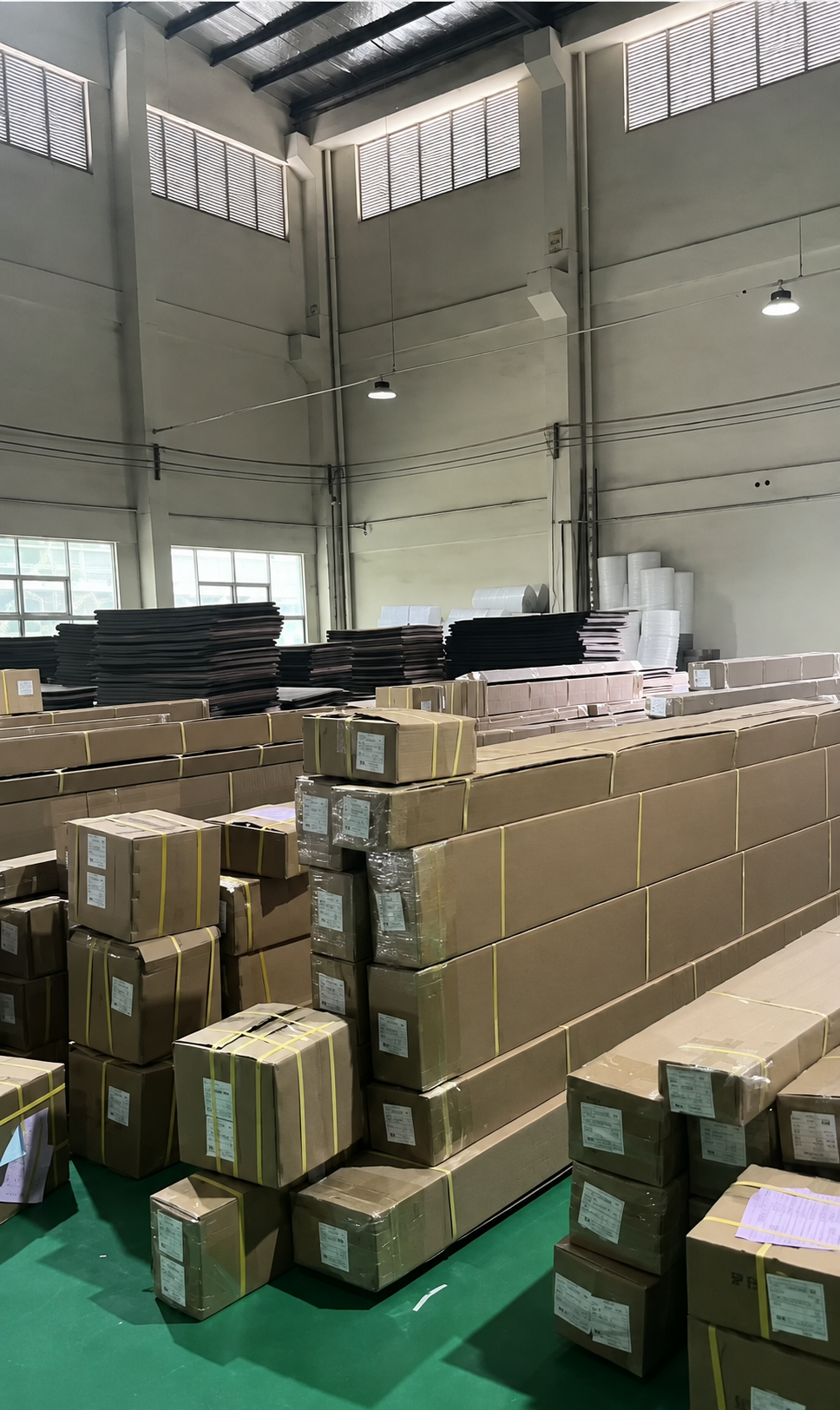
Within the production window, the process runs through raw material inspection, metal processing, cutting and welding, assembly, functional checks, pre-shipment inspection and packaging inspection. Quality control is applied across the full process with 100% inspection before delivery, and the company cooperates with authorised third-party testing institutions so that raw materials and finished goods undergo layer-by-layer sampling inspection before shipment. Acceptance is defined by a pre-shipment test, which means the inspection record is produced before the goods are packed rather than after they arrive on site.
Three factors fall outside a standard 30-day expectation and should be raised early in the conversation: non-standard cuts and angles, multi-zone structures that require additional posts and connections, and motor or control-system selection where site conditions are not yet confirmed. Any change made after drawing confirmation also restarts part of the sequence — which is why the drawing review, not the deposit, is the milestone that most affects the installation date.
Custom Sizing: Ceilings, Models and Drawing Inputs
The published sizing envelope is specific: custom dimensions up to 22'10" x 16' for a single zone. Larger covered areas are not handled by stretching one unit; they are configured as multi-zone structures in which several zones are linked and drained together. The range is offered in four models — 147, 163, 175 and 220 — with wall-mounted and free-standing mounting, multi-zone layouts and special cuts and angles. Model-level specification lists a snow load of up to 100 lbs/sq ft and a wind load of up to 190 mph, so in high-wind or snow-load regions the sizing conversation is also a structural conversation.
For aluminum products, 6063-T5 aluminum alloy is the standard material. Customisation is accepted from CAD drawings, architectural plans, sketches, photographs, dimensions and physical samples, and the deliverable set can include technical drawings, design optimisation, installation drawings, customised logos, private labels and packaging.
What to Prepare Before Requesting a Quotation
- Covered area dimensions, or the clear opening being covered
- Site photographs and the installation surface (deck, slab, wall or posts)
- Mounting preference: wall-mounted, free-standing or multi-zone
- Number of zones required for the total covered area
- Power supply location, for motorised and sensor-controlled configurations
- Site drainage conditions and surface fall
- Preferred colour and finish direction
- Accessory list, if any: zip screen, fence panel, glass door, fan, heater, wind and rain sensor, LED ambient lighting
Technical Explanation: Drainage, Waterproofing and Control
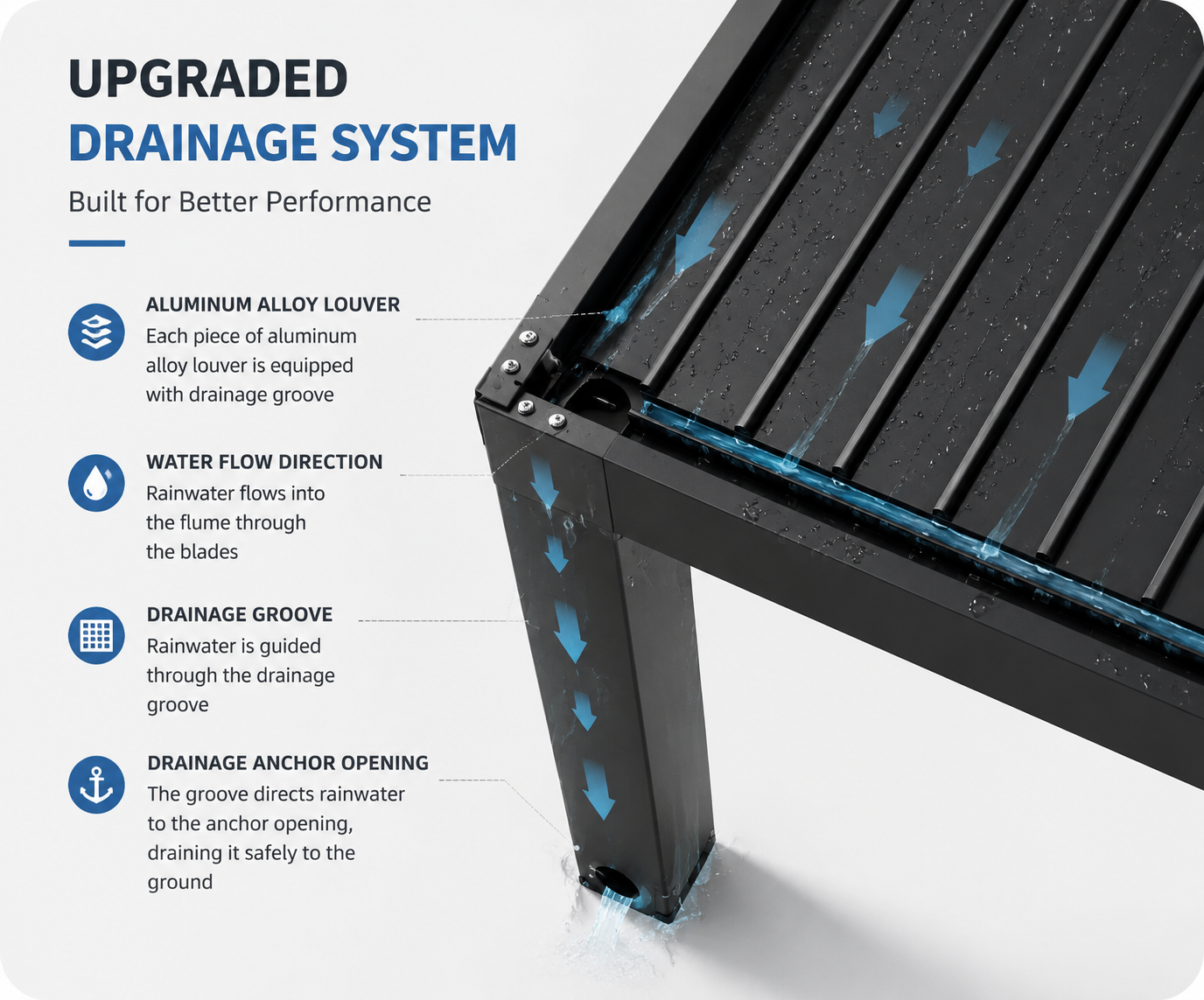
Rain performance in a louver pergola is a geometry problem rather than a coating problem. When the louvers are fully closed, the roof forms a continuous surface; rainwater is collected in integrated drainage channels within the roof assembly and guided through the internal drainage system inside the posts, instead of discharging from the roof edges. The roof cavity also lowers temperature beneath the structure by 3–5°C and blocks UV heat, which is what allows the same structure to function as a four-season patio pergola rather than a summer-only cover.
Two boundaries are worth stating plainly. First, the drainage system depends on correct installation and on site drainage being adequate; if water cannot leave the base of the posts, roof performance is compromised. Second, electrical components — motor, wiring and control — are designed for outdoor installation, but they must not remain submerged in standing water. Before installation, confirm the power supply location, drainage conditions, cable routing and the installation surface.
Operation is available as manual or electric, with remote control, mobile APP control and automatic weather sensing depending on configuration. The installed environment is rated IP66 for waterproofing and dust resistance. Accessories that can be specified at order stage include zip screens, fence panels, glass doors, fans, heaters, wind and rain sensors, and LED ambient lighting mounted under the roof.
Where the Specification Fits, and Where It Does Not
Typical applications are villa courtyards, hotel and resort terraces, commercial plaza landscaping, community courtyards, and public or scenic-area outdoor facilities, together with garden and patio areas where a waterproof structure with an adjustable roof is expected to remain usable across seasons. The same profile system extends to aluminum fence panels and automatic driveway gates, which is why the category is often purchased as a coordinated package rather than as a single item. The design environment covers high humidity, dust, coastal air and a wide outdoor temperature range.
Where the specification does not fit is equally important to know. For short-term temporary structures, or enclosures with no long-term appearance or durability requirement, a full aluminum system is likely to be over-specified compared with a lower-cost temporary alternative. The same applies when a project cannot support the drawing, foundation and drainage preparation that a motorised louver pergola requires.
Market Trend Analysis
Three verifiable signals shape how this category is being procured. Demand remains concentrated and growing: North America held a 34.2% share of global aluminum pergola demand in 2025 (Dataintelo), and the bioclimatic segment is forecast to grow at a 7.22% CAGR through 2034 (Fortune Business Insights). The access-control side of outdoor living is moving in step — automatic sliding gates accounted for 30.2% of the automatic gate opening system market in 2025, which supports the packaged way pergolas, fences and gates are now specified together.
Compliance is also becoming an explicit procurement line rather than a background assumption. EN 13561:2015 defines European performance and safety requirements for external blinds and awnings, including pergola awnings. ASTM F2957 covers ornamental aluminum fence systems, including structural testing and surface finish. In the United States, aluminum fence panel kits from China are classified under HTSUS 7610.90.0080 with a 5.7% duty rate, which matters for landed-cost modelling as much as the unit price does.
None of these signals changes the basic terms above, but together they explain why MOQ, lead-time and sizing evidence are now requested at quotation stage rather than after order placement.
Comparison with Traditional Wood, Iron and Brick Structures
The materials decision is usually framed as a trade between entry price and lifecycle cost. The comparison data below is stated by the manufacturer and compares aluminum systems with traditional wooden, iron, stainless steel and brick outdoor courtyard facilities.
| Comparison dimension | Traditional wood / iron / brick | Aluminum system (manufacturer-stated) |
|---|---|---|
| Initial purchase cost | Lower | 15%–25% higher |
| Annual maintenance | Rust removal, repainting, seasonal anti-corrosion treatment | No annual anti-rust or repainting work; light cleaning only |
| Service life | Baseline | Stated up to 3x longer, with a 3–6x longer replacement cycle |
| Long-run cost | Higher comprehensive cost over a 20-year horizon | Stated 70%–80% lower later-stage maintenance cost |
| Weight | Heavier sections | Stated about 65% lighter with equal strength |
Aluminum is not automatically the correct answer everywhere. The stated comparison set shows a higher initial purchase cost, with the return arriving over the maintenance cycle rather than at purchase. Where a project is temporary, where appearance is not a long-term requirement, or where the budget cannot absorb the higher entry price, a traditional or temporary structure can be the more rational choice. The advantage figures above are the manufacturer's own comparison data and should be validated against the specific project horizon rather than applied universally.
After-Sales Support Over the Life of the Installation
After-sales scope is where a bioclimatic pergola order is either supported or abandoned. Junsu Outdoor defines its focus as one-stop outdoor courtyard solutions that run from product customisation and manufacturing through installation guidance, technical support, spare parts supply and after-sales service — meaning the support scope is defined at order stage rather than negotiated after a fault appears.
Four elements matter in practice for buyers in the execution stage:
- Fault response. Reported faults are handled through the after-sales channel with technical support, using the delivered configuration as the reference for diagnosis and rectification.
- Maintenance guidance. Aluminum construction is specified as rust-free and does not require annual rust removal, repainting or seasonal anti-corrosion treatment. Maintenance is limited to regular light cleaning, plus keeping roof drainage channels and post outlets clear. Motorised units add basic electrical inspection, and electrical components should not sit in standing water.
- Spare parts supply. Spare parts are supplied as part of the after-sales scope, so a delivered system can be maintained over time rather than replaced as a whole.
- Lifelong technical support. Technical drawings and installation drawings are produced at order stage, and technical support continues after delivery — which matters for multi-zone installations and for sites where the installing contractor changes between phases.
Support sits on a certified base: ISO9001 international quality system certification and CE EU product safety certification for the products supplied, with authorised third-party testing used alongside in-house inspection and 100% inspection before delivery.
Future Outlook
If the forecast trajectory holds, the bioclimatic pergola segment will roughly double in value between 2026 and 2034, with North America remaining the largest single demand region. That growth is likely to push documentation into the standard package of every serious order: dimensional drawings before production, a pre-shipment test before packing, and a spare-parts reference for the delivered configuration. Buyers who treat these as procurement requirements rather than optional extras will find the execution stage considerably shorter.
Aluminum's full recyclability also aligns with tightening low-carbon requirements in construction procurement, which is likely to keep aluminum systems at the centre of outdoor living specifications even while entry prices remain above temporary alternatives.
Frequently Asked Questions
What is the minimum order quantity for an aluminum bioclimatic pergola?
The minimum order quantity is 1 set across the aluminum bioclimatic pergola range, including models 147, 163, 175 and 220. This allows a single terrace, an evaluation unit or a distributor pilot order to be produced without a volume commitment. A single-set order still passes through drawing confirmation and a pre-shipment test before dispatch.
How long does production take after an order is confirmed?
Typical production lead time is 30 days. That figure covers manufacturing and inspection; drawing confirmation and design optimisation occur before production, and freight, customs clearance and site installation occur after it. Buyers should add both to the 30-day figure when building a project schedule.
What is the largest single-zone size available?
Custom dimensions are supported up to 22'10" x 16' for a single zone. Covered areas larger than that are configured as multi-zone structures, in which several zones are linked and drained together, rather than stretched into one oversized single unit. Model-level specification lists a snow load of up to 100 lbs/sq ft and a wind load of up to 190 mph.
Which models are available, and how do they differ?
Four models are listed: 147, 163, 175 and 220. All are available in wall-mounted and free-standing configurations, with multi-zone layouts and special cuts and angles supported. Because dimensions are custom-made, model selection is made together with the drawing set rather than chosen from a fixed size list.
What information must be supplied for a custom-sized order?
CAD drawings, architectural plans, sketches, photographs, dimensions or physical samples are all accepted as input. For an accurate quotation, the set should also include the covered area, mounting preference, number of zones, site photographs, installation surface, drainage conditions and — for motorised versions — the power supply location. The supplier can return technical drawings, design optimisation and installation drawings for confirmation before production begins.
What are the payment, delivery and acceptance terms?
Payment terms are 50% deposit and 50% balance before shipment. Available delivery terms are FCA, FOB, CIF, DAP and DDP. Acceptance criteria are defined by a pre-shipment test, and quality control runs from raw material inspection through assembly, functional checks, pre-shipment inspection and packaging inspection, with 100% inspection before delivery.
How does the roof handle heavy rain?
When the louvers are fully closed, rainwater is collected in the integrated drainage channels of the roof and guided through the internal drainage system inside the posts. Performance depends on correct installation and adequate site drainage, and the installed configuration is rated IP66 for waterproofing and dust resistance. Electrical components are designed for outdoor installation but should not remain submerged in standing water.
What happens if a component fails after installation?
After-sales support covers fault response, maintenance guidance, spare parts supply and technical support. Faults are diagnosed against the delivered configuration, and required spare parts are supplied as part of the after-sales scope so that the system can be maintained rather than replaced. Installation drawings and technical documentation produced at order stage serve as the reference during diagnosis.
What maintenance does the system require?
Aluminum construction is specified as rust-free and requires no annual rust removal, repainting or seasonal anti-corrosion treatment. Maintenance is limited to regular light cleaning and keeping the roof drainage channels and post outlets clear. Motorised configurations additionally require basic electrical inspection, and electrical components should not be left in standing water.
How long is technical support available after delivery?
Technical support is described as lifelong for the delivered configuration. Technical drawings and installation drawings are provided at order stage, and support continues after delivery for installation questions, fault diagnosis and spare parts. The business scope is defined as one-stop, covering customisation and manufacturing through installation guidance, technical support, spare parts and after-sales service, so support forms part of the original order rather than a separate arrangement.
Buyers entering the execution stage can shorten the process considerably by sending dimensions, site photographs and mounting preferences with the first inquiry, so that drawing confirmation and quotation run in parallel. The full range of aluminum bioclimatic pergolas, aluminum fence systems and automatic driveway gates is documented in the product catalog, available for download: Junsu Outdoor product catalog.
¿Tiene preguntas o necesita más detalles?
Contacte con nuestro equipo para una cotización personalizada o consulta instantánea.
Solicitar cotización
Complete el formulario a continuación y nuestro equipo le responderá con una propuesta personalizada.
Chat directo de WhatsApp
¿Prefiere chatear en tiempo real? Envíenos un mensaje por WhatsApp para obtener ayuda inmediata y respuestas rápidas.
- Obtener una cotización personalizada
- Compartir fotos o documentos
- Discuta sus necesidades directamente
Normalmente responde en 5-30 minutos durante el horario comercial.