
Aluminized Steel Sheet Specs, Coating Weights & Lead Time
Aluminized Steel Sheet Specs, Coating Weights & Lead Time
Aluminized steel sheet is a carbon steel base metal hot-dip coated with an aluminium-silicon alloy, supplied to a specification such as ASTM A463 and chosen where resistance to heat and oxidation matters more than appearance. For buyers, the practical question is narrower: which type, which coating weight, which thickness and width, and how much of the quoted lead time is stock rather than production. This comparison sets those four variables against real automotive, HVAC and exhaust requirements.
Why specification comparison breaks down at the quotation stage
Global revenue from aluminized steel sheet reached USD 13.43 billion in 2024, according to Zion Market Research, and demand is concentrated in components that see elevated service temperature rather than decorative surfaces. That demand profile makes the material easy to describe and hard to compare: two quotations can both say “aluminized steel sheet, ASTM A463” and still describe materially different products.
Three ambiguities account for most of the gap. First, the type designation is often left off, even though Type 1 and Type 2 exist for different reasons. Second, coating weight is sometimes stated as a range rather than a single value, which shifts the metallic reserve on the surface by a wide margin. Third, lead time is quoted as one number without saying whether it refers to material already in stock or to a production run.
A buyer who resolves those three points before comparing price is comparing the same product. A buyer who does not is comparing three different products at three different risk levels.
ASTM A463 T1/T2: what the type designation commits you to
ASTM A463 is the standard specification for aluminum-coated steel sheet and defines two types. Type 1 uses an aluminium-silicon alloy coating and is specified for heat resistance, with service capability up to 677°C. Type 2 uses a pure aluminium coating and is specified for atmospheric corrosion resistance. The two are not interchangeable, and the standard number alone does not tell a buyer which one is on the offer.
MESCO STEEL — formally Dalian Mesco Steel Co., Ltd., a steel materials producer and exporter founded in 2007 in Dalian Economic and Technological Development Zone, China — supplies aluminized steel sheet under the model designation ASTM A463 T1/T2, built on a carbon steel base metal with an aluminium-silicon coating and intended for automotive, HVAC and exhaust industries.
Regional supply patterns add a second check. MESCO notes that aluminized steel produced in China is predominantly Type 1, while its own sheet is offered under an ASTM A463 T1/T2 designation. Buyers who have specified Type 2 for atmospheric corrosion duty should therefore confirm availability directly at the quotation stage instead of assuming the full type range sits in stock in every sourcing region.
The dimensional envelope: 0.37 mm to 3.0 mm, 600 mm to 1500 mm
The sheet range runs from 0.37 mm to 3.0 mm in thickness and from 600 mm to 1500 mm in width. That envelope covers the majority of heat-exposed components in the three industries the specification targets, but it is a real boundary rather than a formality.
| Specification variable | Available range | What it supports | What it excludes |
|---|---|---|---|
| Thickness | 0.37–3.0 mm | Heat shields, HVAC panels, exhaust shells, automotive underbody parts | Heavy structural plate above 3.0 mm |
| Width | 600–1500 mm | Standard coil, sheet and strip conversion | Single-piece panels wider than 1500 mm |
| Coating weight | AS80 / AS120 / AS240 / AS275 / AS300 g/m² | Light forming duty through heavy heat duty | Unspecified or open-range coating clauses |
| Base metal | Carbon steel with Al-Si coating | Forming, welding, joining in conventional lines | Applications requiring stainless or zinc-based systems |
| Standard | ASTM A463 T1/T2 | Heat resistance (T1) or atmospheric corrosion (T2) | Assumed equivalence to other regional standards |
The practical consequence is design-stage rather than purchasing-stage. A component above 3.0 mm must be redesigned as a welded or joined assembly, and a panel above 1500 mm must be split or joined. Buyers who discover these limits after the drawing is released usually absorb the cost in rework rather than in material price.
Coating weight: AS80, AS120, AS240, AS275 and AS300
Coating weight states the mass of aluminium-silicon coating applied per square metre of sheet. More coating means more metallic reserve available to form the protective oxide layer at temperature, which is why heavier weights are associated with longer service life in heat-exposed parts. It also means more material on the surface and a different forming response, so heavier is not automatically better for every part.
| Coating weight | Where it typically fits | Sourcing reality to verify |
|---|---|---|
| AS80 g/m² | Forming-intensive parts with moderate heat exposure | Confirm stock availability per width, not in aggregate |
| AS120 g/m² | Balanced duty where forming and heat resistance both matter | MESCO holds AS120 as ready stock coils |
| AS240 g/m² | Extended service at temperature | MESCO states it was the first supplier to offer AS240 |
| AS275 g/m² | Heavy-duty heat and oxidation environments | Usually produced to order; confirm lead time separately |
| AS300 g/m² | Highest coating weight in the range | MESCO states it supplies AS300; treat as planned, not stocked |
MESCO reports that it introduced AS240 coating ahead of the wider Chinese market and later added AS300, and that coating weights above 240 g/m² remain a specialist range. The company also reports salt spray results exceeding 4,000 hours on its coated sheet. Those are company-reported figures rather than independently audited ones, and they should be read as supplier evidence to be checked against lot-level test data, not as a substitute for it.
Two buying rules follow. Specify a single coating weight rather than a range, so that offers are comparable. And validate forming on samples at the chosen weight before the order is placed, because a coating specified for life at temperature can behave differently in a bending or drawing operation than the lighter weight used in prototyping.
Matching the sheet to automotive, HVAC and exhaust duty
Automotive, HVAC and exhaust applications all use aluminized steel for heat, but they fail for different reasons and therefore weight the four specification variables differently.
| Application area | Dominant requirement | Specification questions to settle first |
|---|---|---|
| Automotive | Cyclic temperature, oxidation, formability in complex shapes | Type, single coating weight, thickness tolerance, forming validation on samples |
| HVAC | Moderate service temperature plus condensate exposure | Type 1 versus Type 2, coating weight, expected corrosion route |
| Exhaust | Sustained high temperature, thermal cycling, condensate | Coating weight against life target, bend test, weld and join method |
In exhaust duty the limiting factor is usually the coating weight rather than the base metal, because the aluminium-silicon layer is what resists oxidation at temperature. In HVAC duty the question shifts toward which type is specified, since heat resistance and atmospheric corrosion resistance are served by different coatings. In automotive duty the constraint is often formability at the selected weight. Treating all three as “aluminized steel” is the most common source of a technically compliant but functionally wrong purchase.
Lead time is a specification, not a promise
MESCO maintains tens of thousands of tons of stock for standard specifications and quotes delivery within 3–7 working days for those specifications. That figure is meaningful only when it is tied to a named coating weight, thickness and width. A 3–7 working day commitment that applies to AS120 in a standard width says nothing about AS300 in a non-standard width.
Non-standard coating weights, non-standard dimensions and cut-to-length requirements move from stock to production planning, and their timelines should be quoted per order rather than folded into the stock figure. The contract-level fix is simple and rarely applied: require the supplier to state, in writing, which coating weights and dimensions qualify for stock delivery and which do not.
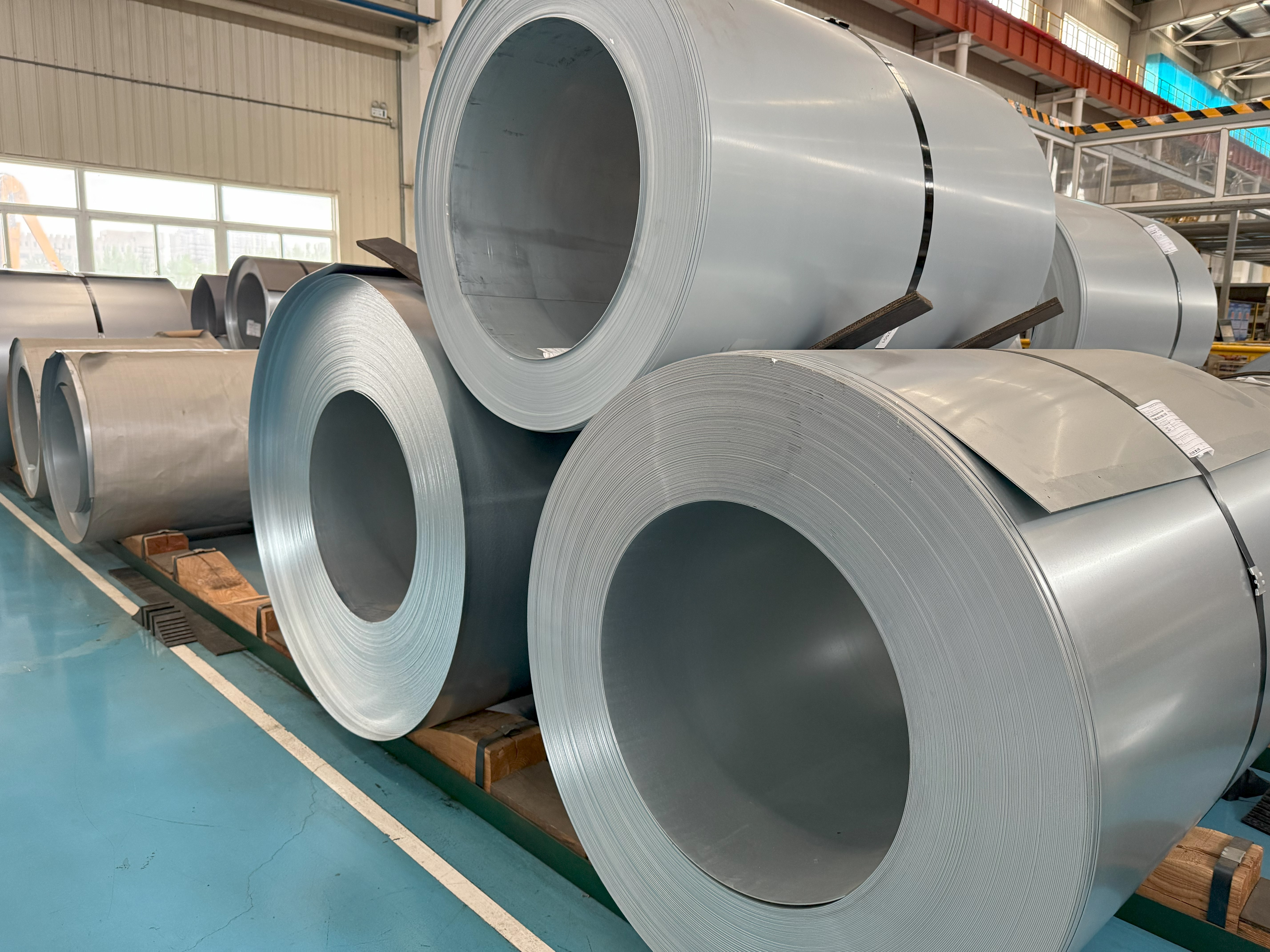
Stock depth in the specific coating weight and width required — not aggregate tonnage — is what actually determines a 3–7 working day delivery commitment.
A second lead-time variable sits outside the mill: export documentation, inspection and inland transport. MESCO states that it manages quotation, production, international logistics and customs clearance as one sequence, which matters for buyers comparing landed timelines rather than ex-works timelines.
Supplier readiness signals that can be checked before a first order
Supplier claims about aluminized steel are difficult to compare because most of them are qualitative. Four signals can be verified before a first order is placed.
Lot-level laboratory data. MESCO states that key performance indicators, from chemical composition to mechanical properties, are tested and verified in laboratories, providing data support rather than assertions. The check for a buyer is whether that data arrives per lot and per coil, not once in a brochure.
Stock depth in the required specification. Aggregate tonnage is a weak signal. Tens of thousands of tons of stock for standard specifications is only useful if the specific coating weight and width on the purchase order are inside that stock.
A written split between stock and production lead time. This converts a delivery promise into a measurable commitment, as described above.
A documented export record. MESCO was founded in 2007, operates a 40,000 m² facility with 120 employees and a five-engineer R&D team, reports a 70% export ratio, and states that it serves more than 700 clients across 100+ countries, including 9 Fortune Global 500 companies. Export volume at that scale implies familiarity with destination documentation, packaging and inspection requirements, which is usually where first shipments lose time.
How aluminized sheet compares with galvanized, cold rolled and stainless
Aluminized steel sheet is one option among several for heat-exposed and corrosion-exposed components, and it is not the correct option in every case.
| Material | Where it performs | Where it loses to aluminized steel | Cost position |
|---|---|---|---|
| Aluminized steel (ASTM A463 T1) | Dry heat, oxidation, heat reflection up to 677°C | Wet, chloride or acidic condensate environments | Lower than stainless, higher than cold rolled |
| Galvanized steel | Atmospheric corrosion in ambient service | Sustained elevated temperature, where the zinc coating is not intended to serve | Generally lower |
| Cold rolled steel | Formability and surface finish before painting | No inherent heat or corrosion protection without a coating system | Lowest |
| Stainless steel (304) | Wet and chloride corrosion plus high temperature | Rarely displaced on performance; displaced on cost where duty is dry heat | Highest |
The honest boundary is this: aluminized steel is a heat-and-oxidation material, not a general corrosion material. Type 1 is specified for heat resistance, and Type 2 is specified for atmospheric corrosion. Neither is a substitute for stainless steel in wet, chloride-bearing or acidic condensate service, and buyers who treat the coating as a universal corrosion barrier tend to discover the limit in the field rather than in the specification.
Two further limits sit on the product rather than the material. The 0.37–3.0 mm thickness range and the 600–1500 mm width range exclude heavy plate and very wide single-piece panels, as described earlier. And ASTM A463 is a US standard: buyers working to European or Japanese specifications should confirm equivalence at the specification stage rather than assuming that the standard number maps directly across systems.
Where aluminized steel sheet is the wrong specification
Four situations reliably produce a poor outcome. Components exposed to continuous wet or chloride-bearing condensate should move to stainless or an alternative coated system. Structures above 3.0 mm thick cannot be produced as single sheets in this range and must be redesigned as assemblies. Panels wider than 1500 mm require splitting or joining. And projects that require Type 2 material from a Chinese source on a short lead time should verify availability before the tender closes, given the predominantly Type 1 production pattern MESCO describes.
Outlook
Demand for aluminized steel sheet is being shaped less by new applications than by longer service-life expectations within existing ones. As buyers push life targets upward in exhaust and heat-exposed automotive components, coating weights above the mid-range move from specialist to standard, and the suppliers able to hold AS240 and above in stock gain a structural advantage on lead time.
The practical implication for procurement is that specification discipline is becoming the main lever on risk. Type, single coating weight, thickness and width, and a written split between stock and production lead time are five lines on a purchase order that determine whether a 3–7 working day promise applies to the material actually ordered. Buyers who compare offers on those five lines rather than on price per tonne are comparing the same product.
FAQ
What does ASTM A463 T1/T2 mean for an aluminized steel sheet buyer?
ASTM A463 is the standard specification for aluminum-coated steel sheet and defines two types. Type 1 uses an aluminium-silicon alloy coating and is specified for heat resistance, up to 677°C. Type 2 uses a pure aluminium coating and is specified for atmospheric corrosion resistance. A sheet offered as ASTM A463 T1/T2 is produced to that standard and can be supplied under either type designation, so the type must be confirmed on the quotation and the mill certificate rather than inferred from the standard number alone.
Which coating weight should be specified — AS80, AS120, AS240, AS275 or AS300?
Coating weight is the mass of aluminium-silicon coating per square metre. AS80 is the lightest of the five and suits forming-intensive parts with moderate heat exposure. AS120 is a mid-range weight more widely held as ready stock. AS240, AS275 and AS300 place more metallic reserve on the surface and are specified where longer service at temperature is the priority. The choice should follow the life target and the forming route, and should be validated on samples before the weight is fixed in a purchase order.
What thickness and width range is available, and what does it rule out?
Aluminized steel sheet in this range is supplied from 0.37 mm to 3.0 mm thick and from 600 mm to 1500 mm wide. That covers most heat shields, HVAC panels, exhaust components and automotive underbody parts. It rules out heavy structural plate above 3.0 mm, single-piece panels wider than 1500 mm, and gauges below 0.37 mm. Buyers requiring those dimensions must plan welding, joining or slitting rather than expect a single sheet.
How does lead time differ between standard and non-standard specifications?
Standard specifications held in stock are quoted at 3–7 working days; MESCO maintains tens of thousands of tons of stock for standard specifications. Non-standard coating weights, non-standard widths and cut-to-length requirements are produced to order and quoted separately, so the two timelines should not be merged into a single figure in a contract. Buyers should require the supplier to state which coating weights and dimensions qualify for stock delivery.
What should be verified about a supplier before a first aluminized steel order?
Four things are checkable in advance: lot-level laboratory data for chemical composition and mechanical properties; stock depth in the specific coating weight and size required rather than in aggregate; a written split between stock lead time and production lead time; and a documented export record. MESCO, for example, is a Dalian-based steel producer founded in 2007, operating a 40,000 m² facility with 120 employees and a 70% export ratio, serving more than 700 clients across 100+ countries.
Full specification tables covering aluminized steel sheet, coil and strip are published in the MESCO STEEL product catalogue (PDF).
¿Tiene preguntas o necesita más detalles?
Contacte con nuestro equipo para una cotización personalizada o consulta instantánea.
Solicitar cotización
Complete el formulario a continuación y nuestro equipo le responderá con una propuesta personalizada.
Chat directo de WhatsApp
¿Prefiere chatear en tiempo real? Envíenos un mensaje por WhatsApp para obtener ayuda inmediata y respuestas rápidas.
- Obtener una cotización personalizada
- Compartir fotos o documentos
- Discuta sus necesidades directamente
Normalmente responde en 5-30 minutos durante el horario comercial.