
All-Electric Injection Molding: Capability Beyond the Machine
An all-electric injection molding machine is defined less by the absence of hydraulic oil than by what its drive architecture allows a molder to control, repeat and connect. That distinction has moved from an engineering detail to a procurement question, because buyers now have to decide not simply which machine to purchase, but which configuration of machine, automation and process data will still be running at the quoted cycle time three years after commissioning.
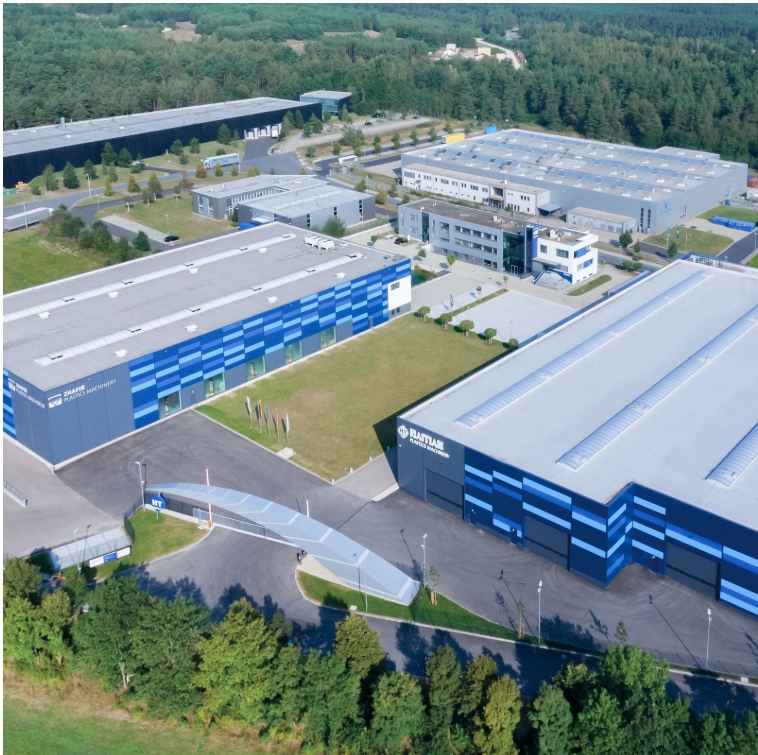
The reference point for this analysis is Haitian International Holdings Ltd., the parent of Haitian Plastic Machinery Group Co., Ltd., a manufacturer founded in 1966 that builds injection molding machines under the Haitian, Zhafir and Niigata brands and serves customers in more than 130 countries and regions. Its all-electric offer sits primarily within Zhafir Plastics Machinery, supported by Niigata electric platforms. This article examines how all-electric capability is structured, where it can be configured, and where it stops being the right answer.
The Capability Gap Between a Specification Sheet and a Production Cell
Every injection molding machine quotation contains the same core numbers: clamping force, injection volume, screw diameter, platen size and tie-bar distance. Those numbers answer the first question a buyer asks - will the mold physically fit and will the shot be filled. They do not answer the second question, which is the one that determines whether a project succeeds: what else has to be decided before the machine can run at rate.
In practice, the unresolved items cluster around four areas. First, the injection unit: whether the standard screw and barrel combination suits the material and shot weight, or whether a different configuration is required. Second, the mold interface: whether the platen pattern, ejector layout and hydraulic or pneumatic core functions match the tool. Third, the peripheral set: robots, conveyors, temperature controllers, dryers, granulators and vision inspection, and how they are sequenced with the machine cycle. Fourth, the data layer: which process values are recorded, in what format, and whether they reach a manufacturing execution system at all.
An all-electric platform changes the economics of these four decisions because precision, cycle time and energy behaviour are set by the drive architecture rather than added afterwards through options. It also raises the bar: a machine capable of highly repeatable injection only delivers that repeatability if the mold, the material conditioning and the process monitoring are held to a comparable standard.
What All-Electric Drive Changes Technically
Zhafir all-electric injection molding machines are built on all-electric drive technology. The design produces no hydraulic oil contamination and delivers what the manufacturer describes as exceptional injection repeat precision, supporting cleanroom-grade production. The stated characteristics of the platform are high precision, fast cycle speed, low energy consumption, flexible process adaptability and strong automation integration capability.
Mechanically, the important difference is that the machine uses independent servo drives to realise high precision and synchronized multi-motion operation, and to enable clean production. When clamping, injection, plastication and ejection are driven by separate servo axes rather than a shared hydraulic circuit, motions can overlap in a controlled way instead of competing for a single pressure supply. That is the origin of both the shorter cycle and the tighter shot-to-shot consistency that buyers associate with electric machines.
Combined with intelligent process adjustment, quality monitoring and open interfaces, the machines can be integrated with robots, vision inspection systems and MES systems to build automated, digital injection molding production cells. The phrase that matters for procurement is 'open interfaces'. It is the difference between an electric machine that is faster in isolation and one that can be wired into a cell without a proprietary gateway.
How the All-Electric Portfolio Is Structured
Haitian International's all-electric capability is not a single model series. It is a set of platforms with different drive logic and different mechanical envelopes, and the choice between them is usually decided by the auxiliary motions the mold requires and by part size rather than by tonnage alone.
The Zhafir Venus Series VE5 is the all-electric counterpart in the Zhafir range. Its published envelope covers clamping force from 400 to 13,800 kN, injection volume from 12 to 5,767 cm3, screw diameter from 16 to 120 mm, mold platen sizes from 440 x 440 mm to 2,150 x 2,050 mm, and tie-bar distances from 320 x 320 mm to 1,550 x 1,450 mm. It uses a Sigmatek controller. The material range quoted for the platform includes PP, PE, ABS, PC, PMMA, COC, COP, PA, POM and TPE, which places optical and high-clarity applications within scope.
The Zhafir Zeres Series ZE5 shares the same clamping force, injection volume, screw, platen and tie-bar envelope as the Venus VE5 and also uses a Sigmatek controller, but adds integrated hydraulics in the side movements. In the manufacturer's own description, two product lines are similar in design: Zeres features integrated hydraulics in the side movements, whilst Venus is the all-electric counterpart. That distinction is the single most useful configuration question a buyer can ask, because it determines which motions on the machine are hydraulic and which are not.
The Zhafir Zeres Series ZE-F is the high-speed configuration of the Zeres electric platform, with clamping force from 1,500 to 6,500 kN, optimised for fast cycles and high injection performance. It is positioned for PP, PE and HDPE work such as caps, closures, thin-wall packaging and other high-output applications.
Two further platforms extend the portfolio in different directions. The Zhafir Multicomponent machine is an electric multi-component platform with clamping force from 3,500 to 33,000 kN and a modular configuration in which injection units and component arrangements vary by application; it is positioned for multi-colour, multi-material and hard-soft components. On the Niigata side, the MD-S8500 Series is a precision horizontal all-electric platform covering models from MD50S8500 to MD350S8500, with tie-bar sensing, high-precision pressure control and OPC UA connectivity, while the MDV-S8500 Series is an all-electric vertical single-station platform for insert molding and precision component work, equipped with high-precision tie-bar sensing and dedicated mold-thickness measurement and control technology.
| Platform | Drive architecture | Clamping force | Notable integration features |
|---|---|---|---|
| Zhafir Venus Series VE5 | All-electric | 400–13,800 kN | Sigmatek controller; no hydraulic oil contamination; cleanroom-grade positioning |
| Zhafir Zeres Series ZE5 | Electric with integrated hydraulics in side movements | 400–13,800 kN | Sigmatek controller; same mechanical envelope as VE5 |
| Zhafir Zeres Series ZE-F | High-speed electric with integrated hydraulic functionality | 1,500–6,500 kN | Fast-cycle configuration for caps, closures and thin-wall packaging |
| Zhafir Multicomponent | Modular electric multi-component | 3,500–33,000 kN | Configurable injection units for multi-material parts |
| Niigata MD-S8500 Series | Precision horizontal all-electric | MD50S8500 to MD350S8500 | Tie-bar sensing; high-precision pressure control; OPC UA connectivity |
| Niigata MDV-S8500 Series | All-electric vertical, single station | Vertical platform | Tie-bar sensing; dedicated mold-thickness measurement and control |
Configuration and Integration: What Customised Manufacturing Actually Covers
The capability that separates a machine supplier from a production-cell supplier is configuration depth. Haitian International's stated production modes are OEM, customised manufacturing, application engineering and turnkey solution engineering, and the customisation scope is defined at a level of detail that maps directly onto the four decision areas described earlier.
On the machine side, the scope covers machine configuration and injection unit configuration, modularisation, special machine options, and industry-specific packages. On the cell side, it covers automation, robotics, peripherals, mold interface, process integration, third-party equipment integration and customised turnkey production cells. In other words, the configuration discussion is not limited to which screw diameter to order; it extends to how the machine is loaded, unloaded, inspected and connected.
The group describes its role as expanding from a manufacturer of injection molding machines to a provider of integrated production systems and manufacturing ecosystems. Through the combination of injection molding technology, automation, auxiliary equipment, digital solutions and complementary technologies within the Haitian Group, customers can source complete manufacturing solutions from a single technology partner. Depending on the application, these components can be configured as individual automation cells or as complete turnkey production systems, and open interfaces and standardised communication protocols allow third-party equipment to be integrated where required.
Quality control follows the same project logic rather than ending at the factory gate. The stated sequence is factory testing, machine inspection before delivery, mold trials, initial sampling, process optimisation, application testing and commissioning, with optional process monitoring and integrated quality inspection. After-sales support is delivered through a local sales and service network covering installation, commissioning, training, preventive maintenance, technical service, spare-parts supply, application support, process optimisation, and both on-site and remote support.
Capacity and lead time are part of the same picture. The group reports large-scale global manufacturing with localised production and machine availability through international manufacturing and stock locations, at a monthly capacity of more than 1,000 units globally. Minimum order quantity is defined as one machine, one production cell or one project. Stock machines carry short lead times subject to availability, configured machines are project-dependent, and customised or turnkey systems follow project scope. For a buyer in the execution phase, that means the lead-time answer is only meaningful once the configuration is fixed.
Where All-Electric Capability Is Applied
Zhafir positions its all-electric machines in high-value sectors - medical, precision electronics, optics and cosmetic packaging - where the requirement is high-quality clean manufacturing combined with productivity and part yield. This is consistent with the technical case: no hydraulic oil in the production environment, high injection repeat precision, and a material range that includes transparent and engineering grades.
A documented reference for the Zeres platform is Templa, a contract molder that operates six electric Zhafir Zeres machines within a 22-machine injection molding fleet and produces approximately 65 million parts per year. In a documented comparison producing a PP TV20 technical part on a 28-second cycle with a shot weight of approximately 90 g, the Zeres machine consumed about 30% less energy than the hydraulic machine it was compared against. The same installation uses digitally networked peripherals, energy monitoring and automated processes to support short throughput times and a zero-defect strategy.
Fleet-level evidence from MöllerGroup shows how electric and servo-hydraulic machines coexist in practice. The automotive and technical-parts molder operates 47 Haitian machines worldwide, mainly Jupiter and Mars machines plus two electric Zeres machines, with clamping forces from 150 to 1,850 tons, and uses them to support frequent tool changes and flexible production planning. The relationship has expanded into automation, including a Mars 200 combined with a Hilectro V1300 robot and a Smart Solutions production cell, and Haitian is involved early in selected projects to customise machine configurations.
What the Market Data Suggests
Directional market research supports the view that the electric segment is growing from a significant but not dominant base. One commercial research publisher places the global electric injection molding machine market at USD 4.9 billion in 2024, while a separate publisher estimates the total injection molding machine market at USD 11.66 billion in 2026, projected to reach USD 18.45 billion by 2034 at a CAGR of 5.90%. A third estimates that hydraulic technology still captured more than 40% of market share in 2024.
These figures come from commercial research houses and, in this dataset, are single-source estimates rather than audited statistics, so they should be used for framing rather than for business-case modelling. Their practical value to a buyer is in the boundary they imply: all-electric is a maturing choice within a category where hydraulic and hybrid architectures retain substantial share, which is why configuration questions - not category loyalty - decide most projects.
The same research links smart manufacturing systems to a 25% reduction in scrap and a 20% to 40% reduction in unplanned downtime. Applied to an all-electric cell, that claim points to where the return actually comes from: not from the drive type alone, but from the combination of repeatable injection, connected process data and the discipline to act on it.
Where All-Electric Stops: Limits and Trade-offs
A credible evaluation has to state the boundaries, and in this portfolio they are specific.
- Size ceiling. The Zhafir Venus VE5 reaches 13,800 kN of clamping force. Large, deep-cavity work sits outside that envelope: the Haitian Jupiter Series JU5 two-platen machine extends to 88,000 kN with injection volume up to 134,303 cm3. A buyer planning both precision parts and very large parts will typically need more than one architecture.
- Hydraulic content in the cell. Zeres is described as an electric machine with integrated hydraulics in the side movements, whereas Venus is the all-electric counterpart. Neither is better in the abstract; they answer different mold requirements. The practical step is to confirm, axis by axis, which motions are electric on the exact configuration being quoted.
- Cleanroom claims need verification. The platform is described as supporting cleanroom-grade production. That is a positioning statement, not a certified cleanliness classification, and it should be validated against the buyer's own contamination protocol and any applicable cleanroom standard.
- Energy savings are case-specific. The approximately 30% advantage reported at Templa applies to one documented part, material and cycle comparison against a hydraulic machine. It is evidence that the difference is real in a controlled case, not a general guarantee for every mold.
- Lead time depends on configuration. Stock machines are short lead time subject to availability, but configured and turnkey systems are project-dependent. Precision alone does not shorten a project schedule.
- Precision is a system property. Excellent injection repeat precision is only realised if the mold, material conditioning and process monitoring are held to a matching standard. An all-electric machine paired with an unstable tool will still produce variation.
From Evaluation to Execution: A Working Checklist
For buyers moving from evaluation into execution, the following sequence converts a specification comparison into a project definition.
| Step | Decision to close | Evidence to obtain |
|---|---|---|
| 1. Part and mold definition | Shot weight, wall thickness, material grade, cavity count, mold dimensions and core functions | Part drawings, mold drawings, target cycle time and annual volume |
| 2. Architecture selection | All-electric, electric with integrated hydraulics, high-speed, multi-component or two-platen | Comparison of clamping force, injection volume and screw options against the mold |
| 3. Injection unit configuration | Screw diameter, barrel configuration and plasticising capacity | Material data sheet and manufacturer's injection unit options |
| 4. Cell and interface definition | Robot, peripherals, mold interface, third-party equipment, MES connection | Interface list, communication protocols and automation scope |
| 5. Acceptance criteria | Mold trial, initial sampling and process capability targets | Factory testing, inspection before delivery and commissioning records |
| 6. Market-access conformity | Applicable machinery, electrical and safety requirements for the destination market | Certification scope that matches the exact model and voltage |
| 7. Service and spares plan | Installation, training, preventive maintenance and spare-parts coverage | Local service network and response arrangements |
| 8. Lead time and capacity | Delivery slot against project schedule | Confirmed configuration, not a generic quotation |
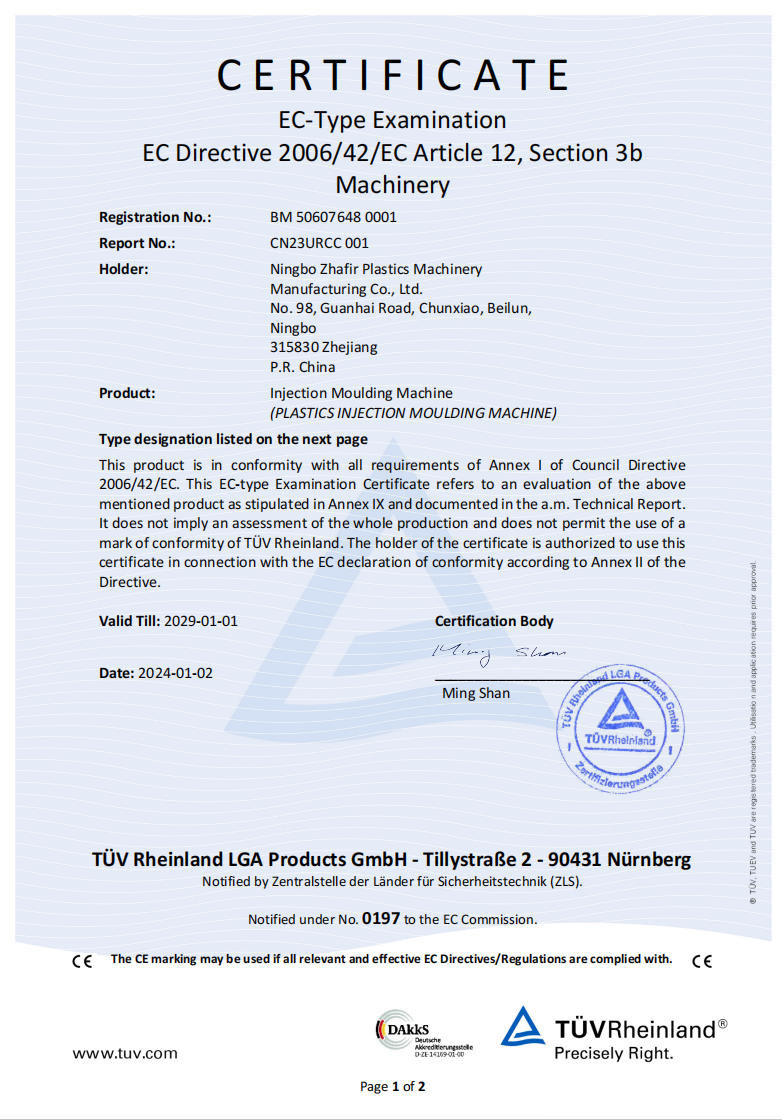
On step six, the documented conformity evidence in this portfolio is specific and worth checking against the model being ordered. An EC-Type Examination certificate BM 50607648 0001 was issued by TUeV Rheinland LGA Products GmbH on 2 January 2024, valid to 1 January 2029, covering plastics injection moulding machines against Annex I of Council Directive 2006/42/EC. A separate TUeV Rheinland certificate, CU 72303354 0001, issued on 11 January 2024 to Ningbo Zhafir Plastics Machinery Manufacturing Co., Ltd., covers listed models VE400V, VE600V, VE900V, VE1200V, VE1500V and VE19000V at 3P/PE, 460 Vac, 60 Hz against ANSI/PLASTICS B151.1-2017, NFPA 79:2021 and CSA C22.2 No. 301-2016 for the US and Canadian markets. Management-system certification is also in place: ISO 9001 (02025Q1180R9L, valid 2025-07-01 to 2028-07-04), ISO 14001 (02026E00868R301) and ISO 45001 (02026S00822R301), both valid 2026-07-20 to 2029-07-19, and ISO 50001 energy management (02024En0075R0L, valid 2024-07-15 to 2027-07-14).
Future Outlook
The direction of travel in all-electric injection molding is less about higher tonnage and more about what the machine connects to. Digitalisation extends the offer beyond the physical production cell: MES solutions enable production monitoring, process-data management and machine connectivity, while intelligent process technologies support setup, optimisation and quality control. The stated aim is an integrated production environment in which machines, automation and digital systems work together rather than operating as isolated components.
For buyers, that shifts the weighting of the purchase decision. A machine's useful life is now partly determined by the openness of its interfaces and the availability of process data, because those determine whether the cell can be optimised after installation. Platforms that already publish connectivity detail - OPC UA on the Niigata MD-S8500, standardised communication protocols for third-party integration across the group - give a procurement team something concrete to specify rather than a general promise of Industry 4.0 readiness.
The competitive question for the next procurement cycle is therefore narrower than 'electric or hydraulic'. It is whether the supplier can define, document and take responsibility for the whole configured cell - machine, automation, data and acceptance - and whether the resulting configuration still meets the part economics the business case was built on.
FAQ
What distinguishes an all-electric injection molding machine from a servo-hydraulic one?
An all-electric machine uses independent servo drives for its motions and produces no hydraulic oil contamination, which is the basis for its positioning in cleanroom-grade production and for its injection repeat precision. A servo-hydraulic machine such as the Haitian Mars Series MA5 uses servo drive and precision motion control to supply power on demand, balancing energy saving, response speed and molding stability. The mechanical envelopes also differ: the Zhafir Venus VE5 covers 400 to 13,800 kN, while the Mars MA5 covers 600 to 33,000 kN.
What clamping force and injection range does the Zhafir Venus Series VE5 cover?
The Venus VE5 is quoted at 400 to 13,800 kN clamping force, 12 to 5,767 cm3 injection volume and 16 to 120 mm screw diameter, with mold platen sizes from 440 x 440 mm to 2,150 x 2,050 mm and tie-bar distances from 320 x 320 mm to 1,550 x 1,450 mm. It uses a Sigmatek controller and is positioned for materials including PP, PE, ABS, PC, PMMA, COC, COP, PA, POM and TPE.
When would a buyer choose Zeres rather than Venus?
Both share the same clamping force, injection volume, screw, platen and tie-bar envelope and both use a Sigmatek controller. The difference is drive logic: Zeres features integrated hydraulics in the side movements, while Venus is the all-electric counterpart. A mold that depends on hydraulic side actions may therefore point toward Zeres, whereas a fully electric motion set points toward Venus. The Zeres ZE-F variant extends the same platform into high-speed work at 1,500 to 6,500 kN for caps, closures and thin-wall packaging.
Which industries and materials are all-electric machines used for?
Zhafir positions its all-electric machines for medical, precision electronics, optics and cosmetic packaging, where high-quality clean manufacturing, productivity and part yield are the priorities. The quoted material range for the Venus VE5 includes PP, PE, ABS, PC, PMMA, COC, COP, PA, POM and TPE, and the Zeres ZE5 range includes PP, PE, ABS, PA, PC, POM, PMMA and TPE. The Niigata MD-S8500 is positioned for precision components, electronics, optical, medical, automotive and cosmetics packaging work.
Can an all-electric machine be integrated with robots, vision inspection and MES?
Yes, where the configuration includes it. The Zhafir all-electric platform uses independent servo drives together with intelligent process adjustment, quality monitoring and open interfaces, which allows integration with robots, vision inspection systems and MES systems to build automated, digital production cells. At group level, MES solutions provide production monitoring, process-data management and machine connectivity, and open interfaces plus standardised communication protocols allow third-party equipment to be integrated. The Niigata MD-S8500 platform additionally provides OPC UA connectivity.
What customisation is available, and what does a project involve?
The stated production modes are OEM, customised manufacturing, application engineering and turnkey solution engineering. Customisation covers machine configuration, injection unit configuration, modularisation, special machine options, industry-specific packages, automation, robotics, peripherals, mold interface, process integration, third-party equipment integration and customised turnkey production cells. The minimum order quantity is one machine, one production cell or one project. Project execution typically includes factory testing, machine inspection before delivery, mold trials, initial sampling, process optimisation, application testing and commissioning, with optional process monitoring and integrated quality inspection, followed by installation, training, preventive maintenance and spare-parts support through a local service network.
Conclusion
All-electric injection molding rewards buyers who treat it as a configuration decision rather than a category choice. The measurable advantages - repeat precision, clean production, cycle speed, energy behaviour - are real within the documented cases, and they are bounded by tonnage limits, by the hydraulic content of specific platforms, and by how completely the surrounding cell is defined. The questions worth asking are therefore concrete: which axes are electric, which interfaces are open, what acceptance evidence will be produced, and which certificate covers the exact model and voltage being ordered.
¿Tiene preguntas o necesita más detalles?
Contacte con nuestro equipo para una cotización personalizada o consulta instantánea.
Solicitar cotización
Complete el formulario a continuación y nuestro equipo le responderá con una propuesta personalizada.
Chat directo de WhatsApp
¿Prefiere chatear en tiempo real? Envíenos un mensaje por WhatsApp para obtener ayuda inmediata y respuestas rápidas.
- Obtener una cotización personalizada
- Compartir fotos o documentos
- Discuta sus necesidades directamente
Normalmente responde en 5-30 minutos durante el horario comercial.