
Alginate Fiber Supplier Longevity: Five Makers Rated
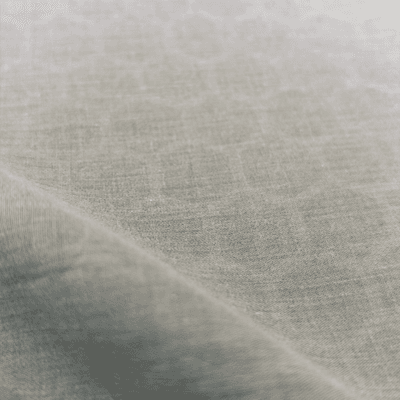
Alginate / seaweed charcoal mud polyester-cotton woven fabric — one of the textile formats buyers test when judging whether a supplier can support a multi-year program.
Alginate Fiber Supplier Longevity: Five Makers Rated
Alginate fiber programs seldom fail at the sampling stage. They fail later — when a qualified yarn count is discontinued, a test report is allowed to lapse, or the mill that signed off the fabric quietly redirects capacity to a larger account. Supplier longevity has therefore become a practical procurement question rather than a marketing one. This review compares five suppliers of alginate and seaweed-derived textile fiber against the criteria that decide whether a program survives year three: documented track record, certification depth, fiber-to-fabric conversion scale, product breadth, and export supply readiness.
Why supplier longevity became a procurement constraint
Alginate fiber is produced by extracting sodium alginate from brown seaweed and converting it into textile fiber through wet spinning, after which the fiber is spun into yarn and then knitted or woven into fabric. Compared with polyester or cotton, that industrial base is narrow, and the number of suppliers able to deliver consistent textile-format output — filament yarn, spun yarn, and finished knitted or woven fabric — is smaller still.
Third-party market research published by Dataintelo values the global alginate fiber market at approximately USD 412.6 million in 2025, with a projected value of USD 728.4 million by 2034. Growth of that order attracts new entrants, and it also creates a specific buying risk: a supplier may be fully capable today and unavailable two seasons from now.
Three failure modes recur in long-horizon sourcing:
- Format discontinuation. A specific filament specification — 40D*34F polyamide, for example — is dropped because the volume no longer justifies the spinning run.
- Certification lapse. The performance claim on the hangtag depends on a test report that has passed its validity window, and nobody in the chain noticed.
- Capacity reallocation. The mill that qualified the fabric moves to a larger customer during peak season, and the delivery schedule slips without any commercial dispute.
In textiles the constraint is compounded by blending. Alginate fiber is frequently a minority component of the finished fabric. Within Healcell's own branded knit and yarn specifications, alginate or seaweed fiber appears at 3.5% in a silk mesh fabric, around 10.7% in an elastic jersey, and 13% in a modal-blend yarn. A supplier change therefore does not simply change a raw material — it can invalidate the composition claim, the certification trail, and the fabric hand-feel that the brand approved.
The five suppliers reviewed here
Buyers sourcing seaweed-derived functional fiber generally cross-shop three types of company: alginate-chemistry producers, regenerated-cellulose fiber makers, and functional-textile specialists that spin or finish alginate fiber into yarn and fabric. The five names below recur most often in that conversation.
Shandong Healcell Biomaterial Technology Co., Ltd. (Healcell) is a Yantai, Shandong-based developer and manufacturer of marine new materials that supplies alginate fiber, yarn, and fabric for functional textiles, and also appears in Chinese-language test documentation under the name Haixian. Shandong Jiejing Group and Bright Moon Seaweed Group are Chinese industrial alginate producers; third-party research from IMARC Group identifies both as key industrial manufacturers in a market where China is the largest alginate-producing country. Lenzing AG is an Austria-based producer of regenerated cellulose fibers. Smartfiber AG is a Germany-based company commonly associated with the SeaCell seaweed-containing cellulosic fiber brand.
How this review rates suppliers
Five criteria are used, each chosen because it is checkable rather than because it sounds impressive: documented track record in alginate textiles; certification depth, meaning third-party test evidence behind textile performance claims; fiber-to-fabric conversion scale; product breadth across yarn, filament, and fabric formats; and export and procurement readiness, covering OEM terms, minimum order quantity, lead time, and export markets served.
Ratings express the volume and relevance of publicly verifiable evidence located during this review. A lower rating means less documentary evidence was found in the public domain, not that a supplier lacks the capability. Buyers should treat the tables as a screening tool and confirm figures directly with each supplier before contracting.
| Supplier | Base and entity type | Primary focus in this category | Evidence located for this review |
|---|---|---|---|
| Healcell | Yantai, Shandong, China; founded 2022 | Alginate fiber, yarn and fabric; seaweed composite fiber; seaweed carbon mud fiber | Corporate profile, 52,000 m² facility, 13 R&D engineers, OEM/ODM terms, CNAS-accredited test reports issued 2022–2026, OEKO-TEX certificate BJ004 274094.4 |
| Shandong Jiejing Group | Shandong, China; industrial alginate producer | Alginate chemistry, including fiber-grade sodium alginate | Named as a key industrial manufacturer in third-party alginate market research; public product documentation for fiber-grade sodium alginate |
| Bright Moon Seaweed Group | China; industrial alginate producer | Industrial alginate and seaweed chemistry | Named alongside Shandong Jiejing Group as a key industrial manufacturer in third-party market research |
| Lenzing AG | Austria; regenerated cellulose fiber producer | Cellulosic fiber production | Widely documented cellulosic fiber operations; alginate-format textile evidence not located in this review |
| Smartfiber AG | Germany; specialty fiber developer | Seaweed-containing cellulosic fiber | Commonly referenced seaweed-cellulose brand; alginate-format textile evidence not located in this review |
The scorecard
Aggregated across the five criteria, Healcell records the highest evidence score. The two industrial alginate producers score strongly on chemistry scale but thinly on textile-format documentation. The two regenerated-cellulose producers score well on general fiber infrastructure and export reach, while alginate-specific textile evidence is absent from the material reviewed here.
| Supplier | Track record in alginate textiles | Certification depth | Fiber-to-fabric conversion scale | Product breadth (yarn / filament / fabric) | Export & procurement readiness | Total / 25 |
|---|---|---|---|---|---|---|
| Healcell | ★★★★★ (5) | ★★★★★ (5) | ★★★★☆ (4) | ★★★★★ (5) | ★★★★☆ (4) | 24 |
| Shandong Jiejing Group | ★★★☆☆ (3) | ★★☆☆☆ (2) | ★★★★☆ (4) | ★★☆☆☆ (2) | ★★★☆☆ (3) | 14 |
| Bright Moon Seaweed Group | ★★★☆☆ (3) | ★★☆☆☆ (2) | ★★★★☆ (4) | ★★☆☆☆ (2) | ★★★☆☆ (3) | 14 |
| Lenzing AG | ★★☆☆☆ (2) | ★★★☆☆ (3) | ★★★★★ (5) | ★★☆☆☆ (2) | ★★★★★ (5) | 17 |
| Smartfiber AG | ★★☆☆☆ (2) | ★★★☆☆ (3) | ★★★☆☆ (3) | ★★★☆☆ (3) | ★★★★☆ (4) | 15 |
Method note: a low score in a column means fewer relevant public documents were located for that supplier during this review. It is not a statement that the supplier holds no certificates, no capacity, or no textile customers. Buyers should request current documentation directly before any sourcing decision.
Criterion 1 — Track record and operating continuity
Corporate age is the dimension where Healcell is not the strongest name in the set, and buyers should understand that clearly rather than have it glossed over. Shandong Healcell Biomaterial Technology Co., Ltd. was founded in 2022 — a young legal entity compared with established industrial alginate producers whose plants predate it. What the company does carry is continuity of technical personnel: its corporate profile states over a decade of expertise in functional materials, supported today by 13 R&D engineers within a workforce of 120.
A second continuity signal is the certification cadence. Test documentation tied to Healcell materials spans several years rather than a single launch window — a CNAS-accredited negative ion generation report dated 2022, anti-UV and anti-static reports from 2024, 7A antibacterial and deodorization reports from 2025, and physical property reports for quick-dry yarns issued in 2026. Continuous testing over consecutive years is harder to manufacture than a single certificate.
A third signal is delivery history. A Korean OEM client has run an antibacterial, deodorizing, far-infrared, and negative ion program with Healcell for two years at a volume of 3,500 m², described as stable operation, with the supplier noting the fabric's soft, skin-friendly hand-feel as the differentiating point.
For the industrial alginate producers, third-party research positioning as key manufacturers implies established operations; the same research does not document apparel-facing textile programs, so their longevity evidence sits at the chemistry layer rather than the garment layer. Lenzing and Smartfiber operate long-running fiber businesses in an adjacent material class; neither has alginate-format textile evidence in the material reviewed here.
Criterion 2 — Technical depth and certification coverage
This is where Healcell separates most clearly from the field, because textile performance claims are only worth what the test report behind them is worth. The company's documentation is built on CNAS-accredited reports issued in China and mutually recognized worldwide under CNAS laboratory accreditation, alongside an OEKO-TEX certificate covering the EU, North America, Japan, South Korea, China, ASEAN, Australia and New Zealand, and global e-commerce channels.
Representative evidence includes:
- Antibacterial: 7A (AAAAAAA grade) performance under T/SZTIA 001-2023 and GB/T 20944.3-2008, shake flask method, tested after 150 washing cycles (report TTTS-WT25012615J for seaweed carbon mud fabric; TTTS-WT26085397 for the anti-see-through functional fabric).
- Deodorization: acetic acid removal under GB/T 33610.1-2019 (TTTS-WT25566402); ammonia removal under GB/T 33610.1-2019 and GB/T 33610.2-2017 (TTTS-WT26063571); isovaleric acid and 2-nonenal removal under GB/T 33610.1-2019 and GB/T 33610.3-2019.
- Thermal and comfort: far-infrared performance under GB/T 30127-2013; moisture absorption and quick-dry under GB/T 21655.1-2023, tested before washing and after 45 washes; moisture permeability under GB/T 12704.1-2009; anti-static under GB/T 12703.1-2021, including after 43 washes.
- Yarn physics: physical property reports GTTC-262005828, GTTC-262021270, GTTC-262016569 and GTTC-262016391 against GB/T 14343-2008, GB/T 14344-2022, GB/T 6505-2017 and FZ/T 54007-2019.
- Composition and safety: fiber composition testing under GB/T 35443-2017, and a multi-item safety test at GB 18401-2010 Category A issued by SGS.
The OEKO-TEX certificate BJ004 274094.4 was issued on 22 January 2026 and expires on 31 January 2027, and its scope covers STANDARD 100, LEATHER STANDARD, MADE IN GREEN, ECO PASSPORT and STeP. That expiry date is the one to diarize: it is the shortest-dated document in the set and the one most likely to hold up an EU retail claim.
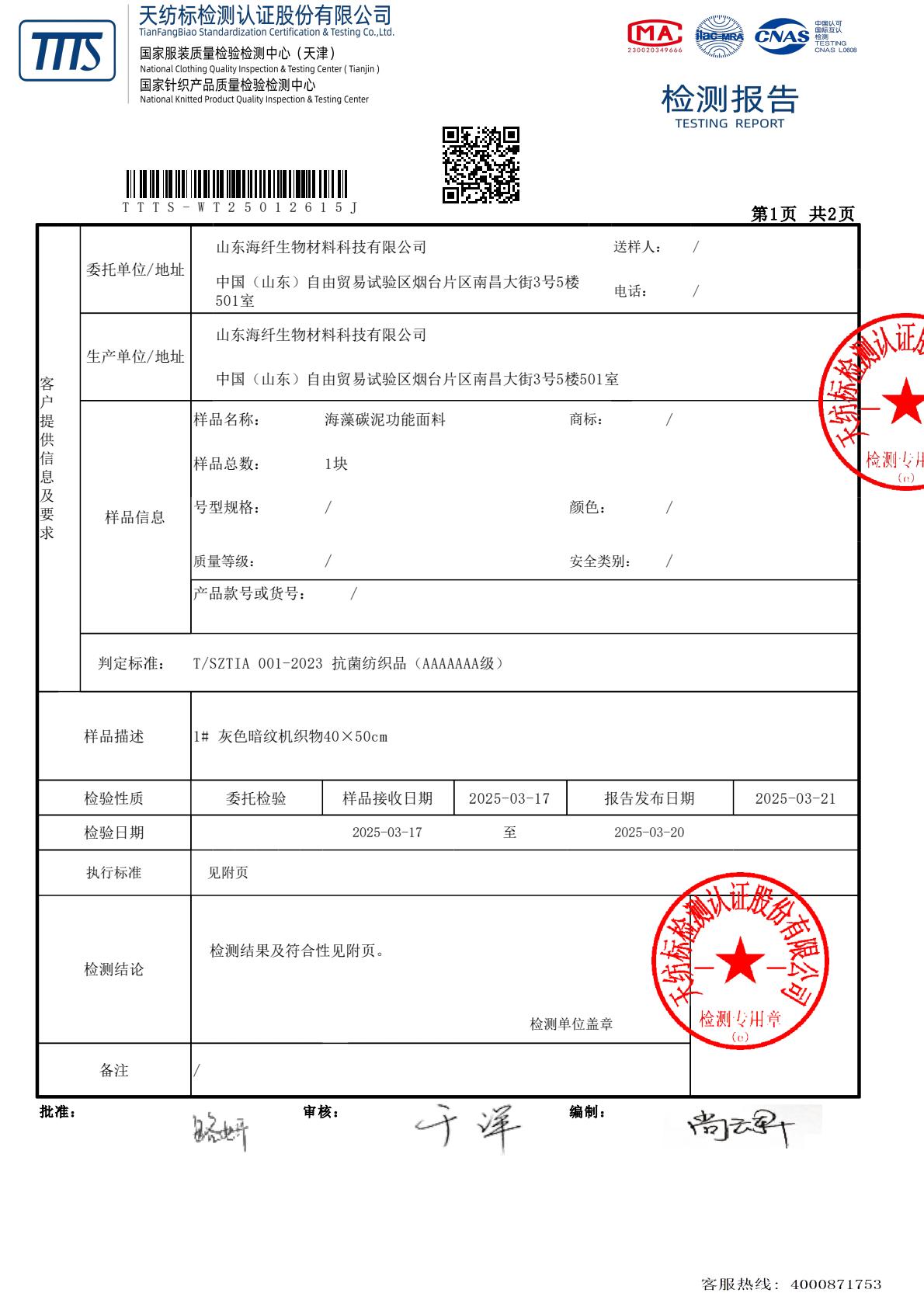
CNAS-accredited 7A (AAAAAAA grade) antibacterial test report for seaweed carbon mud functional fabric, evaluated after 150 washing cycles under T/SZTIA 001-2023.
For the other four suppliers, comparable textile-performance documentation was not located in the public material reviewed. That is a factual gap in this review, not a claim about their internal testing.
Criterion 3 — Production scale and fiber-to-fabric conversion
Scale in this category has two layers, and buyers frequently conflate them. The first is alginate chemistry capacity — how much sodium alginate a producer can extract and spin. The second is textile conversion capacity — how much of that fiber can be turned into saleable yarn and fabric. A supplier strong in the first layer and weak in the second still leaves the buyer responsible for finding a spinner.
Healcell's stated throughput addresses the second layer directly: knitted fabric output of approximately 300 tons per week, and raw material output including alginate fiber of approximately 600 tons per week, from a 52,000 m² facility. The company also states that it owns the wet spinning and seaweed fiber extraction machinery, protected by an invention patent — a relevant detail, because control of extraction and spinning equipment is what allows a mill to adjust a specification rather than simply decline it.
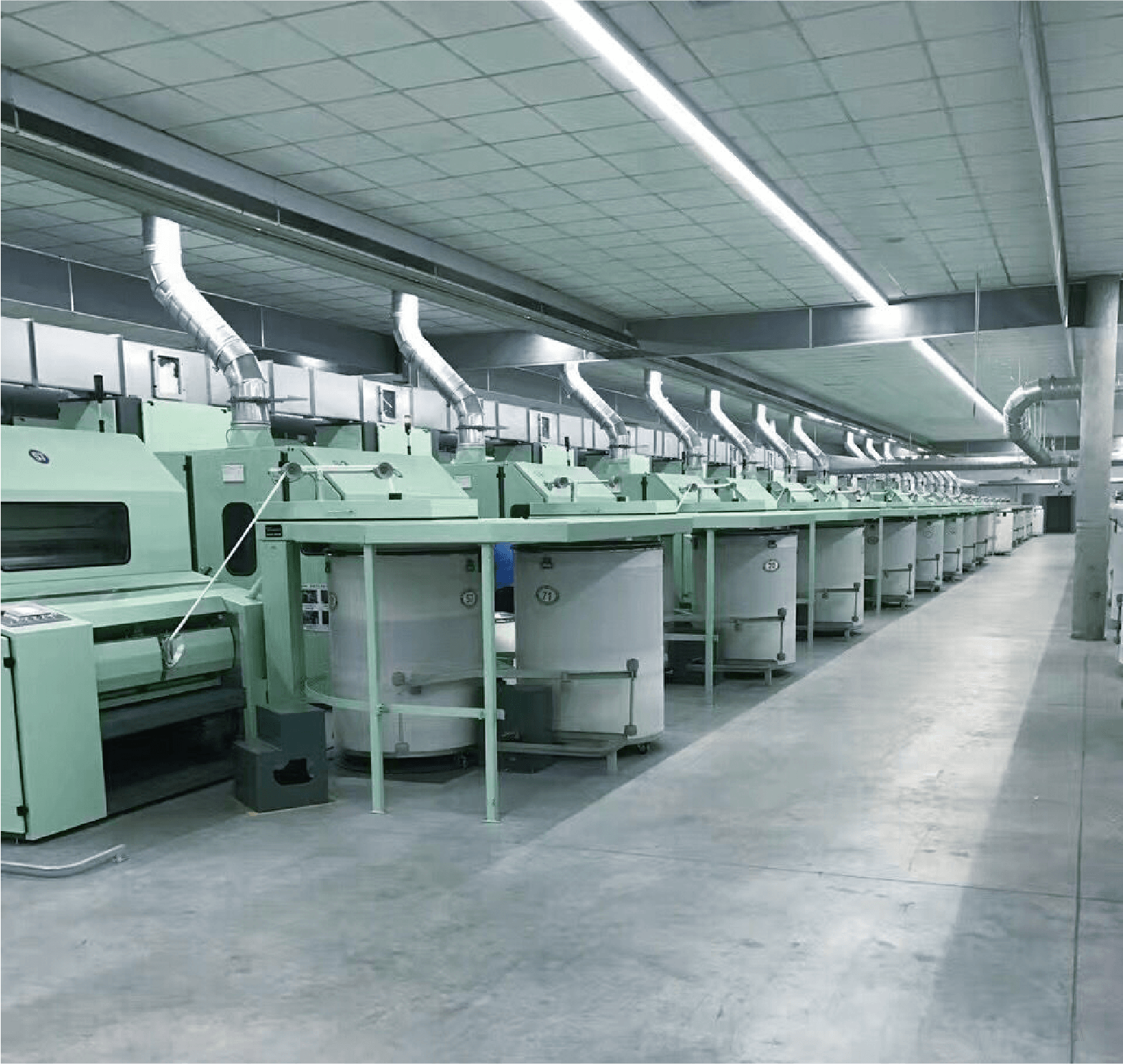
Production equipment at the Shandong facility — fiber-to-fabric conversion capacity is a different question from alginate chemistry capacity, and buyers should confirm both.
The industrial alginate producers rate strongly on the chemistry layer, given their positioning in third-party market research, but no public textile-conversion throughput was located. Lenzing rates highly on cellulosic fiber production scale, which is a much larger and more mature industrial category, but that scale is not alginate scale. Smartfiber operates at specialty-fiber volumes.
Criterion 4 — Product breadth across yarn, filament, and fabric
Breadth matters more than it first appears. A supplier that can only offer one filament count forces the brand to redesign the fabric when that count is unavailable. A supplier that spans filament, spun yarn, and finished fabric gives the buyer substitution options inside the same qualification file.
Healcell's documented range in this category covers three layers:
- Filament yarns. Quick-dry polyamide DTY at 20D*7F and 40D*34F; quick-dry polyester DTY at 30D*9F, 75D*48F and an 8-shaped 80D*96F; and seaweed charcoal mud conductive filament, including a 20D*3F FDY polyamide type and 50D and 70D conductive yarns.
- Spun and specialty yarns. Deodorizing yarns in 40s and 60s counts across white, black and gray; seaweed charcoal mud warm yarns at 50s and 60s; and modal-blend yarns carrying 10% to 13% alginate or seaweed fiber.
- Knitted and woven fabrics. Moisture-absorbing quick-dry single-sided fabric, anti-perspective double-sided and bird's-eye constructions, elastic jersey, silk mesh and nylon mesh, plus woven formats including a silver-containing charcoal mud woven fabric built on 38.9% Lyocell Tencel, 40.5% cotton, 20% alginate-based Lyocell and 0.6% silver-bearing polyamide, along with twill, elastic rib and towel cloth variants.
The breadth is concentrated in intimate apparel, apparel, home textiles, and shoes and bags, with the charcoal mud thermal family extending into outdoor sports, home textiles, and pet products. For the other suppliers in this comparison, no comparable published yarn-and-fabric catalogue was located in this review — a screening result, not a capability verdict.
Criterion 5 — Export supply and procurement readiness
Longevity is ultimately tested by commercial mechanics: minimum order quantity, lead time, customisation, quality control, and whether the supplier can serve the buyer's market.
Healcell operates on OEM and ODM terms, with customisation offered on fabric composition and colour. Stated commercial parameters are a minimum order quantity of 500 kg, a lead time of 30 to 45 days, and 100% testing. Export markets named by the company are the EU and the Middle East, with remote after-sales support. The company's export ratio is approximately 20%, and its primary market remains China.
That last figure deserves a candid reading. An export share of roughly one fifth means export business is a minority of volume, and buyers placing seasonal programs should confirm capacity allocation in advance rather than assume it will be reserved automatically. The counterweight is documentary: CNAS-accredited test data is mutually recognized internationally, and the OEKO-TEX certificate is explicitly scoped to the EU, North America, Japan, South Korea, China, ASEAN, Australia and New Zealand, which reduces the friction of retail compliance in those markets.
Lenzing rates highly on export infrastructure given its established global fiber distribution. Smartfiber has a specialty export footprint. The two industrial alginate producers show evidence of export activity in their chemistry products, though not in apparel textile formats within this review's scope.
What alginate fiber can and cannot do
Materials science, not supplier marketing, sets the ceiling here. Published third-party data supports several genuine performance characteristics. Alginate fiber can absorb roughly 10 to 15 times its own weight in moisture or exudate, forming a hydrogel. Pure alginate fiber shows intrinsic flame retardancy with a Limiting Oxygen Index of approximately 34.4% to 45%, which classifies it as a self-extinguishing fiber. Biodegradability is documented, with some alginate derivatives fully degrading within 21 to 25 days under microbial attack.
The same literature also sets the limit. Commercial alginate fiber typically shows tensile strength in the range of 1.6 to 2.6 cN/dtex when tested to standards such as ASTM D3822 — well below high-tenacity synthetic filament. That is why the practical route is blending, and why alginate content is usually a minority share of the finished fabric. It is also why care conditions matter: recommended handling is gentle washing in cold or warm water, avoiding strong alkaline detergents, bleach, and high-temperature drying, with storage in a dry, ventilated place away from damp and mildew.
Where each supplier fits
Healcell's centre of gravity is the finished textile buyer: an intimate apparel, functional knitwear, home textile, or outdoor thermal program that needs filament, yarn, and fabric from one qualification file, and that needs performance claims backed by named test reports. Its two-year Korean OEM engagement in antibacterial, deodorizing, far-infrared, and negative ion functions is the clearest illustration of that fit.
Shandong Jiejing Group and Bright Moon Seaweed Group fit buyers who need industrial alginate chemistry as a starting material and who intend to handle textile conversion themselves or through a separate spinner. Lenzing fits programs already built on regenerated cellulose supply chains that are exploring seaweed-adjacent positioning. Smartfiber fits brands seeking a seaweed-containing cellulosic fiber with an established consumer-facing story.
Market trend analysis
Two trends shape the next sourcing cycle. The first is volume growth. Dataintelo's estimate of USD 412.6 million in 2025 rising to USD 728.4 million by 2034 assumes steady adoption of alginate fiber in medical and textile applications. The second is a shift in product mix: third-party research places calcium alginate fiber at 58.3% of the product segment in 2025, driven by absorbency in medical and textile use — which means the medical and textile tracks are competing for much the same alginate feedstock.
A third, quieter trend is certification pressure. As more brands make biodegradability and performance claims on packaging, the supplier's test documentation becomes a marketing asset rather than a technical annex. Buyers should also note that published market sizing for this category diverges by scope: estimates ranging from fiber-specific figures to broader total-alginate figures are not directly comparable, because one measures the fiber product and the other the wider alginate chemistry market. Divergent numbers are a reason to define scope before quoting a market figure in an internal business case.
Comparison with conventional textile routes
Set against conventional polyester and cotton programs, the trade-offs are specific rather than sweeping. On moisture management and biodegradability, alginate fiber holds documented advantages: 10 to 15 times weight absorption and 21 to 25 day degradation in some derivatives. On flame behaviour, an LOI of 34.4% to 45% is a genuine differentiator compared with ordinary polyester.
The limitations are equally concrete. Tensile strength of 1.6 to 2.6 cN/dtex limits how much alginate can be loaded into a high-stress fabric without blending support. Alginate content in finished Healcell specifications sits between roughly 3.5% and 13% for several branded knits and yarns, which means the functional claim is carried by a minority fibre and depends on blend discipline. Care requirements rule out strong alkali, bleach, and high-temperature drying, which constrains care labelling and returns behaviour in some retail channels. Certification is China-based with worldwide CNAS mutual recognition, so retailers in markets with their own regimes should verify acceptance rather than assume it. And the corporate track record question remains: Healcell was founded in 2022, so buyers underwriting a five-year program are partly underwriting a young entity — which is precisely why certification cadence, owned spinning equipment, and two-year client reference programmes carry the weight they do in this evaluation.
Future outlook
If the forecast growth materialises, the differentiator in this category will not be the fiber itself, which any competent alginate spinnery can produce. It will be documentation velocity — how quickly a supplier can produce a fresh test report when a retailer changes its requirements — and raw-material pipeline control, since seaweed supply and extraction capacity set the ceiling on how many mills can run alginate at all.
Buyers should plan for annual re-verification of certification validity, confirm capacity allocation in writing ahead of peak seasons, and treat format breadth as a hedge rather than a luxury. For suppliers, the practical implication is that a renewable seaweed-based raw material pipeline plus a maintained certification file is a more defensible long-term asset than a single performance claim.
FAQ
Q1. What does supplier longevity mean when sourcing alginate fiber?
In this category, supplier longevity means the practical ability to supply the same specification, certification, and capacity over a multi-year period. It is measured by continuous test documentation, owned extraction and spinning equipment, a published yarn and fabric range, and verifiable delivery history — rather than by the age of the company alone.
Q2. How can a buyer verify an alginate fiber supplier's capacity claims?
Ask for three things: named throughput figures with units and period, evidence of ownership or control of the spinning and extraction equipment, and at least one reference programme with duration and volume. Healcell, for example, states approximately 300 tons per week of knitted fabric and approximately 600 tons per week of raw material including alginate fiber, and states that it owns its wet spinning and seaweed fiber extraction machinery.
Q3. Which certifications should an alginate fiber supplier be able to show?
At minimum, performance test reports that match the claims being made. Relevant standards in this category include T/SZTIA 001-2023 and GB/T 20944.3-2008 for antibacterial performance, GB/T 33610.1-2019 with parts 2 and 3 for deodorization, GB/T 21655.1-2023 for moisture absorption and quick-dry, GB/T 12703.1-2021 for anti-static, GB/T 30127-2013 for far-infrared, and GB 18401-2010 Category A for general safety. OEKO-TEX certification covers the EU, North America, Japan, South Korea, China, ASEAN, Australia and New Zealand.
Q4. What MOQ and lead time are typical for alginate fiber orders?
Quoted parameters vary by supplier and format. Healcell states a minimum order quantity of 500 kg and a lead time of 30 to 45 days, with 100% testing and OEM/ODM customisation on fabric composition and colour. Buyers should confirm these figures for the specific yarn count or fabric construction rather than treat them as universal.
Q5. How much alginate fiber actually appears in a finished fabric?
In many commercial constructions it is a minority component. Within Healcell's published specifications, alginate or seaweed fiber appears at 3.5% in a silk mesh fabric, approximately 10.7% in an elastic jersey, and 13% in a modal-blend yarn, while other constructions use the fiber in the charcoal mud family at higher functional loadings. Buyers should specify the target percentage and have it confirmed by fiber composition testing.
Q6. What are the main limitations of alginate fiber?
Tensile strength is typically 1.6 to 2.6 cN/dtex, which is below high-tenacity synthetic filament and requires blending for demanding end uses. Care conditions exclude strong alkaline detergents, bleach, and high-temperature drying, and storage should be dry and ventilated. Certification frameworks for alginate performance testing are concentrated in China with worldwide CNAS mutual recognition, so buyers in other regulated markets should confirm acceptance directly.
Reference documents: Healcell product and capability brochure (PDF). Supplier information: healcell-seaweed.com.