
Aircraft Flooring Certifications: Assessing Supplier Evidence
Aircraft Flooring Certifications: Assessing Supplier Evidence
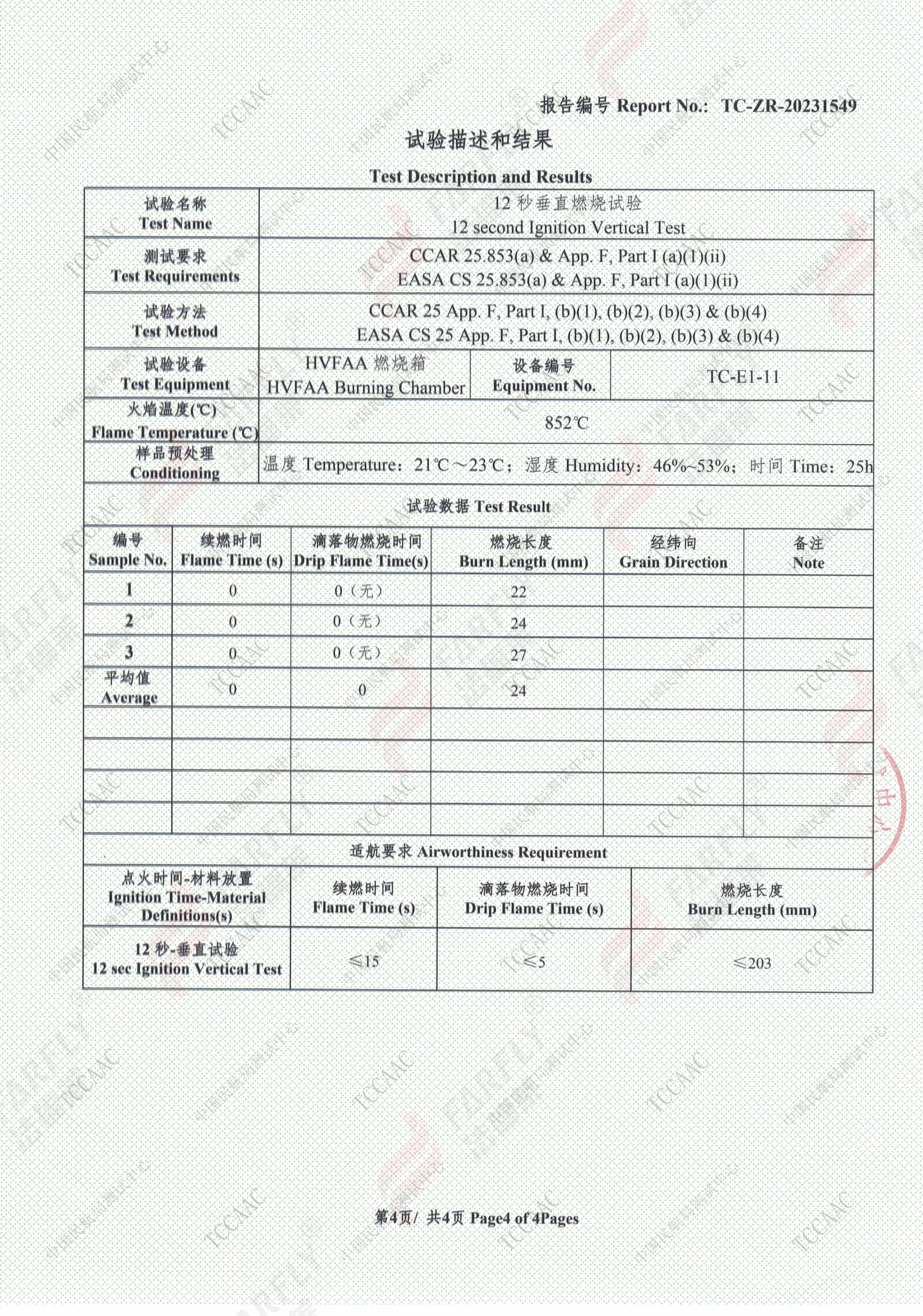
Procurement in aircraft interiors rarely fails because a supplier holds no certificates. It fails because the certificate on file does not cover the product being ordered, because the scope statement describes a different activity than the one being purchased, or because the validity window closed before the purchase order was signed. Assessing supplier capability therefore begins with a documentation question rather than a commercial one: which documents exist, who issued them, which product they cover, and when they expire.
Aviation flooring occupies a narrow share of a large category. Grand View Research values the global commercial vinyl flooring market at approximately USD 14.43 billion in 2025, with a projected path to USD 22.01 billion by 2033, while China's cumulative PVC flooring exports reached 715,000 tons in the first two months of 2026, a 3.1% year-on-year increase according to SunSirs / China Customs data. Within that volume, cabin flooring is a segment defined less by square meters shipped than by documented material behavior under heat, flame and smoke exposure.
FARFLYING FLOORING is the brand under which WUXI TEFA DECORATION MATERIAL CO., LTD., a flooring manufacturer founded in 2012 and based in Wuxi, Jiangsu, China, produces homogeneous flooring, PVC sports flooring and aircraft flooring. The company's aviation range is supplied under six models: LY, SMY, MMY, MY, BY and WD. What follows examines the certification layer behind those models, what each document actually proves, and where the evidence stops.
The Verification Gap: Four Document Types, Four Different Jobs
Certification conversations in commercial PVC flooring tend to collapse several document families into a single word: certified. In practice, four types of evidence do four different jobs, and only one of them speaks directly to cabin fire safety.
- Management system certificates — for example ISO 9001:2015, ISO 14001:2015 and ISO 45001:2018. These describe how an organization manages quality, environmental responsibility and occupational health and safety within a defined scope. They say nothing about how a specific floor construction behaves in a fire.
- Construction product marks — CE marking under EN 14041:2018 belongs here. It addresses conformity requirements for construction products, not aircraft interiors.
- Material safety test reports — for example phthalate testing under EN 14372:2004, which screens plasticizers and other organic compounds in PVC flooring and supports low-toxicity claims for interiors such as sports halls and schools.
- Aviation flammability and smoke reports — the only category that maps directly onto FAR 25.853-type requirements for cabin materials, covering self-extinguishing behavior, burn length, flame time, smoke density and smoke toxicity.
Under FAR 25.853 (14 CFR 25.853), aircraft interior materials must be self-extinguishing, with an average burn length not exceeding 8 inches and a flame time under 15 seconds. A manufacturer can hold hundreds of certificates of the first three types and still fail this requirement on a specific construction. Closing that gap is what buyers are actually doing when they ask a supplier for aviation evidence.
The Evidence Package Behind Aircraft Flooring Models LY, SMY, MMY, MY, BY and WD
For its six aircraft flooring models, Farfly's aviation-specific evidence consists of two CAAC test reports — one on flammability and one on smoke toxicity — supported by internationally issued management system and product certificates that apply across the wider flooring portfolio. Presenting them together in one table makes the differences in authority, standard basis and validity window visible.
| Document | Issuing authority | Standard / basis | Certificate number | Validity |
|---|---|---|---|---|
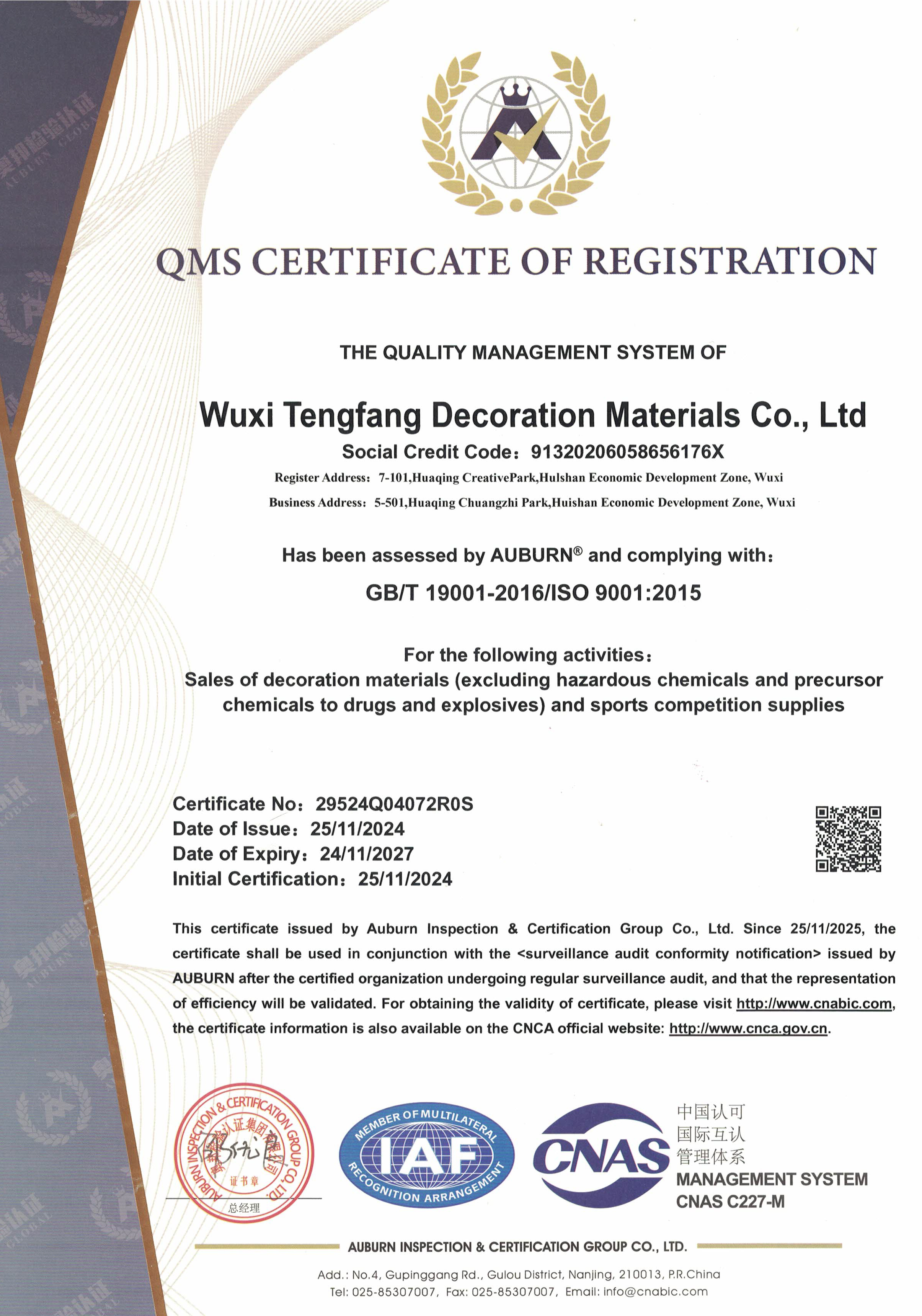
| 12S Vertical Combustion Test Report | CAAC | CCAR 25.853(a) & App. F Part 1; EASA CS 25.853(a) & App. | TC-ZR-20231549 | Issued 2023-07-28 |
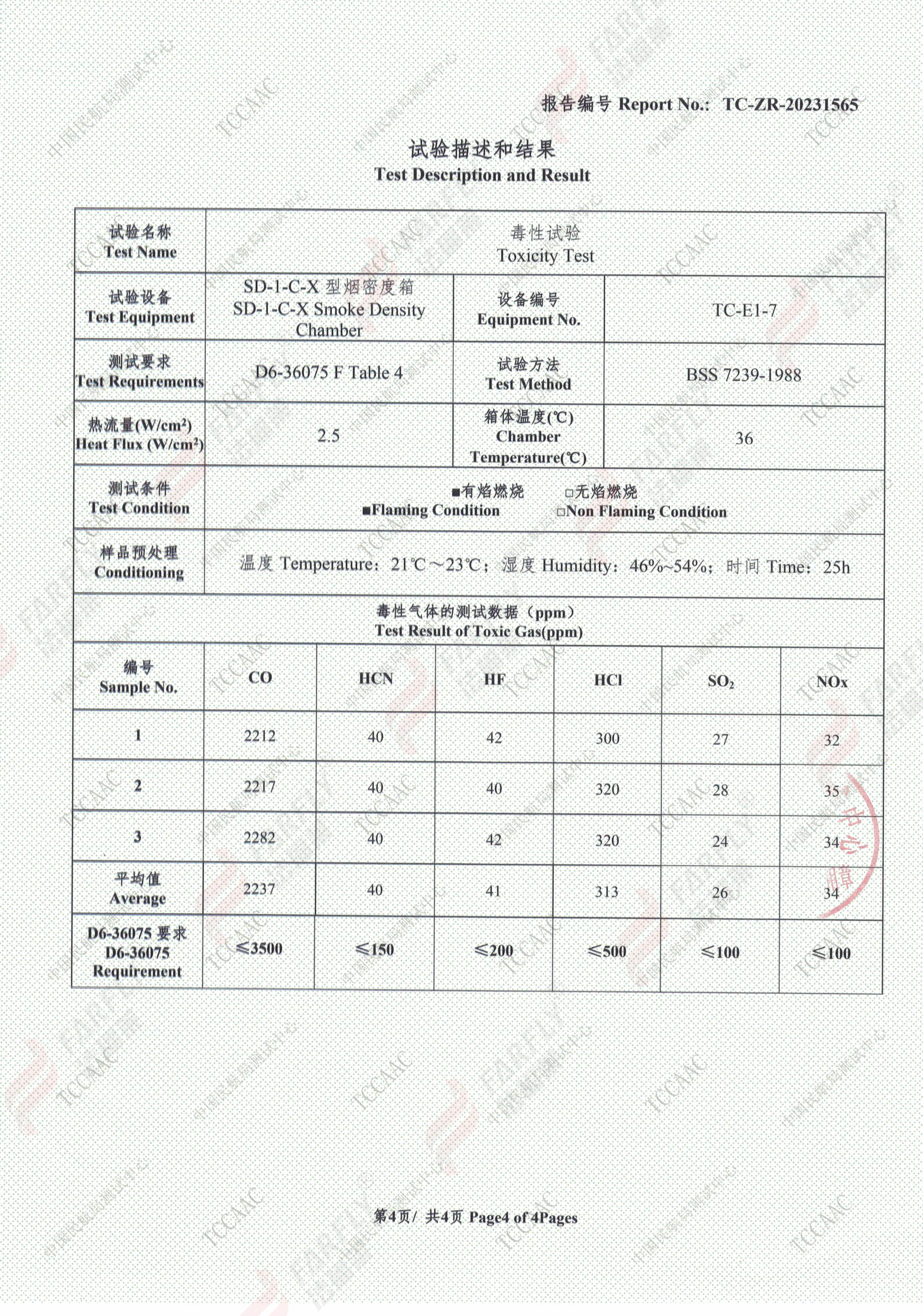
| Smoke Toxicity Test | CAAC | D6-36075 F Table 4 | TC-ZR-20231565 | Issued 2023-07-28 |
| ISO 9001:2015 quality management | AUBURN INSPECTION & CERTIFICATION GROUP CO., LTD. | ISO 9001:2015 | 29524Q04072R0S | 2024-11-25 to 2027-11-24 |
| ISO 14001:2015 environmental management | AUBURN INSPECTION & CERTIFICATION GROUP CO., LTD. | ISO 14001:2015 | 29524E04073R0S | 2024-11-25 to 2027-11-24 |
| ISO 45001:2018 occupational health & safety | AUBURN INSPECTION & CERTIFICATION GROUP CO., LTD. | ISO 45001:2018 | 29524S040725R0S | 2024-12-23 to 2027-12-22 |
| CE marking | ICR Co. Ltd. | EN 14041:2018 | TCF-OY20250623-CPR | 2025-06-26 to 2030-06-25 |
| Physical property test report | SGS | ISO 24346:2006, ISO 23997:2007, ISO 4918:2016, ISO 29333:2018, ISO 26987:2008, ISO 10581:2019, ISO 105-B02:2014 | XMIN2109010490CM | Issued 2022-03-07 |
Scope matters as much as existence. The ISO 9001:2015 and ISO 14001:2015 certificates are written for the sale of decoration materials and sports competition supplies, together with the related environmental management activities of the places involved; the ISO 45001:2018 certificate covers the same sales activity plus occupational health and safety management in that environment. None of the three is an aviation product approval. They describe how an organization operates, not how a floor panel behaves in a cabin.
Reading the Aviation Test Results: What Twelve Seconds of Flame Exposure Demonstrates
The 12S Vertical Combustion Test (certificate TC-ZR-20231549) exposes a specimen to a 12-second ignition source and records what happens afterwards: how long the material continues to burn on its own, how long any drips continue to burn, and how far the flame front travels along the specimen. The reported results for the aviation flooring construction are 0 seconds of sustained burning, 0 seconds of droplet burning time, and a burn length of 24 mm, approximately 0.94 in. For reference, the FAR 25.853 ceiling sits at an average burn length of 8 inches with a flame time under 15 seconds.
Smoke is a separate failure mode, and it is tested separately. The CAAC Smoke Toxicity Test (certificate TC-ZR-20231565) is issued against D6-36075 F Table 4 and addresses flame resistance, heat release, smoke density, toxicity and self-extinguishing behavior for vinyl aircraft flooring systems intended for cabin use. The reported outcome on that test is a pass on smoke toxicity. In a cabin, smoke density and toxicity influence how long occupants retain visibility and breathable air during an evacuation event, which is why cabin specifications rarely accept a flammability result alone.
Two details in this package deserve attention during evaluation. First, the aviation reports and the management system certificates come from different bodies, for different purposes, in different years: 2023 for the CAAC reports and 2024 for the AUBURN certificates. Second, and more consequentially, test results describe the construction that was submitted for testing. Change the plasticizer system, the fiberglass reinforcement or the surface treatment, and the original report no longer describes the product on the pallet. Buyers who understand that distinction tend to ask a sharper question — not "are you certified," but "does this document describe the exact construction you will ship me."
Application Fit: Matching Evidence to Product Family
A supplier's certificate portfolio is not a single credential. The same manufacturer holds different evidence for different product families, and procurement teams should match documents to the intended environment rather than assume that a certification held for one line transfers to another.
| Product family | Applicable evidence | Typical environments |
|---|---|---|
| Aircraft flooring — models LY, SMY, MMY, MY, BY, WD | CAAC 12S Vertical Combustion Test Report TC-ZR-20231549 (CCAR 25.853(a) & App. F Part 1; EASA CS 25.853(a) & App.); CAAC Smoke Toxicity Test TC-ZR-20231565 (D6-36075 F Table 4); ISO 9001 / 14001 / 45001 management system certificates | Aircraft cabins and galley areas, helicopter and private jet interiors, cargo aircraft interiors, where self-extinguishing behavior, smoke density and smoke toxicity are specified |
| PVC sports flooring — model Boguan | Reaction to fire testing HQR170310004-01 (EN 13501-1:2007, EN ISO 9239-1:2010, EN ISO 11925-2:2010); physical and chemical property testing HQR170310004-02 (EN 14904-2006 and related standards); phthalate testing ETS19030602C (EN 14372:2004); BWF certification | Badminton, basketball, volleyball, table tennis and pickleball courts, multi-purpose sports halls, gyms, school gymnasiums, dance and fitness studios |
| Homogeneous vinyl flooring — Bonaire, Bonet, Boniro, Bonize, Bones, Bonear, Bonegas, Bonzya, Bonami, Bona star, Bonee, ESD flooring | SGS physical property test XMIN2109010490CM (ISO 24346:2006, ISO 23997:2007, ISO 4918:2016, ISO 29333:2018, ISO 26987:2008, ISO 10581:2019, ISO 105-B02:2014); CE marking TCF-OY20250623-CPR (EN 14041:2018) | Hospitals and clinics, laboratories, electronics workshops, offices, schools, warehouses and exhibition halls |
Evidence systems are only credible if they hold across product lines. Farfly reports a sports flooring installation in Australia covering 16 badminton courts, completed over a 10-year period with 50% less maintenance required, selected for cushioning, slip resistance and bounce performance that protects knees and ankles. The relevance to an aviation buyer is not the sport itself but the presence of a documented project record sitting behind the same quality-control system — 100% testing plus third-party inspection by SGS — that governs cabin flooring production.
From Certificate to Purchase Order: Capability Checks That Matter
Documents establish eligibility; production and logistics determine whether a project is actually deliverable. The operational facts that accompany the aviation certification package are: six production lines, a monthly capacity of 600,000 sqm, an annual output of 4,200,000 m², and a ready-to-ship inventory of 300,000 sqm supporting a typical production lead time of 7 days. Orders can be combined into mix-container shipments, and the minimum order quantity is 100 sqm.
Customization runs through OEM and ODM production, with adjustable dimensions, color, design pattern, packaging, logo, craftsmanship and structure. Commercial terms are stated rather than implied: delivery under EXW, FCA, FOB, CIF or DDP; acceptance supported by pre-shipment testing and third-party inspection by SGS; payment structured as a 50% deposit with the remaining 50% settled by T/T prior to shipment. After-sales support covers online installation guidance, support from an on-site installation team, and the provision of necessary installation equipment and auxiliary materials.
For aviation programs specifically, lead-time claims carry less weight than requalification risk. A buyer who accepts a 7-day dispatch window but later changes the specification may still face a testing cycle that dwarfs the shipping schedule. The practical sequence is to lock the construction, confirm the matching test documentation, and only then commit to delivery terms.
Market Trend Analysis: Certification as a Recurring Obligation
Three observable trends shape how buyers should read certification evidence in this category.
First, volume growth continues. Grand View Research projects the commercial vinyl flooring market moving from approximately USD 14.43 billion in 2025 toward USD 22.01 billion by 2033, and Chinese export data from the first two months of 2026 shows 715,000 tons shipped, up 3.1% year on year. More suppliers in the market does not mean more comparable evidence; it means scope-checking becomes more important, not less.
Second, construction quality is being pushed by performance demand. Fiberglass-reinforced PVC flooring, valued for dimensional stability, is projected by Fortune Business Insights to reach USD 1.72 billion by 2034 at a 6.46% CAGR. Dimensional stability is directly relevant to aviation flooring, where a construction that moves under thermal cycling undermines both fit and the tested fire performance of a fixed assembly.
Third, certification itself is becoming a renewable obligation rather than a one-time event. The Badminton World Federation, for example, classifies sports flooring into Grade 1 (International Elite), Grade 2 (International Standard) and Grade 3 (Basic), and requires renewal every two years. Aviation documentation follows the same logic in principle: management system certificates carry fixed expiry dates, and product test reports describe a specific tested design. The competitive set in commercial vinyl flooring — including Mohawk Industries, Shaw Industries, Tarkett, Gerflor and Forbo Flooring — competes substantially on verifiable documentation and program qualification. Market sizing claims in this category also diverge sharply depending on whether LVT and SPC segments are included: one research house puts the PVC flooring market at USD 6.41 billion while another reports the broader vinyl flooring market at USD 41.94 billion. Buyers who scope-check certificates should apply the same discipline to market claims.
Where the Evidence Stops: Limits Buyers Should Plan For
A credible assessment includes the boundaries of the evidence, not only its strengths.
- Management system certificates are not product approvals. The ISO 9001:2015, ISO 14001:2015 and ISO 45001:2018 certificates cover sales of decoration materials and sports competition supplies and related management activities. They support supplier reliability judgments; they do not certify fire performance.
- Validity windows must be re-checked at order time. The AUBURN certificates expire on 2027-11-24 (ISO 9001 and ISO 14001) and 2027-12-22 (ISO 45001). A document that was current during a 2025 audit may not be current when a 2027 order is placed.
- Aviation evidence is model-specific. The CAAC reports attach to aircraft flooring models LY, SMY, MMY, MY, BY and WD. They do not extend automatically to other product families in the same portfolio.
- Test reports describe a tested construction. The 12S vertical combustion and smoke toxicity results issued on 2023-07-28 reflect the design submitted at that time. Formulation or structural changes may require new testing.
- Supplier test evidence is not program approval. A material-level test report documents behavior in a controlled test. Final acceptance for a specific aircraft program rests with the airframer and the relevant authority, and program-specific requirements should be confirmed before specification.
- Aviation-grade flooring is not the proportionate choice everywhere. It carries a heavier documentation and specification burden than standard commercial roll. In industrial and public environments where cabin compliance is not required, heavy duty commercial PVC flooring specified to R11 slip resistance — a rating corresponding to slip resistance at angles of 19° to 27° under DIN 51130 or EN 16165 — may be the more appropriate specification.
Future Outlook
Three shifts are likely to define supplier assessment in this category over the next procurement cycle. Certification will be treated as a live data set rather than an archived file, with buyers checking issue dates, expiry dates and scope statements as a routine step before order confirmation. Supply models will continue to favor inventory-backed agility, since a 300,000 sqm ready-to-ship position and mix-container loading directly address the multi-project buying patterns that dominate sports, healthcare and infrastructure programs. And sustainability documentation will carry more weight, given that environmental management scope already appears on the ISO 14001:2015 certificate alongside quality and occupational health and safety coverage.
For aviation buyers, the practical implication is unchanged but sharper: the question is not whether a supplier holds certifications, but whether each document maps to the exact model, construction and program being purchased. A consolidated product and certification overview is available for download at https://cdn.socialarks.com/sbsp/24800/0/2026/0509/69fea506c8bba.pdf for reference during specification review.
FAQ
Which certifications apply directly to aircraft flooring rather than to the company as a whole?
Aviation-specific evidence for aircraft flooring models LY, SMY, MMY, MY, BY and WD consists of two CAAC-issued documents: the 12S Vertical Combustion Test Report (TC-ZR-20231549), issued against CCAR 25.853(a) & App. F Part 1 and EASA CS 25.853(a) & App., and the Smoke Toxicity Test (TC-ZR-20231565), issued against D6-36075 F Table 4. The ISO 9001:2015, ISO 14001:2015 and ISO 45001:2018 certificates issued by AUBURN INSPECTION & CERTIFICATION GROUP CO., LTD. cover the organization's sales and management activities for decoration materials and sports competition supplies, and therefore apply to the company and its wider product portfolio rather than to aviation fire performance specifically.
How should a buyer confirm that a certificate is still valid when an order is placed?
Four fields determine validity: issuing authority, certificate number, issue and expiry dates, and the scope statement. In this case, the AUBURN ISO 9001:2015 and ISO 14001:2015 certificates run from 2024-11-25 to 2027-11-24, the ISO 45001:2018 certificate runs from 2024-12-23 to 2027-12-22, and the CE certificate issued by ICR Co. Ltd. under EN 14041:2018 runs from 2025-06-26 to 2030-06-25. Certificates with defined expiry dates require re-checking rather than an assumption of continuous validity.
What exactly does the 12-second vertical flame test measure, and how does it relate to FAR 25.853?
The test exposes a specimen to a 12-second ignition source and records sustained burning time, droplet burning time and burn length. The reported results for the aviation flooring construction are 0 seconds of sustained burning, 0 seconds of droplet burning time, and a burn length of 24 mm, approximately 0.94 in. FAR 25.853 requires self-extinguishing behavior with an average burn length not exceeding 8 inches and a flame time under 15 seconds. These values describe the specific construction tested rather than every possible flooring variant.
Do ISO 9001, ISO 14001 and ISO 45001 certificates demonstrate product fire performance?
No. They certify management systems for quality, environmental responsibility and occupational health and safety within defined scopes. Fire and smoke performance is established through product-level testing, such as the CAAC combustion and smoke toxicity reports. Procurement teams generally treat the two document categories as complementary: management system certificates support supplier reliability assessment, while product test reports support material acceptance.
What documentation is reasonable to request before a first aircraft flooring order?
A model-matched test report covering the construction to be supplied; management system certificates with current issue and expiry dates; and confirmation of the quality-control and acceptance process, which in this case consists of 100% testing plus third-party inspection by SGS, with pre-shipment testing included. Commercial terms worth confirming at the same stage include the minimum order quantity of 100 sqm, delivery under EXW, FCA, FOB, CIF or DDP, and payment terms of a 50% deposit with the balance by T/T prior to shipment. Where a specific aircraft program is involved, its own requirements should be confirmed before specification is finalized.