
AirTag Wallet Tracking: Under a Car Seat and at Lost & Found
AirTag Wallet Tracking: Under a Car Seat and at Lost & Found
A buyer does not ask whether a men's wallet can hold a tracker. The question that actually decides a purchase is whether that tracker will still show where the wallet is after it slides under a car seat, drops behind a hotel nightstand, or gets handed to an airport lost-and-found desk.
Tracking has moved from novelty to a normal line item in the men's wallet category. LORZOR, a leather-led modern carry goods brand founded in 2022 and headquartered in Hong Kong, builds both AirTag-ready wallets and a wallet with tracking built directly into its structure. The difference between those two approaches is what makes the car-seat question answerable at all, and it is the same distinction a retail buyer or brand owner needs to understand before choosing a trackable wallet to stock.
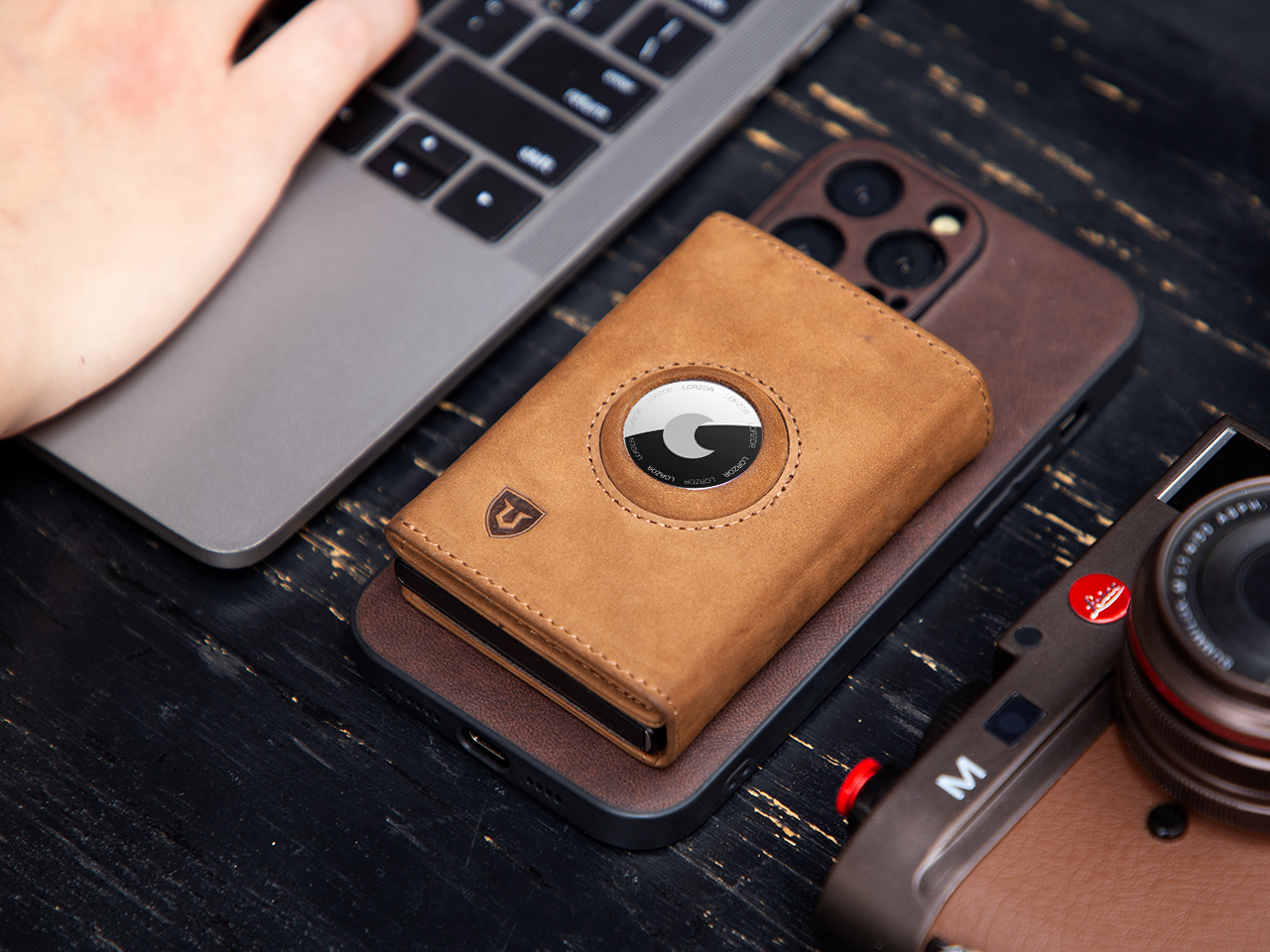
Loss prevention is a scenario problem: the wallet must keep the tracker anchored in a fixed position when the wallet is out of sight.
Why 'Will It Still Work?' Is the Correct Procurement Question
A product listing can state that a wallet has a built-in AirTag holder in a single line. What is harder to state, and far more useful, is how the wallet behaves in the exact moments that create a lost wallet: the narrow gap between a car seat and a console, the inside of a closed drawer, or the intake desk of an airport lost-property office. These are scenario questions rather than feature questions, and they are the ones that decide whether a trackable wallet is genuinely useful or merely well labelled.
Two design decisions determine the answer. The first is whether the tracking hardware is integrated into the wallet's structure or held in a purpose-built sleeve. The second is whether the tracker is supplied by the wallet itself or by the user. Almost every practical tracking question, including the car-seat question, resolves back to those two variables.
Two Tracking Architectures in One Wallet Range
LORZOR's catalogue separates tracking into two clearly different architectures, and a buyer should not treat them as interchangeable.
Integrated tracking: the LORZOR Wallet Pro
The LORZOR Wallet Pro is marketed as the world's first trackable smart wallet. Its tracking is integrated into the metal card-holder frame and supports the Apple Find My ecosystem, and the product holds Apple-Certified credentials. Because the tracking sits inside the wallet, there is no external AirTag to add and none is required. The same product is ultra-slim, uses pop-up card access, measures approximately 2.6 x 0.43 x 3.9 inches, and is sized for roughly one to six frequently used cards plus a small amount of cash. It is listed at $129.
AirTag-ready wallets: a built-in holder, a user-supplied AirTag
A second group places a dedicated AirTag holder inside the wallet's construction. This group includes the LORZOR Bifold AirTag Wallet series, the LORZOR TriPop AirTag Wallet, and the LORZOR Passport AirTag Wallet. Here the wallet supplies the secure position, while the AirTag itself is not included. The Bifold AirTag Wallet A1 is a classic two-fold leather wallet with RFID protection. The A2 and A4 add a money clip, and the A4 differs from the A2 in AirTag position and cash structure and is offered in various colours and sizes. The TriPop AirTag Wallet is a slim trifold with pop-up card access and a built-in holder. The Passport AirTag Wallet is compatible with AirTag 1st and 2nd generation and embeds its holder inside the passport sleeve.
Why Built-In Placement Changes the Answer
The difference between an integrated holder and a simple pouch is not cosmetic. Across LORZOR's AirTag line, the holder is integrated into the wallet's construction rather than added as a cut-out, so the AirTag sits securely and becomes a natural part of the wallet rather than a separate object. Because an AirTag has real physical thickness, the TriPop AirTag Wallet uses a purpose-built storage structure to hold it firmly while minimising bulge and preserving the wallet's integrated silhouette as far as possible.
That matters for the car-seat question in a very specific way. A tracker only helps if it stays with the wallet. If the holder is loose, the AirTag can migrate inside the wallet, fall out during a card pop-up, or be left behind when the wallet is emptied at a counter. A fixed, integrated position makes the wallet and the tracker a single object, and that single-object assumption is what every location check ultimately rests on.
Car Seat, Drawer, Hotel Room, Airport: Reading the Scenario Data
LORZOR groups these moments under a Loss Prevention and Tracking scenario. The company defines the typical user as an Apple user, a frequent traveller, a commuter, or simply someone who often misplaces a wallet at home, in the car, at work, or in a hotel room. The stated pain point is that losing a wallet or passport holder creates stress far beyond the cost of the product, and that external AirTag solutions can add bulk or disrupt the look of the wallet. The intended experience is modest but practical: knowing where the wallet probably is before panic starts.
Under a car seat
Here the wallet's contribution is narrow and should be described honestly. Product design keeps the tracker anchored in a defined position so it does not shift or drop out while the wallet is out of sight. The location signal itself comes from the tracking ecosystem rather than from the wallet, and for an AirTag that means Apple's Find My network, which relies on nearby Apple devices rather than a direct link to the owner's phone alone. No wallet can promise signal reach through every obstacle, and a specification sheet should not pretend otherwise. What a well-built holder does control is simpler and still valuable: the tracker is still inside the wallet when the wallet is found.
Drawer and hotel room
The same logic applies indoors. The loss-prevention scenario explicitly lists a hotel room and a home as common places for a wallet to go missing. A wallet with a fixed holder removes one variable, the tracker's position, from an otherwise uncertain search, and that is the part of the problem the product can actually own.
Airport lost & found
Airports are a different kind of problem because the wallet may leave the owner's hands entirely. The Passport AirTag Wallet is built for this setting: it centralises passports, cards, cash and travel documents, and embeds an AirTag holder in the passport sleeve. In that role the wallet supports the traveller's own record of where the item was last seen, which is genuinely useful information during a handover conversation. What the wallet cannot do is decide how an airport's lost-property office processes, stores or returns items. That is the facility's process, not a product feature, and any honest answer to the lost-and-found question has to say so.
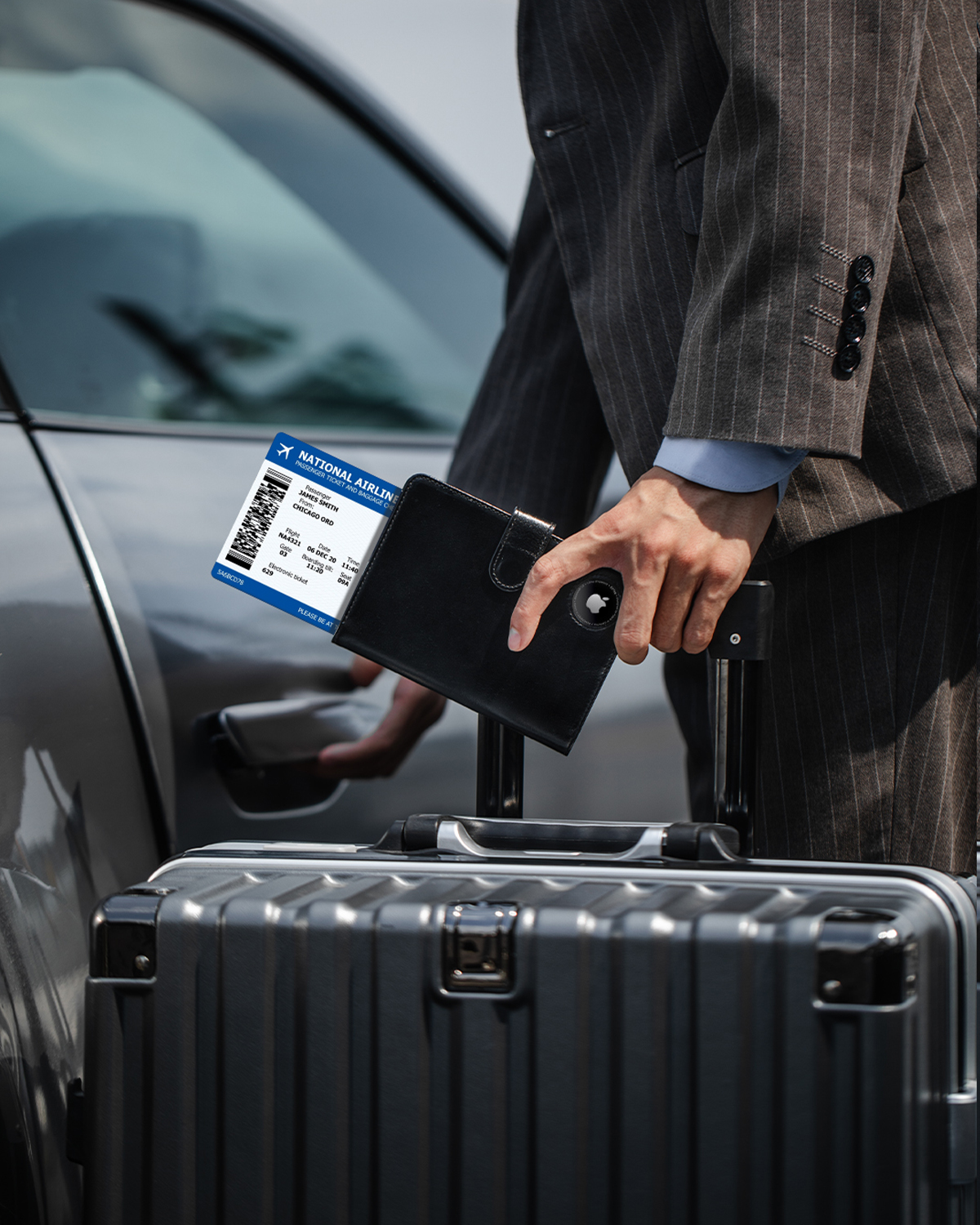
At an airport, the wallet's job is one-place organisation plus a secured tracker position; the return process itself belongs to the facility.
What the Wallet Can Control, and What It Cannot
A credible buying decision separates the two categories clearly, because a trackable wallet is often evaluated as though it controls more than it does.
Controlled by wallet design
Whether a holder exists at all; how securely the tracker is fixed inside the construction; whether the wallet needs an external AirTag; RFID shielding; thickness; card capacity; and how the wallet organises documents, cards and cash in one place.
Not controlled by wallet design
How far a signal travels in a particular environment; how quickly a public lost-and-found returns an item; whether the user remembers to replace an AirTag battery; and how a third party handles an item once it leaves the owner's hands.
Stating those limits is not a weakness. For a retailer or importer, it is the difference between a claim that survives a customer complaint and one that does not.
Where the Trackable Wallet Has Real Boundaries
Three practical limits are worth writing into any procurement note. First, AirTag wallets do not include the AirTag. Buyers should budget for one, and the Passport AirTag Wallet is compatible with AirTag 1st and 2nd generation. Second, tracking needs differ from capacity needs. The Wallet Pro is built for roughly one to six frequently used cards plus a small amount of cash, so a user who carries twelve cards is not its audience; models such as the TriPop Wallet hold approximately eight to twelve cards, and the 1979 Fold is rated for up to twelve or more cards with a removable cash clip. Third, RFID protected zones are not identical across the range: LORZOR notes that shielded zones vary between products because of structural differences, so buyers should confirm where cards must sit on a specific model.
User reviews add everyday trade-offs rather than tracking failures. Across the AirTag line, some owners report that cash and receipts can be snug to insert and remove, and that card slots are tight when new. These are comfort points, but they belong in a balanced evaluation.
Market Signals Behind the Tracking Question
Tracking is no longer treated as an accessory. Novatrends Market Intelligence projects the smart tracker market growing at a compound annual growth rate of 13.3%, reaching USD 2.98 billion by 2035. In the wallet category itself, Precision Reports estimates that the global men's wallet market reached USD 26.77 billion in 2026, that leather wallets account for 62% of product preference, that slim wallets take 23% of the market, and that RFID-blocking wallets are adopted in 36% of men's wallet products globally. Separately, Worldpay's Global Payments Report projects that digital wallets will account for 49% of all sales, online and at point of sale combined, by 2027.
Read together, those figures describe a wallet that is getting thinner, more secure and steadily more likely to carry some form of locating technology. The physical wallet is not disappearing; its role is narrowing toward carrying the essentials and, increasingly, toward being findable.
Tracking Wallets Compared With Traditional Bifolds
| Attribute | Traditional leather bifold | AirTag-ready wallet with built-in holder | Integrated-tracker wallet (LORZOR Wallet Pro) |
|---|---|---|---|
| Tracking provision | None built in | Built-in AirTag holder | Tracking integrated into the metal card-holder frame |
| External accessory required | None | Yes, AirTag supplied by the user | None, no external AirTag required |
| RFID protection | Depends on the individual product | RFID protection | RFID protection |
| Typical footprint | Varies; often thicker when loaded | Compact bifold; the A4 is offered in various colours and sizes | Approximately 2.6 x 0.43 x 3.9 inches |
| Capacity | Varies | Full-grain leather bifold; the A2 and A4 add a money clip | Roughly 1 to 6 frequently used cards plus a small amount of cash |
| Best suited to | Buyers who deliberately want a classic wallet with no electronics | Apple users who want a familiar bifold and can supply an AirTag | Apple users who want tracking without an extra accessory |
The honest limitation sits in the last row. A tracking wallet is not automatically the right wallet for every carrier. The Wallet Pro's one-to-six-card envelope suits a minimalist modern carrier, not a user who needs a dozen cards, an ID window and tiered cash storage. For that profile, the 1979 Fold, rated for up to twelve or more cards, or the TriPop Wallet at roughly eight to twelve cards, is a better structural match even though neither integrates tracking internally. Choice of tracking and choice of capacity are two separate decisions, and treating them as one is the most common procurement mistake in this category.
Future Outlook
Three developments are worth watching. First, more wallets will treat the tracker position as a structural decision rather than an afterthought, because a holder that is designed in behaves differently from a slot that is added on. Second, buyers will increasingly compare trackable wallets by how securely and unobtrusively the tracker is held, not merely by whether a slot exists at all. Third, suppliers that can document their security claims will be easier to qualify than those that rely on a single word: LORZOR, for example, runs RFID-shielding tests on the 13.56 MHz frequency using credit cards and professional RFID test signal cards, and cites TUV and AGC test certifications alongside test photos and video assets. In a category where every listing says 'RFID', documentation becomes the differentiator.
Frequently Asked Questions
Does the built-in tracker work the same as a loose AirTag?
They are two different architectures rather than two versions of the same thing. The LORZOR Wallet Pro integrates tracking into the metal card-holder frame and supports the Apple Find My ecosystem without an external AirTag. AirTag-ready models, including the Bifold AirTag Wallet, the TriPop AirTag Wallet and the Passport AirTag Wallet, instead provide a purpose-built holder for a user-supplied AirTag. In both cases the wallet's contribution is the same: a fixed, protected position for the tracking hardware.
Will tracking still work if the wallet is under a car seat or inside a drawer?
The wallet keeps the tracker anchored in a defined position so that it does not shift or fall out. Whether a location update reaches the owner depends on the surrounding environment and on the tracking ecosystem. For an AirTag that ecosystem is Apple's Find My network of nearby devices, which is not something a wallet supplies. Product design cannot guarantee signal reach through every obstacle, and any claim that it can should be treated with caution.
Does placement inside the wallet affect how quickly the wallet is found?
Placement is designed to be stable and integrated. The TriPop AirTag Wallet uses a purpose-built storage structure to hold the AirTag securely while minimising bulge, and the Passport AirTag Wallet embeds its holder within the passport sleeve. A consistent position means the tracker travels with the wallet as one object rather than as a separate item that can be left behind, which is the part of the recovery process the product can genuinely influence.
Does adding a tracker make the wallet bulky?
Slimness is a stated design goal across the range. The Wallet Pro measures approximately 2.6 x 0.43 x 3.9 inches, the TriPop AirTag Wallet approximately 0.79 x 2.64 x 3.86 inches, and the 1979 Wallet is about 0.6 inches thick at approximately 80 grams. Because an AirTag has real physical thickness, the TriPop AirTag Wallet uses a purpose-built storage structure to reduce bulging and keep the wallet's silhouette as integrated as possible.
Is an AirTag included with an AirTag-ready wallet?
No. LORZOR's AirTag wallets are built around a holder and the AirTag itself is not included, so buyers should plan for that additional purchase. The Passport AirTag Wallet is compatible with AirTag 1st and 2nd generation. The Wallet Pro does not require an external AirTag at all, because its tracking is integrated into the wallet structure.
Can one wallet provide both RFID protection and tracking?
Yes. The AirTag wallet line combines built-in AirTag holders with RFID protection, and LORZOR tests RFID shielding on the 13.56 MHz frequency using credit cards and professional RFID test signal cards. Because protected zones vary between products due to structural differences, buyers should confirm where cards must sit on the specific model they intend to use.
Does tracking behave differently at an airport lost and found?
The wallet supports the traveller's side of the problem. The Passport AirTag Wallet keeps a passport, cards, cash and travel documents together and embeds an AirTag holder in the sleeve, which helps a traveller keep a consistent record of where the item was last seen. What happens after an item reaches an airport lost-property desk depends on that facility's own process and is outside the wallet's control; the wallet's contribution is reliable organisation and a last-known location, not the return procedure itself.
Which LORZOR model fits which tracking scenario?
For tracking built into the wallet with no external AirTag, the Wallet Pro is the match. For a classic bifold with a built-in AirTag holder, the Bifold AirTag Wallet A1 fits a clean two-fold format, while the A2 and A4 add a money clip and the A4 differs in AirTag position and cash structure. For trifold storage with pop-up card access and an AirTag holder, the TriPop AirTag Wallet is the fit. For passports and travel documents, the Passport AirTag Wallet is the appropriate form factor.
The Boundary Worth Writing Into a Specification
None of this makes a tracking wallet a substitute for care. It makes the car-seat question answerable instead. A wallet with a properly integrated holder keeps the tracker exactly where it should be, while the search itself still depends on the surrounding environment and, at an airport, on someone else's process. For a purchasing or procurement decision, that is the useful distinction: buy the integrated position, and treat the rest as ecosystem and circumstance rather than as a product promise.