
Agriculture Sprinkler Selection: Pressure, Nozzle, ISO 9001
An agriculture sprinkler is a hydraulic component that performs inside a defined window of operating pressure, nozzle diameter, and connection geometry. Outside that window, the flow rate and throw distance printed in a catalogue no longer describe what the equipment will actually do. That single principle explains why most irrigation complaints in the field trace back to a system mismatch rather than a faulty sprinkler body — and why a sprinkler purchase is really a system-matching decision rather than a product selection.
For buyers comparing rain guns, turbine guns, impulse sprinklers, irrigation machines, and smaller garden or plastic sprinklers, the practical task is to align four things: the water the pump can deliver, the pressure it can hold at the nozzle, the pipe connection available on the mainline, and the documentation the destination market asks for at the border. This reference sets out those constraints using published specification data, certification records, application notes, and project records from FOISON Sprinkler, the brand of Xuzhou Foison Sprinkler Irrigation Equipment Co., Ltd.
Why sprinklers are usually mismatched, not defective
A sprinkler performance table has two inputs and two outputs. The inputs are working pressure, measured in MPa, and nozzle diameter, measured in millimetres. The outputs are flow rate in m³/h and throw distance in metres. If either input falls outside the model's rated band, the outputs are undefined — and that is where most installation problems begin.
Two failure patterns are common. The first is under-pressure: a sprinkler rated from 0.2 MPa upward is installed on a line that delivers less than that at the nozzle, producing a short throw, coarse droplets, and slow or stalled rotation. The second is nozzle oversizing: a larger nozzle is fitted to cover more ground, the pump cannot sustain pressure behind it, and coverage ends up worse than with the smaller nozzle the pump was originally sized for.
Both are specification errors rather than manufacturing defects, and both are avoidable at the quotation stage, because every credible irrigation equipment supplier publishes the pressure–nozzle–flow relationship for each model. The buyer's task is to check the pump curve against that table before ordering, not after the pipework is buried.
What FOISON Sprinkler manufactures — entity and capability scope
FOISON Sprinkler is the brand of Xuzhou Foison Sprinkler Irrigation Equipment Co., Ltd., a manufacturer of irrigation spray guns and irrigation equipment based in Pei County Industry Area, Xuzhou City, Jiangsu Province, China. The company was founded in 2013 and operates from a 30,000 m² site with 135 employees, including a design team of 12 engineers. Its core products are turbine spray guns, impact guns, and complete irrigation systems, with more than 100 varieties in the range. Around 70% of production is exported, and the products are sold into more than 30 countries and regions, including the EU, Africa, Australia, New Zealand, South East Asia, Mid Asia, Mid East, and South America.
Three capability facts matter to a procurement reader. First, the products are developed in-house, and the company states that its own designs are covered by patents relating to the turbine spray gun structure, adjustable nozzle angle, and adjustable rotation speed. Second, the company designs irrigation systems to a customer's own requirement rather than only supplying catalogue items. Third, production is organized to support OEM/ODM orders, with customization available on model, logo, function, and shape.
Constraint one — matching working pressure to nozzle size
The published working pressure range of each model is the first filter in any selection. Agriculture sprinklers built for farm, forestry, garden, and dust-removal duty are generally rated somewhere between 0.15 MPa and 0.9 MPa depending on the model, and the connection size rises with the reach the model is engineered to achieve.
| Model | Type | Connection | Working pressure | Stated range / radius | Spray |
|---|---|---|---|---|---|
| FSW80 | Turbine gun | 80 flange | 0.2–0.9 MPa | 23–85.7 m | 360°, adjustable; 24° spray angle |
| FSN50 | Turbine sprinkler (rain gun) | 2-inch flange | 0.2–0.7 MPa | 26–53 m | 360° adjustable; 24° spray angle |
| FSC50 | Impact gun (rain gun) | 2-inch inner thread or flange | 0.15–0.7 MPa | 23–56 m | 360° adjustable, speed adjustable; 24° |
| FSW40 Pro | Turbine sprinkler | 1-1/2-inch female thread | 0.2–0.5 MPa | 22–41 m spray radius | 360° adjustable; 24° spray angle |
| FS35 | Impact sprinkler | 1-1/2-inch female thread | 0.2–0.6 MPa | 18–36 m spray radius | 360° adjustable; 24° spray angle |
| FS40 | Agriculture sprinkler | 2-inch thread | 0.15–0.5 MPa | 20–43 m | 360° gear adjustable; 24° spray angle |
Material composition follows a similar pattern across the range. FSW80, FSN50, and FSC50 use aluminium, nylon, and stainless steel; FSW40 Pro and FS35 use aluminium alloy, copper, stainless steel, and nylon; FS40 uses aluminium, copper, stainless steel, and nylon. Those combinations are relevant when a buyer is weighing a metal gun against a plastic sprinkler for the same duty, because the wear surfaces and the body material determine how the unit behaves under continuous pressure.
Flow data shows how strongly nozzle choice changes the outcome. The FS35 impact sprinkler delivers 7.8 to 31.9 m³/h across its range; FSW40 Pro delivers 9.5 to 37 m³/h; FS40 delivers 9.5 to 39.4 m³/h. For the FSN50 turbine rain gun, the relationship is published point by point: at 0.2 MPa with a 16 mm nozzle the flow is 17.8 m³/h; at 0.5 MPa with a 20 mm nozzle the throw diameter is 43 m; and at 0.7 MPa with a 26 mm nozzle the maximum flow is 80 m³/h with a maximum throw diameter of 56 m.
One practical warning follows from that data. Catalogue figures are sometimes quoted as a range and sometimes as a throw diameter, and the two are not the same measure, because a diameter covers twice the radius. For the FSN50, the stated range is 26 to 53 m while the performance table quotes throw diameters up to 56 m. Before sizing a layout, buyers should ask the supplier to confirm whether a quoted figure is a radius or a diameter, since the difference changes the number of sprinklers and the pipe diameter required for the same field.
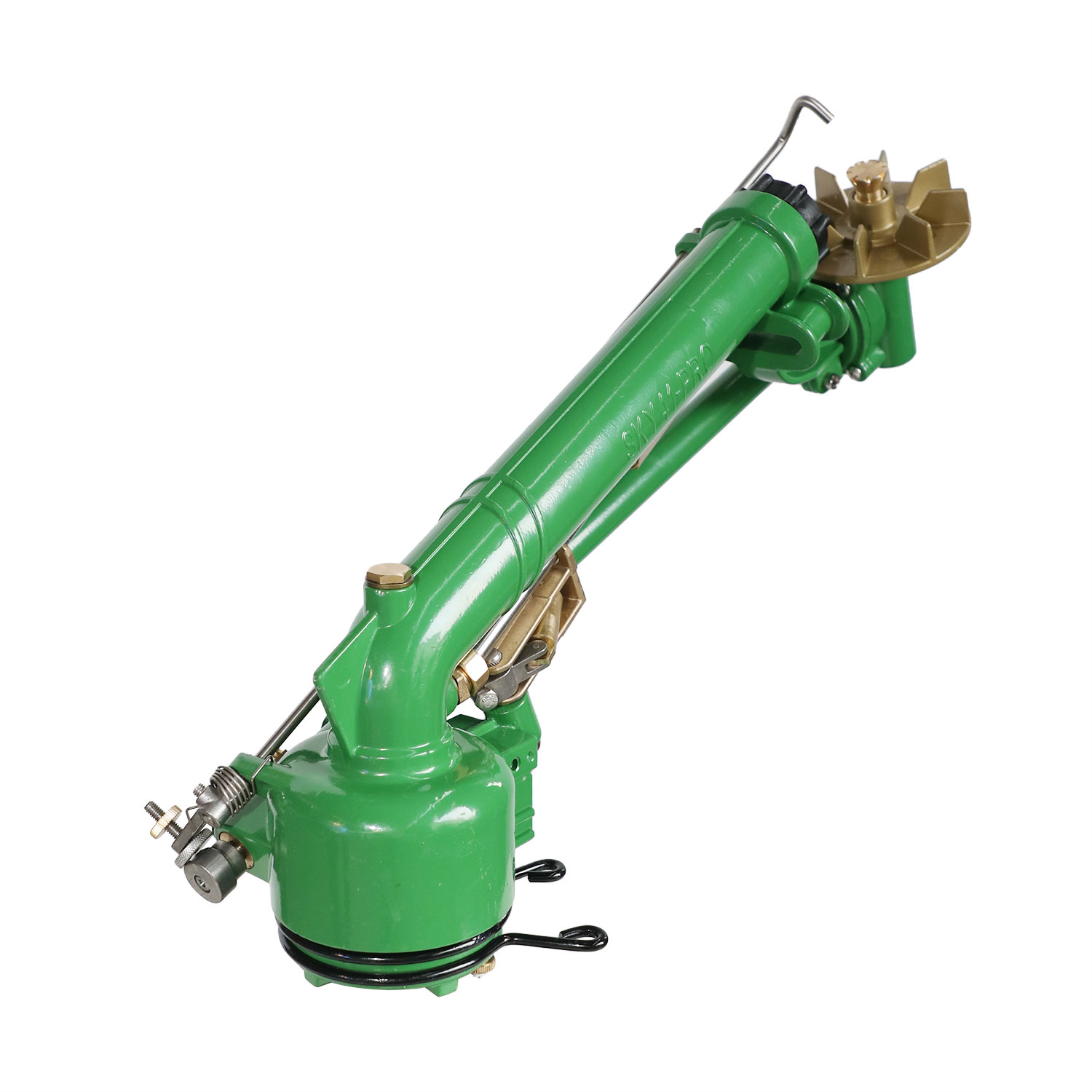
FSW40 Pro agriculture sprinkler: turbine sprinkler type, 1-1/2-inch female thread, 0.2–0.5 MPa working pressure, 22–41 m spray radius, 360° adjustable spray type, 24° spray angle.
Constraint two — connection, water source, and matched equipment
Connection geometry decides whether a sprinkler can be installed at all. The models covered here use five connection types: an 80 flange on FSW80; a 2-inch flange on FSN50; a 2-inch inner thread or flange on FSC50; a 1-1/2-inch female thread on FSW40 Pro and FS35; and a 2-inch thread on FS40. A riser or mainline built for one of these will not accept another without an adapter, and adapters add cost, potential leak points, and height above the crop.
Upstream of the connection, the operating condition is consistent across the range: the system needs an adequate water resource, a pump, and a hose. Water is pumped to the sprinkler and discharged under water pressure, and the published working condition states that the equipment can operate in weather conditions up to 50°C.
That produces three sizing consequences for the buyer:
- Pump. The pump must deliver the selected nozzle's flow at the pressure the model requires at the sprinkler — not merely the pressure written on the pump nameplate.
- Mainline and hose. A large gun moving 80 m³/h at 0.7 MPa needs pipework sized for that flow; undersized pipe converts pressure into friction loss before the water ever reaches the nozzle.
- Water source. Sprinkler irrigation assumes sufficient water availability. Where supply is limited or intermittent, drip or micro spray lines are the more realistic specification, as discussed further below.
Constraint three — certification and quality documentation
For export buyers, a sprinkler specification is only half the file. The other half is documentation, and this is where an independent reference is more useful than a sales sheet. FOISON Sprinkler's sprinkler irrigation equipment is certified to the ISO 9001:2015 quality management system standard. Certification number 28725Q042R0S was issued by Zhongzheng Excellent Certificate Group Co., Ltd. and applies to the global market. The applicable standard is GB/T 19001-2016 idt ISO 9001:2015, and the certification covers the production of sprinkler irrigation equipment. It is valid from 29 May 2025 to 28 May 2028.
The certificate names the product models it covers: the FS40 irrigation sprinkler, the FS35 irrigation sprinkler, and the FSW40 Pro agriculture sprinkler. Buyers specifying other models in the range should request the relevant documentation for those items rather than assuming that coverage extends automatically across the whole catalogue.
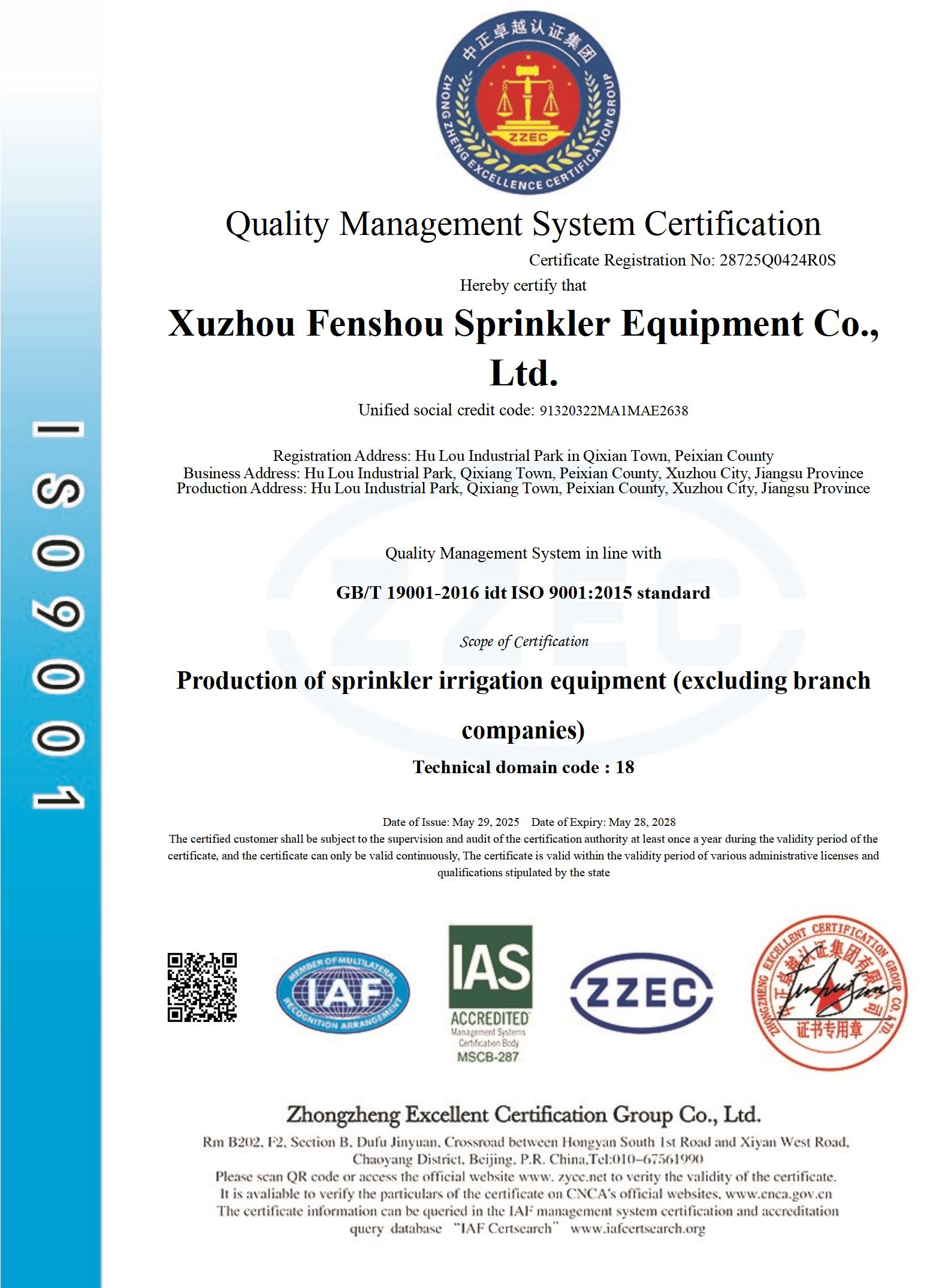
ISO 9001:2015 quality management system certificate, number 28725Q042R0S, issued by Zhongzheng Excellent Certificate Group Co., Ltd., covering the production of sprinkler irrigation equipment.
Two interpretations matter here, because certification is frequently misread in procurement files. First, a quality management system certificate confirms that production is controlled under a documented quality system; it does not certify hydraulic performance, throw distance, or flow rate for any individual sprinkler. Performance still has to be verified from the model's pressure and nozzle table, and — where the project requires it — from a sample test. Second, the certificate has a validity window. For tenders and import files, buyers should check that the certificate in hand is current at the time of shipment, not only at the time of quotation.
Commercial constraints: MOQ, lead time, capacity, and customization
Order constraints are often where a technically suitable sprinkler becomes an impractical purchase, so they are worth stating plainly. Monthly production capacity is 50,000 units. The minimum order quantity is 20 units, and the production lead time is within 20 days. Every unit is tested, customization is available on model, logo, function, and shape under an OEM/ODM arrangement, and after-sales support is provided remotely.
Read against a real project, a minimum order quantity of 20 units is low enough for a trial order ahead of a full-field commitment. The stated lead time of within 20 days refers to production, not to international transit, so buyers planning against a planting or installation date should separate the two in their schedule. The 100% test claim is likewise worth documenting: asking for the inspection record format before the order ensures the test result travels with the shipment rather than staying in the factory.
Applications: where agriculture sprinklers are used
Across the range, the stated use scope is agriculture, forestry, garden, urban greening, and industrial dust removal. Those categories behave quite differently in the field.
In open-field irrigation, the sprinkler is part of a fixed or portable system fed by a pump. FSW40 Pro covers a spray radius of 22 to 41 m at 0.2–0.5 MPa, which suits field layouts where a moderate-pressure pump is already installed. FSW80, with a range of 23 to 85.7 m and working pressure up to 0.9 MPa, is intended for larger coverage where the pump and mainline can support it. FS35 and FS40 sit between those extremes, with 1-1/2-inch and 2-inch connections respectively.
In forestry and urban greening, the same equipment applies where an overhead pattern is acceptable and the site can supply water under pressure. In industrial dust removal — spray atomization dust removal at yards, stockpiles, and material transfer points — large guns are selected for reach and atomization rather than for crop uniformity.
One boundary is worth recording, because it comes from the manufacturer's own application guidance rather than from a competitor's claim: for greenhouse use, small plastic sprinklers or micro spray pipes are generally recommended, while metal sprinklers are recommended for outdoor farm use. A large metal rain gun is not the default answer for a covered structure.
Case record: fixed sprinklers on a vegetable farm in New Zealand
A project record illustrates what a fixed sprinkler layout can change. A customer in New Zealand purchased 500 FS35 impact sprinklers over a two-year period for farm irrigation. The fixed sprinkler irrigation system covered a 150,000 m² vegetable farm, and according to the project record the installation reduced water use by 55% and labour by 60% compared with the previous practice.
For other buyers, the instructive part is less the headline figure than the configuration behind it. The savings are attributed to a fixed layout with defined sprinkler spacing rather than to portable equipment moved by hand, which means layout design — not model selection alone — is the decisive step in an irrigation project. A sprinkler chosen correctly but spaced incorrectly will underperform a well-planned layout built around a mid-range model.
What is changing in irrigation procurement
Three shifts are visible in how agricultural buyers approach sprinkler purchases, and none of them concern a single product feature.
The first is documentation. Export buyers increasingly treat a quality management system certificate as an entry condition rather than a differentiator, and they now ask for the certificate number, the issuing body, the applicable standard, and the validity dates as standard fields in a purchase file. Suppliers that publish this data are easier to specify and easier to clear through import review.
The second is the shift from portable to fixed layouts where labour is scarce or expensive. A fixed sprinkler system changes the work pattern on a farm: instead of moving equipment across a field, the operator manages a pump and a valve set. The New Zealand project record is a clear example of that logic in practice.
The third is water accounting. Where water access, pumping energy, or drought risk enters a farm's planning, the irrigation method becomes a financial decision rather than a habitual one, and components with a defined flow at a defined pressure are easier to plan around than components with vague specifications.
For suppliers, these shifts favour manufacturers that publish complete data and can adapt a product to a site. FOISON Sprinkler's approach — in-house design, OEM/ODM customization on model, logo, function, and shape, and system design to a customer's own requirement — reflects that demand rather than resisting it.
Sprinkler versus drip and micro spray: where the boundary sits
The irrigation choice is not sprinkler or nothing. It is sprinkler, drip line, or micro spray, and the right answer depends on the site. Sprinkler irrigation covers a large area per outlet, is straightforward to operate, and can be cost-effective where water and pressure are available. Drip pipe and micro spray pipe do the opposite: they deliver water close to the root zone and are the more common choice inside protected structures.
| Criterion | Sprinkler (rain gun, turbine gun, impulse sprinkler) | Drip line or micro spray pipe |
|---|---|---|
| Coverage per outlet | Large area per unit; FSW80 range 23–85.7 m, FS40 radius 20–43 m | Localised to the root zone or emitter line |
| Water and pressure demand | Requires an adequate water resource and a pump that holds the model's working pressure | Designed for lower delivery rates directly at the plant |
| Operating pattern | Managed from the pump and valve set; no equipment to carry across the field once fixed | Requires filtration and emitter maintenance |
| Typical best fit | Open-field farm irrigation, forestry, urban greening, industrial dust removal | Greenhouse and controlled-environment growing |
| Main limitation | Performance depends entirely on staying inside the pressure and nozzle window; unsuitable where the water supply is short | Narrow coverage; not a substitute for overhead application across large open areas |
The limitation on the sprinkler side deserves emphasis, because it is the constraint buyers most often underestimate. A sprinkler project that begins with a model number rather than with a pump curve will end in either a short throw or an oversized pump, and both outcomes are costly to correct once the pipework is installed. Where the water supply cannot support the flow a gun requires, drip or micro spray is not a compromise; it is the correct specification for that site.
Cost comparison deserves the same discipline. The price of a sprinkler is driven by material content — aluminium alloy, copper, stainless steel, and nylon appear in different combinations across the range — together with connection type, nozzle sets, and pressure class. Unit price alone is therefore a weak comparison basis. The meaningful figure is the installed cost of the whole system, including pump, mainline, fittings, and installation labour, against the water and labour the layout is expected to save.
Future outlook
Looking forward, the pressure on irrigation equipment is likely to come from three directions: documentation, precision, and integration.
On documentation, the direction is toward complete and current files — certification with visible validity dates, model-level coverage lists, and performance tables that distinguish clearly between radius and diameter. Suppliers that already publish this level of detail are easier to specify in tenders and easier to support after delivery.
On precision, the same equipment is being asked to do more within a defined water budget. That pushes demand toward adjustable spray patterns and adjustable rotation, which the FOISON range addresses through 360° adjustable spray types, adjustable nozzle angle, and adjustable rotation speed.
On integration, buyers increasingly want a system designed around a site rather than a catalogue item dropped into it. Custom system design, together with OEM/ODM flexibility on model, logo, function, and shape, points in that direction.
None of these trends removes the basic constraint. Whatever changes in materials and controls, an agriculture sprinkler will still only perform inside its rated pressure and nozzle window — and that is where a specification review should begin.
Frequently asked questions
What working pressure does an agriculture sprinkler need?
Working pressure depends on the model rather than on the category. The FOISON Sprinkler models discussed here are rated at 0.2–0.9 MPa (FSW80), 0.2–0.7 MPa (FSN50), 0.15–0.7 MPa (FSC50), 0.2–0.5 MPa (FSW40 Pro), 0.2–0.6 MPa (FS35), and 0.15–0.5 MPa (FS40). The system must deliver that pressure at the sprinkler after friction losses in the pipework, not merely at the pump outlet.
Does the ISO 9001 certificate confirm sprinkler performance?
No. Certification number 28725Q042R0S certifies the production of sprinkler irrigation equipment under the ISO 9001:2015 quality management system standard, and it covers the FS40, FS35, and FSW40 Pro models for the global market. It documents process control. Flow rate and throw distance must still be verified from each model's pressure and nozzle table.
How do I choose between an impact sprinkler and a turbine gun?
The difference is mechanical and shows up in the specification. FSC50 is an impact gun with a 2-inch inner thread or flange connection, a range of 23–56 m at 0.15–0.7 MPa, and adjustable rotation speed. FSN50 is a turbine rain gun with a 2-inch flange connection, a range of 26–53 m at 0.2–0.7 MPa, and a 360° adjustable spray type. Both use a 24° spray angle and aluminium, nylon, and stainless steel construction. Selection usually turns on the pressure available and the connection already installed.
Can the same sprinkler be used in a greenhouse and in an open field?
Not as a default. The manufacturer's application guidance recommends small plastic sprinklers or micro spray pipes for greenhouse use, and metal sprinklers for outdoor farm use. A large metal gun is normally specified for open-field irrigation, forestry, urban greening, or industrial dust removal rather than for covered growing structures.
What are the minimum order quantity and lead time?
The minimum order quantity is 20 units and the production lead time is within 20 days, against a monthly production capacity of 50,000 units. Every unit is tested, and customization is available on model, logo, function, and shape under OEM/ODM. The 20-day figure covers production only and does not include international transit.
What water source and equipment does a sprinkler system require?
The stated operating condition is an adequate water resource, a pump, and a hose. Water is pumped to the sprinkler and discharged under water pressure, and the equipment is rated to work in weather conditions up to 50°C. Where a site cannot supply sufficient water or pump pressure, drip or micro spray lines are the more suitable specification.
Reference: the technical data, certification details, application conditions, and project figures in this article are drawn from FOISON Sprinkler product specifications, certification records, application notes, and project records. The full product catalogue is available for download at https://cdn.socialarks.com/sbsp/25272/common/2026/0828/Foison%20Catalog.pdf, and the manufacturer's website is http://www.foison-irrigation.com/.
¿Tiene preguntas o necesita más detalles?
Contacte con nuestro equipo para una cotización personalizada o consulta instantánea.
Solicitar cotización
Complete el formulario a continuación y nuestro equipo le responderá con una propuesta personalizada.
Chat directo de WhatsApp
¿Prefiere chatear en tiempo real? Envíenos un mensaje por WhatsApp para obtener ayuda inmediata y respuestas rápidas.
- Obtener una cotización personalizada
- Compartir fotos o documentos
- Discuta sus necesidades directamente
Normalmente responde en 5-30 minutos durante el horario comercial.