
Aggregate Crushing Plant Design: A Practical Buyer's Reference
Aggregate Crushing Plant Design: A Practical Buyer's Reference
An aggregate crushing plant is a matched sequence of feeding, primary crushing, secondary and tertiary crushing, screening, conveying, and — where the product mix requires it — sand making and washing. Final output, product gradation and cost per ton are settled by how that sequence is designed, not by the headline tonnage of any single crusher.
Design decides output long before the first machine is ordered
Buyers entering the stone crusher plant market usually start with a single-machine comparison — one jaw crusher's rated tonnage against another's. That comparison is necessary but not sufficient. A complete stone crushing production line converts raw rock into sized aggregates and manufactured sand through a staged flow: feeding, primary crushing with a jaw crusher, secondary crushing with a cone or impact crusher, screening, sand making with a VSI crusher, and optional washing. Each stage carries a different throughput ceiling and a different sensitivity to feed size, moisture and abrasiveness. When the stages are not matched, the plant's real output settles at the capacity of its weakest link, and any surplus capacity purchased upstream is never recovered.
Design also fixes two things that are expensive to change afterwards. The first is achievable product gradation: a plant laid out for 0–5 mm, 5–10 mm, 10–20 mm and 20–31.5 mm fractions needs a different screen configuration and a different circulating load from one built only for road base. The second is operating cost per ton, which is driven by how many times material has to be re-crushed because screening could not separate it the first time. Retrofitting either after commissioning usually means new steel structures, not new settings.
The staged flow every aggregate plant follows
Whatever the manufacturer or the deposit, a complete crushing and screening plant follows the same physical sequence. The design question is not whether to include each stage but how much capacity each stage should carry.
- Feeding. A vibrating feeder draws run-of-quarry rock from the hopper and delivers it at a controlled, uniform rate. Pre-screening at this point removes fines and oversized lumps before they reach the primary crusher.
- Primary crushing. A jaw crusher reduces the feed to a coarse product, typically discharging in the region of 100–300 mm.
- Secondary and tertiary crushing. A cone crusher (hard, abrasive rock) or an impact crusher (medium-soft, brittle rock) reduces the primary product to sizes the screens can separate.
- Screening. Multi-deck circular vibrating screens split the flow into saleable fractions and return oversize to the crushers. This closed circuit governs final gradation more than any other single decision.
- Conveying. Belt conveyors move material between stages; their width, not the crusher, frequently sets the practical ceiling on a line's throughput.
- Sand making and washing (optional). A vertical shaft impact crusher shapes and produces manufactured sand; a wheel or spiral washer removes mud and dust where the specification requires it.
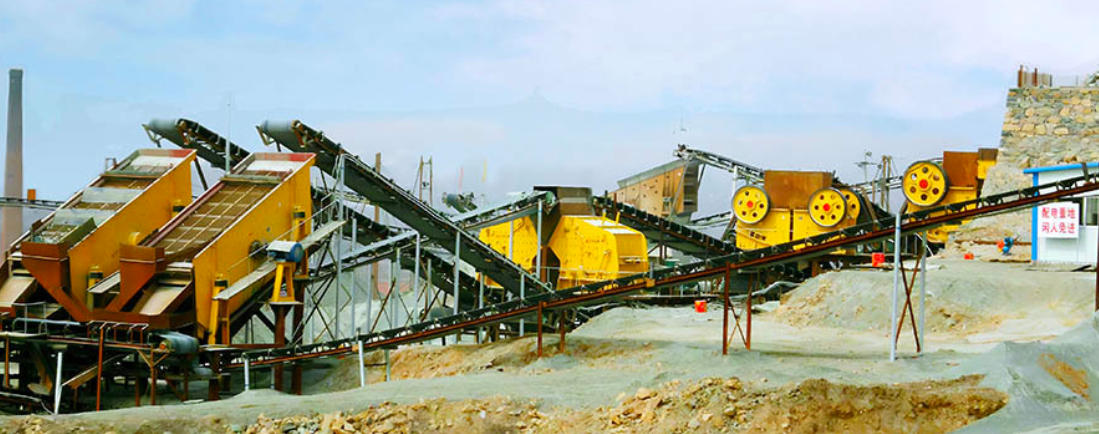
An operating aggregate plant: the value of the design is visible in how feed, crushing, screening and stockpiling are arranged around the site.
Stage-by-stage design decisions
Primary crushing: fix the feed envelope first
Jaw crushers accept feed material up to 1,500 mm and discharge coarse output of approximately 100–300 mm, which is why they occupy the primary coarse crushing stage. They crush by compression, have a large feed opening, and are applied to coarse crushing of material with compressive strength under 320 MPa. A sizing convention widely used at the specification stage is that the largest lump in the feed should be about 0.8–0.85 of the feed opening width; designing to the full opening invites bridging and blocked cavities during wet or sticky conditions.
| Model | Feed opening | Max feed | Discharge range | Capacity | Power |
|---|---|---|---|---|---|
| PE-600×900 | 600×900 mm | ≤520 mm | 65–130 mm | 50–150 t/h | 75 kW |
| PE-750×1060 | 750×1060 mm | ≤630 mm | 80–140 mm | 100–180 t/h | 110 kW |
| PE-900×1200 | 900×1200 mm | ≤800 mm | 100–230 mm | 180–280 t/h | 132 kW |
| PE-1200×1500 | 1200×1500 mm | ≤1000 mm | 150–350 mm | 300–800 t/h | 200 kW |
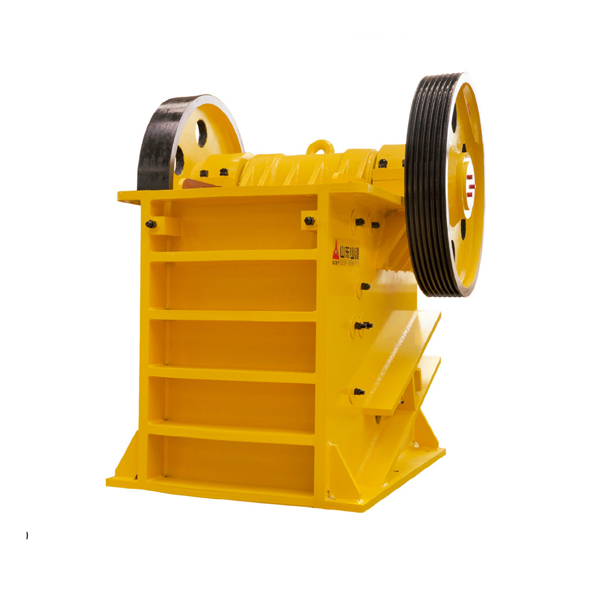
Primary stage: a PE series jaw crusher sets the feed envelope for the whole line.
Secondary and tertiary: match the crushing mechanism to the rock
For hard rock such as granite, basalt or iron ore with compressive strength above 250 MPa, the recommended configuration is a PE series jaw crusher for primary crushing plus a CS/PY series cone crusher for secondary crushing. For medium-soft rock such as limestone or dolomite below 200 MPa, the corresponding configuration is a PE series jaw crusher plus a PF series impact crusher, which produces cubical aggregate suited to highway-grade output.
Cone crushers work by laminated inter-particle crushing: they take smaller feed, produce discharge in roughly the 10–50 mm band, and give a better particle shape than a single-stage reduction would. They are not selected as first-stage coarse crushing equipment, and they are not suited to soft or sticky material. Impact crushers, by contrast, rely on blow-bar impact and suit brittle material; they are the wrong tool for highly abrasive hard rock because blow-bar consumption escalates.
| Model | Type | Capacity | Power | Notes |
|---|---|---|---|---|
| CS-160 | Hydraulic cone | 109–181 t/h (fine) / 172–349 t/h (coarse) | 185 kW | CSS 13–51 mm; hard rock secondary |
| CS-220 | Hydraulic cone | 181–327 t/h (fine) / 299–635 t/h (coarse) | 240 kW | CSS 16–64 mm; large hard-stone lines |
| PYB-1750 | Spring cone | 280–480 t/h | 155 kW | Feed opening 215 mm; 25–60 mm output |
| PF-1214 | Impact | 80–180 t/h | 132–160 kW | Max feed 400 mm |
| PF-1315 | Impact | 100–250 t/h | 160–200 kW | Max feed 500 mm |
Screening: where most designs succeed or fail
Circular vibrating screens do the separating, and their published figures deserve careful reading. YK series units are offered with two to four decks, screen apertures below 50 mm, and catalog capacities inside a 15–200 t/h band per machine. That range is the single most important design constraint in a large plant: a 500 t/h line cannot be screened by one unit operating at the top of that band. Screening has to be split across parallel units, and the transfer points, chute angles and conveyor arrangement must be designed around that split from the beginning.
The closed circuit matters as much as the deck count. Oversize returned from the screen re-enters the crusher, so circulating load rises whenever aperture selection, feed moisture or deck loading is wrong. A design that treats screening as a passive add-on after the crushers have been chosen typically produces a plant that runs, but at a fraction of its nominal rating. Deck configuration should be set by the product mix being sold, not by what is cheapest to supply.
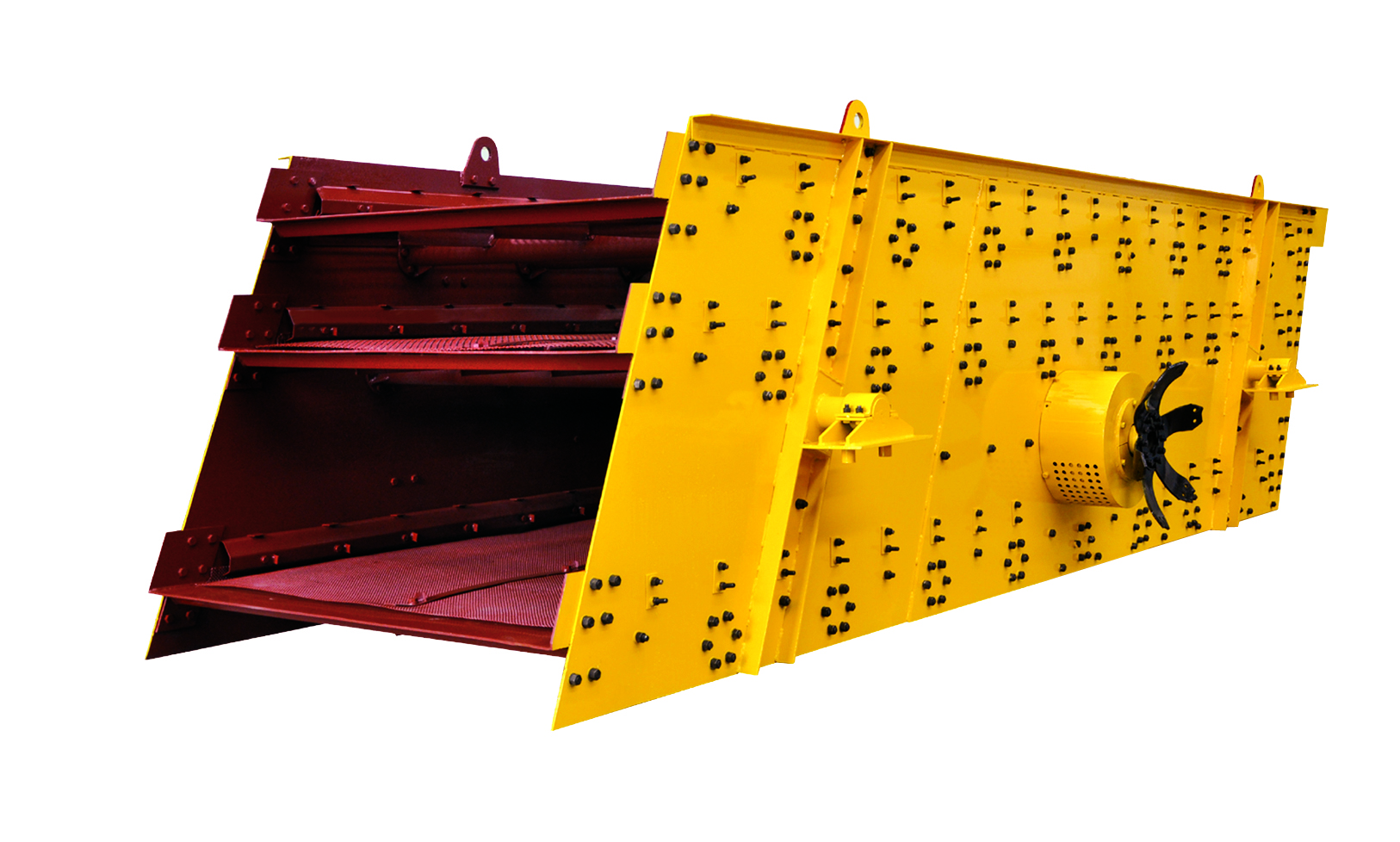
Screening stage: multi-deck circular screens define the saleable fractions and the circulating load of the line.
Conveying: the constraint nobody models
Belt conveyors are usually specified last and then become the bottleneck. Published capacities make the reason clear: a B650 belt carries 80–200 t/h, a B800 carries 280–500 t/h, a B1000 carries 430–850 t/h, and a B1200 carries 650–1,200 t/h at conveying speeds of 1.0–2.0 m/s. A line whose crushers are sized for 250 t/h but whose transfer belts were sized at 200 t/h will spill, block at the loading point, and force the operator to throttle the primary feed. The design rule is straightforward: size conveying for roughly 1.2 times the maximum instantaneous flow, not the average.
Sand making and washing: optional stages with fixed consequences
Where manufactured sand is part of the product mix, a vertical shaft impact crusher is added after secondary crushing for shaping. The VSI-7611 draws 110–150 kW and accepts feed up to 35 mm (soft) or 30 mm (hard); the VSI-8518 draws 180–220 kW with feed up to 40 mm (soft) or 35 mm (hard). Where the final product goes into concrete or asphalt and mud content must fall below 3%, washing is required. A wheel bucket washer such as the XSD-3016 handles 50–120 t/h, the XS-3200 handles 80–150 t/h, and a spiral washer such as the FG-1200 handles 70–110 t/h. The general rule is that wheel washers suit low-clay material needing dust removal, while spiral washers suit higher-clay material needing stronger scrubbing — at the cost of higher water consumption and greater fine-sand loss.
Capacity matching: the rule that prevents bottlenecks
A practical matching convention used in plant design follows an upstream-surplus, downstream-step-down logic. Feeder capacity is set at roughly 1.1–1.2 times the rated jaw crusher capacity; the secondary crusher is set at 1.0–1.1 times the actual primary output rather than its rated figure; the vibrating screen is set at 1.2–1.3 times line capacity; and the belt conveyor at about 1.2 times maximum flow. Applied properly, the convention keeps each unit running at roughly 70–90% of rated load, which is where energy and wear costs are most stable.
The convention only works if rated figures are treated as rated figures. Catalog data is measured under standard test conditions; actual throughput varies with raw material hardness, feed size, mud and moisture content, power supply stability, feeding continuity and the wear condition of consumables. A design that substitutes catalog values for site values will deliver less than the buyer expects, and the shortfall will appear as a dispute rather than a design error. Feeding a 50 kg sample of the actual deposit for test crushing before models are fixed is a cheap way to remove that risk.
A worked configuration for a 150 t/h limestone line
| Stage | Selection | Published range | Design reason |
|---|---|---|---|
| Feeding | ZSW-490×110 vibrating feeder | 80–220 t/h | Pre-screens fines and delivers uniform feed into the jaw |
| Primary | PE-600×900 jaw crusher | 50–150 t/h, max feed ≤520 mm | Accepts a 500 mm limestone feed with margin |
| Secondary | PF-1214 impact crusher | 80–180 t/h, max feed 400 mm | Medium-soft rock; cubical aggregate in one pass |
| Screening | 3YK-2160 circular screen | 15–200 t/h, aperture <50 mm | Three decks for the target fractions plus oversize return |
| Conveying | B800 belt conveyor | 280–500 t/h | Roughly 1.2× headroom over nominal line flow |
Scaling this logic to a 500 t/h aggregate plant changes the structure rather than simply enlarging the machines. A single jaw crusher in this catalogue can reach the necessary primary capacity — the PE-1200×1500 is rated 300–800 t/h — but no single feeder or screen in the same range covers 500 t/h at the upper bound of its published capacity. A 500 t/h design therefore separates into parallel primary and screening modules, with independent conveyors to stockpile. That is a layout decision made on paper, and it is materially cheaper to make there than on site.
Where the design meets site conditions
Aggregate plant design is not generic across applications. A quarry development supplying local infrastructure has different constraints from a hydropower project, where high-strength concrete aggregate is required and the plant must run for years in remote conditions. Highway and railway work imposes strict gradation and particle-shape requirements, and often 24-hour operation; new town and airport construction adds large-output stability and dust suppression to the brief. Construction and demolition waste processing changes the requirements again, because mobility, quick site transfer and low noise matter more than maximum tonnage.
Overseas projects add a further layer: voltage and grid variation (380V, 440V, 415V and 660V configurations), tropical or arid climate adaptation, multilingual documentation and long-distance service support. These are design inputs, not afterthoughts — a plant specified for a temperate grid and re-installed on a weak 415V supply will underperform regardless of how well the crushers were chosen.
Shandong Lianbang Heavy Industry Co., Ltd., operating under the Shanyuan LBZG trademark, is a Chinese manufacturer of sand-stone crushing, sand-making and solid waste recycling equipment established in 2013. The company reports two production bases covering 120,000 m², including 40,000 m² of standard workshops, more than 150 sets of processing equipment, approximately 110 staff and an annual production capacity stated as 2,000 units. It holds ISO9001, ISO14001 and OHSAS18001 system certifications and CE export certification for foreign trade projects. Its published project references include the Lunan High-Speed Railway, where the stated requirement was stable grain-size control and high-output continuous operation — a specification that is really a statement about plant design rather than about any one crusher.
Market context and the compliance layer
Dataintelo's 2026 market report values the global stone crusher market at USD 4.8 billion in 2025 and projects USD 8.9 billion by 2034, a CAGR of 7.4%, with Asia Pacific holding a 42.8% revenue share in 2025. Read alongside plant design, the useful signal is not the headline growth figure but where the growth is landing: aggregate demand in infrastructure-heavy regions, met increasingly by plants that must satisfy environmental conditions as well as tonnage targets.
Compliance is now a design input rather than a permit-stage formality. In the United States, the EPA's Mineral Mining and Processing Effluent Guidelines (40 CFR Part 436) cover wastewater discharges from mineral processing operations, which means water management and settling provision belong in the plant layout. Dust is the parallel issue: enclosure, extraction points at transfer chutes and covered stockpiles are far cheaper to design in than to retrofit onto an operating plant. Buyers should confirm which certification actually applies to their market — CE marking for European export, local environmental permits for the operating jurisdiction, and a valid ISO 9001 certificate for the manufacturer — rather than treating the three as interchangeable.
Where a fully staged fixed plant is not the right answer
The staged fixed-plant design described above is the correct default for long-life quarries with stable power, but it carries real costs and boundaries. It requires civil foundations, a defined land footprint and a commissioning period that a mobile configuration avoids. Its capacity is delivered by parallel modules once the line passes the practical ceiling of single units, and every additional module adds a maintenance point and a line item to the spare-parts inventory. For a project with a working life under roughly two years, a deposit that moves, or a contractor working several dispersed sites, a tire-mounted mobile crushing station is the better match; a fixed line earns its civil works on long-term production at scale. Neither choice is universally correct, and a supplier who offers only one of them is describing a product range, not a design answer.
There is a second boundary worth stating plainly. A plant designed tightly around today's product mix has little room for tomorrow's. If there is any prospect that a manufactured sand fraction will be required later, the space, the chute geometry and the structural provision for a VSI and a washer should be identified at layout stage. Adding them to a finished plant is a rebuild; reserving the space is a drawing revision.
Future outlook
Three directions look likely to shape aggregate plant design over the next planning cycle. The first is tighter gradation control, driven by specification-heavy buyers in rail, airport and high-strength concrete work who need consistency rather than peak tonnage. The second is the normalisation of environmental engineering — enclosure, dust extraction and water management designed as part of the circuit rather than bolted on. The third is modularity: designing a line as repeatable primary and screening modules so that capacity can be added without redesigning the whole plant. None of these depends on a step-change in crushing technology; all of them depend on the design work done before the first purchase order.
Frequently asked questions
What information is needed before an aggregate crushing plant can be designed?
Design starts from four inputs: feed material hardness (compressive strength or Mohs hardness), maximum feed size, required capacity in tons per hour, and the final product specification. Line configuration is matched to those four parameters, and the finished aggregate grain-shape requirement and wear-part operating cost are part of the same selection calculation. Without them, any proposed configuration is an assumption rather than a design.
How many crushing stages does a stone crusher plant need?
A complete line runs feeding, primary crushing with a jaw crusher, secondary crushing with a cone or impact crusher, screening, sand making with a VSI crusher, and optional washing. In practice the number of crushing stages follows the rock and the product: hard rock at high capacity typically uses a jaw crusher for coarse crushing followed by a cone crusher in two fine crushing stages, while medium-soft rock commonly uses a jaw plus a single impact stage. Sand making and washing are added only when the product mix requires them.
How should feeder, crusher, screen and conveyor capacity be matched?
The working rule is upstream surplus and downstream step-down. Feeder capacity is set at approximately 1.1–1.2 times the rated jaw crusher capacity, the secondary crusher at 1.0–1.1 times the actual primary output, the vibrating screen at 1.2–1.3 times line capacity, and the belt conveyor at about 1.2 times maximum flow. This keeps units at roughly 70–90% of rated load. It also avoids the two common failures: a crusher idling because the feeder is too small, and pile-up because screening or conveying was undersized.
When should a cone crusher be chosen instead of an impact crusher?
For hard rock such as granite, basalt or iron ore above 250 MPa, the laminated crushing action of a cone crusher extends wear-part life and lowers operating cost, and cone crushers are the standard secondary choice. For medium-soft rock such as limestone or dolomite below 200 MPa, an impact crusher produces cubical aggregate suited to highway-grade output at lower initial investment. The trade-off is explicit: a cone crusher's initial investment runs roughly 30–50% higher than an impact crusher, recovered over two to three years through wear life, and cone crushers are not suited to soft or sticky material or to first-stage coarse crushing.
Can the same plant design serve construction and demolition waste?
Only partly. Construction and demolition waste processing shares the crushing and screening logic but changes the priorities: mobility, low noise, low dust emission, quick site transfer and the ability to work without a concrete foundation matter more than maximum tonnage. Trailer-mounted mobile stations suit this case, along with a magnetic separator to remove rebar. A fixed plant designed for quarry rock can process waste, but its layout and civil works usually make relocation impractical, which conflicts with how demolition contracts are actually awarded.
Sources referenced: Dataintelo stone crusher market report (2026); US EPA Mineral Mining and Processing Effluent Guidelines, 40 CFR Part 436; Shandong Lianbang Heavy Industry Co., Ltd. product and company documentation. Catalog capacities are rated figures measured under standard test conditions and vary with site conditions.
For readers who want the full equipment and specification detail behind this reference, the company brochure is available for download: Shandong Lianbang Heavy Industry brochure (PDF). Company information is published at www.sypsj.cn.
¿Tiene preguntas o necesita más detalles?
Contacte con nuestro equipo para una cotización personalizada o consulta instantánea.
Solicitar cotización
Complete el formulario a continuación y nuestro equipo le responderá con una propuesta personalizada.
Chat directo de WhatsApp
¿Prefiere chatear en tiempo real? Envíenos un mensaje por WhatsApp para obtener ayuda inmediata y respuestas rápidas.
- Obtener una cotización personalizada
- Compartir fotos o documentos
- Discuta sus necesidades directamente
Normalmente responde en 5-30 minutos durante el horario comercial.