
Aftermarket vs OEM Undercarriage: A Buyer Comparison for CAT & Komatsu
Aftermarket vs OEM Undercarriage: A Buyer Comparison for CAT & Komatsu
Replacing crawler undercarriage on a mixed CAT and Komatsu fleet is a procurement decision before it is an engineering one. Track rollers, idlers, sprockets, carrier rollers and tensioning devices are consumable by design, so the same question returns every replacement cycle: buy through the equipment maker's genuine-parts channel, or buy from an independent undercarriage manufacturer.
Framed as a brand question, that comparison rarely produces a usable answer. Framed as a verification question, it does. The two paths differ less in what the parts are nominally made of than in what a buyer can prove about them before installation, what recourse exists after a failure, and how quickly a mainstream model can be returned to service. This article sets out those differences for the machine families where mixed-fleet operators most often face the choice: CAT D11T, D10N, D9R and D8T dozers, Komatsu D475A, D375A, D355A/D275A, D155A and D65A dozers, and PC200, PC650 and PC1250 excavators.
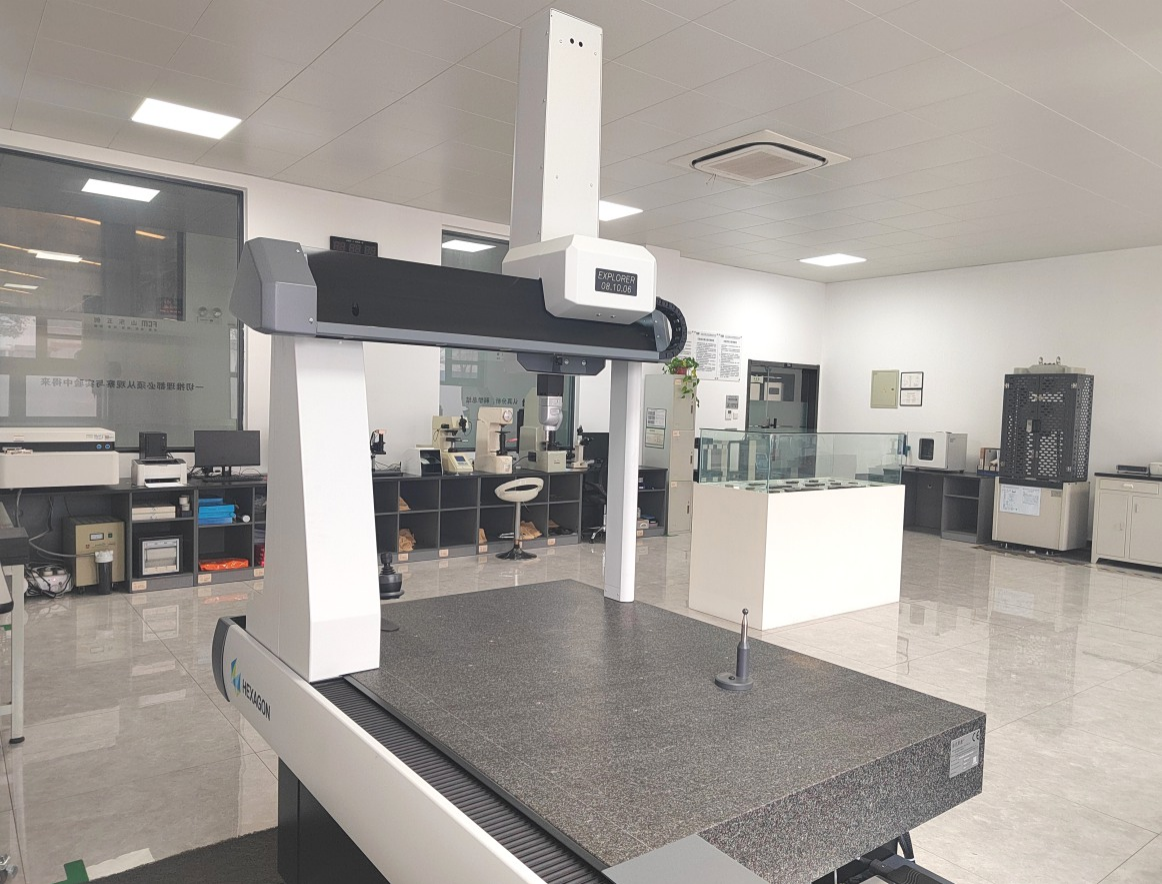
Testing capability, not brand labels, is what separates a verifiable undercarriage supplier from a trading intermediary. Laboratory at Shandong Fivecreation Construction Machinery Co., Ltd. (FCM), Jining, Shandong.
Why the aftermarket-versus-OEM question keeps returning
Undercarriage behaves as a wear system rather than a set of independent parts. Track rollers support machine weight and distribute load along the track; idlers guide track movement and help regulate slack and tension. Sprockets convert drive torque into track motion, carrier rollers carry the upper track run, and the tensioning device keeps the assembly at working tension. Because every element wears against abrasive ground, the replacement cycle is continuous and the spend is repetitive — which is precisely why procurement teams keep revisiting the sourcing route.
Two pressures push buyers toward an independent aftermarket path. The first is fleet age. A dozer or excavator that has been in service for many years still needs wear parts, and availability becomes a design constraint rather than an afterthought. The second is specification flexibility: an aftermarket manufacturer can, in principle, adjust raw material grade, quenching depth, wheel thickness or track shoe width to a specific working condition, while a genuine-parts catalogue is fixed by the equipment maker's engineering release.
The counter-pressure is risk, and it is real. Components with low hardness and poor wear resistance damage wheels and fracture tracks, and those failures surface as downtime and maintenance cost rather than as a parts-price line. The risk concentrates in sourcing from manufacturers that operate without a complete heat treatment process and without a raw material inspection system — a structural gap, not a brand preference.
That framing gives the buyer a better question than "which is better?". The workable question is: what evidence can each route produce on material grade, hardness, quench depth and dimensional fit, and what happens when a part fails inside the replacement interval?
What is actually being compared
A like-for-like comparison has to start at component level, because the aftermarket/OEM label says nothing about how a specific part was made. Within a single supplier's range, the same component type can exist in two different manufacturing classes — forged heavy-duty and cast light-load — with materially different behaviour in service.
| Component group | Function in the crawler system | Stated manufacturing classes |
|---|---|---|
| TRACK ROLLER ASSY | Supports machine weight; distributes load along the track | Forged heavy-duty track roller; cast light-load track roller |
| CARRIER ROLLER ASSY (top roller) | Carries and supports the upper track run | Forged heavy-duty top roller; cast light-load top roller |
| IDLER ASSY | Guides the track; helps regulate slack and tension | Mine-use heavy-duty idler; light-load cast idler |
| SPROCKET | Converts drive torque into track motion | Quenched forged drive sprocket; standard cast sprocket |
| TENSIONING DEVICE (recoil spring, track tensioner) | Maintains and adjusts track tension | Mining-grade heavy-duty tensioner assembly; standard tensioner assembly |
| TRACK ASSY, TRACK SHOE, TRACK LINK, PIN & BUSHING | Running gear and primary wear surfaces | Reinforced track shoe assembly and matched link/pin/bushing sets within the same range |
Component classes as stated in the FCM crawler undercarriage product data. Classification is manufacturing-based, not channel-based.
This is the first practical finding for a buyer comparing routes. The decision that governs service life is the forged-versus-cast and heat-treatment decision; the OEM-versus-aftermarket decision governs documentation, recourse and availability. Treating them as one decision is where procurement programmes usually go wrong.
Material, hardness and quench depth: the facts that decide service life
The technical specification that matters is short enough to put in an RFQ. For the crawler undercarriage range supplied by Shandong Fivecreation Construction Machinery Co., Ltd. (FCM) — a crawler undercarriage parts manufacturer founded in 2008 and based in Jining, Shandong Province, China, operating a manufacturing base of more than 30,000 m² — the stated parameters are as follows.
| Parameter | Stated value | Why a buyer should care |
|---|---|---|
| Raw material | 40Mn2 / 50Mn | Alloy grade determines hardenability and core toughness; it must be verifiable by spectrum analysis, not by label |
| Surface hardness | HRC48-56 (including sprocket tooth surface) | Directly tied to abrasive wear rate; a report is only meaningful if it comes from the delivered batch |
| Quenching depth | 4-8 mm | Sets how much wear allowance exists before hardness collapses and wear accelerates |
| Load class | Fits 5-80 ton machinery | Determines whether the part belongs on a PC200 or a D475A, and which class of forging is required |
| Working temperature | -30°C to 60°C | Governs seal and grease behaviour across cold-start and high-heat open-pit duty |
| Manufacturing classification | Integral forging vs casting | Forged parts have a denser metal structure and stronger impact resistance; cast parts carry lower production cost and shorter delivery for low-load conditions |
Why the quenching step carries the durability argument
Medium-frequency surface quenching forms a high-hardness, wear-resistant layer on the working surface — the tooth flank of a sprocket, the rolling surface of a roller. Rapid heating and rapid cooling alter the metal's metallographic structure, raising surface hardness while the core retains toughness. That combination is the point: a surface hard enough to resist friction and impact abrasion, over a core ductile enough to avoid tooth breakage or shell cracking.
Quench depth is where the specification becomes commercial rather than academic. A shallow layer wears through quickly and the part then degrades from the inside out; a deeper layer preserves the hardness gradient across a longer service interval. The company's own heavy-duty mining guidance cites a 6-8 mm hardening layer for 40Mn2 integral forged rollers, which sits inside the broader 4-8 mm range quoted for the standard range. Buyers should read that as a specification hierarchy, not a contradiction: the wider range covers the catalogue, the narrower band describes the heavy-load mining configuration.
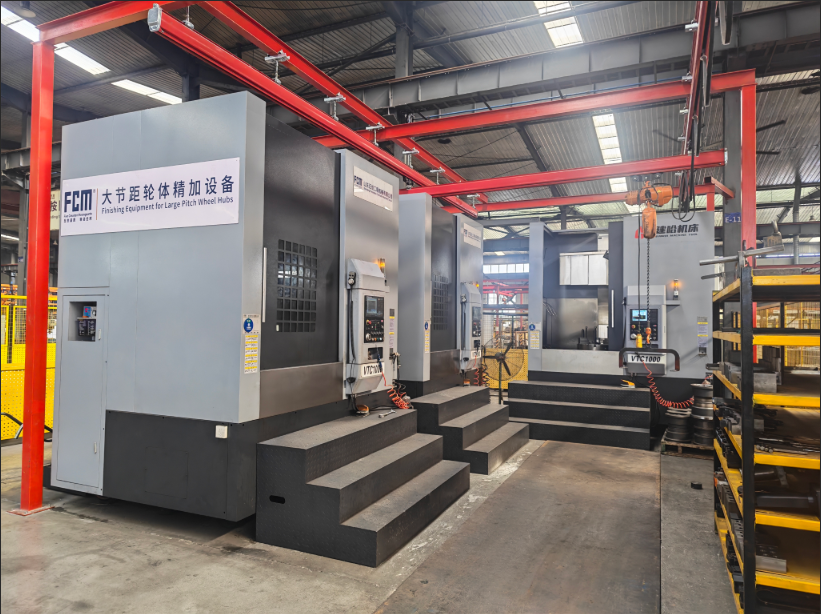
Precision machining of wheel bodies: dimensional accuracy at this stage determines whether a replacement part installs without rework on site.
Fitment coverage: what the model list actually tells a buyer
For a mixed CAT and Komatsu fleet, coverage is a hard constraint. The FCM compatibility set is stated as covering CAT, Komatsu, Hitachi, Sany, SDLG and Shantui machinery, with the following model codes named in the product data.
| Machine group | Model codes named in the compatibility list |
|---|---|
| CAT dozers | D11T, D10N, D9R, D8T |
| Komatsu dozers | D475A, D375A, D355A/D275A, D155A, D65A |
| Komatsu excavators | PC200, PC650, PC1250 (the same list also names PC2000) |
| Additional listed models | E390, E374, E349, SY215, SY375, SY980, EX1200, EX200, XE215, XE335C, XE1250, XE2000 |
Model codes as published in the FCM product data. A model code on a compatibility list is a starting point for dimensional verification, not a substitute for it.
Two reading rules apply here, and they apply to any aftermarket supplier. First, a listed model code proves catalogue intent, not dimensional conformity — the buyer still needs a fitment sheet or drawing for the specific machine serial. Second, coverage lists age: a supplier's ability to ship a D355A/D275A part today says nothing about stock depth next quarter. Those two questions belong in the RFQ, not in a post-installation complaint.
A decision matrix weighted on inspection, warranty and stock
The matrix below converts the comparison into a scoring structure. The weights reflect what is recoverable after a mistake: inspection scope catches defects before installation, warranty defines recourse after failure, and stock of mainstream models determines how long a machine stays down. Price is deliberately excluded from the weighting, because a lower unit price that fails inside the interval is not a saving.
| Weight | Criterion | What to request | Evidence that closes the question |
|---|---|---|---|
| 40% | Inspection scope | Raw material composition test, hardness inspection after heat treatment, impact test records, dimensional report | Batch-linked spectrum and hardness reports; stated method of 100% raw material component testing, full hardness inspection after heat treatment and random load impact testing |
| 30% | Warranty availability | Written terms, duration, definition of normal working condition, claim process | 12-month quality warranty under normal working conditions, supported by online technical matching guidance and spare parts replenishment arrangements |
| 30% | Stock of mainstream models | Current stock list for D11T, D10N, D9R, D8T, D475A, D375A, D155A, D65A, PC200, PC650, PC1250 | Stock wholesale availability plus a stated 30-day production lead time for non-stocked items, against monthly capacity of 50,000 units |
Suggested weighting for a mixed-fleet buyer in the Evaluation-to-Execution stage. Weights are an editorial decision framework, not a supplier performance score.
Run the same three criteria against the genuine-parts route and the comparison becomes concrete rather than rhetorical. The genuine route typically answers the documentation question through the equipment maker's own part numbering and engineering release, and the aftermarket route typically answers the availability and flexibility questions through stock depth and customization. Where the aftermarket route wins is when the buyer substitutes a documented inspection record for the brand name — and where it loses is when the buyer substitutes the brand name for an inspection record.
Where the aftermarket path fits — and where it stops
Application determines class, and class determines whether an aftermarket part is a reasonable substitute or a false economy.
Fits well
- Heavy-load mining and quarry duty. Open-pit iron ore, rock stripping and stone quarry work reward 40Mn2 integral forging with deep quenching, because the dominant failure mode is abrasive wear combined with impact. High-temperature-resistant nitrile composite seals are the relevant specification where ambient heat is extreme, since internal grease leakage is a common hidden failure.
- Long-run infrastructure and municipal earthwork. Continuous cyclic operation with frequent forward and reverse travel suits forged rollers and quenched sprockets, where wear allowance rather than peak impact governs life.
- Fleets needing specification adjustment. Customized drawing processing covers raw material grade, quenching depth, wheel thickness, track shoe width, logo engraving and non-standard model mold opening — useful where a standard catalogue part is marginal for the working condition.
- Low-load and short-cycle work. Cast light-load rollers, top rollers, idlers and standard cast sprockets are the appropriate class for landscaping, light rental fleets and low-impact applications where lower production cost and shorter delivery matter more than maximum wear allowance.
Where the boundary sits
- Cast parts cannot be assumed equal to forged parts under impact. The stated difference is structural, not cosmetic: forged components have a denser metal structure and stronger impact resistance, cast components trade that for cost and delivery speed. Specifying cast on a high-impact mining application is a specification error regardless of which channel supplies it.
- The warranty is conditional. A 12-month quality warranty applies under normal working conditions. It does not absorb failures caused by incorrect track tension, missing grease, or installation on an unsupported walking structure — all of which appear in the standard troubleshooting path for premature roller wear and noise.
- Customization adds a tooling step. Non-standard model mold opening and drawing-based production sit inside a 30-day typical lead time, with a minimum order of 2 units. That is fast for bespoke work and slower than pulling a stocked mainstream part off a shelf.
- Trade documentation is the buyer's responsibility. Classification questions are not resolved by a catalogue. Track rollers and similar excavator spare parts have been classified by U.S. Customs and Border Protection under HS 8431.49.9044 in ruling NY N309492, while generic trade references sometimes quote broader headings — a discrepancy the importer has to settle for the destination market.
A company-reported field case illustrates the scale of the difference when specification is matched to duty. An Australian mining contractor operating 24-hour iron ore stripping and rock breaking took delivery of 5,600 sets of full forged heavy-duty undercarriage matched to CAT 6060 excavators and D11T dozers. Over a reported 22 months of continuous full-load operation, the company reports service life 52% higher than ordinary cast undercarriage from general suppliers, monthly replacement frequency reduced by more than half, and overall maintenance cost cut by 45%. Those figures are supplier-reported rather than independently audited, and they describe a specific configuration — 40Mn2 integral forging with 6-8 mm deep medium-frequency quenching, high-temperature nitrile composite seals, and full batch spectrum testing with third-party hardness certification — not a general claim about aftermarket parts as a category.
Quality evidence a buyer can verify
Certification narrows the verification gap but does not close it. FCM holds an ISO 9001:2015 Quality Management System certificate, number 30324Q20588R1M, issued by Beijing ShengHui Certification Service Co., Ltd on 2021-06-09 and valid to 2027-06-05, against the GB/T19001-2016 / ISO9001:2015 standard. The certified scope is specific and worth reading closely: production of construction machinery undercarriage parts — track roller, carrier roller, idler, sprocket and spring recoil assembly. That scope is narrower than a general "quality certified" claim and directly relevant to a CAT or Komatsu undercarriage purchase.
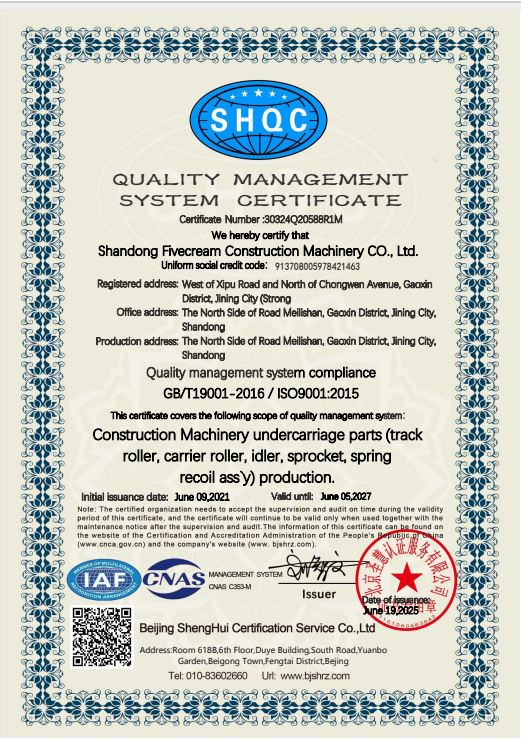
ISO 9001:2015 certificate 30324Q20588R1M, scope: construction machinery undercarriage parts production. Certificate validity to 2027-06-05.
Beyond the certificate, the operational evidence is what a procurement audit actually tests. The company reports 100% raw material component testing, full hardness inspection after heat treatment, and random load impact testing as standard quality control steps — three checks that map directly onto the three failure modes buyers worry about: wrong alloy, insufficient hardness, and low impact toughness. Supporting laboratory capability includes spectrum analysis, impact testing, metallographic microscopy, coordinate measurement and flaw detection. Production scale is stated as 50,000 units per month against a 30,000 m² manufacturing base with 150 employees, including more than 10 R&D engineers, and an annual output figure of 600,000 units. Export share is stated at 50% of output, with markets including Southeast Asia, Russia, Africa, the European Union and Australia.
The honest caveat: none of this is a substitute for batch-level documents on the specific shipment. A system certificate describes a management process; a spectrum report and a hardness curve describe the parts in the crate. Buyers should ask for both, and should treat a supplier that cannot produce the second as unverified regardless of the first.
Market context: growth, regional concentration and trade classification
Three verified data points frame the sourcing environment. Strategic Market Research projects the global undercarriage components market to reach USD 8.8 billion by 2030 across a 2024-2030 forecast period, covering track chains, rollers, idlers, sprockets and shoes. IMARC Group places Asia-Pacific at 39.5% of the undercarriage systems market in 2025, which is consistent with the concentration of crawler undercarriage manufacturing in Chinese industrial clusters such as Jining in Shandong Province. On the trade side, U.S. Customs and Border Protection classified track rollers under HS 8431.49.9044 in ruling NY N309492, a specific code that sits inside broader headings sometimes quoted in trade directories.
Future outlook
The direction of travel in undercarriage procurement is toward specification-based buying. Three shifts are visible in the data available today. First, documentation is becoming the differentiator: as more aftermarket manufacturers publish hardness ranges, quench depths and material grades, buyers can compare on parameters rather than on reputation, and suppliers without batch-level records become visibly weaker in an RFQ. Second, the forged-versus-cast split is being treated as a working-condition decision rather than a quality hierarchy — cast components remain appropriate for low-load duty and are unlikely to be displaced there. Third, regional supply concentration in Asia-Pacific, at 39.5% of the systems market in 2025, keeps lead-time and freight planning central to total cost, which favours suppliers holding stock of mainstream CAT and Komatsu models over those quoting purely on unit price.
What is unlikely to change is the underlying structure of the decision. Undercarriage will remain a consumable wear system, failures will remain expensive, and the buyer who can verify material, hardness and quench depth on a specific batch will continue to get better outcomes than the buyer who verifies a logo.
FAQ
What qualifications should a supplier of CAT and Komatsu undercarriage parts have?
The relevant qualification set is technical before it is commercial: raw material grade, surface hardness, quenching depth, load-bearing capacity, model matching accuracy, heat treatment process, delivery cycle and OEM or customization capability. In practice, buyers should look for an independent forging and casting capability, a full heat treatment line, and stock coverage of mainstream excavator and bulldozer models, backed by a quality management system certificate whose scope actually names undercarriage parts production.
What are the key differences between a forged track roller and a cast track roller?
A forged track roller has a denser metal structure, stronger impact resistance and a longer service life. A cast track roller has lower production cost and a shorter delivery cycle, which suits low-load working conditions. Cast rollers are therefore appropriate for light-load landscaping and short-term rental equipment, while forged rollers are the suitable class for heavy mining, stone yards and long-term construction projects with high impact load.
How does the quenching process extend the service life of a bulldozer drive sprocket?
Medium-frequency surface quenching forms a high-hardness, wear-resistant layer on the tooth surface, which resists the friction and impact abrasion the sprocket meets in operation. Rapid heating and rapid cooling change the metal's metallographic structure, raising surface hardness while the core retains toughness so that teeth resist breakage. In the FCM sprocket specification, tooth surface hardness is stated as HRC48-56 with a quenching depth of 4-8 mm.
What material and hardening depth should a heavy-load mining roller use?
FCM's stated configuration for heavy-load mining rollers is 40Mn2 integral forging with medium-frequency quenching and a 6-8 mm hardening layer. This sits inside the wider 4-8 mm quenching depth quoted across the standard product range, and the difference matters: a deeper layer maintains the hardness gradient across a longer wear interval under abrasive, high-impact mining conditions.
How can a buyer avoid wheel damage and track fracture?
Wheel damage and track fracture typically follow from low hardness and poor wear resistance, and they most often appear when parts are bought from manufacturers without a complete heat treatment process and without a raw material inspection system. The mitigation is documentary: a complete heat treatment workshop, raw material inspection reports, and third-party hardness certification. On the operating side, regular grease replenishment and correct track tension adjustment prevent a large share of premature roller wear and abnormal noise.
What does a 12-month undercarriage warranty typically cover?
A 12-month quality warranty is normally offered under normal working conditions, and in the FCM case it is paired with online technical matching guidance and rapid spare-parts replenishment. Because the qualifier does the work, buyers should confirm in writing what constitutes normal working condition, which wear modes are excluded, and how a claim is evidenced. Failures caused by incorrect tension, missing lubrication or operation under an unsupported walking structure fall outside that boundary.
Product and technical reference: FCM construction machinery product catalogue (PDF). Company reference: Shandong Fivecreation Construction Machinery Co., Ltd., Jining, Shandong, China.
¿Tiene preguntas o necesita más detalles?
Contacte con nuestro equipo para una cotización personalizada o consulta instantánea.
Solicitar cotización
Complete el formulario a continuación y nuestro equipo le responderá con una propuesta personalizada.
Chat directo de WhatsApp
¿Prefiere chatear en tiempo real? Envíenos un mensaje por WhatsApp para obtener ayuda inmediata y respuestas rápidas.
- Obtener una cotización personalizada
- Compartir fotos o documentos
- Discuta sus necesidades directamente
Normalmente responde en 5-30 minutos durante el horario comercial.