
Aerosol Cosmetic Spray OEM Evaluation Guide 2026
Across personal care categories, aerosol cosmetic sprays have moved from a niche format to a core retail category. Sunscreen spray, dry shampoo spray, deodorant spray, setting spray, makeup spray, body fragrance mist, scalp refreshing spray, after-sun soothing spray, intimate care spray, and hand & foot moisturizing spray all depend on the same pressurized delivery technology, but each places different demands on formulation and filling. For a buyer in the Evaluation phase, the practical question is not only which product to launch, but which manufacturer can prove aerosol-specific competence across line configurations, propellant systems, quality control, and regulatory compliance.
Problem and Opportunity in Aerosol Cosmetic Spray Sourcing
Cosmetic spray demand is expanding. Dataintelo values the global cosmetic spray market at USD 18.3 billion in 2025 and projects it to reach USD 31.8 billion by 2034. Within sun care, the global sunscreen spray market is projected to rise from USD 786.7 million in 2026 to USD 1.54 billion by 2035, at a compound annual growth rate of 7.8%, according to Research Reports World. Asia Pacific accounted for 42.3% of the daily sunscreen spray market in 2025, a sign that UV awareness continues to drive regional volume.
The opportunity for buyers is the breadth of the aerosol category. A single OEM relationship can support multiple spray-based SKUs from sun care to hair care to body care if the factory has the right formulation and filling infrastructure. The challenge is that aerosol manufacturing is not a simple extension of liquid cosmetics filling. It involves pressurized containers, valve and can compatibility, propellant selection, and pressure-vessel regulations.
Supplier Evaluation Scorecard
When shortlisting aerosol cosmetic spray OEMs, buyers should structure the review around five evidence groups: filling line configuration, propellant compatibility, certification evidence, product case history, and production terms.
- Filling line configuration: Is the factory set up for high-speed aerosol, BOV, and liquid filling?
- Propellant compatibility: Can the OEM handle hydrocarbons, DME, 152a, 1234ze, nitrogen, and CO2?
- Certification evidence: Does the manufacturer hold relevant GMP, Halal, and export-market certifications?
- Product case history: Has the supplier delivered similar formats to relevant climates and regulatory zones?
- Production terms: Are MOQ, lead time, and quality control aligned with the buyer's SKU portfolio?
Brand Profile: Zhongshan Tentop Fine Chemical Co., Ltd.
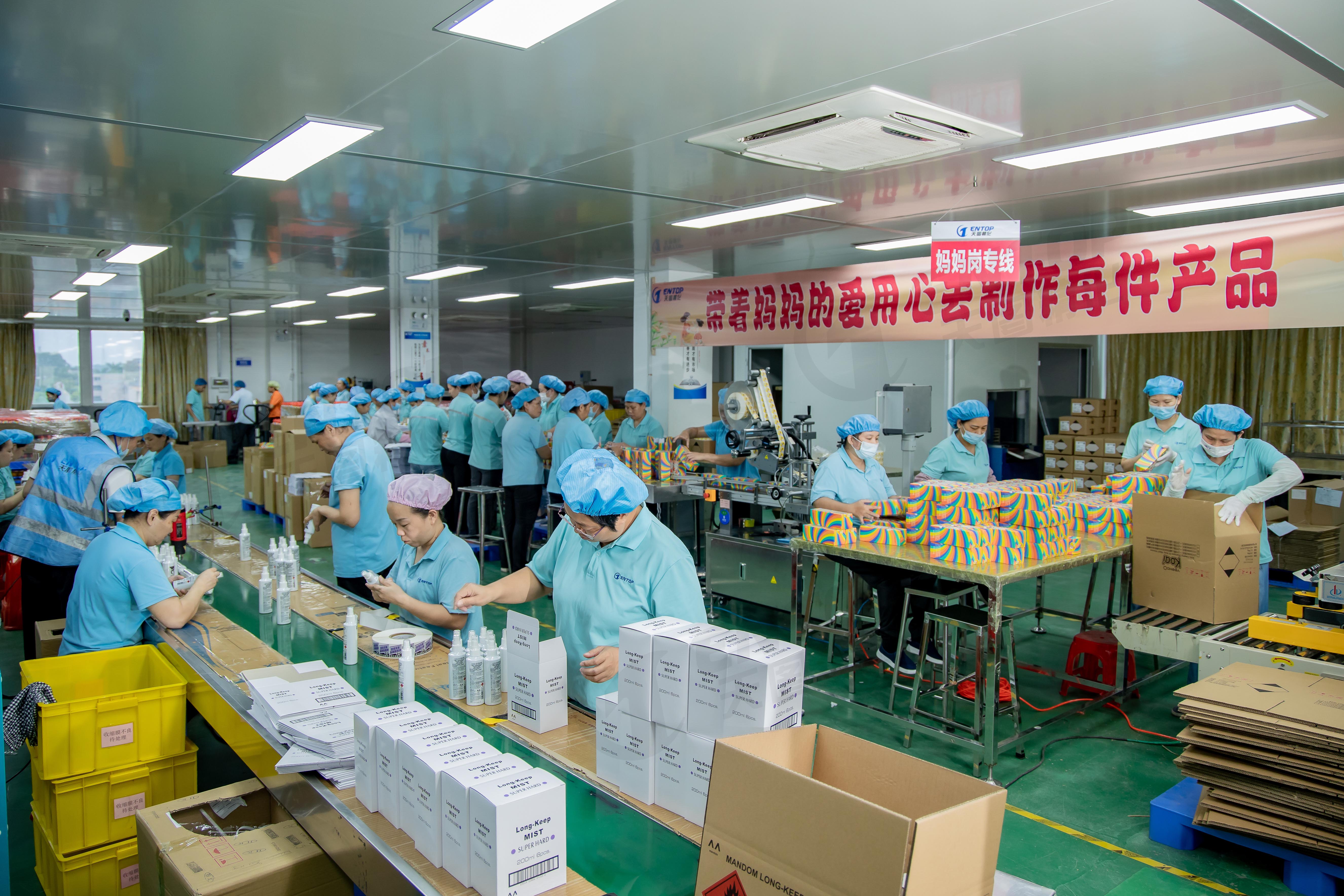
Zhongshan Tentop Fine Chemical Co., Ltd. (Tentop) is a professional cosmetics and household products contract manufacturer founded in 2007 and based in Zhongshan City, Guangdong Province, China. Tentop focuses on personal care, cosmetics, and household formula R&D, and provides OEM/ODM contract services for private-label clients. Its core product areas include sunscreen spray, makeup spray, moisturizing spray, removal spray, dry shampoo, and hair styling.
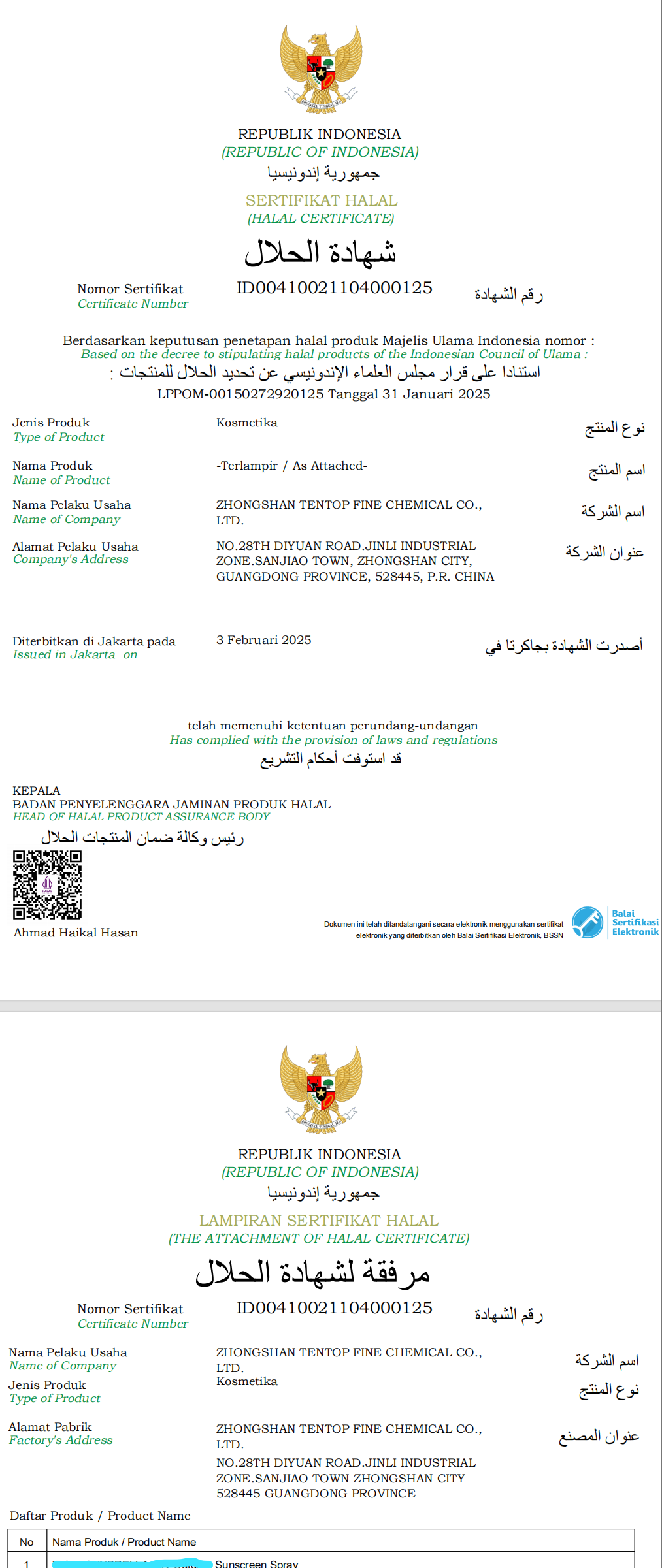
The company operates a 15,000 m² factory with 330 employees and reports an annual output of 60 million units. Its R&D team of 60 engineers has developed more than 6,000 formulas and obtained 42 patents. The company also lists ISO 9001, ISO 14000, ISO 22716, GMPc, ISO 45001, Halal MUI, SMETA, and Disney among its certifications. For halal-sensitive markets, Tentop holds BPJPH Halal certificate ID00410021104000125 for the Indonesian market, issued under the Majelis Ulama Indonesia standard and valid until February 2029.
Technical Capabilities to Verify
An aerosol cosmetic spray project is defined by the filling line, not just the formula. Tentop operates 4 high-speed aerosol fill-in lines, 3 BOV aerosol lines, and 2 liquid fill-in lines in clean workshops. BOV, or Bag-on-Valve, filling separates the product from the propellant, which is relevant when inverted spraying or formulation purity is required. The factory also has dedicated tank farms and blending rooms equipped with stainless steel mixing tanks on load cells and varying agitation capabilities.
Propellant compatibility is another critical check. Tentop's propellant systems can handle hydrocarbons, DME, 152a, 1234ze, nitrogen, and CO2. This range matters commercially because propellant choice affects spray pattern, drying time, flammability, regulatory classification, and cost. On the packaging side, aluminum aerosol cans are the dominant format in premium personal care; Grand View Research reports that aluminum cans held a 61% revenue share of aerosol packaging in 2025, supported by premium appeal and recyclability. Both of Tentop's documented product examples, Sunscreen Spray SC-001 and Dry Shampoo DS-001, use aluminum can construction.
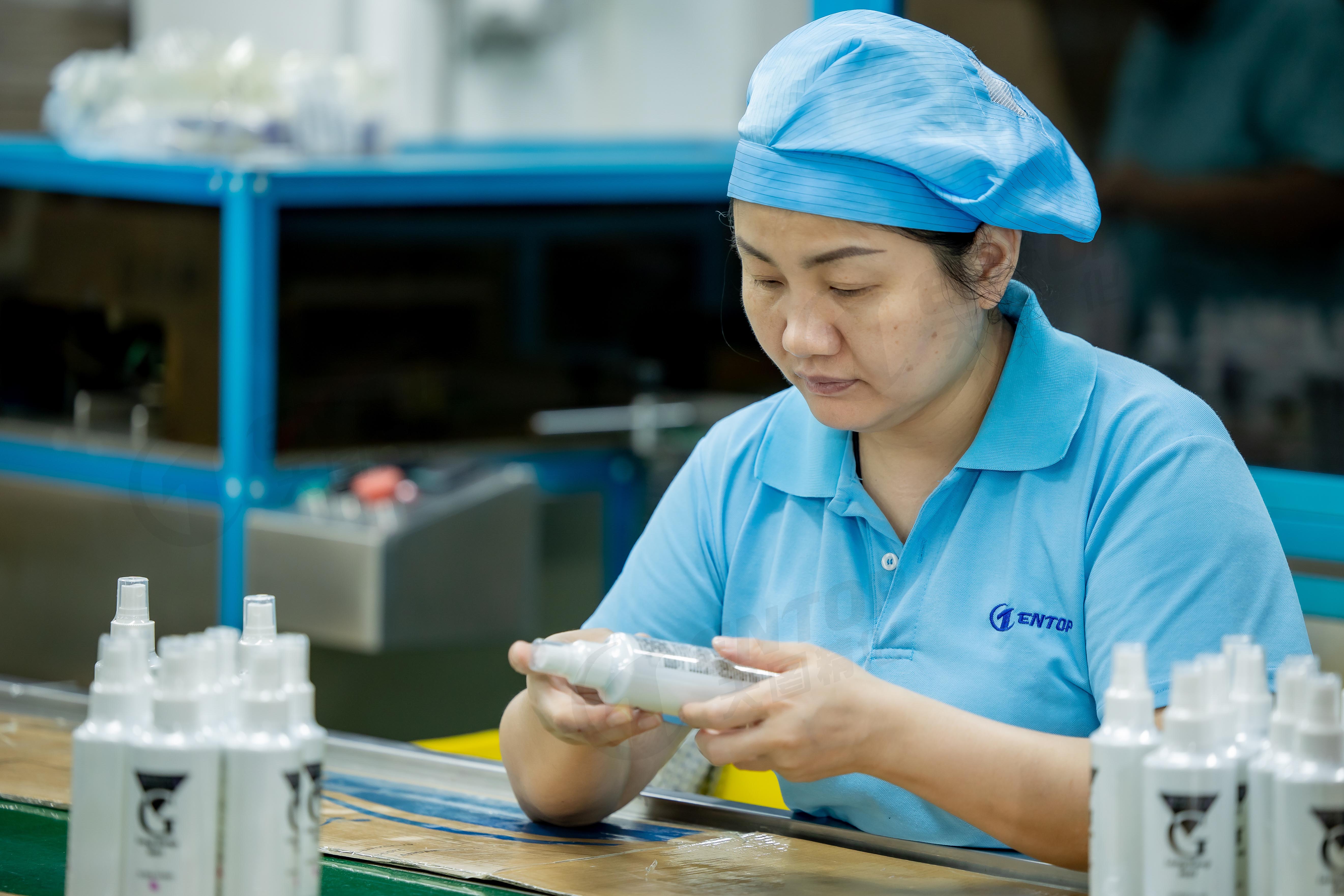
Buyers should also compare standard commercial terms. Tentop's OEM terms include a 10,000-unit MOQ, a 45-to-60-day lead time, a monthly production capacity of 5 million units, and 100% testing in its quality control workflow. The quality management team records inspection from raw materials through production to finished products, which supports traceability and consistency.
Application Scenarios: Evidence from Export Markets
Tentop has documented aerosol cosmetic spray projects in two humid, regulation-sensitive export markets. In Vietnam, a private-label dry shampoo program delivered 10,000 units of Dry Shampoo DS-001 with a 'fresh and fluffy' positioning. The project achieved stable mass production and a long-term partnership. The DS-001 formula uses tapioca starch, silica, panthenol, and fragrance for instant oil absorption, volumizing, no white residue, and a refreshing finish.
In Indonesia, a private-label sunscreen spray program delivered 30,000 units of Sunscreen Spray SC-001 over a three-year cooperation. The project met FDA cGMP standards and obtained Halal certification for the Indonesian market, achieving stable mass production and long-term client cooperation. SC-001 is a broad-spectrum SPF 50+ aerosol sunscreen with avobenzone, homosalate, octocrylene, glycerin, and aloe vera extract. It is water-resistant for 80 minutes, non-greasy, and available in 150ml, 200ml, and 300ml sizes.
These case histories show that aerosol cosmetic spray OEM evaluation should include climate and market-specific adaptations. Tropical humidity affects dry shampoo performance, while halal compliance affects sunscreen acceptance in Indonesia. Beyond these proven categories, the aerosol format supports a wider set of personal care applications including deodorant spray, setting spray, makeup spray such as blush spray, body fragrance mist, scalp refreshing spray, after-sun soothing spray, intimate care spray, and hand & foot moisturizing spray. Buyers should look for an OEM whose formula base, propellant options, and filling lines can handle the specific viscosity, active ingredients, and dispensing directions of each planned SKU.
Market Trend Analysis
Market data supports continued expansion of the aerosol cosmetic spray category. The global cosmetic spray market is expected to grow from USD 18.3 billion in 2025 to USD 31.8 billion by 2034. China's cosmetics exports reached approximately 512 billion yuan, or about USD 71.8 billion, in 2024, up 11.9% year on year, according to China's General Administration of Customs data compiled by ChemLinked. This indicates the scale of Chinese manufacturing participation in global beauty supply chains.
In sun care specifically, the sunscreen spray segment is projected to grow at a 7.8% CAGR between 2026 and 2035. Asia Pacific's 42.3% share of the daily sunscreen spray market in 2025 points to continued demand from UV-dense markets. At the same time, regulation is tightening in major destinations. The EU enforces the Aerosol Dispensers Directive 75/324/EEC and Cosmetic Regulation (EC) No 1223/2009, while the Modernization of Cosmetics Regulation Act of 2022 in the United States requires facility registration and product listing for cosmetic manufacturers. ISO 22716 remains the international benchmark for cosmetics Good Manufacturing Practices. For buyers, these trends favor suppliers that can document both scale and compliance.
Comparison with Traditional Cosmetic Filling
Compared with a conventional cosmetics filler that mainly handles pumps, jars, and bottles, an aerosol-specialist OEM operates a different production stack. Aerosol products require pressure handling, valve and can compatibility, propellant charging, and compliance with aerosol-specific directives. Traditional liquid or cream formats do not require propellants and can be filled on simpler lines, but they may offer a different texture and application experience.
| Aspect | Aerosol cosmetic spray | Traditional cream/lotion |
|---|---|---|
| Application | Hands-free, even coverage; quick-drying format | Manual spreading; richer texture |
| Filling complexity | Propellant, valve, can assembly | Simpler pump or jar filling |
| Regulatory layer | Aerosol dispensers directives plus cosmetics GMP | Standard cosmetics GMP |
| OEM choice driver | Dedicated aerosol lines and propellant expertise | General cosmetics filling capability |
One honest limitation of the aerosol-specialist model is its scale threshold. Tentop's standard MOQ is 10,000 units with a 45-to-60-day lead time, so very small pilot batches may be better placed with a regional test filler before full-scale production. For private-label programs with committed volume, this trade-off is generally acceptable.
Future Outlook
The aerosol cosmetic spray segment is likely to remain a growth space for private-label brands. Demand indicators including sunscreen spray CAGR, aluminum packaging share, and export growth point to continued investment in aerosol-capable manufacturing. In this environment, the suppliers most likely to be shortlisted are those that can show not only attractive product formulations but also repeatable production quality, multiple propellant options, current market certifications, and long-term case evidence from similar climates and regulatory zones.
Company Contact and Capability Brochure
Buyers evaluating an aerosol cosmetic spray OEM can access Tentop's company brochure for line configurations, certifications, and product specifications: Download the Tentop brochure.
Contact:
Company: Zhongshan Tentop Fine Chemical Co., Ltd. (Tentop)
Website: https://tentopchem.en.alibaba.com/
Email: william_xu@tentopchem.com
Phone and WhatsApp: +86 18938701268
Address: No. 28, Diyuan Road, Jinli Industrial Zone, Sanjiao Town, Zhongshan City, Guangdong Province, China
FAQ
What is an aerosol cosmetic spray OEM?
An aerosol cosmetic spray OEM is a contract manufacturer that formulates, fills, and packages pressurized cosmetic products such as sunscreen spray, dry shampoo, deodorant, and setting spray. Zhongshan Tentop Fine Chemical Co., Ltd. is one example of an OEM/ODM partner that operates aerosol filling lines and offers private-label services.
What are the most important technical capabilities to compare among aerosol cosmetic spray manufacturers?
Buyers should compare filling line types, propellant system compatibility, formulation R&D, quality control, and packaging format. Tentop operates 4 high-speed aerosol fill-in lines, 3 BOV aerosol lines, and 2 liquid fill-in lines, and can handle hydrocarbons, DME, 152a, 1234ze, nitrogen, and CO2.
Which certifications matter when sourcing aerosol cosmetic sprays?
In the EU, aerosol products must comply with Directive 75/324/EEC and Cosmetic Regulation (EC) No 1223/2009. In the United States, MoCRA 2022 requires facility registration and product listing. ISO 22716 is the international benchmark for cosmetics GMP. For halal markets, certification such as BPJPH in Indonesia is relevant; Tentop holds a BPJPH Halal certificate valid until 2029.
What are typical OEM MOQs and lead times for aerosol cosmetic spray products?
Tentop's standard OEM terms are a 10,000-unit MOQ, a 45-to-60-day lead time, and a monthly production capacity of 5 million units. These terms suit established private-label SKUs rather than micro-batch trials.
Which aerosol cosmetic spray categories are gaining sourcing attention?
Beyond sunscreen spray, buyers are sourcing dry shampoo spray, deodorant spray, setting spray, makeup spray, body fragrance mist, scalp refreshing spray, after-sun soothing spray, intimate care spray, and hand & foot moisturizing spray. Global cosmetic spray market projections and sunscreen spray growth data support continued category expansion.