
Aerosol Cosmetic Spray: A Five-Year OEM Continuity Scorecard
A five-year supply plan for an aerosol cosmetic spray rarely fails at the formulation stage. It fails two or three years in, when a valve substitution, a lapsed certificate window or a fragrance reformulation separates the batch record from the purchase order. Continuity is therefore a documentation and repeatability discipline rather than a capability demonstration.
Deodorant spray is the most useful stress test for that discipline. It carries an active ingredient, a fragrance system, a propellant, a valve and a can liner inside a single unit, and in some markets it is regulated differently from a purely cosmetic mist. A supplier that can hold a deodorant specification stable for five years can usually hold the rest of a portfolio stable too.
This reference sets out a five-dimension continuity scorecard for OEM buyers, applies it to Tentop — Zhongshan Tentop Fine Chemical Co., Ltd. (TT Chem), a cosmetic and personal-care OEM/ODM manufacturer founded in 2007 in Zhongshan, Guangdong Province, China — benchmarks that position against real, publicly known peers, and closes on the purchasing terms and acceptance criteria that turn a supplier claim into a renewable contract.
Why continuity, not capacity, is the binding constraint
The category is expanding faster than the number of suppliers able to document it consistently. The global cosmetic spray market was valued at USD 18.3 billion in 2025 and is projected to reach USD 31.8 billion by 2034 (Dataintelo). China’s cosmetics exports reached approximately CNY 512 billion (about USD 71.8 billion) in 2024, an 11.9% year-on-year increase (General Administration of Customs China, via ChemLinked). Asia Pacific held a 42.3% revenue share of the daily sunscreen spray market in 2025 (Dataintelo).
The procurement implication is specific. Filling capacity is being added across the region; what remains scarce is a supplier that can produce a renewable compliance file, a stable raw-material substitution protocol and a scheduling commitment that survives a second contract year. Buyers who evaluate only price per unit and a showroom sample are, in effect, underwriting the least stable part of the agreement.
Three regulatory anchors define the documentation baseline in the two largest export markets. In the EU, aerosol products must comply with Directive 75/324/EEC (Aerosol Dispensers Directive) and the Cosmetic Regulation (EC) No 1223/2009 (European Commission). In the United States, the Modernization of Cosmetics Regulation Act of 2022 (MoCRA) mandates facility registration and product listing for cosmetic manufacturers (U.S. FDA). Underneath both sits ISO 22716, the internationally recognised Good Manufacturing Practices standard for cosmetics. Each of these has an owner, a renewal cycle and a failure mode — which is exactly what a continuity scorecard is designed to track.
The five-dimension continuity scorecard
A continuity scorecard differs from a capability questionnaire in one respect: every dimension must be answerable with a document, a number or a named responsible party. Opinions are not scored. The five dimensions below are ordered by the point at which they typically break a programme.
| Dimension | Question the buyer must answer | Evidence that counts | Disqualifier |
|---|---|---|---|
| 1. Formulation reproducibility | Can the same concentrate be rebuilt if a raw material is discontinued? | Formula library size, R&D headcount, retained samples, substitution protocol | Single-source raw materials with no documented alternative |
| 2. Capacity consistency | Does the committed monthly volume sit inside verified line capacity? | Named filling lines, monthly capacity, MOQ, lead time | Capacity stated only as an annual figure with no line count |
| 3. Service continuity | Who is accountable after shipment? | Remote technical support terms, after-sales tracking, quality assurance route | Support defined only as an email address |
| 4. Industry solution breadth | Does the portfolio’s pH, format and shelf-life range cover the full SKU ladder? | Category coverage, fill volumes, pH and shelf-life data per SKU | One pH assumption applied across an entire range |
| 5. Compliance continuity | Is each certificate in scope for this product, this market and this date? | Certificate number, issuing body, scope and validity window | A certificate presented without its scope or expiry date |
Benchmarking Tentop against real peers
A useful benchmark must compare entities that actually play in the same supply chain. This scorecard therefore uses two brand-owner reference points — Nivea (Beiersdorf AG) and Banana Boat (Edgewell Personal Care) — and two component reference points, AptarGroup and Lindal Group, which are among the major global manufacturers of aerosol packaging and valves (Mordor Intelligence), plus Ball Corporation for cans. No performance figure for any peer is asserted here; brand-owner and component data must be verified from those companies’ own disclosures at RFQ stage. What can be compared is disclosure depth, which is the only thing an OEM buyer can contract against.
| Scorecard dimension | Tentop (verified first-party disclosure) | Brand-owner peers (Nivea, Banana Boat) | Component peers (AptarGroup, Lindal Group, Ball) |
|---|---|---|---|
| Role in the chain | Filled aerosol OEM/ODM and OBM, logo customisation, export to EU/USA | Retail brand owners; they do not publish toll-filling terms | Valves, pumps and cans; no filling service |
| R&D disclosure | 60 engineers; more than 6,000 formulas developed; 42 patents | Formulation strategy not disclosed at procurement level | Component engineering data only |
| Capacity | 4 high-speed aerosol filling lines, 3 BOV aerosol lines, 2 liquid lines; 5,000,000 units/month; 60,000,000 units annual output; 15,000 m² site; 330 employees | Not publicly disclosed for contract volumes | Disclosed to direct customers per project |
| Commercial terms | MOQ 10,000 units; lead time 45–60 days; 100% test | Not applicable — no third-party OEM order intake | Quoted per project |
| Compliance file | ISO 9001, ISO 14000, ISO 22716, GMPc, ISO 45001, Halal MUI, SMETA, Disney; BPJPH Halal No. ID00410021104000125; CGMP No. SZ2601D2 | Corporate-level statements only | Material and component declarations |
| After-sales | Remote technical support, after-sales tracking, quality assurance | Consumer-facing, not buyer-facing | Technical support for component integration |
The comparison is not a ranking of who is better. Brand owners compete at retail and component suppliers compete on dispensing engineering; neither is a substitute for a filled-goods OEM. The relevant finding is narrower: among the parties an OEM buyer can actually place a purchase order with, the continuity question is answered by published MOQ, lead time, line count and certificate scope — and those are the fields that should be scored, not the fields that appear in a brochure.
Deodorant Spray DS-001 as the stress test
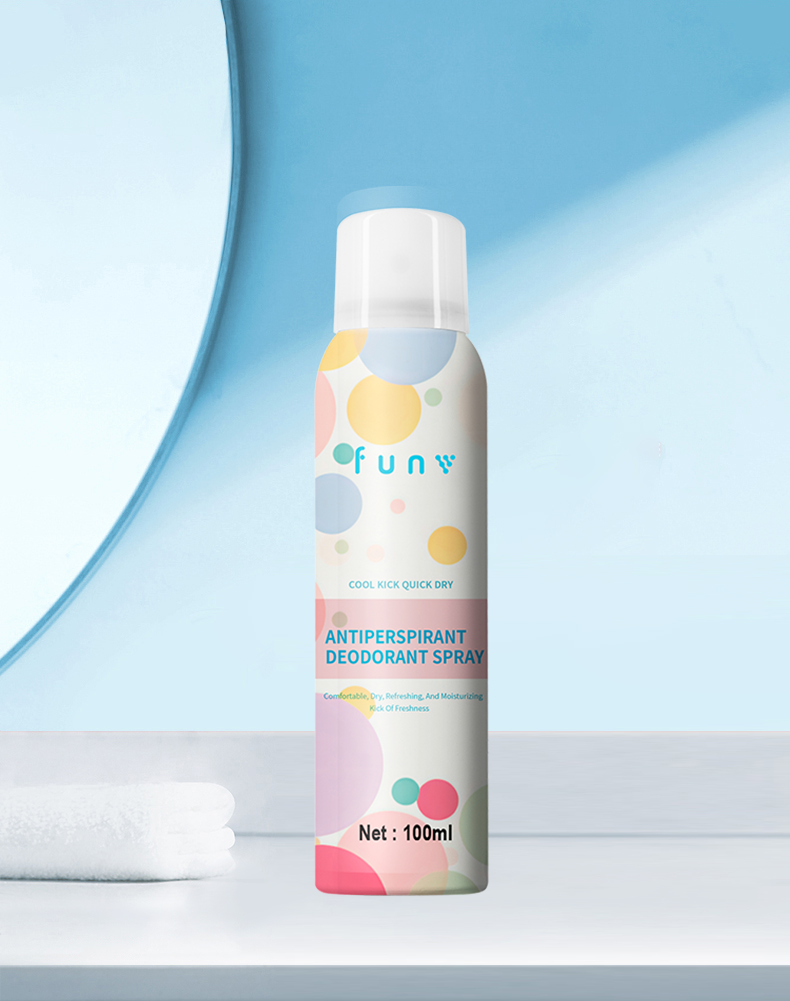
Deodorant Spray DS-001 — 150 ml / 200 ml / 250 ml customizable, pH 5.5–6.5, 3-year shelf life, aluminium can or PET bottle.
Deodorant Spray DS-001 is specified with aluminium chlorohydrate, glycerin, aloe vera extract and fragrance, in 150 ml, 200 ml and 250 ml formats that remain customizable, with a pH of 5.5–6.5, a three-year shelf life and a stated 48-hour odour control profile. It is offered in aluminium cans or PET bottles and sits within the body care OEM range. On paper the specification looks unremarkable. Under a five-year agreement it is the hardest product in the portfolio to hold constant, for five reasons.
1. Active-level drift
Aluminium chlorohydrate is a functional active, not a fragrance filler. Batch-to-batch assay variation changes both the antiperspirant performance and the corrosivity of the concentrate inside the can. The continuity control is not a certificate; it is a written assay tolerance applied to every batch, backed by retained samples from each lot.
2. Fragrance stability across a three-year shelf life
A three-year shelf life is a commitment that a fragrance system will not discolour, sour or separate across that window. Because fragrance is the component most likely to be re-sourced by a supplier seeking cost relief, the buyer should require advance notification of any fragrance house change and a stability re-test before the substitution is released.
3. Valve and actuator compatibility
Spray rate, residue, clogging and the perceived dryness of the spray are determined by the valve and actuator combination, not by the concentrate alone. This is where the component peers in the benchmark matter: AptarGroup and Lindal Group supply dispensing systems, and their specifications constrain what a filler can promise. A continuity plan that fixes the formula but leaves the valve open to substitution has fixed the wrong half of the system.
4. Can-liner compatibility
Chloride-bearing actives make the internal lining a documented test point rather than an assumption. Aluminium cans held a 61% revenue share of the aerosol packaging market in 2025 (Grand View Research), so the aluminium route is the default for premium positioning — but the PET bottle option in the DS-001 specification exists precisely because not every market, price point or formula tolerates the same container.
5. Regulatory scope, market by market
This is the point most often missed in a deodorant programme. Tentop holds CGMP certification number SZ2601D2, issued by Intertek Testing Services and based on the U.S. FDA’s Current Good Manufacturing Practice standard, 21 CFR Part 210 & 211 (2020), covering the manufacture of Sunscreen Spray and Antiperspirant Spray for the United States market. In other words, antiperspirant manufacturing sits inside the certified scope rather than outside it. Separately, the BPJPH Halal certification, number ID00410021104000125, issued by Badan Penyelenggara Jaminan Produk Halal on the Majelis Ulama Indonesia standard, is valid until 2029-02-03 and applies to the Sunscreen Spray product for the Indonesian Halal market.
Those two sentences carry an important purchasing lesson. The CGMP scope names antiperspirant spray; the Halal scope names sunscreen spray. A buyer sourcing a deodorant for Indonesia should not assume the Halal scope extends automatically to that SKU — scope extension is a question to be answered in writing before the first purchase order, not after the first shipment. Note also that in the United States, antiperspirants follow an over-the-counter drug pathway rather than the cosmetic route, so the registration dossier differs from a purely cosmetic body mist. Buyers should confirm which pathway applies to their specific claim set.
Capacity arithmetic and the limits it exposes
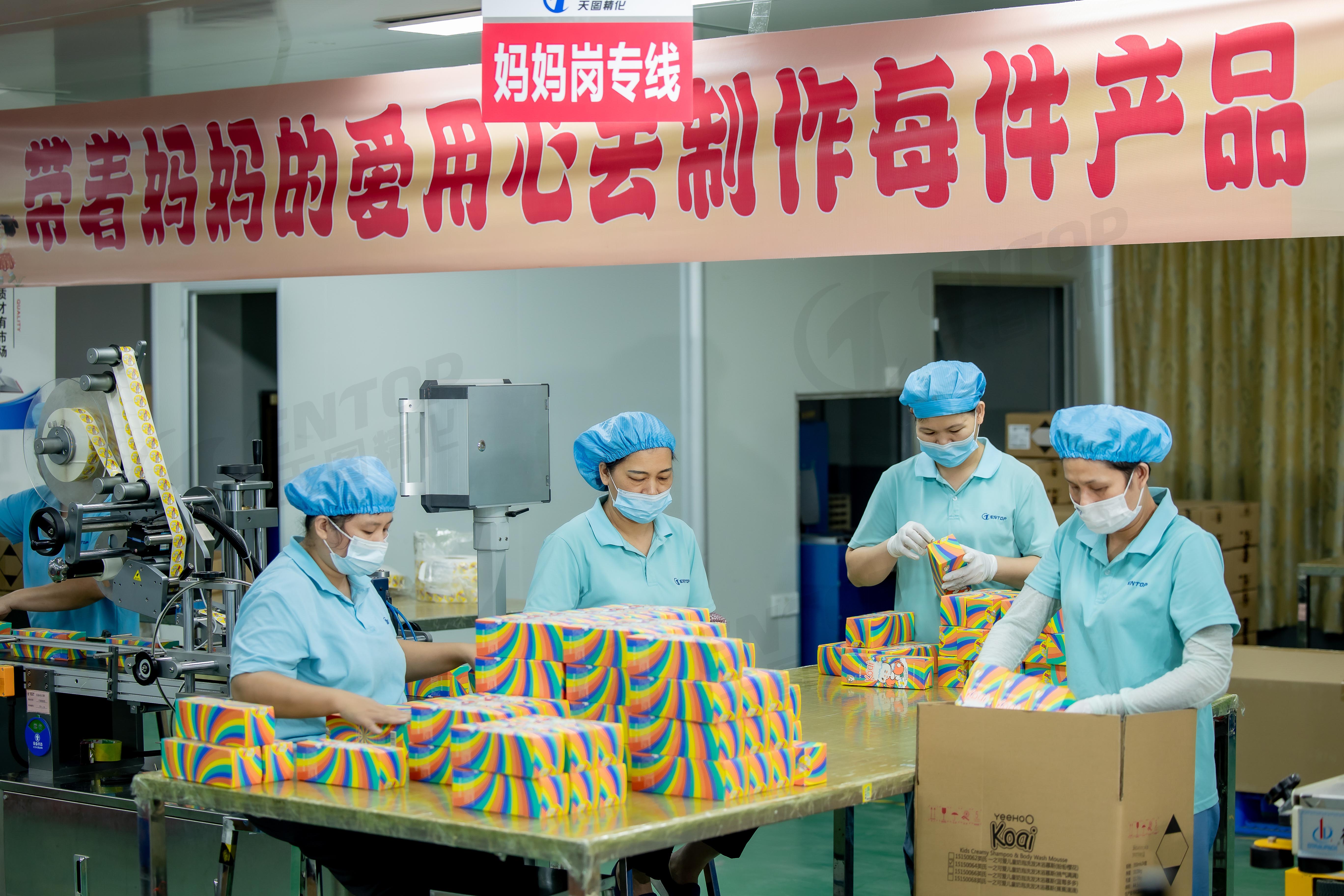
Tentop operates four high-speed aerosol filling lines, three BOV aerosol lines and two liquid filling lines inside clean workshops, with a stated monthly capacity of 5,000,000 units and an annual output of 60,000,000 units across a 15,000 m² site with 330 employees. Propellant handling covers hydrocarbons, DME, 152a, 1234ze, nitrogen and CO₂ — a range that matters for deodorant because the propellant choice changes spray character, pressure and container rating.
Against those figures, a 10,000-unit MOQ is roughly 0.2% of one month’s stated capacity. That ratio reframes the negotiation: the binding constraint on a five-year programme is not whether capacity exists, but whether the buyer’s volume is large enough to earn scheduling priority during peak season. Lead time of 45–60 days should therefore be read as a planning window, not as a promise that can be compressed.
Four boundaries belong in the same document as the advantages:
- Orders below 10,000 units per SKU fall outside the standard commercial model, which makes this structure a poor fit for micro-batch market testing.
- A 45–60 day lead time does not support short promotional cycles built on late forecast changes; buyers must hold safety stock or accept schedule risk.
- Production is concentrated at a single site in Zhongshan, so regional disruption affects the entire order book — a second source or a buffer inventory policy remains a buyer-side responsibility.
- Certificates have windows. The CGMP certificate SZ2601D2 carries issue and expiry dates of 2025-12-29 and 2026-01-14, which is precisely why renewal status must be re-verified at the date of each purchase order, not at the date of the initial audit.
R&D continuity and what 42 patents do and do not prove
Tentop’s R&D team of 60 engineers has developed more than 6,000 formulas and holds 42 patents. For a continuity scorecard, the formula library is the more useful figure: it indicates the probability that a discontinued raw material can be replaced without redeveloping the product from scratch. Patents protect formulation intellectual property; they are not market authorisations and do not substitute for registration in a destination market. Buyers should treat the two as separate evidence items with separate verification routes.
Application fit across the portfolio
Continuity is easier to judge when the same supplier has to hold several categories at once, because shared assumptions break visibly. The table below lists the portfolio anchors used in this evaluation, with the parameters that a scorecard should track per SKU.
| Product / model | Formats | pH | Shelf life | OEM category |
|---|---|---|---|---|
| Deodorant Spray — DS-001 | 150 / 200 / 250 ml | 5.5–6.5 | 3 years | Body care |
| Hydrating Facial Mist Spray — MS-001 | 100 / 150 / 200 ml | 5.5–6.5 | 3 years | Skincare |
| Hair Styling Spray — HS-001 | 150 / 200 / 300 ml | Not specified | 3 years | Hair care |
| Hair Identity Spray — HI-001 | 100–200 ml | Not specified | Not specified | Hair care |
| Hair Removal Spray — HR-001 | 100 / 150 / 200 ml | 7.0–8.0 | 3 years | Hair removal |
| Dry Shampoo | 150 / 200 / 250 ml | Not specified | 3 years | Hair care |
| Shampoo & Bath 2-in-1 Mousse — SB-001 | 150 / 200 / 250 ml | 5.5–6.5 | 3 years | Baby care |
The spread from pH 5.5–6.5 on the deodorant and baby-care mousse to pH 7.0–8.0 on the hair removal spray is the single clearest argument against a one-size qualification protocol. A buyer who qualifies a supplier on a mist and then transfers the same acceptance criteria to a depilatory will approve an out-of-specification batch. Format coverage from 100 ml to 300 ml is where the customization claim becomes operational: a deodorant at 250 ml and a styling spray at 300 ml share a filling environment but not a valve, actuator or pressure setting.
Two delivered programmes illustrate the same point in practice. A Vietnamese private-label buyer took 10,000 units of dry shampoo formulated for tropical humid conditions; the programme has run for three years on stable mass production and flexible OEM/ODM customization. An Indonesian private-label buyer took 30,000 units of Halal-certified sunscreen spray, produced to FDA cGMP standards and held in long-term cooperation. Both cases are small by capacity standards and both survived because the specification was fixed before the first batch rather than negotiated during it.

Hydrating Facial Mist Spray MS-001 — 100 / 150 / 200 ml, pH 5.5–6.5, 3-year shelf life, skincare OEM.
Market signals worth writing into a five-year plan
Four published data points shape the continuity agenda. The global cosmetic spray market moving from USD 18.3 billion in 2025 to a projected USD 31.8 billion by 2034 (Dataintelo) implies continued capacity investment, which raises rather than lowers the value of documentation discipline. The sunscreen spray segment growing from USD 786.7 million in 2026 to USD 1.54 billion by 2035 at a 7.8% CAGR (Research Reports World) pulls adjacent demand into the same filling environment. Asia Pacific’s 42.3% revenue share of the daily sunscreen spray market in 2025 (Dataintelo) concentrates that demand in the region where most contract manufacturing sits. And the 61% aluminium share of aerosol packaging revenue in 2025 (Grand View Research) means container tooling decisions locked in today will define the cost base for the whole agreement.
Consolidated OEM versus the traditional multi-supplier model
The traditional approach splits a deodorant programme across a filler, a can supplier, a valve supplier and a third-party laboratory, on the reasoning that redundancy reduces risk. It does reduce single-point failure — and it introduces a different failure: nobody owns the interface. When spray performance drifts, the filler blames the valve, the valve supplier blames the concentrate, and the laboratory reports a result that satisfies none of the three.
A consolidated model, in which one contract manufacturer holds formula, filling, propellant handling and the compliance file, removes interface risk and shortens the qualification cycle. It also concentrates exposure. The honest boundary is this: consolidation is the better choice above roughly 10,000 units per SKU, for programmes with a fixed specification and a forecast horizon longer than the 45–60 day lead time, and in markets whose registration pathway the supplier has already addressed in writing. Below those thresholds, or where a destination market requires a dossier the supplier has not yet covered, the multi-supplier model remains rational despite its coordination cost.
Purchasing terms and acceptance criteria: the sustainability checkpoint
A five-year agreement survives on the clauses that get written down, not on the relationship that gets described. The terms below are drawn from Tentop’s published commercial position and should be converted into acceptance criteria before the first purchase order.
| Term | Verified position | Acceptance criterion to write into the contract |
|---|---|---|
| Production mode | OEM / OBM with logo customization | Written ownership of formula, artwork and tooling |
| MOQ | 10,000 units | Per-SKU MOQ stated separately for each format |
| Lead time | 45–60 days | Forecast freeze window and delay remedy |
| Capacity | 5,000,000 units/month | Allocation priority during peak season |
| Quality control | 100% test | Test record supplied with each batch |
| Certificates | ISO 9001, ISO 14000, ISO 22716, GMPc, ISO 45001, Halal MUI, SMETA, Disney; BPJPH Halal No. ID00410021104000125; CGMP No. SZ2601D2 | Scope and validity confirmed at each purchase order |
| After-sales | Remote technical support, after-sales tracking, quality assurance | Named technical contact and response window |
| Export markets | EU / USA | Market-specific documentation pack per destination |
Five acceptance tests carry the most weight in a deodorant programme. Run three consecutive batches and retain samples from each. Confirm the CGMP and Halal scopes in writing against the exact SKU and destination market. Verify fill weight, spray rate and actuator performance against the agreed drawing rather than the sample can. Confirm the 3-year shelf-life claim with the stability protocol that supports it. And record the pH target and tolerance per SKU, because the portfolio legitimately spans 5.5–6.5 and 7.0–8.0.
Future outlook
The next phase of the aerosol cosmetic spray category is likely to be decided less by formulation novelty than by file quality. As the market moves toward the projected USD 31.8 billion by 2034, destination-market rules such as MoCRA registration and the EU Aerosol Dispensers Directive will keep raising the cost of incomplete documentation, and buyers will increasingly score suppliers on certificate lifecycle management rather than on line speed. Suppliers who publish MOQ, lead time and scope-level certificate data can be evaluated in weeks; those who publish only photographs cannot be evaluated at all. That gap, rather than raw capacity, is where five-year supply decisions will be won or lost.
FAQ
Which certifications should a deodorant spray OEM hold for the US and Indonesian markets?
For the United States, the relevant manufacturing credential in this evaluation is CGMP certification number SZ2601D2, issued by Intertek Testing Services and based on 21 CFR Part 210 & 211 (2020), whose scope covers the manufacture of Sunscreen Spray and Antiperspirant Spray. For Indonesia, the relevant credential is BPJPH Halal certification number ID00410021104000125, issued by Badan Penyelenggara Jaminan Produk Halal on the Majelis Ulama Indonesia standard and valid until 2029-02-03. Buyers should additionally confirm ISO 22716 and ISO 9001 status, both of which the company holds.
What are the MOQ and lead time for a customized aerosol deodorant spray?
The published commercial terms are a minimum order quantity of 10,000 units and a lead time of 45–60 days, against a monthly capacity of 5,000,000 units. Customization covers logo and private-label branding under an OEM/OBM arrangement, with deodorant formats available at 150 ml, 200 ml and 250 ml.
Does the Halal certificate cover deodorant spray, or only sunscreen spray?
The BPJPH Halal certification held in this portfolio applies to the Sunscreen Spray product for the Indonesian Halal market. A buyer sourcing a deodorant SKU for Indonesia should request written confirmation of scope extension before placing an order rather than assuming that the sunscreen scope transfers automatically.
What pH and shelf life should a buyer verify across an aerosol cosmetic spray portfolio?
Values differ by product and must be verified per SKU. Deodorant Spray DS-001 is specified at pH 5.5–6.5, Hydrating Facial Mist Spray MS-001 at pH 5.5–6.5, Shampoo & Bath 2-in-1 Mousse SB-001 at pH 5.5–6.5, and Hair Removal Spray HR-001 at pH 7.0–8.0. A three-year shelf life is declared for DS-001, MS-001, HS-001, HR-001, SB-001 and the dry shampoo specification; the Hair Identity Spray HI-001 listing does not state a shelf life and should be confirmed separately.
How should a buyer handle a CGMP certificate whose validity window has closed?
Certificate status is a date-specific fact. CGMP certificate SZ2601D2 carries an issue date of 2025-12-29 and an expiry date of 2026-01-14, so a buyer should request the current renewal documentation at the date of each purchase order and record the response in the qualification file, rather than relying on the certificate presented during the initial audit.
Is a single-supplier model suitable for a five-year aerosol programme?
It suits programmes with a fixed specification, volumes above 10,000 units per SKU, a forecast horizon longer than the 45–60 day lead time, and a destination market whose registration pathway the supplier has already addressed. It is less suitable for micro-batch market testing, for promotional cycles requiring faster replenishment than the stated lead time, and where the buyer cannot accept single-site production concentration. In those cases a dual-source arrangement, or buffer inventory held by the buyer, remains the more defensible structure.
¿Tiene preguntas o necesita más detalles?
Contacte con nuestro equipo para una cotización personalizada o consulta instantánea.
Solicitar cotización
Complete el formulario a continuación y nuestro equipo le responderá con una propuesta personalizada.
Chat directo de WhatsApp
¿Prefiere chatear en tiempo real? Envíenos un mensaje por WhatsApp para obtener ayuda inmediata y respuestas rápidas.
- Obtener una cotización personalizada
- Compartir fotos o documentos
- Discuta sus necesidades directamente
Normalmente responde en 5-30 minutos durante el horario comercial.