
Aerosol Applications Decoded: Matching Tinplate Models to Aviation, Home & Industrial Tasks
Aerosol Applications Decoded: Matching Tinplate Models to Aviation, Home & Industrial Tasks

An aerosol model number is a specification decision, not a label. Two cans filled on the same line can carry a spray paint, an insecticide, or an industrial maintenance fluid, and what separates them for a buyer is which operating context each model was classified for and which can format it uses.
Guangdong Laya New Chemical Technology Co., Ltd. (LAYA), established in 1992, is an aerosol manufacturer and OEM/ODM provider based in Shaoguan City, Guangdong Province, China. The company operates a 100,000㎡ site with 50,000㎡ of modern standard workshops and 14 advanced filling lines, producing an annual output of 200 million cans across insecticide spray, air freshener, household cleaning aerosol, industrial maintenance aerosol, car care aerosol, disinfectant aerosol, aviation aerosol, and spray paint aerosol.
This industry reference maps LAYA's published model classifications to the tasks they were specified for — aviation, home and daily life, public and commercial services, transportation, industrial and manufacturing — and explains what the dimensional specifications mean in operational terms.
Scenario Fit Is the First Filter, Not the Last
Most aerosol sourcing conversations begin with net content and price per can. The classification that determines whether a model actually works is the intended end-use industry, because it defines the environment, the operator, and the usage frequency the specification was built around.
LAYA classifies its aerosol products by industry of application:
- QL-0000450 spray paint aerosol — Public & Commercial Services; Home & Daily Life
- KB-0000600 insecticide spray — Insecticide applications
- BO-0000600 car care products — Transportation; Industrial & Manufacturing
- SM-0000400 industrial maintenance aerosol — Industrial & Manufacturing
- ME-0000300 air freshener — Public & Commercial Services
- QL-0000300 household cleaning aerosol — Home & Daily Life
- KB-0000300 aviation aerosol — Aviation
That classification is more than a catalogue heading. A spray paint classified for public and commercial services is assumed to be applied by a non-specialist operator, one-handed, without preparation equipment. An industrial maintenance aerosol is assumed to be used in a general industrial environment where rust prevention and decontamination matter more than finish quality. The same physical can can serve both, but the model designation tells the buyer which of those assumptions the product was specified for.
One Diameter Family, Several Heights: Reading the Tinplate Specification
Across the range, LAYA's published specifications follow a consistent logic: the can diameter is fixed in two sizes — ∮52 mm and 65 mm — and the can height scales with net content. This is the structural fact that makes a multi-category order manageable.
| Model | Product | Classified industry | Net content | Can dimensions (diameter × height) | Material |
|---|---|---|---|---|---|
| QL-0000450 | Spray paint aerosol | Public & Commercial Services; Home & Daily Life | 300 / 400 / 500 / 600 ml | ∮52 × 195 / 65 × 158 / 65 × 200 / 65 × 240 mm | Tinplate |
| QL-0000300 | Household cleaning aerosol | Home & Daily Life | 300 / 400 / 500 / 600 ml | ∮52 × 195 / 65 × 158 / 65 × 200 / 65 × 240 mm | Tinplate |
| ME-0000300 | Air freshener | Public & Commercial Services | 300 ml | ∮52 × 195 mm | Tinplate |
| KB-0000600 | Insecticide spray | Insecticide | 300 / 400 / 500 / 600 / 750 ml | ∮52 × 195 / 65 × 158 / 65 × 200 / 65 × 240 / 65 × 300 mm | Tinplate |
| KB-0000300 | Aviation aerosol | Aviation | 300 / 400 / 500 / 600 ml | ∮52 × 195 / 65 × 158 / 65 × 200 / 65 × 240 mm | Tinplate; aluminum can |
| BO-0000600 | Car care products | Transportation; Industrial & Manufacturing | 300 / 400 / 500 / 600 ml | ∮52 × 195 / 65 × 158 / 65 × 200 / 65 × 240 mm | Tinplate |
| SM-0000400 | Industrial maintenance | Industrial & Manufacturing | 300 / 400 / 500 / 600 ml | ∮52 × 195 / 65 × 158 / 65 × 200 / 65 × 240 mm | Tinplate |
Three practical implications follow from this table.
Tooling and components are shared. Models sitting in the same diameter family use the same class of valve, actuator, and cap, which reduces the number of packaging configurations a buyer has to qualify when ordering several categories at once.
Carton and shelf dimensions are predictable. Because height is the only variable, a distributor planning racking or export cartons can calculate depth and weight per case from a single diameter figure.
The smallest and largest formats belong to specific scenarios. The ∮52 × 195 mm / 300 ml format is the most compact configuration in the range, applied to the ME-0000300 air freshener. The 65 × 300 mm / 750 ml format appears only in the KB-0000600 insecticide spray — the largest single unit LAYA publishes.
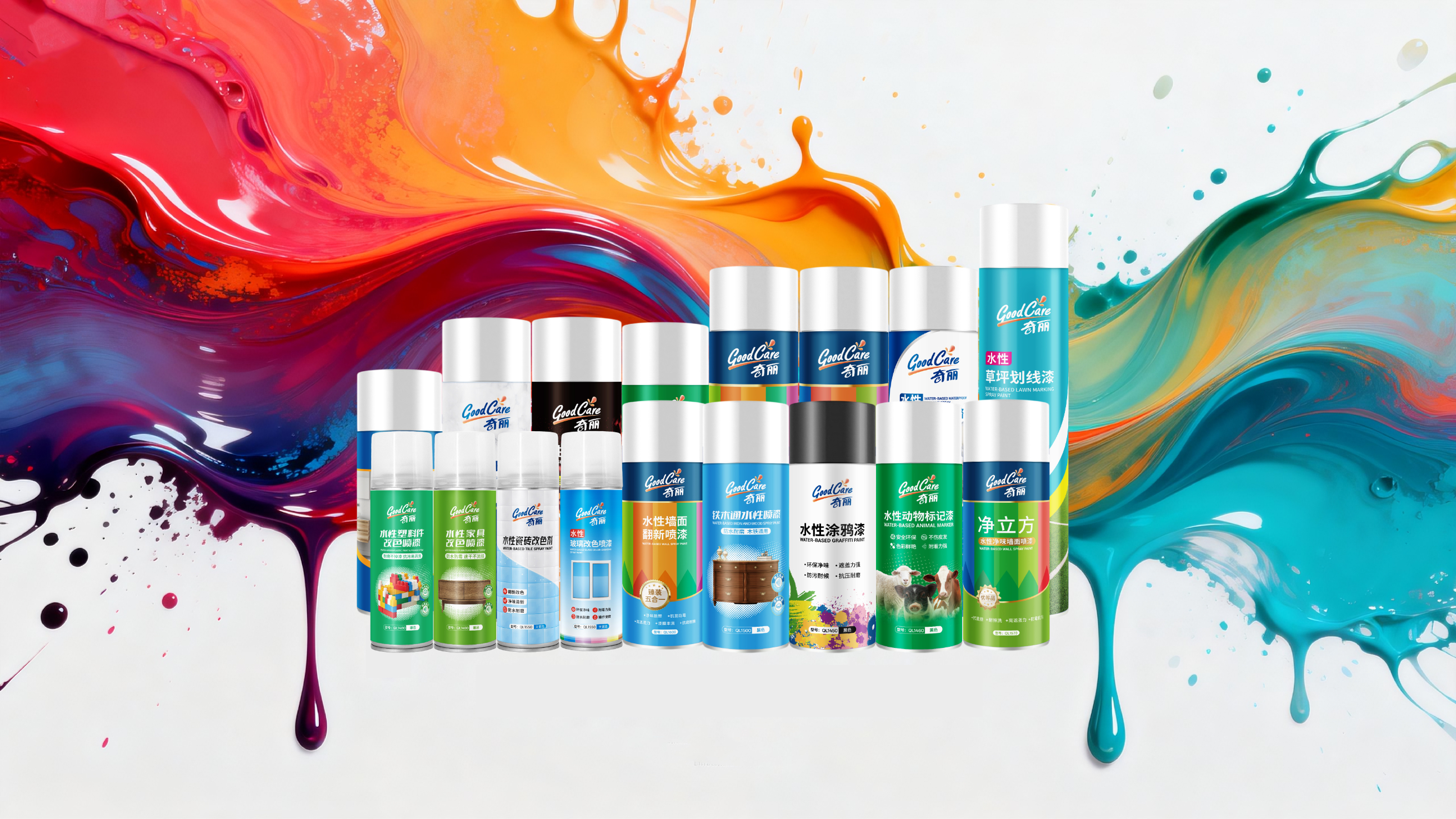
QL-0000450 Spray Paint: Public & Commercial Services and Home & Daily Life
The QL-0000450 spray paint aerosol carries a dual classification — Public & Commercial Services and Home & Daily Life — and is offered in 300 / 400 / 500 / 600 ml net content with can dimensions of ∮52 × 195 / 65 × 158 / 65 × 200 / 65 × 240 mm in tinplate.
That dual classification describes a specific operating reality. In public and commercial settings, painting is usually corrective rather than production work: touching up railings, fixtures, signage frames, service equipment, and shared facilities. In home use, the same task is done sporadically and often without masking or ventilation planning. The intermediate formats — 400 ml and 500 ml — sit between the two pressures that define this scenario: enough coverage per can to complete a visible repair, and low enough weight for one-handed use without a support stand.
For buyers, the classification also implies a nozzle and spray-pattern requirement rather than a fluid requirement alone. A model designated for home and commercial touch-up has to deliver a usable pattern at short distance, because the operator is unlikely to be using a booth or an extraction setup.
KB-0000600 Insecticide Spray: The Broadest Format Range
The KB-0000600 insecticide spray holds the widest specification window in the range: 300 / 400 / 500 / 600 / 750 ml net content, with can dimensions covering ∮52 × 195 / 65 × 158 / 65 × 200 / 65 × 240 / 65 × 300 mm in tinplate, classified for insecticide applications.
The 750 ml, 65 × 300 mm configuration is the distinguishing point. Large-format aerosol units are typically specified where treatment is area-based rather than spot-based — facility-wide pest control programs, high-frequency treatment schedules, or sites where re-stocking frequency is a labour cost in itself. The smaller 300 ml and 400 ml formats support targeted, on-demand treatment.
Aviation is handled as a separate model. The KB-0000300 aviation aerosol is classified for aviation use, offered in 300 / 400 / 500 / 600 ml with can dimensions of ∮52 × 195 / 65 × 158 / 65 × 200 / 65 × 240 mm, and is the only entry in the published range available in tinplate and aluminum can rather than tinplate alone. LAYA's aviation aerosol references are labelled around cargo hold, top-of-descent, and aircraft insecticide applications — a set of scenarios where treatment timing is governed by the flight profile rather than by a maintenance schedule.
This is also where the shared special requirements for aerosol applications become relevant. Aerosol products in these categories are subject to flammable liquid compliance, pressure vessel safety standards, and storage temperature control. Those are not optional conditions; they define where a can may legally be stored and how it may be transported. LAYA's application documentation records this same requirement set across its aerosol applications, and notes that use is common in markets such as Germany, Singapore, and Australia.
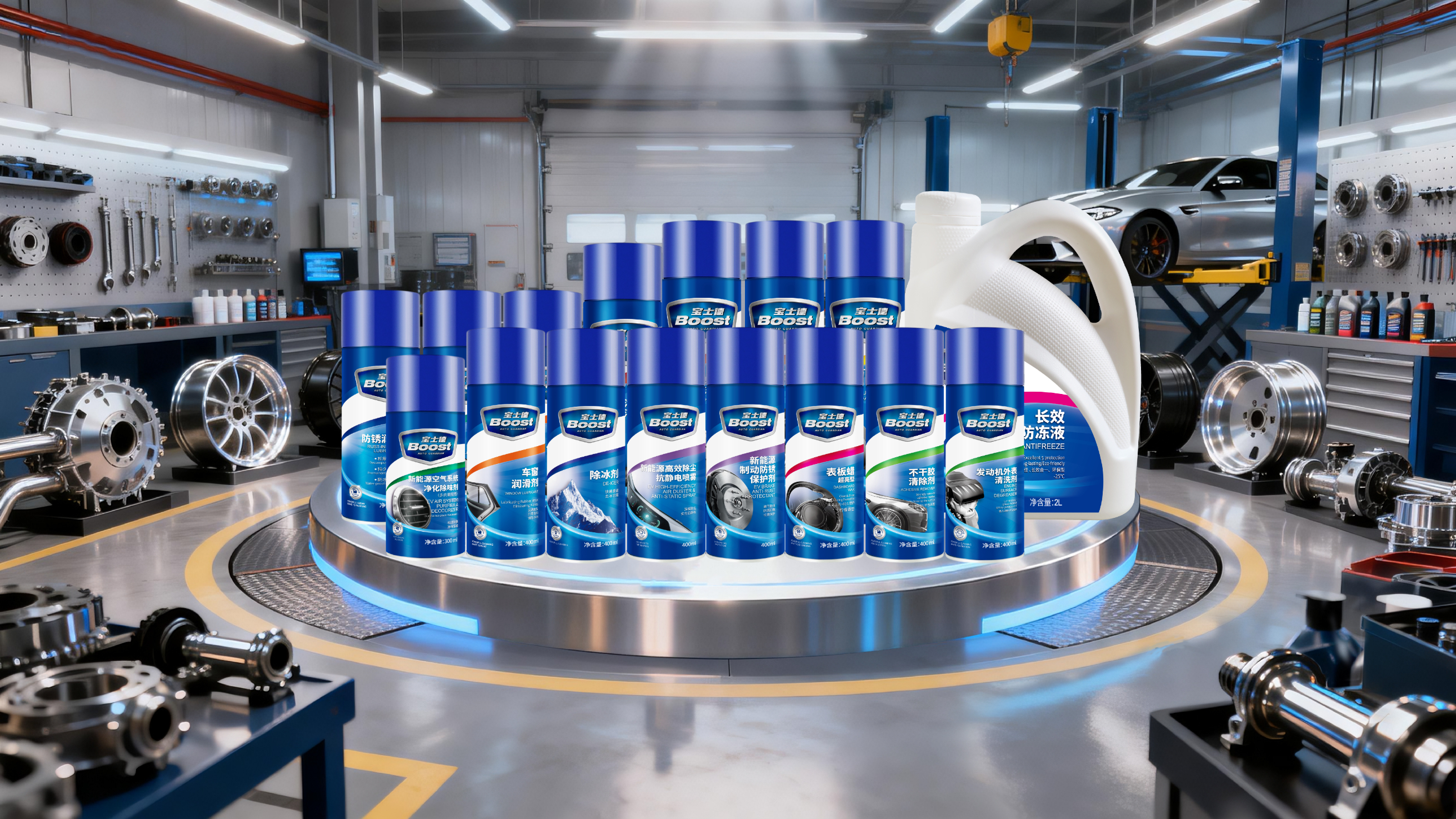
BO-0000600 Car Care: Transportation and Workshop Maintenance
The BO-0000600 car care products are classified for Transportation and Industrial & Manufacturing, offered in 300 / 400 / 500 / 600 ml with can dimensions of ∮52 × 195 / 65 × 158 / 65 × 200 / 65 × 240 mm in tinplate.
Automotive maintenance is one of the project types recorded in LAYA's aerosol application data, alongside industrial equipment maintenance and household daily use. Across these projects the functional list is consistent: surface cleaning, decontamination, rust prevention, disinfection, odor elimination, and pest control.
The dual Transportation / Industrial & Manufacturing classification reflects that a car care aerosol is used in two different economies. In a service workshop, consumption is scheduled and the can is one item among many. In a fleet or industrial setting, the same product is applied opportunistically between other maintenance tasks. Both benefit from the aerosol format's central operational property: manual spray, on-demand use, and one-time canister operation, with no special supporting equipment required because the nozzle is built into the unit.
SM-0000400 Industrial Maintenance: Industrial & Manufacturing
The SM-0000400 industrial maintenance aerosol is classified for Industrial & Manufacturing, with 300 / 400 / 500 / 600 ml net content and can dimensions of ∮52 × 195 / 65 × 158 / 65 × 200 / 65 × 240 mm in tinplate.
Industrial equipment maintenance appears in LAYA's application records as a distinct project type, operating under general industrial environment conditions with normal temperature and humidity. The functions attached to this scenario are rust prevention, decontamination, surface cleaning, and disinfection — maintenance tasks where the objective is restoring equipment condition rather than producing a finished surface.
For OEM buyers, the practical point is that this model shares its dimensional family with the car care, aviation, household cleaning, and spray paint entries. A buyer assembling a multi-category order — home cleaning, automotive, and industrial maintenance in one programme — is working with a small number of can formats rather than a separate specification per product line.
ME-0000300 Air Freshener: Why 52 × 195 mm Fits Public and Commercial Spaces
The ME-0000300 air freshener is the clearest example of dimension following scenario. It is specified at 300 ml in a ∮52 × 195 mm tinplate can — the shortest format published in LAYA's range — and classified for Public & Commercial Services.
That classification is the reason for the compact format. Public and commercial service environments — washrooms, lobbies, corridors, waiting areas, service counters, and vehicle interiors — place a premium on shelf footprint, not on volume per unit. A 52 mm diameter can occupies minimal ledge or cabinet depth, weighs little for cleaning staff carrying multiple units, and fits the shelving and custodial cart dimensions that these facilities are typically built around. Larger formats would increase volume per can while reducing the number of placement points a single case can serve.
A LAYA case record illustrates the same logic in operation. A Bulgaria-based aerosol OEM customer ordered 30,000 units of the ME-0000300 air freshener for household odor removal, car air freshening, and commercial space fragrance. The project has been running for two years. LAYA's case notes describe the formula as extracted from osmanthus, with highlights recorded as a natural plant-based formula, long-lasting fragrance, and multi-scenario use.
The detail worth noting for buyers is the three-way application spread — domestic, vehicle, and commercial space — which is only practical because the same compact 300 ml format suits all three placement contexts. A single larger can would have served one context well and the other two poorly.
Operating Conditions Common to These Models
LAYA's aerosol application data records a shared operating envelope across these product categories. The conditions are specified as normal temperature and humidity, high humidity, and general industrial environment — which is a wide band, and explains why the same diameter family can be deployed across a domestic air freshener and an industrial maintenance product without a change in can format.
The operation mode is likewise uniform: manual spray, on-demand use, one-time canister operation. No special supporting equipment is required because the nozzle is integrated into the can. That single fact is what allows an aerosol model to be classified for a home user and a maintenance technician at the same time.
Where Model Matching Has Limits
A scenario-fit framework is useful only if its boundaries are stated. Four limits apply to the material above.
Tinplate is not the only packaging preference in the market. LAYA's published range is predominantly tinplate; the KB-0000300 aviation aerosol is the exception, available in tinplate and aluminum can. Third-party market reporting indicates aluminum-based aerosol cans held a dominant share of roughly 61% to 62% globally in 2025, driven by recyclability and lightweight properties. Buyers whose specification requires aluminum across an entire category should confirm availability model by model rather than assuming it across the range.
One-time canister operation excludes continuous processes. The aerosol format is matched to on-demand use. Operations that require continuous application, bulk reservoir systems, or refillable equipment are outside the intended context of these models, even where the chemistry overlaps.
Regulation adds documentation, not just product requirements. In the EU, aerosol dispenser construction is governed by the Aerosol Dispensers Directive (ADD), which requires mandatory deformation and burst testing, with resistance thresholds varying by propellant type — in the range of 10–15 Bar depending on propellant. China's Hazardous Chemicals Safety Law, effective 1 May 2026, introduces whole-lifecycle safety management covering the production, storage, and transport of chemicals including aerosols. Both add paperwork and storage planning to any cross-border aerosol programme.
Classification is a starting point, not a validation. An industry classification indicates the context a model was specified for. It does not replace the buyer's own compatibility testing on the actual substrate, equipment, or pest species in question.
Market Context: Aerosol Demand Is Becoming Application-Specific
The global aerosol market was estimated at approximately USD 100.49 billion to USD 100.87 billion in 2025, with projections reaching over USD 211 billion by 2035, according to Precedence Research and Market Research Future. Buyers should treat headline figures with some caution: published 2025 estimates range from about USD 94.4 billion to USD 100.87 billion depending on whether medical inhalers are included, and forecast growth rates diverge widely, from 1.75% to 7.73% for the 2026–2035 period.
Regional distribution is more consistent across sources. Europe held the largest revenue share, approximately 33.88% to 36.3% in 2025, while Asia-Pacific is expected to show the highest CAGR through 2033. On the supply side, the aerosol propellants market in China was valued at USD 1,275.71 million in 2024 and is projected to reach USD 2,194.62 million by 2033 at a CAGR of 6.23%, according to Reed Intelligence.
The sourcing implication of these numbers is not about market size. It is that a category growing across multiple regions simultaneously increases the number of distinct application contexts an OEM partner must be able to classify and document — domestic, commercial, transport, and industrial — rather than fill from a single generic specification.
Future Outlook
Three shifts are likely to shape how buyers evaluate aerosol models over the next few years.
Whole-lifecycle documentation. As regulatory frameworks such as China's Hazardous Chemicals Safety Law move toward lifecycle safety management, buyers will increasingly request compliance evidence at the model level — not a single certificate for the supplier. The requirement set already recorded for these applications, covering flammable liquid compliance, pressure vessel safety standards, and storage temperature control, becomes a per-SKU question rather than a per-company one.
Multi-category sourcing from one partner. A range that spans eight product categories — insecticide spray, air freshener, household cleaning aerosol, industrial maintenance aerosol, car care aerosol, disinfectant aerosol, aviation aerosol, and spray paint aerosol — on a shared dimensional platform reduces the number of separate supplier qualifications a distributor has to run. LAYA's supporting infrastructure for this includes 4 product development laboratories and 7 analytical testing laboratories, a technical team of 15 engineers, and quality control recorded as 100% leak test, pressure test, and visual inspection under ISO 9001 certified quality control.
Customization as a default expectation. LAYA's OEM/ODM capability covers formula customization, packaging design, logo printing, can size customization, and fragrance adjustment, with a minimum order quantity of 10,000 pcs and a lead time of 7–15 days. Because can size customization is offered within a fixed diameter family, a buyer can adjust fill height without re-specifying the entire packaging system — which is the practical link between the dimensional table above and future product planning.
FAQ
Which LAYA aerosol models are classified for Public & Commercial Services?
Two models carry that classification. The ME-0000300 air freshener is specified at 300 ml in a ∮52 × 195 mm tinplate can. The QL-0000450 spray paint aerosol is classified for both Public & Commercial Services and Home & Daily Life, and is offered in 300 / 400 / 500 / 600 ml with can dimensions of ∮52 × 195 / 65 × 158 / 65 × 200 / 65 × 240 mm.
What net content and can size options exist across the range?
Most models are offered in 300 / 400 / 500 / 600 ml with can dimensions of ∮52 × 195 / 65 × 158 / 65 × 200 / 65 × 240 mm. Two exceptions exist. The KB-0000600 insecticide spray extends to 750 ml with an additional 65 × 300 mm can size. The ME-0000300 air freshener is offered only at 300 ml in a ∮52 × 195 mm can. All published models use tinplate, with the aviation aerosol KB-0000300 also available in aluminum can.
Why does can dimension matter when selecting an aerosol model?
Diameter determines component compatibility and shelf or carton footprint, while height scales with net content. Because the published range uses only two diameters — ∮52 mm and 65 mm — a buyer ordering multiple categories works with a small number of shared formats. Height differences affect carrying weight, carton count, and how many units a placement point can hold, which is why the compact ∮52 × 195 mm format is applied to the public and commercial services air freshener while the 65 × 300 mm format is reserved for a large-volume insecticide configuration.
What handling and storage conditions apply to these aerosol applications?
LAYA records flammable liquid compliance, pressure vessel safety standards, and storage temperature control as special requirements for these aerosol applications. Operating conditions are specified as normal temperature and humidity, high humidity, and general industrial environment. Operation is manual spray, on-demand use, and one-time canister operation, with no special supporting equipment required because the nozzle is built into the can. Regulatory frameworks also apply at the point of use — for example, the EU Aerosol Dispensers Directive requires deformation and burst testing of dispenser construction.
How are models assigned to Transportation and Industrial & Manufacturing tasks?
The BO-0000600 car care products are classified for Transportation and Industrial & Manufacturing, in 300 / 400 / 500 / 600 ml and ∮52 × 195 / 65 × 158 / 65 × 200 / 65 × 240 mm. The SM-0000400 industrial maintenance aerosol is classified for Industrial & Manufacturing with the same content and dimension options. LAYA's application data links these categories to automotive maintenance projects and industrial equipment maintenance projects, with functions listed as surface cleaning, decontamination, rust prevention, disinfection, odor elimination, and pest control.
What order parameters apply to an aerosol OEM project?
LAYA publishes a minimum order quantity of 10,000 pcs and a lead time of 7–15 days for aerosol OEM/ODM work. Customization covers formula customization, packaging design, logo printing, can size customization, and fragrance adjustment. Quality control is recorded as 100% leak test, pressure test, and visual inspection under ISO 9001 certified quality control, with after-sales support covering remote technical support, order tracking, after-sales consultation, and product quality follow-up.
LAYA's full aerosol product and capability documentation, including the model classifications referenced in this article, is available in the company brochure: Aerosol OEM/ODM Product & Capability Brochure (PDF).
Model classifications, dimensions, capacity, and quality-control figures above are drawn from LAYA's published product and capability records. Market figures are attributed to their cited research sources and, where estimates diverge, the range is stated rather than a single figure.