
Advanced Silicone OCA for Automotive Displays: A Procurement Comparison
Advanced Silicone OCA for Automotive Displays: A Procurement Comparison
For procurement teams working on automotive display lamination, the material decision usually moves beyond optical clarity into reliability, yield, and total cost. The relevant comparison is often between acrylic OCA and silicone OCA. In 2024, the global optically clear adhesives (OCA) market was valued at USD 2.1 billion, and automotive displays accounted for roughly 20% of that revenue, according to Verified Market Research. This article focuses on advanced silicone optical bonding OCA and explains the decision factors buyers should use when comparing it with traditional acrylic OCA.
Why Advanced Silicone Optical Bonding OCA Matters
The main reason advanced silicone OCA matters is mechanical stress. Modern displays use larger cover glass, curved surfaces, and narrow bezels. When temperature changes or mechanical loads occur, the adhesive layer must absorb stress instead of transferring it to the display panel. If the adhesive is too rigid, the result can be mura, bubbles, or local separation.
Traditional acrylic OCA has a higher modulus. In large-size display bonding, this can lead to mura issues and surface distortion. According to the comparison data for Polomo's silicone OCA, acrylic OCA also has lower molecular bond energy, which can weaken weather resistance and lead to high-temperature bubble rebound, yellow spots, and delamination during long-term use. Acrylic OCA can also generate more odor and VOC emissions at high temperatures, which affects cabin comfort.
The opportunity for silicone OCA is an extremely low elastic modulus. Polomo's silicone OCA is positioned for full display lamination and supports curved displays, irregular shapes, and narrow bezels. These structural advantages are directly relevant to the trend toward larger and more integrated vehicle displays.
Polomo's Silicone OCA Product Position
Guangdong Polomo New Materials Technology Co., Ltd, known as Polomo, is a materials manufacturer based in Dongguan, Guangdong Province, China. Founded in 2002, the company integrates R&D, manufacturing, and sales. Its product scope covers silicone OCA and related adhesive and functional film solutions for optoelectronic displays, semiconductor packaging, energy storage/batteries, and AI-enabled smart hardware.
Polomo's operational data describes a 90,000-square-meter factory, about 300 employees, an annual output of 10 million pieces, and an R&D team of 80 engineers. Around 30% of output is exported. These figures give buyers a basic reference point for supplier capacity and internal resources.
For display lamination, Polomo supplies an all-climate silicone OCA family under model numbers TS107, TS108, and TS109. The product is described as a colorless transparent solid, with a thickness range of 20 to 2000 μm and a product size range of 3 to 50 inches.
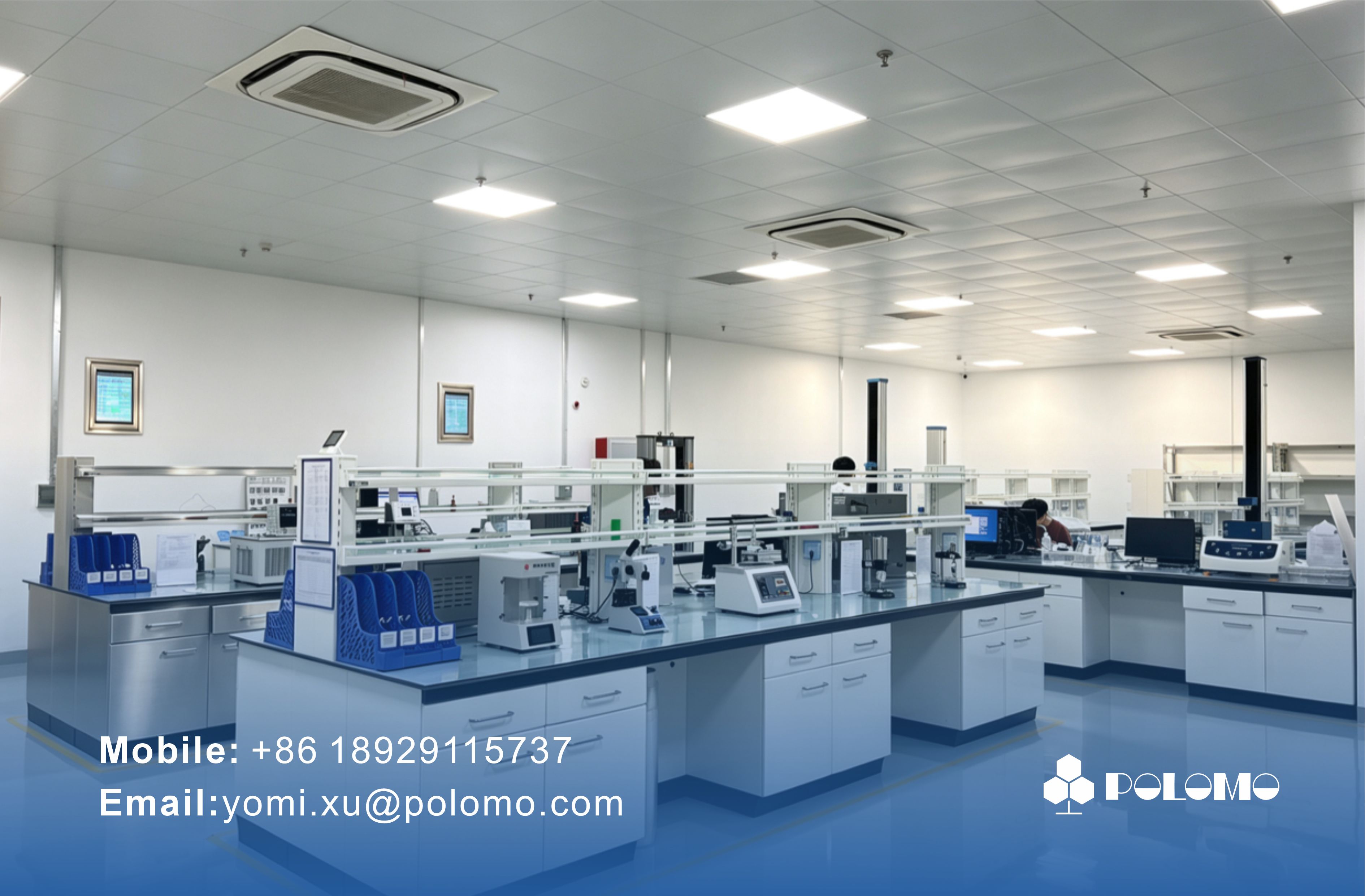
The R&D function at Polomo supports silicone OCA development across automotive, industrial, and medical display applications.
Technical Profile of Advanced Silicone OCA
In display full lamination, silicone OCA functions as the interlayer between the cover glass, the touch panel layer, and the display panel layer. The documented lamination sequence is: remove the light release liner, apply STH, remove the heavy release liner, apply HTH, and finish in an autoclave. The process is carried out with lamination equipment at room temperature and low pressure.
The material parameters explain why the adhesive is considered advanced. Low modulus helps the adhesive absorb stress. A low Δb* value indicates low yellowing, and low haze preserves display clarity. Low water absorption helps stability in humid environments, and a low dielectric constant supports signal-sensitive displays.
| Parameter | Polomo Silicone OCA Value |
|---|---|
| Thickness | 20–2000 μm |
| Product size | 3–50 inches |
| Appearance | Colorless transparent solid |
| Modulus | 22±5 |
| Δb* value | 0.03 |
| Haze | <0.3 |
| Water absorption | <0.3 |
| Dielectric constant (1 MHz) | 2.9 |
For automotive qualification, material behavior matters across a wide temperature range. The documented scenario for this silicone OCA includes -40°C to 120°C, high temperature and high humidity, high-altitude negative pressure, vibration, and strong UV exposure. According to Rogers Corporation, advanced silicone materials used in optical bonding for automotive applications can be rated from -55°C to +200°C.
Silicone OCA Applications in Display Lamination
Silicone OCA is used for display full lamination across a broad range of industries. The documented applicable industries include automotive, industrial control, medical, smart home, commercial display, consumer electronics, aerospace, marine, and education.
In automotive interiors, the relevant display positions include center displays, digital instrument clusters, passenger entertainment displays, rear-seat entertainment displays, armrest displays, streaming rear-view mirrors, head-up displays, and air-conditioning displays. These applications require reliability and optical consistency over long service life.
The product also fits large curved display modules with narrow bezels, which are increasingly common in vehicle cockpit designs. The key technical link is stress absorption: low-modulus adhesive reduces the chance of mura and bubble formation during lamination and in-field thermal loading.
Market Context for Silicone OCA in 2026
The market context supports the growing role of silicone OCA in display lamination. Grand View Research valued the global automotive silicone market at approximately USD 10.2 billion in 2024. Fortune Business Insights projects silicone-based adhesives in the automotive market to grow at an 8.8% CAGR from 2025 to 2032. In the OCA segment, Verified Market Research reports a global market of USD 2.1 billion in 2024, with automotive displays representing about 20% of revenue and industrial or rugged display systems about 15%.
The same report notes that liquid OCA holds about 40% of the OCA segment and is increasingly used for curved and flexible displays. Separately, Asia Pacific accounted for 51% of the global automotive adhesives market in 2024, according to Precedence Research. These figures help buyers understand both material demand and regional supply concentration.
At the application level, large curved automotive displays require low-modulus silicone OCA to prevent mura under thermal stress. Market reporting also identifies UV resistance and anti-yellowing as key formulation priorities for automotive silicone OCA. This aligns with the material profile of Polomo's silicone OCA, which records a Δb* value of 0.03 and covers UV-resistant outdoor and automotive conditions.
Market reports identify Dow Inc., Wacker Chemie AG, and Shin-Etsu Chemical as global leaders in the automotive silicone and adhesives segment. For buyers, the presence of global chemical suppliers means the silicone OCA category is mature, but sourcing decisions still depend on product specifications, process support, and total cost.
Silicone OCA vs. Acrylic OCA: A Decision-Oriented Comparison
For procurement purposes, the comparison between silicone OCA and acrylic OCA should be structured around four factors: material properties, reliability limits, processing behavior, and total lamination cost.
The table below summarizes the recorded differences for Polomo's silicone OCA and acrylic OCA.
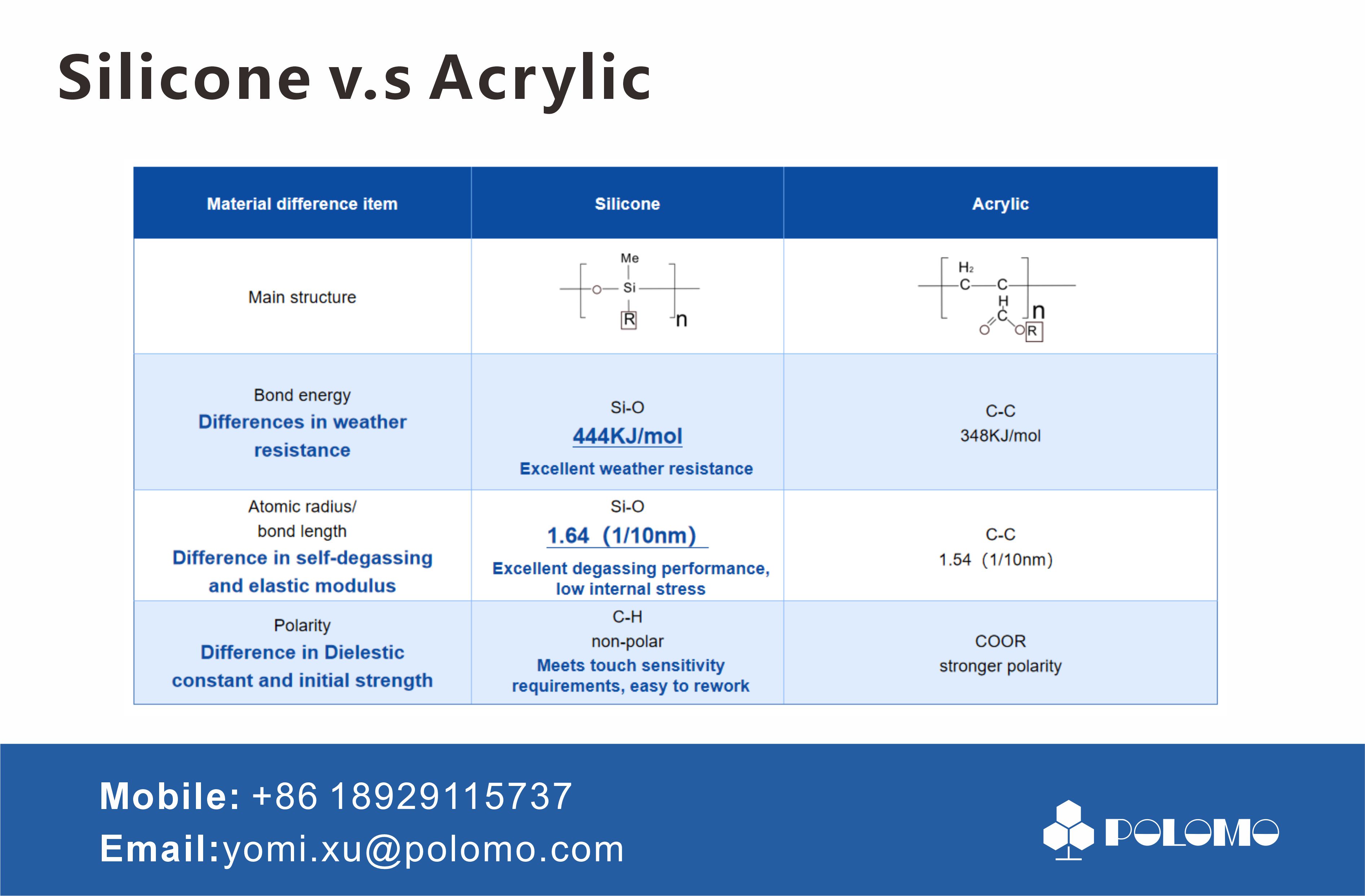
Comparison data covers modulus, yellowing, dielectric constant, odor, and weather resistance.
| Parameter | Silicone OCA | Acrylic OCA |
|---|---|---|
| Elastic modulus | Stable under high and low temperatures | High modulus, especially at low temperatures |
| Δb* value | 0.03 | 0.5 |
| Dielectric constant | 2.9 | >6.3 |
| Odor level | 2.5 | 3.5/4 |
| Weather resistance | -40°C to 120°C | -40°C to 95°C |
| Material cost | Comparable to acrylic OCA | Comparable to silicone OCA |
| Reliability behavior | Prevents mura and bubble issues; better long-term weather resistance | May show high-temperature bubble rebound, yellow spots, and delamination |
| Process and maintenance | Advantages in yield, labor efficiency, and equipment requirements | Higher maintenance demands and defect-related risk in demanding applications |
Material cost is comparable. The cost difference appears in downstream processing. Polomo's silicone OCA provides significant advantages in yield, labor efficiency, and equipment requirements. Higher first-pass lamination yield reduces rework, scrap, quality complaints, and compensation risk. This is usually the more important number for program cost planning.
The other side of the decision is suitability. Silicone OCA is more suitable for automotive display applications where reliability and optical performance are critical, including center displays, digital instrument clusters, and HUDs. For less demanding products with short life cycles and limited environmental requirements, acrylic OCA may still be a rational choice; the boundary should be based on product reliability targets, not material price alone.
Silicone OCA also imposes environmental control requirements. Storage should be in a temperature- and humidity-controlled clean warehouse. Light exposure, dust contamination, shelf-life, inventory aging, and adhesive-layer contamination all need to be managed. FIFO inventory management and standardized opening and storage procedures are part of the control method. Buyers should verify that their warehousing and lamination environment can meet these requirements.
Standardized environmental control and FIFO management are part of silicone OCA storage discipline.
Future Outlook
Display architecture is moving toward larger curved modules, hidden displays, and more integrated cockpit surfaces. These designs increase the mechanical demands on the adhesive layer and reduce tolerance for optical distortion. Low modulus, optical stability, and process consistency are likely to become standard selection criteria rather than differentiators.
The market outlook for optical bonding materials is positive. Verified Market Research projects the global optical bonding market to reach USD 1,519.48 million by 2031, with a CAGR of 6.63%. Data Insights Reports estimates the optical bonding materials market at USD 3.11 billion with a projected CAGR of 11.6% from 2026 to 2034. The range shows that growth estimates vary by scope, but the direction is consistent.
Supply chain requirements will also tighten. IATF 16949:2016 is the mandatory global quality management standard for automotive suppliers and focuses on zero-defect manufacturing, according to the International Automotive Task Force. Buyers involved in Tier 1 automotive display programs should treat IATF 16949 documentation as a baseline requirement rather than the only evidence of suitability. They should also review reliability data under temperature cycling, high humidity, high-altitude negative pressure, vibration, and UV exposure.
FAQ
What is the main difference between silicone OCA and acrylic OCA?
Silicone OCA has an extremely low elastic modulus and can absorb stress during large-size display bonding. Acrylic OCA has a higher modulus and may cause mura, bubble rebound, yellow spots, and delamination in long-term use. Silicone OCA also has lower yellowing and better weather resistance in the recorded comparison data.
Is silicone OCA more expensive than acrylic OCA?
The material costs of Polomo's silicone OCA and acrylic OCA are comparable. The total lamination cost can differ because silicone OCA provides advantages in yield, labor efficiency, and equipment requirements. Lower defect rates reduce quality complaints and compensation risk.
What temperature range can silicone OCA support?
The documented working range for Polomo's silicone OCA is -40°C to 120°C. External automotive material benchmarks for advanced silicone optical bonding materials extend from -55°C to +200°C, according to Rogers Corporation.
Which display applications are suitable for silicone OCA?
Silicone OCA is applicable to automotive, industrial control, medical, smart home, commercial display, consumer electronics, aerospace, marine, and education applications. In vehicles, it can be used for center displays, digital instrument clusters, passenger and rear-seat entertainment displays, armrest displays, streaming rear-view mirrors, head-up displays, and air-conditioning displays.
What storage conditions does silicone OCA require?
Silicone OCA should be kept in a temperature- and humidity-controlled clean warehouse. Light exposure and dust contamination must be limited, and shelf-life and inventory aging must be managed. FIFO management and standardized opening and storage procedures help prevent adhesive-layer contamination.
What quality standards should buyers check for automotive silicone OCA?
IATF 16949:2016 is the mandatory global quality management standard for automotive suppliers and focuses on zero-defect manufacturing. Buyers should request the supplier's IATF 16949 documentation and review reliability data under relevant automotive conditions, such as temperature cycling, high humidity, and UV exposure.
Data References
- Grand View Research - Automotive Silicone Market (2024)
- Fortune Business Insights - Automotive Silicone Market Size and Share Report (2025-2032)
- Verified Market Research - Optically Clear Adhesives Market Report 2026
- Precedence Research - Automotive Adhesives Market (2024)
- Rogers Corporation - BISCO Silicones
- International Automotive Task Force - IATF 16949:2016
- MarketsandMarkets - Silicone Market
Reference Material
Polomo maintains a publicly accessible product brochure for specification review: Polomo Product Brochure (PDF).