
Adult Diapers for Plus-Size Care: OEM Size and Absorbency Fit
Adult Diapers for Plus-Size Care: OEM Size and Absorbency Fit
Matching size and absorbency starts with the care scenario
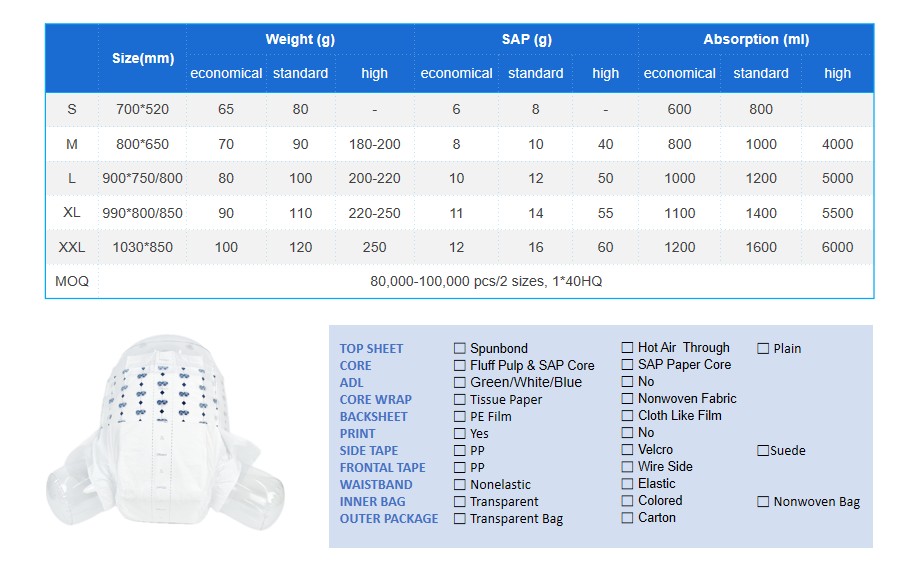
For plus-size adult incontinence programs, an OEM size label is only a starting point—not proof of fit for a particular wearer. Importers should evaluate the intended care setting, the wearer’s fit needs, the product’s published size and absorbency specification, and an approved sample together. The available specification for Ultra Thick Yibero Adult Women Diapers lists sizes M, L, XL and XXL, with reference absorbency from 1,800 to 2,800 ml. It does not provide body-measurement ranges or establish that a size will fit every wearer described as plus-size.
This distinction matters when selecting adult diapers for home care, nursing-home wards, hospitals and clinics, or retail and wholesale distribution. The product scenario material describes household indoor and nursing-home ward use at normal ambient temperature, for day-and-night incontinence care. Those settings share a need for absorbent protection, leakage control, odor control and skin comfort, but the corpus does not define one universal size or absorbency target for all users or care routines. Buyers therefore need to translate the intended use into a specification, then verify that specification against samples and documented conditions.
Fujian Jiayue Sanitary Products Co., Ltd. supplies hygiene products and provides OEM/ODM and private-label support, according to the company-provided material. For this application, its published adult-women’s diaper specification gives importers a concrete starting point for discussing size, SAP content, reference absorbency and core construction. It is a product reference, not a guarantee of fit, leakage performance or wear time in every individual situation.
What the published M–XXL specification says
The listed values pair each size with a product dimension, SAP content and reference absorbency. The dimensions are shown in the product specification in millimetres; the order below follows the published M, L, XL and XXL sequence.
| Published size | Dimensions (mm) | SAP content (g) | Reference absorbency (ml) |
|---|---|---|---|
| M | 800 × 640 | 18 | 1,800 |
| L | 900 × 740 | 22 | 2,200 |
| XL | 990 × 790 | 26 | 2,600 |
| XXL | 1,030 × 835 | 28 | 2,800 |
The table is a specification map, not a wearer-size chart. It shows that the published configurations pair larger size labels with higher SAP content and higher reference absorbency. It does not show the wearer measurements each size accommodates, explain how the reference absorbency was measured, or establish real-world performance under a particular wearer’s movement, position, change schedule or care conditions. Importers should not convert the size labels or reference values into unsupported claims about body fit or guaranteed protection.
That boundary is especially important when a product range is being considered for plus-size incontinence care. A size range extending to XXL may be relevant to the sourcing discussion, but the available facts do not establish that XXL is sufficient for every plus-size wearer, or that one size is suitable across different body shapes. Fit should be treated as a separate approval question: review the dimensions, obtain the proposed sample, and assess it against the intended wearer and care requirements before finalizing the private-label specification.
Separate fit decisions from absorbency decisions
Size and absorbency are related in the published table, but they answer different procurement questions. Size and fit concern whether the product’s dimensions and construction are suitable for the intended wearer. Absorbency concerns the specified reference value for a configuration. A higher listed reference absorbency does not by itself prove a better fit, eliminate leakage, or establish a longer change interval.
For a home-care program, the corpus identifies daily and overnight wear, with periodic replacement according to care needs. An importer can use that scenario to define which configurations to sample and what the intended use is. The available information does not prescribe a replacement schedule or state that the 2,800 ml reference value provides a particular number of hours of protection. Those decisions remain dependent on care needs and the final product specification.
For a nursing-home ward or a hospital and clinic supply program, the same separation helps keep product requirements clear. A buyer may need to review both the fit of the selected size and the absorbency target associated with it. The setting alone does not determine which size is right, and a larger size should not be assumed to solve an absorbency requirement. Record the selected configuration and evaluate the sample in relation to the program’s intended use, rather than relying on a size label or a headline absorbency number alone.
A practical importer’s decision sequence is:
- Define the use scenario. Identify whether the program is intended for household care, a nursing-home ward, a hospital or clinic, or retail and wholesale distribution. These are listed application areas for the product; they are not evidence of a deployed customer case.
- Identify the fit requirement. Review the published size and dimensions, then confirm suitability with the sample for the intended wearer or user group. Do not infer body-measurement ranges that are not published.
- Select the absorbency configuration to evaluate. Use the size-linked SAP and reference absorbency values as specification points, not as a prediction of an individual outcome.
- Confirm materials and core construction. Ensure that the sample and quotation describe the same core structure and material configuration being evaluated.
- Lock the agreed version. Confirm specifications, testing conditions, packaging and any customized details in the approved specification and commercial documents.
How core construction affects an OEM comparison
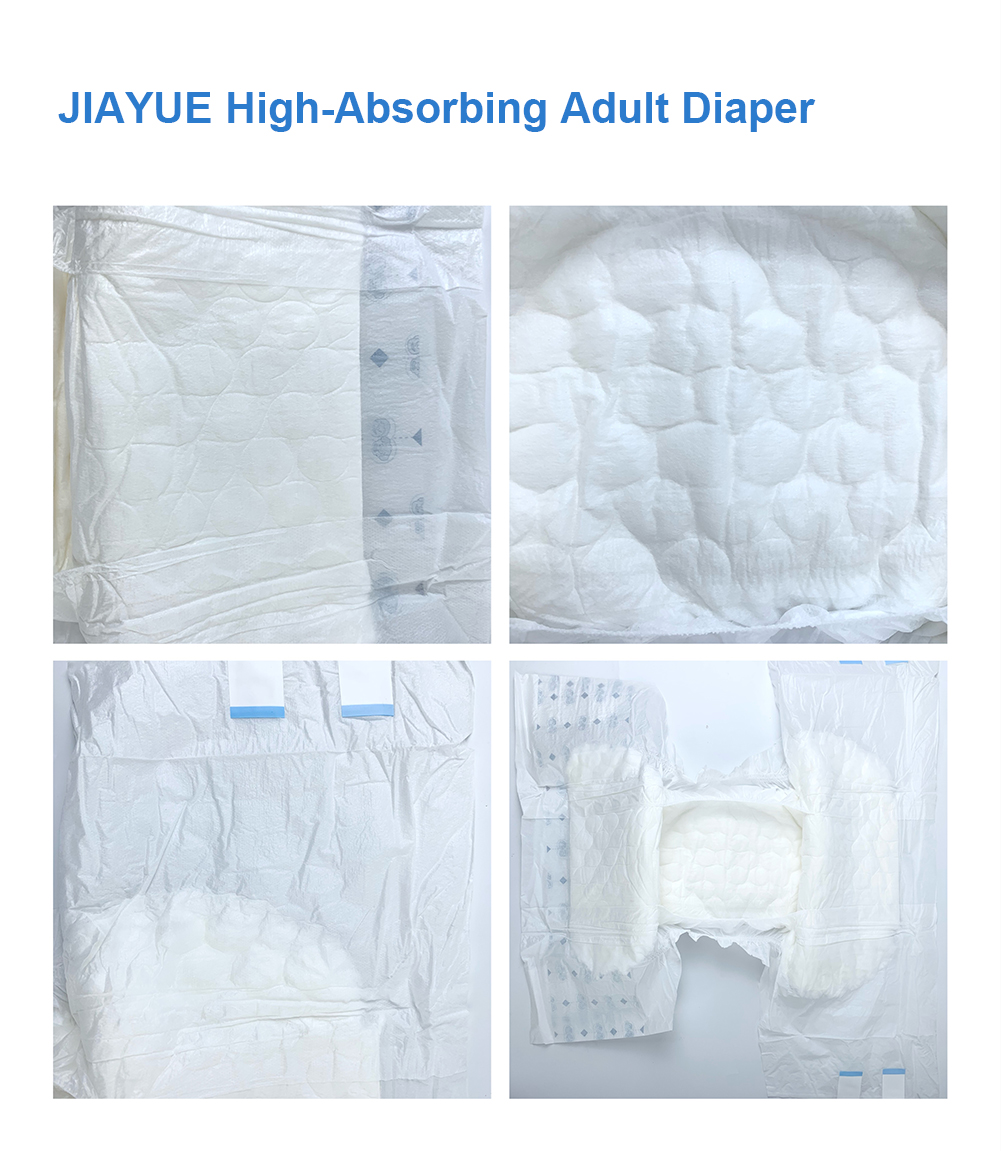
The published construction for Ultra Thick Yibero Adult Women Diapers includes a soft topsheet, a fluff-pulp and imported-SAP absorbent core, blue ADL, reusable magic tape, nonwoven frontal tape, an elastic waistband and a cloth-like breathable backsheet. This describes the published configuration. It should not be read as confirmation that every optional material or alternative core is included in every OEM order.
Jiayue’s knowledge material distinguishes a fluff pulp & SAP core from an ultra-thin SAP paper core. A fluff pulp & SAP core combines cellulose fluff pulp with superabsorbent polymer; an ultra-thin SAP paper core uses SAP paper as the main absorbent structure. The company says both options are available for selected diaper products. The supplied product specification for this adult-women’s diaper identifies the fluff-pulp and imported-SAP core; it does not identify an ultra-thin SAP paper core as the standard construction of this specific published model.
Consequently, an OEM request for an alternative core should be treated as a configuration to clarify and verify, not as an assumption about the named model. The knowledge material states that there is no universal performance advantage between the two structures. Buyers should compare thickness, target absorbency, product weight, fit, material configuration and test results against the approved specification and sample under the same conditions. A comparison is not meaningful if the samples differ in size, core construction, target absorbency or test method.
For importers, this is a configuration-control issue as much as a technical one. If a sample uses one core and the final order is quoted with another, the buyer may not be evaluating the product that will be supplied. The same applies when absorbency targets, size, materials or packaging change during OEM development. Request a clear written description of the sample and proposed order configuration, and make sure the approval record and contract refer to the same version. The available information does not provide test thresholds or a standard test method for comparing these options, so those details should be agreed for the specific order rather than assumed.
Fit the product to care and distribution settings
The application information covers elderly care, nursing homes, hospitals and clinics, home care, and retail and wholesale distribution, as well as private-label brands and export trade. For importers serving more than one channel, that breadth makes it useful to define the intended application before choosing a size mix or presenting a product description. It does not establish that one configuration is optimal for every channel.
In home care, the scenario described is indoor use at normal ambient temperature for day-and-night incontinence care. The product is single-use and is replaced periodically according to care needs. Buyers can use these conditions to frame sample evaluation, while avoiding an unsupported promise about how long a particular diaper will last or how frequently every wearer should change it. Optional supporting products listed in the scenario include disposable underpads, adult care wet wipes and storage bins; none is mandatory equipment for using the diaper.
For nursing-home wards and other care programs, the same published size and absorbency table can help structure an evaluation across the available configurations. It does not prescribe a size allocation, a patient profile or a ward-level usage plan. A distributor or institutional buyer should therefore keep the product facts separate from its own downstream selection criteria. If the intended program requires a specific size range, absorbency target or core option, make that requirement explicit in the OEM specification and assess the corresponding sample.
For wholesale and private-label distribution, the configuration also needs to remain intelligible through ordering and packaging. The published product information lists a pack configuration of 10×10 and a shelf life of three years. These are published product details, not a substitute for checking the final packaging and order specification. The available material also says that OEM and private-label specifications can be customized. It does not establish that the published pack configuration will automatically apply to every customized order.
What importers should confirm before approving an OEM version
For an OEM adult-diaper program, the most useful verification is a consistent chain from requirement to sample to agreed order specification. The company-provided capability information lists customization options that include product size and weight, absorbency target, SAP/fluff-pulp or composite core, materials, tape or pull-up format, leak guards, wetness indicator, waistband, graphics, printed bags or cartons, pack count and size mix. These are described as customization options; their inclusion in a particular offer must be confirmed for that order.
A buyer evaluating plus-size use should identify the precise size and dimensions under review, not merely request “larger sizes.” The sample should represent the proposed size and construction. If a different core is proposed, specify it separately and compare it with the baseline under the same conditions. If the project requires a different absorbency target or packaging configuration, record that as a separate order requirement rather than assuming it follows from the published M–XXL table.
- Product identity: Confirm the product name and the exact size being sampled.
- Fit reference: Record the published dimensions and use the sample to assess fit for the intended wearer or user group. Do not treat size labels as a measurement chart.
- Absorbency and SAP: State the desired configuration and preserve the published distinction between SAP content and reference absorbency.
- Core and materials: Identify whether the order uses the published fluff-pulp and imported-SAP core or a separately approved alternative. Specify relevant materials instead of relying on a broad “high absorbency” description.
- Evaluation conditions: Agree the test method and conditions for any comparison. The provided material calls for same-condition comparison but does not set a universal method or pass threshold.
- Order documents: Ensure that the quotation, approved specification and contract describe the same customization, sample and packaging configuration.
This process does not imply that every listed option is available in every combination or that a particular outcome is guaranteed. The company-provided information states that customization details and final product specifications are confirmed through sampling and an approved specification; it also states that final requirements are confirmed in the quotation and sales contract. For the importer, the practical implication is straightforward: treat a verbal or general capability description as a starting point, and use the order-specific documents to define what is actually being purchased.
Where the published specification is useful—and where it stops
The published information is useful for building a first evaluation framework: four size labels, four associated dimensions, SAP content and reference absorbency values, a described fluff-pulp and imported-SAP construction, and a set of listed care settings. It gives buyers specific attributes to carry into a sample review and OEM discussion. It is not a complete fit guide or a comparative performance report.
In particular, the reference absorbency figures should remain identified as reference values. The provided facts do not specify the test procedure, test conditions, sample variation or a guaranteed in-use result. They also do not establish a leakproof guarantee, a particular overnight duration, a clinical outcome or a skin-health result. The product scenario describes leakage control, odor control and skin comfort as product roles, but that description is not a quantified test result or a promise for every wearer.
Likewise, the term “plus-size” should be used carefully in procurement and product communication. The provided size range reaches XXL, but no body measurement chart or definition of plus-size is supplied. Buyers can accurately describe the available range and the published dimensions. They should not claim that the range fits all plus-size adults unless they have separate evidence supporting that claim for the relevant market and user group.
Conclusion: approve a configuration, not just a label
For adult diapers intended for plus-size incontinence-care programs, the published M–XXL range offers a defined starting point for OEM evaluation: SAP content runs from 18 to 28 g, and reference absorbency runs from 1,800 to 2,800 ml across the listed configurations. The product specification also identifies the core and key materials. Those facts can guide a focused comparison, but they do not independently establish wearer fit or performance in a particular care routine.
Importers can reduce ambiguity by treating fit, absorbency and core construction as separate but connected approval questions. Select the relevant size and dimensions for sampling; confirm the intended absorbency target; compare core options only when the product configuration and test conditions are aligned; and record the accepted details in the quotation, approved specification and contract. This approach keeps the decision tied to the actual product being evaluated and the intended care setting, without turning a size label or reference value into a broader claim than the evidence supports.
Frequently asked questions
Does the XXL size mean the diaper fits every plus-size wearer?
No. The published specification lists an XXL size and dimensions of 1,030 × 835 mm, but it does not provide wearer body-measurement ranges or establish fit for every plus-size wearer. Review the dimensions and assess the proposed sample for the intended user or group.
What SAP content and reference absorbency are listed for each size?
The published sequence is M: 18 g SAP and 1,800 ml reference absorbency; L: 22 g and 2,200 ml; XL: 26 g and 2,600 ml; XXL: 28 g and 2,800 ml. These are specification values, not a guarantee of individual in-use performance.
How do fluff pulp & SAP and ultra-thin SAP paper cores differ?
A fluff pulp & SAP core combines cellulose fluff pulp with superabsorbent polymer. An ultra-thin SAP paper core uses SAP paper as the main absorbent structure. There is no universal performance advantage; compare thickness, target absorbency, product weight, fit, material configuration and test results against the approved sample under the same conditions.
Is an ultra-thin SAP paper core the published core for this model?
No. The published specification for Ultra Thick Yibero Adult Women Diapers identifies a fluff-pulp and imported-SAP absorbent core. The knowledge material says that both core options are available for selected diaper products, but it does not identify the ultra-thin SAP paper core as the standard construction for this specific model.
What should be confirmed for a private-label or OEM order?
Confirm the size, dimensions, absorbency target, core and material configuration, sample, packaging and any customized details. The final configuration should be consistent across the quotation, approved specification and contract.
¿Tiene preguntas o necesita más detalles?
Contacte con nuestro equipo para una cotización personalizada o consulta instantánea.
Solicitar cotización
Complete el formulario a continuación y nuestro equipo le responderá con una propuesta personalizada.
Chat directo de WhatsApp
¿Prefiere chatear en tiempo real? Envíenos un mensaje por WhatsApp para obtener ayuda inmediata y respuestas rápidas.
- Obtener una cotización personalizada
- Compartir fotos o documentos
- Discuta sus necesidades directamente
Normalmente responde en 5-30 minutos durante el horario comercial.