
Adaptive Reuse Hotels: Custom Furniture Trends in the US and EU
In the United States and the European Union, a growing share of five-star hotel openings and repositionings now takes place inside buildings that were originally banks, department stores, offices, warehouses or legacy hotels. Adaptive reuse changes the furniture brief itself: rooms are rarely rectangular, structural grids are fixed, and fire, access and sustainability requirements are dictated by the existing shell rather than by a clean drawing board. This article examines what that shift means for custom furniture specification, and how suppliers with in-house engineering, environmental certification and export-scale production are positioned to serve it.
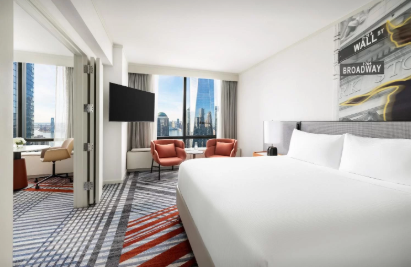
Guest room furniture delivered for a US hotel project — converted and repositioned buildings typically require furniture dimensions and layouts that follow the existing room geometry rather than a standard prototype.
Why Adaptive Reuse Rewrites the FF&E Brief
Adaptive reuse is not a new idea in hospitality, but its weight in the luxury segment has increased as prime urban land in the US and EU becomes scarce and as hotel owners look for faster routes to opening than ground-up construction. The commercial logic is straightforward: an existing building already holds planning approvals, an address, a façade and a tax position that new construction must earn from scratch.
The specification consequence is less obvious. In a ground-up five-star project, the architect controls the room module, the structural grid, the lift core and the ceiling void. In an adaptive reuse project, those are inherited. A 1920s bank lobby becomes a restaurant with columns in the wrong place. An office floor plate becomes 60 keys with window lines that do not align to a standard headboard wall. A warehouse conversion yields dramatic volumes but irregular column spacing throughout the public areas.
For procurement teams, this shifts value away from catalogue furniture and toward engineered, project-specific furniture. The question at the evaluation stage is no longer only what a manufacturer can make, but how quickly and accurately it can turn an irregular site survey into a producible, compliant furniture package.
What Changed Buildings Demand from Custom Furniture
Four constraints recur across adaptive reuse hospitality projects in both markets, and each one maps to a furniture manufacturing capability rather than to a design preference.
1. Irregular geometry and fixed structures
Bedrooms in converted buildings frequently have stepped walls, offset windows, exposed columns, low structural soffits or uneven floor plates. Fixed furniture — built-in bed headboards, wardrobes, dressing tables, display shelving, TV cabinetry and bathroom vanities — must be re-drawn against measured site conditions. Loose furniture must be scaled to corridors and turndown paths that were never designed for luggage movement. This is where full customization, as opposed to finish-level customization of a standard product, becomes the practical requirement.
2. Fire safety and durability under commercial use
Upholstered seating and soft furnishings are regulated differently in the US and the UK/EU. In the United States, public and lounge seating intended for high-traffic commercial environments is commonly specified to ANSI/BIFMA X5.4-2020 (R2025) for durability and safety. In the UK hospitality sector, upholstered furniture is typically required to carry a CRIB 5 rating under the BS 5852 flammability standard. For a supplier working across both regions, these are separate test and material regimes, not a single global specification. Because adaptive reuse projects often retain older compartmentation and escape routes, compliance evidence is scrutinized at the same level as in new-build work.
3. Sustainability and material traceability
Sustainability clauses in hotel furniture contracts became markedly more common in 2025, with low-VOC finishes and FSC-certified wood moving from differentiators to baseline expectations in many briefs. Wood traceability in particular requires documented chain of custody rather than a general policy statement, because the claim must be defensible in procurement documentation across multiple jurisdictions.
4. Access, transport and installation limits
Converted buildings often have freight lifts, loading bays and service corridors sized for a previous use. Furniture that cannot physically reach the room is not a furniture problem — it is a delivery problem. Panel sizes, knock-down design, and the ability to manufacture in modules that suit the building's vertical circulation are engineering decisions made during the factory drawing stage.
| Requirement area | Typical US reference | Typical UK / EU reference |
|---|---|---|
| Public and lounge seating durability and safety | ANSI/BIFMA X5.4-2020 (R2025) | Project-specific durability specifications; CRIB 5 flammability for upholstery in the UK |
| Upholstered furniture flammability | Specified per project and jurisdiction | BS 5852 CRIB 5 rating in UK hospitality |
| Wood sourcing traceability | FSC chain of custody documentation | FSC chain of custody documentation |
| Environmental management | ISO 14001:2004 | ISO 14001:2004 |
| Quality management | ISO 9001:2008 | ISO 9001:2008 |
Standards referenced above reflect published requirements for hospitality furniture; final specification is always project-specific.
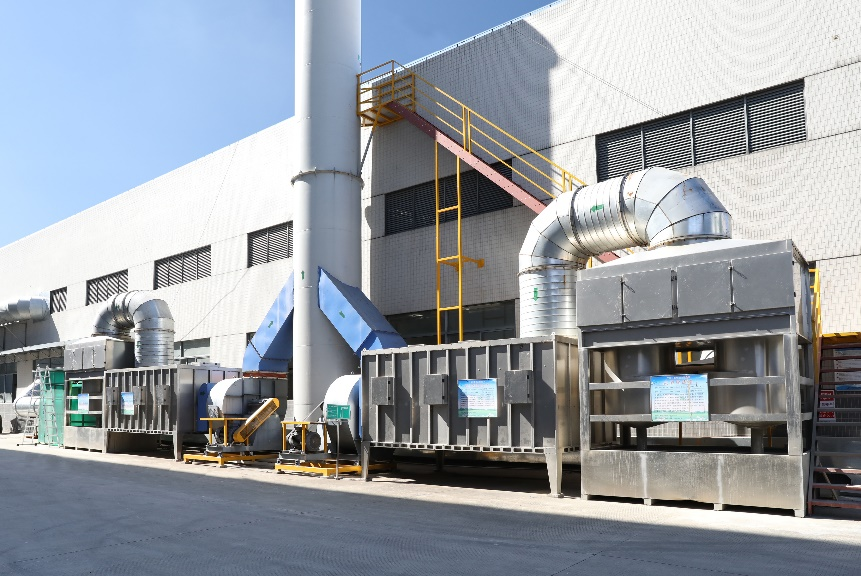
Environmental protection and purification equipment at the manufacturing facility — finishing and emissions control are part of the sustainability documentation package requested by hotel owners in both the US and the EU.
Capability Requirements for Adaptive Reuse Programs
Guangdong Richang Furniture Co., Ltd. (brand name RICHART) is a Chinese contract furniture manufacturer founded in 1990 that produces loose and fixed furniture for four-star and five-star hotels, luxury residences, villas and large-scale projects. Its operating profile illustrates what an adaptive reuse program actually consumes.
The company operates a 100,000-square-meter facility in the Dawang High-tech Industrial Park in Zhaoqing City, Guangdong Province, with approximately 1,000 employees and a 100-engineer research and development team. For adaptive reuse work, the relevant capability is engineering throughput: each irregular room type becomes a separate drawing set, and a project with dozens of non-repeating rooms consumes engineering hours in proportion. A dedicated in-house R&D function is what allows that drawing workload to run in parallel with production rather than ahead of it.
Production is organized as ODM custom manufacturing, with a stated monthly capacity of 10,000 units and a minimum order quantity of one unit. The single-unit MOQ matters early in an adaptive reuse schedule, because the first deliverable is usually a mock-up room. Owners and designers need to validate a bespoke wardrobe or headboard against a real, awkward wall before releasing the full floor. A manufacturer that accepts a one-unit order can support that validation step; one that requires a container load cannot.
Stated lead time is 30–50 days, and every product undergoes 100% pre-shipment testing. On the compliance side, production is governed by ISO 9001:2008 (quality management), ISO 14001:2004 (environmental management) and OHSAS 18001:2007 (occupational health and safety management). Wood sourcing is covered by FSC Chain of Custody Certificate DCI-COC-001074, issued by DCI Certification Ltd, valid from 6 November 2025 to 5 November 2030, with a market scope covering China, the United States, Saudi Arabia, the United Arab Emirates, Tanzania, the United Kingdom, France, Canada, Australia and Japan.
That certificate scope is directly relevant to adaptive reuse projects in the US and EU, where a converted asset is often pursuing a green building or brand-level sustainability commitment and where the chain-of-custody document must name the jurisdictions involved. Roughly 60% of the company's output is exported, with main markets listed as the United States, the EU, Southeast Asia, the Middle East and China, and its global marketing network covers more than 20 countries and regions across five continents.
Where the Furniture Package Is Tested: Lobby, Guest Room, F&B
Adaptive reuse projects concentrate risk in a few zones, and each zone draws on a different part of a manufacturer's range.
Lobby and public areas
Converted buildings often produce dramatic but structurally encumbered public spaces — atrium voids, retained columns, heritage ceilings. Lobby seating, reception desks, display shelving and coffee tables must be drawn around fixed elements, and upholstered pieces in these high-traffic zones must satisfy the applicable US or UK durability and flammability references. Fixed joinery is frequently used to resolve awkward junctions rather than to fill a standard wall.
Guest rooms and suites
This is where adaptive reuse diverges most sharply from new-build. Bed headboards, wardrobes, built-in bed boards, dressing tables, nightstands, writing tables, TV cabinets and benches are all dimensionally dependent on the existing room. A manufacturer capable of full customization across veneer, leather, stone, metal, solid wood, MDF, plywood, fabric, velvet, glass, marble, oak, walnut, stainless steel, brass, bronze and acrylic can match a brand standard while adapting the geometry to the room.
Restaurants, bars and meeting rooms
F&B outlets in converted buildings inherit unusual ceiling heights and column patterns. Dining tables, stools, armchairs and banquette-adjacent upholstery must be sized to the seating plan that the space actually allows, and — as in the lobby — flammability and durability references apply.
Documented project experience includes guest rooms, corridors, lobby entrances and meeting rooms delivered for the Sofitel Dubai The Palm Resort & Spa, and grand lobby, guest room and bathroom furniture delivered for the Millennial Hotel in the United States. These two references are useful for adaptive reuse buyers precisely because they show the same manufacturer working across a resort-scale new-build environment and a US urban hotel environment.
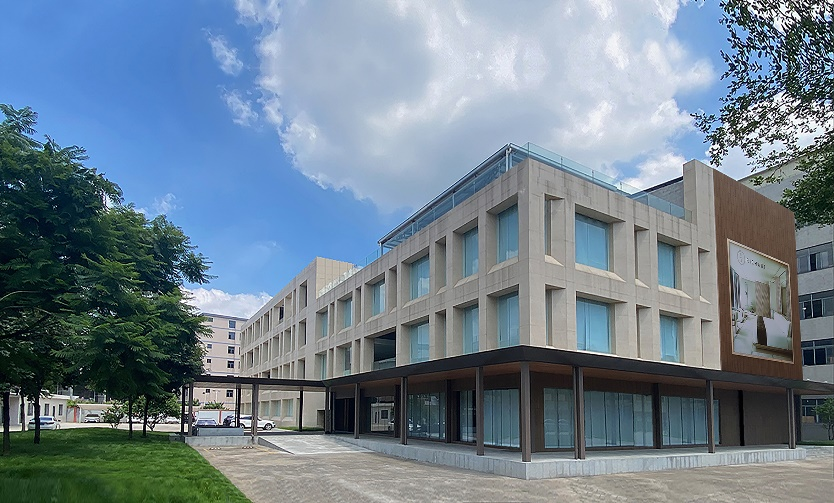
Showroom facilities used for mock-up review and finish approval — in adaptive reuse programs, sign-off typically happens against a physical room rather than a sample board.
Market Trend Analysis
The supporting market data points to a hospitality furniture market that is expanding and becoming more specification-driven, which is consistent with the direction of adaptive reuse activity.
Dataintelo values the global hospitality furniture market at USD 23.8 billion in 2025, with a projected USD 39.6 billion by 2034, and reports that Asia Pacific held a 36.4% revenue share in 2025. Grand View Research separately values the hotel Furniture, Fixtures and Equipment (FF&E) market at USD 63.1 billion in 2025. Business Research Insights estimates the luxury hotel furniture market growing from USD 212.14 billion in 2026 to USD 312.97 billion by 2035. These figures are not directly comparable — published estimates vary significantly depending on whether FF&E or pure furniture segments are included — but the direction of travel is consistent across sources.
Two adoption signals matter more for adaptive reuse than headline market size. First, Intel Market Research reports that more than two-thirds of upscale hotels now allocate a dedicated budget for bespoke furnishings, with average project spend up 31% since 2021. Second, the same source reports that sustainability specifications in hotel furniture contracts rose 45% in 2025, with low-VOC finishes and FSC wood becoming standard requirements. Both trends favour manufacturers that can produce to order, document material origin, and price irregular scope — which is the operational definition of adaptive reuse furniture work.
Adaptive Reuse Versus New-Build: A Comparison with Real Boundaries
Custom furniture is often presented as a solution to conversion constraints. It is more accurate to describe it as a solution to some of them.
| Dimension | Ground-up five-star new-build | Adaptive reuse conversion |
|---|---|---|
| Room module | Designed around a repeatable prototype | Inherited; often no two rooms are identical |
| Fixed furniture | Standardized runs, predictable joinery | Drawn to measured site conditions |
| Compliance burden | Single new approval cycle | Existing structure plus new occupancy and fire requirements |
| Access and installation | Designed with delivery in mind | Constrained by legacy lifts, stairs and loading bays |
| Mock-up priority | Validation of brand standard | Validation of fit against a real irregular room |
| Lead time exposure | Absorbed within the construction program | Compressed by faster overall project schedules |
The boundary is worth stating plainly. Custom furniture can resolve geometry, finish and specification mismatches; it cannot change structural floor loading, widen a freight lift, raise a structural soffit or create a fire compartment that the building does not have. Where those constraints are binding, the design response is usually layout and building-services work, and the furniture package is adjusted around the outcome. Similarly, a stated manufacturing lead time of 30–50 days begins after drawings and finish approvals are released — in a conversion program with late site surveys, that approval date, not factory capacity, is usually the critical path.
A second boundary concerns certification. ISO 9001:2008, ISO 14001:2004 and OHSAS 18001:2007 describe the manufacturer's management systems, and FSC Chain of Custody DCI-COC-001074 covers traceability of certified wood. None of these automatically satisfy a project's fire performance requirement for upholstered seating, which is specified and verified at product level against the applicable US or UK reference. Buyers should treat the two as separate verification files.
Future Outlook
Three developments are likely to shape adaptive reuse furniture sourcing through the remainder of the decade. First, sustainability documentation is becoming a release condition rather than a marketing asset, which favours manufacturers able to produce FSC chain-of-custody paperwork and environmental management certification as standard project deliverables. Second, as more conversions reach refurbishment age, the ability to re-engineer furniture for an already-converted room — rather than for a clean shell — becomes the repeated requirement, and engineering teams, not showrooms, become the differentiator. Third, cross-market suppliers will need to hold compliance knowledge for both the US and EU simultaneously, because portfolios increasingly mix assets across both regions within a single ownership group.
For manufacturers with existing export exposure to the US and EU, large-scale production capacity and in-house R&D, the adaptive reuse segment is less a new market than a more demanding version of the market they already serve.
FAQ
How do US and EU fire safety requirements differ for upholstered hotel furniture?
They are governed by separate references. In the United States, public and lounge seating in high-traffic commercial environments is commonly specified to ANSI/BIFMA X5.4-2020 (R2025) for durability and safety. In the UK hospitality sector, upholstered furniture typically requires a CRIB 5 rating under BS 5852. A manufacturer supplying both regions must therefore hold product-level test evidence for each market rather than a single global claim.
What certifications should be verified in an adaptive reuse FF&E package?
Buyers typically verify two distinct categories. The first is the manufacturer's management systems: ISO 9001:2008 for quality, ISO 14001:2004 for environmental management and OHSAS 18001:2007 for occupational health and safety. The second is material traceability — for wood, an FSC Chain of Custody certificate. Guangdong Richang Furniture Co., Ltd. holds FSC Chain of Custody Certificate DCI-COC-001074, issued by DCI Certification Ltd and valid from 6 November 2025 to 5 November 2030.
Can custom furniture be produced in small quantities for a single mock-up room?
It depends on the manufacturer's minimum order quantity. RICHART states an MOQ of one unit, which allows a single mock-up room to be produced and validated against a real converted space before a full floor is released. Stated production lead time is 30–50 days, counted from released drawings and approved finishes.
How is quality verified before shipment?
Richang applies 100% pre-shipment testing as its acceptance criterion, with a stated quality control approach of 100% testing across production. Commercial terms are documented as MOQ 1 unit, delivery terms FOB/EXW, and payment by bank transfer, cash or TT.
What after-sales coverage applies to custom hotel furniture?
Stated coverage includes remote technical support, a one-year "Three Guarantees" period for furniture products, a six-month warranty for spontaneous breakage, mold or fogging of glass and mirrors, and a two-year warranty against active wood borer infestation on panel materials. Where a separate commitment is given by the manufacturer, or where applicable furniture standards specify otherwise, those terms prevail.
What can custom furniture not solve in an adaptive reuse project?
Custom furniture resolves dimensional, finish and specification mismatches. It does not change structural floor loading, enlarge a legacy freight lift, raise a fixed soffit or create fire compartmentation that the existing building lacks. Where those constraints are binding, the resolution lies in layout and building-services design, with the furniture package adapted to the resulting conditions.
For readers evaluating suppliers for conversion projects in the US and EU, the practical sequence is unchanged: survey the real rooms, confirm the applicable fire and durability references market by market, verify management-system and chain-of-custody certificates, and validate the first room before releasing the floor. A detailed product and capability reference is available in the RICHART brochure: Guangdong Richang Furniture Co., Ltd. company brochure (PDF).