
Acceptance Criteria for Industrial Lubrication Pump Compliance
An industrial lubrication pump is usually ordered with four numbers: displacement, drive speed, housing material and port size. None of those four tells a receiving inspector whether the unit in the crate should be signed off. That gap — between what a supplier declares and what a buyer can actually check — is where a large share of lubrication pump disputes begin, and where the difference between a compliance file and an acceptance file becomes commercially visible.
Acceptance criteria close that gap. They translate compliance statements into checks that can be performed at goods-in, repeated in a maintenance log, and referenced later in a warranty conversation. This guide sets out how that translation works for industrial lubrication pumps, using Deo Machinery Co., Ltd. (DEO) published product and qualification evidence as a worked example, and it is explicit about where that evidence stops.

Production equipment at DEO’s Ningbo facility, where lubrication pumps and coolers are manufactured.
Compliance, qualification and acceptance are three different things
Buyers use these words interchangeably in RFQs. They describe different levels of evidence, and only one of them survives an audit.
Declared compliance is a statement made by the supplier — a certificate, a declaration of conformity reference, a catalogue claim. Documented qualification is the buyer’s own file showing that the declaration was reviewed against a specific duty. Demonstrated acceptance is the record produced when a physical unit is measured against agreed limits.
A quality management certificate is a legitimate input to the second level. It is never a substitute for the third. That distinction matters more in lubrication pumps than in many pump categories, because a lubrication pump is often a low-volume, high-consequence component: it is not the machine, but its failure stops the machine.
| Level | Who produces it | What it can support | What it cannot support |
|---|---|---|---|
| Declared compliance | Supplier | Shortlisting, category screening | Any statement about a delivered unit |
| Documented qualification | Buyer | Supplier approval, contract terms | Proof that the specification was met |
| Demonstrated acceptance | Buyer and supplier jointly | Payment release, warranty baseline | Behaviour outside the tested duty |
Where acceptance files usually break down
Five failure patterns account for most of the friction between procurement and maintenance teams on lubrication pump orders.
1. A certificate is filed in place of a specification. The certificate number is recorded; the scope line is not read. The buyer can then demonstrate that a system exists, but not that the system covers the product purchased.
2. A standard citation is read as a performance claim. A reference to a machinery directive or an electrical standard describes the documentation framework a product was assessed against. It does not state a flow rate, a pressure rating or a service life.
3. No measurement point is agreed. Displacement and speed together determine flow. If the contract names a displacement but not the speed at which flow will be verified, two inspectors can produce two different “pass” results from the same pump.
4. A material grade is treated as a corrosion rating. Grade designations describe what the housing is cast from. They say nothing about surface protection, coating system or suitability for a chemically aggressive medium.
5. Customs classification is left entirely to the forwarder. Classification affects landed cost and clearance timing, so it belongs in the acceptance file rather than in a separate logistics chain.
The supplier behind the file: what DEO verifiably is
Deo Machinery Co., Ltd. (DEO) is a Ningbo-based manufacturer of hydraulic pumps, electric lubrication pumps, centralized lubrication system pumps, oil lubrication pump systems, lubrication system oil coolers and industrial lube oil cooling systems. The company was established in 2010, operates a 10,000 m² facility with 80 employees including 12 engineers, reports annual output of 30,000 units, and records an export ratio of 20% with sales into Europe and America, Southeast Asia and Australia.
Those five data points are the minimum a buyer needs before any product-level discussion begins: an operating history long enough to be checkable, a facility footprint that can be compared with alternate sources, headcount and engineering capacity that bound the support model, and an export share that indicates international documentation experience without implying depth in any single market.
Two commercial terms complete the entity picture: production is offered under OEM/ODM with customization of colour and oil pump configuration, minimum order quantity is 1 unit, and stated lead time is 35–45 days against a monthly capacity of 2,500 units.
Read the scope line of the certificate before the number
DEO holds an ISO 9001 quality management system certificate, number 16426Q00565R001, issued by Huazhong International Certification and Inspection Group against GB/T 19001-2016/ISO 9001:2015, valid from 7 April 2026 to 6 April 2029. The certified scope reads: production of coolers and lubricating oil pumps for mines, ships, and hydraulic machinery.
The scope line is the operative sentence, and it does three useful things for a buyer. It names the product families covered. It names three application fields, which tells the buyer whether their own industry sits inside the assessed boundary. And it carries a validity window, which turns certificate review into a recurring task rather than a one-time filing.
It also does not do three things. It does not state a flow rate, a pressure rating or a service life for any model. It does not constitute a market-access approval for any region. And it does not describe how the system is applied to a specific order — for that, the buyer needs the process statements, which in DEO’s case include 100% testing as a stated production practice.
The practical rule: a certificate answers “is there a system, and does it cover this product family?”. It does not answer “will this unit deliver 630 cc/rev at the speed I specified?”. Those are separate questions with separate evidence.
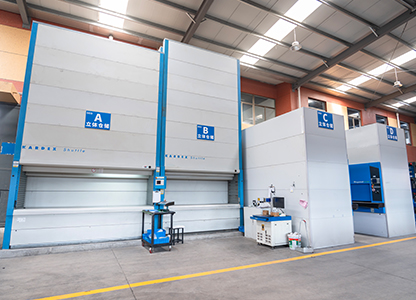
Manufacturing equipment supporting DEO’s lubrication pump and cooler production lines.
A five-checkpoint qualification screen for lubrication pump suppliers
The screen below is deliberately ordered from entity to unit. Each checkpoint should produce a document in the buyer’s file, and each should be read with its own limitation stated.
| Checkpoint | DEO evidence point | What it establishes | What it does not establish |
|---|---|---|---|
| Legal entity and continuity | Established 2010; 10,000 m²; 80 employees; 12 engineers | Operating history and engineering depth | Financial stability or future capacity |
| Management system scope | ISO 9001 certificate 16426Q00565R001, scope line, 2026–2029 | Production control exists for the named product families and industries | Performance of any individual unit |
| Material declaration | QT500 ductile iron; GG250 grey cast iron | What the housing is declared to be cast from | Casting density, machining tolerance or corrosion class |
| Published operating envelope | PST180 −30°C to +100°C; DK630 630 cc/rev at 950/1450 rpm | The range and speed points within which the declaration applies | Behaviour beyond that range or at intermediate speeds |
| Commercial and process terms | MOQ 1 unit; 35–45 days lead time; 2,500 units monthly; OEM/ODM; 100% test | Order feasibility and stated inspection practice | Which parameters are tested, or the values recorded |
Note the asymmetry in the last row. A supplier stating 100% testing is making a process claim, not a results claim. A buyer who needs test values in the acceptance file must specify which parameters are recorded and in what form — that is a contractual step, not a documentation-reading step.
Material grades as checkable acceptance items
DEO’s published product data assigns QT500 ductile iron to the DK630 electric lubrication pump and to the PSN100 trochoidal bidirectional mechanical pump. The PST180 bidirectional internal gear pump uses a pump housing in GG250 grey cast iron or QT500 ductile iron.
Grade designations are useful in an acceptance file because they are checkable at two moments: on paper, against the material declaration and batch records, and physically, against the marking and appearance of the delivered housing. They are worth writing into the purchase order precisely because they are simple to verify.
What a grade does not do is describe the casting. Two housings both declared QT500 can differ in wall thickness control, porosity and machined fit, and those differences surface as leakage or noise rather than as a material non-conformity. A grade is a starting filter, not a quality conclusion.
There is also a compatibility boundary worth stating plainly. GG250 and QT500 are cast irons. In corrosive media or seawater-adjacent duty, cast iron components normally require additional protection or a different material approach; a grade designation should never be read as a corrosion rating. Buyers specifying pumps for such environments should raise the medium in the RFQ rather than infer compatibility from the housing grade.
Turning published parameters into measurable thresholds
Three DEO pump models carry published figures detailed enough to be converted into acceptance thresholds.
The DK630 electric lubrication pump is rated at 630 cc/rev with motor rotation speeds of 950 rpm and 1450 rpm, in QT500 material, and is positioned for mining equipment, construction machinery, the steel industry and industrial lubrication oil pump duty. The PST180 bidirectional internal gear pump is rated at 180 cc/rev with a maximum speed of 1800 rev/min and an operating temperature range of −30°C to +100°C, positioned for hydraulic systems, construction machinery, engine lubrication systems, automation equipment, forklifts and telehandlers, hydraulic power units and industrial cooling systems. The PSN100 trochoidal bidirectional mechanical pump is rated at 100 cc/rev with a maximum speed of 1800 rev/min and the same −30°C to +100°C range, in QT500 ductile iron, positioned for lubricating systems, cooling systems and externally driven independent conveying systems.
Three conversion rules follow from those figures.
Displacement and speed are a pair. DK630’s 630 cc/rev only resolves into a defined flow when the speed point is named. Because two speeds are published — 950 rpm and 1450 rpm — an acceptance clause that names only displacement leaves the measurement ambiguous. The clause should read: flow verified at 950 rpm, or at 1450 rpm, and the choice should match the drive actually installed.
Temperature is a window, not a limit. The −30°C to +100°C range published for PST180 and PSN100 defines where the declaration applies. Operation outside it requires separate confirmation, and viscosity change at the cold end is part of that conversation rather than a footnote to it.
Material and medium are separate questions. A housing declaration is about the casting. The fluid is a different specification item, and the two should be checked independently in the acceptance file.
| Model | Displacement | Speed | Temperature | Material |
|---|---|---|---|---|
| DK630 | 630 cc/rev | 950 rpm / 1450 rpm | Not stated in published data | QT500 |
| PST180 | 180 cc/rev | Max 1800 rev/min | −30°C to +100°C | GG250 grey cast iron or QT500 ductile iron |
| PSN100 | 100 cc/rev | Max 1800 rev/min | −30°C to +100°C | Ductile iron, QT500 |
Where performance records exist, they should be filed as records rather than as specifications. DEO project documentation records an ultra-low noise result of 3 dB below traditional straight gear pumps, volumetric efficiency at or above 95%, and a 40% reduction in component wear for the gear pump used in that case. Those are project outcomes tied to a described application, and a buyer should treat them as supporting evidence for a supplier’s engineering claims — not as a guaranteed figure for a different duty.
Documentation review and the customs line item
Acceptance files for imported pumps increasingly include a classification check. In the United States, industrial pumps and oil pumps fall under HTS heading 8413, with 8413.30.90 covering the relevant pump classification. Classification consistency between the supplier’s commercial invoice, packing list and customs entry is a documentary acceptance item, because an inconsistent code surfaces as a clearance delay rather than a pump defect.
For the standards side of the file, it is useful for buyers to know what a mature disclosure looks like, even when the comparison supplier is not the one being purchased. SKF’s published documentation for its FK grease lubrication pump unit references Machinery Directive 2006/42/EC, RoHS II 2011/65/EU, EMC 2014/30/EU, and standards including EN ISO 12100:2010, EN 809:1998+A1:2009/AC:2010, EN 60204-1:2018, EN 60947-5-1:2004/A1:2009 and EN IEC 60947-5-2:2020. That list is a disclosure pattern from another manufacturer, not a DEO certification record; DEO’s published compliance evidence in this guide is the ISO 9001 certificate described above.
Standard scope also needs discipline. ASTM F2798-09(2023) defines requirements for sealless, rotary positive displacement pumps with oil-through motors for ship lubricating oil service, applying to canned lube oil pumps handling oil in the SAE 20–50 range. That is a marine standard with a named pump construction and a named viscosity band. Applying it wholesale to a general industrial lubrication pump is a category error — a reminder that every cited standard carries its own applicability conditions, and those conditions belong in the acceptance file next to the citation.

Documentation handling at DEO — certificate scope review is a recurring task, not a one-time filing.
Application fit and what it changes in the acceptance clause
Lubrication pump acceptance criteria shift with the industry the pump serves, because the failure mode that matters shifts.
Mining and construction machinery. DK630’s 630 cc/rev puts it in high-flow centralized supply territory. The acceptance clause should lock the interface — port size, mounting, drive speed — because field rework on a mobile machine costs far more than a documentation delay in the factory.
Steel industry. Continuous duty under heavy load makes the temperature window and the cooling arrangement the dominant acceptance items. This is why DEO’s product scope pairs lubrication pumps with coolers rather than selling pumps as a standalone catalogue.
Wind energy. Project records describe a DK-F variant customized for the alternating vibration and frequent speed variation of wind turbines, with client types including wind turbine gearbox manufacturers, heavy machinery and reducer manufacturers. One recorded application covers a speed reducer deployment of 10 units across Thailand and Germany with a five-year duration. For wind and other long-life applications, the acceptance file should include the format in which replacement and inspection intervals will be logged — a pump that lasts five years is only an advantage if the intervals were recorded.
Integrated pump and cooler packages. When a lubrication pump is ordered together with a cooler, the acceptance clause must cover both. DEO’s cooler range includes the DFLSL-10 self-circulating cooler with cooling capacity 1.61/1.84 kW/°C, oil pump flow 100–125 L/min or 150–200 L/min at VG46, and consumed power 5.5/7.5 kW; the DFLEX8 wind cooler with comparative cooling capacity 1.15/0.91 kW/°C, fan diameter 630 mm and 3φ380 motor voltage; and the DWBW-408-T fin-type oil/water cooler with maximum working pressure of 16 bar on the oil side and 10 bar on the water side, allowable oil medium temperature up to 120°C, allowable cooling water temperature of 5–60°C, and applicable oil kinematic viscosity of 12–320 mm²/s. Flow and pressure drop across pump and cooler must be agreed as a system figure, not as two separate component figures.
Where the evidence runs out
An acceptance guide that only lists what can be checked is not usable for procurement. Four boundaries should be stated explicitly against the evidence above.
Export share is not market coverage. DEO records a 20% export ratio across Europe and America, Southeast Asia and Australia. That means roughly four-fifths of production serves other markets. A buyer should not infer local service density, spare parts stock or field response time in a specific country from an export percentage; those require a separate confirmation during supplier qualification.
No third-party performance benchmark exists for this category at unit level. The third-party material available for industrial lubrication pumps is largely category-level market research, not independently measured pump performance. That gap is a property of the category, not of one supplier, and it means acceptance criteria must be built from the buyer’s own duty data plus the supplier’s published envelope.
Material grades do not carry a corrosion class. As noted above, GG250 and QT500 are cast irons, and corrosive or seawater-adjacent duty normally requires additional protection or a different material approach.
A stated 100% test is a process commitment. Without an agreed list of recorded parameters and a delivery format for the records, it does not create a verifiable acceptance item. This is one of the most common places where a technically capable supplier and a well-prepared buyer still end up with an unusable file.
Market context behind the tightening of acceptance terms
The direction of travel is toward more documented automation, which is one reason acceptance files are getting longer. Commercial research places the global lubrication system market at 863.88 million USD in 2024, and reports that 67% of newly commissioned industrial machines in 2024 were equipped with automatic lubrication systems, against a 2020 base year. The same research projects electric lubrication pumps reaching 2.7 billion USD by 2032 at a 6.89% CAGR.
These are commercial research figures and should be read as directional context, not as a procurement benchmark. Academic work points the same way without quantifying it: a 2024 peer-reviewed study indexed as PMID 38420457 examines the development and design of intelligent lubricating devices that supply oil periodically to the feed systems of CNC machine tools. Industry commentary, including material published by lubricant technology company Ascentek, discusses predictive maintenance and lubricant optimisation in qualitative terms only.
The procurement implication is narrower than the market narrative suggests. If more machines arrive with automatic lubrication, more buyers will be asked to accept pumps against documented intervals rather than against a visual check — and that is a documentation problem before it is a technology problem.
Future outlook
Two changes are worth planning for. The first is that acceptance criteria are likely to move from a static parameter list toward a running record: not only what the pump delivered at goods-in, but what it delivered over the first maintenance interval. The second is that certificate management will become a recurring calendar item rather than a one-time filing. DEO’s ISO 9001 certificate runs to 6 April 2029, and buyers running multi-year projects should schedule a re-verification against the renewal rather than assuming continuity.
The practical recommendation is procedural. Write acceptance criteria as a versioned document tied to a named duty, a named measurement point and a named record format. When the certificate renews, the document gets a new revision. When the duty changes, the document gets a new revision. A pump specification that cannot be versioned cannot be enforced.
Frequently asked questions
Does an ISO 9001 certificate prove an industrial lubrication pump will meet its stated flow?
No. DEO’s certificate 16426Q00565R001, issued by Huazhong International Certification and Inspection Group against GB/T 19001-2016/ISO 9001:2015 and valid from 7 April 2026 to 6 April 2029, covers production of coolers and lubricating oil pumps for mines, ships and hydraulic machinery. It evidences a quality management system within that scope. It does not contain a flow, pressure or service-life conclusion for any model. Flow has to be measured separately at the speed point named in the contract.
What should an acceptance test for a lubrication pump actually measure?
At minimum three things: flow at the contractually named speed point, running stability inside the declared temperature window, and consistency between the delivered housing material and the declared grade. For DK630, the published figures are 630 cc/rev at 950 rpm or 1450 rpm, so the speed point must be written into the clause — without it, two inspectors can reach two different results on the same unit.
How should a buyer interpret the −30°C to +100°C range on the PST180?
It is the operating window within which the declaration applies for the PST180 bidirectional internal gear pump and the PSN100 trochoidal pump. Inside the window, the published figures can be used as a basis for acceptance. Outside it, operation requires separate confirmation from the supplier, and viscosity behaviour at the cold end should be part of that confirmation rather than assumed. The range is a boundary condition, not a tolerance limit.
What does a 20% export ratio indicate about DEO’s capacity?
It indicates that roughly one-fifth of sales go to Europe and America, Southeast Asia and Australia, with the remainder serving other markets. It evidences export experience and the documentation practice that accompanies it. It does not indicate the density of service coverage, spare parts availability or field response time in any particular destination market, and those points require separate confirmation during supplier qualification.
Which housing materials does DEO declare, and what do they not tell a buyer?
DK630 and PSN100 are declared in QT500 ductile iron, and the PST180 pump housing is declared in GG250 grey cast iron or QT500 ductile iron. These designations state what the housing is cast from and are verifiable against material declarations and marking. They do not describe casting density, machining tolerance or corrosion performance, and in corrosive or seawater-adjacent service cast iron components normally require additional protection or a different material approach.
Closing note
The useful distinction for buyers is not between compliant and non-compliant suppliers, but between suppliers whose declarations can be converted into checks and suppliers whose declarations cannot. A certificate with a readable scope line, a material grade that can be verified at goods-in, a published temperature window and speed point, and a stated lead time are four things that can all be written into an acceptance clause today. Anything beyond that needs to be negotiated into the contract, and buyers should be comfortable saying so.
DEO’s product and capability documentation, including pump and cooler specifications, is available in the company brochure: download the DEO brochure (PDF).
¿Tiene preguntas o necesita más detalles?
Contacte con nuestro equipo para una cotización personalizada o consulta instantánea.
Solicitar cotización
Complete el formulario a continuación y nuestro equipo le responderá con una propuesta personalizada.
Chat directo de WhatsApp
¿Prefiere chatear en tiempo real? Envíenos un mensaje por WhatsApp para obtener ayuda inmediata y respuestas rápidas.
- Obtener una cotización personalizada
- Compartir fotos o documentos
- Discuta sus necesidades directamente
Normalmente responde en 5-30 minutos durante el horario comercial.