
AUV Corrosion-Protection Evidence: Hull, Frame, Electronics
Corrosion-protection qualification on an autonomous underwater vehicle is not one certificate and not one coating. It is the documented link between three separate seawater boundaries — pressure hull, structural frame, and electronics enclosure — and the exposure each of those boundaries is designed to survive. Material specifications are the first layer of that evidence, and in procurement reviews they are also the layer most often misread.
Autonomous underwater vehicle (AUV) buyers in the research and evaluation stage increasingly review hardware the way they review a technical file: they want to know which material statement covers which part, which standard that statement refers back to, and what the supplier has deliberately not claimed. This article sets out how to read those statements on the Pelagix AUV range, where the evidence is strong, and where a material line on a datasheet should not be treated as a qualification at all.
Why corrosion evidence became a procurement gate
The commercial context explains the scrutiny. MarketsandMarkets estimates the global AUV market at roughly USD 2.0–2.57 billion for 2024/2025, and Fortune Business Insights projects the large and deep AUV segment (depth greater than 1000 m) growing at a 12.0% CAGR over its forecast period. Growth concentrated in the deep segment matters because that is precisely the band where material choice stops being interchangeable: below a few hundred metres, a polymer casing and a painted frame are routine; at 2000 m and beyond, the hull material, the buoyancy material, and the sealing strategy all become part of the qualification argument.
Two procurement behaviours follow. First, buyers no longer accept a single company-level certificate as a substitute for model-level evidence, because a certificate issued for a platform family does not automatically extend to every model a supplier sells. Second, buyers separate design statements from test statements. A line reading "high-strength anodized aluminum alloy housing" is a design and material-selection statement. It is meaningful, but it is not the same class of evidence as a salt-spray duration, an immersion test result, or a pressure-test report identifier.
The three-boundary model: hull, frame, electronics
Corrosion failures on an AUV rarely present as a dramatic hull breach. They present as a seized fastener, a drifting sensor channel, a degraded connector pin, or a frame that has lost section after several seasons of immersion. Each of those symptoms belongs to a different boundary, and each boundary is qualified by different evidence.
Boundary 1 — the pressure hull
The pressure hull keeps hydrostatic pressure out of the payload and battery volume. Its corrosion risk concentrates at sealing faces, penetrator bores, and any joint where two dissimilar metals meet in conductive water. The relevant evidence is the alloy designation, the surface treatment of the housing, and the isolation method used at each penetration. Depth rating alone says nothing about any of these.
Boundary 2 — the structural frame
The frame carries thruster thrust, payload mass, and handling loads. It is usually the largest wetted surface area on the vehicle and the part most exposed to abrasion during launch and recovery. Its failure mode is loss of section or fatigue at bolted joints, which means the relevant evidence is not only the frame material but also the fastening hardware and the way dissimilar materials are separated.
Boundary 3 — the electronics enclosure and wet interfaces
Electronics protection depends on the enclosure and on every connector that crosses it. A statement that electronics are seawater-resistant describes the specification intent for the electronics; it does not by itself document an ingress protection test, an immersion duration, or a connector-level qualification.
What Pelagix AUV specifies, model by model
Pelagix AUV is the autonomous underwater vehicle product line of Sanya Poseidon Ocean Technology Co., Ltd., a deep-sea intelligent equipment manufacturer based in the Yazhou Bay Deep-Sea Equipment Industrial Park in Sanya, Hainan Province, China, which develops and produces AUV and ROV systems plus core underwater components for marine research, offshore engineering, and environmental monitoring. Across the range, three distinct material strategies are visible, and they map onto depth class rather than onto marketing tiers.
Anodized aluminum or titanium housings: AUV-324 and AUV-480
The AUV-324 is specified with a pressure-rated hull rated for 2000 m, a high-strength anodized aluminum alloy housing with a titanium housing available as a material option, a corrosion-resistant composite frame, and seawater-resistant electronics. It is built as a modular platform accepting custom payload integration up to 30 kg, with overall dimensions of 324 mm × 4 m and a total weight of 300 kg. The AUV-480 follows the same material logic on a larger, streamlined high-stability hull: a pressure-rated hull rated for 2000 m, a high-strength anodized aluminum alloy or titanium housing, a corrosion-resistant composite frame, and seawater-resistant electronics, packaged at 480 mm × 6.5 m and 700 kg with an integrated INS+DVL+GNSS+USBL navigation suite quoted at 0.3% of range.
The significance of that pairing is that it names the material of the two most exposed boundaries separately. The hull statement covers the pressure boundary; the composite frame statement covers the load path. A buyer reading only a depth rating would not know that the frame is non-metallic, which is the detail that changes the maintenance profile.
Titanium pressure housing with syntactic foam: AUV-533, AUV-600, AUV-900
At the deep end of the range, the pressure housing material changes from aluminum to titanium. The AUV-533 is specified with a pressure-rated hull rated for 6000 m, a titanium alloy pressure housing, a corrosion-resistant syntactic foam buoyancy module, and seawater-resistant electronics. It is dimensioned at 533 mm × 5 m with a total weight of 1200 kg and a 150 kg payload, supports configurable operating depths of 2000 m or 6000 m, cruises at 1–6 knots, and delivers standard endurance of at least 90 hours at 3 knots with a custom option up to 180 hours or 1000 km. Its navigation suite combines INS, DVL, GNSS, USBL, and SLAM, and the platform is capable of multi-AUV swarm coordinated survey missions.
The same three-material pattern — titanium pressure housing, corrosion-resistant syntactic foam buoyancy, seawater-resistant electronics — is stated for the AUV-600 and AUV-900. The AUV-600 is rated for 6000 m with configurable depths of 1000 m, 3000 m, and 6000 m; the AUV-900 supports configurable operating depths of 3000 m, 4500 m, and 6000 m with a 250 kg payload.
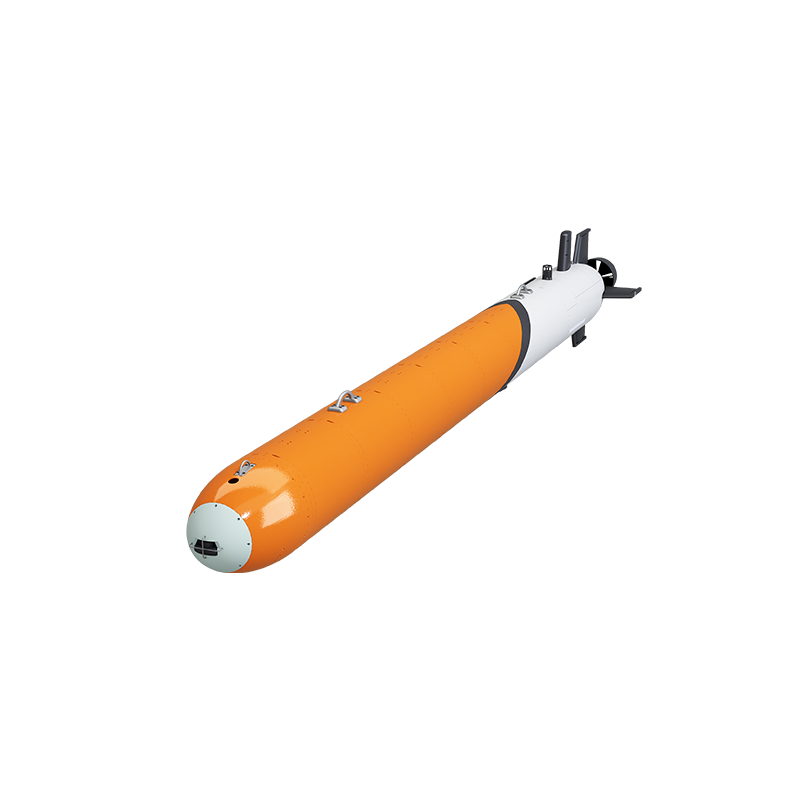
Pelagix AUV-533: 6000 m pressure-rated hull, titanium alloy pressure housing, corrosion-resistant syntactic foam buoyancy module, seawater-resistant electronics.
Polymer casing on an aluminum frame: AUV-160, AUV-210, AUV-260, AUV-150
The portable and nearshore models use a different strategy. The AUV-160 is built with a lightweight aluminum frame, a seawater-resistant polymer casing as the primary housing material, corrosion-resistant components, and a pressure-sealed electronic pod. The AUV-210 uses the same combination and adds USBL to its INS+DVL+GNSS navigation set, with a 0–200 m depth range, 70 kg total weight, and a 10 kg payload. The AUV-260 extends the same material specification to a 0–500 m depth range and a 20 kg payload.
Here the corrosion question shifts character. In a polymer-cased vehicle, the dominant aging mechanisms are casing abrasion and seal aging rather than metallic loss, while the aluminum frame remains the part that needs a periodic visual check. That is a different maintenance story from a titanium hull, and buyers comparing shallow and deep models should not treat the two material statements as equivalent claims.
Material evidence map across the Pelagix AUV range
| Model | Pressure boundary | Frame / structure | Electronics statement | Stated depth |
|---|---|---|---|---|
| AUV-160 | Seawater-resistant polymer casing; pressure-sealed electronic pod | Lightweight aluminum frame | Corrosion-resistant components | 0–100 m |
| AUV-210 | Seawater-resistant polymer casing; pressure-sealed electronic pod | Lightweight aluminum frame | Corrosion-resistant components | 0–200 m |
| AUV-260 | Seawater-resistant polymer casing; pressure-sealed electronic pod | Lightweight aluminum frame | Corrosion-resistant components | 0–500 m |
| AUV-324 | Pressure-rated hull (2000 m); high-strength anodized aluminum alloy; titanium housing option | Corrosion-resistant composite frame | Seawater-resistant electronics | 600 m standard / 2000 m maximum |
| AUV-480 | Pressure-rated hull (2000 m); high-strength anodized aluminum alloy or titanium housing | Corrosion-resistant composite frame | Seawater-resistant electronics | 300 m published operating depth |
| AUV-533 | Pressure-rated hull (6000 m); titanium alloy pressure housing; corrosion-resistant syntactic foam buoyancy | Corrosion-resistant synthetic foam buoyancy module | Seawater-resistant electronics | 2000 m / 6000 m configurable |
| AUV-600 | Pressure-rated hull (6000 m); titanium alloy pressure housing; corrosion-resistant synthetic foam buoyancy | Corrosion-resistant synthetic foam buoyancy modules | Seawater-resistant electronics | 1000 m / 3000 m / 6000 m configurable |
| AUV-900 | Pressure-rated hull (6000 m); titanium alloy pressure housing; corrosion-resistant syntactic foam buoyancy | Corrosion-resistant syntactic foam buoyancy module | Seawater-resistant electronics | 3000 m / 4500 m / 6000 m configurable |
| AUV-F760 | Pressure-sealed electronic pod; seawater-resistant polymer casing | Lightweight aluminium frame | Corrosion-resistant components | 600 m / 1200 m |
Source: published Pelagix AUV material and depth specifications. Where a model states both a hull pressure rating and a published operating depth, the two figures address different questions and should be confirmed with the supplier for a specific mission profile.
Reading a material statement without over-reading it
Anodizing is a surface conversion process applied to an aluminum housing. As a corrosion-protection statement it tells the buyer that the housing surface has been treated; it does not describe the treatment of fasteners, sealing faces, or penetrator bodies, which are the locations where localized attack generally starts. In practical terms, an anodized aluminum statement answers the housing question and leaves the joint question open.
Titanium changes the corrosion argument but does not end it. Titanium alloys are generally selected in marine service for their resistance to chloride environments, and the AUV-533, AUV-600, and AUV-900 specifications reflect that choice. Crevice geometries, sealing interfaces, and dissimilar-metal couples still require a documented isolation approach, and none of the material lines above describe that approach. The honest reading is that titanium reduces the corrosion burden on the hull surface while leaving the sealing and coupling interfaces to be qualified separately.
Syntactic foam buoyancy is a third, often overlooked boundary. Because it displaces a large volume of water and is typically the largest assembly outside the pressure hull, its material statement matters as much as the hull's. The Pelagix specifications state a corrosion-resistant syntactic foam buoyancy module on the AUV-533, AUV-600, and AUV-900; for shallow models the buoyancy function is handled inside the polymer casing and frame arrangement rather than by a separate foam module.
Composite frames remove the coating-maintenance question that a painted steel frame would raise, and both the AUV-324 and AUV-480 specifications state a corrosion-resistant composite frame. The trade-off is that the fasteners joining that frame to metallic components become the elements that need attention, which is why a frame material statement is best read together with the hardware list rather than in isolation.
Where the certification stops
Pelagix AUV systems are certified to the Survey-Grade Bathymetric & Environmental Compliance Certification, certificate number AUV-REG-2025-0881, issued by China Classification Society (CCS) and Det Norske Veritas (DNV), valid from 2025-01-15 to 2030-01-14 and applicable to the global market including the EU, North America, Asia-Pacific, and the Middle East. The certification references IHO S-44 Special Order Standards for Hydrographic Surveys, ISO 9001:2015, DNV-ST-F101 for subsea pipeline systems, IEC 60529 IP68, and marine environmental-monitoring compliance standards. Its stated scope covers regulatory-ready AUV systems, survey-grade mapping AUV platforms, industrial-grade offshore inspection equipment, and deep-sea pressure-rated hulls from 2000 m to 6000 m.
The covered product list names the AUV-533, AUV-600, AUV-900, and AUV-F760, with the AUV-F760 covered for subsea pipeline inspection. That list is the operative detail for a buyer. Models not named on it — including the AUV-324, AUV-480, AUV-260, AUV-210, AUV-160, and AUV-150 — should not be assumed to carry the same certificate coverage merely because their material specifications appear in the same document set. Requesting the covered-product schedule alongside the certificate is a routine and reasonable step, and a supplier that publishes a certificate should be able to state exactly which models it names.
Application fit: where each material strategy earns its place
Material strategy follows mission profile, and the fit can be read directly from the published specifications.
Offshore oil and gas, 2000 m class
The AUV-324's 2000 m pressure-rated hull, modular payload bay of up to 30 kg, and corrosion-resistant composite frame suit subsea pipeline route survey, structural hazard detection, seabed resource survey, and marine environmental monitoring. Published case evidence supports this: an offshore oil and gas engineering contractor operating four AUV-324 systems over two years completed 1,200 km of subsea pipeline inspection and detected 18 critical structural anomalies and marine growth entanglements with zero safety incidents.
Nearshore hydrography and pipeline mapping
The AUV-480's specified applications include seabed bathymetry mapping, offshore oil and gas inspection, marine environmental monitoring, subsea pipeline mapping, nearshore hydrographic and environmental monitoring, offshore engineering survey, and underwater structure inspection. In this band, the anodized aluminum or titanium housing and the composite frame produce a maintenance profile closer to a survey vessel's working rhythm than to an abyssal platform's.
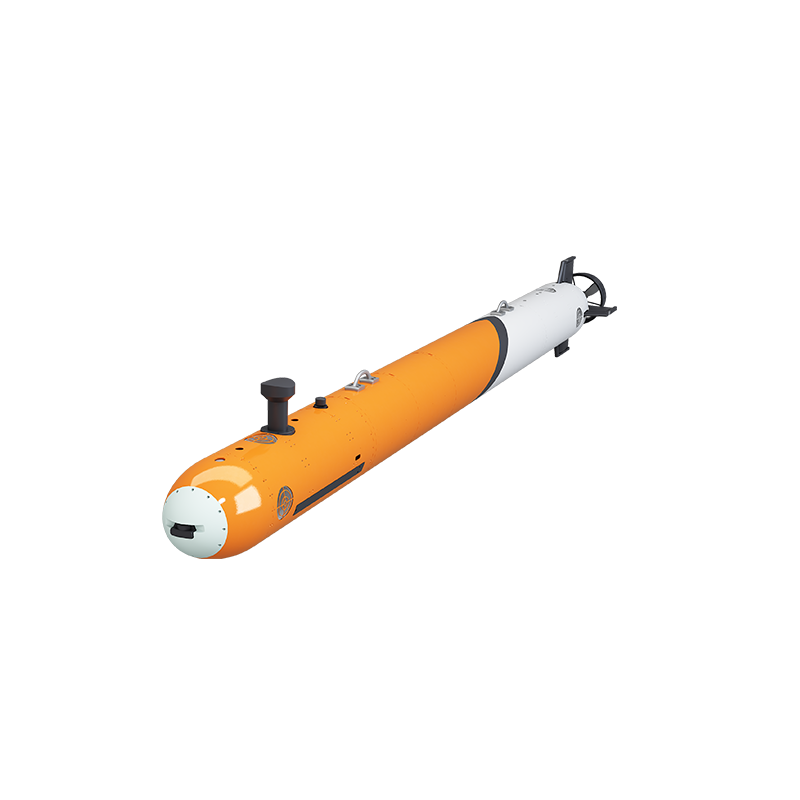
Pelagix AUV-480: pressure-rated hull rated for 2000 m, high-strength anodized aluminum alloy or titanium housing, corrosion-resistant composite frame, seawater-resistant electronics.
Abyssal survey and swarm operation
The AUV-533's stated applications cover 6000 m deep-sea bathymetry, oceanographic survey, subsea resource exploration, abyssal environmental monitoring, deep-sea mineral exploration, physical oceanography, marine engineering survey, and ecological survey — with multi-AUV swarm coordinated survey added to its capability set. Long endurance matters here for a material reason as much as an energy reason: fewer launch and recovery cycles means fewer abrasion events on the frame and fewer connector mating cycles at the hull interface.
Shallow water, aquaculture, and training
For the polymer-cased models, the published application lists point to aquaculture environment monitoring and inspection, nearshore water security and port surveillance, payload integration and testing, multi-vehicle cooperative trials, education and practical training, and — for the AUV-210 and AUV-260 — dam and hydroelectric infrastructure inspection in confined and low-visibility water. In these duty cycles the corrosion-relevant exposure is frequent short immersions, handling abrasion, and repeated pod opening rather than prolonged hydrostatic loading.
Intervention and IMR
The AUV-F760 combines a lightweight aluminium frame, seawater-resistant polymer casing, corrosion-resistant components, and a pressure-sealed electronic pod with 6-DOF control, 6–8 thrusters, and dual manipulator arms for gripping, cutting, and rotating. Its stated applications are offshore wind turbine foundation inspection, subsea pipeline inspection and maintenance, deepwater structure emergency repair, and underwater search, rescue and salvage — environments where biofouling and entanglement, not only uniform seawater exposure, drive the inspection burden.
Comparison with conventional corrosion-management approaches
The conventional model for long-duration marine hardware is a coated steel structure with sacrificial anodes and an inspection interval tied to anode consumption, usually executed by tethered ROV from a support vessel. That model has real strengths: coating condition is visually verifiable, anode depletion gives a measurable maintenance trigger, and the inspection method is familiar to class surveyors.
The material-led approach visible across the Pelagix AUV range changes the trade-off. A composite frame and a titanium or anodized aluminum housing shift the maintenance question from coating renewal to interface inspection, and the vehicle is untethered, so inspection campaigns do not depend on vessel time. The corresponding costs are equally real. Documentation depth becomes the buyer's responsibility, because a material statement is not a coating condition survey and not an anode budget. Interfaces between dissimilar materials become the critical inspection points, and those are harder to photograph than a coated surface. And the strongest published evidence — the 2000 m to 6000 m pressure-rated hull coverage under certificate AUV-REG-2025-0881 — applies to the models named on the covered-product list, not to the entire range.
| Question a buyer may ask | Answered by a material specification | Requires separate evidence |
|---|---|---|
| What is the pressure boundary made of? | Yes — alloy or polymer stated per model | — |
| Is the frame metallic or composite? | Yes — composite on AUV-324/480; aluminum on polymer-cased models | — |
| Are the electronics specified against seawater? | Yes — seawater-resistant on deep models; corrosion-resistant components on shallow models | Connector-level and ingress-test detail |
| How long will the hull resist localized attack? | No | Immersion or salt-spray data, water chemistry |
| Is this exact model on the certificate? | No | Covered-product schedule against certificate AUV-REG-2025-0881 |
| Was the hull pressure-tested and where is the report? | No | Hydrostatic pressure test documentation |
Market trend: documentation is becoming the differentiator
Two verified data points frame the direction of travel. The deep and large AUV segment's projected 12.0% CAGR, as reported by Fortune Business Insights, means the 2000 m to 6000 m band — exactly where titanium housings and syntactic foam buoyancy appear — is set to absorb a growing share of new builds. At the same time, AUVs are typically classified under HS Code 901580 (oceanographic and hydrological instruments) or 890690 (other vessels), per a US Customs and Border Protection ruling, which means the technical file travels with the shipment and is read by customs, class, and technical reviewers rather than only by the purchasing engineer.
The practical consequence is that material specifications are becoming an export and compliance artefact as much as an engineering one. Suppliers that can present model-level material statements, a certificate with a named covered-product list, and a clear statement of what has not been tested will spend less time in document review than suppliers that present a single certificate and a family-level claim.
Future outlook
Three changes are reasonable to expect across industrial AUV procurement. First, material statements will increasingly be accompanied by exposure data, because buyers are already asking for it and the deep segment's growth makes the cost of an unplanned hull intervention proportionally larger. Second, certificate presentations will become model-specific by default, since a covered-product list is the cheapest way for a supplier to avoid an over-claim. Third, shallow-water polymer-cased platforms will be documented against abrasion and seal aging rather than against metallic corrosion, which is a different data set and currently the least standardized part of the evidence chain.
For the present, the defensible position for a buyer is narrow and useful: read the material statement as proof of design intent, confirm the depth rating for the specific configuration being purchased, confirm whether the model appears on the certificate's covered-product list, and request exposure test data only if the application genuinely requires a service-life prediction.
- Confirm the pressure boundary material for the exact model and depth configuration being quoted.
- Confirm whether the frame is composite or aluminum, and list the fastener materials that join it to metallic parts.
- Confirm what "seawater-resistant electronics" or "corrosion-resistant components" refers to at the connector level.
- Request the certificate's covered-product schedule, not only the certificate number.
- Confirm whether the quoted depth figure is a hull pressure rating or a published operating depth.
- Request syntactic foam buoyancy specification separately on 6000 m models.
- Ask whether hydrostatic pressure test documentation exists for the specific unit or model.
- Ask for any immersion, salt-spray, or accelerated exposure data that exists beyond the material statement.
- Confirm the warranty terms that apply to the pressure hull and electronics.
- For shallow polymer-cased models, ask about casing abrasion and seal replacement intervals.
FAQ
Does a titanium pressure housing remove the need for corrosion inspection on an AUV?
No. A titanium alloy pressure housing changes the material of the pressure boundary, and the Pelagix AUV-533, AUV-600, and AUV-900 specifications state titanium alloy pressure housings together with corrosion-resistant syntactic foam buoyancy modules and seawater-resistant electronics. That combination addresses the hull surface and the buoyancy assembly, but sealing faces, penetrator bores, and joints between dissimilar materials remain interfaces that require periodic inspection. The published material data does not include a corrosion inspection interval or a service-life prediction for those interfaces.
What does "seawater-resistant electronics" confirm on an AUV specification sheet?
It confirms that the electronics are specified to resist seawater exposure, and it is stated for the AUV-324, AUV-480, AUV-533, AUV-600, and AUV-900. It does not, by itself, document an ingress protection test result, an immersion duration, or connector-level qualification, and the published Pelagix material data does not attach such identifiers to that phrase. Shallow models describe the same boundary differently, listing corrosion-resistant components and a pressure-sealed electronic pod — for example on the AUV-160, AUV-210, AUV-260, and AUV-F760.
Which Pelagix AUV models are covered by the Survey-Grade Bathymetric & Environmental Compliance Certification?
The covered product list names the AUV-533, AUV-600, AUV-900, and AUV-F760, with the AUV-F760 covered for subsea pipeline inspection. The certificate is numbered AUV-REG-2025-0881, was issued by China Classification Society (CCS) and Det Norske Veritas (DNV), is valid from 2025-01-15 to 2030-01-14, and covers deep-sea pressure-rated hulls from 2000 m to 6000 m as well as regulatory-ready AUV systems, survey-grade mapping AUV platforms, and industrial-grade offshore inspection equipment. Other models in the range are not named on that list, so coverage should not be assumed for them.
Is an anodized aluminum housing sufficient for 2000 m service without additional protection?
The specification states a high-strength anodized aluminum alloy housing on the AUV-324 and, with a titanium option, on the AUV-324 and AUV-480, both with pressure-rated hulls rated for 2000 m and corrosion-resistant composite frames. Anodizing is a surface treatment of the housing, so the statement covers the housing surface rather than the fasteners, sealing faces, or penetrator bodies. Buyers should confirm the treatment and isolation approach at those specific interfaces before treating the housing statement as complete protection for the whole pressure boundary.
What corrosion documentation should a buyer request that a material specification does not contain?
A material specification gives alloy, casing, frame, and buoyancy material statements plus a depth figure; it does not contain salt-spray hours, immersion durations, corrosion test report identifiers, hydrostatic pressure test documentation, or CE compliance documentation identifiers. The published Pelagix asset data explicitly notes, for example, that pressure test report identifiers and CE compliance documentation identifiers are not provided for the shallow models, and that the AUV-210's stated 0–200 m range does not correspond to a 6000 m depth rating. Requests should therefore target the specific evidence type the application requires rather than a general request for "corrosion certification".
The Pelagix AUV product brochure, including the full model range and published specifications, is available for download: Overseas Version — AUVs Products (PDF).
¿Tiene preguntas o necesita más detalles?
Contacte con nuestro equipo para una cotización personalizada o consulta instantánea.
Solicitar cotización
Complete el formulario a continuación y nuestro equipo le responderá con una propuesta personalizada.
Chat directo de WhatsApp
¿Prefiere chatear en tiempo real? Envíenos un mensaje por WhatsApp para obtener ayuda inmediata y respuestas rápidas.
- Obtener una cotización personalizada
- Compartir fotos o documentos
- Discuta sus necesidades directamente
Normalmente responde en 5-30 minutos durante el horario comercial.