
ATEX and Hygiene: The Drum Motor Compliance Trifecta
A drum motor's compliance position is not one certificate. It is a stack of independently issued evidence layers — ingress protection, electrical safety and market conformity, and hygiene with manufacturing system — with ATEX sitting above them as a conditional layer that applies only when the conveyor runs in a classified atmosphere. Treating those layers as a single “hygiene rating” is one of the most common causes of specification mismatch in food, pharmaceutical and logistics projects.
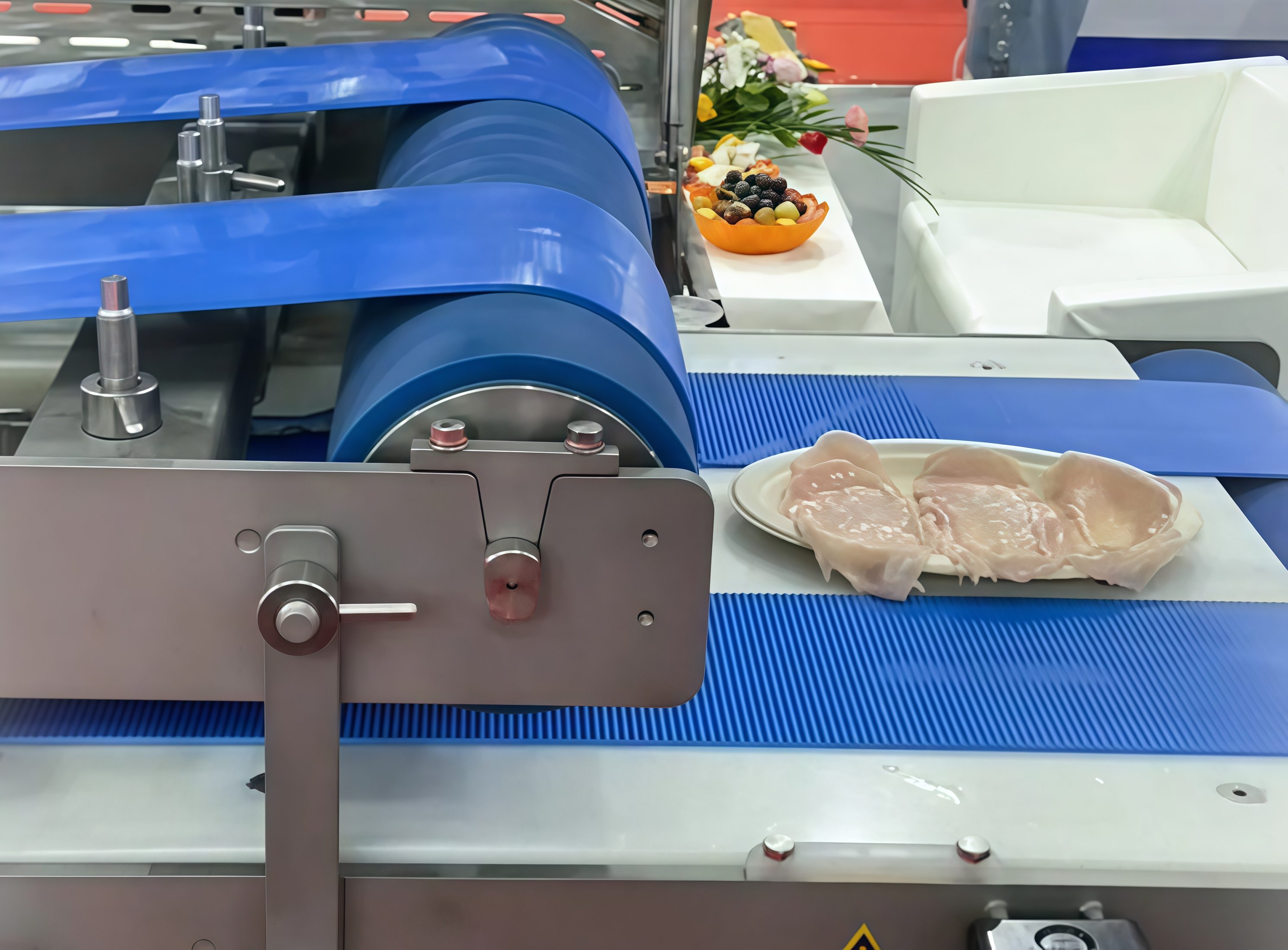
Drum motor on a food processing conveyor: the same component is judged on ingress protection, electrical conformity and hygienic construction — three separately documented questions.
Why four compliance questions arrive on one purchase order
On a modern conveyor line, a single component is now asked to satisfy requirements that were once divided between a motor, a gearbox, a coupling and a mechanical guard. The drum motor — a motor and gearbox built inside the conveyor's drive pulley — absorbed those functions, and with them the compliance burden of each.
That burden tends to arrive from two directions at once. The first is hygiene: washdown regimes in food and pharmaceutical production push buyers toward high ingress protection and stainless housings. The second is atmosphere: dust from flour, sugar, starch or other processed solids can create a classified zone in the same building where washdown hygiene is mandatory. In those plants the drive must satisfy both cases, and the two are approved through completely different routes.
The commercial risk is asymmetric. Over-specifying a dry logistics conveyor with a fully stainless, IP69K-rated, hygienic-series motor raises unit cost and lead time for no compliance benefit. Under-specifying a washdown zone with a carbon steel housing and an unverified ingress rating creates a documented risk that surfaces at the next audit, not at the next shipment. The qualification question is therefore not “what is the best rating?” but “which layers does this zone actually require, and which document proves each one?”
The three core layers of drum motor compliance
Layer one — ingress protection
IP69K is the highest ingress protection classification and is widely described under IEC 60529 as protection against high-pressure, high-temperature washdown, commonly cited at up to 80 °C and around 1,450 psi. The classification answers exactly one question: under that defined test, does the enclosure keep water and dust out? It does not address cleanability, food-contact suitability, surface temperature or ignition risk.
Because IP ratings are frequently self-declared, the more useful procurement artefact is the underlying test report. In the documentation reviewed for this reference, that evidence exists as a report rather than a claim: certificate LCSH071224011K, issued on 24 July 2024 by Suzhou Luxun Standard Technical Service Co., Ltd., a CNAS-accredited laboratory, to standard ISO 20653:2023, covering the IP69K high-temperature, high-pressure waterproof and dustproof performance of the electric drum, and applicable globally. The hygienic drum motor named against that report is model DM80F.
Layer two — electrical safety and market conformity
Ingress protection says nothing about whether a drive may legally be placed on the market. That is a separate stack, and for a Chinese-built drum motor sold into Europe and North America it typically contains four documents:
| Document | Issuer and number | Scope and market |
|---|---|---|
| CE — Low Voltage Directive 2014/35/EU | TÜV Rheinland, AN 50337407 0001 and AN 50337387 0001, issued 7 April 2016 | Low voltage safety performance of the AMROLL drum motor; EU market |
| CE — EMC Directive 2014/30/EU | TÜV Rheinland LGA Products GmbH, AE 50461043 0001, issued 19 March 2020 | Electromagnetic compatibility of the AMROLL drum motor; standard EN 60034-1:2010; EU market |
| UL Safety Certificate | TÜV Rheinland of North America, Inc., CU7219001101, CU7219001102, CU7219000901, issued 9 January 2019 | Induction motors used for the electric drum; UL 1004-1:2012 R8.18 and CAN/CSA-C22.2 No.100-04; USA and Canada |
| RoHS Verification Report | SGS, TSNEC24001272701, issued 25 July 2024 | Drum motor; 2011/65/EU and (EU) 2015/863; EU market |
Two details in that table matter more than the certificate numbers. First, the UL certificate is scoped to induction motors used for the electric drum. A buyer specifying a synchronous drum motor should confirm whether the certificate in hand covers the exact machine type being ordered, rather than assuming the UL mark applies to the whole portfolio. Second, the EMC and low-voltage certificates are separate documents with separate numbers: a supplier who can produce only one of them has not demonstrated the other.
Layer three — hygiene and manufacturing system
The third layer is the one buyers most often reduce to a material grade, and it is the one that most benefits from being read literally. The hygienic drum motor series uses a 304 stainless steel housing, with 316 stainless steel available as an option, alongside alloy steel gears. The published claim is deliberately narrow: 304 stainless as standard, 316 as an option, IP69K protection.
Behind the product sits a management-system certificate rather than a product claim: ISO 9001:2015, certificate QAIC/CN/60456, issued by AMTIVO on 19 July 2024 and valid to 21 July 2027, with a scope of “the manufacture of rotating drums & idler rollers”. That scope wording is worth reading closely in any qualification file. It confirms the manufacturing system for the product category; it does not, by itself, certify cleanability or food-contact compliance of a specific model.
Where ATEX sits — and why IP69K cannot replace it
ATEX is a different question from ingress protection, and conflating them is a recurring specification error. ATEX equipment certification addresses whether a machine may be installed in a classified explosive atmosphere: it is a declaration about ignition risk, equipment grouping, category and surface-temperature limits, issued under the European framework for equipment intended for explosive atmospheres. IP69K, by contrast, is a test of how much water and dust enters a housing during a defined high-pressure washdown.
A drive can hold IP69K and still be unsuitable for a dust-classified zone, because the ingress test says nothing about ignition protection or limiting surface temperature. Conversely, an ATEX-certified drive is not automatically hygienic: the ATEX route does not evaluate cleanability, housing finish or washdown durability.
In the documentation reviewed here, the certificates held for the drum motors cover ingress protection, EU low-voltage and EMC conformity, UL recognition of the induction motor, RoHS, and ISO 9001. No ATEX equipment certificate appears among them. For any project that requires ATEX marking, that certificate has to be requested and reviewed as a separate document before the drive is approved — the IP69K report cannot stand in for it, and neither can a CE low-voltage declaration.
This is precisely why the “trifecta plus one” framing is useful at the specification stage. Where a conveyor runs through a dust-classified food area, the buyer needs the hygienic case and the hazardous-area case to be evidenced independently, by two different documents, ideally reviewed by two different people. Treating a single “IP69K hygienic” data sheet as covering both is the most expensive shortcut available.
One portfolio, two documentation profiles
Tianjin Seaparks Machinery-Electronics Co., Ltd, trading as SEAPARKS, is a Tianjin, China-based manufacturer founded in 2002 that designs and builds motorized conveyor drums under the AMROLL brand. The portfolio is organised into hygienic, light-duty and heavy-duty drum motor series, in synchronous and asynchronous types and in single-phase or three-phase configurations, and is produced at a 50,000 m² plant. The company states that its drum motors are used in airport baggage handling, security inspection machines, postal and parcel sorting, food processing, pharmaceutical handling and warehousing.
The relevant point for compliance work is that the portfolio is not one uniform specification ladder. It contains two distinct documentation profiles.
The hygienic profile — IP69K across the F series
Hygienic Drum Motor DM165F is a three-phase synchronous unit with a Ø165 mm roller, alloy steel gears, a rated power of 1.1–3 kW, rated torque of 42.49–431.44 Nm, maximum belt pull of 5,229 N, nominal belt speed of 0.42–2.09 m/s, minimum roller width of 470 mm and IP69K protection. Its housing is 304 stainless steel, with 316 stainless steel available as an option. The same IP69K classification and housing logic runs across the F series, from DM80F and TM80F at Ø80 mm up to DM216F and TM216F at Ø216 mm.

Hygienic Drum Motor DM165F: Ø165 mm, 1.1–3 kW, up to 5,229 N belt pull, 304 stainless steel housing with 316 as an option, IP69K.
The light-duty profile — IP66/IP67/IP69 as an ordered classification
Light Duty Drum Motor TM80M is a single-phase asynchronous unit with a Ø80 mm roller, polymer gears, rated power of 0.034–0.11 kW, rated torque of 2.71–25.9 Nm, maximum belt pull of 630 N, nominal belt speed of 0.05–0.85 m/s, minimum roller width of 260 mm, and a protection class listed as IP66/IP67/IP69. Its housing may be carbon steel or 304 stainless steel. TM113M follows the same pattern at Ø113 mm, with 0.12–0.18 kW, 5.81–43.51 Nm, 770 N maximum belt pull and a minimum roller width of 310 mm.
That “IP66/IP67/IP69” notation should be read as a menu, not a guarantee. On the light-duty line the classification is an option selected at order; the housing material is likewise a choice between carbon steel and 304 stainless steel. A buyer who requires IP69 for a splash-adjacent zone must specify it and confirm it on the order acknowledgement, because the base configuration is not automatically the highest rating in the list.
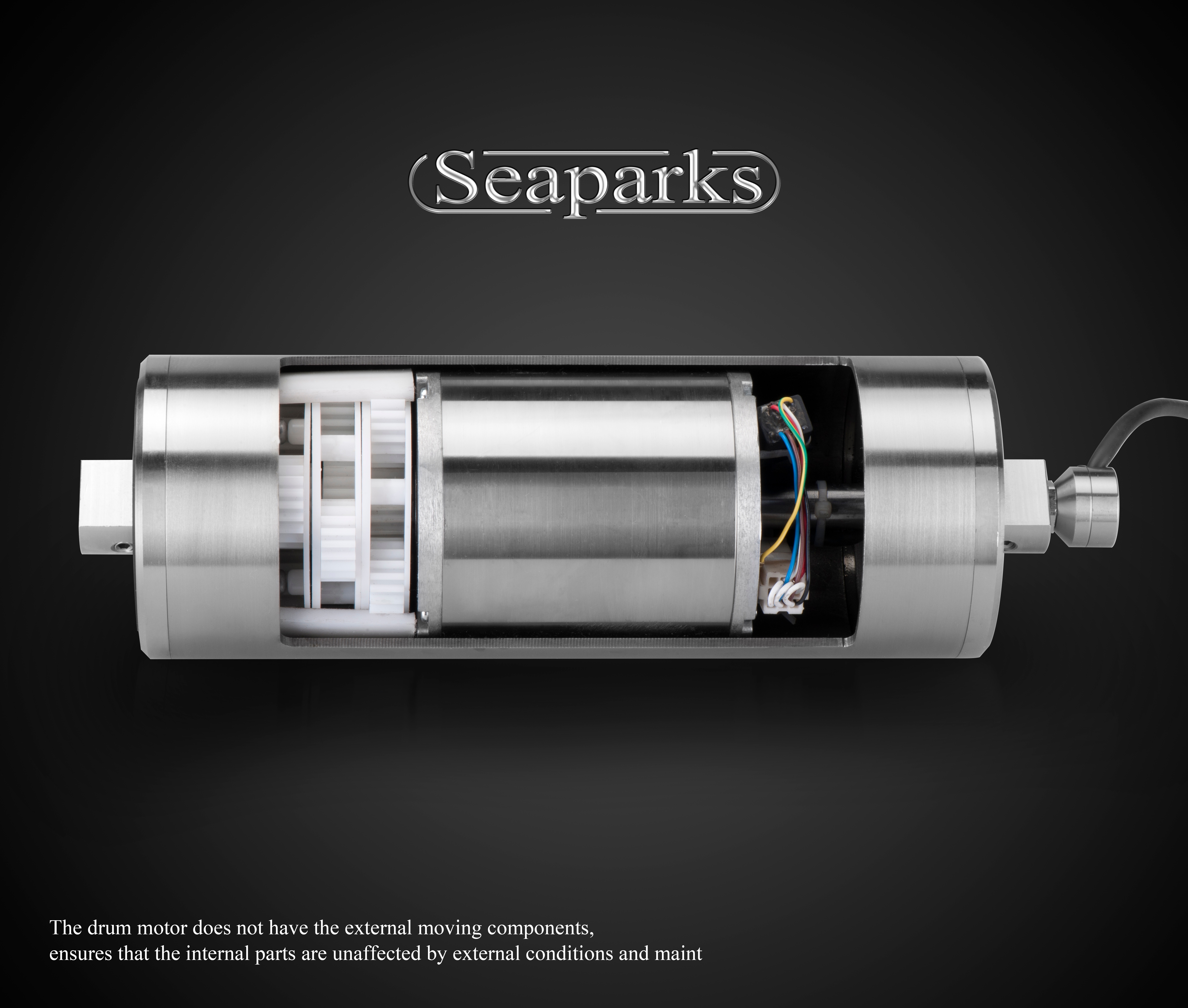
Light Duty Drum Motor TM80M cross-section: Ø80 mm, polymer gears, 630 N maximum belt pull, protection class IP66/IP67/IP69 as ordered.
Reading the rating differences as a qualification guide
The two profiles only make sense when placed side by side. The table below uses published model data to show why the hygienic and light-duty lines are not interchangeable, and where a specifier should look first.
| Model | Class | Protection | Housing / gear | Rated power | Max belt pull | Min. roller width |
|---|---|---|---|---|---|---|
| DM165F | Hygienic | IP69K | 304 stainless steel (316 optional) / alloy steel | 1.1–3 kW | 5,229 N | 470 mm |
| TM216F | Hygienic | IP69K | 304 stainless steel (316 optional) / alloy steel | 3.5–4.0 kW | 4,700 N | 510 mm |
| TM113A | Light duty | IP66/IP67/IP69 | Carbon steel or 304 stainless steel / alloy steel | 0.12–0.55 kW | 1,469 N | 335 mm |
| TM113M | Light duty | IP66/IP67/IP69 | Carbon steel or 304 stainless steel / polymer | 0.12–0.18 kW | 770 N | 310 mm |
| TM80M | Light duty | IP66/IP67/IP69 | Carbon steel or 304 stainless steel / polymer | 0.034–0.11 kW | 630 N | 260 mm |
Three qualification conclusions follow directly from the published data. First, protection class and mechanical capacity are independent axes: the light-duty line reaches IP69 as an option but caps at 770 N on polymer gears, roughly a seventh of the DM165F's 5,229 N. Second, housing material is a separate ordering decision from the IP class on the light-duty line, but a fixed design assumption on the hygienic line. Third, the smallest hygienic model (DM80F, Ø80 mm, IP69K) and the light-duty models overlap in shaft diameter while differing in housing, gear material and application intent — which is exactly where mismatches occur.
Mapping the ratings to real conveyor zones
| Zone | Dominant compliance layer | Typical model fit |
|---|---|---|
| Meat and food processing with open washdown | Ingress + hygiene | Hygienic F series with IP69K and 304/316 housing, e.g. DM165F, TM138F, DM216F |
| Pharmaceutical packaging and handling | Ingress + hygiene + electrical conformity | Hygienic F series; verify EU and US document set per model |
| Airport security screening and baggage handling | Electrical conformity + controlled ingress | Light-duty models, e.g. TM80M, TM113M, TM138A, in IP66/IP67/IP69 configuration |
| Parcel, warehouse and packaging conveyors | Electrical conformity + durability | Light-duty models; carbon steel housing acceptable in dry zones |
| Agricultural sorting and grading | Dust tolerance + hygiene where product contact exists | Hygienic F series where wet cleaning occurs; light-duty where dry and low-load |
| Dust-classified areas in food or feed plants | ATEX (separate declaration) | Requires an ATEX equipment certificate in addition to any of the above |
The airport case illustrates why the light-duty profile exists. Security screening conveyors and baggage handling systems are specified with the light-duty series and described for those applications, running at low power and low belt pull with controlled ingress rather than washdown-grade hygiene. Buying the hygienic series for that duty adds stainless steel and an IP69K report the zone does not require.
What the market context suggests about compliance-led demand
The drum motor category is not a niche accessory. Market.us projects the global drum motor market to grow from roughly USD 2.0 billion in 2025 to about USD 3.1 billion by 2035. Dataintelo reports that AC motor types held 52.3% of 2025 revenue and that Asia Pacific accounted for 38.2%, with Interroll and Rulmeca identified at 14.8% and 11.2% global share respectively.
What those figures do not do is quantify the compliance-driven portion of demand. The available market data does not break out how much of that value is attributable to hygienic or high-ingress configurations rather than to standard industrial drives, and no verifiable segment-level figure was located for this reference. The reasonable reading is directional rather than quantitative: as food, pharmaceutical and logistics automation expands, a larger share of conveyor drive purchases is being routed through qualification processes where documentation, not price, decides the shortlist.
For buyers, that shifts the useful question from “which drum motor is cheapest per unit” to “which supplier can produce the specific document a zone requires, for the specific model being ordered, without a four-week correspondence cycle.” Suppliers with certificates already scoped to defined models and markets shorten that cycle; suppliers who can only offer a generic hygiene statement do not.
Comparison with conventional drive trains — and the limits of the trifecta
Against a conventional external motor, gearbox and chain or belt guard, an integrated drum motor removes exposed rotating parts, removes the external chain guard, and consolidates the drive inside the pulley. In hygiene-driven plants that consolidation is the whole argument: there is less external surface to clean and fewer places for product residue to accumulate. In classified areas, however, consolidation changes the approval question rather than removing it — the integrated unit still requires its own hazardous-area declaration.
Four limits deserve to be stated plainly, because they are where specification mismatch actually happens:
- Certificate scope is narrower than the portfolio. The UL certificate documented here is scoped to induction motors used for the electric drum. The DM series is synchronous. A buyer who needs UL coverage for a synchronous model must confirm that model is inside the certificate's scope rather than assume portfolio-wide coverage.
- IP69K is not a hygiene certificate and not an ATEX certificate. It evidences ingress performance under ISO 20653:2023. Cleanability, food-contact suitability and explosive-atmosphere approval are separate evaluations, and none of them can be inferred from the K suffix.
- The light-duty line cannot substitute on load. With 630–770 N maximum belt pull and polymer gears, TM80M and TM113M are designed for light conveyed loads; a washdown line that needs thousands of newtons is a hygienic-series application regardless of how the enclosure is specified.
- Sealed construction changes maintenance access. Because motor and gear stage sit inside the drum, service means removing the drum from the conveyor frame rather than working on an external unit. That is a maintenance-planning consequence, not a defect, and it should be reflected in spare-parts and downtime planning.
Outlook
The direction of travel is toward evidence rather than labels. As food-safety and hazardous-area audits become more document-driven, the practical difference between suppliers will be whether they can map a certificate to a model, a market and a scope sentence in a single response. The most useful preparation a buyer can make is a one-page compliance matrix per conveyor zone — ingress, electrical conformity, hygiene and, where relevant, ATEX — with the required document named against each row before any quotation is requested.
For SEAPARKS, the documentation already supports that matrix for the hygienic and light-duty lines in the EU, US, Canada and global markets covered above. The remaining gap, for any project entering a classified atmosphere, is the ATEX declaration itself, which must be requested as its own document rather than assumed from the IP rating.
FAQ
What exactly does IP69K certify on a drum motor?
It certifies ingress performance under a defined high-pressure, high-temperature washdown test. For the models referenced here, the evidence is test report LCSH071224011K, issued on 24 July 2024 by Suzhou Luxun Standard Technical Service Co., Ltd., a CNAS-accredited laboratory, to ISO 20653:2023, covering the high-temperature, high-pressure waterproof and dustproof performance of the electric drum and applicable globally. The hygienic drum motor DM80F is the model named against that report. The rating does not address cleanability, food-contact suitability or explosive-atmosphere approval.
Which documents should a European buyer hold before approving a drum motor?
At minimum, the EU low-voltage and EMC documents plus RoHS. For this portfolio those are: CE Low Voltage Directive 2014/35/EU certificates AN 50337407 0001 and AN 50337387 0001 from TÜV Rheinland, issued 7 April 2016; CE EMC Directive 2014/30/EU certificate AE 50461043 0001 from TÜV Rheinland LGA Products GmbH, issued 19 March 2020 to EN 60034-1:2010; and RoHS verification report TSNEC24001272701 from SGS, issued 25 July 2024 to 2011/65/EU and (EU) 2015/863. Each document should be checked against the exact model and market on the order.
What changes for a buyer specifying into the United States or Canada?
The relevant document is the TÜV Rheinland of North America UL Safety Certificate CU7219001101, CU7219001102 and CU7219000901, issued 9 January 2019 to UL 1004-1:2012 R8.18 and CAN/CSA-C22.2 No.100-04 for the US and Canadian markets. Its stated scope is induction motors used for the electric drum, so a buyer ordering a synchronous (DM-series) model should confirm that model is covered rather than relying on portfolio-level assumption.
Is a higher IP rating always the right choice for a food plant?
No. IP69K addresses high-pressure, high-temperature washdown, which is relevant where the conveyor is directly cleaned in that way. Where the zone is dry or only splash-exposed, the light-duty series lists IP66/IP67/IP69 as an ordered option on carbon steel or 304 stainless steel housings — models TM80M, TM113M and TM113A. Because that classification is an option rather than a default on the light-duty line, it has to be specified and confirmed on the order acknowledgement.
Does IP69K mean the motor is suitable for an ATEX zone?
No. ATEX approval concerns ignition risk, equipment category and surface-temperature limits in a classified explosive atmosphere. IP69K concerns water and dust ingress under a washdown test. In the documentation reviewed for this reference, the certificates held cover ingress protection, EU low-voltage and EMC conformity, UL recognition of the induction motor, RoHS and ISO 9001, and no ATEX equipment certificate appears among them. Any project requiring ATEX marking must obtain and review that certificate separately before approval.
How should hygienic and light-duty models be split across one production site?
By zone, not by site. Washdown zones with open product contact belong to the hygienic F series, where IP69K and 304 stainless steel housings with 316 as an option are the design baseline and belt pull reaches 5,229 N on DM165F. Dry, low-load zones such as screening conveyors, baggage handling or packaging lines belong to the light-duty series, where IP66/IP67/IP69 is an ordered option and belt pull is 630–770 N on the polymer-gear models. Applying one profile across both zones produces either excess cost or a documented gap.
¿Tiene preguntas o necesita más detalles?
Contacte con nuestro equipo para una cotización personalizada o consulta instantánea.
Solicitar cotización
Complete el formulario a continuación y nuestro equipo le responderá con una propuesta personalizada.
Chat directo de WhatsApp
¿Prefiere chatear en tiempo real? Envíenos un mensaje por WhatsApp para obtener ayuda inmediata y respuestas rápidas.
- Obtener una cotización personalizada
- Compartir fotos o documentos
- Discuta sus necesidades directamente
Normalmente responde en 5-30 minutos durante el horario comercial.