
AT10, T5, S8M, HTD 8M/14M: What a Verified Timing Belt Shortlist Covers
Independent industry reference · Buyer evaluation stage · Industrial Equipment & Components
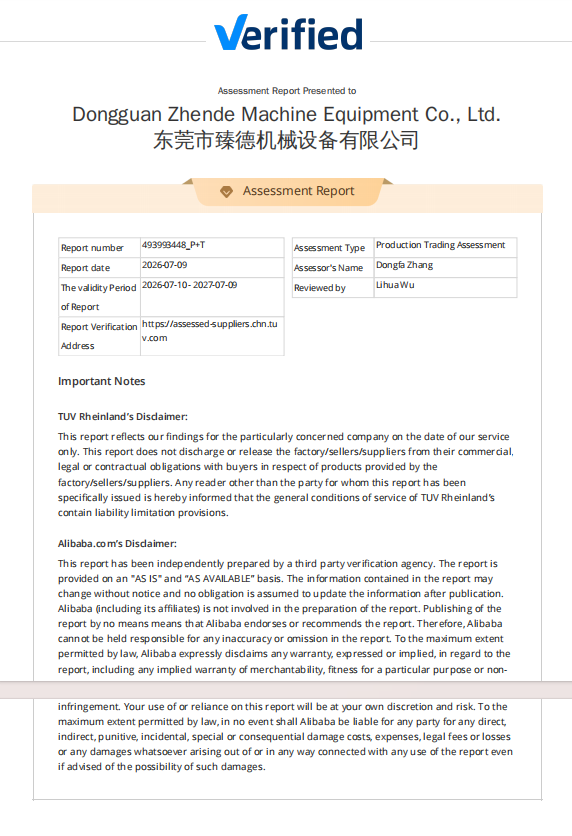
A factory audit report is a supplier-level document. It establishes who was assessed and against which standard, not how an individual belt profile performs in a drive.
Verification paperwork has moved onto the product page in industrial belt sourcing. For a buyer evaluating AT10, T5, S8M, HTD 8M or HTD 14M belts, the practical question is no longer whether a supplier holds a certificate. It is what the certificate covers, where it stops, and which purchasing terms have to be written into the order before the certificate becomes useful.
Dongguan Zhende Machinery Equipment Co., LTD is a manufacturer and one-stop procurement supplier of FA automation transmission parts — timing belts, timing pulleys, couplings, linear guides, pneumatic cylinders and related hardware — based in Dalang Town, Dongguan, China. The company reports a 4,500 m² facility, 40 employees, a six-engineer technical team and an export share of roughly 75%, concentrated in the EU and USA.
This shortlist places eight belt options and three pulley families against the verification evidence actually published for them: Alibaba.com Verified Supplier assessments 493993448_P+T and 494177048_P, both assessed to an SGS/TÜV standard and both valid from 2026-07-10 to 2027-07-09. It then sets out the purchasing terms and acceptance criteria that convert that evidence into a defensible purchase order rather than a supplier bookmark.
What a verified shortlist can and cannot establish
In this category, three different things are routinely confused: a supplier assessment, a product test report and a material compliance declaration. They answer different questions and expire on different clocks.
A supplier assessment answers: is this a real operating entity, was its production or trading activity reviewed, against which standard, and by whom? That is what 493993448_P+T and 494177048_P record, with the assessed scope stated as Timing Belt.
A product test report answers: what did a specific sample measure on a specific test? That is profile-level evidence, and it sits outside the verification documents in this shortlist.
A material compliance declaration answers: do the elastomer or polyurethane compounds clear a market-access rule such as REACH or 21 CFR 177.2600? That is a chemistry question, not a dimensional one.
A shortlist built on the first category is therefore a screening instrument, not a release certificate. It tells an evaluation team which options are worth sampling, and it removes the cheapest failure mode in sourcing — ordering from a party whose operating status has never been checked. It does not tell anyone what load an HTD 14M belt will carry at a given speed.
The shortlist at a glance
The table below groups the options by construction and states what still has to be closed at the RFQ stage. The last column is the part most shortlists omit; it is also the part that decides whether the order runs.
| Option | Construction | Position in the assessed range | Still to close at RFQ |
|---|---|---|---|
| AT10 PU | Polyurethane, AT profile | Listed AT PU timing belt model family | Governing dimensional standard, cord type, width and length |
| AT5 PU | Polyurethane, AT profile | Same AT PU family, smaller profile series | Minimum pulley diameter, cord, coating requirement |
| T5 PU | Polyurethane, T profile | Listed T PU timing belt model family | DIN 7721 reference on the drawing, tooth count, length |
| S8M rubber | Rubber, metric curvilinear | Listed STD rubber timing belt model family | Profile system reference, cord, operating temperature |
| HTD 5M rubber | Rubber, HTD curvilinear | Listed HTD rubber timing belt model family | Standard coverage confirmation, pulley matching |
| HTD 8M rubber | Rubber, HTD curvilinear | Listed HTD rubber timing belt model family | Torque and speed data, width confirmation |
| HTD 14M rubber | Rubber, HTD curvilinear | Heaviest HTD profile in the shortlist | Pulley availability, cord specification, installation data |
| 8MGT POLYCHIAN | POLYCHIAN GT carbon belt | Listed POLYCHIAN GT model family | Profile definition source, sprocket pairing, tensioning |
| T series timing pulley | Aluminium or steel | Listed pulley family, T5 and T10 profiles in stock range | Bore, keyway, flange, balance requirement |
| Imperial timing pulley | Aluminium or steel | Listed pulley family, inch-pitch profiles | Inch dimension verification against ISO 5296 belt |
| HTD timing pulley | Aluminium or steel | Listed pulley family matched to HTD belts | Tooth count pairing, bore tolerance, concentricity record |
Reading the two assessment records correctly
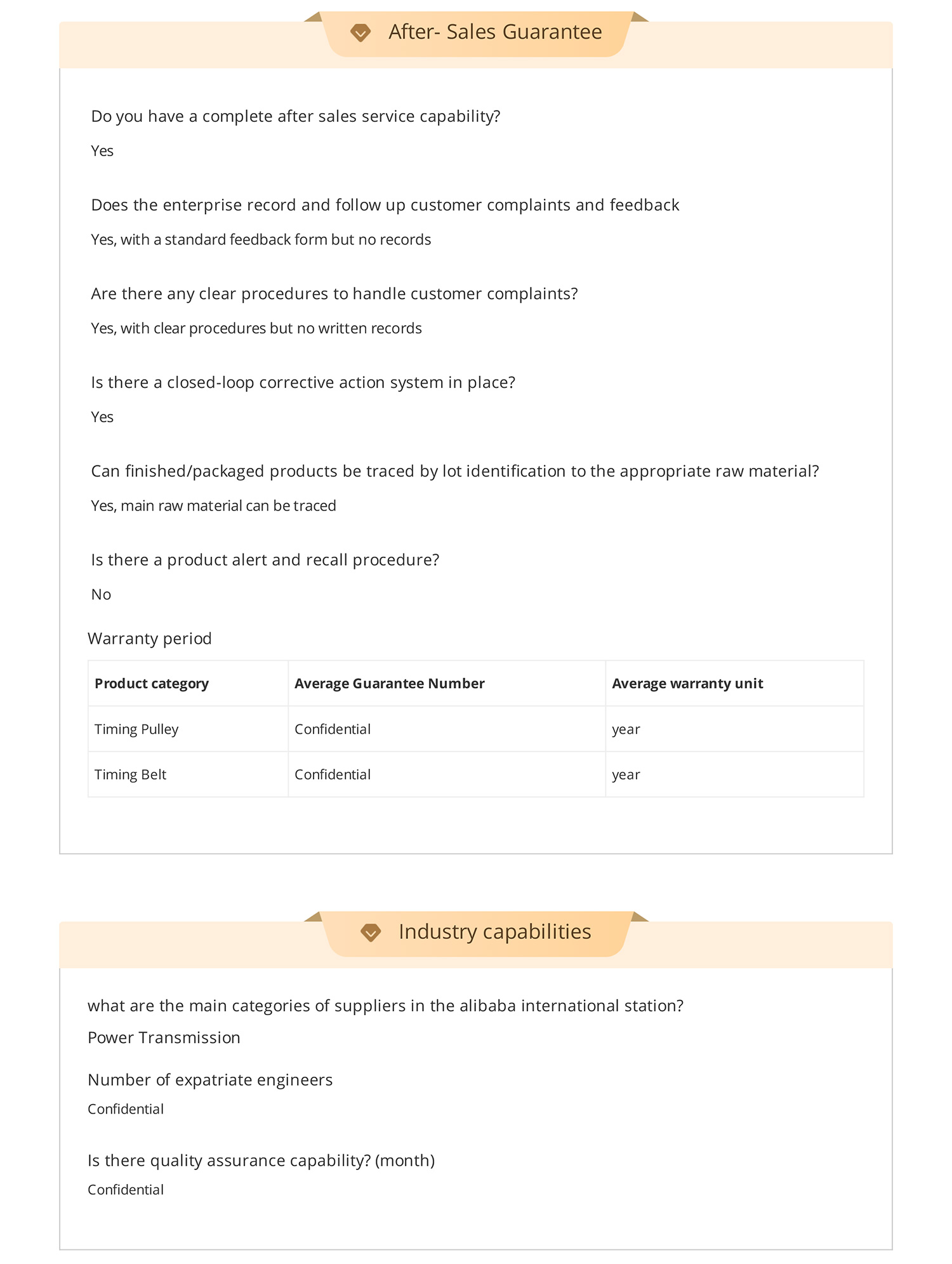
Assessment report pages record the assessed entity, the assessed activity and the standard applied. The assessed scope is stated as Timing Belt on both Alibaba.com records.
Two separate Alibaba.com Verified Supplier records exist for the supplier, and they are not duplicates. The distinction matters when a buyer is assembling a document file for a project package.
493993448_P+T — Alibaba.com Verified Supplier, record type Production Trading Assessment, assessed to an SGS/TÜV standard, market coverage listed as International, scope Timing Belt, issued 2026-07-10, expiring 2027-07-09.
494177048_P — Alibaba.com Verified Supplier, record type Production Assessment, assessed to an SGS/TÜV standard, market coverage listed as International, scope Timing Belt, issued 2026-07-10, expiring 2027-07-09.
Alongside these, a TÜV Rheinland factory audit report carries the same number as the first record, 493993448_P+T, against the standard described as a Production & Trading Factory Assessment Standard, issued 2026-07-09, expiring 2027-07-09, with the scope recorded as timing belt and timing pulley.
For an evaluation team, three implications follow. First, the trading record type indicates that the commercial activity was reviewed, not only a production site — relevant when a supplier consolidates belts, pulleys, couplings and linear components into one shipment. Second, the audit document is the only record in the set that names pulleys explicitly in its scope; the two Alibaba.com records name timing belts. Third, all three documents share a July 2027 expiry, which means a programme running past that date will need a refreshed file before renewal.
Profile notes: AT10, AT5, T5, S8M, HTD 5M/8M/14M and 8MGT
Profile names are designations, not performance promises. Two profiles with the same nominal pitch can differ in tooth geometry, cord construction and allowable pulley diameter, and the shortlist is only as strong as the drawing that specifies them.
AT10 PU and AT5 PU
The AT profiles sit in the metric-pitch family and appear in the shortlist as polyurethane belts. Polyurethane construction is the reason these options are usually raised in the same conversation as coated belts: the PU body is where the documented customization fields apply — length, width, tooth profile, pitch, tensile cord in fibreglass, Kevlar or steel, coating, colour, perforation and logo printing. AT components typically appear where an existing drawing already carries an AT designation and the buyer is replacing rather than re-engineering. The dimensional standard the drawing references should be stated explicitly, because the evidence available for this shortlist does not confirm a single published standard covering every AT variant.
T5 PU
T5 belongs to the T-profile series, the trapezoidal range for which DIN 7721 is the reference standard series for endless synchronous belt dimensions, associated with the T2,5, T5, T10 and T20 profiles. That is a useful anchor in a purchase specification: naming DIN 7721 alongside the T5 designation removes ambiguity about which dimensional system the belt and its matching T5 timing pulley are being built to. T5 PU is generally positioned as the lighter end of the PU range, with T10 pulleys covering the heavier end of the same pulley family.
S8M rubber
S8M is a metric curvilinear rubber profile, and it belongs to the STD rubber belt model family in the assessed range. Curvilinear geometry is where the standards landscape becomes less tidy for buyers: ISO 13050:2022 specifies characteristics for metric-pitch curvilinear synchronous belts and pulleys across profile systems G, H, R and S, and a buyer should confirm on the drawing which system a given S8M part is dimensioned to rather than assuming interchangeability from the profile name alone.
HTD 5M, HTD 8M and HTD 14M rubber
The HTD family spans a wide load range across 5M, 8M and 14M, and the three are not interchangeable alternatives to each other — they are different points on the same design ladder. In practice, 5M is reached for in lighter drives, 8M in general industrial transmission, and 14M where the drive needs the largest tooth section in the set. All three appear in the HTD rubber timing belt model family, and HTD timing pulleys are listed to match them. One open item deserves to be flagged: the evidence available here does not confirm whether the HTD 5M/8M/14M profiles are defined in a published dimensional standard or only in rights-holder documentation, so the specification should name whichever document governs the drawing.
8MGT POLYCHIAN
The 8MGT POLYCHIAN GT carbon belt is the specialist entry on the list. GT-family designations are typically tied to a specific manufacturer's profile definition rather than to a generic standard family, which makes documentation more important, not less: the profile source, the matching sprocket, and the tensioning procedure should all be named in the RFQ. Where a replacement is being made against an existing GT part, the incumbent designation should be quoted in full on the enquiry so that the profile is confirmed rather than inferred.
The pulley side of the order
Belts are rarely bought alone. The shortlist pairs them with three pulley families: T series timing pulleys covering T5 and T10, imperial timing pulleys for inch-pitch drives, and HTD timing pulleys for the HTD belts above. Pulley material is drawn from high-strength aviation aluminium, stainless steel and alloy steel, and the company reports more than 6,000 timing pulleys held in stock across profiles that include MXL, XL, L, H, 3M, 5M, 8M, S3M, S5M, S8M, T5 and T10.
Pulley customization is a separate specification exercise from belt customization, with different fields: material, tooth profile, pitch, number of teeth, bore diameter, keyway, flange type, surface treatment and logo engraving. A buyer replacing an aluminium timing pulley should expect to supply bore and keyway dimensions with the drawing, because those dimensions are not implied by the tooth profile.
One boundary is worth stating plainly. V-belt drives are a different product family from synchronous drives, governed by different standards and a different dimensional designation system — ISO 4183 covers groove profiles for classical and narrow V-grooved pulleys and ISO 4184 covers V-belt lengths in the datum system. A V belt pulley requirement, including cast iron V pulley patterns or optibelt V belt references held in an existing maintenance list, should be raised as a separate line in the enquiry rather than folded into a timing belt shortlist. Mixing the two families inside one specification line is a common cause of mismatched delivery.
Purchasing terms to fix before the RFQ closes
A verified shortlist converts into a purchase order only when commercial and inspection terms are stated alongside the technical ones. The table below sets out the terms the supplier publishes, split between belts and pulleys.
| Term | Timing belts | Timing pulleys |
|---|---|---|
| Minimum order | 4 pcs | 10 pcs standard models; 50 pcs customized pulleys |
| Lead time | 7–20 days | 7–20 days |
| Monthly capacity | 500,000 pcs | 100,000 pcs |
| Customization fields | Length, width, tooth profile, pitch, material (rubber/PU), tensile cord (fibreglass/Kevlar/steel), coating, colour, perforation, logo printing | Material, tooth profile, pitch, number of teeth, bore diameter, keyway, flange type, surface treatment, logo engraving |
| Quality control | 100% dimensional inspection, tensile strength test, tooth profile inspection, pre-shipment inspection, third-party SGS inspection | 100% dimensional inspection, bore and tooth profile inspection, concentricity test, pre-shipment inspection, third-party SGS inspection |
| Production mode | OEM, ODM | OEM, ODM |
| After-sales | Technical selection support, installation guidance, OEM packaging, quality guarantee, replacement for manufacturing defects within the warranty period | Technical selection support, installation guidance, OEM/ODM service, quality warranty, replacement for manufacturing defects within the warranty period |
Two of these terms carry more weight than they appear to. A four-piece minimum on belts means a single-line trial on a new profile is economically possible, which shortens the validation loop. In parallel, the 50-piece minimum on customized pulleys means a bespoke bore, keyway or flange should be treated as a tooling decision rather than a sample request — worth confirming before a drawing is released.
Acceptance criteria for incoming inspection
Acceptance criteria should be agreed before shipment, not negotiated after a failed delivery. A practical checklist for this category reads as follows.
- Document currency. Confirm the certificate number quoted on the order matches the file held by the buyer, and that its validity window covers the shipment date. Both Alibaba.com records run to 2027-07-09, and the TÜV Rheinland audit report to the same date.
- Scope match. Check that the document scope names the product actually shipped. The Alibaba.com records state Timing Belt; the audit report states timing belt and timing pulley.
- Dimensional record. Require the 100% dimensional inspection record and, for belts, the tooth profile inspection result against the drawing designation.
- Tensile evidence. For belts, request the tensile strength test record for the batch; for pulleys, the concentricity test record.
- Third-party option. Where the end customer requires independent confirmation, SGS third-party inspection is available and should be written into the order as a named step.
- Customs classification. Endless synchronous belts of vulcanised rubber fall under HS heading 4010; subheading 4010.35 covers belts with an outside circumference above 60 cm and up to 150 cm, and 4010.39 is the residual subheading. Confirm the subheading against the importing country's national tariff, since national adaptations vary.
- Market-access documents. Match the compliance file to the destination and the application, not to habit: REACH applies to articles placed on the EU market, RoHS applies only where the belt forms part of or is supplied with electrical or electronic equipment, and 21 CFR 177.2600 applies to rubber articles intended for repeated food contact in the United States.
Where the verification stops
A shortlist that never states its boundaries is a marketing document. Four limits apply to the evidence behind this one.
Certificate expiry is a live issue, not a formality. An SGS-CSTC RoHS test report held for the wider product range, numbered CANEC24017410403 and issued 2024-08-12, carried a validity date of 2026-08-14. That window has closed, so a buyer needing current RoHS documentation should request an up-to-date report rather than rely on the archived file.
The assessment scope is written for the product line, not for each profile. Neither Alibaba.com record certifies AT10, T5, S8M, HTD 8M or 8MGT individually. A project that requires profile-level qualification has to obtain sample test data, and the specification should say so.
Performance ratings are absent from the published evidence. The available material does not include torque ratings, speed limits, operating temperature ranges or service-life figures per profile. Engineers should treat any such figure as needing a supplier datasheet or an independent test before it enters a design calculation.
Standards coverage is uneven across the family. T-profile belts have a clear reference in DIN 7721, inch-pitch belts in ISO 5296, and metric curvilinear belts in ISO 13050:2022. For AT, HTD and GT-family designations, the governing document should be named by the supplier on the drawing, because published standard coverage is not established for every variant in this shortlist.
Certificate-led selection versus three common alternatives
Evaluation teams usually arrive at this category through one of four routes. Each has a defensible use case; each also has a characteristic failure.
| Route | What it is good at | Where it fails |
|---|---|---|
| Price-led listing selection | Fast, cheap, useful for non-critical conveyors | Displayed prices rarely state specification, quantity, Incoterm or customization status, so comparison is not like-for-like |
| Sample-only trial | Fastest route to physical evidence on a running machine | A good sample says nothing about whether the entity, the site and the process behind it will repeat the result at volume |
| Incumbent part-number replacement | Lowest engineering effort; the drive is already proven | Substituting a GT or AT designation without naming the profile source invites a near-match that fits but does not match the tooth geometry |
| Certificate-led screening, then sampling | Establishes entity and process before any sample is cut, and produces a document file that survives an internal audit | Slower and more document-heavy; the certificate still does not replace product-level testing, so the sample step cannot be skipped to save time |
The honest reading is that certificate-led screening is the better route for a programme with a multi-year horizon and an audit trail, and a poor route for a single emergency replacement where the machine is down. Where an incumbent belt from a named brand such as a GATES, BANDO or CONTINENTAL part is already fitted, the practical approach is to quote the original designation in full and treat the shortlist as a route to a verified equivalent rather than a substitute for confirming the profile.
Market context behind the verification pressure
Category-level sizing gives context for why buyers are being asked for more paperwork, but it should not be mistaken for a profile-level forecast. Mordor Intelligence values the global timing belt market at USD 9.10 billion in 2025, with forecasts extending to 2030. A second estimate recorded in the same evidence set places 2025 at USD 7.82 billion with a 3.89% CAGR. The gap between the two is a scope and methodology difference rather than an error to average, which is precisely why profile-level buying decisions should rest on supplier evidence rather than on a headline number.
On material mix, commercial research in the same evidence set indicates that rubber-based belts hold the leading share of the category on the strength of durability and cost balance. That is consistent with the composition of this shortlist, where S8M and the HTD 5M/8M/14M options are rubber while AT5, AT10 and T5 are polyurethane. It also explains a pattern in evaluation work: PU is usually specified for a reason — cleanroom compatibility, coating, or a specific chemical environment — rather than as a default upgrade over rubber.
Application evidence from documented programmes
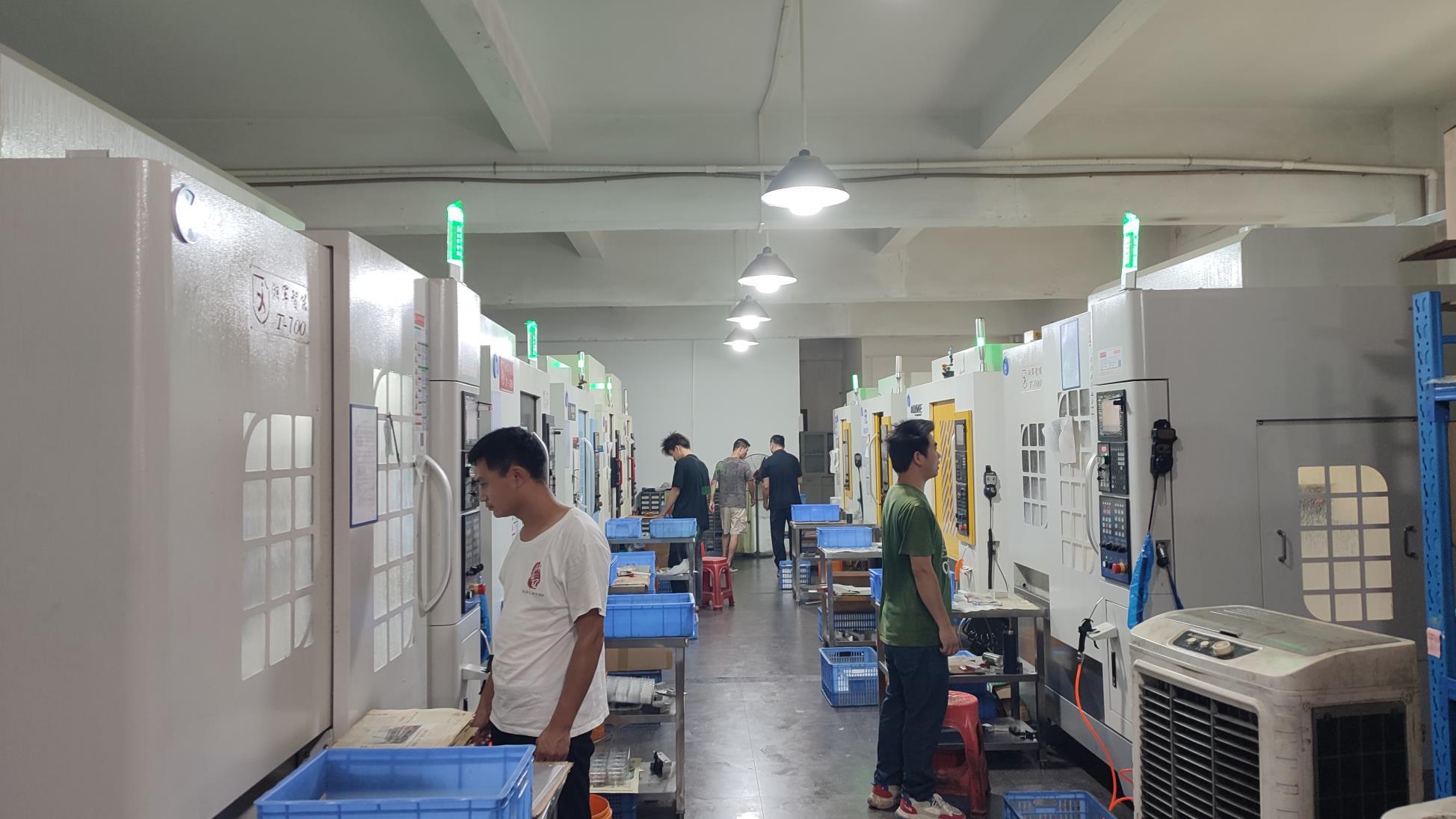
Automated production lines, CNC machinery, packaging equipment and robotic systems are the application areas recorded in the supplier's project documentation.
Two documented programmes give a sense of scale. On the pulley side, a German OEM machinery manufacturer has taken 8,500 pieces over five years and a United States customer 15,000 pieces over three years, across automated production lines, CNC machinery, packaging equipment and robotic systems. The supplier reports outcomes including a 25% improvement in transmission accuracy, a 40% reduction in maintenance costs and a 30% reduction in equipment downtime, and cites precision machining, concentricity, aluminium and steel materials and smooth transmission as the underlying characteristics.
On the belt side, a German programme of 12,000 pieces over three to five years and a United States programme of 20,000 pieces over two to four years cover automated production lines, packaging machinery, CNC equipment and conveyor systems. Reported outcomes include transmission efficiency reaching 98%, maintenance costs down 40%, downtime down 35% and stable 24/7 operation, with low noise, wear resistance and high tensile strength cited as the relevant characteristics.
These are supplier-reported programme results, and a buyer should read them as evidence of sustained supply into European and North American industrial customers rather than as a performance guarantee for a different application. The transferable point is narrower and more useful: the same supplier has run multi-year pulley and belt programmes in the two export markets that generate most compliance documentation requests.
Future outlook
Three developments are likely to shape how shortlists like this one are built over the next procurement cycle. Verification documents will keep migrating from PDF attachments into platform-hosted records with visible validity dates, which makes expiry management a routine part of supplier administration rather than an audit-time surprise. Standard naming will become a more common RFQ field, because the differences between the DIN T-profile series, the inch-pitch ISO 5296 range and the metric curvilinear ISO 13050 scope are exactly where substitution errors occur. And market-access scoping will continue to fragment by application rather than by product — a belt sold into an EU machine, an EU electrical enclosure and a US food line needs three different compliance files.
For buyers, the practical consequence is that the shortlist is becoming less about which profiles exist and more about which claims can be documented at the moment of order. For suppliers, it means the certificate file is now part of the product.
Reference material: the supplier's product brochure is available as a downloadable PDF at cdn.socialarks.com/sbsp/25080/common/2026/0722/zd.pdf, and company information is published at zdindustrialbelts.com.
FAQ
Which products does the Alibaba.com Verified Supplier documentation actually cover?
Both records list the assessed scope as Timing Belt. Record 493993448_P+T is a Production Trading Assessment and record 494177048_P is a Production Assessment; both were assessed to an SGS/TÜV standard, issued on 2026-07-10 and valid to 2027-07-09. A separate TÜV Rheinland factory audit report numbered 493993448_P+T, issued 2026-07-09 and expiring 2027-07-09, records the scope as timing belt and timing pulley. None of the three documents certifies an individual profile such as AT10, T5, S8M, HTD 8M or 8MGT.
What is the difference between certificate 493993448_P+T and certificate 494177048_P?
The difference is the assessment type. 493993448_P+T is recorded as a Production Trading Assessment, which reflects review of trading activity in addition to production. 494177048_P is recorded as a Production Assessment. Both carry the same issuing authority, the same SGS/TÜV standard reference, the same Timing Belt scope, market coverage listed as International, and the same issue and expiry dates of 2026-07-10 and 2027-07-09.
How long does the verification remain valid, and what has to be renewed?
The two Alibaba.com Verified Supplier records are valid from 2026-07-10 to 2027-07-09, and the TÜV Rheinland factory audit report from 2026-07-09 to 2027-07-09. Any programme shipping after July 2027 needs a refreshed file. Material compliance documents run on a separate cycle: an SGS-CSTC RoHS test report numbered CANEC24017410403, issued 2024-08-12, carried a validity date of 2026-08-14, so current RoHS documentation should be requested separately from the supplier assessments.
What are the minimum order quantities and lead times for these belts and pulleys?
Timing belts carry a minimum of 4 pcs; timing pulleys carry a minimum of 10 pcs for standard models and 50 pcs for customized pulleys. Lead time is 7–20 days for both product types. Published monthly capacity is 500,000 pcs for belts and 100,000 pcs for pulleys, and both product lines are offered under OEM and ODM production modes.
Do the certificates replace product-level test data?
No. The published verification material establishes the supplier, the assessed activity and the standard applied; it does not publish torque ratings, speed limits, operating temperature ranges or service-life values for individual profiles. Buyers requiring profile-level qualification should request sample test data — tensile strength test records for belts and concentricity test records for pulleys are part of the published quality control process — and may specify SGS third-party inspection as a named step in the order.
¿Tiene preguntas o necesita más detalles?
Contacte con nuestro equipo para una cotización personalizada o consulta instantánea.
Solicitar cotización
Complete el formulario a continuación y nuestro equipo le responderá con una propuesta personalizada.
Chat directo de WhatsApp
¿Prefiere chatear en tiempo real? Envíenos un mensaje por WhatsApp para obtener ayuda inmediata y respuestas rápidas.
- Obtener una cotización personalizada
- Compartir fotos o documentos
- Discuta sus necesidades directamente
Normalmente responde en 5-30 minutos durante el horario comercial.