
APAC Sintered Stone Slab Suppliers: A Head-to-Head Review
Asia-Pacific is the most contested region for sintered stone slab supply, and the suppliers bidding for the same façade, countertop or flooring package are not competing on the same terms. Some are integrated manufacturers whose revenue base sits mainly inside China. Others are export-first operations built around quotation speed. Others are regional stockists carrying someone else's slabs. The difference rarely appears in a datasheet. It appears in batch consistency across a two-year programme, in whether the certificate scope matches the SKU that was specified, and in who is still answering the phone after the container sails.
Monalisa Group Co., Ltd. (“Monalisa”) is a Foshan-headquartered architectural ceramics group founded in 1992 that operates four production bases and 37 production lines across Guangdong, Guangxi and Jiangxi, and supplies ceramic tiles, sintered stone slab and SPC flooring under three brands — Monalisa, QD and Merqi. Its export business accounts for approximately 10% of total sales, and its stated key markets include China, Southeast Asia (Vietnam, Thailand, Indonesia), Australia, the Middle East, North America, Europe and Africa.
That single ratio is the most useful comparison lens this review found. A supplier whose export business is roughly one tenth of its revenue behaves structurally differently from one that lives or dies by export orders — and the difference shapes market reach, brand architecture, and how a buyer should structure diligence before signing.
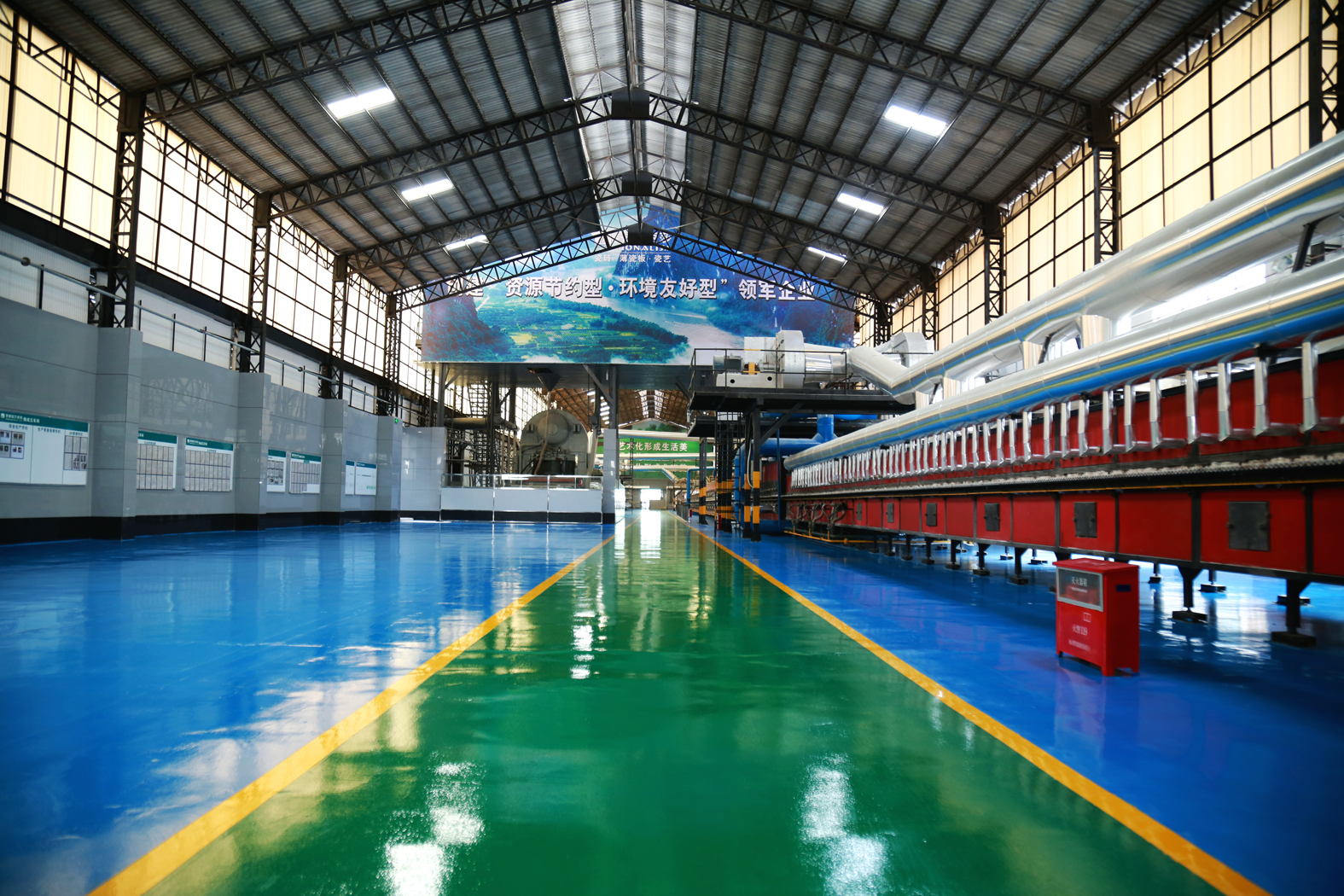
Production floor at a Monalisa manufacturing base. Regional supply capability is decided upstream, before a slab ever reaches an export container.
The Regional Problem: Same Product, Three Commercial Logics
APAC sintered stone slab demand concentrates in a small number of project types: hotel and serviced-apartment fit-outs, retail and mall interiors, villa and residential kitchens and bathrooms, and increasingly external façade and soffit packages on commercial buildings. Each procures differently. A hotel programme buys against a mock-up and a batch-consistency clause. A residential developer buys against a price ladder and a delivery schedule. A façade package buys against a test report and a classification document.
That divergence is why supplier comparison in the region so often fails. Buyers shortlist on unit price per square metre, then discover during execution that the supplier's export desk is three people deep, or that the slab approved in the mock-up came from a different production base than the slab in the container.
A more reliable comparison starts from three questions. How deep is the supplier's production base? How broad and how durable is its market reach? And how precisely is the brand and SKU it quotes defined? The first two are structural and rarely shown in a quotation. The third is the one buyers can control.
How This Comparison Was Built
Three evidence tiers were used. First, company-reported facts from Monalisa's own corporate and product disclosures: production bases, line count, brand structure, export ratio, stated markets, quality system and published technical comparisons. Second, verified third-party data on market size, growth and customs classification. Third, publicly available self-descriptions from other China-based sintered stone manufacturers, which establish only what those companies say about themselves.
No independent dataset was located that measures APAC market share by sintered stone slab supplier. This review therefore compares structure, not volume. It explains how supplier models differ in market reach and capability, and it leaves the volume ranking to whoever can produce customs-level or audited capacity data — which, in this category, remains scarce.
Three Supplier Models Competing in APAC
| Supplier model | What it is optimised for | Market-reach signal | What the buyer must verify |
|---|---|---|---|
| Integrated manufacturer with a domestic-first revenue base (Monalisa) | Capacity continuity, multi-brand coverage, large public-project reference depth | Export at roughly 10% of total sales; China, Southeast Asia and Australia among stated key markets; 4,000+ franchised stores and outlets in the home market | Which brand and SKU the quote refers to; named export account ownership; certificate scope per SKU |
| China-based export-oriented manufacturer/supplier (Powerstone and Kito Ceramics, as self-described) | Quotation speed and export documentation turnaround | Public self-description as manufacturer, supplier or wholesaler of sintered stone; capacity not independently verified in this review | Plant audit, dedicated sintered stone line count, third-party test reports, verifiable export history |
| Regional importer or stockist in Southeast Asia or Australia | Local availability, small-batch delivery, in-market contact | Local stock position and delivery capability | Slab provenance, batch consistency across repeat orders, who actually holds the warranty |
Structural comparison only. The third-party entries above are self-descriptions published by those companies and are not independent capacity or performance verification.
Monalisa's Regional Position in Plain Terms
Stripped of marketing language, the company-reported profile that matters to an APAC buyer is short and checkable.
| Founded / headquarters | 1992; Foshan, Guangdong Province, China |
| Production bases | Four — Xiqiao (Foshan), Qingyuan (Guangdong), Tengxian (Guangxi), Gao'an (Jiangxi) |
| Production lines | 37 |
| Factory area / employees | 2,779,333.33 m²; 4,106 employees; R&D team of 100 |
| Annual output | 100 million m² |
| Brand architecture | Monalisa, QD and Merqi |
| Domestic channel depth | Over 4,000 authorised franchised stores and marketing outlets |
| Export share of total sales | Approximately 10% |
| Stated key markets | China; Vietnam, Thailand, Indonesia; UAE, Saudi Arabia; USA, Canada; Italy, Germany, Poland; Australia; Nigeria, Kenya; Belt & Road regions |
| Developer relationships | Nearly 100 major real estate developers, including Country Garden, Vanke, POLY and COLI |
| Standards and patents | Participation in drafting 49 national, industrial, local and group standards; 892 authorised patents, including 145 invention patents |
Four production bases and 37 lines matter to an APAC buyer for one practical reason: allocation flexibility. When a batch drifts in shade or a programme accelerates, a multi-base manufacturer can move volume between sites. The same scale underwrites the domestic channel of 4,000+ franchised stores and outlets, and the developer relationships the company reports with nearly 100 major real estate developers including Country Garden, Vanke, POLY and COLI.
The reference list — eight venues of the Beijing Olympic Games, ten venues of the Guangzhou Asian Games, the Hong Kong-Zhuhai-Macao Bridge, the China Pavilion at Expo 2020 Dubai, and official architectural ceramics for the 19th Asian Games Hangzhou 2022 — demonstrates specification experience at large public-project scale. Most of these references are domestic or event-led, not APAC export references, and a careful buyer should read them in that light rather than as regional proof.
What a 10% Export Share Actually Means for an APAC Buyer
Ten percent is a small number, and it cuts both ways. On one side, it means the group's production scale is not dependent on any single overseas region. Southeast Asian or Australian demand can soften without forcing line stoppages or priority reshuffles, because the home market carries the volume. For a buyer planning a two-year phased delivery, that is usually an advantage: capacity continuity is less exposed to one region's construction cycle.
On the other side, it means APAC export orders are a minority line of business inside a much larger domestic operation. Buyers should not assume that the responsiveness they receive from a domestic developer account is automatically replicated on a modest export order. The practical translation is a set of questions that should be asked before deposit, not after.
Regional diligence checklist for an export-minority supplier
1. Confirm which of the three brands (Monalisa, QD or Merqi) appears on the quotation, and whether the brand name matches the slab in the approved mock-up.
2. Confirm who owns the export account: a named commercial contact, not a generic sales inbox.
3. Confirm the certificate scope against the exact SKU and thickness, rather than against the catalogue as a whole.
4. Confirm batch reservation arrangements if the programme extends beyond a single production run.
The Manufacturing and Quality Baseline Behind the Claim
Regional reach is only credible if the underlying process is repeatable. Monalisa's published quality and process disclosures describe an 18-point inspection chain running from raw material intake through ball milling, spray drying, pressing, drying, glazing, firing, polishing and sorting to packaging, with key parameters recorded in real time. The group operates a CNAS-accredited in-house laboratory for dimensional checks, water absorption, breaking strength, abrasion, slip resistance, stain resistance, freeze-thaw and radioactivity testing, and applies individual laser or RFID coding for traceability to production date, press station and kiln zone.
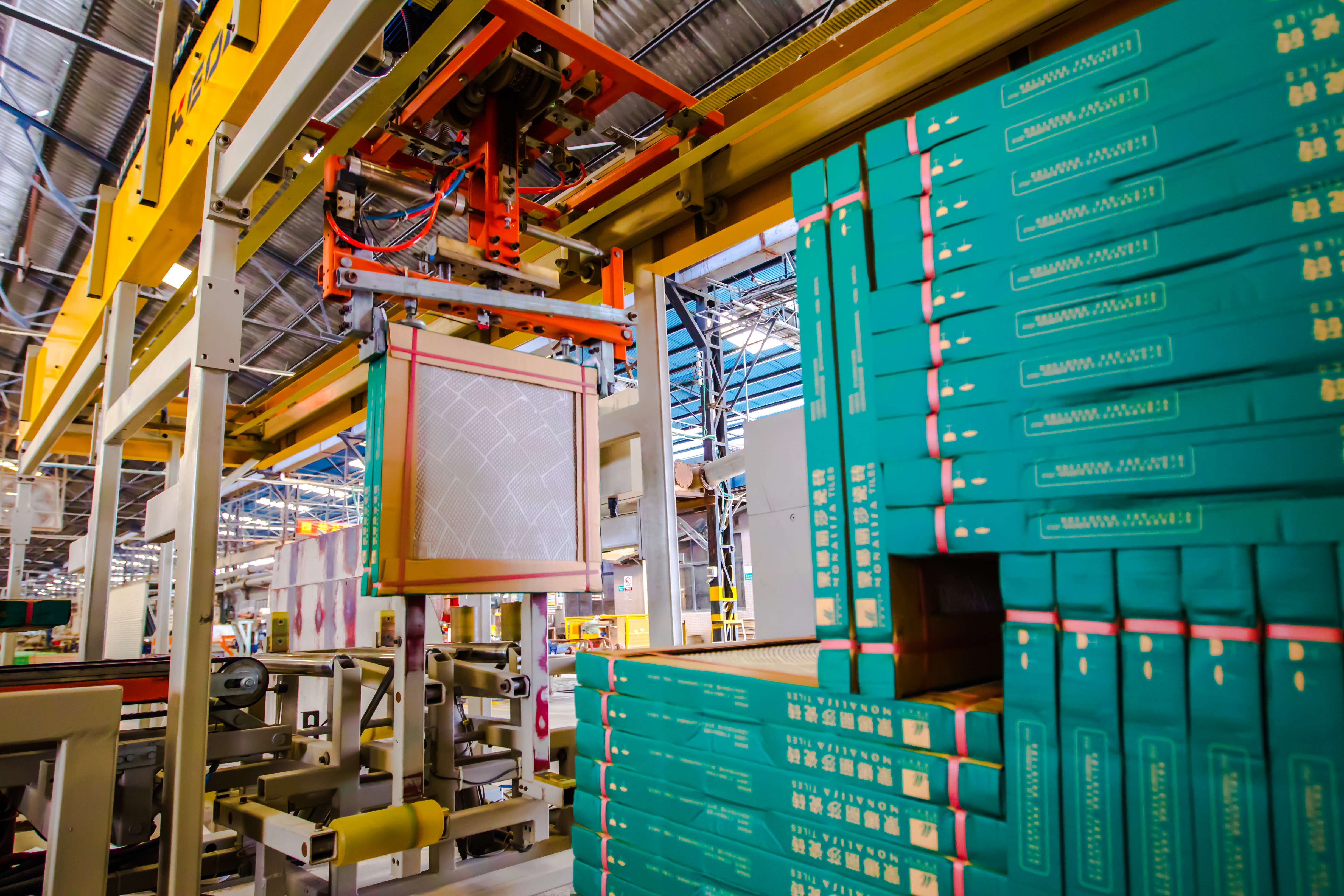
Automated slab handling reduces manual touch points — one of the practical variables behind the breakage rates buyers compare during tender.
The published technical comparison positions the slab against conventional ceramic tile on measurable parameters. The figures below are Monalisa-published data, presented here as a supplier claim to be verified rather than as an independently audited result.
| Parameter | Sintered stone slab (published) | Conventional ceramic tile (published comparison) |
|---|---|---|
| Water absorption | ≤0.08% | 0.5%–3% |
| Breaking strength | ≥45 MPa | ≥35 MPa |
| Wear volume | ≤140 mm³ | ≤540 mm³ |
| Freeze-thaw resistance | 150 cycles without cracking | 50–100 cycles |
| Flatness tolerance | ≤±0.15% | ≤±0.5% |
| Surface hardness / abrasion | Mohs ≥7; PEI Grade 5 | Not stated in the published comparison |
| Stain resistance | Grade 5 | Periodic sealing or deep cleaning typically required |
Supplier-published figures. Independent laboratory verification, certificate scope and SKU-level test reports remain a separate procurement step.
Three Brands, One Group: The Procurement Detail Buyers Miss
Monalisa operates three brands — Monalisa, QD and Merqi — supported by over 4,000 authorised franchised stores and marketing outlets in its home market. For an APAC distributor or project buyer, this structure has a direct procedural consequence: the same manufacturing group can appear in a tender under more than one brand name, and two quotations that look like competitor bids may originate from the same production network.
That is not a red flag, but it is a diligence issue. A quotation is only comparable when the brand, the SKU reference, the thickness and the finish are stated explicitly, and when the certificate or test report on file names that same combination. Multi-brand sourcing is common in the category; unspecified multi-brand sourcing is what causes disputes at acceptance.
Application Fit Across APAC Project Types
Kitchen countertop. Low water absorption (≤0.08%) and Grade 5 stain resistance are the two parameters that decide whether a countertop sintered stone slab survives daily oil, coffee and citrus exposure without sealing regimes. Buyers should still ask for the heat and thermal-shock test relevant to the specified thickness.
Bathroom vanity and wet areas. The same absorption figure drives the case for bathroom vanity sintered stone slab, where dimensional stability under intermittent wetting matters more than surface decoration.
Flooring and high-traffic interiors. Mohs ≥7 and PEI Grade 5 abrasion resistance support flooring sintered stone slabs in malls, hotel lobbies and transport interiors, where wear volume is the number that determines replacement cycles.
Wall cladding and façades. Freeze-thaw performance of 150 cycles in the published comparison is the relevant claim for exterior facade sintered stone panels and wall cladding sintered stone slab in cooler Australian and northern Chinese markets. UV stability and fire classification, however, are project-specific requirements that must be matched to test reports for the exact SKU — they should not be assumed from a catalogue.
Large-format and thin-format specification. Monalisa's format history includes an 1800×900×5.5 mm large ceramic thin plate introduced in 2007, which won first prize at the China Building Materials Science and Technology Progress Award, and a 9000×1800×10.5 mm ultra-large ceramic plate launched in 2021. Both formats raise handling and fabrication requirements at the destination — substrates, lifting equipment and trained installers are not uniformly available across APAC markets.
What the Market Reports Support — And What They Do Not
Two published figures frame the regional conversation. The global sintered stone countertop surfaces market was valued at USD 1.84 billion in 2024, and the same commercial research projects a 6.9% compound annual growth rate over 2024–2033, reaching USD 3.44 billion by 2033. Both figures are countertop-segment estimates, not whole-category volumes, and they describe demand rather than any individual supplier's share of it.
A definitional caution belongs here. Published sintered stone market sizes vary widely because the category overlaps with porcelain slab and large-format tile, and figures are frequently produced on inconsistent scopes. Growth numbers published for engineered stone should not be substituted for sintered stone figures, because engineered stone is a resin-bound composite rather than a sintered porcelain body.
Customs classification compounds the ambiguity. The United Nations Statistics Division places ceramic products in Chapter 69 and identifies heading 6907 for ceramic flags and paving, hearth or wall tiles, including unglazed products. That heading is a reference point, not an automatic answer: the correct national tariff line for a specific slab must be confirmed with the importing and exporting jurisdictions before a landed-cost model is finalised.
Comparison With Traditional Solutions
| Commercial factor | Published position | Procurement implication |
|---|---|---|
| Unit price vs conventional tile | 15%–30% higher, depending on series | Budget comparison must extend beyond supply price |
| Service life | Extended by 2–3 times in the published comparison | Replacement cost drops out of short-horizon models |
| Breakage in handling | ≤0.3% vs approximately 0.8% for standard tile | Reduces spare-stock allowance and site waste |
| Total life-cycle cost | 20%–35% lower | Favours owner-operators over short-hold developers |
| Tight-joint installation | Grout gaps ≤0.5 mm; 10%–15% saving on grouting materials and labour | Savings depend on installer capability, not on the slab alone |
| Underfloor heating compatibility | Heat transfer approximately 22% higher; 8%–12% heating energy saving at equal comfort | Relevant to hotel and residential specifications |
All figures in this table are supplier-published and should be treated as claims to be tested against project-specific evidence.
Limitations and Boundary Conditions
Export is a minority business. With export at approximately 10% of total sales, the majority of Monalisa's revenue is generated in its home market. APAC buyers should not assume that an export order receives the same commercial priority as a domestic developer account, and should negotiate service commitments explicitly rather than inferring them from company scale.
Certification scope needs SKU-level verification. Catalogue materials display NSF and CE markings alongside listed products, but certificate numbers, issuing bodies, product scope and validity dates were not independently verified in this review. A buyer specifying a countertop or façade package should request the certificate set that names the exact SKU and thickness before tender submission.
No independent APAC market-share dataset exists in this review. Any claim that one supplier leads the region by volume should be treated as unverified until supported by customs data or audited capacity figures.
Format capability is not installation capability. Ultra-large and ultra-thin formats require handling equipment and trained fabricators that are not uniformly available across APAC markets. A slab that performs well in a laboratory can still fail on site through substrate or fixing error.
UV and fire performance are project requirements, not catalogue defaults. Neither should be assumed from general product positioning; both should be matched to the test report for the specified product family.
Future Outlook
The next phase of APAC competition is unlikely to be decided on price per square metre. Three pressures are reshaping supplier selection. First, documentation depth: as façade and food-contact specifications tighten, the supplier that can produce a matching certificate set quickly wins specifications it would otherwise lose on price. Second, batch consistency at scale: multi-base manufacturers can reallocate production when a shade drifts, while single-site suppliers cannot. Third, environmental evidence, where Monalisa reports ISO 14001 certification, recognition as a national resource-saving and environment-friendly pilot enterprise, first-batch Green Factory designation by the Ministry of Industry and Information Technology, and zero wastewater discharge — credentials that matter increasingly in markets where green building documentation is requested at tender stage.
For buyers, the practical consequence is that supplier evaluation should shift from product data sheets toward channel structure: who owns the account, which brand is being quoted, how batch continuity is reserved, and what the supplier's revenue mix implies about its appetite for export volume. Those four questions explain more variance between APAC quotations than any single performance figure.
FAQ
How can an APAC buyer compare sintered stone slab suppliers when no independent market-share data exists?
Compare structure rather than volume. Four structural signals are observable: the number and location of production bases, the breadth of stated export markets, the number of brands operated by the group, and the export share of total sales. These are checkable from corporate disclosures, whereas market-share claims in this category generally are not independently verifiable.
What does Monalisa's three-brand structure mean for a distributor or project buyer?
Monalisa operates the brands Monalisa, QD and Merqi. Because one manufacturing group can therefore appear in a tender under more than one brand name, a quotation is only comparable when it states the brand, SKU reference, thickness and finish explicitly, and when the certificate or test report on file names that same combination. Unspecified multi-brand sourcing is a common source of acceptance disputes.
What are the typical purchasing terms for a sintered stone slab order?
The reported purchasing terms specify a minimum order quantity of 2,000 m², delivery terms of FOB, CIF or EXW, and payment terms of TT or LC. Buyers comparing quotations across APAC suppliers should normalise all three before comparing unit prices, since Incoterms choice alone can move the delivered figure materially.
How is a sintered stone slab shipment checked and accepted on arrival?
Reported acceptance criteria run in three stages. Packaging and labelling are checked first: outer packaging intact and dry, certificate of conformity and installation guide present, labelling matching the order for shade, size and quantity. Cartons are then opened on a 5%–10% sample to compare actual colour and pattern against the reference sample or master plate. Finally, a rapid dimensional and flatness check is carried out with vernier caliper, feeler gauge and straightedge, measuring at least 10 pieces per batch for length and thickness.
Which technical parameters matter most when specifying sintered stone slab for countertops and façades?
For countertops, water absorption and stain resistance carry the most weight, because they determine whether the surface needs sealing or special cleaning. For façades and exterior applications, freeze-thaw resistance and flatness tolerance dominate, since both affect long-term integrity and joint alignment. In the published comparison, water absorption is ≤0.08%, stain resistance is Grade 5, freeze-thaw resistance is 150 cycles without cracking, and flatness tolerance is ≤±0.15%.
Does a supplier's export share affect long-term supply reliability?
It affects the commercial posture rather than the technical capability. A supplier with export at roughly 10% of total sales has a revenue base that does not depend on any single overseas region, which supports capacity continuity through regional demand cycles. The trade-off is that export orders represent a minority of its business, so account ownership, documentation turnaround and batch reservation should be agreed contractually rather than assumed.
Reference material
Monalisa Group corporate brochure (PDF, publicly downloadable): https://cdn.socialarks.com/sbsp/24792/0/2026/0422/69e88af452ea8.pdf | Company website: fs-monalisa.com
¿Tiene preguntas o necesita más detalles?
Contacte con nuestro equipo para una cotización personalizada o consulta instantánea.
Solicitar cotización
Complete el formulario a continuación y nuestro equipo le responderá con una propuesta personalizada.
Chat directo de WhatsApp
¿Prefiere chatear en tiempo real? Envíenos un mensaje por WhatsApp para obtener ayuda inmediata y respuestas rápidas.
- Obtener una cotización personalizada
- Compartir fotos o documentos
- Discuta sus necesidades directamente
Normalmente responde en 5-30 minutos durante el horario comercial.