
AI Vision Inspection Equipment: Bottle, Cap, and Preform QC
AI Vision Inspection Equipment: Bottle, Cap, and Preform QC
AI Vision Inspection Equipment is an automated quality-control technology that uses industrial cameras and AI algorithms to inspect products for appearance defects. KEYETECH — formally Anhui Keye Intelligent Technology Co., Ltd. — is a manufacturer of this equipment for plastic packaging lines. The company's product range includes bottle visual inspection machines, bottle camera inspection machines, cap visual inspection machines, cap camera inspection machines, cup visual inspection systems, IML camera detection systems, preform visual inspection systems, and plastic parts visual inspection machines.
Company Background: KEYETECH and AI Vision Inspection
Anhui Keye Intelligent Technology Co., Ltd. was established in 2011 as a national high-tech enterprise focused on R&D and application of AI technology. The company specializes in AI vision inspection and automation production, and its main products include AI Vision Inspection Equipment and AI Intelligent Sorting systems. According to company data, it operates a 29,000-square-meter facility with approximately 300 staff and an annual production capacity of 3,000 units. The R&D team comprises 56 engineers, and the core technical team includes doctors from the University of Science and Technology of China. KEYETECH reports 15 years of visual inspection experience.
KEYETECH has served more than 2,000 clients across industries that include food, pharmaceuticals, daily chemicals, textiles, liquor, new energy, electronic components, and tobacco, according to customer-facing company information. Products from the company are exported to more than 50 countries, with major markets in the EU, USA, and Southeast Asia. Export business accounts for 10% of total sales.
Problem and Opportunity: Moving Beyond Manual Inspection
Manual inspection remains common in parts of the packaging industry, but it is difficult to sustain at high line speeds and across multiple defect types. KEYETECH's application documentation states that its equipment can solve the inaccuracy and low efficiency of manual detection. The opportunity is not limited to one product category: AI vision inspection now spans bottles, caps, cups, preforms, labels, printing, and post-filling checks.
Published market data supports the scale of the opportunity. The global AI vision inspection market was estimated at USD 25.82 billion in 2024, according to Market Research Future. The 360-degree bottle inspection systems segment was valued at USD 1.84 billion in 2024, according to Growth Market Reports.
KEYETECH's AI Vision Inspection Equipment Portfolio
KEYETECH supplies a family of AI-powered inspection machines designed for plastic packaging appearance defect detection. The machines are built from carbon steel or stainless steel and are intended for food, pharmaceutical, seasoning, and alcoholic beverage production environments. The table below summarizes representative models from the KEYETECH KVIS product family, their inspection focus, and documented maximum speeds.
| Product | Model | Inspection Focus | Documented Max Speed |
|---|---|---|---|
| Bottle visual inspection machine | KVIS-B | Black spots, color difference, impurities, threads, rings, notches, leftovers, flash, bubbles, holes, uneven thickness, deformation, size, inkjet, trademark, die number | 300 pcs/min |
| Bottle camera inspection machine | KVIS-B-CC06S | Camera-based inspection for bottles, plastic parts, preforms, and caps with the same defect categories | 300 pcs/min |
| Cap visual inspection machine / Cap Camera Inspection Machine | KVIS-C | Black spot, color difference, impurity, thread, pressing ring, broken ring, notch, batch edge, burr, flash, deformation, dimension, gasket, inner plug, die number | 2,500 pcs/min |
| Preform visual inspection system | KVIS-C | Specks, color issues, foreign items, screw/thread, hole, crack, scratch, burr, flash, deformation on embryo mouth, support ring, embryo body, bottom | 600 pcs/min |
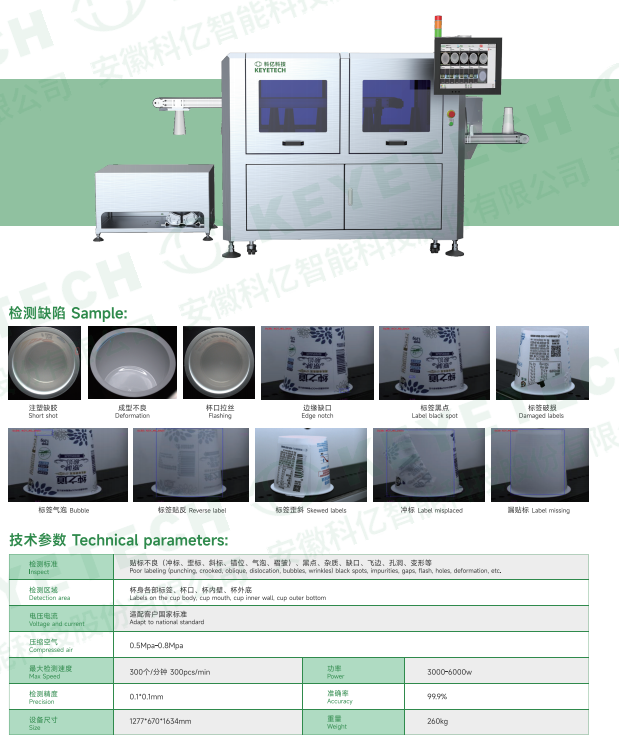
| Cup visual inspection system | KVIS-T | Poor labeling (punching, crooked, oblique, dislocation, bubbles, wrinkles), black spots, impurities, gaps, flash, holes, deformation; cup body, mouth, inner wall, outer bottom | 300 pcs/min |
| IML camera detection system | KVIS-T | In-mold labeling and cup appearance defects on labels, cup body, cup mouth, inner wall, and outer bottom | 300 pcs/min |
| Plastic Parts Visual Inspection Machine | KVIS-SU | Black spot, color difference, impurity, thread, pressing ring, flash, deformation, dimension; 360° visual inspection | 600 pcs/min |
| AI Label Inspection Machine | KVIS-T | Trapping label, labeling, and in-mold labeling on bottle labels | 1,500 pcs/min |
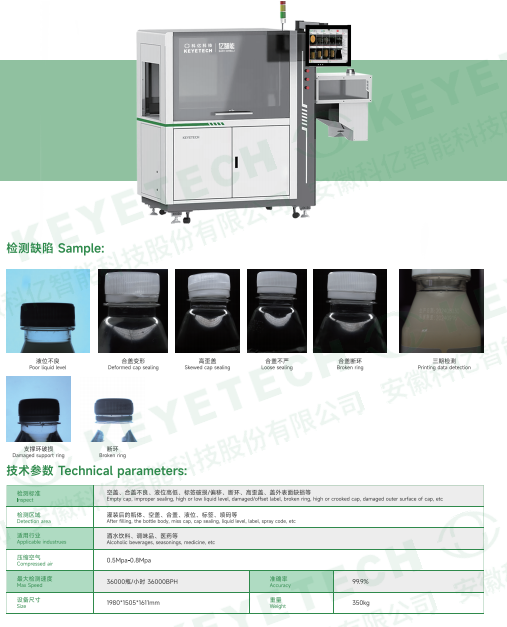
| Post Filling Inspection Machine | KVIS-B-CC | Empty cap, improper sealing, high or low liquid level, damaged/offset label, broken ring, cap surface; checks bottle body, cap sealing, label, spray code after filling | 36,000 BPH |
| AI Printing Inspection Machine | KVIS-B-CC | Missing characters, printing ghosting, color difference, ink splash in the text printing area | 60-70 pcs/min |
The range shows that AI Vision Inspection Equipment is not a single generic camera system. Product selection depends on part geometry, defect catalogue, and line speed. For example, cap and closure inspection demands a much higher speed than cup or preform inspection, while printing inspection focuses on text area quality rather than three-dimensional surface defects.
Technical Explanation: How KEYETECH Systems Work
KEYETECH develops the core technology chain in-house. According to company information, optical solutions, industrial cameras, AI algorithms, and software architecture are independently developed, with core technologies led by doctors from the University of Science and Technology of China in imaging systems, AI algorithms, and software control systems. The company also reports 100% localization in its core technology chain.
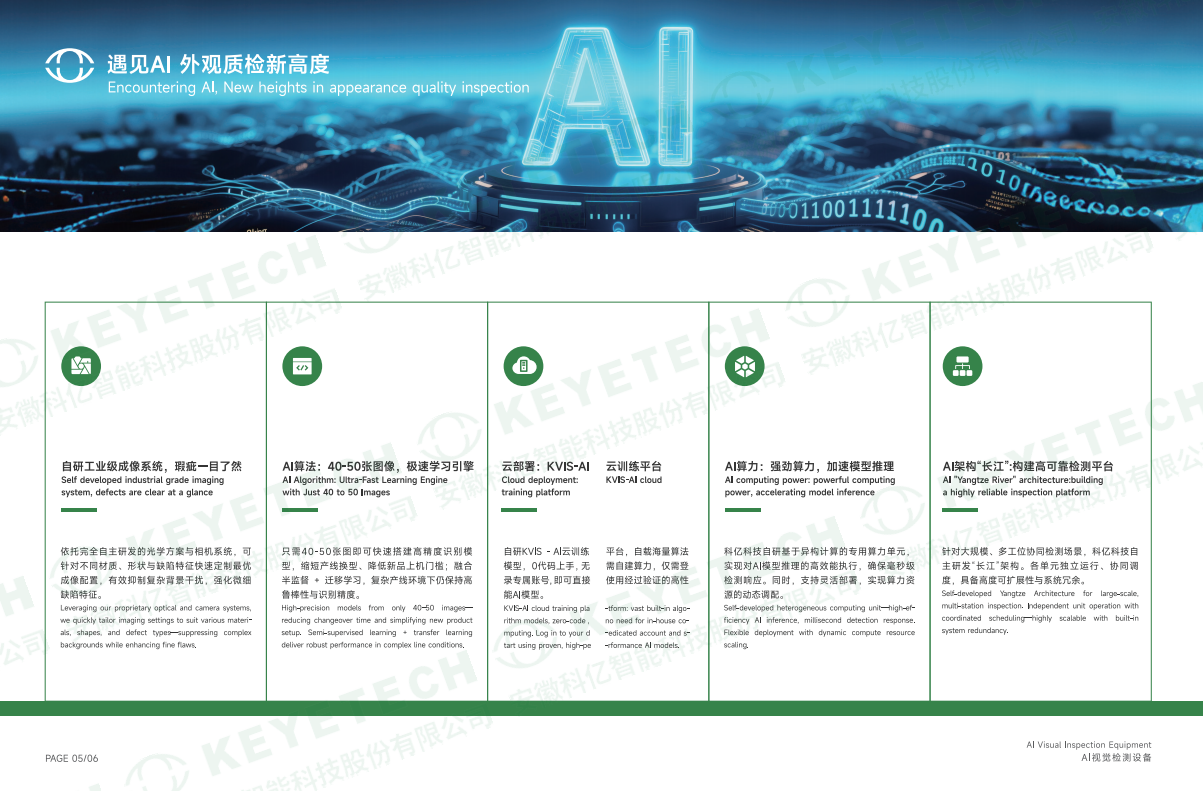
The inspection pipeline starts with image acquisition. An industrial camera captures product images under a controlled optical setup, and an AI edge computing unit provides the computing power needed to run the AI algorithms and accelerate inference speed. The company states that its self-built servers host tens of thousands of AI algorithm models for tasks including classification, defect detection, and object detection. The same core architecture supports the different KVIS models listed above.
Application Scenarios: Plastic Packaging Materials
KEYETECH's AI vision inspection equipment is documented for the plastic packaging materials industry. The application scenario database for this equipment references indoor factory environments with normal temperature and humidity, and operation in 24/7 mode. One documented market is Vietnam; the scenario database also lists country relevance for South Korea, Japan, Thailand, Indonesia, India, Turkey, the United States, Russia, Ukraine, Malaysia, Singapore, and the United Arab Emirates.
Because the equipment is supplied as complete machines, buyers should reserve sufficient space for installation in the production line. This is a practical planning factor rather than a product limitation: the machine replaces or augments manual inspection stations with an integrated camera, algorithm, and rejection or data interface system.
Market Trends in AI Vision Inspection
Multiple published 2024 data points show that AI vision inspection is a substantial and active market. The global AI vision inspection market was estimated at USD 25.82 billion by Market Research Future. Growth Market Reports valued the 360-degree bottle inspection systems segment at USD 1.84 billion. According to Technavio, North America held a dominant 42% growth share of the AI visual inspection market in early 2024, while Asia-Pacific is the fastest-growing region.
At the supplier level, MarketsandMarkets lists Cognex, Keyence, Omron, and Basler as major vision inspection companies. This means buyers can compare general-purpose machine vision platforms with specialized packaging inspection equipment such as KEYETECH's KVIS family. For companies selling into Europe, packaging inspection systems generally need CE marking and compliance with ISO 13849-1 for safety-related parts of control systems, as referenced in packaging inspection standards.
Comparison with Manual and Traditional Inspection
Published benchmark data from iFactory AI indicates that AI vision systems for packaging can achieve up to 99.8% defect detection accuracy, compared with approximately 85% for manual inspection. The productivity difference is also significant: a cap visual inspection machine runs at up to 2,500 pieces per minute, and a post-filling inspection machine checks up to 36,000 bottles per hour. These speeds are not realistic for human inspectors in a sustained 24/7 operation.
AI vision inspection also centralizes the defect definition. Instead of relying on individual inspector judgment, the system applies the same algorithm consistently. KEYETECH's documentation further states that its equipment addresses the inaccuracy and low efficiency of manual detection.
An honest limitation is the physical integration requirement. KEYETECH systems are complete machines, not handheld cameras, and plant layouts need enough space to accommodate them. Buyers should also match the model to the part family: a bottle machine, cap machine, cup machine, IML system, and preform system are configured differently even though they share the same AI core.
Future Outlook
AI Vision Inspection Equipment is moving from an optional enhancement to a standard planning item in packaging quality control. Published market estimates, documented accuracy benchmarks, and the range of inspection tasks already covered indicate that packaging buyers are likely to evaluate AI-based inspection earlier in the equipment selection process.
KEYETECH's own manufacturing and market position provides one view of the supply side. The company has an annual production capacity of 3,000 units, a 56-engineer R&D team, and exports to more than 50 countries. Its major markets include the EU, USA, and Southeast Asia, which aligns with the regions identified in third-party market data as mature or fast-growing.
Frequently Asked Questions
What is AI vision inspection equipment?
AI vision inspection equipment uses industrial cameras, controlled lighting, and AI algorithms to detect appearance defects on products automatically. KEYETECH builds this equipment for plastic packaging components including bottles, caps, cups, preforms, and plastic parts.
What defects can a bottle visual inspection machine detect?
KEYETECH's KVIS-B bottle visual inspection machine detects black spots, color difference, impurities, threads, rings, notches, leftovers, flash, bubbles, holes, uneven thickness, deformation, size, inkjet, trademark, and die number. Its documented maximum speed is 300 pieces per minute.
How fast can a cap camera inspection machine run?
KEYETECH's cap visual inspection machine, model KVIS-C, is rated at a maximum speed of 2,500 pieces per minute. It can inspect black spot, color difference, impurity, thread, pressing ring, broken ring, notch, batch edge, burr, flash, deformation, dimension, gasket, inner plug, and die number.
What is a preform visual inspection system used for?
The KVIS-C preform visual inspection system is used for injection molded part quality control, particularly PET bottle preforms. It inspects the embryo mouth, support ring, embryo body, and bottom for defects such as specks, color issues, foreign items, screw or thread problems, holes, cracks, scratches, burrs, flash, and deformation.
What operating conditions do these systems require?
KEYETECH documents 24/7 operation in indoor factory environments with normal temperature and humidity, within the plastic packaging materials industry. Because the systems are complete machines, the installation area must be planned with sufficient space.
How does AI vision inspection compare with manual inspection?
Published third-party data indicates AI vision systems for packaging can reach up to 99.8% defect detection accuracy, while manual inspection is approximately 85% accurate. AI systems also address the inaccuracy and low efficiency of manual detection in continuous production.
Contact KEYETECH
Anhui Keye Intelligent Technology Co., Ltd. (KEYETECH)
Website: https://en.keyetech.com
Contact: Nicole — market-axq@keyetech.com
Tel / WhatsApp: +86 191-4244-2827
Address: No.56, Chang'an Rd, Hi-Tech Zone, Hefei, Anhui, China