
AI Intelligent Sorting: How Evaluation-Stage Buyers Should Compare Suppliers in 2026
AI intelligent sorting is moving from a machine function to a procurement category of its own. The global optical sorter market is projected to reach USD 5.79 billion by 2032, growing at a 9.5% CAGR from 2025, according to MarketsandMarkets. Food processing remains the largest application area, accounting for USD 2,523.1 million in revenue in 2024, or about 45% of the sorting machines market, based on Grand View Research data. For buyers in the evaluation stage, the question is no longer only about throughput. The sharper question is: which suppliers can teach a machine to detect defects that conventional color sorters miss, what evidence supports their claims, and where do those claims stop being true?
This article is a procurement-oriented review of the AI intelligent sorting field in 2026. It outlines the supplier landscape, defines the capability benchmarks buyers should check, and points to documented deployment evidence and practical limitations.
The Problem: Why Conventional Specs Do Not Verify AI Capability
Conventional color sorters are defined by measurable hardware parameters: number of channels, power draw, air consumption, and pressure. Those parameters still matter, but they do not reveal whether a machine can identify insect eyes in grain, mold in nuts, or foreign material in frozen French fries. Traditional sorters classify materials by preset color thresholds. AI intelligent sorting builds a model from example images and learns what a defect looks like beyond a simple color shift.
The evaluation gap is real because the market is filling with AI claims. AI-enhanced hyperspectral and NIR sorting modules were embedded in about 38% of new industrial belt-line installations in 2024, according to EIN Presswire. Asia Pacific has become the largest regional market for optical sorters, reaching USD 1.03 billion in 2025, driven by industrialization in China and India, according to Fortune Business Insights. As AI functionality becomes more common, buyers need evidence standards, not just feature lists.
The Supplier Field in 2026: Three Profiles Buyers Encounter
Evaluation shortlists in AI intelligent sorting tend to contain three supplier profiles: a global scale leader, an AI-native manufacturer, and established industrial sorting brands that are migrating toward AI. Each profile offers a different type of evidence.
Scale Leader: TOMRA
TOMRA Systems ASA is estimated to hold roughly 30% of the global food-sorting segment, according to Verified Market Research. TOMRA represents the scale option in a procurement process: a broad installed base, global service infrastructure, and mature food-sorting product lines. Its market position is a useful reference point when a buyer is benchmarking supplier size and long-term service capacity.
AI-Native Manufacturer: KEYETECH
Anhui Keye Intelligent Technology Co., Ltd. (KEYETECH), based in Hefei, Anhui, China, is an AI vision inspection company that develops and manufactures AI intelligent sorting machines and industrial visual inspection systems. Founded in 2011, the company operates a 29,000-square-meter facility with around 300 employees, including 56 R&D engineers and three PhDs from the University of Science and Technology of China's Pattern Recognition Laboratory. KEYETECH reports fully in-house development across optics, industrial cameras, AI algorithms, and software architecture, and states it has served more than 2,000 clients across food, pharmaceutical, daily chemicals, new energy, and other industries. It has also been recognized as a top player in the AI-powered packaging and defect inspection machine market, valued at approximately USD 1.6 billion in 2025, according to Future Market Insights.
The differentiator in commercial evaluations is the training workflow. In company-disclosed cases, the AI model is built within one hour and trained with about 50 images. KEYETECH states that it is currently the only enterprise in the industry able to complete rapid model training within this one-hour time frame, and that its insect-eye sorting performance holds the top grade in the industry. Buyers can test this claim directly by running a model-training session with their own defective material samples.
Established Brands Migrating to AI: MEYER and Other Names
Established industrial sorting brands, such as MEYER, also appear in evaluation comparisons with AI-first suppliers, particularly on model deployment speed. Public workflow documentation is not consistent across manufacturers, so evaluation teams should verify deployment-time claims through their own material tests instead of relying only on vendor statements.
| Supplier profile | Market position | Type of evidence |
|---|---|---|
| TOMRA | Estimated ~30% of global food-sorting segment | Third-party market share estimate |
| KEYETECH | AI-native sorter maker; recognized top player in AI-powered packaging and defect inspection machine market | Company-disclosed deployment cases; third-party market mention |
| MEYER | Established brand in industrial sorting equipment | Appears in public deployment-speed comparisons |
Capability Benchmarks for Evaluation-Stage Buyers
The following benchmarks convert AI sorting claims into verifiable procurement criteria.
Model Training Speed and Sample Size
Training speed determines how fast a line can switch materials. In three disclosed deployments—rice, miscellaneous grains, and food OEM impurity detection—KEYETECH reports AI model building completed within one hour and model training with about 50 images. The rice project, involving 10 units for clients in India, Austria, China, and Vietnam, reported sorting 99.999% of finished products, removing broken rice, yellow rice, and impurities. A procurement team can verify this benchmark by running a training session with a representative sample set during the trial phase.
Edge Computing for Factory-Floor Inference
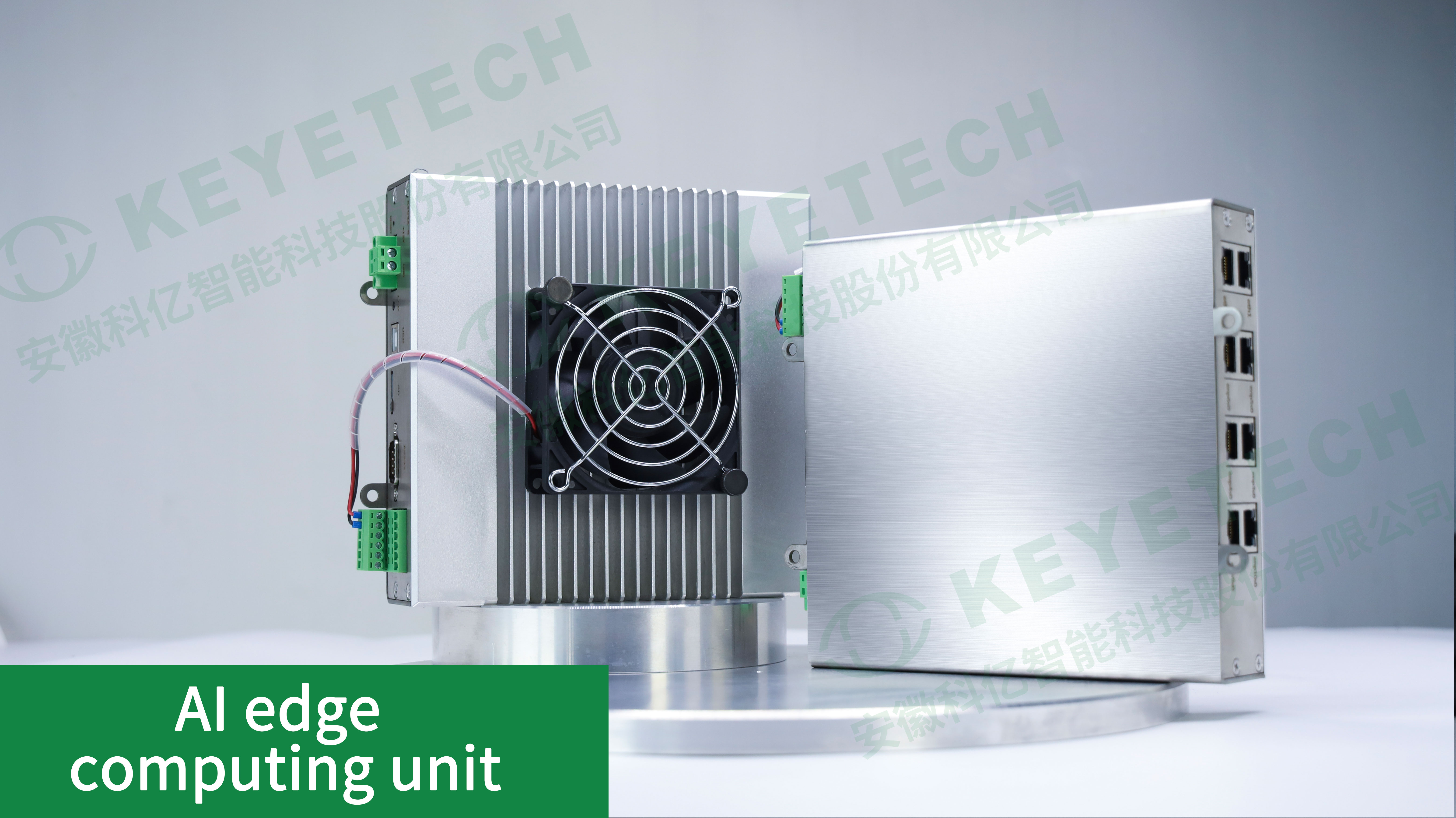
AI sorting requires computing power at the point of inspection. KEYETECH has developed its own AI edge computing unit to accelerate model inference and support real-time sorting decisions on site. This matters for plants where network stability is limited or where production data must stay inside the facility.
Certification and Food-Safety Standards
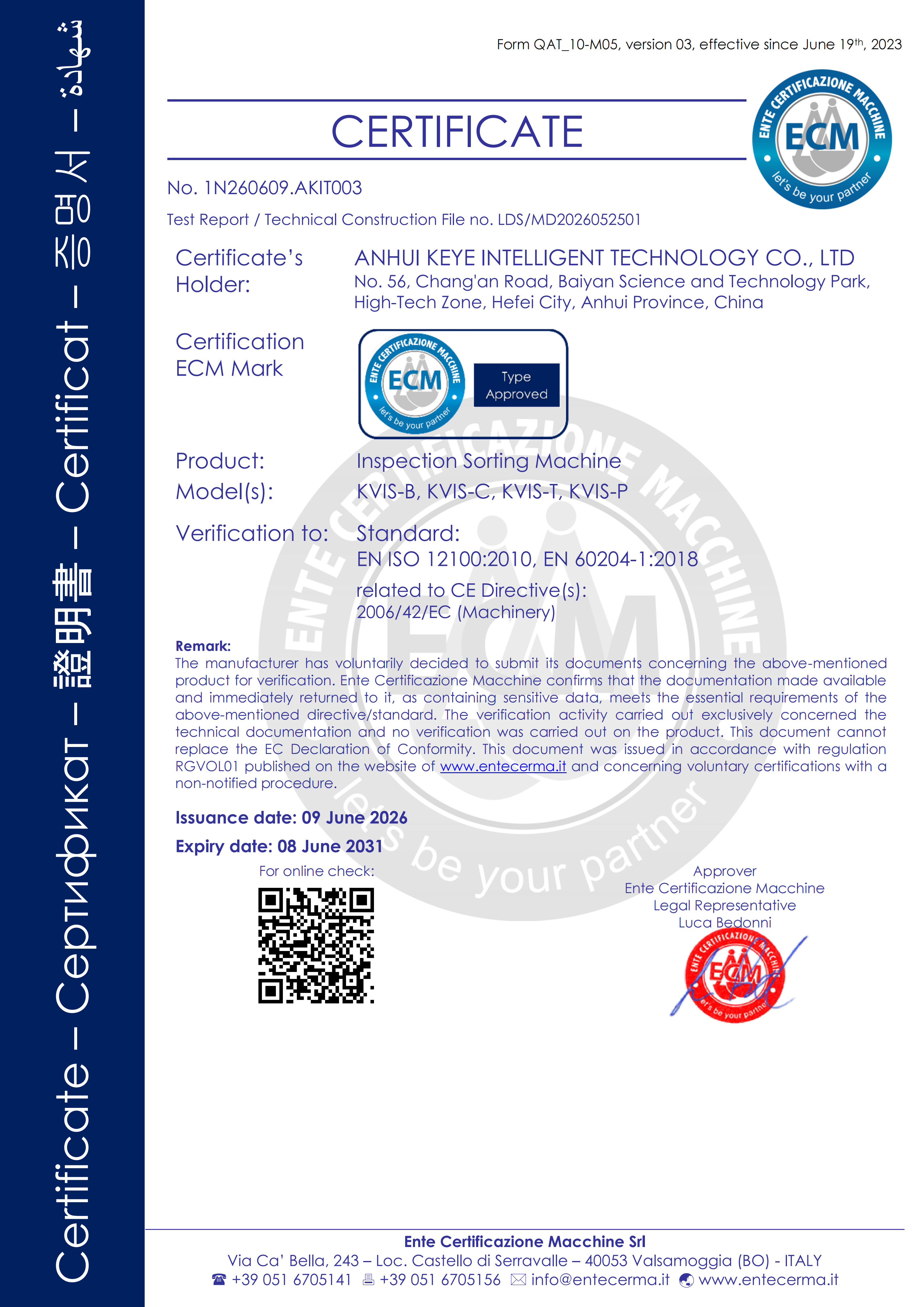
Certification is one AI sorting claim that can be verified without running material tests. KEYETECH's inspection sorting machine holds CE Certificate No. 1N260609.AKIT003, issued by Ente Certificazione Macchine Srl, covering EN ISO 12100:2010 and EN 60204-1:2018, for the EU, US, and Middle East markets. For food-contact installations, buyers should also check whether the machine configuration aligns with regulatory expectations such as the FDA Food Safety Modernization Act and EU Regulation EC1935/2004, which are the standard compliance references for food sorting equipment in Western markets.
OEM/ODM, MOQ, and Delivery
For trading companies and OEM brands, commercial terms are part of the evaluation. KEYETECH's published production parameters include OEM/ODM support with logo customization, a minimum order quantity of one unit, monthly production capacity of about 100 units, lead time of 30 to 45 days, 100% testing before delivery, and remote after-sales support. Export focus markets are the EU, US, Middle East, and Southeast Asia.
Material Coverage and Machine Models
The practical value of AI sorting increases when the same supplier platform has been applied across many materials. KEYETECH lists AI intelligent sorters for rice, grains, nuts, coffee beans, frozen food, pet food, traditional Chinese medicinal materials, seasonings, ore, metal, plastic, salt, flower tea, fresh flowers, French fries, vegetables, chicken nuggets, candy, lemon slices, and coffee cherries. Representative models range from the 6SXZ-63LFI for nuts and candy to the 6SXZ-990C for rice and the KQA for lemon slices. This breadth gives buyers a larger reference base when evaluating a new application.
Evidence from Live Deployments
The table below summarizes company-disclosed deployment data. The figures are useful as verification starting points, not as a substitute for a supervised trial with the buyer's own material.
| Application | Units | Client countries | Reported result | Workflow facts |
|---|---|---|---|---|
| Rice sorting: broken rice, yellow rice, impurities | 10 | India, Austria, China, Vietnam | 99.999% of finished products sorted | 1-hour model building; 50-image training; completed within 1 year |
| Coarse cereals: insect eyes, impurities | 25 | Turkey, USA, Italy, Ethiopia, Vietnam, Malaysia | Stable operation | 1-hour model building; 50-image training; completed within 1 year |
| Food OEM: impurities, spoilage | 12 | UAE, Italy, Malaysia, Turkey, Peru | Stable operation | 1-hour model building; 50-image training; completed within 1 year |
AI Sorting vs. Traditional Color Sorting: What Changes and What Does Not
| Dimension | Traditional color sorter | AI intelligent sorter |
|---|---|---|
| Defect logic | Preset color thresholds | Learned from example images |
| New-material setup | Manual threshold adjustment | 1-hour model building in KEYETECH case studies |
| Sample requirement | Operator tuning | About 50 images per model |
| Hardware layer | Fixed optical channels | Cameras plus an AI edge computing unit |
| Weak point | Misses complex or subtle defects | Depends on sample quality; higher initial system complexity |
AI intelligent sorting is not a universal replacement for conventional sorting. The most honest limitation is that training depends on sample quality: someone must collect defective and acceptable examples that represent the real production stream. Materials with extreme moisture, dust, or shape variation may require on-site configuration and repeated calibration. Adding hyperspectral or NIR modules expands the detectable defect range but increases system cost and integration effort. Buyers should treat 'AI capability' as something to be tested on their own material, not accepted from a brochure.
Market Trends Driving the Shift
Several verified market trends shape the AI intelligent sorting procurement context in 2026:
- The global optical sorter market is projected to grow from 2025 to USD 5.79 billion by 2032, at a CAGR of 9.5% (MarketsandMarkets).
- Food processing maintained the largest application share in the sorting machines market, with revenue of USD 2,523.1 million in 2024, or about 45% of the total (Grand View Research).
- Asia Pacific is the largest regional optical sorter market, reaching USD 1.03 billion in 2025 (Fortune Business Insights).
- AI-enhanced hyperspectral and NIR sorting modules are embedded in about 38% of new industrial belt-line installations as of 2024 (EIN Presswire).
In this environment, model-training capability is shifting from a differentiator to a baseline procurement criterion. When one supplier can demonstrate one-hour model building with roughly 50 training images, buyers are likely to ask the next supplier to demonstrate the same workflow, which raises the evidence bar for the whole category.
Future Outlook: From Sorting to Broader Quality Control
AI sorting is expanding beyond defect removal. KEYETECH's product system already includes AI quality analysis instruments and glass-turntable grading machines, indicating a path where the same vision-and-learning platform performs grading, analysis, and sorting within one workflow. In mining and recycling, ore, metal, and plastic sorters extend the same technology to material recovery. The procurement question is likely to evolve from 'does this sorter have AI?' to 'how fast can the AI learn a new material, and how well can the supplier prove it?'
For structured technical specifications across KEYETECH's machine models, the company provides a downloadable vertical sorter brochure: KEYETECH vertical sorter brochure (PDF).
FAQ: AI Intelligent Sorting Procurement Questions
What is the difference between AI intelligent sorting and traditional color sorting?
Traditional color sorters classify materials by preset color thresholds. AI intelligent sorting uses machine-learning models trained on example images to detect defects such as insect eyes, mold, and impurities. In disclosed KEYETECH projects, the AI model is built within one hour and trained with approximately 50 images before sorting begins.
How long does it take to train an AI sorting model for a new material?
In published case studies from KEYETECH, AI model building is completed within one hour, and the sorting model is trained with about 50 images. The same workflow was used for rice sorting, miscellaneous grain sorting, and food OEM impurity detection across projects installed in multiple countries.
What certifications should an AI sorting machine have for EU and US buyers?
KEYETECH's inspection sorting machine has obtained CE Certificate No. 1N260609.AKIT003, issued by Ente Certificazione Macchine Srl, in accordance with EN ISO 12100:2010 and EN 60204-1:2018, for the EU, US, and Middle East markets. For food-contact applications, industry compliance references include the FDA Food Safety Modernization Act and EU Regulation EC1935/2004.
Can one AI sorting machine handle rice, nuts, frozen food, and other materials?
KEYETECH's product family covers more than twenty material categories, including rice (6SXZ-990C), nuts (6SXZ-63LFI), French fries (6SXZ-378LFI), and lemon slices (KQA). Each model is configured for a specific material, while the same AI learning platform supports model building across categories.
What are the MOQ and lead time for customized AI sorting equipment?
KEYETECH supports OEM/ODM production with logo customization. The minimum order quantity is one unit, monthly capacity is approximately 100 units, and delivery lead time is 30 to 45 days, with 100% testing before shipment and remote after-sales support.
What proof is available for sorting performance in real production?
Company-disclosed deployments include a 10-unit rice project reporting 99.999% sorting of finished products, a 25-unit coarse cereals project running stably for insect-eye and impurity detection, and a 12-unit food OEM project for impurity and spoilage detection. Buyers should verify these figures through supervised material tests or reference checks before purchase.
¿Tiene preguntas o necesita más detalles?
Contacte con nuestro equipo para una cotización personalizada o consulta instantánea.
Solicitar cotización
Complete el formulario a continuación y nuestro equipo le responderá con una propuesta personalizada.
Chat directo de WhatsApp
¿Prefiere chatear en tiempo real? Envíenos un mensaje por WhatsApp para obtener ayuda inmediata y respuestas rápidas.
- Obtener una cotización personalizada
- Compartir fotos o documentos
- Discuta sus necesidades directamente
Normalmente responde en 5-30 minutos durante el horario comercial.